


 |
市場調查報告書
商品編碼
2123591
生物安全櫃:市場佔有率分析、產業趨勢與統計、成長預測(2026-2031)Biological Safety Cabinet - Market Share Analysis, Industry Trends & Statistics, Growth Forecasts (2026 - 2031) |
||||||

※ 本網頁內容可能與最新版本有所差異。詳細情況請與我們聯繫。
據 Mordor Intelligence 稱,2025 年生物安全櫃市場價值為 2.6221 億美元,預計到 2031 年將達到 4.1039 億美元,而 2026 年為 2.8255 億美元,預測期(2026-2031 年)的複合成長率為 7.76%。
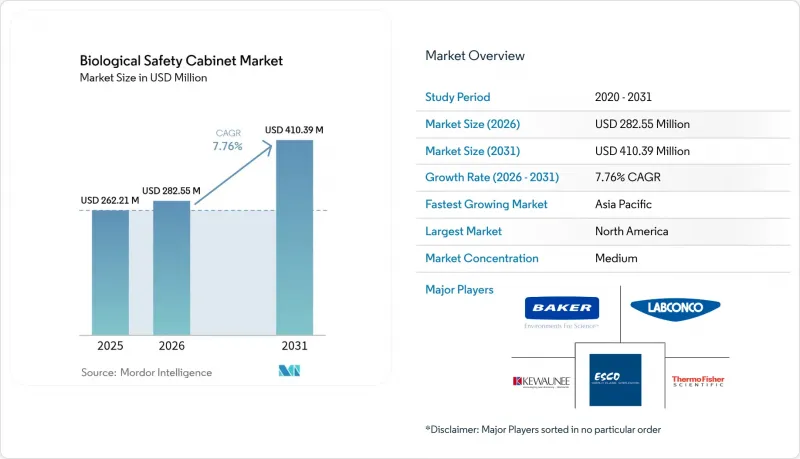
本報告按類型(I類、II類、III類)、排氣系統(管道式(硬連接)和循環式/無管道式)、應用(藥物發現和臨床前研究與開發等)、最終用戶(學術和研究機構等)以及地區(北美、歐洲、亞太地區等)進行細分。市場預測以價值(美元)表示。
全球生物安全櫃市場趨勢與洞察
擴大製藥和生技領域的研究經費
在強大的藥物研發管線支援下,領先企業正在建造冗餘的研究設施,而這些設施需要配備新的生物安全防護設備。賽默飛世爾科技公司已在其為期四年的美國投資計畫中撥款15億美元用於實驗室基礎建設,其中包括生物安全櫃。併購活動將後期研發資產納入其中,進一步加速了設施維修;人工智慧驅動的藥物研發平台正在重新配置工作空間,以適應自動化、高通量檢測,而這些檢測仍需要操作人員的防護。因此,每個新配備的研發設施都在進一步推動生物安全櫃市場的發展。大學也受益於用於生物安全升級的津貼增加,從而支撐了公共部門的穩定需求。這一趨勢在北美最為顯著,但西歐也正在進行類似的設施擴建。
加強全球應對新興感染疾病的準備
自2024年以來,世界各國政府都將建構具有韌性的實驗室網路列為優先事項。美國疾病管制與預防中心(CDC)第六版《微生物和生物醫學實驗室生物安全手冊》提高了氣流和過濾器完整性的性能標準,並加快了生物安全櫃的更換週期。此外,美國職業安全與健康管理局(OSHA)即將發布的新感染疾病法規也將對臨床檢查室提出類似要求,加速了國內訂單的成長。研究生物氣溶膠威脅的國防計畫也依賴高效能空氣微粒過濾器(HEPA)工作站,凸顯了跨領域的需求。國家快速反應檢測基礎設施儲備現已永久包含生物安全櫃,確保在疫情爆發時能夠立即部署。這種對準備工作的重視正在推動短期成長,尤其是在公共衛生實驗室快速擴張的亞太地區。
高昂的資本投資成本和認證成本
當驗證、結構改造和GMP文件編製成本計入時,總實施成本通常會是標價的兩倍。科研津貼很少涵蓋基礎設施成本,因此學術實驗室很難為設備升級資金籌措。未來ISO 14644-4相關認證規則的不確定性導致一些買家推遲下單。小規模的生物技術公司透過租賃共用實驗室空間來降低成本,這延緩了設備的直接銷售。處理高活性化合物的客製化驗證進一步增加了成本,尤其是對於首次使用CDMO服務的公司。
細分市場分析
至2025年,II級生物安全櫃在生物安全櫃市場將維持60.88%的市場佔有率,滿足大多數常規研究和診斷需求。然而,對高活性藥物成分(HPAPI)和病毒載體處理需求的不斷成長,推動了III級手套箱市場以10.01%的複合年成長率(CAGR)快速成長。 Esco高度密封的III級系列產品可支援化療藥物和疫苗製劑的製備,同時完全防止操作人員接觸。隨著CRISPR和溶瘤病毒研發管線的擴展,III級生物安全櫃的市場規模預計將快速成長。在所有級別的產品中,製造商都在整合觸控螢幕氣流分析和自動壓降測試功能,以簡化年度再認證程序。能源最佳化仍然是所有等級產品的通用設計重點,以滿足基於ISO標準的生命週期成本要求。
儘管技術差距正在縮小,但I級生物安全櫃仍屬於小眾產品,其防護能力不如更高等級的生物安全櫃,主要用於需要人員和環境防護的教育實驗室。軟體整合可以將使用資料傳輸到建築管理系統,使實驗室管理人員能夠即時確認通風是否符合標準。全球統一的氣流速度目標可望加速生物安全櫃的維修,並維持各等級生物安全櫃市場的需求。
2025年,受GMP設施監管要求的推動,有管道式生物安全櫃將佔總銷售量的57.92%。在必須直接排放有害空氣的場所,尤其是在大規模生物製藥園區,有管道式生物安全櫃仍然至關重要。然而,由於無管道式生物安全櫃避免了空間受限建築中高成本的暖通空調系統維修,其複合年成長率(CAGR)也達到了10.28%。在實驗室維修專案數量超過新建專案的新興市場,無管道式生物安全櫃的市場規模預計將加速成長。 Better Basics Laborbedarf的「SmartIntegrate」模組便是該領域創新的典範,該模組可將工作站效率提高30%,並支援免工具更換過濾器。
隨著能源法規朝著淨零能耗建築的目標邁進,無管道機組的優勢在於能夠最大限度地減少冷熱空氣的流失。供應商目前提供混合模式,未來可在有管道系統和循環系統之間切換,從而在法規變更時保護客戶的投資。儘管如此,這兩種系統仍將在生物安全櫃市場共存,因為高風險的活性藥物成分(HPAPI)實驗室仍需要硬管排氣系統來確保負壓。
區域分析
預計到2025年,北美將以41.98%的市佔率引領生物安全櫃市場。諾和諾德公司佔地140萬平方英尺的無菌設施以及賽默飛世爾科技公司多年的資本投資計畫等大型項目,凸顯了設備需求的持續性。美國食品藥物管理局(FDA)採納ISO 14644-4標準,以及美國職業安全與健康管理局(OSHA)即將訂定的感染疾病法規,正在形成一系列合規週期,並促使生物安全櫃進行升級改造。此外,聯邦政府為促進藥品供應鏈回歸美國而推出的獎勵,也推動了對需要高等級生物安全防護設施的合約研發生產(CDMO)園區的投資。
亞太地區是成長最快的地區,預計到2031年年複合成長率(CAGR)將達到9.22%。美國《生物安全法案》正推動外包業務向印度轉移,該國的合約研發生產(CDMO)市場預計將從2023年的156.3億美元成長到2028年的267.3億美元。頗爾公司在新加坡投資1.5億美元興建的過濾工廠體現了該地區不斷發展的生態系統,整合了上游工程耗材和機櫃製造。中國製藥設施的持續擴張以及日本的疫苗自給自足計劃進一步刺激了需求。標準的統一化簡化了進口程序,鼓勵跨國供應商在更靠近客戶的地方建立最終組裝基地。
在歐洲,受嚴格的監管要求和綠色建築指令的推動,市場呈現穩定成長態勢。機械法規和生態設計規則促使實驗室採用配備數位護照的節能設備。 Renzler BioPharma 對緩衝液和培養基複合設施以及其他生物製藥相關設施的投資,推動了對高性能生物更換櫃的需求。該地區活性成分 (API) 市場的成長支撐了符合 GMP 標準的現代化設施,並推動了生物安全櫃市場的擴張。到 2050 年實現淨零排放的永續性目標,正促使採購趨勢轉向無管道或低壓設計,進一步加劇了供應商之間的技術差異化。
其他好處:
- Excel格式的市場預測(ME)表
- 3個月的分析師支持
目錄
第1章:引言
- 研究假設和市場定義
- 調查範圍
第2章:調查方法
第3章執行摘要
第4章 市場狀況
- 市場概覽
- 市場促進因素
- 擴大製藥和生技領域的研究經費
- 加強全球應對新興感染疾病的準備
- 嚴格的職業安全與健康法規
- 加速細胞和基因治療生產規模的擴大
- 智慧節能櫥櫃技術的廣泛應用
- 市場限制因素
- 高昂的資金和認證成本
- 替代密封隔離系統的出現
- HEPA/ULPA過濾組件的供應鏈脆弱性
- 遵守能源效率法規的壓力日益增大
- 監理情勢
- 波特五力分析
第5章 市場規模與成長預測
- 按類型
- 一級
- 二類
- 三級
- 按類型分類的排氣系統
- 風管式(硬連接)
- 循環式/無管道式
- 透過使用
- 藥物發現與臨床前研究與開發;
- 臨床/診斷實驗室
- 生物製藥的生產、填充與包裝
- 最終用戶
- 製藥和生物技術公司
- 學術研究機構
- 合約研究/CDMO
- 其他最終用戶
- 地區
- 北美洲
- 美國
- 加拿大
- 墨西哥
- 歐洲
- 德國
- 英國
- 法國
- 義大利
- 西班牙
- 其他歐洲國家
- 亞太地區
- 中國
- 日本
- 印度
- 澳洲
- 韓國
- 其他亞太國家
- 中東和非洲
- GCC
- 南非
- 其他中東和非洲國家
- 南美洲
- 巴西
- 阿根廷
- 其他南美國家
- 北美洲
第6章 競爭情勢
- 市場集中度
- 市佔率分析
- 公司簡介
- Thermo Fisher Scientific, Inc.
- Esco Micro
- Labconco
- The Baker Company
- NuAire
- Kewaunee Scientific
- Germfree Laboratories
- Air Science
- BIOBASE
- Telstar(Azbil)
- Faster Srl
- Haier Biomedical
- PHCbi(Panasonic Healthcare)
- Erlab
- Bigneat
- Shanghai Boxun
- Heal Force
- Angelantoni Life Science
- AireLab Systems
- Astec Microflow
第7章 市場機會與未來展望
According to Mordor Intelligence, the biological safety cabinets market size was valued at USD 262.21 million in 2025 and estimated to grow from USD 282.55 million in 2026 to reach USD 410.39 million by 2031, at a CAGR of 7.76% during the forecast period (2026-2031).
This report is Segmented by Type (Class I, Class II, and Class III), Exhaust System (Ducted (Hard-Connected) and Recirculating / Ductless), Application (Drug Discovery & Pre-Clinical R&D, and More), End-User (Academic & Research Institutes, and More), Geography (North America, Europe, Asia-Pacific, and More). The Market Forecasts are Provided in Terms of Value (USD).
Global Biological Safety Cabinet Market Trends and Insights
Expanding Pharmaceutical and Biotechnology Research Expenditure
Robust drug-development pipelines are prompting large companies to build redundant research hubs that need new containment suites. Thermo Fisher Scientific is allocating USD 1.5 billion of its four-year U.S. investment program to laboratory infrastructure that includes biological safety cabinets. Mergers that add late-stage assets further boost facility retrofits, and AI-enabled discovery platforms are re-configuring workspaces for automated, high-throughput assays that still require operator protection. As a result, the biological safety cabinets market gains additional pull-through from every newly equipped research laboratory. Universities benefit from expanded grant funding that covers biosafety upgrades, supporting steady public-sector demand. The trend is most visible in North America, but similar capacity builds are underway in Western Europe.
Escalating Global Preparedness for Emerging Infectious Diseases
Governments have prioritized resilient laboratory networks since 2024. The CDC's sixth edition of the Biosafety in Microbiological and Biomedical Laboratories outlines tighter performance criteria for airflow and filter integrity, prompting cabinet replacement cycles. OSHA's forthcoming infectious-disease rule will extend similar requirements to clinical laboratories, accelerating domestic orders. Defense programs that study bioaerosol threats also rely on HEPA-filtered workstations, underlining cross-sector demand. National stockpiles of rapid-response testing infrastructure now routinely include biosafety cabinets, ensuring immediate deployment during outbreaks. This focus on readiness sustains short-term growth, particularly in Asia-Pacific where public-health laboratories are scaling up.
High Capital and Certification Costs
Total installed cost often doubles list price once validation, construction modifications, and GMP documentation are added. Academic laboratories struggle to fund upgrades because research grants rarely cover infrastructure. Uncertainty over future certification rules tied to ISO 14644-4 has prompted some buyers to postpone orders. Smaller biotech firms mitigate expense by leasing shared lab space, which delays direct equipment sales. Custom validation for potent-compound handling pushes expenses higher, particularly for first-time CDMOs.
Other drivers and restraints analyzed in the detailed report include:
- Stringent Occupational Health and Safety Regulations
- Accelerating Cell and Gene Therapy Manufacturing Expansion
- Emergence of Alternative Closed Isolator Systems
For complete list of drivers and restraints, kindly check the Table Of Contents.
Segment Analysis
Class II units retained 60.88% of the biological safety cabinets market share in 2025 because they meet the majority of routine research and diagnostic needs. However, Class III glove-box designs are on a 10.01% CAGR trajectory thanks to rising HPAPI and viral-vector handling requirements. Esco's leak-tight Class III series supports chemotherapy compounding and vaccine formulation while ensuring zero operator exposure. The biological safety cabinets market size for Class III units is projected to grow rapidly as CRISPR and oncolytic-virus pipelines expand. Across all classes, manufacturers embed touch-screen airflow analytics and automatic pressure-decay tests that simplify annual recertification. Energy-optimization remains a cross-class design focus to satisfy ISO-driven lifecycle cost mandates.
Technological parity is narrowing, yet Class I equipment remains niche, serving teaching labs that require personnel and environmental protection without the product shielding offered by higher classes. Software integrations now push usage data to building-management systems, enabling laboratory managers to demonstrate ventilation compliance in real time. Global harmonization of airflow velocity targets is expected to drive retrofits, sustaining demand for all classes within the biological safety cabinets market.
Ducted configurations captured 57.92% of revenue in 2025 due to regulatory preference in GMP suites. They remain indispensable where direct hazardous-air removal is mandated, especially in large biopharmaceutical campuses. Even so, ductless units are advancing at a 10.28% CAGR because they avoid costly HVAC rework in space-constrained buildings. The biological safety cabinets market size for ductless models will accelerate in emerging economies where laboratory retrofits exceed new-build projects. Better Basics Laborbedarf's SmartIntegrate module boosts workstation efficiency by 30% and allows tool-free filter swaps, illustrating innovation in this segment.
Energy codes pushing toward net-zero buildings give ductless units an advantage by minimizing conditioned-air losses. Suppliers now offer hybrid models that allow future conversion between ducted and recirculating modes, protecting customer capital as regulations evolve. Despite these gains, high-risk HPAPI suites still specify hard-ducted exhaust to guarantee negative pressure, so both systems will coexist in the biological safety cabinets market.
Complete Report Scope:
- By Type
- Class I
- Class II
- Class III
- By Exhaust System
- Ducted (Hard-Connected)
- Recirculating / Ductless
- By Application
- Drug Discovery & Pre-Clinical R&D
- Clinical / Diagnostic Testing Labs
- Biopharmaceutical Manufacturing & Fill-Finish
- By End-User
- Pharmaceutical & Biotechnology Companies
- Academic & Research Institutes
- Contract Research / CDMOs
- Other End Users
- Geography
- North America
- United States
- Canada
- Mexico
- Europe
- Germany
- United Kingdom
- France
- Italy
- Spain
- Rest of Europe
- Asia-Pacific
- China
- Japan
- India
- Australia
- South Korea
- Rest of Asia-Pacific
- Middle East & Africa
- GCC
- South Africa
- Rest of Middle East & Africa
- South America
- Brazil
- Argentina
- Rest of South America
- North America
Geography Analysis
North America led the biological safety cabinets market at 41.98% revenue share in 2025. Large-scale projects such as Novo Nordisk's 1.4-million-square-foot aseptic facility and Thermo Fisher Scientific's multiyear capital program underscore sustained equipment pull. FDA adoption of ISO 14644-4 plus OSHA's forthcoming infectious-disease rule create back-to-back compliance cycles that compel cabinet upgrades. Federal incentives for reshoring pharmaceutical supply chains also channel investment into U.S. CDMO campuses that specify high-containment designs.
Asia-Pacific is the fastest-growing region at a 9.22% CAGR through 2031. The US Biosecure Act is redirecting outsourcing toward India, where the CDMO market will climb from USD 15.63 billion in 2023 to USD 26.73 billion by 2028. Singapore's USD 150 million Pall Corporation filtration plant demonstrates the region's evolving ecosystem that integrates upstream consumables with cabinet manufacturing. China's ongoing pharmaceutical build-out and Japan's vaccine self-sufficiency plans further elevate demand. Harmonized standards simplify imports, encouraging multinational suppliers to locate final assembly closer to customers.
Europe shows steady expansion anchored by strict regulatory mandates and green-building directives. The Machinery Regulation and Ecodesign rules push laboratories to adopt energy-efficient units with digital passports. Rentschler Biopharma's buffer-media complex and other biologics investments bolster replacement demand for high-performance cabinets. The region's active-pharmaceutical-ingredient market growth supports modern GMP suites, lifting the biological safety cabinets market. Sustainability targets that require net-zero emissions by 2050 are tilting procurement toward ductless or low-pressure designs, reinforcing technology differentiation among suppliers.
- Thermo Fisher Scientific
- Esco Lifesciences
- Labconco
- The Baker Company
- NuAire
- Kewaunee Scientific
- Germfree Laboratories
- Air Science
- BIOBASE
- Telstar (Azbil)
- Faster Srl
- Haier Biomedical
- PHCbi (Panasonic Healthcare)
- Erlab
- Bigneat
- Shanghai Boxun
- Heal Force
- Angelantoni Life Science
- AireLab Systems
- Astec Microflow
Additional Benefits:
- The market estimate (ME) sheet in Excel format
- 3 months of analyst support
TABLE OF CONTENTS
1 Introduction
- 1.1 Study Assumptions & Market Definition
- 1.2 Scope Of The Study
2 Research Methodology
3 Executive Summary
4 Market Landscape
- 4.1 Market Overview
- 4.2 Market Drivers
- 4.2.1 Expanding Pharmaceutical and Biotechnology Research Expenditure
- 4.2.2 Escalating Global Preparedness for Emerging Infectious Diseases
- 4.2.3 Stringent Occupational Health and Safety Regulations
- 4.2.4 Accelerating Cell and Gene Therapy Manufacturing Expansion
- 4.2.5 Rising Adoption of Smart Energy-Efficient Cabinet Technologies
- 4.3 Market Restraints
- 4.3.1 High Capital and Certification Costs
- 4.3.2 Emergence of Alternative Closed Isolator Systems
- 4.3.3 Supply Chain Vulnerabilities In HEPA / ULPA Filtration Components
- 4.3.4 Intensifying Energy Efficiency Compliance Pressure
- 4.4 Regulatory Landscape
- 4.5 Porter's Five Forces Analysis
- 4.5.1 Threat Of New Entrants
- 4.5.2 Bargaining Power Of Buyers
- 4.5.3 Bargaining Power Of Suppliers
- 4.5.4 Threat Of Substitutes
- 4.5.5 Intensity Of Competitive Rivalry
5 Market Size & Growth Forecasts (Value, USD)
- 5.1 By Type
- 5.1.1 Class I
- 5.1.2 Class II
- 5.1.3 Class III
- 5.2 By Exhaust System
- 5.2.1 Ducted (Hard-Connected)
- 5.2.2 Recirculating / Ductless
- 5.3 By Application
- 5.3.1 Drug Discovery & Pre-Clinical R&D
- 5.3.2 Clinical / Diagnostic Testing Labs
- 5.3.3 Biopharmaceutical Manufacturing & Fill-Finish
- 5.4 By End-User
- 5.4.1 Pharmaceutical & Biotechnology Companies
- 5.4.2 Academic & Research Institutes
- 5.4.3 Contract Research / CDMOs
- 5.4.4 Other End Users
- 5.5 Geography
- 5.5.1 North America
- 5.5.1.1 United States
- 5.5.1.2 Canada
- 5.5.1.3 Mexico
- 5.5.2 Europe
- 5.5.2.1 Germany
- 5.5.2.2 United Kingdom
- 5.5.2.3 France
- 5.5.2.4 Italy
- 5.5.2.5 Spain
- 5.5.2.6 Rest of Europe
- 5.5.3 Asia-Pacific
- 5.5.3.1 China
- 5.5.3.2 Japan
- 5.5.3.3 India
- 5.5.3.4 Australia
- 5.5.3.5 South Korea
- 5.5.3.6 Rest of Asia-Pacific
- 5.5.4 Middle East & Africa
- 5.5.4.1 GCC
- 5.5.4.2 South Africa
- 5.5.4.3 Rest of Middle East & Africa
- 5.5.5 South America
- 5.5.5.1 Brazil
- 5.5.5.2 Argentina
- 5.5.5.3 Rest of South America
- 5.5.1 North America
6 Competitive Landscape
- 6.1 Market Concentration
- 6.2 Market Share Analysis
- 6.3 Company Profiles (includes Global level Overview, Market level overview, Core Business Segments, Financials, Headcount, Key Information, Market Rank, Market Share, Products and Services, and analysis of Recent Developments)
- 6.3.1 Thermo Fisher Scientific, Inc.
- 6.3.2 Esco Micro
- 6.3.3 Labconco
- 6.3.4 The Baker Company
- 6.3.5 NuAire
- 6.3.6 Kewaunee Scientific
- 6.3.7 Germfree Laboratories
- 6.3.8 Air Science
- 6.3.9 BIOBASE
- 6.3.10 Telstar (Azbil)
- 6.3.11 Faster Srl
- 6.3.12 Haier Biomedical
- 6.3.13 PHCbi (Panasonic Healthcare)
- 6.3.14 Erlab
- 6.3.15 Bigneat
- 6.3.16 Shanghai Boxun
- 6.3.17 Heal Force
- 6.3.18 Angelantoni Life Science
- 6.3.19 AireLab Systems
- 6.3.20 Astec Microflow
7 Market Opportunities & Future Outlook
- 7.1 White-Space & Unmet-Need Assessment

 生物安全櫃市場:按類型、應用、排氣系統、最終用戶、國家及地區分類-全球產業分析、市場規模、市場佔有率及2026年至2033年預測
 生物安全諮詢服務市場:全球市場預測,2026-2032年生物安全櫃市場:按等級、類型、形式、應用、最終用戶和銷售管道分類-2026-2032年全球市場預測生物安全櫃市場:依產品、應用、最終用途、國家及地區分類-全球產業分析、市場規模、市場佔有率及2026年至2033年預測
 生物安全櫃市場報告:按類型、最終用戶和地區分類(2026-2034 年)
 全球生物安全櫃市場規模、佔有率、趨勢和成長分析報告(2026-2034年)全球生物安全櫃市場規模、佔有率、趨勢和成長分析報告(2026-2034年)全球生物安全櫃市場:市場規模、佔有率、成長率、產業分析、依類型、應用和地區劃分的分析、未來預測(2026-2034)
 生物安全櫃市場規模、佔有率及成長分析(按類型、應用、最終用戶和地區分類)-產業預測(2026-2033)
 生物安全櫃市場-全球產業規模、佔有率、趨勢、機會和預測(按類型、最終用戶、地區和競爭細分,2020-2030 年)