

 |
市場調查報告書
商品編碼
2123576
超低溫冷凍庫:市場佔有率分析、行業趨勢和統計數據以及成長預測(2026-2031 年)Ultra Low Temperature Freezer - Market Share Analysis, Industry Trends & Statistics, Growth Forecasts (2026 - 2031) |
||||||

※ 本網頁內容可能與最新版本有所差異。詳細情況請與我們聯繫。
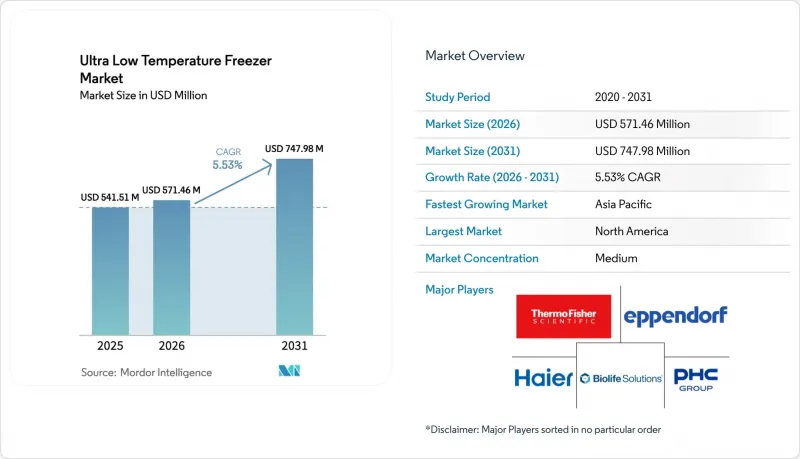
據 Mordor Intelligence 稱,2025 年超低溫冷凍庫市值為 5.4151 億美元,預計到 2031 年將達到 7.4798 億美元,而 2026 年為 5.7146 億美元,預測期(2026-2031 年)的複合年成長率為 5.53%。
本報告按產品類型(垂直型、水平型)、最終用戶(生物樣本庫、製藥和生物技術公司、學術和研究機構、合約研究組織、醫院和血站)、容量(小於300公升、301-500公升、501-700公升、701-900公升、大於900公升)以及其他地區(北美、歐洲)細分地區及其地區進行細分(北美地區及其地區(北美地區)以及其他地區(北美地區及其細分)。市場預測以美元計價。
全球超低溫冷凍庫市場趨勢及洞察
全球生物樣本庫網路的擴展
各國基因組舉措正在將樣本庫擴展到學術機構之外,從而增加了對檢驗的低溫儲存設備的長期需求。中國國家基因庫正在擴建,目標是儲存5,000萬個樣本;日本基因組資料基礎設施計畫正在資助與人工智慧主導的藥物研發相關的生物銀行建設,這兩個計畫都指定使用符合ISO 13485品管標準的冷凍庫。印度的BioE3政策將生物製造中心與1萬個基因組的目標連結起來,促使那些經常面臨停電問題的實驗室訂購節能型電池供電設備。 Azenta Life Sciences與英國生物中心簽訂的2025年BioArc Ultra合約實現了70%的節能,這表明永續性如今在競標標準中與檢體安全同等重要。
後疫情時代疫苗冷鏈的擴建
為mRNA疫苗建設的基礎設施正被重新用於單株抗體和下一代療法。 DHL已撥款5億歐元用於亞太地區的醫療物流,UPS也投資2.5億美元建造類似的冷藏設施,以確保生物相似藥的-80 度C低溫儲存能力。沙烏地阿拉伯的生物技術藍圖要求在臨床試驗樣本現場進行超低溫(ULT)存儲,而日本則維持著緊急授權制度,以鼓勵製藥公司保持應對需求激增的能力。世界衛生組織更新的指南加強了驗證規則,並鼓勵採用物聯網監控和雲端存檔服務的製造商。
高資本投資及營運成本
購置價格差異很大,從小型機型的 8,000 美元到大容量雙壓縮機機組的 25,000 美元不等,此外每年運行成本還需 1,000 至 3,000 美元。奈及利亞對發電機的高度依賴使總成本增加高達 60%,即使是高效機組也需支付 20% 至 30% 的溢價,加重了公共部門的預算負擔。
細分市場分析
由於立式冷凍櫃擁有高效的層架設計和從打開櫃蓋到快速取樣的便利性,預計到2025年,立式冷凍櫃將佔據超低溫冷凍庫市場61.25%的佔有率。能源效率、物聯網監控和能源之星認證如今已成為採購檢體上的重要考量。同時,臥式冷凍庫卓越的保溫性能使其預計到2031年將維持6.61%的複合年成長率。 Binder、Liebherr和Meling等公司正在採用真空絕熱板,透過加厚壁體保溫層,在不減少可用容積的前提下實現這一目標。隨著生物樣本庫將不可取代的基因組檔案保存數十年,臥式冷凍櫃設計的重要性日益凸顯,即便取樣速度有所下降。
競爭性創新正在改變這兩個品類。立式冷凍庫正在整合雲端控制面板,用於記錄警報以符合FDA的審核要求;臥式冷凍櫃則增加了側面取放口,用於安裝機器人取放模組。攜帶式冷凍庫也已出現,開闢了一個細分市場,為行動疫苗接種診所提供支持,但出於報告目的,它們仍被歸類為更廣泛的超低溫冷凍庫市場。
區域分析
預計到2025年,北美將佔超低溫(ULT)冷凍庫市場銷售額的42.45%。超過600家生物樣本庫以及美國國立衛生研究院(NIH)的「我們所有人」(All of Us)計畫正在推動對老舊設備的持續更新換代需求,這些老舊設備將不再符合將於2025年6月生效的能源之星2.0版標準。加拿大的多倫多-蒙特利爾走廊正在見證依賴經檢驗的超低溫(ULT)儲存技術的再生醫學產品生產規模的擴張,而近岸外包正在將契約製造轉移到墨西哥,以支持拉丁美洲的臨床試驗中心。
亞太地區預計將以6.81%的複合年成長率實現最高成長。中國的國家基因庫、日本耗資33億美元的大東京生物社區以及印度的BioE3政策已累計在生物資源庫建設方面投入數十億美元,加速了符合CE和GB標準的碳氫化合物製冷劑裝置的訂單成長。隨著澳洲TGA與FDA和EMA標準接軌,市場准入變得更加容易,但高昂的物流成本使得新加坡和香港的分銷中心更具優勢。
歐洲嚴格的分階段減排氟化物政策正在推動替代需求,而沙烏地阿拉伯和巴西則透過努力實現疫苗自給自足,推動了中東和南美洲的成長。相較之下,撒哈拉以南非洲地區6億人口缺乏穩定的電力供應,限制了機械冷凍庫的應用,一些設施正在採用液態氮杜瓦瓶或太陽能-電池混合裝置,直到電網可靠性得到改善。
其他好處:
- Excel格式的市場預測(ME)表
- 3個月的分析師支持
目錄
第1章:引言
- 研究假設和市場定義
- 調查範圍
第2章:調查方法
第3章執行摘要
第4章 市場狀況
- 市場概覽
- 市場促進因素
- 全球生物樣本庫網路的擴展
- 新冠疫苗接種後的冷鏈發展
- 節能型天然冷媒超低溫儲槽的快速普及
- 細胞和基因療法產品線的擴展
- 因符合能源之星標準而更換需求
- 「冷凍櫃即服務」租賃模式的出現。
- 市場限制因素
- 高昂的資本和營運成本
- 遵守跨多個司法管轄區的複雜法規
- 新興市場電網不穩定的風險
- 在細分領域中使用液態氮的低溫替代技術
- 價值供應鏈分析
- 監理情勢
- 技術展望
- 波特五力分析
第5章 市場規模與成長預測
- 依產品類型
- 直立式超低溫冷凍庫
- 臥式超低冷凍庫
- 最終用戶
- 生物樣本庫
- 製藥和生物技術公司
- 學術和研究機構
- 受託研究機構(CRO)
- 醫院和血液中心
- 按產能
- 少於300公升
- 301-500公升
- 501-700升
- 701-900升
- 900公升或以上
- 按地區
- 北美洲
- 美國
- 加拿大
- 墨西哥
- 歐洲
- 德國
- 英國
- 法國
- 義大利
- 西班牙
- 其他歐洲國家
- 亞太地區
- 中國
- 日本
- 印度
- 澳洲
- 韓國
- 其他亞太國家
- 中東和非洲
- GCC
- 南非
- 其他中東和非洲國家
- 南美洲
- 巴西
- 阿根廷
- 其他南美國家
- 北美洲
第6章 競爭情勢
- 市場集中度
- 市佔率分析
- 公司簡介
- Abzil Telstar SL
- Arctiko A/S
- Azenta Life Sciences
- B Medical Systems
- Binder GmbH
- Biolife Solutions
- Bionics Scientific Technologies(P)Ltd.
- Eppendorf SE
- Esco Micro Pte Ltd.
- Froilabo
- Global Cooling Inc.
- Haier Smart Home Co., Ltd(Haier Biomedical)
- Helmer Scientific Inc.
- K2 Scientific
- Labcold Ltd.
- Liebherr Group
- Nuaire Inc.
- Panasonic Healthcare(legacy models)
- PHC Holdings Corporation(PHCbi)
- So-Low Environmental Equipment Co.
- Thermo Fisher Scientific Inc.
- VWR International(Avantor)
- Zhongke Meiling Cryogenics
第7章 市場機會與未來展望
According to Mordor Intelligence, the ultra-low temperature freezer market size was valued at USD 541.51 million in 2025 and is estimated to grow from USD 571.46 million in 2026 to reach USD 747.98 million by 2031, at a CAGR of 5.53% during the forecast period (2026-2031).
This report is Segmented by Product Type (Upright, Chest), End User (Bio-Banks, Pharmaceutical & Biotechnology Companies, Academic & Research Laboratories, Cros, Hospitals & Blood Centers), Capacity (Less Than 300L, 301-500L, 501-700L, 701-900L, More Than 900L), and Geography (North America, Europe, Asia-Pacific, and More). Market Forecasts are Provided in Terms of Value (USD).
Global Ultra Low Temperature Freezer Market Trends and Insights
Expanding Biobank Networks World-Wide
National genomic initiatives are scaling sample repositories beyond academic settings, lifting long-term demand for validated ultra low temperature storage. China's National GeneBank added capacity for 50 million samples, and Japan's Genome and Data Infrastructure Project funds biobanking tied to AI-led drug discovery, both of which specify freezers that meet ISO 13485 quality controls. India's BioE3 Policy pairs biomanufacturing hubs with a 10,000-genome target, pressuring laboratories facing frequent power disruptions to order energy-efficient, battery-ready units. Azenta Life Sciences' 2025 BioArc Ultra deal with UK Biocentre, which delivers 70% energy savings, shows sustainability now ranks alongside specimen security in tender criteria.
Post-COVID Vaccine Cold-Chain Build-Out
Infrastructure built for mRNA vaccines is being repurposed for monoclonal antibodies and next-gen therapeutics. DHL earmarked EUR 500 million for Asia-Pacific healthcare logistics and UPS invested USD 250 million in similar freezer farms, ensuring -80 °C capacity for biosimilars. Saudi Arabia's biotechnology roadmap requires localized ULT storage for clinical-trial materials, and Japan keeps an emergency-approval pathway that encourages pharmaceutical firms to maintain surge capacity. Updated WHO guidelines strengthen validation rules, favoring manufacturers that bundle IoT monitoring and cloud archival services.
High Capital & Operating Costs
Purchase prices range from USD 8,000 for compact models to USD 25,000 for high-capacity dual-compressor units, and annual running costs add USD 1,000-3,000. Nigeria's heavy generator reliance lifts total costs by up to 60%, while even efficient units carry 20-30% price premiums that stress public-sector budgets.
Other drivers and restraints analyzed in the detailed report include:
- Rapid Adoption of Energy-Efficient Natural-Refrigerant ULT Models
- Growth of Cell & Gene Therapy Pipelines
- Complex Multi-Jurisdictional Regulatory Compliance
For complete list of drivers and restraints, kindly check the Table Of Contents.
Segment Analysis
Upright units comprised 61.25% of 2025 revenue for the ultra low temperature freezer market thanks to efficient racking and faster lid-to-specimen retrieval. Energy savings, IoT monitoring and ENERGY STAR labels now dictate procurement checklists. Conversely, chest freezers' superior thermal retention underpins a 6.61% forecast CAGR through 2031. Binder, Liebherr and Meling capitalize on thicker wall insulation to house vacuum-insulation panels without shrinking usable volume. As biobanks store irreplaceable genomic archives for decades, chest designs find renewed relevance despite slower sample access.
Competitive innovation is reshaping both categories. Uprights integrate cloud dashboards that log alarms for FDA-compliant audits, and chest designs add side-access ports for robotic pick-and-place modules. Portable micro-freezers are also emerging, carving out a sub-segment that supports mobile vaccination clinics, yet they still roll up under the broader ultra low temperature freezer market for reporting purposes.
Complete Report Scope:
- By Product Type
- Upright ULT Freezers
- Chest ULT Freezers
- By End User
- Bio-Banks
- Pharmaceutical & Biotechnology Companies
- Academic & Research Laboratories
- Contract Research Organizations (CROs)
- Hospitals & Blood Centers
- By Capacity
- Less than 300 Liters
- 301-500 Liters
- 501-700 Liters
- 701-900 Liters
- More than 900 Liters
- By Geography
- North America
- United States
- Canada
- Mexico
- Europe
- Germany
- United Kingdom
- France
- Italy
- Spain
- Rest of Europe
- Asia-Pacific
- China
- Japan
- India
- Australia
- South Korea
- Rest of Asia-Pacific
- Middle East and Africa
- GCC
- South Africa
- Rest of Middle East and Africa
- South America
- Brazil
- Argentina
- Rest of South America
- North America
Geography Analysis
North America generated 42.45% of 2025 revenue in the ultra low temperature freezer market. Over 600 biobanks and the NIH All of Us program create steady replacement demand as older units fail ENERGY STAR Version 2.0 thresholds that began in June 2025. Canada's Toronto-Montreal corridor expands regenerative-medicine manufacturing that relies on validated ULT storage, and nearshoring pushes contract manufacturing into Mexico to serve Latin American trial sites.
Asia-Pacific is set for the fastest 6.81% CAGR. China's National GeneBank, Japan's USD 3.3 billion Greater Tokyo Biocommunity and India's BioE3 Policy collectively pump billions into biorepositories, accelerating orders for hydrocarbon-refrigerant units compliant with CE and GB standards. Australia's TGA alignment with FDA and EMA eases market entry but high logistics costs favor Singapore-Hong Kong distribution hubs.
Europe's strict F-gas phasedown propels replacement demand, while Saudi Arabia and Brazil spearhead growth in the Middle East and South America through vaccine self-sufficiency drives. Conversely, Sub-Saharan Africa's 600 million residents without reliable power limit mechanical freezer uptake, steering some facilities toward LN2 dewars or solar/battery hybrid kits until grid reliability improves.
- Abzil Telstar
- Arctiko
- Azenta
- B Medical Systems
- Binder
- Biolife Solutions
- Bionics Scientific Technologies (P) Ltd.
- Eppendorf
- Esco Micro Pte Ltd.
- Froilabo
- Global Cooling Inc.
- Haier Biomedical
- Helmer Scientific
- K2 Scientific
- Labcold
- Liebherr Group
- Nuaire Inc.
- Panasonic Healthcare (legacy models)
- PHC Holdings Corporation (PHCbi)
- So-Low Environmental Equipment Co.
- Thermo Fisher Scientific
- VWR International (Avantor)
- Zhongke Meiling Cryogenics
Additional Benefits:
- The market estimate (ME) sheet in Excel format
- 3 months of analyst support
TABLE OF CONTENTS
1 Introduction
- 1.1 Study Assumptions & Market Definition
- 1.2 Scope of the Study
2 Research Methodology
3 Executive Summary
4 Market Landscape
- 4.1 Market Overview
- 4.2 Market Drivers
- 4.2.1 Expanding biobank networks world-wide
- 4.2.2 Post-COVID vaccine cold-chain build-out
- 4.2.3 Rapid adoption of energy-efficient natural-refrigerant ULT models
- 4.2.4 Growth of cell & gene therapy pipelines
- 4.2.5 ENERGY-STAR compliance-driven replacement demand
- 4.2.6 Emergence of freezer-as-a-service rental models
- 4.3 Market Restraints
- 4.3.1 High capital & operating costs
- 4.3.2 Complex multi-jurisdictional regulatory compliance
- 4.3.3 Grid-instability risks in emerging markets
- 4.3.4 Liquid-nitrogen cryogenic alternatives in niche segments
- 4.4 Value / Supply-Chain Analysis
- 4.5 Regulatory Landscape
- 4.6 Technological Outlook
- 4.7 Porter's Five Forces Analysis
- 4.7.1 Threat of New Entrants
- 4.7.2 Bargaining Power of Buyers
- 4.7.3 Bargaining Power of Suppliers
- 4.7.4 Threat of Substitute Products
- 4.7.5 Intensity of Competitive Rivalry
5 Market Size & Growth Forecasts(Value, USD)
- 5.1 By Product Type
- 5.1.1 Upright ULT Freezers
- 5.1.2 Chest ULT Freezers
- 5.2 By End User
- 5.2.1 Bio-Banks
- 5.2.2 Pharmaceutical & Biotechnology Companies
- 5.2.3 Academic & Research Laboratories
- 5.2.4 Contract Research Organizations (CROs)
- 5.2.5 Hospitals & Blood Centers
- 5.3 By Capacity
- 5.3.1 Less than 300 Liters
- 5.3.2 301-500 Liters
- 5.3.3 501-700 Liters
- 5.3.4 701-900 Liters
- 5.3.5 More than 900 Liters
- 5.4 By Geography
- 5.4.1 North America
- 5.4.1.1 United States
- 5.4.1.2 Canada
- 5.4.1.3 Mexico
- 5.4.2 Europe
- 5.4.2.1 Germany
- 5.4.2.2 United Kingdom
- 5.4.2.3 France
- 5.4.2.4 Italy
- 5.4.2.5 Spain
- 5.4.2.6 Rest of Europe
- 5.4.3 Asia-Pacific
- 5.4.3.1 China
- 5.4.3.2 Japan
- 5.4.3.3 India
- 5.4.3.4 Australia
- 5.4.3.5 South Korea
- 5.4.3.6 Rest of Asia-Pacific
- 5.4.4 Middle East and Africa
- 5.4.4.1 GCC
- 5.4.4.2 South Africa
- 5.4.4.3 Rest of Middle East and Africa
- 5.4.5 South America
- 5.4.5.1 Brazil
- 5.4.5.2 Argentina
- 5.4.5.3 Rest of South America
- 5.4.1 North America
6 Competitive Landscape
- 6.1 Market Concentration
- 6.2 Market Share Analysis
- 6.3 Company Profiles (includes Global level Overview, Market level overview, Core Segments, Financials as available, Strategic Information, Market Rank/Share for key companies, Products & Services, and Recent Developments)
- 6.3.1 Abzil Telstar S.L
- 6.3.2 Arctiko A/S
- 6.3.3 Azenta Life Sciences
- 6.3.4 B Medical Systems
- 6.3.5 Binder GmbH
- 6.3.6 Biolife Solutions
- 6.3.7 Bionics Scientific Technologies (P) Ltd.
- 6.3.8 Eppendorf SE
- 6.3.9 Esco Micro Pte Ltd.
- 6.3.10 Froilabo
- 6.3.11 Global Cooling Inc.
- 6.3.12 Haier Smart Home Co., Ltd (Haier Biomedical)
- 6.3.13 Helmer Scientific Inc.
- 6.3.14 K2 Scientific
- 6.3.15 Labcold Ltd.
- 6.3.16 Liebherr Group
- 6.3.17 Nuaire Inc.
- 6.3.18 Panasonic Healthcare (legacy models)
- 6.3.19 PHC Holdings Corporation (PHCbi)
- 6.3.20 So-Low Environmental Equipment Co.
- 6.3.21 Thermo Fisher Scientific Inc.
- 6.3.22 VWR International (Avantor)
- 6.3.23 Zhongke Meiling Cryogenics
7 Market Opportunities & Future Outlook
- 7.1 White-space & Unmet-Need Assessment

 超低溫冷凍庫市場:2026-2032 年全球市場預測,按產品類型、容量、溫度範圍、技術、冷卻系統、應用、最終用戶和分銷管道分類。
 超低溫冷凍庫市場商機、成長要素、產業趨勢分析及2026-2035年預測。
 2026年全球超低溫冷凍庫市場報告
 超低溫冷凍機市場