


 |
市場調查報告書
商品編碼
2123559
化肥和灌溉/化學灌溉:市場佔有率分析、行業趨勢和統計數據、成長預測(2026-2031)Fertigation And Chemigation - Market Share Analysis, Industry Trends & Statistics, Growth Forecasts (2026 - 2031) |
||||||

※ 本網頁內容可能與最新版本有所差異。詳細情況請與我們聯繫。
根據 Mordor Intelligence 預測,化肥和化學灌溉市場規模將從 2025 年的 503 億美元成長到 2026 年的 526.8 億美元,然後在 2031 年達到 663.3 億美元,2026 年至 2031 年的複合年成長率為 4.73%。
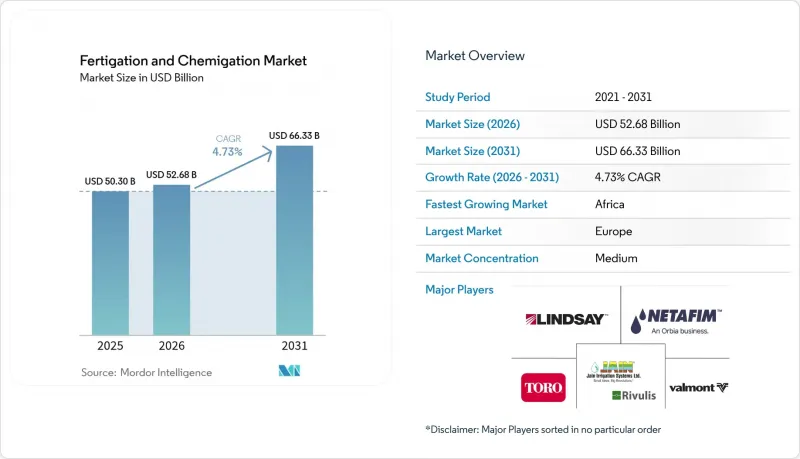
本報告按投入類型(化肥、殺蟲劑及其他)、作物類型(穀類及其他)、應用方式(露地種植及其他)、灌溉方式(滴灌及其他)和地區(北美及其他)進行分類。市場預測以美元計價。
全球化肥及灌溉市場趨勢及洞察
對糧食安全和產量最大化的需求日益成長
全球卡路里需求成長速度超過耕地供應速度,迫使農民最大限度地提高單位水、養分和勞動力的生產力。施肥灌溉可將養分直接輸送到植物根際,透過使氮、磷、鉀的供應與植物生長階段同步,可使高價值作物增產15%至35%。商業果園和蔬菜農場報告稱,肥料利用效率提高了30%,不僅有助於在投入品價格波動時期降低成本,還能控制養分流失。將施肥灌溉與氣候敏感型耕作方式結合,使農民能夠實施數據驅動的持續養分管理方案,而不是週期性的大規模施肥。
政府對微灌的補貼與獎勵
政府政策透過津貼、稅額扣抵和低利率貸款等方式支持農業技術的推廣應用。美國農業部2025財政年度預算重點在於精準水資源管理系統,其中自然資源保護局撥款105億美元。印度和中國也推出了類似的計劃,為低壓滴灌系統提供高達55%的補貼,從而促進中小農戶的採用。這些舉措帶動了相關服務的發展,包括農業諮詢、感測器製造和基於軟體的灌溉管理。
高昂的初始投資和營運/維護成本
高性能滴灌系統需要大規模的配套設施,包括壓力調節主管道、雙重過濾系統、止回閥和可程式設計控制器。這些要求導致初始成本高昂,許多小規模農戶難以負擔。經濟分析表明,對於一般作物而言,變數灌溉系統的投資回收期超過27年,而固定流量中心支軸式噴灌系統僅需10年。這些經濟障礙在低收入地區尤其突出,這些地區的農場規模小,融資管道有限。持續的維護成本,包括系統清洗、酸洗和感測器校準,進一步加重了農民的經濟負擔,阻礙了系統升級和新設備的購買。
細分市場分析
化肥和化學灌溉市場以化肥為主導,預計2025年將佔銷售額的45.42%。這種主導地位主要歸功於水溶性NPK配方,這類配方溶解迅速,並能最大限度地減少管道中的沉澱。領先的生產商正在開發螯合微量元素混合物,以解決密集園藝中存在的營養缺乏問題。
生物促效劑和微量營養素正成為關鍵的成長要素,預計2026年至2031年將以9.68%的複合年成長率成長。這一成長的驅動力來自農民尋求即使在不可預測的天氣條件下也能獲得穩定的產量。研究表明,與傳統施肥相比,植物來源和微生物群落可將養分利用效率提高30%,主要的生菜和漿果生產商正在其生產運作中採用這些解決方案。一種專為低壓滴灌系統設計的新型液體接種劑可促進土壤微生物相互作用,而不會造成滴頭堵塞。
殺蟲劑和殺菌劑市場保持著適度的成長。這是因為施肥和灌溉系統使得化學物質能夠均勻地噴灑在密集生長的作物整個冠層上,從而在保持有效病蟲害防治水平的同時,減少了化學品的總用量。除草劑市場雖然由於應用限制規模較小,但在控制抗Glyphosate雜草方面呈現適度成長。
預計到2025年,水果和蔬菜將保持37.35%的最大市場佔有率,這主要得益於市場對及時施肥的高需求,而施肥和灌溉能夠有效滿足這一需求。滴灌系統可使藤蔓作物、草莓和綠葉蔬菜的產量提高15%至35%,在土地成本高、提高生產力至關重要的郊區,滴灌效果特別顯著。糧食生產商正從試驗計畫轉向商業性化應用,玉米和小麥種植者已在其輪作計畫中採用低壓滴灌系統。這項技術在油籽和豆類作物種植中也得到越來越廣泛的應用,尤其是在缺水地區,因為其透過分段施用氮肥來減少養分揮發損失的能力備受重視。
茶葉、咖啡、可可、椰子和橡膠等種植作物具有獨特的種植作物和灌溉模式。儘管目前種植園作物施肥和化學灌溉市場市場佔有率較小,但預計2026年至2031年間將以7.62%的複合年成長率成長。這些作物生長週期長,根系多年生,因此非常受益於低劑量、高頻率的養分供應,尤其是在長期乾旱時期。生產者反映,滴灌技術的引入促進了葉片生長,提高了豆類品質的均勻性。在降雨量高的地區,養分流失也得以減少。種植作物的長壽命使其初始資本投資物有所值,因為利潤將在數年內持續累積,最終帶來更高的投資報酬率(ROI)。
區域分析
至2025年,歐洲將佔全球化肥料和化學灌溉市場33.62%的佔有率。橄欖、葡萄和溫室蔬菜生產商正在採用基於感測器的施肥和灌溉系統,以提高產量穩定性和產品質量,同時滿足歐盟硝酸鹽指令的要求。通用農業政策(CAP)提供政府補貼和低利率貸款,以支持採用包含土壤濕度感測器、自動過濾和數位監測平台的先進系統,從而在人事費用上升的情況下縮短投資回收期。荷蘭、西班牙和義大利的大規模溫室設施正在推動技術應用,因為可控環境能夠最大限度地提高精準施肥和pH值控制的效率。市場成長得益於成熟的服務網路,使農業供應供應商與科技公司合作,提供從設計到維護的綜合解決方案,目標客戶是需要遵守法規但又不想增加技術人員的中型農業合作社。
北美地區佔據第二大市場佔有率(按以金額為準),這得益於數位技術的廣泛應用和完善的技術支援網路。預計到2031年,中西部地區的銷售額將從2025年的2.9658億美元成長至4.6817億美元,主要得益於農民能夠更好地應對化肥價格的波動。調查顯示,78.6%的玉米和大豆種植者將提高化肥利用效率作為首要任務,推動了可變速率中心支軸式噴灌施肥和灌溉技術的普及。聯邦政府的環境資金投入和嚴格的徑流法規也進一步促進了這一趨勢。
預計非洲將展現出最高的成長潛力,2026年至2031年間的複合年成長率將達到8.92%。 2024年,非洲肥料與土壤健康高峰會將與區域智慧灌溉舉措同期舉行,重點在於肥料灌溉的節水和營養效益。各地區的採用率差異顯著;截至2021年,南非文貝區僅有24%的農場實施了氣候適應性灌溉,而卡普里科恩區的比例則高達68%。為了彌合知識差距,目前正在使用短訊簡訊和低頻寬數位傳播服務的數位傳播服務。此外,肯亞和坦尚尼亞的精準施肥計畫表明,該地區對使用行動應用程式指南營養管理表現出濃厚的興趣。
其他好處
- Excel格式的市場預測(ME)表
- 3個月的分析師支持
目錄
第1章:引言
- 研究假設和市場定義
- 調查範圍
第2章:調查方法
第3章執行摘要
第4章 市場狀況
- 市場概覽
- 市場促進因素
- 對糧食安全和產量最大化的需求日益成長
- 政府對微灌的補貼與獎勵
- 由於水資源短缺日益嚴重,高效營養供應的重要性日益凸顯。
- 水溶性特殊肥料的快速推廣
- 基於物聯網的變數施肥和灌溉系統
- 勞動和成本效率
- 市場限制因素
- 高昂的初始投資和營運/維護成本
- 農業工人缺乏技術知識
- 沉澱物和生物膜導致的排放口阻塞。
- 監管機構加強對營養物質洩漏的監測。
- 監理情勢
- 技術展望
- 波特五力分析
第5章 市場規模與成長預測
- 依輸入物料類型
- 肥料
- 殺蟲劑
- 消毒劑
- 除草劑
- 生物促效劑和微量營養素
- 其他投入材料類型
- 按作物類型
- 穀類和穀類食品
- 油籽/豆類
- 水果和蔬菜
- 種植作物
- 草坪和觀賞植物
- 其他
- 透過使用
- 露天耕作
- 溫室和水耕
- 幼苗和景觀設計
- 城市垂直農業
- 其他
- 按灌溉類型
- 滴灌
- 噴水灌溉
- 其他灌溉方式
- 按地區
- 北美洲
- 美國
- 加拿大
- 墨西哥
- 其他北美國家
- 歐洲
- 德國
- 英國
- 法國
- 義大利
- 西班牙
- 俄羅斯
- 其他歐洲國家
- 亞太地區
- 中國
- 印度
- 日本
- 澳洲
- 韓國
- 其他亞太國家
- 南美洲
- 巴西
- 阿根廷
- 其他南美國家
- 中東
- 土耳其
- 沙烏地阿拉伯
- 阿拉伯聯合大公國
- 其他中東國家
- 非洲
- 南非
- 埃及
- 肯亞
- 其他非洲地區
- 北美洲
第6章 競爭情勢
- 市場集中度
- 策略趨勢
- 市佔率分析
- 公司簡介
- Netafim 有限公司(Orbia 的業務)
- Jain Irrigation Systems Limited(Rivulis Irrigation Ltd.)
- Lindsay Corporation
- Valmont Industries, Inc.
- The Toro Company
- Rain Bird Corporation
- Automat Industries Private Limited
- Mahindra EPC Irrigation Limited
- Hunter Industries Inc.
- Irritec SpA
第7章 市場機會與未來展望
According to Mordor Intelligence, the fertigation and chemigation market size is expected to grow from USD 50.3 billion in 2025 to USD 52.68 billion in 2026 and is forecast to reach USD 66.33 billion by 2031 at 4.73% CAGR over 2026-2031.
This report is Segmented by Input Type (Fertilizers, Insecticides, and More), by Crop Type (Grains and Cereals, and More), by Application (Open-Field Agriculture, and More), by Irrigation Type (Drip Irrigation, and More), and by Geography (North America and More). The Market Forecasts are Provided in Terms of Value (USD).
Global Fertigation And Chemigation Market Trends and Insights
Rising Demand for Food Security and Yield Maximization
The global demand for calories is increasing faster than the availability of arable land, requiring farmers to maximize output per unit of water, nutrients, and labor. Fertigation, which delivers nutrients directly to plant root zones, increases crop yields by 15-35% in high-value crops by synchronizing nitrogen, phosphorus, and potassium delivery with plant developmental stages. Commercial orchards and vegetable farms report up to 30% improvement in fertilizer use efficiency, reducing costs during periods of volatile input prices while decreasing nutrient run-off. Fertigation, when integrated with climate-smart farming practices, enables farms to implement data-driven, continuous nutrition programs instead of periodic bulk fertilizer applications.
Government Subsidies and Micro-Irrigation Incentives
Government policies support the adoption of agricultural technology through grants, tax credits, and subsidized loans. The United States Department of Agriculture's 2025 budget allocates USD 10.5 billion to the Natural Resources Conservation Service, with a focus on precision water management systems.Similar programs in India and China provide reimbursements of up to 55% for low-pressure drip irrigation equipment, encouraging adoption among small and medium-scale farmers. These initiatives have fostered the development of supporting services, including agronomic consulting, sensor production, and software-based irrigation management.
High Capital and Operational and Maintenance Costs
Drip fertigation systems with advanced features require significant infrastructure, including pressure-regulated mainlines, dual filtration, backflow prevention, and programmable controllers. These requirements increase initial costs beyond what many smallholder farmers can afford. Economic analyses indicate that variable-rate fertigation systems have payback periods of over 27 years for commodity crops, while fixed-rate pivot systems achieve payback in 10 years. The financial barriers are particularly challenging in low-income regions with small farm sizes and limited credit access. The ongoing maintenance costs, including system flushing, acid treatment, and sensor calibration, create additional financial pressure, which reduces system upgrades and new purchases.
Other drivers and restraints analyzed in the detailed report include:
- Rapid Adoption of Water-Soluble Specialty Fertilizers
- Growing Water Scarcity Heightens Efficient Nutrient Delivery
- Less Technical Knowledge Among Farmers
For complete list of drivers and restraints, kindly check the Table Of Contents.
Segment Analysis
The fertigation and chemigation market is dominated by fertilizers, which accounted for 45.42% of revenue share in 2025. This dominance is primarily due to water-soluble NPK formulations that offer rapid dissolution and minimal line precipitation. Major manufacturers are developing chelated micronutrient blends to address nutrient deficiencies in intensive horticultural operations.
Biostimulants and micronutrients are emerging as significant growth drivers, with projections indicating a 9.68% CAGR from 2026-2031. This growth is driven by farmers seeking consistent yields during unpredictable weather conditions. Research indicates that plant-based extracts and microbial consortia improve nutrient-use efficiency by 30% compared to conventional fertilizer applications, leading major lettuce and berry producers to implement these solutions across their operations. New liquid inoculants designed for low-pressure drip systems enhance soil-microbe interactions without emitter blockage.
Insecticides and fungicides maintain moderate growth rates, as fertigation systems enable uniform distribution throughout dense crop canopies, reducing overall chemical usage while maintaining effective pest control levels. The herbicide segment, though smaller due to application limitations, shows gradual growth in managing glyphosate-resistant weed populations.
Fruits and vegetables maintain the largest market share at 37.35% in 2025, driven by their high nutrient timing requirements that fertigation effectively addresses. Drip line fertigation systems demonstrate yield increases of 15-35% in vine crops, strawberries, and leafy greens, particularly in peri-urban areas where high land costs necessitate increased productivity. Cereal and grain producers are transitioning from pilot programs to commercial implementation, with maize and wheat farmers adopting low-pressure systems within crop rotation schedules. The technology also shows increasing adoption in oil crops and pulses, especially in water-scarce regions where split nitrogen applications reduce nutrient loss through volatilization.
Plantation crops, including tea, coffee, cocoa, coconut, and rubber, exhibit unique fertigation adoption patterns. While currently holding a smaller market share, the fertigation and chemigation market for plantation crops is projected to grow at an 7.62% CAGR from 2026-2031. These crops benefit significantly from low-volume, high-frequency nutrient delivery due to their long production cycles and perennial root systems, particularly during extended dry periods. Growers report improved leaf development and bean quality uniformity after implementing drip fertigation, which reduces nutrient leaching in high-rainfall areas. The extended lifespan of plantation crops supports the initial capital investment, as the revenue benefits accumulate over multiple years, improving the overall return on investment.
Complete Report Scope:
- By Input Type
- Fertilizers
- Insecticides
- Fungicides
- Herbicides
- Biostimulants and Micronutrients
- Other Input Types
- By Crop Type
- Cereals and Grains
- Oilseeds and Pulses
- Fruits and Vegetables
- Plantation Crops
- Turf and Ornamentals
- Other Crop Types
- By Application
- Open-Field Agriculture
- Greenhouse and Hydroponics
- Nursery and Landscaping
- Urban Vertical Farming
- Other Applications
- By Irrigation Type
- Drip Irrigation
- Sprinkler Irrigation
- Other Irrigation Types
- By Geography
- North America
- United States
- Canada
- Mexico
- Rest of North America
- Europe
- Germany
- United Kingdom
- France
- Italy
- Spain
- Russia
- Rest of Europe
- Asia-Pacific
- China
- India
- Japan
- Australia
- South Korea
- Rest of Asia-Pacific
- South America
- Brazil
- Argentina
- Rest of South America
- Middle East
- Turkey
- Saudi Arabia
- United Arab Emirates
- Rest of Middle East
- Africa
- South Africa
- Egypt
- Kenya
- Rest of Africa
- North America
Geography Analysis
Europe holds a 33.62% of the fertigation and chemigation market share in 2025. Growers of olives, vineyards, and greenhouse vegetables have implemented sensor-based fertigation systems to meet EU nitrate-directive requirements while improving yield consistency and product quality. The Common Agricultural Policy provides government grants and low-interest loans that support the adoption of advanced systems incorporating soil-moisture sensors, automated filtration, and digital monitoring platforms, reducing return-on-investment periods despite increasing labor costs. The extensive greenhouse facilities in the Netherlands, Spain, and Italy drive technology adoption, as controlled environments maximize the effectiveness of precise nutrient application and pH management. The market growth is supported by an established service network, where agricultural input suppliers collaborate with technology companies to deliver complete solution packages, from design through maintenance, targeting medium-sized farming cooperatives that require regulatory compliance without expanding their technical staff.
North America holds the second-largest market share by value, driven by widespread adoption of digital technology and established technical support networks. Regional revenue is anticipated to grow from USD 296.58 million in 2025 to USD 468.17 million by 2031, driven by Midwestern farmers responding to fertilizer price fluctuations. Research indicates 78.6% of corn and soybean farmers prioritize fertilizer efficiency, increasing the implementation of variable-rate pivot fertigation. Federal conservation funding and strict runoff regulations strengthen the implementation rationale.
Africa is projected to exhibit the highest growth potential, with a 8.92% CAGR from 2026 to 2031. In 2024, the Africa Fertilizer and Soil Health Summit, in conjunction with regional smart-irrigation initiatives, will highlight the water conservation and nutritional benefits of fertigation. Implementation levels vary significantly, with 24% of farms in South Africa's Vhembe district adopting climate-smart irrigation, compared to 68% in the Capricorn district in 2021. Short Message Service (SMS)-based and low-bandwidth digital extension services are being used to bridge knowledge gaps. Additionally, precision-fertilization programs in Kenya and Tanzania highlight regional interest in mobile applications for nutrient management guidance.
- Netafim Limited (An Orbia Business)
- Jain Irrigation Systems Limited (Rivulis Irrigation Ltd.)
- Lindsay Corporation
- Valmont Industries, Inc.
- The Toro Company
- Rain Bird Corporation
- Automat Industries Private Limited
- Mahindra EPC Irrigation Limited
- Hunter Industries Inc.
- Irritec S.p.A
Additional Benefits:
- The market estimate (ME) sheet in Excel format
- 3 months of analyst support
TABLE OF CONTENTS
1 Introduction
- 1.1 Study Assumptions and Market Definition
- 1.2 Scope of the Study
2 Research Methodology
3 Executive Summary
4 Market Landscape
- 4.1 Market Overview
- 4.2 Market Drivers
- 4.2.1 Rising Demand for Food Security and Yield Maximization
- 4.2.2 Government Subsidies and Micro-Irrigation Incentives
- 4.2.3 Growing Water Scarcity Heightens Efficient Nutrient Delivery
- 4.2.4 Rapid Adoption of Water-Soluble Specialty Fertilizers
- 4.2.5 IoT-enabled variable-rate fertigation systems
- 4.2.6 Labor and Cost Efficiency
- 4.3 Market Restraints
- 4.3.1 High Capital and Operational and Maintenance Costs
- 4.3.2 Less Technical Knowledge Among Farmers
- 4.3.3 Emitter Clogging from Precipitates and Biofilms
- 4.3.4 Increasing Regulatory Scrutiny on Nutrient Leaching
- 4.4 Regulatory Landscape
- 4.5 Technological Outlook
- 4.6 Porter's Five Forces Analysis
- 4.6.1 Threat of New Entrants
- 4.6.2 Bargaining Power of Buyers
- 4.6.3 Bargaining Power of Suppliers
- 4.6.4 Threat of Substitute Products
- 4.6.5 Intensity of Competitive Rivalry
5 Market Size and Growth Forecasts (Value)
- 5.1 By Input Type
- 5.1.1 Fertilizers
- 5.1.2 Insecticides
- 5.1.3 Fungicides
- 5.1.4 Herbicides
- 5.1.5 Biostimulants and Micronutrients
- 5.1.6 Other Input Types
- 5.2 By Crop Type
- 5.2.1 Cereals and Grains
- 5.2.2 Oilseeds and Pulses
- 5.2.3 Fruits and Vegetables
- 5.2.4 Plantation Crops
- 5.2.5 Turf and Ornamentals
- 5.2.6 Other Crop Types
- 5.3 By Application
- 5.3.1 Open-Field Agriculture
- 5.3.2 Greenhouse and Hydroponics
- 5.3.3 Nursery and Landscaping
- 5.3.4 Urban Vertical Farming
- 5.3.5 Other Applications
- 5.4 By Irrigation Type
- 5.4.1 Drip Irrigation
- 5.4.2 Sprinkler Irrigation
- 5.4.3 Other Irrigation Types
- 5.5 By Geography
- 5.5.1 North America
- 5.5.1.1 United States
- 5.5.1.2 Canada
- 5.5.1.3 Mexico
- 5.5.1.4 Rest of North America
- 5.5.2 Europe
- 5.5.2.1 Germany
- 5.5.2.2 United Kingdom
- 5.5.2.3 France
- 5.5.2.4 Italy
- 5.5.2.5 Spain
- 5.5.2.6 Russia
- 5.5.2.7 Rest of Europe
- 5.5.3 Asia-Pacific
- 5.5.3.1 China
- 5.5.3.2 India
- 5.5.3.3 Japan
- 5.5.3.4 Australia
- 5.5.3.5 South Korea
- 5.5.3.6 Rest of Asia-Pacific
- 5.5.4 South America
- 5.5.4.1 Brazil
- 5.5.4.2 Argentina
- 5.5.4.3 Rest of South America
- 5.5.5 Middle East
- 5.5.5.1 Turkey
- 5.5.5.2 Saudi Arabia
- 5.5.5.3 United Arab Emirates
- 5.5.5.4 Rest of Middle East
- 5.5.6 Africa
- 5.5.6.1 South Africa
- 5.5.6.2 Egypt
- 5.5.6.3 Kenya
- 5.5.6.4 Rest of Africa
- 5.5.1 North America
6 Competitive Landscape
- 6.1 Market Concentration
- 6.2 Strategic Moves
- 6.3 Market Share Analysis
- 6.4 Company Profiles (Includes Global Level Overview, Market Level Overview, Core Segments, Financials as Available, Strategic Information, Market Rank/Share for Key Companies, Products and Services, and Recent Developments)
- 6.4.1 Netafim Limited (An Orbia Business)
- 6.4.2 Jain Irrigation Systems Limited (Rivulis Irrigation Ltd.)
- 6.4.3 Lindsay Corporation
- 6.4.4 Valmont Industries, Inc.
- 6.4.5 The Toro Company
- 6.4.6 Rain Bird Corporation
- 6.4.7 Automat Industries Private Limited
- 6.4.8 Mahindra EPC Irrigation Limited
- 6.4.9 Hunter Industries Inc.
- 6.4.10 Irritec S.p.A
7 Market Opportunities and Future Outlook

 果樹木炭市場規模、佔有率和成長分析:按產品類型、原料、應用、最終用戶、分銷管道、包裝和地區分類-2026-2033年產業預測
 化肥和化學灌溉市場-2026-2032年全球市場預測
 智慧施肥灌溉系統市場預測至2034年-按系統類型、營養類型、技術、應用、最終用戶和地區分類的全球分析
 施肥灌溉控制系統市場分析及預測(至2035年):類型、產品類型、技術、組件、應用、製程、最終用戶、功能、安裝模式、解決方案
 2026年全球施肥和化學灌溉市場報告
 全球施肥灌溉與化學灌溉市場,2026-2030年果樹肥料市場按產品類型、應用階段、來源、水果類型、銷售管道和最終用戶分類-全球預測(2026-2032 年)液態硫代硫酸鉀市場:按應用、等級、最終用途、通路和形態分類 - 全球預測 2026-2032
 化學肥料和化學灌溉市場規模、佔有率和成長分析(按農業投入、作物類型、應用、灌溉系統和地區分類)-2026-2033年產業預測全球水肥一體化和化學灌溉市場:預測至 2032 年—按投入類型、作物類型、灌溉技術、應用、最終用戶和地區進行分析