


 |
市場調查報告書
商品編碼
2123501
飼料:市場佔有率分析、產業趨勢與統計、成長預測(2026-2031 年)Forage Feed - Market Share Analysis, Industry Trends & Statistics, Growth Forecasts (2026 - 2031) |
||||||

※ 本網頁內容可能與最新版本有所差異。詳細情況請與我們聯繫。
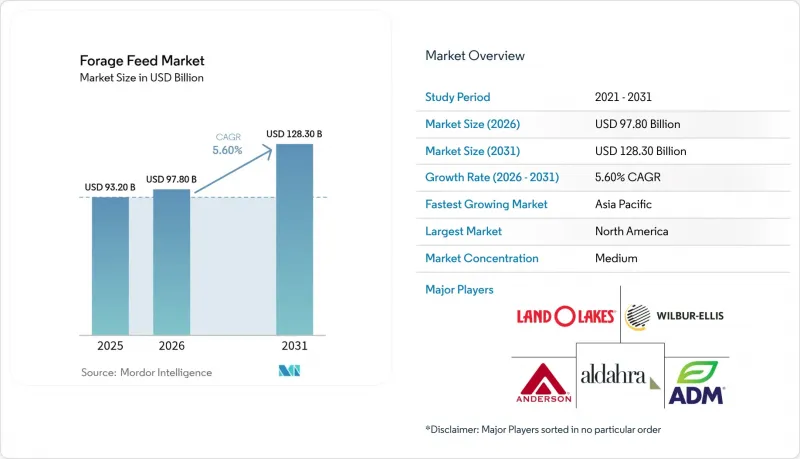
據 Mordor Intelligence 稱,2025 年飼料市場價值為 932 億美元,預計到 2031 年將達到 1283 億美元,而 2026 年為 978 億美元,預測期(2026-2031 年)的複合年成長率為 5.60%。
本報告按產品類型(苜蓿乾草、提摩西草等)、牲畜類型(乳牛、牛等)、形態(捆包、顆粒等)、分銷管道(飼料廠、直接供應農場等)和地區(北美、南美、歐洲、亞太等)進行細分。市場預測以價值(美元)和數量(公噸)表示。
全球飼料市場趨勢及洞察。
擴大大規模乳牛和牛養殖規模
大規模乳牛和肉牛牛場的垂直整合正在改變其採購慣例。擁有5000頭以上牲畜的農場擴大簽訂多年期飼料合約。這些合約以固定價格換取穩定的供應和蛋白質含量,從而降低了現貨市場價格波動的風險。這種方式使營養學家能夠開發出乾物質含量穩定的飼料配方,在集約化乳牛養殖系統中將飼料轉換率提高8%至12%。在這些地區,政府支持的合作社正在建造容量高達5萬噸的集中式牧草倉儲設施,以緩解季節性價格波動。這反映出亞洲乳製品加工商認知到北美飼料是優質原料,足以支撐每噸超過150美元的貨櫃運費。
促進高纖維飼料的甲烷減量政策
加拿大、歐盟和紐西蘭政府正在實施腸道甲烷減量目標,鼓勵乳牛和植物來源牛在牲畜飼料中添加更高比例的可消化纖維。這項轉變旨在推廣豆科飼料的使用,以取代以穀物為主的濃縮飼料。該措施為記錄基準和實施後排放量的企業提供了一筆收入,可抵銷高達8%的飼料總成本。該政策鼓勵採用高纖維飼料混合物,以減少腸道發酵,並符合國家排放交易計畫的報銷條件。此外,目前正在測試將3-硝基氧丙醇(3-NOP)和生物炭等飼料添加劑與豆科乾草結合使用,以期將甲烷排放量減少20%以上。
天氣變化和乾旱風險
美國、澳洲和阿根廷大平原地區連續數年乾旱,導致2024年和2025年苜蓿和牧草產量下降10%至15%。這迫使日本、韓國和阿拉伯聯合大公國的進口商調整籌資策略,並接受更高的進口成本。 2025年中,美國乾旱監測機構將加州、內華達州和愛達荷州42%的苜蓿產區列為「嚴重」至「極端」乾旱地區。結果,首茬苜蓿產量平均下降18%,優質苜蓿現貨市場價格上漲至每噸320美元以上,較2024年水準上漲25%。氣候模型預測,到 2030 年,主要飼料全部區域氣溫高於攝氏 35 度的天數將增加 20% 至 30%。
細分市場分析
苜蓿乾草是最大的飼料品類,預計到2025年將佔飼料市場佔有率的37.4%,鞏固其作為高產乳牛首選飼料的地位。這種偏好源自於其超過18%的粗蛋白含量和超過150的相對飼料價值。市場獎勵,例如自願性碳權計畫和監管排放上限,正鼓勵集約化畜牧養殖戶將更多預算投入能夠改善瘤胃功能的高纖維、低蛋白複合飼料。供應商現在提供添加益生菌的接種劑和濕度控制包裝,可以將保存期限延長至多八個月。
三葉草和其他豆科乾草預計將成為成長最快的細分市場,到2031年將以7.8%的複合年成長率成長,並有望成為所有產品類型中成長最快的。這一成長歸功於三葉草的固氮特性,使種植者每年每英畝可節省80至120美元的合成肥料成本。此外,由於三葉草能夠促進土壤固碳,種植者有資格根據VERRA和氣候行動儲備組織(Climate Action Reserve)管理的協議獲得碳抵消補貼。三葉草的共生根瘤能夠固定大氣中的氮,從而減少對合成肥料的依賴,並有助於獲得檢驗的碳抵消。
乳牛是最大的消費群體,預計到2025年將佔飼料乾草市場佔有率的42.6%。這主要得益於北美、歐洲和亞太地區的集約化養殖。這些飼料採用全混合日糧(TMR),其中乾草含量為40%至55%,以維持瘤胃健康,並將乳脂肪保持在3.8%以上。 2025年,日本和韓國共進口了45萬噸提摩西草和苜蓿乾草。日本酪農合作社規定,荷蘭牛的蛋白質含量必須達到18%以上,水分含量必須低於12%,以最佳化乳脂肪產量(平均每泌乳期1萬公斤)。歐盟的「從農場到餐桌」策略旨在2030年將農業溫室氣體排放量減少30%。
預計家禽業將成為成長最快的產業,到2031年將以6.9%的複合年成長率成長。美國、歐洲和東南亞的綜合家禽企業正在蛋雞飼料中添加切碎的苜蓿,以滿足放養雞蛋的標準(該標準要求纖維攝取量達到5%至7%或更高)。亞洲和非洲人口成長以及人均收入的提高正在推動動物蛋白消費量的成長。印度、印尼和奈及利亞等國的中等收入家庭正從以植物為主的飲食轉向以家禽為主的飲食,其速度超過了國內飼料的生產能力。飼料和粉碎的飼料對那些在蛋雞飼料中添加苜蓿的綜合家禽企業尤其具有吸引力。此外,在酪農產業,發酵乾草和青貯飼料添加劑被用於即使在長期儲存期間也能維持65%以上的總可消化營養密度(TDN)。
區域分析
預計到2025年,北美將繼續保持其飼料市場的地位,佔據33.7%的市場。這一成長得益於工業規模的酪農、先進的精密農業基礎設施以及暢通的出口管道。該地區也面臨一些挑戰,例如牛成長停滯和土地利用競爭日益激烈。美國在牧草產量方面處於領先地位,加州和亞利桑那州透過經濟高效的物流路線向亞洲市場出口乾苜蓿。加拿大利用了冷季作物的優勢,但由於高昂的運輸成本,其利潤率面臨壓力。在墨西哥,隨著綜合牛肉加工企業加強飼養管理,飼料市場正逐步擴張。
亞太地區預計將成為成長最快的地區,到2031年複合年成長率(CAGR)預計將達到6.3%。這一成長主要受人口成長、飲食西化趨勢以及畜牧業垂直整合快速發展的推動。在中國,受內蒙古集約化酪農養殖的推動,2024年至2025年間,優質壓縮苜蓿葉的進口量顯著成長。在印度,合作社酪農網路的擴張,以及對冷鏈基礎設施的投資,正在推動對發酵青貯飼料和強化蛋白顆粒飼料的需求。澳洲作為主要出口國,面臨著反覆乾旱和水資源分配政策變化等挑戰,這些挑戰可能會限制產量成長,但也使節水型豆科作物成為飼料市場的策略性作物。
在歐洲,受永續性法規和基於通用農業政策(CAP)的改革推動,預計成長潛力巨大。這些法規和改革旨在推廣固氮豆科植物並支持碳權計畫。德國、法國和荷蘭的乳製品產業依然強勁,但對美國乾草進口的植物檢疫限制正在促使在地採購增加。在東歐,匈牙利等市場正受益於對新興加工產業的投資,例如ADM的「Vitafort」合資企業,該合資企業有助於實現自給自足的目標。
其他好處:
- Excel格式的市場預測(ME)表
- 3個月的分析師支持
目錄
第1章:引言
- 研究假設和市場定義
- 調查範圍
第2章:調查方法
第3章執行摘要
第4章 市場狀況
- 市場概覽
- 市場促進因素
- 大規模酪農和肉牛生產企業的擴張
- 對高蛋白肉類和乳製品的需求不斷成長
- 促進高纖維飼料的甲烷減量政策
- 增加用於飼料的固氮豆科植物的排碳權。
- 田間運作的移動式打包機/包膜機器人提高了收割品質。
- 在飼料中添加生物炭可以提高飼料的消化率。
- 市場限制因素
- 天氣變化和乾旱風險
- 對經濟作物用地的競爭
- 加強跨境乾草貿易的植物檢疫壁壘
- 從粗飼料過渡到發酵濃縮飼料
- 監理情勢
- 技術展望
- 波特五力分析
第5章 市場規模及成長預測(數量與價值)
- 依產品類型
- 苜蓿乾草
- 蒂莫西·海
- 三葉草和其他豆科植物乾草
- 青貯飼料
- 嘿,憤怒
- 其他飼料(牧草混合物、作物殘茬)
- 依牲畜類型
- 乳牛
- 肉牛
- 家禽
- 馬
- 豬
- 其他牲畜(綿羊、山羊、駱駝科動物)
- 按形式
- 面紗
- 顆粒和塊狀
- 切碎/碾碎的飼料
- 發酵乾草和青貯飼料的添加劑
- 透過分銷管道
- 飼料廠
- 農場直接供應
- 線上平台
- 按地區
- 北美洲
- 美國
- 加拿大
- 其他北美國家
- 南美洲
- 巴西
- 阿根廷
- 其他南美國家
- 歐洲
- 德國
- 法國
- 英國
- 義大利
- 西班牙
- 俄羅斯
- 其他歐洲國家
- 亞太地區
- 中國
- 印度
- 日本
- 澳洲
- 韓國
- 其他亞太國家
- 中東
- 沙烏地阿拉伯
- 阿拉伯聯合大公國
- 其他中東國家
- 非洲
- 南非
- 埃及
- 其他非洲國家
- 北美洲
第6章 競爭情勢
- 市場集中度
- 策略趨勢
- 市佔率分析
- 公司簡介
- ADM
- Wilbur-Ellis Company LLC
- Triple Crown Nutrition
- Land O'Lakes, Inc.
- Anderson Hay
- Al Dahra ACX, Inc.
- Gruppo Carli
- Border Valley Trading
- Standlee Premium Products, LLC
- Lucerne Farms
- Mitsubishi Corporation(Riverina)
- Baileys Horse Feeds
第7章 市場機會與未來展望
According to Mordor Intelligence, the forage feed market size was valued at USD 93.20 billion in 2025 and estimated to grow from USD 97.80 billion in 2026 to reach USD 128.30 billion by 2031, at a CAGR of 5.60% during the forecast period (2026-2031).
This report is Segmented by Product Type (Alfalfa Hay, Timothy Hay, and More), by Livestock Type (Dairy Cattle, Beef Cattle, and More), by Form (Bales, Pellets, and More), by Distribution Channel (Feed Mills, Direct Farm Supply, and More), and by Geography (North America, South America, Europe, Asia-Pacific, and More). The Market Forecasts are Provided in Terms of Value (USD) and Volume (Metric Tons).
Global Forage Feed Market Trends and Insights
Expanding Large-Scale Dairy and Beef Operations
Vertical integration among large-scale dairies and beef feedlots is transforming procurement practices. Operations with more than 5,000 head are increasingly entering into multi-year forage contracts. These agreements ensure consistent volume and protein specifications in exchange for fixed pricing, reducing exposure to spot-market fluctuations. This approach enables nutritionists to formulate rations with consistent dry matter content, improving feed conversion ratios by 8% to 12% in intensive dairy systems . In these regions, state-backed cooperatives are constructing centralized hay-storage facilities with capacities of up to 50,000 metric tons to mitigate seasonal price volatility. This reflects the perception among Asian dairy processors that North American forage is a premium input, justifying container freight rates exceeding USD 150 per metric tons.
Methane-Mitigation Policies Favoring High-Fiber Forage
Governments in Canada, the European Union, and New Zealand are implementing enteric methane reduction targets that encourage dairy and beef producers to incorporate higher proportions of digestible fiber into livestock rations. This shift promotes the use of legume-based forages over grain-heavy concentrates. This initiative provides a revenue stream that can offset up to 8% of total feed costs for operations that document baseline and post-intervention emissions. Policy incentivizes the adoption of high-fiber forage blends that reduce enteric fermentation and qualify for rebates under the country's Emissions Trading Scheme. Additionally, feed-grade additives such as 3-nitrooxypropanol (3-NOP) and biochar are being tested in combination with legume hay to achieve methane reductions exceeding 20%.
Weather Volatility and Drought Risk
Consecutive drought years in the United States Great Plains, Australia, and Argentina reduced alfalfa and grass-hay yields by 10% to 15% in 2024 and 2025. This compelled importers in Japan, South Korea, and the United Arab Emirates to diversify their sourcing strategies and accept higher landed costs. In mid-2025, the United States Drought Monitor classified 42% of the alfalfa-producing counties in California, Nevada, and Idaho as experiencing severe to exceptional drought conditions. This resulted in an average 18% reduction in first-cutting yields and drove spot-market prices for premium alfalfa above USD 320 per metric ton, representing a 25% increase from 2024 levels . Climate models predict that by 2030, extreme-heat days exceeding 35 degrees Celsius will increase by 20% to 30% across major forage-producing regions.
Other drivers and restraints analyzed in the detailed report include:
- Carbon-Credit Upside from Nitrogen-Fixing Forage Legumes
- Rising Demand for High-Protein Meat and Dairy
- Stricter Phytosanitary Barriers on Cross-Border Hay Trade
For complete list of drivers and restraints, kindly check the Table Of Contents.
Segment Analysis
Alfalfa hay was the largest segment, led with 37.4% of the forage feed market share in 2025, underscoring its position as a preferred forage for high-producing dairy cattle. This preference is attributed to its crude protein content exceeding 18% and a relative feed value above 150. Market incentives, including voluntary carbon credit schemes and regulatory emission caps, are encouraging intensive cattle farms to allocate larger budgets to high-fiber, low-protein blends that enhance rumen function. Suppliers are now offering probiotic-infused inoculants and moisture-controlled wrapping, which can extend shelf life by up to eight months.
Clover and other legume hay will be the fastest-growing segment and are projected to expand at a 7.8% CAGR through 2031, marking the fastest growth among all product types. This growth is driven by clover's nitrogen-fixing properties, which enable growers to eliminate the annual synthetic fertilizer costs of USD 80-120 per acre. Additionally, clover supports soil carbon sequestration, qualifying growers for carbon offset payments under protocols administered by Verra and the Climate Action Reserve. The symbiotic root nodules of clover fix atmospheric nitrogen, reducing reliance on synthetic fertilizers and contributing to verified carbon offsets.
Dairy cattle were the largest segment, accounting for 42.6% of the forage feed market share in 2025, driven by intensive operations in North America, Europe, and the Asia-Pacific. These operations formulated total mixed rations with 40% to 55% forage inclusion to support rumen health and maintain milk-fat content above 3.8%. Japan and South Korea collectively imported 450,000 metric tons of timothy and alfalfa hay in 2025. Japanese dairy cooperatives specified protein content above 18% and moisture levels below 12% to optimize milk-fat yields in Holstein herds, which averaged 10,000 kilograms per lactation. The European Union's Farm to Fork strategy aimed to reduce agricultural greenhouse gas emissions by 30% by 2030.
Poultry will be the fastest-growing segment, advancing at a 6.9% CAGR through 2031. Integrators in the United States, Europe, and Southeast Asia are incorporating chopped alfalfa into layer rations to meet cage-free egg standards, which require a minimum fiber intake of 5% to 7% by weight . Population growth and rising per capita incomes in Asia and Africa are driving increased animal protein consumption. Middle-income households in countries such as India, Indonesia, and Nigeria are transitioning from plant-based diets to include poultry at rates that exceed domestic forage production capacity. Chopped and chaffed forage is particularly appealing to poultry integrators blending alfalfa into layer rations. Additionally, dairy operations use fermented haylage and silage additives to maintain nutrient density above 65% total digestible nutrients during extended storage periods.
Complete Report Scope:
- By Product Type
- Alfalfa Hay
- Timothy Hay
- Clover & Other Legume Hay
- Silage
- Haylage
- Other Forage (grass mix, crop residues)
- By Livestock Type
- Dairy Cattle
- Beef Cattle
- Poultry
- Equine
- Swine
- Other Livestock (sheep, goats, camelids)
- By Form
- Bales
- Pellets and Cubes
- Chopped/Chaffed Forage
- Fermented Haylage and Silage Additives
- By Distribution Channel
- Feed Mills
- Direct Farm Supply
- Online Platforms
- By Geography
- North America
- United States
- Canada
- Rest of North America
- South America
- Brazil
- Argentina
- Rest of South America
- Europe
- Germany
- France
- United Kingdom
- Italy
- Spain
- Russia
- Rest of Europe
- Asia-Pacific
- China
- India
- Japan
- Australia
- South Korea
- Rest of Asia-Pacific
- Middle East
- Saudi Arabia
- United Arab Emirates
- Rest of Middle East
- Africa
- South Africa
- Egypt
- Rest of Africa
- North America
Geography Analysis
North America retained the largest regional position 33.7% of of the forage feed market share in 2025. This growth is supported by industrial-scale dairy complexes, advanced precision agriculture infrastructure, and strong export pipelines. The region faces challenges such as plateauing herd expansions and increased land-use competition. The United States leads production, with California and Arizona exporting dehydrated alfalfa to Asian markets through cost-efficient logistics corridors. Canada benefits from cool-season crop advantages but faces margin pressures due to high freight rates. In Mexico, the forage feed market is gradually expanding as integrated beef processors enhance feeding protocols.
Asia-Pacific will be the fastest-growing forecast to post the quickest 6.3% CAGR through 2031. This growth is driven by population increases, dietary shifts toward Western preferences, and the rapid adoption of vertical livestock integration. China experienced a significant rise in premium compressed alfalfa bale imports during 2024-2025, fueled by intensive dairy operations in Inner Mongolia. In India, the expanding cooperative dairy network, supported by investments in cold-chain infrastructure, is driving demand for fermented haylage and protein-enriched pellets. Australia, a key exporter, faces challenges from recurring droughts and evolving water-allocation policies, which may limit production growth but position water-efficient legumes as strategic crops in the forage feed market.
Europe shows growth potential, driven by sustainability mandates and reforms under the Common Agricultural Policy, which promote nitrogen-fixing legumes and carbon credit initiatives. Germany, France, and the Netherlands maintain strong dairy industries, but phytosanitary restrictions on United States hay imports are encouraging localized sourcing. In Eastern Europe, markets like Hungary are benefiting from new processing investments, such as ADM's Vitafort joint venture, which supports self-sufficiency goals.
- ADM
- Wilbur-Ellis Company LLC
- Triple Crown Nutrition
- Land O'Lakes, Inc.
- Anderson Hay
- Al Dahra ACX, Inc.
- Gruppo Carli
- Border Valley Trading
- Standlee Premium Products, LLC
- Lucerne Farms
- Mitsubishi Corporation (Riverina)
- Baileys Horse Feeds
Additional Benefits:
- The market estimate (ME) sheet in Excel format
- 3 months of analyst support
TABLE OF CONTENTS
1 Introduction
- 1.1 Study Assumptions and Market Definition
- 1.2 Scope of the Study
2 Research Methodology
3 Executive Summary
4 Market Landscape
- 4.1 Market Overview
- 4.2 Market Drivers
- 4.2.1 Expanding large-scale dairy and beef operations
- 4.2.2 Rising demand for high-protein meat and dairy
- 4.2.3 Methane mitigation policies favoring high-fiber forage
- 4.2.4 Carbon-credit upside from nitrogen-fixing forage legumes
- 4.2.5 In-field mobile baler-wrapper robots boosting harvest quality
- 4.2.6 Feed-grade biochar blends improving forage digestibility
- 4.3 Market Restraints
- 4.3.1 Weather volatility and drought risk
- 4.3.2 Competition for arable land with cash crops
- 4.3.3 Stricter phytosanitary barriers on cross-border hay trade
- 4.3.4 Shift toward fermented concentrates over loose forage
- 4.4 Regulatory Landscape
- 4.5 Technological Outlook
- 4.6 Porter's Five Forces Analysis
- 4.6.1 Threat of New Entrants
- 4.6.2 Bargaining Power of Suppliers
- 4.6.3 Bargaining Power of Buyers
- 4.6.4 Threat of Substitutes
- 4.6.5 Intensity of Competitive Rivalry
5 Market Size and Growth Forecasts (Volume and Value)
- 5.1 By Product Type
- 5.1.1 Alfalfa Hay
- 5.1.2 Timothy Hay
- 5.1.3 Clover & Other Legume Hay
- 5.1.4 Silage
- 5.1.5 Haylage
- 5.1.6 Other Forage (grass mix, crop residues)
- 5.2 By Livestock Type
- 5.2.1 Dairy Cattle
- 5.2.2 Beef Cattle
- 5.2.3 Poultry
- 5.2.4 Equine
- 5.2.5 Swine
- 5.2.6 Other Livestock (sheep, goats, camelids)
- 5.3 By Form
- 5.3.1 Bales
- 5.3.2 Pellets and Cubes
- 5.3.3 Chopped/Chaffed Forage
- 5.3.4 Fermented Haylage and Silage Additives
- 5.4 By Distribution Channel
- 5.4.1 Feed Mills
- 5.4.2 Direct Farm Supply
- 5.4.3 Online Platforms
- 5.5 By Geography
- 5.5.1 North America
- 5.5.1.1 United States
- 5.5.1.2 Canada
- 5.5.1.3 Rest of North America
- 5.5.2 South America
- 5.5.2.1 Brazil
- 5.5.2.2 Argentina
- 5.5.2.3 Rest of South America
- 5.5.3 Europe
- 5.5.3.1 Germany
- 5.5.3.2 France
- 5.5.3.3 United Kingdom
- 5.5.3.4 Italy
- 5.5.3.5 Spain
- 5.5.3.6 Russia
- 5.5.3.7 Rest of Europe
- 5.5.4 Asia-Pacific
- 5.5.4.1 China
- 5.5.4.2 India
- 5.5.4.3 Japan
- 5.5.4.4 Australia
- 5.5.4.5 South Korea
- 5.5.4.6 Rest of Asia-Pacific
- 5.5.5 Middle East
- 5.5.5.1 Saudi Arabia
- 5.5.5.2 United Arab Emirates
- 5.5.5.3 Rest of Middle East
- 5.5.6 Africa
- 5.5.6.1 South Africa
- 5.5.6.2 Egypt
- 5.5.6.3 Rest of Africa
- 5.5.1 North America
6 Competitive Landscape
- 6.1 Market Concentration
- 6.2 Strategic Moves
- 6.3 Market Share Analysis
- 6.4 Company Profiles (Includes Global-level Overview, Market-level Overview, Core Segments, Financials, Strategic Information, Market Rank/Share, Products and Services, and Recent Developments)
- 6.4.1 ADM
- 6.4.2 Wilbur-Ellis Company LLC
- 6.4.3 Triple Crown Nutrition
- 6.4.4 Land O'Lakes, Inc.
- 6.4.5 Anderson Hay
- 6.4.6 Al Dahra ACX, Inc.
- 6.4.7 Gruppo Carli
- 6.4.8 Border Valley Trading
- 6.4.9 Standlee Premium Products, LLC
- 6.4.10 Lucerne Farms
- 6.4.11 Mitsubishi Corporation (Riverina)
- 6.4.12 Baileys Horse Feeds
7 Market Opportunities and Future Outlook


