


 |
市場調查報告書
商品編碼
2123491
腦機介面:市場佔有率分析、產業趨勢與統計、成長預測(2026-2031)Brain-computer Interface - Market Share Analysis, Industry Trends & Statistics, Growth Forecasts (2026 - 2031) |
||||||

※ 本網頁內容可能與最新版本有所差異。詳細情況請與我們聯繫。
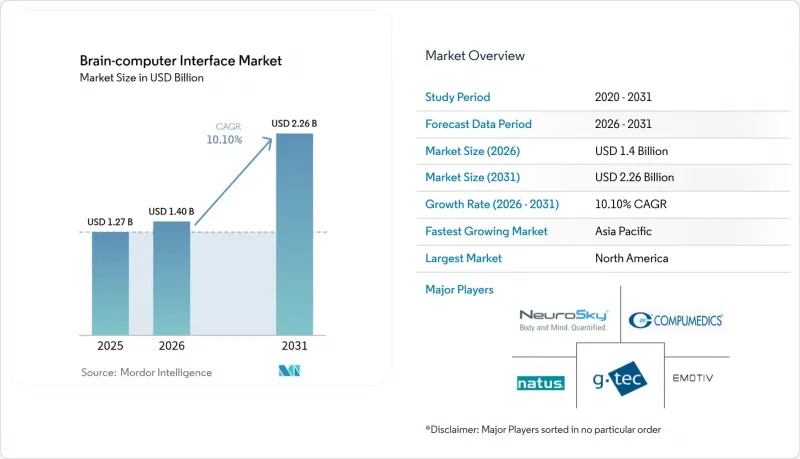
根據 Mordor Intelligence 估計,腦機介面 (BCI) 市場在 2026 年的價值將達到 14 億美元,高於 2025 年的 12.7 億美元,預計到 2031 年將達到 22.6 億美元。
預計 2026 年至 2031 年的複合年成長率為 10.1%。
本报告按组件(硬體、软件/算法、服务)、介面(运动功能脑机介面、通訊脑机介面等)、应用(義肢/运动康复等)、最终用户(医院/诊所、研究/学术机构等)和地区(北美、欧洲等)对市场进行分类。市場預測以美元計價。
全球腦機介面(BCI)市場趨勢與洞察
對通訊支援技術的需求正在激增。
一項由美國國立衛生研究院 (NIH) 資助的研究表明,癱瘓患者恢復了清晰的言語能力,詞彙等級的準確率高達 99%[2]。隨後,Synchron 公司將其 Stentrode植入與生成式人工智慧模型結合,使更多用戶能夠實現免手輸入。醫院報告稱,看護者的工作週期縮短,患者的自主性評分提高,臨床應用範圍也從肌萎縮側索硬化症 (ALS) 擴展到創傷性脊髓損傷和腦幹中風(使用者數據)。美國私人保險公司已開始審查語音解碼植入體的早期保險索賠,顯示保險公司越來越認可語音植入對病患生活品質的持續改善。歐洲的教學醫院目前正在將配備增強型語言模型的腦機介面 (BCI) 整合到多學科神經復健計畫中,推動該技術在全部區域中期廣泛應用。
基於腦電圖的穿戴式式耳機迅速普及
遊戲工作室、電競組織者和消費者健康品牌正在將乾電極頭戴裝置整合到互動遊戲、健身課程和冥想平台中。主播們正在展示如何透過神經輸入完全控制遊戲,而競技聯賽則在測試如何利用專注力和情緒狀態數據進行教練指導。這些應用正在改進低延遲訊號擷取演算法,加速設備小型化,並提高大眾(而不僅僅是醫療相關人員)對腦機互動日常益處的認知。隨著出貨量的成長,規模經濟效應開始降低單位成本,使供應商能夠透過捆綁訂閱式分析服務來提高每用戶收入。
手術風險和監管挑戰
植入式系統具有卓越的訊號保真度,但需要進行顱內或血管手術,這限制了能夠進行此類手術的醫療機構數量。電極移位、感染疾病和設備移除等事件的報告引起了臨床醫生和保險公司的擔憂。監管機構要求長期安全監測,延長產品上市時間並增加臨床試驗預算。這些障礙使得早期應用僅限於資金雄厚的大學醫院和富裕的私人患者,減緩了植入式系統的廣泛普及。供應商正在透過改進支架等輸送工具和開發可移除植入來應對這些挑戰,但他們仍然需要克服可能耗時數年的批准流程。
細分市場分析
預計到2025年,非侵入式頭戴裝置和電極陣列將佔銷售額的75.90%,凸顯了它們作為眾多腦機介面(BCI)市場開發者的入門級產品的地位。採用乾電極和低功耗藍牙技術的產品的推出,縮短了設定時間,提高了舒適度,從而實現了虛擬實境(VR)遊戲和遠端神經反饋等日常應用場景。醫院高度重視避免手術風險的能力,而消費品牌則利用監管門檻的降低來加速產品上市速度。儘管競爭日益激烈,但更低的價格和更高的信噪比(SNR)仍然支撐著兩位數的成長。
軟體和演算法領域正以0.88%的複合年成長率快速擴張,成長超過硬體領域,因為每部署一台頭戴式設備都能帶來持續的授權收入。基於變壓器的解碼器、遷移學習和自校準框架正以三位數的速度提升訊息傳輸速率。這些進步催生了一個新的SaaS細分市場,預計到2023年,該細分市場的規模將從3.8億美元成長到9.7億美元。服務供應商也紛紛效仿,為缺乏內部專業知識的醫療保健採購方提供雲端控制面板、電極維護合約和合規性審計服務。這些業務活動共同維持了均衡的收入結構,使供應商免受僅依賴硬體利潤率的壓力。
到2025年,馬達/輸出平台將佔總支出的50.30%,這反映了臨床上對恢復癱瘓患者遊標控制、輪椅操作和義肢操作的重視。非侵入式深度學習解碼器實現亞秒級響應時間的成功演示,使其應用範圍已擴展到加護病房(ICU)之外。消費級產品開發商正在將這些突破性技術應用於擴增擴增實境(AR)頭戴裝置和智慧家庭設備的無手勢輸入,進一步提升了該領域的成熟度。
結合腦電圖 (EEG)、肌電圖 (EMG)、功能性近紅外線光譜 (fNIRS) 或聚焦超音波的混合架構預計將以 3.34% 的複合年成長率成長。這些架構透過融合多種神經和周邊訊號來提高可靠性,並補償單模態系統面臨的偽影問題。一項實驗性中風復健設備展示了其優勢:經過兩週的腦肌混合訓練,83% 的患者恢復了可測量的手部功能。隨著組件成本的降低,混合電路可望從實驗室走向模組化消費級配件市場。
區域分析
預計到2025年,北美將佔全球銷售額的48.0%,並將繼續保持腦機介面市場的關鍵地位。美国国立卫生研究院 (NIH) 的资助、充裕的創業投資以及一支专家外科医生团队,共同支持着一系列临床试验的持续推进,这些试验涵盖了从语音解码、双向感觉到憂鬱症神经调控等多个领域。該地區受益於率先採用相關技術的醫療保健系統,這些系統將報銷研究成果整合到臨床工作流程中,並加快了保險公司的接受度。隱私法規正在快速發展,這不僅給早期投資於安全資料架構的公司帶來了合規壓力,也帶來了競爭優勢。
亞太地區正以2.38%的複合年成長率維持最高增速,這得益於中國政府將腦機介面列為戰略產業。政府津貼正在促進產學合作,而新的標準化機構也致力於制定訊號收集協議和倫理準則。中國新創公司在普通話語音解碼方面已達到7%的準確率,進一步鞏固了該地區的發展勢頭。日本人口老化推動了對神經退化性疾病管理技術的結構性需求,而韓國領先的電子公司則在感測器小型化方面提供了專業技術支援。
歐洲佔了相當大的佔有率,其公共醫療體系資助了情緒改善臨床試驗和中風復健計畫。英國國家醫療服務體系 (NHS) 一項耗資 650 萬英鎊的基於超音波介面 (BCI) 臨床試驗,凸顯了政策層面在精神健康非藥物療法方面的努力。即將訂定的歐盟人工智慧法案將把許多人工智慧驅動的醫療設備歸類為高風險產品,迫使供應商採用嚴格的網路安全和效能檢驗程序,這在其他地區可能成為競爭優勢。中東、非洲和南美洲等規模較小但成長迅速的市場,正增加遠距復健和遠端神經監測的投資,充分利用行動連線和跨境培訓夥伴關係。
其他好處:
- Excel格式的市場預測(ME)表
- 3個月的分析師支持
目錄
第1章:引言
- 研究假設和市場定義
- 調查範圍
第2章:調查方法
第3章執行摘要
第4章 市場狀況
- 市場概覽
- 市場促進因素
- 電子競技和遊戲公司迅速普及以腦電圖為基礎的穿戴式式耳機。
- 大量創業投資(VC)資金湧入神經技術中心(矽谷、洛桑、維也納),縮短了產品上市時間。
- 政府活性化研發投入,旨在改善腦機介面技術
- 日本和歐盟老化社會中神經退化性疾病的日益普遍,正在推動臨床試驗的發展。
- 市場限制因素
- 手術風險和監管障礙阻礙了植入式腦機介面系統的廣泛應用。
- 圍繞神經數據收集的數據隱私問題引發了人們的擔憂
- 公共醫療系統中缺乏基於腦機介面的復健治療的報銷代碼。
- 由於頭髮和頭皮的電阻,大眾市場腦電圖設備在訊號準確性方面面臨挑戰。
- 供應鏈分析
- 技術展望
- 波特五力模型
第5章 市場規模與成長預測
- 按組件
- 硬體
- 侵入性
- 非侵入性
- 其他
- 軟體演算法
- 服務
- 硬體
- 透過介面
- 馬達/輸出 BCI
- 通訊型腦機介面
- 被動式/監測式腦機介面
- 混合腦機介面
- 透過使用
- 義肢和運動功能恢復
- 通訊與控制
- 其他
- 最終用戶
- 醫院和診所
- 研究和學術機構
- 其他
- 按地區
- 北美洲
- 美國
- 加拿大
- 墨西哥
- 歐洲
- 德國
- 英國
- 法國
- 義大利
- 西班牙
- 其他歐洲國家
- 亞太地區
- 中國
- 日本
- 印度
- 韓國
- 澳洲
- 亞太其他地區
- 中東和非洲
- GCC
- 南非
- 其他中東和非洲國家
- 南美洲
- 巴西
- 阿根廷
- 其他南美國家
- 北美洲
第6章 競爭格局
- 市場集中度
- 策略趨勢
- 市佔率分析
- 公司簡介
- g.tec medical engineering GmbH
- 貝萊德神經科技
- Emotiv, Inc.
- NeuroSky, Inc.
- Kernel
- Paradromics, Inc.
- MindMaze SA
- Cognixion
- CTRL-Labs(Meta Platforms)
- NextMind(Snap Inc.)
- OpenBCI
- Synchron Inc.
- Neurable
- BrainCo, Inc.
- Interaxon Inc.(Muse)
- Bitbrain Technologies
- Cyberkinetics
- 日本光電株式會社
- Compumedics Ltd
- Alea Neurotherapeutics
第7章 市場機會與未來展望
According to Mordor Intelligence, brain-computer interface market size in 2026 is estimated at USD 1.4 billion, growing from 2025 value of USD 1.27 billion with 2031 projections showing USD 2.26 billion, growing at 10.1% CAGR over 2026-2031.
This report Segments by Component (Hardware, Software & Algorithm and Services), by Interface (Motor BCI, Communication BCI, and More), by Application (Neuro-Prosthetics & Motor Restoration and More), by End User (Hospitals & Clinics, Research & Academic Institutes, and Others) and by Geography ( Northa America, Europe and More) the Market Forecasts are Provided in Terms of Value (USD).
Global Brain-computer Interface Market Trends and Insights
Surging demand for assistive communication technologies
National Institutes of Health-backed research restored intelligible speech for a paralyzed patient with 99% word-level accuracy [2]. Synchron subsequently paired its Stentrode implant with a generative-AI model, enabling hands-free texting for additional users. Hospitals report shorter caregiver cycles and higher patient-autonomy scores, expanding the clinical addressable pool beyond ALS to traumatic spinal-cord injury and brain-stem stroke (user data). Private insurers in the United States have begun reviewing early reimbursement cases for speech-decoding implants, indicating growing payer recognition of durable quality-of-life gains. European teaching hospitals now integrate language-model-enhanced BCIs in multidisciplinary neuro-rehabilitation programs, reinforcing mid-term adoption across the region.
Rapid adoption of EEG-based wearable headsets
Gaming studios, e-sports organizers, and consumer-wellness brands integrate dry-electrode headsets into interactive titles, fitness programs, and meditation platforms. Streamers demonstrate full-gameplay control with neural inputs, while competitive leagues trial concentration and emotional-state data for coaching. These deployments sharpen algorithms for low-latency signal extraction, accelerate miniaturization, and educate non-medical audiences on everyday benefits of brain-computer interaction. As shipments grow, economies of scale begin to lower unit costs, allowing vendors to bundle subscription-based analytics that deepen revenue per user.
Surgical risks and regulatory hurdles
Implantable systems deliver superior signal fidelity yet involve cranial or vascular procedures that few centers can perform. Reports of electrode migration, infection, and device retrieval create caution among clinicians and insurers. Regulatory agencies require lengthy safety monitoring, stretching time-to-market and inflating trial budgets. These obstacles confine early adoption to well-funded academic hospitals and wealthy self-pay patients, slowing broad penetration. Vendors respond by refining stent-like delivery tools and developing reversible implants but must still navigate multi-year approval pathways.
Other drivers and restraints analyzed in the detailed report include:
- High VC funding in neuro-tech hubs
- Rising R&D activities by government
- Data-privacy concerns over neural data collection
For complete list of drivers and restraints, kindly check the Table Of Contents.
Segment Analysis
Non-invasive headsets and electrode arrays generated 75.90% of 2025 revenue, underscoring their role as the entry point for many developers in the Brain-Computer Interface market. Product launches with dry electrodes and low-energy Bluetooth have reduced setup times and improved comfort, enabling everyday usage scenarios such as virtual-reality gaming and remote neurofeedback. Hospitals appreciate the avoidance of surgical risk, and consumer brands leverage lower regulatory hurdles to speed shelf placement. Price declines and improved signal-to-noise ratios continue to support double-digit growth despite intensifying competition.
Software and algorithm layers are expanding at a .88% CAGR, a pace that outstrips hardware because every incremental headset installation yields recurring licensing opportunities. Transformer-based decoders, transfer learning, and self-calibrating frameworks raise information-transfer rates by triple-digit percentages. These advances create an emergent SaaS sub-segment forecast to climb from USD 0.38 billion to USD 0.97 billion by 203. Service providers follow close behind, offering cloud dashboards, electrode-maintenance contracts, and compliance audits to clinical buyers who lack in-house specialists. Together, these activities sustain a balanced revenue mix that shields vendors from pure hardware margin compression.
Motor/output platforms accounted for 50.30% of spending in 2025, reflecting clinical priorities around restoring cursor control, wheelchair navigation, and prosthetic manipulation for paralysis patients. Successful demonstrations of non-invasive deep-learning decoders capable of sub-second response rates have widened appeal beyond the intensive-care unit. Consumer developers adapt these breakthroughs to gesture-less input for augmented-reality headsets and smart-home devices, reinforcing the segment's maturity.
Hybrid architectures, combining EEG, electromyography, functional near-infrared spectroscopy, or focused ultrasound, are on course for 3.34% CAGR. They lift reliability by fusing multiple neural and peripheral signals, thereby compensating for artifacts that hamper single-modality systems. Experimental stroke-rehabilitation rigs illustrate the benefit: after two weeks of hybrid brain-muscle training, 83% of patients regained measurable hand function. As component costs fall, hybrid circuitry will migrate from the laboratory into modular consumer accessories.
Complete Report Scope:
- By Component (Value)
- Hardware
- Invasive
- Non-invasive
- Others
- Software & Algorithms
- Services
- Hardware
- By Interface Type (Value)
- Motor / Output BCI
- Communication BCI
- Passive / Monitoring BCI
- Hybrid BCI
- By Application (Value)
- Neuro-prosthetics & Motor Restoration
- Communication & Control
- Others
- By End-User (Value)
- Hospitals & Clinics
- Research & Academic Institutes
- Others
- By Geography (Value)
- North America
- United States
- Canada
- Mexico
- Europe
- Germany
- United Kingdom
- France
- Italy
- Spain
- Rest of Europe
- Asia-Pacific
- China
- Japan
- India
- South Korea
- Australia
- Rest of Asia- Pacific
- Middle East and Africa
- GCC
- South Africa
- Rest of Middle East and Africa
- South America
- Brazil
- Argentina
- Rest of South America
- North America
Geography Analysis
North America generated 48.0% of 2025 revenue and remains the anchor of the Brain-Computer Interface market. National Institutes of Health funding, deep venture pools, and specialized surgical teams underpin a continuous trial pipeline that spans speech decoding, bidirectional sensation, and neuromodulation for depression. The region benefits from early adopter health systems that integrate reimbursement studies into clinical workflows, accelerating payer acceptance. Privacy legislation is evolving rapidly, creating both compliance overhead and competitive advantage for firms that invest early in secure data architectures.
Asia-Pacific delivers the fastest 2.38% CAGR, propelled by Chinese government designation of brain-machine interfaces as a strategic industry. State grants encourage industrial-academic consortia, while new standards bodies tackle signal-acquisition protocols and ethical guidelines. Chinese start-ups have already demonstrated 7% accuracy in decoding Mandarin speech, underscoring regional momentum. Japan's aging demographics add a structural demand driver for neuro-degenerative disease management, and South-Korean electronics majors contribute sensor miniaturization expertise.
Europe holds a significant share, with public-health systems funding mood-enhancement trials and stroke-recovery programs. The National Health Service's GBP 6.5 million ultrasound-based BCI trial reinforces policy-level commitment to non-pharma approaches for mental-health conditions. The forthcoming EU AI Act classifies many AI-enabled medical devices as high-risk, compelling vendors to adopt rigorous cyber-security and performance-validation procedures that can become competitive differentiators in other regions. Smaller but growing markets in the Middle East, Africa, and South America invest in tele-rehabilitation and remote neuromonitoring, leveraging mobile connectivity and cross-border training partnerships.
- g.tec medical engineering
- Blackrock Neurotech
- Emotiv, Inc.
- NeuroSky, Inc.
- Kernel
- Paradromics, Inc.
- MindMaze SA
- Cognixion
- CTRL-Labs (Meta Platforms)
- NextMind (Snap Inc.)
- OpenBCI
- Synchron
- Neurable
- BrainCo, Inc.
- Interaxon Inc. (Muse)
- Bitbrain Technologies
- Cyberkinetics
- Nihon Kohden
- Compumedics
- Alea Neurotherapeutics
Additional Benefits:
- The market estimate (ME) sheet in Excel format
- 3 months of analyst support
TABLE OF CONTENTS
1 Introduction
- 1.1 Study Assumptions & Market Definition
- 1.2 Scope of the Study
2 Research Methodology
3 Executive Summary
4 Market Landscape
- 4.1 Market Overview
- 4.2 Market Drivers
- 4.2.1 Rapid adoption of EEG-based wearable headsets by eSports and gaming companies
- 4.2.2 High VC funding in neuro-tech hubs (Silicon Valley, Lausanne, Vienna) accelerating product commercialization timelines
- 4.2.3 Rising R&D Activities by Government to Improve the Brain-computer Interface Technology
- 4.2.4 Rising prevalence of neuro-degenerative disorders in ageing populations of Japan and EU spurring clinical trials
- 4.3 Market Restraints
- 4.3.1 Surgical risks and regulatory hurdles limiting adoption of implantable BCI systems
- 4.3.2 Data-privacy concerns over neural data collection
- 4.3.3 Scarcity of reimbursement codes for BCI-based rehabilitation therapies in public healthcare systems
- 4.3.4 Signal accuracy challenges due to hair & scalp impedance in mass-market EEG devices
- 4.4 Supply-Chain Analysis
- 4.5 Technological Outlook
- 4.6 Porter's Five Forces
- 4.6.1 Threat of New Entrants
- 4.6.2 Threat of Substitutes
- 4.6.3 Bargaining Power of Buyers
- 4.6.4 Bargaining Power of Suppliers
- 4.6.5 Industry Rivalry
5 Market Size & Growth Forecasts
- 5.1 By Component (Value)
- 5.1.1 Hardware
- 5.1.1.1 Invasive
- 5.1.1.2 Non-invasive
- 5.1.1.3 Others
- 5.1.2 Software & Algorithms
- 5.1.3 Services
- 5.1.1 Hardware
- 5.2 By Interface Type (Value)
- 5.2.1 Motor / Output BCI
- 5.2.2 Communication BCI
- 5.2.3 Passive / Monitoring BCI
- 5.2.4 Hybrid BCI
- 5.3 By Application (Value)
- 5.3.1 Neuro-prosthetics & Motor Restoration
- 5.3.2 Communication & Control
- 5.3.3 Others
- 5.4 By End-User (Value)
- 5.4.1 Hospitals & Clinics
- 5.4.2 Research & Academic Institutes
- 5.4.3 Others
- 5.5 By Geography (Value)
- 5.5.1 North America
- 5.5.1.1 United States
- 5.5.1.2 Canada
- 5.5.1.3 Mexico
- 5.5.2 Europe
- 5.5.2.1 Germany
- 5.5.2.2 United Kingdom
- 5.5.2.3 France
- 5.5.2.4 Italy
- 5.5.2.5 Spain
- 5.5.2.6 Rest of Europe
- 5.5.3 Asia-Pacific
- 5.5.3.1 China
- 5.5.3.2 Japan
- 5.5.3.3 India
- 5.5.3.4 South Korea
- 5.5.3.5 Australia
- 5.5.3.6 Rest of Asia- Pacific
- 5.5.4 Middle East and Africa
- 5.5.4.1 GCC
- 5.5.4.2 South Africa
- 5.5.4.3 Rest of Middle East and Africa
- 5.5.5 South America
- 5.5.5.1 Brazil
- 5.5.5.2 Argentina
- 5.5.5.3 Rest of South America
- 5.5.1 North America
6 6. Competitive Landscape
- 6.1 Market Concentration
- 6.2 Strategic Moves
- 6.3 Market Share Analysis
- 6.4 Company Profiles (includes Global level Overview, Market level overview, Core Segments, Financials as available, Strategic Information, Market Rank/Share, Products & Services, Recent Developments)
- 6.4.1 g.tec medical engineering GmbH
- 6.4.2 Blackrock Neurotech
- 6.4.3 Emotiv, Inc.
- 6.4.4 NeuroSky, Inc.
- 6.4.5 Kernel
- 6.4.6 Paradromics, Inc.
- 6.4.7 MindMaze SA
- 6.4.8 Cognixion
- 6.4.9 CTRL-Labs (Meta Platforms)
- 6.4.10 NextMind (Snap Inc.)
- 6.4.11 OpenBCI
- 6.4.12 Synchron Inc.
- 6.4.13 Neurable
- 6.4.14 BrainCo, Inc.
- 6.4.15 Interaxon Inc. (Muse)
- 6.4.16 Bitbrain Technologies
- 6.4.17 Cyberkinetics
- 6.4.18 Nihon Kohden Corporation
- 6.4.19 Compumedics Ltd
- 6.4.20 Alea Neurotherapeutics
7 Market Opportunities & Future Outlook

 2026年全球腦機植入市場報告
 穿戴式腦機介面設備市場-2026-2032年全球市場預測腦機介面市場:按組件、介面類型、技術和應用分類-2026-2032年全球市場預測
 穿戴式腦機介面設備市場規模、佔有率和成長分析:按產品類型、應用、最終用戶、分銷管道和地區分類-2026-2033年產業預測
 腦機介面(BCI)市場規模、佔有率、趨勢和預測:按產品、應用和地區分類,2026-2034年
 腦機介面市場預測至2034年:按產品、組件、技術、適應症、最終用戶和地區分類的全球分析2026年全球植入式腦機介面市場報告
 腦機介面市場:依產品、應用、最終用戶和地區分類
 腦機介面市場分析及預測(至2035年):依類型、產品類型、技術、組件、應用、最終用戶、功能、安裝類型及設備分類
 全球腦指紋辨識技術市場規模、佔有率、趨勢和成長分析報告(2026-2034年)