


 |
市場調查報告書
商品編碼
2123486
折疊式智慧型手機:市佔率分析、產業趨勢與統計及成長預測(2026-2031)Foldable Smartphone - Market Share Analysis, Industry Trends & Statistics, Growth Forecasts (2026 - 2031) |
||||||

※ 本網頁內容可能與最新版本有所差異。詳細情況請與我們聯繫。
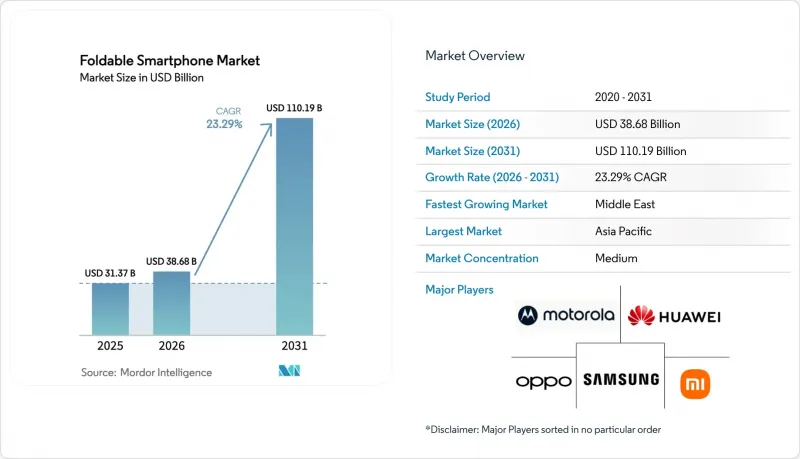
根據 Mordor Intelligence 預測,折疊式智慧型手機市場預計將從 2025 年的 313.7 億美元成長到 2026 年的 386.8 億美元,到 2031 年的複合年成長率為 23.29%。
本報告外形規格(翻蓋式、書本式、其他)、螢幕大小(6.9吋以下、7-8吋、8吋以上)、價格區間(1,000美元以下、1000-1499美元、1,500美元以上)、銷售管道(電信業者、消費性電子零售商、電子商務/DTC)、最終用戶(一般消費者、政府/國防)和消費者地區進行細分。市場預測以美元計價。
全球折疊式智慧型手機市場趨勢與洞察
超薄玻璃產率的快速提高
超薄玻璃的良率已從2023年的60%提升至2025年的85%,降低了廢棄物處理成本,使得在不影響毛利率的前提下,能夠向新興市場提供售價低於1000美元的產品。三星顯示器和康寧公司透過精密化學蝕刻技術實現了30微米的基板,從而減少了對易刮傷的聚醯亞胺薄膜的依賴。預計到2027年,隨著良率接近90%,折疊式顯示器與傳統旗艦顯示器之間的成本差距將縮小至15%以下,為可折疊顯示器的更廣泛應用鋪平道路。
軟性AMOLED面板單價降低
預計2024年至2025年間,OLED價格將下降30%。這主要得益於京東方和維信諾在其第六代OLED生產線上新增5萬平方公尺的產能,以及三星顯示器低溫多晶氧化物技術授權專案的實施。面板成本的降低將使中階設備能夠支援120Hz刷新率和HDR10+,抵禦關稅波動帶來的風險,並符合歐盟能源指令,因為OLED製造比LCD製造節能40%。
人們擔心鉸鏈在潮濕的熱帶地區使用壽命不到 20 萬次循環。
來自印尼和印度沿海地區的現場報告顯示,在濕度持續高達80%的環境中,鉸鏈因腐蝕而在18個月內失效,這一失效率是溫帶地區的三倍。原始設備製造商(OEM)面臨著不斷增加的保固成本,並正在考慮引入增加重量和零件成本的機制,以及採用密封或塗層設計。
細分市場分析
預計到2025年,書本式折疊式螢幕設備將佔據折疊式智慧型手機市場62.31%的佔有率,這主要得益於三星「Galaxy Z Fold」系列和華為「Mate X」系列的強勁表現。 OPPO和摩托羅拉的捲軸式螢幕正以24.21%的複合年成長率成長,由於它們可以在不增加厚度的情況下從6.7英寸無縫擴展到7.4英寸,折疊式智慧型手機市場有望迎來新一輪的外形規格變革。
儘管高度便攜的折疊式折疊手機在追求時尚的消費者中仍保持著一定的市場需求,但由於螢幕保護方面的挑戰,外折疊式手機仍然是小眾產品。這款三折疊原型機預示著未來10吋螢幕的潛力,其目標用戶是注重效率的商務用戶,並有望進一步拓展折疊式智慧型手機市場。
預計到2025年,7-8吋尺寸的手機將佔總銷量的44.34%,這主要得益於消費者擴大將折疊螢幕手機作為單一裝置使用,以取代平板電腦。預計到2031年,8吋以上尺寸的手機將以25.76%的複合年成長率成長。這一成長表明,折疊式智慧型手機市場正在發生策略性轉變,朝著更大螢幕的方向發展,以便同時顯示多個應用程式。
儘管6.9英寸以下的翻蓋式手機仍然因其便攜性而存在,但隨著折疊式智慧型手機市場不斷擴大,並滿足企業資源規劃(ERP)和視訊會議等應用場景的需求,企業負責人越來越傾向於選擇7-8英寸的設備。為了在易用性和厚度之間取得平衡,試驗不同的長寬比,例如展開時為21:9,折疊式時為25:9。
區域分析
預計到2025年,亞太地區將佔全球折疊式螢幕手機銷量的54.84%。這主要歸功於華為、榮耀、小米和OPPO在前三個季度出貨量超過800萬部,儘管面臨晶片供應限制,凸顯了該地區生態系統在折疊式螢幕手機市場的領先地位。中國的Mate XT三折疊螢幕手機以19999元人民幣(約2870.78美元)的價格售罄;韓國人均普及率高;印度由於2025年3月的關稅減免措施而降低了成本,但價格仍然是普通消費者的一大障礙。在東南亞,收入成長和營運商補貼正在推動折疊式手機市場的發展,但潮濕氣候下鉸鏈故障問題正在減緩市場成長勢頭。
中東地區以23.43%的複合年成長率領跑,這主要得益於「2030願景」的數位化目標以及營運商推出的零首付套餐計劃,使得富裕消費者能夠以1800美元的價格購買設備。沙烏地阿拉伯公共投資基金已撥款5億美元用於數位政府服務,將為企業和公共部門拓展折疊式智慧型手機市場創造採購機會。
預計到2025年,北美將佔全球銷售額的約22%。三星憑藉與Verizon、AT&T和T-Mobile的合作,保持著64%的市場佔有率,但谷歌售價1799美元的Pixel 9 Pro Fold的銷售管道覆蓋範圍有限。歐洲也呈現類似的高階市場趨勢,但由於關稅和外匯風險的影響,拉丁美洲和非洲總合市場佔有率不足5%,這意味著未來的成長將取決於本地組裝和企業應用的增加。
其他好處:
- Excel格式的市場預測(ME)表
- 3個月的分析師支持
目錄
第1章:引言
- 研究的先決條件
- 調查範圍
第2章:調查方法
第3章執行摘要
第4章 市場狀況
- 市場概覽
- 市場促進因素
- 超薄玻璃產率的快速提升
- 電信業者對高階 5G 套餐的補貼策略
- 物流行業對折疊式設備的需求,以支援提高生產力的應用程式
- 需要更寬寬長寬比的內容串流合作
- 軟性AMOLED面板單價降低
- 一款專為折疊式設備設計的手機遊戲已經問世,旨在透過應用程式內收費實現盈利。
- 市場限制因素
- 人們擔心在潮濕的熱帶地區,使用次數少於 20 萬次的鉸鏈的耐用性。
- 針對多視窗折疊式使用者介面的應用最佳化有限
- UTG和鉸鏈零件供應鏈瓶頸(自2023年台灣大地震以來)
- 主要新興市場軟性OLED組件進口關稅的變化
- 產業價值鏈分析
- 監理展望
- 技術展望
- 折疊式智慧型手機科技場景
- 折疊式顯示面板概述
- 折疊式智慧型手機的變形功能
- 研究與開發投資與產業政策
- 折疊式智慧型手機相容性
- 軟體相容性
- 硬體相容性
- 波特五力分析
第5章 市場規模與成長預測
- 按外形規格
- 蛤殼式(垂直折疊)
- 書籍裝訂方式(橫向折疊)
- 向外折疊
- 捲簾式/滑出式
- 螢幕大小
- 6.9 英吋或更小
- 7-8英寸
- 超過 8 英寸
- 按價格範圍
- 不到1000美元
- 1,000 美元 – 1,499 美元
- 1,500 美元 – 1,999 美元
- 超過2000美元
- 按銷售管道
- 電信業者/實體店
- 家用電器和專賣店
- 電子商務/直接向消費者銷售
- 最終用戶
- 一般消費者
- 公司/企業
- 政府/國防
- 按地區
- 北美洲
- 美國
- 加拿大
- 墨西哥
- 歐洲
- 德國
- 英國
- 法國
- 義大利
- 西班牙
- 俄羅斯
- 其他歐洲國家
- 亞太地區
- 中國
- 日本
- 印度
- 韓國
- ASEAN
- 澳洲和紐西蘭
- 其他亞太國家
- 南美洲
- 巴西
- 阿根廷
- 其他南美國家
- 中東
- 沙烏地阿拉伯
- UAE
- 土耳其
- 其他中東國家
- 非洲
- 南非
- 奈及利亞
- 其他非洲國家
- 北美洲
第6章 競爭情勢
- 市場集中度
- 策略趨勢
- 市佔率分析
- 公司簡介
- Samsung Electronics Co. Ltd.
- Huawei Technologies Co. Ltd.
- Motorola Mobility LLC(Lenovo)
- Xiaomi Corp.
- Oppo Co. Ltd.
- vivo Communication Technology Co. Ltd.
- Royole Corp.
- Honor Device Co. Ltd.
- TCL Technology Group Corp.
- ZTE Corporation
- Google LLC
- Microsoft Corp.
- Sony Corp.
- LG Electronics Inc.
- Apple Inc.
- TECNO Mobile Ltd.
- OnePlus Technology(Shenzhen)Co. Ltd.
- Energizer Holdings Inc.
- Sharp Corp.
- BOE Technology Group Co. Ltd.
- Visionox Technology Inc.
- Kyocera Corp.
第7章 市場機會與未來展望
According to Mordor Intelligence, the foldable smartphone market size is expected to increase from USD 31.37 billion in 2025 to USD 38.68 billion in 2026 and reach USD 110.19 billion by 2031, growing at a CAGR of 23.29% over 2026-2031.
This report is Segmented by Form Factor (Clamshell, Book-Style, and More), Screen Size (<=6. 9 Inch, 7-8 Inch, and More Than 8 Inch), Price Range (Less Than USD 1, 000, USD 1, 000-1, 499, and More), Sales Channel (Carrier/Operator, Consumer Electronics Retail, and E-commerce/DTC), End User (Consumer, and Government/Defense), and Geography. The Market Forecasts are Provided in Terms of Value (USD).
Global Foldable Smartphone Market Trends and Insights
Rapid Advancements in Ultra-Thin Glass Yield Rates
Ultra-thin-glass yield improvements from 60% in 2023 to 85% in 2025 cut scrap costs and enabled sub-USD 1,000 models for emerging markets without eroding gross margins. Samsung Display and Corning achieved 30 micrometer substrates via precision chemical etching, reducing dependence on polyimide films that scratch easily. As yields approach 90% by 2027, the cost gap between foldable and conventional flagship displays is projected to shrink below 15%, paving the path for broader adoption.
Declining Per-Unit Cost of Flexible AMOLED Panels
A 30% price drop between 2024 and 2025 followed BOE and Visionox capacity expansions that added 50,000 m2 of Gen-6 OLED lines and Samsung Display's low-temperature polycrystalline oxide licensing program. Cheaper panels now support 120 Hz and HDR10+ on mid-tier devices, absorb tariff volatility, and align with EU energy directives, as OLED manufacturing consumes 40% less energy than LCD.
Sub-200k Cycle Hinge Durability Concerns in Humid Tropics
Field reports from Indonesia and coastal India show hinges failing within 18 months, three times the claim-rate of temperate markets, due to corrosion from sustained 80% humidity. OEMs face elevated warranty costs and explore sealed or coated mechanisms that increase weight and bill-of-materials.
Other drivers and restraints analyzed in the detailed report include:
- Carrier Subsidization Strategies for Premium 5G Plans
- Enterprise Demand for Foldables to Support Field-Productivity Apps in Logistics Sector
- Volatile Import Tariffs on Flexible OLED Components in Key Emerging Markets
For complete list of drivers and restraints, kindly check the Table Of Contents.
Segment Analysis
Book-style units held 62.31% of 2025 foldable smartphone market share, anchored by Samsung's Galaxy Z Fold line and Huawei's Mate X series. Rollable displays from OPPO and Motorola, growing at 24.21% CAGR, promise crease-free expansion from 6.7 inches to 7.4 inches without added thickness, positioning the foldable smartphone market for another wave of form-factor disruption.
Folding clamshells, prized for pocketability, sustain demand among fashion-forward buyers, while outward-fold designs remain niche due to screen-protection challenges. Tri-fold prototypes hint at future 10-inch displays that could further enlarge the foldable smartphone market size for productivity-oriented professionals.
The 7-8 inch bracket generated 44.34% of 2025 revenue as customers used single devices to replace tablets, and models exceeding 8 inches are slated for a 25.76% CAGR to 2031. These gains underline a strategic pivot within the foldable smartphone market toward bigger canvases that accommodate side-by-side applications.
Clamshells below 6.9 inches endure for portability, but enterprise buyers gravitate to 7-8 inch devices where foldable smartphone market size expansion aligns with ERP and video-conferencing use cases. Screen-ratio experimentation, such as 21:9 unfolded versus 25:9 folded, aims to balance usability and thickness.
Complete Report Scope:
- By Form Factor
- Clamshell (Vertical Fold)
- Book-Style (Horizontal Fold)
- Outward Fold
- Rollable/Slide-out
- By Screen Size
- Less than Equal 6.9 inch
- 7 - 8 inch
- Greater than to 8 inch
- By Price Range
- Less than USD 1,000
- USD 1,000 - 1,499
- USD 1,500 - 1,999
- Greater than equal USD 2,000
- By Sales Channel
- Carrier/Operator Stores
- Consumer Electronics and Specialty Retail
- E-commerce/Direct-to-Consumer
- By End User
- Consumer
- Enterprise/Corporate
- Government and Defense
- By Geography
- North America
- United States
- Canada
- Mexico
- Europe
- Germany
- United Kingdom
- France
- Italy
- Spain
- Russia
- Rest of Europe
- Asia Pacific
- China
- Japan
- India
- South Korea
- ASEAN
- Australia and New Zealand
- Rest of Asia Pacific
- South America
- Brazil
- Argentina
- Rest of South America
- Middle East
- Saudi Arabia
- UAE
- Turkey
- Rest of Middle East
- Africa
- South Africa
- Nigeria
- Rest of Africa
- North America
Geography Analysis
Asia-Pacific captured 54.84% of 2025 revenue, as Huawei, Honor, Xiaomi, and Oppo shipped over 8 million units in three quarters despite chipset supply constraints, underscoring how local ecosystems power foldable smartphone market leadership. China's Mate XT tri-fold sold out at CNY 19,999 (USD 2870.78), South Korea enjoys high per-capita uptake, and India's tariff relief in March 2025 trimmed costs, though price remains a hurdle for mass buyers. Southeast Asia's rising incomes and carrier subsidies are widening the foldable smartphone market, yet hinge failures in humid climates are tempering momentum.
The Middle East exhibits the highest CAGR of 23.43%, propelled by Vision 2030 digitization targets and zero-down carrier bundles that place USD 1,800 devices within the reach of affluent consumers. Saudi Arabia's Public Investment Fund earmarked USD 500 million for digital government services, creating procurement opportunities that will expand the foldable smartphone market across the enterprise and public sectors.
North America accounts for roughly 22% of 2025 revenue; Samsung's 64% share is maintained through partnerships with Verizon, AT&T, and T-Mobile, though Google's Pixel 9 Pro Fold launches at USD 1,799 with limited channel reach. Europe mirrors this premium profile, while Latin America and Africa collectively stay below 5% share because of tariffs and currency risk, suggesting future growth will depend on local assembly and enterprise seeding.
- Samsung Electronics Co. Ltd.
- Huawei Technologies Co. Ltd.
- Motorola Mobility LLC (Lenovo)
- Xiaomi Corp.
- Oppo Co. Ltd.
- vivo Communication Technology Co. Ltd.
- Royole Corp.
- Honor Device Co. Ltd.
- TCL Technology Group Corp.
- ZTE Corporation
- Google LLC
- Microsoft Corp.
- Sony Corp.
- LG Electronics Inc.
- Apple Inc.
- TECNO Mobile Ltd.
- OnePlus Technology (Shenzhen) Co. Ltd.
- Energizer Holdings Inc.
- Sharp Corp.
- BOE Technology Group Co. Ltd.
- Visionox Technology Inc.
- Kyocera Corp.
Additional Benefits:
- The market estimate (ME) sheet in Excel format
- 3 months of analyst support
TABLE OF CONTENTS
1 INTRODUCTION
- 1.1 Study Assumptions
- 1.2 Scope of the Study
2 RESEARCH METHODOLOGY
3 EXECUTIVE SUMMARY
4 MARKET LANDSCAPE
- 4.1 Market Overview
- 4.2 Market Drivers
- 4.2.1 Rapid Advancements in Ultra-Thin Glass Yield Rates
- 4.2.2 Carrier Subsidization Strategies for Premium 5G Plans
- 4.2.3 Enterprise Demand for Foldables to Support Field-Productivity Apps in Logistics Sector
- 4.2.4 Content-Streaming Partnerships Requiring Wider Aspect Ratios
- 4.2.5 Declining Per-Unit Cost of Flexible AMOLED Panels
- 4.2.6 Emergence of Foldable-Specific Mobile Gaming Titles Monetized via In-App Purchases
- 4.3 Market Restraints
- 4.3.1 Sub-200 k Cycle Hinge Durability Concerns in Humid Tropics
- 4.3.2 Limited App Optimization for Multi-Window Foldable UI
- 4.3.3 Supply-Chain Bottlenecks for UTG and Hinge Components (Post-2023 Taiwan Quake)
- 4.3.4 Volatile Import Tariffs on Flexible OLED Components in Key Emerging Markets
- 4.4 Industry Value Chain Analysis
- 4.5 Regulatory Outlook
- 4.6 Technological Outlook
- 4.7 Folding Smartphone Technology Scenario
- 4.7.1 Folding Display Panel Overview
- 4.7.2 Foldable Smartphone Convertibility
- 4.7.3 RandD Investment and Industry Policies
- 4.7.4 Foldable Smartphone Compatibility
- 4.7.4.1 Software Compatibility
- 4.7.4.2 Hardware Compatibility
- 4.8 Porter's Five Forces Analysis
- 4.8.1 Threat of New Entrants
- 4.8.2 Bargaining Power of Buyers
- 4.8.3 Bargaining Power of Suppliers
- 4.8.4 Threat of Substitute Products
- 4.8.5 Intensity of Competitive Rivalry
5 MARKET SIZE AND GROWTH FORECASTS (VALUE)
- 5.1 By Form Factor
- 5.1.1 Clamshell (Vertical Fold)
- 5.1.2 Book-Style (Horizontal Fold)
- 5.1.3 Outward Fold
- 5.1.4 Rollable/Slide-out
- 5.2 By Screen Size
- 5.2.1 Less than Equal 6.9 inch
- 5.2.2 7 - 8 inch
- 5.2.3 Greater than to 8 inch
- 5.3 By Price Range
- 5.3.1 Less than USD 1,000
- 5.3.2 USD 1,000 - 1,499
- 5.3.3 USD 1,500 - 1,999
- 5.3.4 Greater than equal USD 2,000
- 5.4 By Sales Channel
- 5.4.1 Carrier/Operator Stores
- 5.4.2 Consumer Electronics and Specialty Retail
- 5.4.3 E-commerce/Direct-to-Consumer
- 5.5 By End User
- 5.5.1 Consumer
- 5.5.2 Enterprise/Corporate
- 5.5.3 Government and Defense
- 5.6 By Geography
- 5.6.1 North America
- 5.6.1.1 United States
- 5.6.1.2 Canada
- 5.6.1.3 Mexico
- 5.6.2 Europe
- 5.6.2.1 Germany
- 5.6.2.2 United Kingdom
- 5.6.2.3 France
- 5.6.2.4 Italy
- 5.6.2.5 Spain
- 5.6.2.6 Russia
- 5.6.2.7 Rest of Europe
- 5.6.3 Asia Pacific
- 5.6.3.1 China
- 5.6.3.2 Japan
- 5.6.3.3 India
- 5.6.3.4 South Korea
- 5.6.3.5 ASEAN
- 5.6.3.6 Australia and New Zealand
- 5.6.3.7 Rest of Asia Pacific
- 5.6.4 South America
- 5.6.4.1 Brazil
- 5.6.4.2 Argentina
- 5.6.4.3 Rest of South America
- 5.6.5 Middle East
- 5.6.5.1 Saudi Arabia
- 5.6.5.2 UAE
- 5.6.5.3 Turkey
- 5.6.5.4 Rest of Middle East
- 5.6.6 Africa
- 5.6.6.1 South Africa
- 5.6.6.2 Nigeria
- 5.6.6.3 Rest of Africa
- 5.6.1 North America
6 COMPETITIVE LANDSCAPE
- 6.1 Market Concentration
- 6.2 Strategic Moves
- 6.3 Market Share Analysis
- 6.4 Company Profiles (includes Global Level Overview, Market Level Overview, Core Segments, Financials as Available, Strategic Information, Market Rank/Share for Key Companies, Products and Services, and Recent Developments)
- 6.4.1 Samsung Electronics Co. Ltd.
- 6.4.2 Huawei Technologies Co. Ltd.
- 6.4.3 Motorola Mobility LLC (Lenovo)
- 6.4.4 Xiaomi Corp.
- 6.4.5 Oppo Co. Ltd.
- 6.4.6 vivo Communication Technology Co. Ltd.
- 6.4.7 Royole Corp.
- 6.4.8 Honor Device Co. Ltd.
- 6.4.9 TCL Technology Group Corp.
- 6.4.10 ZTE Corporation
- 6.4.11 Google LLC
- 6.4.12 Microsoft Corp.
- 6.4.13 Sony Corp.
- 6.4.14 LG Electronics Inc.
- 6.4.15 Apple Inc.
- 6.4.16 TECNO Mobile Ltd.
- 6.4.17 OnePlus Technology (Shenzhen) Co. Ltd.
- 6.4.18 Energizer Holdings Inc.
- 6.4.19 Sharp Corp.
- 6.4.20 BOE Technology Group Co. Ltd.
- 6.4.21 Visionox Technology Inc.
- 6.4.22 Kyocera Corp.
7 MARKET OPPORTUNITIES AND FUTURE OUTLOOK
- 7.1 White-space and Unmet-Need Assessment

 折疊式智慧型手機市場-全球產業規模、佔有率、趨勢、機會、預測:依顯示面板類型、模式、分銷管道、地區和競爭格局分類,2021-2031年
 折疊式智慧型手機市場報告:趨勢、預測和競爭分析(至2035年)
 折疊式智慧型手機市場:依顯示類型、鉸鏈方向、螢幕大小及銷售管道分類-2026-2032年全球市場預測
 折疊式智慧型手機市場:按功能類型、銷售管道和地區分類折疊式智慧型手機市場-全球產業規模、佔有率、趨勢、機會和預測:按功能、價格範圍、銷售管道、地區和競爭格局分類,2021-2031年
 折疊式智慧型手機的全球市場
 2025年全球折疊式智慧型手機市場報告
 折疊式智慧型手機市場規模、佔有率、趨勢分析報告:按功能、分銷管道、地區、細分市場預測,2024-2030