


 |
市場調查報告書
商品編碼
2123469
內容分析:市場佔有率分析、產業趨勢與統計、成長預測(2026-2031年)Content Analytics - Market Share Analysis, Industry Trends & Statistics, Growth Forecasts (2026 - 2031) |
||||||

※ 本網頁內容可能與最新版本有所差異。詳細情況請與我們聯繫。
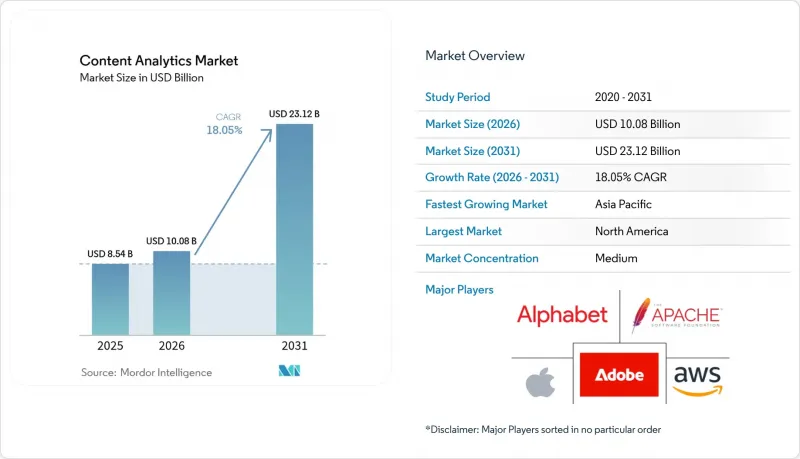
據 Mordor Intelligence 稱,2025 年內容分析市值為 85.4 億美元,預計到 2031 年將達到 231.2 億美元,而 2026 年為 100.8 億美元,預測期(2026-2031 年)的複合年成長率為 18.05%。
本報告按部署類型(本地部署、公共雲端、混合/多重雲端)、應用領域(文字分析、影片分析等)、最終用戶產業(銀行、金融服務和保險、醫療保健/生命科學等)、組織規模(大型企業、中小企業)、內容類型(文字、圖像、音訊等)和地區進行細分。市場預測以美元計價。
全球內容分析市場趨勢與洞察
企業非結構化資料的爆炸性成長
非結構化資訊已構成企業資料的重要組成部分,預計到2025年,175Zetta位元組的資料中將有80%產生於關係系統之外。例如,醫療機構已將數百萬張圖像和圖表數位化,以提取即時臨床訊息,同時降低實體儲存成本。資料量的成長迫使企業轉向「湖屋」架構,該架構將向量功能整合到熟悉的SQL引擎中。這使得知識工作者能夠在同一查詢中對文件、聊天記錄和醫學掃描影像提出語義問題。
基於雲端的分析平台的使用正在迅速增加。
公共雲端人工智慧服務使企業能夠按需租用變壓器級規模的模型,從而避免對專用硬體進行資本投資。亞馬遜雲端服務 (AWS) 公佈,2025 年第一季營收達 335 億美元,年增 17%,主要得益於分析工作負載的成長。隨著企業將工作負載分佈在多個供應商之間以最佳化延遲、成本和合規性,混合模型正逐漸成為主流。 Google BigQuery 和微軟知識挖掘管道透過提供向量搜尋API 並抽象化基礎設施,正在推動這一轉變。
缺乏具備數據素養的人員以及變革管理的挑戰。
目前,僅有37%的技術領導者重視生成式人工智慧。主要原因是企業難以將原型部署到大規模工作流程。根據聯準會的一項調查,企業人工智慧採用率在5%到40%之間,凸顯了資料工程、模型管治和特定領域提示設計的技能差距。如果沒有針對性的技能再培訓計劃,即使供應商提供了豐富的服務,分析價值的實現也存在停滯的風險。
細分市場分析
隨著企業尋求無縫存取變壓器級模型,預計到 2025 年,公共雲端服務將佔總收入的 55.60%。這一佔有率凸顯了雲端超大規模資料中心業者不斷提升的成本效益和彈性優勢。受託管特徵儲存、模型中心和企業級提示庫的推動,面向公共雲端工作負載的內容分析市場預計將快速成長。由於企業必須在對延遲敏感的用例和資料儲存位置的監管要求之間取得平衡,因此混合雲和多重雲端的採用率正以 20.7% 的複合年成長率成長。在嚴格監管的行業中,對於需要確定性吞吐量和自主控制的工作負載,本地部署設備仍然至關重要。
企業透過在邊緣部署向量索引,並將資源密集型嵌入生成流程卸載到雲端GPU,在不犧牲洞察力的前提下,日益實現合規性。供應商現在將可觀測性儀表板捆綁在一起,用於評估私有和公共端點管道的運作狀況,這一趨勢正在增強內容分析市場應對單一提供者故障的韌性。
預計到2025年,社群媒體監測將維持33.10%的市場佔有率,反映出品牌監聽套件和影響者追蹤模組的成熟度。同時,在客服中心自動化、即時轉錄和語音生物識別的推動下,語音和音訊分析預計將以19.9%的複合年成長率成長,成為所有追蹤領域中成長最快的細分市場。隨著語音助理在銀行、旅遊和醫療保健自助服務終端的普及,以語音為中心的工具的內容分析市場正在不斷擴張。高品質的自動語音辨識(ASR)技術可將資訊提供給多模態儀表板,其中語氣、情緒和意圖評分可用於指導客服人員並觸發升級工作流程。
儘管文字分析對於合約審查和合違規檢測仍然至關重要,但影片為中心的分析流程在詐欺預防和串流內容最佳化方面正展現出日益成長的價值。隨著社群媒體影片片段、客服中心文字記錄和用戶生成的圖像被整合到同一模型中,這種融合趨勢正在加速發展。因此,產業趨勢正從孤立的產品轉向整合式體驗引擎,從而推動內容分析市場的長期成長。
區域分析
預計到2025年,北美將佔據37.70%的收入佔有率。這主要得益於該地區早期對雲端運算的採用,從而培育了成熟的資料科學人才庫和廣泛的第三方市場生態系統。 AWS等領先供應商透過將先進的向量搜尋原語整合到無伺服器資料庫中,實現了兩位數的成長,提高了區域內新興企業的進入門檻。儘管技術買家受益於穩定的法規環境,但歐洲即將實施的ESG(環境、社會和治理)報告義務已經對數千家美國跨國公司產生影響,這些公司必須相應地調整其資訊揭露流程。該地區的支出結構涵蓋金融服務、醫療科技和D2C零售等領域,確保了內容分析市場多元化的成長動力。
亞太地區是成長最快的地區,預計到2031年將達到21.0%的年複合成長率(CAGR)。政府支持的基礎設施項目,例如香港的3000千兆次浮點運算級超級計算中心和印度13億美元的計算戰略,正在確保多模態和大規模語言模型工作負載所需的GPU密度。微信、LINE和抖音等社群媒體平台的普及提供了豐富的本地語言數據,加速了模型的微調週期。區域雲端服務供應商競相提供自主人工智慧區域以符合在地化法規,此舉可望維持國內價值鏈的高業務收益。
儘管隱私法規較為分散,但歐洲在人工智慧領域正穩步取得進展。雖然75%的專家認為監管是人工智慧普及的最大障礙,但該地區在隱私保護分析(包括聯邦學習)方面處於主導。汽車、工業和能源產業正與學術研究機構合作,將運行在嵌入式硬體上的輕量級多模態模型商業化,從而增強製造業的競爭力。私人投資仍然落後於北美和中國,這引發了關於戰略性人工智慧自主性的積極政策討論。
中東和非洲的公共部門數位化和金融科技領域正迎來新的發展動能。由於本地GPU資源有限,邊緣加速器因其能夠最大限度減少資料外溢而備受關注。拉丁美洲也呈現類似的趨勢,零售支付創新企業和城市安全機構正在採用基於SaaS的語音分析技術。儘管這些地區的市場規模相對較小,但它們正在推動需求成長,實現供應商收入來源多元化,並降低全球內容分析市場地理集中度所帶來的風險。
其他好處:
- Excel格式的市場預測(ME)表
- 3個月的分析師支持
目錄
第1章:引言
- 研究假設和市場定義
- 調查範圍
第2章:調查方法
第3章執行摘要
第4章 市場狀況
- 市場概覽
- 市場促進因素
- 非結構化企業資料呈指數級成長
- 基於雲端的分析平台的使用正在迅速增加。
- 即時社群媒體監聽,了解品牌聲譽
- 向量搜尋和語義嵌入提供了更深入的見解。
- GenAI工作流程中的多模態(文字、圖像、影片)分析
- 受監管產業面臨電子發現合規壓力
- 市場限制因素
- 數據素養人才短缺與變革管理的挑戰
- 加強有關資料隱私/資料主權的法規
- 大規模人工智慧管道的能源消耗和碳足跡
- 內容格式片段化和缺乏標準化
- 產業價值鏈分析
- 監理情勢
- 技術展望
- 產業吸引力—五力分析
- 新進入者的威脅
- 買方的議價能力
- 供應商的議價能力
- 替代品的威脅
- 競爭公司之間的競爭
- 宏觀經濟因素對市場的影響
第5章 市場規模與成長預測
- 依部署類型
- 現場
- 公共雲端
- 混合/多重雲端
- 透過使用
- 文字分析
- 影片分析
- 社群媒體分析
- 語音/音訊分析
- 網路和文件分析
- 按最終用戶行業分類
- BFSI
- 醫療保健和生命科學
- 零售和消費品
- 資訊科技/通訊
- 製造業
- 政府/公共部門
- 媒體與娛樂
- 其他終端用戶產業
- 按組織規模
- 大公司
- 中小企業
- 按內容類型
- 文字
- 影像
- 聲音的
- 影片
- 多模態/複合材料
- 按地區
- 北美洲
- 美國
- 加拿大
- 墨西哥
- 南美洲
- 巴西
- 阿根廷
- 智利
- 其他南美國家
- 歐洲
- 德國
- 英國
- 法國
- 義大利
- 西班牙
- 俄羅斯
- 其他歐洲國家
- 亞太地區
- 中國
- 印度
- 日本
- 韓國
- 新加坡
- 馬來西亞
- 澳洲
- 其他亞太國家
- 中東和非洲
- 中東
- 阿拉伯聯合大公國
- 沙烏地阿拉伯
- 土耳其
- 其他中東國家
- 非洲
- 南非
- 奈及利亞
- 其他非洲國家
- 中東
- 北美洲
第6章 競爭情勢
- 市場集中度
- 策略趨勢
- 市佔率分析
- 公司簡介
- Adobe Inc.
- Alphabet Inc.(Google Cloud)
- Amazon Web Services, Inc.
- Apache Software Foundation(OpenSearch)
- Apple Inc.(Apple Analytics)
- Bazaarvoice, Inc.
- Cision Ltd.(Brandwatch)
- Clarabridge, Inc.(a Qualtrics company)
- ContentSquare SAS
- Databricks, Inc.
- Hootsuite Inc.
- IBM Corporation
- Meltwater BV
- Microsoft Corporation
- NetBase Quid, Inc.
- NICE Ltd.
- OpenText Corporation
- Oracle Corporation
- Palantir Technologies Inc.
- SAS Institute Inc.
- Sprinklr, Inc.
- Talkwalker SA
- Teradata Corporation
- TIBCO Software Inc.
- Verint Systems Inc.
第7章 市場機會與未來趨勢
- 評估閒置頻段和未滿足的需求
According to Mordor Intelligence, the content analytics market size was valued at USD 8.54 billion in 2025 and estimated to grow from USD 10.08 billion in 2026 to reach USD 23.12 billion by 2031, at a CAGR of 18.05% during the forecast period (2026-2031).
This report is Segmented by Deployment Type (On-Premise, Public Cloud, and Hybrid/Multi-Cloud), Application (Text Analytics, Video Analytics, and More), End-User Industry (BFSI, Healthcare and Life Sciences, and More), Organisation Size (Large Enterprises and Small and Medium-Sized Enterprises), Content Type (Text, Image, Audio, and More), and Geography. The Market Forecasts are Provided in Terms of Value (USD).
Global Content Analytics Market Trends and Insights
Exponential Growth of Unstructured Enterprise Data
Unstructured information already represents the majority of corporate memory, with 80% of the 175 zettabytes expected in 2025 originating outside relational systems. Health-care providers, for example, digitized millions of images and charts to unlock real-time clinical insight while eliminating physical storage costs. These volumes are pushing enterprises toward lakehouse architectures that embed vector functions inside familiar SQL engines, allowing knowledge workers to ask semantic questions against documents, chat logs, and medical scans in the same query.
Surging Adoption of Cloud-Based Analytics Platforms
Public-cloud AI services let enterprises rent transformer-scale models on demand, avoiding capital expenditure on specialized hardware. Amazon Web Services recorded USD 33.5 billion in Q1 2025 sales, up 17% year on year, driven largely by analytics workloads. Hybrid patterns are now mainstream as firms split workloads across providers to optimize for latency, cost, and jurisdictional compliance. Google BigQuery and Microsoft Knowledge Mining pipelines are anchoring this shift by abstracting infrastructure while exposing vector search APIs.
Shortage of Data-Literate Workforce and Change Management Gaps
Only 37% of technology leaders judge generative AI as valuable today, largely because firms struggle to translate prototypes into scaled workflows. Federal Reserve research shows AI uptake ranging from 5% to 40% across companies, highlighting the skills dispersion in data engineering, model governance, and domain-specific prompt design. Without targeted reskilling programs, analytics value realisation risks stalling despite abundant vendor offerings.
Other drivers and restraints analyzed in the detailed report include:
- Real-Time Social Media Listening for Brand Reputation
- Vector Search and Semantic Embedding Unlock Deeper Insights
- Escalating Data-Privacy and Sovereignty Regulations
For complete list of drivers and restraints, kindly check the Table Of Contents.
Segment Analysis
Public-cloud services captured 55.60% revenue in 2025 as enterprises sought frictionless access to transformer-class models. This share underscores the cost-efficiency and elasticity advantages that cloud hyperscalers continue to refine. The content analytics market size for public-cloud workloads is projected to climb steeply on the back of managed feature stores, model hubs, and enterprise prompts libraries. Hybrid and multi-cloud deployments are on a 20.7% CAGR trajectory because firms must reconcile latency-sensitive use cases with data-residency statutes. In regulated sectors, on-premise appliances remain indispensable for workloads requiring deterministic throughput or sovereign control.
Enterprises increasingly position vector indexes at the edge while offloading heavy embedding generation to cloud GPUs, achieving policy compliance without sacrificing insight depth. Vendors now bundle observability dashboards that score pipeline health across private and public endpoints, a trend that strengthens the content analytics market's resilience to single-provider outages.
Social media monitoring retained a 33.10% share in 2025, reflecting mature adoption of brand-listening suites and influencer tracking modules. Yet contact-center automation, real-time transcription, and voice biometrics are pushing speech and audio analytics toward a 19.9% CAGR, the fastest among tracked segments. The content analytics market size for speech-centric tools is scaling as voice assistants proliferate across banking, travel, and healthcare kiosks. High-quality automatic speech recognition feeds multi-modal dashboards where tone, sentiment, and intent scores guide agent coaching or trigger escalation workflows.
Text analytics remains essential for contractual review and compliance flagging, while video-centric pipelines serve loss-prevention and streaming-content optimisation. Convergence is gaining speed as social-video clips, call-center transcriptions, and user-posted images are routed into the same model garden. The industry narrative, therefore, shifts away from siloed products toward cohesive experience engines, reinforcing long-term growth prospects for the content analytics market.
Complete Report Scope:
- By Deployment Type
- On-Premise
- Public Cloud
- Hybrid/Multi-Cloud
- By Application
- Text Analytics
- Video Analytics
- Social Media Analytics
- Speech/Audio Analytics
- Web and Document Analytics
- By End-user Industry
- BFSI
- Healthcare and Life Sciences
- Retail and Consumer Goods
- IT and Telecom
- Manufacturing
- Government and Public Sector
- Media and Entertainment
- Other End-user Industries
- By Organisation Size
- Large Enterprises
- Small and Medium-sized Enterprises (SMEs)
- By Content Type
- Text
- Image
- Audio
- Video
- Multimodal/Composite
- By Geography
- North America
- United States
- Canada
- Mexico
- South America
- Brazil
- Argentina
- Chile
- Rest of South America
- Europe
- Germany
- United Kingdom
- France
- Italy
- Spain
- Russia
- Rest of Europe
- Asia-Pacific
- China
- India
- Japan
- South Korea
- Singapore
- Malaysia
- Australia
- Rest of Asia-Pacific
- Middle East and Africa
- Middle East
- United Arab Emirates
- Saudi Arabia
- Turkey
- Rest of Middle East
- Africa
- South Africa
- Nigeria
- Rest of Africa
- Middle East
- North America
Geography Analysis
North America held 37.70% revenue share in 2025 because early cloud adoption produced mature data-science talent pools and extensive third-party marketplace ecosystems. Major providers like AWS drove double-digit percentage growth by bundling advanced vector search primitives into serverless databases, raising the entry barrier for regional challengers. Technology buyers benefit from a stable regulatory backdrop, although impending European ESG-reporting mandates already affect thousands of US multinationals that must align disclosure pipelines accordingly. The region's spend mix spans financial services, health-tech, and direct-to-consumer retail, ensuring diversified momentum for the content analytics market.
Asia-Pacific is the fastest-growing territory, expected to clock a 21.0% CAGR through 2031. Government-backed infrastructure projects, including Hong Kong's 3,000-petaflops supercomputing centre and India's USD 1.3 billion compute strategy, provision the GPU density required for multimodal and large-language model workloads. Social-media penetration across WeChat, LINE, and Douyin ensures abundant vernacular data that accelerates fine-tuning cycles. Regional cloud providers are racing to deliver sovereign AI zones to meet localisation rules, a move likely to preserve high services revenue inside domestic value chains.
Europe advances steadily despite fragmented privacy regimes. Seventy-five percent of professionals cite regulation as their biggest AI hurdle, yet the region leads in privacy-preserving analytics such as federated learning. Automotive, industrial, and energy sectors align with academic labs to commercialise lightweight multimodal models that run on embedded hardware, reinforcing manufacturing competitiveness. Private investment still trails North American and Chinese levels, motivating policy debate on strategic AI autonomy.
Middle East and Africa show emerging momentum in public-sector digitalisation and fintech. Limited local GPU availability has spurred interest in edge accelerators that minimise data egress. Latin America mirrors this trend, with retail payment disruptors and urban-safety agencies embracing SaaS voice analytics. Although smaller in absolute terms, these regions contribute incremental demand that diversifies vendor revenue streams and mitigates geographic concentration risk in the global content analytics market.
- Adobe Inc.
- Alphabet Inc. (Google Cloud)
- Amazon Web Services, Inc.
- Apache Software Foundation (OpenSearch)
- Apple Inc. (Apple Analytics)
- Bazaarvoice, Inc.
- Cision Ltd. (Brandwatch)
- Clarabridge, Inc. (a Qualtrics company)
- ContentSquare S.A.S.
- Databricks, Inc.
- Hootsuite Inc.
- IBM Corporation
- Meltwater B.V.
- Microsoft Corporation
- NetBase Quid, Inc.
- NICE Ltd.
- OpenText Corporation
- Oracle Corporation
- Palantir Technologies Inc.
- SAS Institute Inc.
- Sprinklr, Inc.
- Talkwalker S.A.
- Teradata Corporation
- TIBCO Software Inc.
- Verint Systems Inc.
Additional Benefits:
- The market estimate (ME) sheet in Excel format
- 3 months of analyst support
TABLE OF CONTENTS
1 INTRODUCTION
- 1.1 Study Assumptions and Market Definition
- 1.2 Scope of the Study
2 RESEARCH METHODOLOGY
3 EXECUTIVE SUMMARY
4 MARKET LANDSCAPE
- 4.1 Market Overview
- 4.2 Market Drivers
- 4.2.1 Exponential growth of unstructured enterprise data
- 4.2.2 Surging adoption of cloud-based analytics platforms
- 4.2.3 Real-time social media listening for brand reputation
- 4.2.4 Vector search and semantic embedding unlock deeper insights
- 4.2.5 Multimodal (text-image-video) analytics in GenAI workflows
- 4.2.6 e-Discovery compliance pressures in regulated industries
- 4.3 Market Restraints
- 4.3.1 Shortage of data-literate workforce and change management gaps
- 4.3.2 Escalating data-privacy/sovereignty regulations
- 4.3.3 High energy and carbon footprint of large-scale AI pipelines
- 4.3.4 Fragmentation of content formats and lack of standardisation
- 4.4 Industry Value Chain Analysis
- 4.5 Regulatory Landscape
- 4.6 Technological Outlook
- 4.7 Industry Attractiveness - Porter's Five Forces Analysis
- 4.7.1 Threat of New Entrants
- 4.7.2 Bargaining Power of Buyers
- 4.7.3 Bargaining Power of Suppliers
- 4.7.4 Threat of Substitutes
- 4.7.5 Intensity of Competitive Rivalry
- 4.8 Impact of Macroeconomic Factors on the Market
5 MARKET SIZE AND GROWTH FORECASTS (VALUES)
- 5.1 By Deployment Type
- 5.1.1 On-Premise
- 5.1.2 Public Cloud
- 5.1.3 Hybrid/Multi-Cloud
- 5.2 By Application
- 5.2.1 Text Analytics
- 5.2.2 Video Analytics
- 5.2.3 Social Media Analytics
- 5.2.4 Speech/Audio Analytics
- 5.2.5 Web and Document Analytics
- 5.3 By End-user Industry
- 5.3.1 BFSI
- 5.3.2 Healthcare and Life Sciences
- 5.3.3 Retail and Consumer Goods
- 5.3.4 IT and Telecom
- 5.3.5 Manufacturing
- 5.3.6 Government and Public Sector
- 5.3.7 Media and Entertainment
- 5.3.8 Other End-user Industries
- 5.4 By Organisation Size
- 5.4.1 Large Enterprises
- 5.4.2 Small and Medium-sized Enterprises (SMEs)
- 5.5 By Content Type
- 5.5.1 Text
- 5.5.2 Image
- 5.5.3 Audio
- 5.5.4 Video
- 5.5.5 Multimodal/Composite
- 5.6 By Geography
- 5.6.1 North America
- 5.6.1.1 United States
- 5.6.1.2 Canada
- 5.6.1.3 Mexico
- 5.6.2 South America
- 5.6.2.1 Brazil
- 5.6.2.2 Argentina
- 5.6.2.3 Chile
- 5.6.2.4 Rest of South America
- 5.6.3 Europe
- 5.6.3.1 Germany
- 5.6.3.2 United Kingdom
- 5.6.3.3 France
- 5.6.3.4 Italy
- 5.6.3.5 Spain
- 5.6.3.6 Russia
- 5.6.3.7 Rest of Europe
- 5.6.4 Asia-Pacific
- 5.6.4.1 China
- 5.6.4.2 India
- 5.6.4.3 Japan
- 5.6.4.4 South Korea
- 5.6.4.5 Singapore
- 5.6.4.6 Malaysia
- 5.6.4.7 Australia
- 5.6.4.8 Rest of Asia-Pacific
- 5.6.5 Middle East and Africa
- 5.6.5.1 Middle East
- 5.6.5.1.1 United Arab Emirates
- 5.6.5.1.2 Saudi Arabia
- 5.6.5.1.3 Turkey
- 5.6.5.1.4 Rest of Middle East
- 5.6.5.2 Africa
- 5.6.5.2.1 South Africa
- 5.6.5.2.2 Nigeria
- 5.6.5.2.3 Rest of Africa
- 5.6.5.1 Middle East
- 5.6.1 North America
6 COMPETITIVE LANDSCAPE
- 6.1 Market Concentration
- 6.2 Strategic Moves
- 6.3 Market Share Analysis
- 6.4 Company Profiles (includes Global level Overview, Market level overview, Core Segments, Financials as available, Strategic Information, Market Rank/Share for key companies, Products and Services, and Recent Developments)
- 6.4.1 Adobe Inc.
- 6.4.2 Alphabet Inc. (Google Cloud)
- 6.4.3 Amazon Web Services, Inc.
- 6.4.4 Apache Software Foundation (OpenSearch)
- 6.4.5 Apple Inc. (Apple Analytics)
- 6.4.6 Bazaarvoice, Inc.
- 6.4.7 Cision Ltd. (Brandwatch)
- 6.4.8 Clarabridge, Inc. (a Qualtrics company)
- 6.4.9 ContentSquare S.A.S.
- 6.4.10 Databricks, Inc.
- 6.4.11 Hootsuite Inc.
- 6.4.12 IBM Corporation
- 6.4.13 Meltwater B.V.
- 6.4.14 Microsoft Corporation
- 6.4.15 NetBase Quid, Inc.
- 6.4.16 NICE Ltd.
- 6.4.17 OpenText Corporation
- 6.4.18 Oracle Corporation
- 6.4.19 Palantir Technologies Inc.
- 6.4.20 SAS Institute Inc.
- 6.4.21 Sprinklr, Inc.
- 6.4.22 Talkwalker S.A.
- 6.4.23 Teradata Corporation
- 6.4.24 TIBCO Software Inc.
- 6.4.25 Verint Systems Inc.
7 MARKET OPPORTUNITIES AND FUTURE TRENDS
- 7.1 White-Space and Unmet-Need Assessment


