


 |
市場調查報告書
商品編碼
2123464
簡訊防火牆:市場佔有率分析、產業趨勢與統計、成長預測(2026-2031)SMS Firewall - Market Share Analysis, Industry Trends & Statistics, Growth Forecasts (2026 - 2031) |
||||||

※ 本網頁內容可能與最新版本有所差異。詳細情況請與我們聯繫。
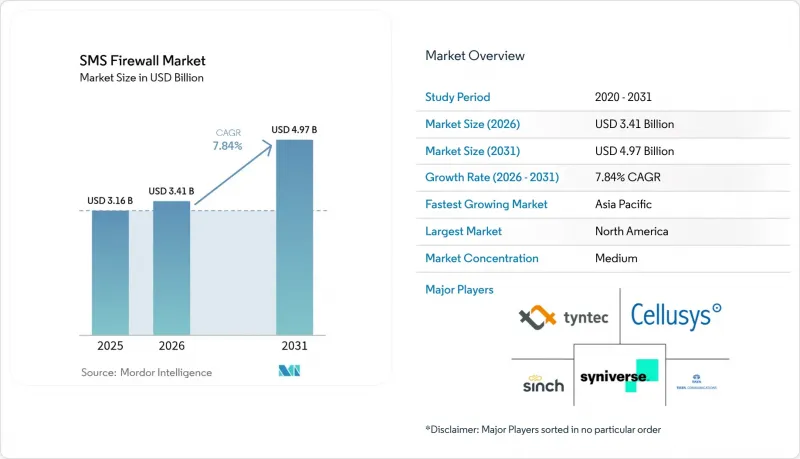
根據 Mordor Intelligence 預測,簡訊防火牆市場規模將從 2025 年的 31.6 億美元成長到 2026 年的 34.1 億美元,然後在 2031 年達到 49.7 億美元,2026 年至 2031 年的複合年成長率為 7.84%。
本報告按簡訊類型(A2P、P2A、P2P)、部署模式(本地部署和雲端部署)、服務類型(專業服務和託管服務)、最終用戶行業(銀行、金融服務和保險 (BFSI)、政府和公共安全部門、其他)、網站世代(2G/3G、4G/LTE、5G)以及地區進行細分。市場預測以美元 (USD) 為單位。
全球簡訊防火牆市場趨勢與洞察
A2P流量貨幣化的激增
電信業者正面臨語音收入下滑的困境,而經過認證的A2P通訊是恢復收入的關鍵。在印度,分散式帳本框架已幫助Airtel用戶減少了40%的流量外流和98%的垃圾資訊。巴西和奈及利亞類似的獲利模式也依賴先進的流量分析技術來區分合法的企業聲明和灰色路由流量。這種模式還允許營運商轉售具有內建安全功能的優質發送服務。雖然盈利豐厚,但實施起來需要基於機器學習的偵測工具,而小規模營運商的傳統基礎設施無法運作這些工具。
行動詐騙和灰色路由造成的損失日益加劇
SIM卡盒詐騙每年造成31.1億美元的損失,佔電信詐騙總額的7.8%。人為誇大的流量和網路釣魚宣傳活動如今將語音、簡訊和社交應用程式結合起來,給監管機構帶來了越來越大的壓力,迫使其採取行動。印度一個基於人工智慧的反欺騙平台在三個月內將詐騙電話減少了90%。鑑於此類成功案例,其他監管機構現在要求將簡訊防火牆功能整合到更廣泛的反詐騙系統中,從而擴大了簡訊防火牆市場。
三、四級行動通訊業者(MNO)的技術意識程度較低
成千上萬的小規模企業正苦於應對分散式帳本技術(DLT)註冊和規則最佳化,印度有27,000家企業尋求合規支援便是最好的證明。機器學習規則的不斷調整和即時威脅情報的整合迫使這些企業遷移到託管服務,但預算限制阻礙了它們的普及。
細分市場分析
受金融、醫療保健和公共服務等行業強制性身份驗證規則的推動,預計到2025年,A2P通訊將佔據短信防火牆市場64.72%的佔有率。隨著企業加大對可靠送達和垃圾郵件防護的投入,簡訊防火牆市場中的A2P細分市場預計將以7.79%的複合年成長率成長。企業也在投資安全的P2P警報,這推動了P2P企業級應用以9.74%的複合年成長率擴張。 Jack Henry Inc.目前每月透過Twilio發送1200萬至1500萬條安全警報,並計劃將這一數字提高50倍。
儘管A2P的成長加速了防火牆升級以過濾灰色路由,但P2A用例(例如客戶諮詢)仍依賴身分驗證來保護企業免受欺騙攻擊。雖然RCS等競爭管道正在減緩P2A的成長勢頭,但受監管的行業仍依賴簡訊來確保覆蓋範圍。動態密碼和服務通知數量的不斷成長,使得安全的A2P流量始終是營運商收入策略的核心,從而鞏固了簡訊防火牆市場。
預計到2025年,本地部署仍將維持52.71%的收入佔有率,因為一級營運商優先考慮本地資料管理。儘管如此,雲端部署方案預計將實現12.62%的複合年成長率,反映出中小型電信業者的強勁需求。隨著允許跨境處理的區域監管機構鼓勵威脅情報共用,雲端部署中的簡訊防火牆市場預計將快速擴張。
在存在資料本地化法律的地區,混合架構正變得越來越流行,它允許營運商在國內儲存訊息內容,同時在雲端分析元資料。位於營運商機房內的邊緣節點可提供近乎即時的分析,而無需將敏感資料傳輸到機房外。這種柔軟性正在推動進一步的投資,並確保簡訊防火牆市場在傳統和新興部署模式下持續成長。
區域分析
預計到2025年,北美將繼續保持領先地位,佔據37.25%的收入佔有率,這得益於嚴格的隱私法規、早期5G部署以及將防火牆整合到企業通訊堆疊中的大規模CPaaS生態系統。與加拿大和墨西哥的跨境通訊往來預計將推動新的審計追蹤需求,進一步提升營運商在2025年的支出。聯邦政府對語音自動電話和簡訊詐騙的關注也進一步增加了需求,鞏固了北美在簡訊防火牆市場的主導地位。
亞太地區是成長最快的地區,預計到2031年複合年成長率將達到12.07%。印度的分散式帳本技術(DLT)框架強制要求訊息端到端可追溯,為全部區域樹立了典範。同時,中國大力部署5G切片技術,加速了下一代防火牆的普及。東南亞電信業者也積極進行垃圾簡訊攔截工作,並取得了與印度類似的成效。這些舉措共同推動了簡訊防火牆市場的發展。
在歐洲,需要在遵守《一般資料保護規則》(GDPR) 和歐盟範圍內的跨境流量法規之間取得平衡,後者要求進行精細化的同意記錄。資料主權條款迫使電信業者在國內進行資料過濾,但威脅情報共用正在推動低風險類別採用雲端技術。在中東和非洲,雲端原生防火牆正被採用以降低行動優先經濟體的資本支出 (CAPEX),但小規模行動網路營運商 (MNO) 的認知度較低,減緩了其普及速度。在南美洲,與印度類似,KYC(了解你的客戶)是即時訊息的強制性要求,這增加了對低成本、受監管解決方案的需求。
其他好處:
- Excel格式的市場預測(ME)表
- 3個月的分析師支持
目錄
第1章:引言
- 研究假設和市場定義
- 調查範圍
第2章:調查方法
第3章執行摘要
第4章 市場狀況
- 市場概覽
- 市場促進因素
- A2P流量貨幣化的激增
- 行動詐騙和灰色路由損失日益嚴重
- SS7 到 Diameter 防火牆升級週期
- 基於國內數據主權條款的國內強制過濾
- 電信公司正專注於用戶的體驗品質 (QoE) 和品牌信任度。
- 5G切片技術正在創造新的攻擊面。
- 市場限制因素
- 三、四線行動通訊業者。
- CPaaS產業重組帶來的價格壓力
- RCS技術的延遲引入使得資本投資的時間變得不確定。
- 關於跨境訊息檢查的監管模糊之處
- 產業價值鏈分析
- 監理情勢
- 技術展望
- 產業吸引力—五力分析
- 新進入者的威脅
- 買方的議價能力
- 供應商的議價能力
- 替代品的威脅
- 競爭公司之間的競爭
- 宏觀經濟因素對市場的影響
第5章 市場規模與成長預測
- 按簡訊類型
- A2P
- P2A
- P2P(企業閃信/警報)
- 部署模式
- 現場
- 雲
- 按服務類型
- 專業服務(諮詢、整合)
- 託管服務(全天候監控、安全營運中心)
- 按最終用戶行業分類
- BFSI
- 政府/公共安全
- 資訊科技/通訊
- 醫療保健和生命科學
- 零售與電子商務
- 媒體與娛樂
- 教育
- 製造業
- 其他終端用戶產業
- 透過網路生成
- 2G/3G
- 4G/LTE
- 5G
- 按地區
- 北美洲
- 美國
- 加拿大
- 墨西哥
- 南美洲
- 巴西
- 阿根廷
- 智利
- 其他南美國家
- 歐洲
- 德國
- 英國
- 法國
- 義大利
- 西班牙
- 俄羅斯
- 其他歐洲國家
- 亞太地區
- 中國
- 印度
- 日本
- 韓國
- 馬來西亞
- 新加坡
- 澳洲
- 其他亞太國家
- 中東和非洲
- 中東
- 阿拉伯聯合大公國
- 沙烏地阿拉伯
- 土耳其
- 其他中東國家
- 非洲
- 南非
- 奈及利亞
- 其他非洲國家
- 中東
- 北美洲
第6章 競爭情勢
- 市場集中度
- 策略趨勢
- 市佔率分析
- 公司簡介
- Cellusys Telecommunications
- Tyntec GmbH
- Tata Communications Ltd.
- Syniverse Technologies LLC
- Sinch AB
- Omobio(Pvt)Ltd.
- Route Mobile Ltd.
- AMD Telecom SA
- BICS SA/NV
- SAP SE
- Monty Mobile
- NewNet Communication Technologies
- Mahindra Comviva
- Infobip Ltd.
- Twilio Inc.
- Anam Technologies
- Mobileum Inc.
- Mavenir Systems Inc.
- Proofpoint Inc.
- AdaptiveMobile Security(Enea)
- NetNumber Global Data Services
- Openmind Networks
- HORISEN AG
- Sparkle(Telecom Italia)
- Orange Wholesale International
- VOX Solutions
- Global Message Services AG
第7章 市場機會與未來趨勢
- 評估閒置頻段和未滿足的需求
According to Mordor Intelligence, the SMS firewall market size is expected to grow from USD 3.16 billion in 2025 to USD 3.41 billion in 2026 and is forecast to reach USD 4.97 billion by 2031 at 7.84% CAGR over 2026-2031.
This report is Segmented by SMS Type (A2P, P2A, and P2P), Deployment Mode (On-Premise and Cloud), Service Type (Professional Services and Managed Services), End-User Industry (BFSI, Government and Public Safety, and More), Network Generation (2G/3G, 4G/LTE, and 5G), and Geography. The Market Forecasts are Provided in Terms of Value (USD).
Global SMS Firewall Market Trends and Insights
Surge in A2P Traffic Monetisation
Operators face declining voice income, so authenticated A2P messaging has become pivotal for revenue recovery. India's distributed ledger framework showed a 40% cut in leakage and a 98% spam drop for Airtel customers. Similar monetisation programs in Brazil and Nigeria rely on advanced traffic analytics that separate legitimate enterprise messages from grey routes. The model also lets carriers resell premium delivery services with embedded security. Although profitable, rollout demands machine-learning inspection tools that smaller carriers cannot host on legacy infrastructure.
Intensifying Mobile Fraud and Grey-Route Losses
SIM-box fraud causes USD 3.11 billion in yearly losses and represents 7.8% of total telecom fraud. Artificially inflated traffic and phishing campaigns now combine voice, SMS, and social apps, pressuring regulators to act. India's AI-based anti-spoofing platform cut fraudulent calls by 90% in three months. Such successes push other regulators to demand integrated SMS firewall capability within wider fraud-prevention stacks, expanding the SMS firewall market.
Low Technical Awareness Among Tier-3/4 MNOs
Thousands of smaller operators grapple with DLT registration and rule optimization, as seen when 27,000 entities in India sought compliance assistance. Continuous tuning of machine-learning rules and integration of live threat feeds push these operators toward managed services, yet budget limits slow adoption.
Other drivers and restraints analyzed in the detailed report include:
- SS7 to Diameter Firewall Upgrade Cycle
- 5G Slicing Opening New Attack Surfaces
- Pricing Pressure from CPaaS Consolidations
For complete list of drivers and restraints, kindly check the Table Of Contents.
Segment Analysis
A2P messaging held 64.72% of the SMS firewall market share in 2025, underpinned by mandatory authentication rules across finance, healthcare, and public services. The SMS firewall market size for A2P segments is set to expand at a 7.79% CAGR as enterprises pay for guaranteed delivery and spam control. Enterprises also invest in secure P2P alerts, pushing the P2P enterprise category to a 9.74% CAGR. Jack Henry already moves 12-15 million secured alerts each month through Twilio and plans a fifty-fold volume growth.
A2P growth accelerates firewall upgrades that filter grey routes, while P2A use cases such as inbound customer queries hinge on authentication that shields enterprises from impersonation attacks. Competing channels like RCS slow P2A momentum, yet regulated sectors still rely on SMS for universal reach. The rising volume of one-time passwords and service notifications keeps security-rich A2P traffic central to operator revenue strategies, fortifying the SMS firewall market.
On-premise deployments retained 52.71% revenue share in 2025 because tier-1 carriers favor local data control. Even so, cloud options are projected to record a 12.62% CAGR, reflecting strong demand from smaller operators. The SMS firewall market size for cloud deployments is forecast to rise sharply as regulators in regions that allow cross-border processing endorse shared-threat feeds.
Hybrid architectures gain traction where data localization laws exist, letting operators analyze metadata in the cloud while storing message content on shore. Edge nodes positioned inside carrier facilities provide near-real-time analytics without moving sensitive data off-site. This flexibility spurs additional investment, ensuring that the SMS firewall market continues to grow in both traditional and emerging deployment models.
Complete Report Scope:
- By SMS Type
- A2P
- P2A
- P2P (Enterprise Flash/Alert)
- By Deployment Mode
- On-Premise
- Cloud
- By Service Type
- Professional Services (Consulting, Integration)
- Managed Services (24X7 Monitoring, SOC)
- By End-user Industry
- BFSI
- Government and Public Safety
- IT and Telecom
- Healthcare and Life Sciences
- Retail and E-Commerce
- Media and Entertainment
- Education
- Manufacturing
- Other End-user Industries
- By Network Generation
- 2G / 3G
- 4G / LTE
- 5G
- By Geography
- North America
- United States
- Canada
- Mexico
- South America
- Brazil
- Argentina
- Chile
- Rest of South America
- Europe
- Germany
- United Kingdom
- France
- Italy
- Spain
- Russia
- Rest of Europe
- Asia-Pacific
- China
- India
- Japan
- South Korea
- Malaysia
- Singapore
- Australia
- Rest of Asia-Pacific
- Middle East and Africa
- Middle East
- United Arab Emirates
- Saudi Arabia
- Turkey
- Rest of Middle East
- Africa
- South Africa
- Nigeria
- Rest of Africa
- Middle East
- North America
Geography Analysis
North America led with a 37.25% revenue share in 2025, thanks to stringent privacy rules, early 5G adoption, and large CPaaS ecosystems that embed firewalls into enterprise communication stacks. Carrier spending stays strong in 2025 as cross-border messaging with Canada and Mexico triggers new audit trail mandates. Federal attention on robocalls and smishing scams further boosts demand, anchoring North American leadership within the SMS firewall market.
Asia-Pacific is the fastest-growing region at a 12.07% CAGR to 2031. India's DLT framework enforces end-to-end message traceability and functions as a regional blueprint, while China's aggressive 5G slicing deployment accelerates next-generation firewall uptake. Southeast Asian operators follow with spam-reduction drives that mirror India's performance gains, collectively enlarging the SMS firewall market.
Europe balances GDPR compliance with pan-EU cross-border traffic rules that require granular consent logs. Data-sovereignty clauses push operators toward on-shore filtering, yet shared threat feeds encourage cloud adoption in low-risk categories. In the Middle East and Africa, mobile-first economies adopt cloud-native firewalls to reduce capital expenses, though awareness gaps among smaller MNOs slow penetration. South America mirrors India by mandating KYC verification on messages, fueling demand for low-cost, regulation-ready solutions.
- Cellusys Telecommunications
- Tyntec GmbH
- Tata Communications Ltd.
- Syniverse Technologies LLC
- Sinch AB
- Omobio (Pvt) Ltd.
- Route Mobile Ltd.
- AMD Telecom S.A.
- BICS SA/NV
- SAP SE
- Monty Mobile
- NewNet Communication Technologies
- Mahindra Comviva
- Infobip Ltd.
- Twilio Inc.
- Anam Technologies
- Mobileum Inc.
- Mavenir Systems Inc.
- Proofpoint Inc.
- AdaptiveMobile Security (Enea)
- NetNumber Global Data Services
- Openmind Networks
- HORISEN AG
- Sparkle (Telecom Italia)
- Orange Wholesale International
- VOX Solutions
- Global Message Services AG
Additional Benefits:
- The market estimate (ME) sheet in Excel format
- 3 months of analyst support
TABLE OF CONTENTS
1 INTRODUCTION
- 1.1 Study Assumptions and Market Definition
- 1.2 Scope of the Study
2 RESEARCH METHODOLOGY
3 EXECUTIVE SUMMARY
4 MARKET LANDSCAPE
- 4.1 Market Overview
- 4.2 Market Drivers
- 4.2.1 Surge in A2P traffic monetisation
- 4.2.2 Intensifying mobile fraud and grey-route losses
- 4.2.3 SS7 -> Diameter firewall upgrade cycle
- 4.2.4 National data-sovereignty clauses forcing on-shore filtering
- 4.2.5 Operator focus on subscriber QoE and brand trust
- 4.2.6 5G slicing opening new attack surfaces
- 4.3 Market Restraints
- 4.3.1 Low technical awareness among Tier-3/4 MNOs
- 4.3.2 Pricing pressure from CPaaS consolidations
- 4.3.3 Delayed RCS roll-outs blurring capex timing
- 4.3.4 Regulatory ambiguity on cross-border message inspection
- 4.4 Industry Value Chain Analysis
- 4.5 Regulatory Landscape
- 4.6 Technological Outlook
- 4.7 Industry Attractiveness - Porter's Five Forces Analysis
- 4.7.1 Threat of New Entrants
- 4.7.2 Bargaining Power of Buyers
- 4.7.3 Bargaining Power of Suppliers
- 4.7.4 Threat of Substitutes
- 4.7.5 Intensity of Competitive Rivalry
- 4.8 Impact of Macroeconomic Factors on the Market
5 MARKET SIZE AND GROWTH FORECASTS (VALUES)
- 5.1 By SMS Type
- 5.1.1 A2P
- 5.1.2 P2A
- 5.1.3 P2P (Enterprise Flash/Alert)
- 5.2 By Deployment Mode
- 5.2.1 On-Premise
- 5.2.2 Cloud
- 5.3 By Service Type
- 5.3.1 Professional Services (Consulting, Integration)
- 5.3.2 Managed Services (24X7 Monitoring, SOC)
- 5.4 By End-user Industry
- 5.4.1 BFSI
- 5.4.2 Government and Public Safety
- 5.4.3 IT and Telecom
- 5.4.4 Healthcare and Life Sciences
- 5.4.5 Retail and E-Commerce
- 5.4.6 Media and Entertainment
- 5.4.7 Education
- 5.4.8 Manufacturing
- 5.4.9 Other End-user Industries
- 5.5 By Network Generation
- 5.5.1 2G / 3G
- 5.5.2 4G / LTE
- 5.5.3 5G
- 5.6 By Geography
- 5.6.1 North America
- 5.6.1.1 United States
- 5.6.1.2 Canada
- 5.6.1.3 Mexico
- 5.6.2 South America
- 5.6.2.1 Brazil
- 5.6.2.2 Argentina
- 5.6.2.3 Chile
- 5.6.2.4 Rest of South America
- 5.6.3 Europe
- 5.6.3.1 Germany
- 5.6.3.2 United Kingdom
- 5.6.3.3 France
- 5.6.3.4 Italy
- 5.6.3.5 Spain
- 5.6.3.6 Russia
- 5.6.3.7 Rest of Europe
- 5.6.4 Asia-Pacific
- 5.6.4.1 China
- 5.6.4.2 India
- 5.6.4.3 Japan
- 5.6.4.4 South Korea
- 5.6.4.5 Malaysia
- 5.6.4.6 Singapore
- 5.6.4.7 Australia
- 5.6.4.8 Rest of Asia-Pacific
- 5.6.5 Middle East and Africa
- 5.6.5.1 Middle East
- 5.6.5.1.1 United Arab Emirates
- 5.6.5.1.2 Saudi Arabia
- 5.6.5.1.3 Turkey
- 5.6.5.1.4 Rest of Middle East
- 5.6.5.2 Africa
- 5.6.5.2.1 South Africa
- 5.6.5.2.2 Nigeria
- 5.6.5.2.3 Rest of Africa
- 5.6.5.1 Middle East
- 5.6.1 North America
6 COMPETITIVE LANDSCAPE
- 6.1 Market Concentration
- 6.2 Strategic Moves
- 6.3 Market Share Analysis
- 6.4 Company Profiles (includes Global level Overview, Market level overview, Core Segments, Financials as available, Strategic Information, Market Rank/Share for key companies, Products and Services, and Recent Developments)
- 6.4.1 Cellusys Telecommunications
- 6.4.2 Tyntec GmbH
- 6.4.3 Tata Communications Ltd.
- 6.4.4 Syniverse Technologies LLC
- 6.4.5 Sinch AB
- 6.4.6 Omobio (Pvt) Ltd.
- 6.4.7 Route Mobile Ltd.
- 6.4.8 AMD Telecom S.A.
- 6.4.9 BICS SA/NV
- 6.4.10 SAP SE
- 6.4.11 Monty Mobile
- 6.4.12 NewNet Communication Technologies
- 6.4.13 Mahindra Comviva
- 6.4.14 Infobip Ltd.
- 6.4.15 Twilio Inc.
- 6.4.16 Anam Technologies
- 6.4.17 Mobileum Inc.
- 6.4.18 Mavenir Systems Inc.
- 6.4.19 Proofpoint Inc.
- 6.4.20 AdaptiveMobile Security (Enea)
- 6.4.21 NetNumber Global Data Services
- 6.4.22 Openmind Networks
- 6.4.23 HORISEN AG
- 6.4.24 Sparkle (Telecom Italia)
- 6.4.25 Orange Wholesale International
- 6.4.26 VOX Solutions
- 6.4.27 Global Message Services AG
7 MARKET OPPORTUNITIES AND FUTURE TRENDS
- 7.1 White-Space and Unmet-Need Assessment


