


 |
市場調查報告書
商品編碼
2123459
調色板:市場佔有率分析、行業趨勢和統計數據、成長預測(2026-2031 年)Pallets - Market Share Analysis, Industry Trends & Statistics, Growth Forecasts (2026 - 2031) |
||||||

※ 本網頁內容可能與最新版本有所差異。詳細情況請與我們聯繫。
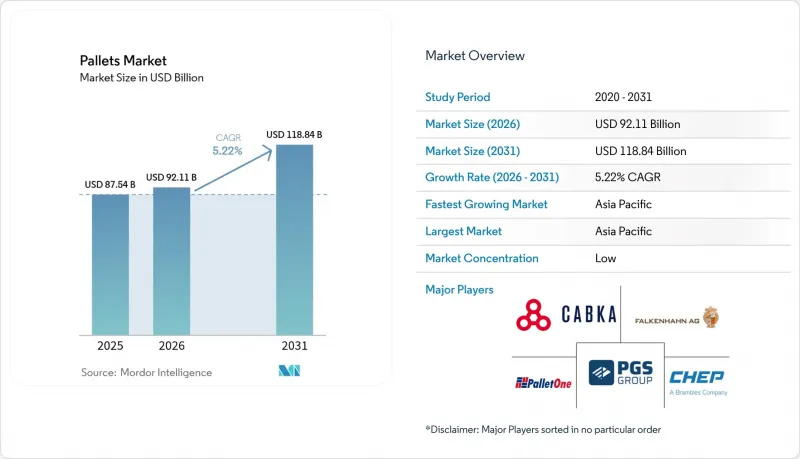
據 Mordor Intelligence 稱,托盤市場預計到 2026 年價值 921.1 億美元,高於 2025 年的 875.4 億美元,預計到 2031 年將達到 1,188.4 億美元。
預計 2026 年至 2031 年的複合年成長率為 5.22%。
本報告按材質(木材、塑膠等)、設計(塊狀、縱樑式、客製化)、托盤類型(嵌套式、貨架相容型、堆疊式、其他類型)、承載能力(輕型等)、終端用戶行業(食品飲料、化學、醫藥保健、零售電商等)和地區進行細分。市場預測以美元計價。
全球托盤市場趨勢與洞察
電子商務履約中心正在推動模組化托盤的普及。
在高速全通路倉庫中,堆疊配置已標準化,以確保四向通行和結構完整性。偏離標準堆疊規格可能導致每個倉庫5萬至20萬美元的調整成本,迫使營運商使用尺寸統一的堆疊單元。據報道,混合堆疊設計可使處理能力提升高達30%,並提高機器人碼垛效率,這進一步支持了採用堆疊設計的必要性。
ISPM-15托盤法規的推進正在提高亞太地區的托盤池利用率。
ISPM-15框架目前已覆蓋182個國家,每年約4500萬美元的罰款迫使托運人使用經認證的托盤共享網路,以確保托盤經過熱處理。亞太地區的托盤共享利用率預計從2024年起將成長23%,這主要得益於數位化溯源設備的普及,這些設備可以將合規資料與每個托盤關聯起來。
美國和加拿大關稅導致木材價格波動
對加拿大針葉木材徵收14.54%的關稅導致木材投入成本季度波動高達40%,迫使製造商對沖採購風險,並擠壓利潤空間。在此背景下,對玉米秸稈和葉片等替代纖維的投資正在增加,這些纖維目前正處於試點生產階段。
細分市場分析
預計到2025年,木托盤將維持68.83%的市場佔有率,其價格優勢為每托盤8至12美元。然而,由於關稅、ISPM-15標準下的熱處理成本以及客戶的脫碳目標等因素導致成本上升,這一優勢正在逐漸減弱。 Brambles公司透過採購78%的認證木材,並承諾每砍伐一棵樹就種植兩棵樹,來確保資源的永續性,但使用者仍需要更輕、更易回收的替代方案。
隨著衛生和可重複使用性要求的提高,預計到2031年,塑膠托盤的年複合成長率將達到7.02%。塑膠托盤的普及速度正在加快,尤其是在製藥和食品行業,這些行業對接觸材料的監管非常嚴格,而塑膠托盤的整體擁有成本(TCO)可以抵消其較高的採購價格。由稻殼、玉米秸稈和葉子製成的生物複合材料可在兩個月內生物分解,既符合監管要求,也符合企業碳排放目標。這些特性在亞太地區越來越受歡迎,因為該地區農業廢棄物豐富,且已實施減少廢棄物的政策。
塊狀托盤可以從四個方向訪問,並且與機器人相容,預計到 2025 年將佔托盤市場的 54.78%。自動化履約設施報告稱,與桁架式托盤相比,塊狀托盤的處理速度提高了 15-20%。
客製化托盤的複合年成長率 (CAGR) 為 7.28%,主要受營運商對 RFID 插件、感測器插槽以及針對特定輸送機係數量身定做的托盤表面的需求不斷成長的推動。採用木質托盤和塑膠滑軌的混合結構兼顧了摩擦最佳化和成本控制,從而支持食品和服裝物流行業日益成長的自動化需求。
區域分析
預計亞太地區將成為市場的主要驅動力,到2025年將佔據托盤市場44.66%的佔有率,複合年成長率(CAGR)為6.23%。中國和印度製造地的集中,以及東南亞電子商務的快速發展,持續推動托盤出貨量的成長。 Rothcam的托盤池擴張清楚地表明,跨境資產輪換機制能夠縮短重新部署距離,並緩解市場不平衡。
北美排名第二,這主要得益於自動化改造和近岸外包政策加速了托盤升級。雖然木材關稅會造成市場波動,但也推動了替代纖維和塑膠的採用。墨西哥與美國供應鏈的深度融合,為國內和出口管道對符合ISPM-15認證標準的托盤創造了新的需求。
歐洲市場受益於循環經濟立法、碳定價機制以及高昂的人事費用,這些因素都促進了自動化發展。可重複使用托盤方案的引入正在減少廢棄物,而德國和北歐國家則透過生物複合材料試點計畫展示下一代材料。中東、非洲和南美洲潛力巨大,但仍受制於逆向物流和標準不統一等議題。然而,沙烏地阿拉伯和巴西的國家物流規劃表明,到2027年以後,這些地區仍有成長空間。
其他好處:
- Excel格式的市場預測(ME)表
- 3個月的分析師支持
目錄
第1章:引言
- 研究假設和市場定義
- 調查範圍
第2章:調查方法
第3章執行摘要
第4章 市場狀況
- 市場概覽
- 市場促進因素
- 北美和歐洲的電子商務履約中心正在推動塊狀托盤的普及。
- 亞太地區正在推廣符合 ISPM-15 標準的托盤法規,這推動了托盤共享的發展。
- 食品和飲料 (FandB) 工廠對符合 FSMA 和 EU 1935/2004 標準的衛生塑膠托盤的需求。
- 大洋洲和印度醫藥冷鏈物流中RTP實施現狀
- 倉庫機器人需要尺寸統一的複合托盤
- 淨零排放目標正在加速中國和東南亞地區採用米糠生物複合材料托盤。
- 市場限制因素
- 由於美國和加拿大之間的關稅,木材價格出現波動。
- 南美洲和非洲塑膠托盤逆向物流的脆弱性
- 在歐洲、中東和非洲地區的空運中,金屬托盤的高成本和重量是阻礙因素。
- 東協標準的不一致性阻礙了透過資源整合實現的擴充性。
- 供應鏈分析
- 監理展望
- 托盤的永續性和回收/再利用
- 技術展望
- 波特五力分析
- 地緣政治影響分析
第5章 市場規模與成長預測
- 材料類型
- 樹
- 塑膠
- 金屬
- 瓦楞紙板/複合材料
- 有意為之
- 堵塞
- 弦樂
- 客製化
- 托盤類型
- 可嵌套
- 機架式安裝
- 可堆疊
- 其他托盤類型
- 按載重能力
- 輕型托盤
- 中型托盤
- 重型托盤
- 按最終用戶行業分類
- 食品/飲料
- 化學品
- 藥品和醫療保健
- 零售與電子商務
- 物流和倉儲
- 車
- 其他行業
- 按地區
- 北美洲
- 美國
- 加拿大
- 墨西哥
- 歐洲
- 德國
- 英國
- 法國
- 義大利
- 西班牙
- 俄羅斯
- 其他歐洲國家
- 亞太地區
- 中國
- 印度
- 日本
- 韓國
- 澳洲和紐西蘭
- 其他亞太國家
- 中東和非洲
- 中東
- 阿拉伯聯合大公國
- 沙烏地阿拉伯
- 土耳其
- 其他中東國家
- 非洲
- 南非
- 奈及利亞
- 埃及
- 其他非洲國家
- 中東
- 南美洲
- 巴西
- 阿根廷
- 其他南美國家
- 北美洲
第6章 競爭情勢
- 市場集中度
- 策略趨勢
- 市佔率分析
- 公司簡介
- Brambles Ltd(CHEP)
- PalletOne Inc.
- CABKA Group GmbH
- Craemer Holding GmbH
- Schoeller Allibert
- Rehrig Pacific Co.
- Loscam International Holdings
- UFP Industries Inc.
- ORBIS Corporation(Menasha)
- Pallet Logistics of America
- PECO Pallet LLC
- Falkenhahn AG
- World Steel Pallet Co. Ltd.
- Millwood Inc.
- PGS Group(Palettes Gestion Services)
- Euroblock Pallets
- Beijing LuckyStar Logistics
- Interpak Pallets
- Palletways Group
- Polymer Logistics
第7章 市場機會與未來展望
According to Mordor Intelligence, the pallets market size in 2026 is estimated at USD 92.11 billion, growing from 2025 value of USD 87.54 billion with 2031 projections showing USD 118.84 billion, growing at 5.22% CAGR over 2026-2031.
This report is Segmented by Material Type (Wood, Plastic, and More), Design (Block, Stringer, Customized), Pallet Type (Nestable, Rackable, Stackable, Other Pallet Types), Load Capacity (Light-Duty, and More), End-User Industry (Food and Beverage, Chemical, Pharmaceutical and Healthcare, Retail and E-Commerce, and More), and Geography. The Market Forecasts are Provided in Terms of Value (USD).
Global Pallets Market Trends and Insights
E-commerce fulfilment centres driving block-pallet adoption
High-velocity omnichannel warehouses are standardising on block formats to secure four-way access and structural integrity. Deviation from the reference block specification can trigger USD 50,000-200,000 recalibration costs per site, locking operators into dimensionally consistent units.Throughput improvements of up to 30% and robotic mixed-case palletising gains of 288% have been recorded, reinforcing the preference for block designs.
Regulatory push for ISPM-15 pallets fuelling pooling in Asia-Pacific
The ISPM-15 framework now spans 182 countries and levies roughly USD 45 million in annual penalties, forcing shippers toward certified pooling networks that guarantee heat-treated assets. Pooling volumes in Asia-Pacific have risen 23% since 2024, aided by digital traceability devices that keep compliance data linked to each pallet.
Volatile lumber prices from US-Canada tariffs
A 14.54% duty on Canadian softwood swings wood input costs by as much as 40% per quarter, forcing manufacturers to hedge purchases and compress margins. The exposure encourages investment in alternative fibres such as corn stover panels now in pilot production.
Other drivers and restraints analyzed in the detailed report include:
- Hygienic plastic pallets demand from FSMA and EU 1935/2004 compliance
- RTP uptake in pharma cold-chain logistics across Oceania and India
- Weak reverse-logistics for plastic pallets in South America and Africa
For complete list of drivers and restraints, kindly check the Table Of Contents.
Segment Analysis
Wood retained 68.83% of pallets market share in 2025, underpinned by a USD 8-12 unit price advantage. However, tariff-driven cost inflation, ISPM-15 heat-treatment fees and customer decarbonisation targets are eroding this lead. Brambles sources 78% certified timber and plants two trees for each harvested one to sustain its pool, yet users still seek lighter, recyclable options.
Plastic pallets are tracking a 7.02% CAGR through 2031 as hygiene and reusability requirements mount. Adoption accelerates where total cost of ownership offsets higher acquisition prices, especially in pharma and food sectors bound by strict contact-material rules. Bio-composites derived from rice husk and corn stover offer biodegradability within two months, meeting both regulatory and corporate carbon objectives. These attributes are gaining traction across Asia-Pacific, where agricultural residues are abundant and waste-reduction policies supportive.
Block formats commanded 54.78% of the pallets market in 2025 due to four-way access and robotic compatibility. Automated fulfilment floors report 15-20% faster handling relative to stringer alternatives.
Customized pallets are growing 7.28% CAGR as operators demand RFID inserts, sensor slots and deck surfaces tailored to specific conveyor coefficients. Hybrid builds that marry wooden decks to plastic runners balance friction optimisation with cost, supporting the rising automation installed base in grocery and apparel distribution.
Complete Report Scope:
- By Material Type
- Wood
- Plastic
- Metal
- Corrugated Paper/Composite
- By Design
- Block
- Stringer
- Customized
- By Pallet Type
- Nestable
- Rackable
- Stackable
- Other Pallet Types
- By Load Capacity
- Light - Duty Pallets
- Medium - Duty Pallets
- High - Duty Pallets
- By End-User Industry
- Food and Beverage
- Chemical
- Pharmaceutical and Healthcare
- Retail and E-Commerce
- Logistics and Warehousing
- Automotive
- Other Industries
- By Geography
- North America
- United States
- Canada
- Mexico
- Europe
- Germany
- United Kingdom
- France
- Italy
- Spain
- Russia
- Rest of Europe
- Asia-Pacific
- China
- India
- Japan
- South Korea
- Australia and New Zealand
- Rest of Asia-Pacific
- Middle East and Africa
- Middle East
- United Arab Emirates
- Saudi Arabia
- Turkey
- Rest of Middle East
- Africa
- South Africa
- Nigeria
- Egypt
- Rest of Africa
- Middle East
- South America
- Brazil
- Argentina
- Rest of South America
- North America
Geography Analysis
Asia-Pacific led with 44.66% of pallets market share in 2025 and is expected to post a 6.23% CAGR. Manufacturing hub consolidation in China and India, plus e-commerce acceleration in Southeast Asia, continue to lift volume. Loscam's pool expansion illustrates how cross-border asset rotation lowers repositioning miles and reduces imbalances.
North America ranks second as automation retrofits and near-shoring policy drive pallet upgrades. Lumber tariffs inject volatility but also promote alternative fibres and plastic adoption. Mexico's deeper integration into US supply chains generates fresh demand for ISPM-15-certified pallets serving both domestic and export lanes.
Europe's market benefits from circular-economy law, carbon pricing and high labour costs that favour automation. Implementation of reusable pallet schemes compresses waste, while bio-composite pilots in Germany and the Nordics test next-generation materials. Middle East, Africa and South America exhibit high latent potential yet remain constrained by reverse-logistics and standards fragmentation, although national logistics plans in Saudi Arabia and Brazil point to upside beyond 2027.
- Brambles Ltd (CHEP)
- PalletOne Inc.
- CABKA Group GmbH
- Craemer Holding GmbH
- Schoeller Allibert
- Rehrig Pacific Co.
- Loscam International Holdings
- UFP Industries Inc.
- ORBIS Corporation (Menasha)
- Pallet Logistics of America
- PECO Pallet LLC
- Falkenhahn AG
- World Steel Pallet Co. Ltd.
- Millwood Inc.
- PGS Group (Palettes Gestion Services)
- Euroblock Pallets
- Beijing LuckyStar Logistics
- Interpak Pallets
- Palletways Group
- Polymer Logistics
Additional Benefits:
- The market estimate (ME) sheet in Excel format
- 3 months of analyst support
TABLE OF CONTENTS
1 INTRODUCTION
- 1.1 Study Assumptions and Market Definition
- 1.2 Scope of the Study
2 RESEARCH METHODOLOGY
3 EXECUTIVE SUMMARY
4 MARKET LANDSCAPE
- 4.1 Market Overview
- 4.2 Market Drivers
- 4.2.1 E-commerce Fulfilment Centres Driving Block-Pallet Adoption in North America and Europe
- 4.2.2 Regulatory Push for ISPM-15 Pallets Fuelling Pooling in Asia-Pacific
- 4.2.3 Hygienic Plastic Pallets Demand from FSMA and EU 1935/2004-Compliant FandB Plants
- 4.2.4 RTP Uptake in Pharma Cold-Chain Logistics across Oceania and India
- 4.2.5 Warehouse Robotics Requiring Dimensionally Consistent Composite Pallets
- 4.2.6 Net-Zero Targets Accelerating Bio-Composite Rice-Husk Pallets in China and SE-Asia
- 4.3 Market Restraints
- 4.3.1 Volatile Lumber Prices from US-Canada Tariffs
- 4.3.2 Weak Reverse-Logistics for Plastic Pallets in South America and Africa
- 4.3.3 High Cost and Weight Limiting Metal Pallets in EMEA Air-Freight
- 4.3.4 Fragmented ASEAN Standards Hindering Pooling Scalability
- 4.4 Supply-Chain Analysis
- 4.5 Regulatory Outlook
- 4.6 Sustainability and Recycling/Reusability of Pallets
- 4.7 Technological Outlook
- 4.8 Porter's Five Forces Analysis
- 4.8.1 Bargaining Power of Suppliers
- 4.8.2 Bargaining Power of Buyers
- 4.8.3 Threat of New Entrants
- 4.8.4 Threat of Substitutes
- 4.8.5 Intensity of Competitive Rivalry
- 4.9 Geopolitical Impact Analysis
5 MARKET SIZE AND GROWTH FORECASTS (VALUE)
- 5.1 By Material Type
- 5.1.1 Wood
- 5.1.2 Plastic
- 5.1.3 Metal
- 5.1.4 Corrugated Paper/Composite
- 5.2 By Design
- 5.2.1 Block
- 5.2.2 Stringer
- 5.2.3 Customized
- 5.3 By Pallet Type
- 5.3.1 Nestable
- 5.3.2 Rackable
- 5.3.3 Stackable
- 5.3.4 Other Pallet Types
- 5.4 By Load Capacity
- 5.4.1 Light - Duty Pallets
- 5.4.2 Medium - Duty Pallets
- 5.4.3 High - Duty Pallets
- 5.5 By End-User Industry
- 5.5.1 Food and Beverage
- 5.5.2 Chemical
- 5.5.3 Pharmaceutical and Healthcare
- 5.5.4 Retail and E-Commerce
- 5.5.5 Logistics and Warehousing
- 5.5.6 Automotive
- 5.5.7 Other Industries
- 5.6 By Geography
- 5.6.1 North America
- 5.6.1.1 United States
- 5.6.1.2 Canada
- 5.6.1.3 Mexico
- 5.6.2 Europe
- 5.6.2.1 Germany
- 5.6.2.2 United Kingdom
- 5.6.2.3 France
- 5.6.2.4 Italy
- 5.6.2.5 Spain
- 5.6.2.6 Russia
- 5.6.2.7 Rest of Europe
- 5.6.3 Asia-Pacific
- 5.6.3.1 China
- 5.6.3.2 India
- 5.6.3.3 Japan
- 5.6.3.4 South Korea
- 5.6.3.5 Australia and New Zealand
- 5.6.3.6 Rest of Asia-Pacific
- 5.6.4 Middle East and Africa
- 5.6.4.1 Middle East
- 5.6.4.1.1 United Arab Emirates
- 5.6.4.1.2 Saudi Arabia
- 5.6.4.1.3 Turkey
- 5.6.4.1.4 Rest of Middle East
- 5.6.4.2 Africa
- 5.6.4.2.1 South Africa
- 5.6.4.2.2 Nigeria
- 5.6.4.2.3 Egypt
- 5.6.4.2.4 Rest of Africa
- 5.6.4.1 Middle East
- 5.6.5 South America
- 5.6.5.1 Brazil
- 5.6.5.2 Argentina
- 5.6.5.3 Rest of South America
- 5.6.1 North America
6 COMPETITIVE LANDSCAPE
- 6.1 Market Concentration
- 6.2 Strategic Moves
- 6.3 Market Share Analysis
- 6.4 Company Profiles (includes Global level Overview, Market level overview, Core Segments, Financials as available, Strategic Information, Market Rank/Share for key companies, Products and Services, and Recent Developments)
- 6.4.1 Brambles Ltd (CHEP)
- 6.4.2 PalletOne Inc.
- 6.4.3 CABKA Group GmbH
- 6.4.4 Craemer Holding GmbH
- 6.4.5 Schoeller Allibert
- 6.4.6 Rehrig Pacific Co.
- 6.4.7 Loscam International Holdings
- 6.4.8 UFP Industries Inc.
- 6.4.9 ORBIS Corporation (Menasha)
- 6.4.10 Pallet Logistics of America
- 6.4.11 PECO Pallet LLC
- 6.4.12 Falkenhahn AG
- 6.4.13 World Steel Pallet Co. Ltd.
- 6.4.14 Millwood Inc.
- 6.4.15 PGS Group (Palettes Gestion Services)
- 6.4.16 Euroblock Pallets
- 6.4.17 Beijing LuckyStar Logistics
- 6.4.18 Interpak Pallets
- 6.4.19 Palletways Group
- 6.4.20 Polymer Logistics
7 MARKET OPPORTUNITIES AND FUTURE OUTLOOK
- 7.1 White-space and Unmet-Need Assessment

 拉伸食品包裝系統市場:全球市場預測,2026-2032年電動托盤堆高機市場:全球市場預測,2026-2032年
 模壓木棧板市場規模、佔有率和成長分析:按產品類型、木材來源、托盤尺寸、應用、最終用途行業、再利用性別和地區分類 - 行業預測,2026-2033年
 2026年全球托盤拉伸包裝機市場報告托盤展示市場:2026-2032年全球市場預測(按材料、托盤尺寸、托盤負載容量、結構樣式、安裝位置、圖形應用、安裝方式、最終用途行業和配銷通路分類)托盤市場:按類型、材料、入口、最終用戶產業和分銷管道分類-全球預測,2026-2032年
 可重複使用工業托盤和貨櫃共享服務市場預測至2034年——全球資產類型、材料、產品設計、服務類型、共享模式、技術整合、應用、最終用戶和區域分析
 托盤市場:依產品類型、材料、最終用途產業及地區分類
 壓制木托盤市場規模、佔有率和成長分析:按產品類型、承載能力、應用、最終用途產業、分銷管道和地區分類-2026-2033年產業預測
 全球托盤市場規模、佔有率、趨勢和成長分析報告(2026-2034年)