


 |
市場調查報告書
商品編碼
2123454
商業印刷:市場佔有率分析、產業趨勢與統計、成長預測(2026-2031)Commercial Printing - Market Share Analysis, Industry Trends & Statistics, Growth Forecasts (2026 - 2031) |
||||||

※ 本網頁內容可能與最新版本有所差異。詳細情況請與我們聯繫。
根據 Mordor Intelligence 預測,商業印刷市場規模預計將在 2026 年達到 5,942.4 億美元,到 2031 年達到 7,040.7 億美元,在預測期內以 3.45% 的複合年成長率成長。
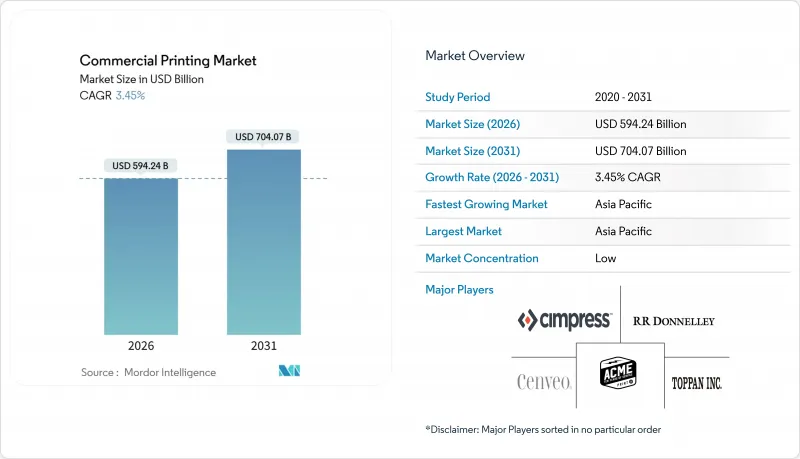
本報告依印刷方式(平張膠印、數位噴墨、柔版印刷等)、應用領域(包裝、廣告、出版等)、印刷材料(紙張/瓦楞紙板、塑膠/合成基材、布料/紡織品等)、幅面(大尺寸印刷、小幅面印刷等)和地區進行細分。市場預測以美元計價。
全球商業印刷市場趨勢與洞察
按需包裝印刷業務爆炸性成長
目前,電商平台優先考慮小批量包裝印刷,以縮短交貨週期,從數週縮短至數天。這一趨勢使得高速數位噴墨印刷優於使用製版的平版印刷。亞馬遜的「無挫折」指南以及區域市場類似的舉措降低了數位印刷的成本效益閾值,尤其是在5000件以下的批量生產中。投資了單一途徑PageWide生產線的加工商表示,他們的訂單到出貨週期已從10天縮短至48小時。亞太地區的履約網路也呈現類似的趨勢,阿里巴巴和Flipkart透過將每個SKU的圖稿發送到當地印刷廠,降低了運輸成本和碳排放。隨著生產規模的日益分散,生產分析證實,準備過程中的浪費正在減少,並且由於品牌為速度支付了更高的單價,毛利率也在提高。
可變數據印刷在個人化行銷的應用日益廣泛。
利用廣告信和產品目錄的行銷負責人正在重新啟用印刷預算,因為與固定設計材料相比,採用可變數據的宣傳活動在回應率方面取得了顯著提升。美國郵政服務 (USPS) 預測,到 2025 年,廣告信量將趨於穩定,這主要得益於金融服務和保險公司將預算重新轉向印刷媒體,以擺脫數位資訊過載的困擾。採用 varioPRINT iX 和彩色噴墨輪轉印刷機的印刷公司每年可處理數十億份個人化印刷材料,其處理能力可與平版印刷相媲美,同時降低了製版成本。雖然歐洲的 GDPR 要求個人化行銷方式必須獲得明確同意,但品牌正在利用自身的忠誠度數據和融合實體體驗和擴增實境(AR) 體驗的QR碼產品目錄來降低風險。這使得印刷品成為全通路行銷漏斗中具有豐富歸因功能的觸點。
廣告支出持續向數位媒體管道轉移
到2025年,程序化影片、社交平臺和聯網電視廣告將占美國廣告支出的72%,這將加速紙本出版物和報紙需求的下降。隨著收入的運作,出版商已經關閉了輪轉印刷生產線,一些歐洲雜誌也完全停止了紙本出版。雖然廣告信仍然強勁,但紙質廣告的普遍下滑已經縮小了專門從事出版物印刷的商業印刷商的潛在基本客群。為了彌補收入的下降,許多公司正在向包裝和大尺寸圖像多元化經營,但傳統的固定成本仍然對利潤率構成壓力,尤其是在市場價格趨於同質化的領域。
細分市場分析
到2025年,膠印將佔據商業印刷市場38.62%的佔有率,這主要得益於其在印量超過1萬張時的規模經濟優勢。然而,數位噴墨印刷預計將以4.11%的複合年成長率成長,並有望透過提高印刷速度、減少裁切損耗以及與網路平版印刷平台的緊密整合來縮小與膠印的差距。例如,Canon的「varioPRINT」技術能夠在每張紙上印刷可變數據,同時在塗佈紙上實現膠印品質,使印刷商能夠透過個性化客製化實現盈利,而無需承擔製版成本。柔版印刷由於其與水性油墨的兼容性,在軟質包裝領域仍然保持優勢,但隨著結合了噴墨列印頭和柔版印刷機的混合印刷機的出現,兩者之間的界限正變得模糊。凹版印刷在超大印量目錄和裝飾性層壓材料領域仍然具有可行性,由於滾筒的使用壽命較長,其成本可以攤銷到數百萬米的印刷量上。然而,隨著出版刊物的衰落,其市場佔有率預計將會萎縮。標籤和瓦楞紙板應用領域的競爭轉折點似乎最為迫在眉睫。在這些領域,單一途徑噴墨生產線目前的列印速度已達到每分鐘200米,這一吞吐量重新定義了總體擁有成本的假設,並將採購決策轉向數位化方式。
同時,印刷服務供應商正在對其現有的平版印刷設施進行數位化改造,以利用基於雲端的工作流程套件,按承印物和表面處理方式批量處理訂單,同時保留其現有的房地產投資。這種營運模式能夠以最少的人員實現更長的正常維修,因為文件準備、拼版和運作管理都由自動化的、基於規則的引擎處理。財務相關人員認為,噴墨印刷的單頁成本可預測且可模組化升級,風險低於替代平版印刷(後者需要更大的資本負擔),這正在推動噴墨印刷在商業印刷市場的普及。
預計到2025年,包裝將佔全球銷售額的45.74%,並以4.54%的複合年成長率(CAGR)持續成長,預計將成為2031年之前商業印刷市場成長的主要驅動力。電子商務的加速發展、反假冒法規的實施以及對商店展示兼容性的要求,正迫使消費品品牌增加對瓦楞紙箱、折疊紙盒和軟質包裝的預算投入。同時,隨著讀者轉向電子螢幕,出版業正面臨長期衰退,導致企業廣告商重新評估廣告支出。圖書印刷由於客製印刷的經濟優勢而成為一個顯著的例外,這種模式可以持續供應長尾圖書而無需承擔庫存風險,儘管電子書的競爭正在擠壓圖書的單價。諸如帳單和支票之類的商業交易印刷仍然受益於優先考慮紙本記錄的監管要求,並且仍然是一個成熟但穩定的收入來源。廣告和促銷資料(包括 POS 展示品)仍然參差不齊,但用於體驗式零售的優質大幅面圖形繼續保持較高的利潤率。
在更廣泛的包裝類別中,軟包裝的商業印刷市場佔有率成長最快,因為立式袋正在取代零嘴零食、寵物食品和個人保健產品中的硬容器。這些薄膜結構便於輕便運輸和360度全方位展示,因此對能夠實現金屬光澤、觸感清漆和可變塗層的印刷機的需求日益成長。飲料瓶的直接成型印刷專案為無標籤品牌推廣鋪平了道路,展現了設計自由如何與減少材料用量的需求相協調。
區域分析
預計到2025年,亞太地區將佔全球銷售額的38.73%,並在2031年之前以4.55%的複合年成長率成長,這主要得益於不斷擴大的消費群體、日益嚴格的監管標準以及包裝生產線的近岸外包。中國正將「雙循環」政策與國內印刷能力結合,金嘉集團等領導企業已採用高速柔版印刷系統取代進口瓦楞紙板。在印度,統一商品和服務稅的實施以及更嚴格的食品包裝標籤法規正在推動對多語言佈局最佳化的數位噴墨生產線的投資。日本高度都市化的人口正受益於Raksul的雲端平台,該平台可將工作分配給能夠當日交付的合作印刷商;目前,首爾和台北也正在採用這種模式。
北美在商業印刷市場保持成熟且穩健的佔有率,而近岸外包的趨勢正在加速對瓦楞紙箱和折疊紙箱工廠的投資。為了滿足飲料製造商和電子商務企業對快速補充紙箱的需求,Westrock 和 International Paper 已對其喬治亞和德克薩斯州的工廠進行了升級改造。儘管報紙發行量下降,但這種轉型仍使區域印刷量保持穩定。歐洲的印刷企業透過提供低揮發性有機化合物 (VOC) 油墨和綠色能源認證,贏得了永續性,同時還要應對不斷上漲的能源成本和日益嚴格的排放法規。德國的產業重組浪潮正在削弱中型平版印刷企業的訂單能,它們的印刷量正被整合到像 Onlineprinters 這樣的數位印刷仲介業者,這些中間商集中處理文件並將生產外包給合作夥伴。
由於宏觀經濟穩定性、外匯波動和基礎設施健全程度的差異,南美洲、中東和非洲以及東南亞部分地區的市場趨勢各不相同。阿拉伯聯合大公國(阿拉伯聯合大公國)正透過扶持國內軟包裝生產來推進其糧食安全工作,例如Hotpack Global公司為清真食品出口商引進了一條運作廣色域柔版印刷機的新產品線。在巴西,外匯壓力推高了油墨進口價格,構成了一項挑戰,但由於日常消費品(FMCG)製造商正在縮小包裝尺寸以保持價格競爭力,因此對軟包裝袋的需求仍然強勁。南非正面臨電網不穩定的問題,促使電力轉換商投資建造屋頂太陽能發電系統,以確保運作並減少碳排放揭露。
整體而言,各地區的成長趨勢有所不同,亞太地區的商業印刷市場絕對成長最為顯著,而北美和歐洲的銷售結構則正向包裝和工業裝飾領域轉變。
其他好處:
- Excel格式的市場預測(ME)表
- 3個月的分析師支持
目錄
第1章:引言
- 研究假設和市場定義
- 調查範圍
第2章:調查方法
第3章執行摘要
第4章 市場狀況
- 市場概覽
- 市場促進因素
- 按需包裝印刷訂單正在大幅成長。
- 可變數據印刷在個人化行銷的應用日益廣泛。
- 零售商和消費品 (CPG) 品牌對促銷印刷材料的需求仍然強勁。
- 過渡到環保基材和植物來源油墨
- 將印刷電子技術(RFID、NFC)整合到包裝和標籤中
- 提供「列印即服務」解決方案的微型工廠正在湧現,它們離客戶越來越近。
- 市場限制因素
- 廣告支出持續向數位媒體管道轉移
- 紙張、油墨和能源等原物料價格波動。
- 對傳統油墨中揮發性有機化合物和化學品的使用有嚴格的規定。
- 新型數位印刷機半導體元件供不應求
- 產業價值鏈分析
- 監理情勢
- 技術展望
- 波特五力分析
第5章 市場規模與成長預測
- 按印刷類型
- 膠印光刻
- 數位噴墨
- 柔版印刷
- 螢幕
- 凹版印刷
- 其他印刷方法
- 透過使用
- 包裝
- 廣告
- 發布
- 圖書
- 雜誌
- 報紙
- 其他出版品
- 企業及商業相關印刷
- 其他用途
- 印刷品
- 紙張和紙板
- 塑膠和合成基材
- 織物和紡織品
- 金屬和箔材
- 其他印刷材料
- 按格式
- 大尺寸列印
- 小幅面印刷
- 直接列印到物體上
- 按地區
- 北美洲
- 美國
- 加拿大
- 墨西哥
- 南美洲
- 巴西
- 阿根廷
- 其他南美國家
- 歐洲
- 德國
- 英國
- 法國
- 義大利
- 西班牙
- 其他歐洲國家
- 亞太地區
- 中國
- 日本
- 印度
- 韓國
- ASEAN
- 其他亞太國家
- 中東和非洲
- 中東
- 沙烏地阿拉伯
- 阿拉伯聯合大公國
- 其他中東國家
- 非洲
- 南非
- 奈及利亞
- 其他非洲國家
- 中東
- 北美洲
第6章 競爭情勢
- 市場集中度
- 策略趨勢
- 市佔率分析
- 公司簡介
- Dai Nippon Printing Co., Ltd.
- Toppan Inc.
- RR Donnelley and Sons Company
- Quad/Graphics Inc.
- TC Transcontinental Inc.
- Cenveo Worldwide Limited
- Cimpress plc
- Deluxe Corporation
- Shutterfly LLC
- LSC Communications LLC
- Mondi plc
- Printpack Inc.
- Multi-Color Corporation
- ACME Printing Company, Inc.
- O'Neil Printing Inc.
- Xerox Holdings Corporation(Print Services)
- WestRock Company(Print and Packaging)
- Berry Global Group, Inc.(Graphics Services)
- Seiko Epson Corporation(Commercial Inkjet Systems)
- HP Inc.(PageWide Industrial)
- Taylor Corporation
- Vistaprint BV
- Blurb, Inc.
- AlphaGraphics, Inc.
- Raksul Inc.
第7章 市場機會與未來展望
According to Mordor Intelligence, the commercial printing market reached USD 594.24 billion in 2026 and is projected to attain USD 704.07 billion by 2031, advancing at a 3.45% CAGR during the forecast period.
This report is Segmented by Printing Type (Offset Lithography, Digital Inkjet, Flexographic, and More), Application (Packaging, Advertising, Publishing, and More), Print Material (Paper and Cardboard, Plastic and Synthetic Substrates, Fabric and Textiles, and More), Format (Large-Format Printing, Small-Format Printing, and More), and Geography. The Market Forecasts are Provided in Terms of Value (USD).
Global Commercial Printing Market Trends and Insights
Explosive Growth in On-Demand Packaging Print Runs
E-commerce platforms now prioritize shorter packaging runs that turn around in days rather than weeks, a dynamic favoring high-speed digital inkjet over plate-based offset. Amazon's frustration-free guidelines and similar mandates from regional marketplaces lowered the economic threshold at which digital presses become cheaper per unit, especially for batches under 5,000 units. Converters that invested in single-pass PageWide lines reported order-to-ship cycles shrinking from ten days to forty-eight hours. The same trend is evident in Asia-Pacific fulfillment networks, where Alibaba and Flipkart route SKU-specific artwork to localized print hubs to trim freight and carbon footprints. As volumes fragment, production analytics confirm higher gross margins due to minimized makeready waste and premium per-box pricing that brands absorb in exchange for speed.
Rising Adoption of Variable-Data Printing for Personalised Marketing
Direct-mail and catalog marketers are reviving print budgets because variable-data campaigns generate measurable lift in response rates versus static pieces. The United States Postal Service cited a stabilization of direct-mail volumes in 2025, driven by financial-services and insurance firms that shifted budgets back to print to escape digital clutter. Printers installing varioPRINT iX and color-inkjet web presses process billions of individualized impressions annually, demonstrating throughput that rivals conventional offset while eliminating plate costs. Although Europe's GDPR requires explicit consent for personalized outreach, brands mitigate the risk by leveraging first-party loyalty data and QR-enabled catalogs that merge physical and augmented-reality experiences, thereby positioning print as an attribution-rich touchpoint in omnichannel funnels.
Ongoing Shift of Advertising Spend to Digital Media Channels
Programmatic video, social platforms, and connected-TV inventory captured 72% of United States ad spend in 2025, accelerating the contraction of publication and newspaper print demand. Publishers idled web-offset lines as revenues fell, and several European magazine titles ceased print editions entirely. Although direct mail proved resilient, the broader erosion of print advertising shrinks the overall addressable base for commercial printers that specialize in publication work. To offset revenue losses, many have diversified into packaging and large-format graphics, but legacy fixed costs still weigh on margins, especially where market pricing remains commoditized.
Other drivers and restraints analyzed in the detailed report include:
- Sustained Demand for Promotional Print from Retail and CPG Brands
- Transition Toward Eco-Friendly Substrates and Vegetable-Based Inks
- Volatile Prices of Paper, Ink and Energy Inputs
For complete list of drivers and restraints, kindly check the Table Of Contents.
Segment Analysis
Offset lithography commanded 38.62% of commercial printing market share in 2025, a position rooted in scale economies at volumes above 10,000 impressions. Digital inkjet, however, is forecast to grow at a 4.11% CAGR, shrinking the differential through higher speed, lower makeready waste, and tight integration with web-to-print portals. Canon varioPRINT installations, for instance, achieve offset-comparable quality on coated stocks while delivering variable data on every sheet, enabling printers to monetize personalization without incurring plate charges. Flexographic printing maintains an edge in flexible packaging due to its compatibility with water-based inks, but hybrid presses that merge inkjet heads with flexo decks are blurring boundaries. Gravure remains viable for ultra-high-volume catalog work and decorative laminates where cylinder life amortizes costs across millions of meters, yet its share will likely erode as subscription publications decline. The competitive inflection point appears most imminent in label and corrugated applications where single-pass inkjet lines now print 200 meters per minute, a throughput that reshapes total cost of ownership assumptions and tilts procurement in favor of digital.
In parallel, print service providers are retrofitting legacy offset sites with digital retrofits to preserve sunk real estate investments while leveraging cloud-based workflow suites that batch orders by substrate and finish. This operational model allows lean staffing and extended uptime because file prep, imposition, and color management ride on automated rules-based engines. Financiers view inkjet's predictable cost per page and modular upgrade path as lower risk than capex-heavy offset replacements, reinforcing adoption momentum across the commercial printing market.
Packaging represented 45.74% of global revenue in 2025, and its 4.54% CAGR positions it as the principal driver of the commercial printing market size through 2031. E-commerce acceleration, anti-counterfeiting mandates, and shelf-ready display requirements compel consumer-goods brands to allocate larger budgets to corrugated, folding carton, and flexible formats. Meanwhile, publishing segments confront secular declines as readers migrate to screens, causing corporate advertisers to redirect spend. Book printing has remained a notable exception because print-on-demand economics allow perpetual availability of long-tail titles without inventory risk, yet unit prices are under pressure from e-book competition. Corporate transactional print, such as statements and checks, benefits from regulatory obligations that still favor paper trails, providing a stable albeit mature revenue stream. Advertising collateral, including point-of-sale displays, remains uneven, but premium large-format graphics for experiential retail continue to command high margins.
The commercial printing market share for flexible packaging is rising fastest within the broader packaging category as stand-up pouches replace rigid containers in snacks, pet food, and personal-care products. These film structures facilitate lightweight shipping and 360-degree graphics, which in turn demand presses capable of metallics, tactile varnish, and variable coding. Direct-to-shape beverage bottle projects illustrate the path toward label-free branding, demonstrating how design freedom dovetails with material reduction mandates.
Complete Report Scope:
- By Printing Type
- Offset Lithography
- Digital Inkjet
- Flexographic
- Screen
- Gravure
- Other Printing Types
- By Application
- Packaging
- Advertising
- Publishing
- Books
- Magazines
- Newspapers
- Other Publishing
- Corporate and Transactional Printing
- Other Applications
- By Print Material
- Paper and Cardboard
- Plastic and Synthetic Substrates
- Fabric and Textiles
- Metal and Foils
- Other Print Materials
- By Format
- Large-Format Printing
- Small-Format Printing
- Direct-to-Object Printing
- By Geography
- North America
- United States
- Canada
- Mexico
- South America
- Brazil
- Argentina
- Rest of South America
- Europe
- Germany
- United Kingdom
- France
- Italy
- Spain
- Rest of Europe
- Asia-Pacific
- China
- Japan
- India
- South Korea
- ASEAN
- Rest of Asia-Pacific
- Middle East and Africa
- Middle East
- Saudi Arabia
- United Arab Emirates
- Rest of Middle East
- Africa
- South Africa
- Nigeria
- Rest of Africa
- Middle East
- North America
Geography Analysis
Asia-Pacific controlled 38.73% of global sales in 2025 and is forecast to rise at a 4.55% CAGR through 2031, bolstered by consumer-class expansion, rising regulatory standards, and near-shoring of packaging lines. China aligns its dual-circulation policy with domestic print capacity, leading enterprises such as Jinjia Group to deploy high-speed flexographic systems that replace imported cartons. India's implementation of unified goods and service taxes and tighter food-package labeling drives investments in digital inkjet lines optimized for multi-language layouts. Japan's highly urban population benefits from Raksul's cloud platform that dispatches jobs to partner presses capable of same-day output, a model now emulated in Seoul and Taipei.
North America claims a mature yet resilient share of the commercial printing market with nearshoring trends accelerating investment in corrugated and folding carton plants. WestRock and International Paper upgraded mills in Georgia and Texas to support beverage and e-commerce shippers seeking rapid box replenishment, a pivot that stabilizes regional print volumes even as newspaper circulation declines. European operators navigate higher energy costs and stringent emission rules but win contracts from sustainability-driven CPGs by offering low-VOC ink sets and green energy certificates. Germany's consolidation wave trimmed capacity among mid-sized offset houses, funneling volume to digital forwarding entities like Onlineprinters that centralize file handling and outsource production to affiliated sites.
South America, the Middle East and Africa, and select Southeast Asian markets display heterogeneous momentum linked to macroeconomic stability, currency fluctuations, and infrastructure robustness. The United Arab Emirates advanced food-security initiatives by nurturing domestic flexible-packaging output, exemplified by Hotpack Global's new lines that run extended-color-gamut flexo units for halal food exporters. Brazil grapples with currency pressures that inflate imported ink prices, yet demand persists for flexible pouches as FMCG producers downsize pack sizes to preserve affordability. South Africa wrestled with grid instability, driving converters to invest in rooftop solar arrays that guarantee uptime and reduce carbon disclosures.
Overall, regional divergence creates a patchwork of growth vectors, with Asia-Pacific commanding the largest commercial printing market size increase in absolute terms, while North America and Europe transition revenue mixes toward packaging and industrial decoration.
- Dai Nippon Printing Co., Ltd.
- Toppan Inc.
- R.R. Donnelley and Sons Company
- Quad/Graphics Inc.
- TC Transcontinental Inc.
- Cenveo Worldwide Limited
- Cimpress plc
- Deluxe Corporation
- Shutterfly LLC
- LSC Communications LLC
- Mondi plc
- Printpack Inc.
- Multi-Color Corporation
- ACME Printing Company, Inc.
- O'Neil Printing Inc.
- Xerox Holdings Corporation (Print Services)
- WestRock Company (Print and Packaging)
- Berry Global Group, Inc. (Graphics Services)
- Seiko Epson Corporation (Commercial Inkjet Systems)
- HP Inc. (PageWide Industrial)
- Taylor Corporation
- Vistaprint B.V.
- Blurb, Inc.
- AlphaGraphics, Inc.
- Raksul Inc.
Additional Benefits:
- The market estimate (ME) sheet in Excel format
- 3 months of analyst support
TABLE OF CONTENTS
1 INTRODUCTION
- 1.1 Study Assumptions and Market Definition
- 1.2 Scope of the Study
2 RESEARCH METHODOLOGY
3 EXECUTIVE SUMMARY
4 MARKET LANDSCAPE
- 4.1 Market Overview
- 4.2 Market Drivers
- 4.2.1 Explosive growth in on-demand packaging print runs
- 4.2.2 Rising adoption of variable-data printing for personalised marketing
- 4.2.3 Sustained demand for promotional print from retail and CPG brands
- 4.2.4 Transition toward eco-friendly substrates and vegetable-based inks
- 4.2.5 Integration of printed electronics (RFID, NFC) into packaging and labels
- 4.2.6 Emergence of micro-factory "print-as-a-service" hubs close to customers
- 4.3 Market Restraints
- 4.3.1 Ongoing shift of advertising spend to digital media channels
- 4.3.2 Volatile prices of paper, ink and energy inputs
- 4.3.3 Stringent VOC and chemical-use regulations on conventional inks
- 4.3.4 Shortage of semiconductor components for new digital presses
- 4.4 Industry Value Chain Analysis
- 4.5 Regulatory Landscape
- 4.6 Technological Outlook
- 4.7 Porter's Five Forces Analysis
- 4.7.1 Bargaining Power of Suppliers
- 4.7.2 Bargaining Power of Buyers
- 4.7.3 Threat of New Entrants
- 4.7.4 Threat of Substitutes
- 4.7.5 Intensity of Competitive Rivalry
5 MARKET SIZE AND GROWTH FORECASTS (VALUE)
- 5.1 By Printing Type
- 5.1.1 Offset Lithography
- 5.1.2 Digital Inkjet
- 5.1.3 Flexographic
- 5.1.4 Screen
- 5.1.5 Gravure
- 5.1.6 Other Printing Types
- 5.2 By Application
- 5.2.1 Packaging
- 5.2.2 Advertising
- 5.2.3 Publishing
- 5.2.3.1 Books
- 5.2.3.2 Magazines
- 5.2.3.3 Newspapers
- 5.2.3.4 Other Publishing
- 5.2.4 Corporate and Transactional Printing
- 5.2.5 Other Applications
- 5.3 By Print Material
- 5.3.1 Paper and Cardboard
- 5.3.2 Plastic and Synthetic Substrates
- 5.3.3 Fabric and Textiles
- 5.3.4 Metal and Foils
- 5.3.5 Other Print Materials
- 5.4 By Format
- 5.4.1 Large-Format Printing
- 5.4.2 Small-Format Printing
- 5.4.3 Direct-to-Object Printing
- 5.5 By Geography
- 5.5.1 North America
- 5.5.1.1 United States
- 5.5.1.2 Canada
- 5.5.1.3 Mexico
- 5.5.2 South America
- 5.5.2.1 Brazil
- 5.5.2.2 Argentina
- 5.5.2.3 Rest of South America
- 5.5.3 Europe
- 5.5.3.1 Germany
- 5.5.3.2 United Kingdom
- 5.5.3.3 France
- 5.5.3.4 Italy
- 5.5.3.5 Spain
- 5.5.3.6 Rest of Europe
- 5.5.4 Asia-Pacific
- 5.5.4.1 China
- 5.5.4.2 Japan
- 5.5.4.3 India
- 5.5.4.4 South Korea
- 5.5.4.5 ASEAN
- 5.5.4.6 Rest of Asia-Pacific
- 5.5.5 Middle East and Africa
- 5.5.5.1 Middle East
- 5.5.5.1.1 Saudi Arabia
- 5.5.5.1.2 United Arab Emirates
- 5.5.5.1.3 Rest of Middle East
- 5.5.5.2 Africa
- 5.5.5.2.1 South Africa
- 5.5.5.2.2 Nigeria
- 5.5.5.2.3 Rest of Africa
- 5.5.5.1 Middle East
- 5.5.1 North America
6 COMPETITIVE LANDSCAPE
- 6.1 Market Concentration
- 6.2 Strategic Moves
- 6.3 Market Share Analysis
- 6.4 Company Profiles (includes Global level Overview, Market level overview, Core Segments, Financials as available, Strategic Information, Market Rank/Share for key companies, Products and Services, and Recent Developments)
- 6.4.1 Dai Nippon Printing Co., Ltd.
- 6.4.2 Toppan Inc.
- 6.4.3 R.R. Donnelley and Sons Company
- 6.4.4 Quad/Graphics Inc.
- 6.4.5 TC Transcontinental Inc.
- 6.4.6 Cenveo Worldwide Limited
- 6.4.7 Cimpress plc
- 6.4.8 Deluxe Corporation
- 6.4.9 Shutterfly LLC
- 6.4.10 LSC Communications LLC
- 6.4.11 Mondi plc
- 6.4.12 Printpack Inc.
- 6.4.13 Multi-Color Corporation
- 6.4.14 ACME Printing Company, Inc.
- 6.4.15 O'Neil Printing Inc.
- 6.4.16 Xerox Holdings Corporation (Print Services)
- 6.4.17 WestRock Company (Print and Packaging)
- 6.4.18 Berry Global Group, Inc. (Graphics Services)
- 6.4.19 Seiko Epson Corporation (Commercial Inkjet Systems)
- 6.4.20 HP Inc. (PageWide Industrial)
- 6.4.21 Taylor Corporation
- 6.4.22 Vistaprint B.V.
- 6.4.23 Blurb, Inc.
- 6.4.24 AlphaGraphics, Inc.
- 6.4.25 Raksul Inc.
7 MARKET OPPORTUNITIES AND FUTURE OUTLOOK
- 7.1 White-space and Unmet-need Assessment

 商業印刷市場-2026-2032年全球市場預測
 2026-2030年全球商業印刷市場
 2026-2030年全球商業印刷外包市場
 商業印刷市場-全球產業規模、佔有率、趨勢、機會、預測:按類型、應用、地區和競爭格局分類,2021-2031年
 美國商業印刷市場規模、佔有率和趨勢分析報告:按印刷技術、應用、公司、產品和細分市場預測(2026-2033 年)
 商業印刷市場規模、佔有率、趨勢和預測:按技術、印刷類型、應用和地區分類,2026-2034年商業印刷市場規模、佔有率和趨勢分析報告:按印刷技術、應用、地區和細分市場預測(2026-2033 年)
 商業印刷市場:按印刷類型、應用和地區分類
 全球商業印刷市場規模、佔有率、趨勢和成長分析報告(2026-2034年)
 2026年全球商業印刷服務市場報告