


 |
市場調查報告書
商品編碼
2123439
家禽包裝:市場佔有率分析、產業趨勢與統計、成長預測(2026-2031)Poultry Packaging - Market Share Analysis, Industry Trends & Statistics, Growth Forecasts (2026 - 2031) |
||||||

※ 本網頁內容可能與最新版本有所差異。詳細情況請與我們聯繫。
根據 Mordor Intelligence 預測,家禽包裝市場規模將從 2025 年的 36.5 億美元成長到 2026 年的 38.2 億美元,到 2031 年將達到 47.9 億美元,2026 年至 2031 年的複合年成長率為 4.64%。
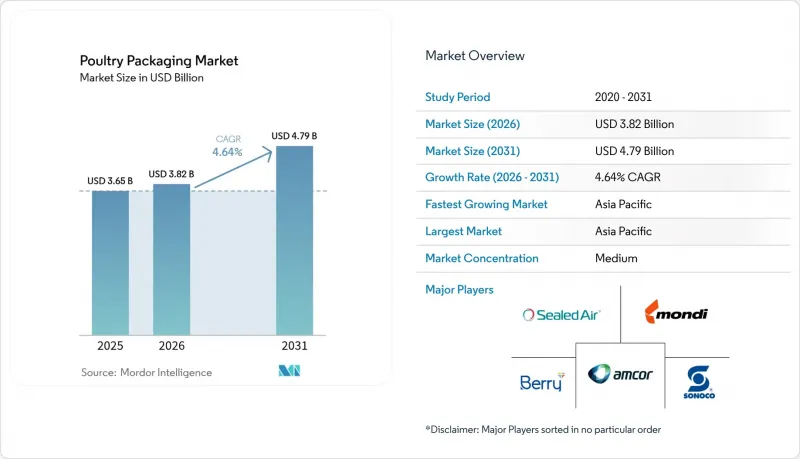
本報告按肉類類型(雞肉、火雞肉、鴨肉)、包裝類型(固定/硬質、軟包裝)、包裝材料(塑膠、紙/紙板、金屬)、包裝技術(調氣包裝、真空緊縮包裝等)、分銷管道(零售、餐飲服務、工業/機構)和地區進行細分。市場預測以美元計價。
全球家禽包裝市場趨勢及洞察
對便利產品和即食禽肉的需求不斷成長
千禧世代和Z世代消費者偏好便捷易用的禽類菜餚,例如採用易撕托盤或烤箱適用包裝袋的菜餚。因此,大型零售商正在強制推行集中式「預包裝」方案,以減少店內人工成本並提高產品品質的一致性。托盤製造商現在將吸水墊和氣體注入閥整合到托盤中,以延長保鮮期數天。像G.Mondini這樣的設備供應商正在提供模組化生產線,將精確的份量控制與超薄薄膜相結合,在不影響視覺效果的前提下減少材料用量。連鎖餐廳也紛紛效仿,訂購預先醃製、真空密著包裝,以便直接從冷藏櫃轉移到烤架上。高階食材自煮包平台也利用類似的包裝來延長運輸過程中的保存期限,並確保更高的利潤率以抵消不斷上漲的薄膜成本。
MAP和真空皮膚技術的激增
調氣包裝透過減緩微生物生長來延長保存期限,但早期高氧混合氣體加速了脂質氧化和變色。加工企業目前正在測試一氧化碳添加劑,以穩定薄膜,同時避免安全隱患。像Duropac這樣的公司提供的真空貼體膜非常適合帶骨肉,因為它們可以防止氣體洩漏並具有抗穿刺性。經等離子處理的托盤可在包裝內產生臭氧,無需使用化學物質即可減少90%的曲狀桿菌和60%的沙門氏菌。像MULTIVAC這樣的設備製造商將MAP閥與微孔蓋結合,使加工商能夠針對每個SKU調整氣體比例。
禽流感導致供應鏈中斷
2024-2025 年高致病性禽流感 (HPAI) 疫情導致數百萬隻家禽從供應鏈中損失,擾亂了生產計劃,並改變了不同重量等級的托盤需求。儘管美國農業部已投入 18 億美元用於補償,但由於家禽養殖場需要長達 24 週的時間才能補充庫存,供應不穩定的局面仍然存在。華盛頓大學開發的高速生物感測器可在 5 分鐘內檢測出 H5N1 病毒,從而能夠更早採取控制措施並進行有針對性的撲殺。家禽養殖週期的縮短迫使加工商調整其規格和品牌,進一步影響了加工商的生產批次計畫。
細分市場分析
雞肉品類佔據家禽包裝市場65.34%的佔有率,這得益於消費者的廣泛接受度和高效的去骨生產線。高加工能力使加工商能夠與供應商協商薄膜成本,並推動了「易撕易封蓋」等減少食物廢棄物的包裝方式的試驗。鴨肉雖然市場規模小規模,但隨著高階零售商推出採用真空緊縮包裝托盤的定量鴨胸肉,其複合年成長率(CAGR)達到5.45%。預計隨著這種獨特的蛋白質來源逐漸滲透到普通冷凍食品市場,鴨肉的家禽包裝市場規模將穩定成長。安姆科(Amcor)的增強型阻隔袋能夠已調整的油脂滲漏並保持瘦肉的色澤,符合高階產品展示標準。
鴨肉的興起促使加工商在保持透明度的同時,採用耐油塗層來提升其零售吸引力。目前,自動化系統能夠按照重量規格對鴨肉進行分裝,並像雞肉一樣直接裝箱銷售。火雞憑藉商店的整雞產品保持著一定的市場佔有率,而高價值的烤肉和切片熟食包裝則支撐著全年需求。因此,每種蛋白質都需要特定的阻隔性、抗穿刺性和形狀特性,促使薄膜供應商在不增加SKU數量的前提下,拓展其產品線。
到2025年,軟包裝將佔家禽包裝市場62.45%的佔有率,這主要得益於材料用量的減少以及提升商店展示效果的高品質圖形設計。隨著單層PET和PE複合材料在商店中實現可回收利用,預計這種包裝形式將繼續推動市場成長,年成長率將達到5.27%。在整個家禽包裝市場中,硬托盤在展示高階烤箱烹飪產品和整雞方面仍將發揮重要作用,因為這些產品需要良好的堆疊穩定性。
GEA 的「PowerPak 1000」等設備使中型工廠能夠在單一機架上切換真空包裝、氣調包裝 (MAP) 和貼體包裝方式,從而減少因換型而造成的停機時間。如今,軟包裝袋內建了保鮮感測器,當 pH 值升高時,感測器會改變顏色,因此包裝本身就起到了品質監控器的作用。這些改進使企業能夠在對成本高度敏感的蛋白質食品類別中保持價格區間,同時滿足零售商對延長保存期限以減少浪費的需求。
區域分析
預計到2025年,亞太地區將佔全球禽肉包裝市場38.45%的佔有率,並在2031年之前以5.11%的複合年成長率持續成長。中國和印度快速的都市區化進程以及可支配收入的成長正在推動冷藏禽肉的需求,而泰國作為出口國的地位也不斷鞏固。各國循環經濟法規的推出促進了可回收複合材料的應用,當地加工商正與全球機械製造商合作,以滿足出口衛生標準。進入印尼和越南市場的跨國零售商正在推行即食包裝方案,為商店加工商創造了新的商機。
北美佔據第二大市場。儘管聯邦法規保持穩定,但加州和奧勒岡州等州已引入生產者責任費,鼓勵使用單一材料包裝。消費者表現出強烈的意願為不含抗生素且獲得永續認證的包裝買單,這促使各大品牌試用可堆肥托盤。加拿大修訂後的「零塑膠廢棄物」議程與歐盟目標一致,並進一步加速了向紙質和聚合物混合材料的過渡。智慧標籤的應用程式正在快速推進,大型量販店已開始在包裝上試用QR碼以實現可追溯性。
在歐洲,儘管表面上的成長率較低,但創新密度卻很高。隨著2025/40號法規強制要求在2030年實現100%可回收並禁止使用PFAS,加工商被迫迅速更換材料。零售商正與供應商合作,驗證全纖維托盤的有效性,例如Coveris公司新推出的「BarrierFresh」系列產品,該系列產品能使雞肉保鮮21天。在德國,一些試點計畫利用智慧感測器檢驗溫度和時間管理不善的情況,並利用這些數據實施動態折扣,以減少廢棄物。
其他好處:
- Excel格式的市場預測(ME)表
- 3個月的分析師支持
目錄
第1章:引言
- 市場定義與研究假設
- 調查範圍
第2章:調查方法
第3章執行摘要
第4章 市場狀況
- 市場概覽
- 市場促進因素
- 對方便快速的即食雞肉產品的需求日益成長。
- MAP和真空皮膚技術的激增
- 向生物基和可回收材料過渡
- 電子商務冷鏈的擴展
- 智慧保鮮感測器的引入
- 主要市場強制要求使用再生材料
- 市場限制因素
- 禽流感導致供應鏈中斷
- 與食品接觸相關的嚴格合規成本
- 聚烯原料價格波動
- 消費者對高氧MAPs的懷疑態度
- 價值供應鏈分析
- 重要法規結構的評估
- 對關鍵相關人員的影響評估
- 技術展望
- 波特五力分析
- 宏觀經濟因素的影響
第5章 市場規模與成長預測
- 依肉類種類
- 雞肉
- 火雞
- 鴨子
- 按包裝類型
- 固定/剛性
- 靈活的
- 透過包裝材料
- 塑膠
- 紙張和紙板
- 金屬
- 產品技術
- 調氣包裝(MAP)
- 真空緊縮包裝(VSP)
- 主動智慧包裝
- 高壓和其他
- 透過分銷管道
- 零售
- 餐飲服務業/HORECA
- 對於行業和機構
- 按地區
- 北美洲
- 美國
- 加拿大
- 墨西哥
- 南美洲
- 巴西
- 阿根廷
- 其他南美國家
- 歐洲
- 德國
- 英國
- 法國
- 義大利
- 西班牙
- 俄羅斯
- 其他歐洲國家
- 亞太地區
- 中國
- 日本
- 印度
- 韓國
- 澳洲和紐西蘭
- 其他亞太國家
- 中東和非洲
- 中東
- 沙烏地阿拉伯
- 阿拉伯聯合大公國
- 土耳其
- 其他中東國家
- 非洲
- 南非
- 奈及利亞
- 埃及
- 其他非洲國家
- 中東
- 北美洲
第6章 競爭情勢
- 市場集中度
- 策略趨勢
- 市佔率分析
- 公司簡介
- Amcor plc
- Berry Global Group Inc.
- Mondi plc
- Sealed Air Corporation
- Sonoco Products Company
- ProAmpac Holdings LLC
- UFlex Limited
- Huhtamaki Oyj
- Winpak Ltd.
- Glenroy Inc.
- LINPAC SEALPAC International BV
- Coveris Holding SA
- Smurfit Kappa Group plc
- Klockner Pentaplast GmbH
- Cascades Inc.
- DS Smith plc
- Printpack Inc.
- Graphic Packaging Holding Company
- Innovia Films Ltd.
- Flexopack SA
第7章 市場機會與未來趨勢
- 評估未開發的領域和未滿足的需求
According to Mordor Intelligence, the poultry packaging market size is expected to grow from USD 3.65 billion in 2025 to USD 3.82 billion in 2026 and is forecast to reach USD 4.79 billion by 2031 at 4.64% CAGR over 2026-2031.
This report is Segmented by Meat Type (Chicken, Turkey, Duck), Packaging Format (Fixed/Rigid, Flexible), Packaging Material (Plastics, Paper and Paperboard, Metals), Packaging Technology (Modified Atmosphere Packaging, Vacuum Skin Packaging, and More), Distribution Channel (Retail, Foodservice/HORECA, Industrial and Institutional), and Geography. The Market Forecasts are Provided in Terms of Value (USD).
Global Poultry Packaging Market Trends and Insights
Rising Demand for Convenience and Case-Ready Poultry
Millennial and Generation Z shoppers favor quick, no-mess poultry meals that arrive in easy-peel trays or ovenable pouches. Large retailers therefore specify centralized case-ready programs that cut in-store labor and improve product consistency. Tray producers now integrate absorbent pads and gas-flush valves that extend freshness by several days. Equipment vendors such as G.Mondini supply modular lines that blend precise portioning with lower film gauge, trimming material use without sacrificing visual appeal. Foodservice chains mirror this shift by ordering pre-marinated, vacuum-skin packs that move from cooler to grill in one step. Premium meal-kit platforms exploit the same packaging to boost shelf life during shipping, capturing higher margins that offset advanced film costs.
Surge in MAP and Vacuum-Skin Technologies
Modified-atmosphere packaging improves shelf life by slowing microbial growth, yet early high-oxygen blends accelerated lipid oxidation and color shifts. Converters now trial carbon-monoxide adjuncts that stabilize bloom without raising safety concerns. Vacuum-skin films from firms like Duropac prevent purge and withstand puncture, making them attractive for bone-in cuts. Plasma-treated trays that create in-pack ozone cut Campylobacter by 90% and Salmonella by 60% without chemicals. Equipment makers such as MULTIVAC pair MAP valves with micro-perforated lids so processors can tune gas ratios to each SKU.
Avian-Influenza Supply Disruptions
The 2024-2025 HPAI wave removed millions of birds from supply chains, unsettling production schedules and altering tray demand by weight class. USDA spent USD 1.8 billion on indemnities, but barns need up to 24 weeks to repopulate, prolonging volume instability. Rapid biosensors from Washington University now detect H5N1 in five minutes, enabling earlier lockdowns and targeted culls. Shorter flock cycles force processors to order more flexible sizes and adjust brand mix, which in turn influences run-length planning for converters.
Other drivers and restraints analyzed in the detailed report include:
- Shift Toward Bio-Based and Recyclable Materials
- E-Commerce Cold-Chain Expansion
- Stringent Food-Contact Compliance Costs
For complete list of drivers and restraints, kindly check the Table Of Contents.
Segment Analysis
The chicken category owns 65.34% of the poultry packaging market, thanks to broad consumer acceptance and streamlined deboning lines. High throughput lets processors negotiate film cost and spur experimentation with peel-reseal lids that cut food waste. Duck, despite its modest base, grows at a 5.45% CAGR as upscale retailers introduce portion-controlled breasts in sleek vacuum-skin trays. Here, the poultry packaging market size for duck is forecast to climb steadily as exotic proteins move into mainstream freezers. Enhanced barrier bags from Amcor prevent grease migration and preserve dark-meat color, meeting premium presentation standards.
Duck's rise compels converters to integrate oil-resistant coatings while keeping clarity for retail appeal. Automation now portions duck to weight specs, enabling case-ready rollouts similar to chicken. Turkey holds share through seasonal whole-bird formats, yet value-added roasts and sliced deli packs sustain year-round demand. Each protein therefore demands tailored barrier, puncture strength, and silhouette, nudging film suppliers to broaden portfolios without inflating SKU count.
Flexible structures delivered 62.45% of the poultry packaging market in 2025, supported by lower material intensity and high graphics that elevate shelf presence. The format will remain the growth leader, advancing 5.27% each year as mono-PET and PE laminates become store-drop recyclable. Within the poultry packaging market size, rigid trays retain roles in premium oven-ready SKUs and whole-bird presentations that benefit from stacking stability.
Equipment such as GEA's PowerPak 1000 lets mid-scale plants swing between vacuum, MAP, and skin variants on a single frame, cutting change-over downtime . Flexible pouches now embed freshness sensors that change color when pH rises, turning the wrapper into a quality monitor. These upgrades defend price points in a cost-sensitive protein category and satisfy retailers that push for longer coded life to lower shrink.
Complete Report Scope:
- By Meat Type
- Chicken
- Turkey
- Duck
- By Packaging Format
- Fixed / Rigid
- Flexible
- By Packaging Material
- Plastics
- Paper and Paperboard
- Metals
- By Packaging Technology
- Modified Atmosphere Packaging (MAP)
- Vacuum Skin Packaging (VSP)
- Active and Intelligent Packaging
- High-Pressure and Others
- By Distribution Channel
- Retail
- Foodservice / HORECA
- Industrial and Institutional
- By Geography
- North America
- United States
- Canada
- Mexico
- South America
- Brazil
- Argentina
- Rest of South America
- Europe
- Germany
- United Kingdom
- France
- Italy
- Spain
- Russia
- Rest of Europe
- Asia-Pacific
- China
- Japan
- India
- South Korea
- Australia and New Zealand
- Rest of Asia-Pacific
- Middle East and Africa
- Middle East
- Saudi Arabia
- United Arab Emirates
- Turkey
- Rest of Middle East
- Africa
- South Africa
- Nigeria
- Egypt
- Rest of Africa
- Middle East
- North America
Geography Analysis
Asia-Pacific controlled 38.45% of the poultry packaging market in 2025 and is projected to expand at a 5.11% CAGR to 2031. Rapid urban migration and rising disposable income in China and India lift chilled-poultry demand, while Thailand strengthens its export position. National circular-economy rules spur adoption of recyclable laminates, and local processors engage global machinery firms to meet export hygiene codes. Multinational retailers entering Indonesia and Vietnam specify case-ready programs, unlocking new business for regional converters.
North America ranks second in value. Federal regulation remains stable, but states such as California and Oregon add producer-responsibility fees that reward mono-material formats . Consumers display strong willingness to pay for antibiotic-free and sustainability-certified packs, encouraging brands to pilot compostable trays. Canada's updated Zero Plastic Waste agenda echoes EU targets, further accelerating the shift to paper-polymer hybrids. Intelligent labels see early uptake as big-box stores test on-pack QR codes for traceability.
Europe shows low headline growth yet high innovation density. Regulation 2025/40 enforces 100% recyclability by 2030 and bans PFAS, forcing converters into rapid material substitution. Retailers collaborate with suppliers to validate fully fiber trays that keep poultry fresh for 21 days, exemplified by Coveris' new BarrierFresh line. Smart-sensor pilots in Germany track time-temperature abuse, delivering data that informs dynamic discounting to curb waste.
- Amcor plc
- Berry Global Group Inc.
- Mondi plc
- Sealed Air Corporation
- Sonoco Products Company
- ProAmpac Holdings LLC
- UFlex Limited
- Huhtamaki Oyj
- Winpak Ltd.
- Glenroy Inc.
- LINPAC SEALPAC International BV
- Coveris Holding SA
- Smurfit Kappa Group plc
- Klockner Pentaplast GmbH
- Cascades Inc.
- DS Smith plc
- Printpack Inc.
- Graphic Packaging Holding Company
- Innovia Films Ltd.
- Flexopack SA
Additional Benefits:
- The market estimate (ME) sheet in Excel format
- 3 months of analyst support
TABLE OF CONTENTS
1 INTRODUCTION
- 1.1 Market Definition and Study Assumptions
- 1.2 Scope of the Study
2 RESEARCH METHODOLOGY
3 EXECUTIVE SUMMARY
4 MARKET LANDSCAPE
- 4.1 Market Overview
- 4.2 Market Drivers
- 4.2.1 Rising demand for convenience and case-ready poultry
- 4.2.2 Surge in MAP and vacuum-skin technologies
- 4.2.3 Shift toward bio-based and recyclable materials
- 4.2.4 E-commerce cold-chain expansion
- 4.2.5 Adoption of intelligent freshness sensors
- 4.2.6 Recycled-content mandates in key markets
- 4.3 Market Restraints
- 4.3.1 Avian-influenza supply disruptions
- 4.3.2 Stringent food-contact compliance costs
- 4.3.3 Feedstock-price volatility for polyolefins
- 4.3.4 Consumer skepticism of high-O2 MAP
- 4.4 Value / Supply-Chain Analysis
- 4.5 Evaluation of Critical Regulatory Framework
- 4.6 Impact Assessment of Key Stakeholders
- 4.7 Technological Outlook
- 4.8 Porter's Five Forces Analysis
- 4.8.1 Bargaining Power of Suppliers
- 4.8.2 Bargaining Power of Consumers
- 4.8.3 Threat of New Entrants
- 4.8.4 Threat of Substitutes
- 4.8.5 Intensity of Competitive Rivalry
- 4.9 Impact of Macro-economic Factors
5 MARKET SIZE AND GROWTH FORECASTS (VALUE)
- 5.1 By Meat Type
- 5.1.1 Chicken
- 5.1.2 Turkey
- 5.1.3 Duck
- 5.2 By Packaging Format
- 5.2.1 Fixed / Rigid
- 5.2.2 Flexible
- 5.3 By Packaging Material
- 5.3.1 Plastics
- 5.3.2 Paper and Paperboard
- 5.3.3 Metals
- 5.4 By Packaging Technology
- 5.4.1 Modified Atmosphere Packaging (MAP)
- 5.4.2 Vacuum Skin Packaging (VSP)
- 5.4.3 Active and Intelligent Packaging
- 5.4.4 High-Pressure and Others
- 5.5 By Distribution Channel
- 5.5.1 Retail
- 5.5.2 Foodservice / HORECA
- 5.5.3 Industrial and Institutional
- 5.6 By Geography
- 5.6.1 North America
- 5.6.1.1 United States
- 5.6.1.2 Canada
- 5.6.1.3 Mexico
- 5.6.2 South America
- 5.6.2.1 Brazil
- 5.6.2.2 Argentina
- 5.6.2.3 Rest of South America
- 5.6.3 Europe
- 5.6.3.1 Germany
- 5.6.3.2 United Kingdom
- 5.6.3.3 France
- 5.6.3.4 Italy
- 5.6.3.5 Spain
- 5.6.3.6 Russia
- 5.6.3.7 Rest of Europe
- 5.6.4 Asia-Pacific
- 5.6.4.1 China
- 5.6.4.2 Japan
- 5.6.4.3 India
- 5.6.4.4 South Korea
- 5.6.4.5 Australia and New Zealand
- 5.6.4.6 Rest of Asia-Pacific
- 5.6.5 Middle East and Africa
- 5.6.5.1 Middle East
- 5.6.5.1.1 Saudi Arabia
- 5.6.5.1.2 United Arab Emirates
- 5.6.5.1.3 Turkey
- 5.6.5.1.4 Rest of Middle East
- 5.6.5.2 Africa
- 5.6.5.2.1 South Africa
- 5.6.5.2.2 Nigeria
- 5.6.5.2.3 Egypt
- 5.6.5.2.4 Rest of Africa
- 5.6.5.1 Middle East
- 5.6.1 North America
6 COMPETITIVE LANDSCAPE
- 6.1 Market Concentration
- 6.2 Strategic Moves
- 6.3 Market Share Analysis
- 6.4 Company Profiles (includes Global level Overview, Market level overview, Core Segments, Financials as available, Strategic Information, Market Rank/Share for key companies, Products and Services, and Recent Developments)
- 6.4.1 Amcor plc
- 6.4.2 Berry Global Group Inc.
- 6.4.3 Mondi plc
- 6.4.4 Sealed Air Corporation
- 6.4.5 Sonoco Products Company
- 6.4.6 ProAmpac Holdings LLC
- 6.4.7 UFlex Limited
- 6.4.8 Huhtamaki Oyj
- 6.4.9 Winpak Ltd.
- 6.4.10 Glenroy Inc.
- 6.4.11 LINPAC SEALPAC International BV
- 6.4.12 Coveris Holding SA
- 6.4.13 Smurfit Kappa Group plc
- 6.4.14 Klockner Pentaplast GmbH
- 6.4.15 Cascades Inc.
- 6.4.16 DS Smith plc
- 6.4.17 Printpack Inc.
- 6.4.18 Graphic Packaging Holding Company
- 6.4.19 Innovia Films Ltd.
- 6.4.20 Flexopack SA
7 MARKET OPPORTUNITIES AND FUTURE TRENDS
- 7.1 White-space and Unmet-need Assessment

 全球鮮肉包裝市場規模、佔有率、趨勢及成長分析報告(2026-2034)
 肉類包裝市場:全球市場預測,2026-2032年
 肉類包裝市場預測至2034年-按包裝類型、材料、肉類類型、包裝形式、通路和地區分類的全球分析鮮肉包裝市場:2026-2032年全球市場預測(按包裝類型、材料、肉類類型、應用和最終用戶分類)
 肉類包裝市場:市場規模、佔有率、成長和行業分析:按材料、產品類型、肉類類型和區域分類,預測至2034年
 生肉包裝市場:依材料、包裝技術、肉品類型和地區分類。
 2026-2030年全球肉品包裝市場家禽包裝市場規模、佔有率、成長及全球產業分析:按類型、應用和地區的洞察,2026-2034年預測肉類包裝市場規模、佔有率、成長及全球產業分析:按類型、應用和地區的洞察,2026-2034年預測
 2026年全球生鮮肉包裝市場報告