


 |
市場調查報告書
商品編碼
2123437
瓦楞紙板和紙板箱:市場佔有率分析、行業趨勢和統計數據、成長預測(2026-2031 年)Corrugated And Paperboard Boxes - Market Share Analysis, Industry Trends & Statistics, Growth Forecasts (2026 - 2031) |
||||||

※ 本網頁內容可能與最新版本有所差異。詳細情況請與我們聯繫。
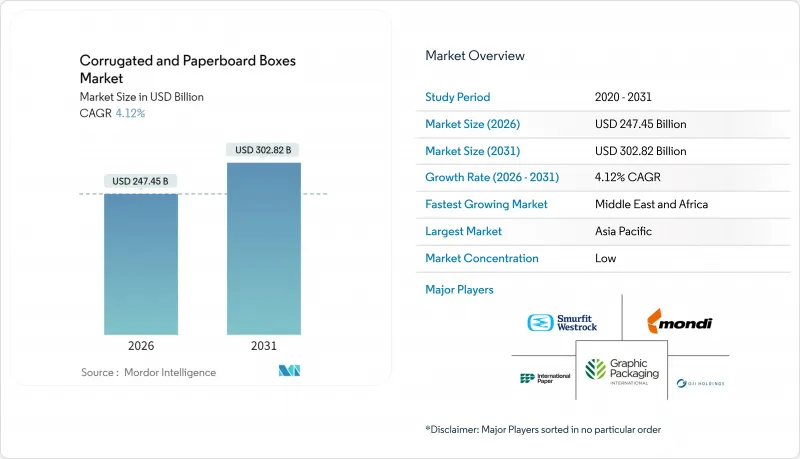
據 Mordor Intelligence 稱,2026 年瓦楞紙板和紙板箱市場價值為 2,474.5 億美元,預計到 2031 年將達到 3,028.2 億美元。
預計在預測期內,其複合年成長率將達到 4.12%。
本報告按產品類型(瓦楞紙箱、固態纖維紙箱、折疊式紙箱等)、壁厚結構(單層、雙層、三層)、終端用戶行業(食品飲料、耐用消費品等)、印刷技術(柔版印刷、膠版印刷等)和地區進行細分。市場預測以美元計價。
全球瓦楞紙板及紙板箱市場趨勢及洞察
電子商務銷售額成長
2025年,全球小包裹運輸量將達到1,610億件,其中瓦楞紙包裝將滿足68%的關鍵運輸需求。這凸顯了直接面對消費者(D2C)的運輸模式與瓦楞紙箱市場之間的結構性連結。亞馬遜的AI驅動包裝選擇引擎將平均紙箱體積減少了11%,減少了12萬噸箱板紙的使用,同時維持了國際安全運輸協會(ISTA)的性能標準。阿里巴巴旗下的菜鳥網路採用了模組化內襯,在23億小包裹中減少了19%的二次包裝。這表明微客製化可以與大規模生產並存。到2025年,預計北美47%的訂單將在當天或隔天送達,這將迫使像國際紙業這樣的製造商在其主要履約中心附近建造微型加工中心。歐洲法規要求在2030年實現30%的再生材料使用率,這正在推動對光學分揀能力的閉合迴路投資。
消費者對永續紙包裝的意識日益增強
一項針對12個國家18,000名消費者的2025年調查發現,72%的消費者更喜歡紙質包裝而非塑膠包裝,並且如果包裝上印有森林管理委員會(FSC)或森林認證促進計畫(POFC)的標誌,他們願意支付5%至8%的溢價。 Mondi的「Performing」等級瓦楞紙板含有40%的農業殘餘纖維,符合歐洲食品接觸法規,使麵包店能夠在保持可回收性的同時,無需使用聚乙烯內襯紙盒。在哥倫比亞,Smurfit Westrock公司證實了由甘蔗渣製成的碳負排放瓦楞紙板的有效性。經碳信託基金檢驗,本產品每生產一噸可固碳0.3公噸。加州參議院第54號法案和中國在2028年實現85%回收率的目標等監管里程碑正在推動瓦楞紙板產業消除混合材料成分並簡化其規格。
高性能塑膠和剛性替代材料的供應情況
對於需要阻隔性水分和氧氣含量低於 0.5 cc/m²·day 的應用,例如已調理食品和濃縮液體,硬質聚丙烯箱和多層包裝袋仍然是主流選擇。單劑量藥品符合美國藥典 (USP) 標準,標準要求水蒸氣透過率低於 0.1 g/100 in²·day,因此對泡殼包裝和雙層薄膜複合材料的需求依然強勁。採用瓦楞紙板替代品需要鋁箔內襯,這將使每單位成本增加 0.15 至 0.30 美元,並且需要耗時的監管重新認證,從而在中短期內構成成本障礙。相較之下,射出成型成型的可回收箱的周轉率可達 80 至 120 次,而瓦楞紙板同類產品的周轉率僅為 1 至 3 次,從而降低了閉合迴路供應鏈中的總擁有成本。
細分市場分析
預計到2025年,瓦楞紙板和普通纖維板紙箱將佔總銷售額的53.43%,這表明抗衝擊產品形式在瓦楞紙板和紙板箱市場中對電子商務、農業和工業供應鏈具有重要的結構性意義。同時,可折疊紙板預計將超越其他領域,到2031年將以5.32%的複合年成長率成長,這主要得益於化妝品、電子產品和製藥行業對膠印和觸感飾面的需求,這些飾面能夠提升產品的貨架吸引力。 Graphic Packaging International的24磅普通漂白硫酸紙漿紙盒採用全像壓印技術,無需二次禮盒,在保持高階質感的同時,減少了28%的材料用量。高階電子品牌對可折疊紙板的採用表明,它能夠兼顧跌落測試要求和零售美觀性,使其成為瓦楞紙板和紙板箱市場的關鍵驅動力。
消費性電子產品製造商證實了這一轉變:蘋果在所有iPhone出貨包裝中用符合ISTA 3A標準的模壓紙漿墊和折疊式紙套取代了塑膠托盤。這項突破性舉措對整個瓦楞紙板和紙板箱產業產生了重大影響。隨後,三星也採用了符合歐洲鄰苯二甲酸酯和重金屬法規並確保可回收性的大豆油墨和水性塗料。儘管產量有所下降,但硬紙盒仍維持著4.8%的複合年成長率。這是因為珠寶飾品、酒類和鐘錶製造商將開箱體驗視為品牌故事的一部分。用於盛裝受聯合國法規約束的危險品的專用容器,採用多層紙板加鋁箔和聚合物內襯,保持穩定的細分市場。
到2025年,單層瓦楞紙層級構造產品將佔據60.32%的市場。這主要歸功於成本績效效益和每英吋32至44磅的邊緣抗壓強度,使其在瓦楞紙板和紙板箱市場中能夠承載高達65磅的負載容量。雖然雙層瓦楞紙板產品適用於出口路線上的重物運輸,但隨著引擎、太陽能組件和精密機械出口商對更輕、更符合IPPC標準的包裝產品的需求,三層瓦楞紙板市場預計將以5.74%的複合年成長率成長。 Lengo的高性能三層瓦楞紙板的抗破強度超過1000磅/平方英寸,無需內部緩衝即可運輸重達1200磅的引擎缸體,並將包裝成本降低25%至35%。
普拉特工業公司為太陽能板物流採用了層級構造瓦楞紙板解決方案,該方案使用符合IEC 61215機械載荷標準的再生材料製作邊緣保護裝置,同時摒棄了發泡聚苯乙烯。在汽車和航太供應鏈中,瓦楞紙板的預算從設計初期就開始累計,因為減輕重量可以降低運輸成本,並便於目的地工廠的回收。雖然12-18毫米的三層瓦楞紙板厚度仍然限制了其在零售領域的應用,但專為跑步機、平板家具等大型電商商品客製化的開槽式瓦楞紙板正在擴大其在瓦楞紙板和紙箱市場的佔有率。
區域分析
到2025年,亞太地區將佔據40.31%的市場。這主要得益於中國7,100萬噸的箱板紙產能以及印度對電熱包裝15%的需求成長。 2025年3月,九龍紙業在廣西壯族自治區運作了一家年產能120萬噸的工廠,該工廠強調使用再生纖維和生質汽電共生。這種模式將使石化燃料依賴減少85%。印度的生產連結獎勵計畫計畫(PLI)在2023年至2025年間資助了210萬噸的新增產能,足以滿足Flipkart和亞馬遜印度19億小包裹的總合需求。同時,在日本,由於人口結構變化帶來的不利影響,國內需求下降了1.8%,但加工商透過向東南亞和大洋洲出口產品來平衡產能運轉率。
預計到2031年,中東和非洲的瓦楞紙板及紙箱市場將以6.86%的複合年成長率成長。這主要得益於沙烏地阿拉伯的「2030願景」計劃,該計劃撥款42億美元用於冷鏈資產建設,預計每年將需要42萬噸瓦楞紙板。儘管非洲對紙箱的需求年增34%,Jumia預計到2025年將處理4,700萬個小包裹,但該地區的箱板紙產能仍維持在310萬噸,導致進口需求增加,並造成接收成本上升12%至18%。 Mondi公司位於理查茲灣的工廠現代化後,再生箱板紙的產能增加了18萬噸,顯示該地區的供應趨於穩定。
到2025年,北美將佔全球整體銷售額的28%,這主要得益於美國在電子商務、餐飲服務和工業應用領域3,300萬噸的消費量。美國包裝公司(Packing Corporation of America)在覆蓋美國85%人口的地區方圓200英里內居住94家工廠,以應對即時交付(JIT)的趨勢。墨西哥的產量增加了11%,反映了汽車和電子產業的近岸外包趨勢,Cravin公司從蒙特雷向特斯拉、通用汽車和三星等公司供應產品。在歐洲,由於能源價格飆升給製造業帶來壓力,消費量下降了2.3%,但嚴格的包裝法規提振了對優質再生紙的需求。受巴西大宗商品出口和阿根廷經濟復甦的支撐,南美洲預計在 2025 年將實現 5.1% 的成長,併計劃在 2026 年至 2027 年期間繼續投資 6.8 億美元用於瓦楞紙板原紙的生產。
其他好處:
- Excel格式的市場預測(ME)表
- 3個月的分析師支持
目錄
第1章:引言
- 研究假設和市場定義
- 調查範圍
第2章:調查方法
第3章執行摘要
第4章 市場狀況
- 市場概覽
- 市場促進因素
- 電子商務銷售額成長
- 消費者對永續紙包裝的意識日益增強
- 零售包裝的採用率正在迅速提高。
- 冷鏈物流的擴張需要特殊的瓦楞紙箱
- 人工智慧驅動的包裝最佳化軟體可減少廢棄物
- 利用農業廢料創新生產負碳纖維
- 市場限制因素
- 高性能塑膠和硬質替代品的供應情況
- 營運成本和能源成本不斷上漲
- 再生紙價格波動
- 新興地區瓦楞紙板原紙廠產能的限制因素
- 宏觀經濟因素對市場的影響
- 產業價值鏈分析
- 監理情勢
- 技術展望
- 波特五力分析
第5章 市場規模與成長預測
- 依產品類型
- 瓦楞紙箱和固體纖維箱
- 折疊式瓦楞紙箱
- 硬盒
- 其他產品類型
- 透過牆體結構
- 單層牆體
- 雙層壁
- 三層壁
- 按最終用戶行業分類
- 食品/飲料
- 耐久性消費品
- 紙張/出版
- 化學品
- 其他終端用戶產業
- 透過印刷技術
- 柔版印刷
- 微影術印刷
- 數位印刷
- 其他印刷技術
- 按地區
- 北美洲
- 美國
- 加拿大
- 墨西哥
- 南美洲
- 巴西
- 阿根廷
- 其他南美國家
- 歐洲
- 德國
- 英國
- 法國
- 義大利
- 西班牙
- 其他歐洲國家
- 亞太地區
- 中國
- 日本
- 印度
- 韓國
- 澳洲
- 其他亞太國家
- 中東和非洲
- 中東
- 沙烏地阿拉伯
- 阿拉伯聯合大公國
- 土耳其
- 其他中東國家
- 非洲
- 南非
- 埃及
- 奈及利亞
- 其他非洲國家
- 中東
- 北美洲
第6章 競爭情勢
- 市場集中度
- 策略趨勢
- 市佔率分析
- 公司簡介
- International Paper Company
- Smurfit WestRock
- Mondi Group
- Packaging Corporation of America
- Georgia-Pacific LLC
- Oji Holdings Corporation
- Nine Dragons Paper(Holdings)Limited
- Cascades Inc.
- Klabin SA
- Nippon Paper Industries Co. Ltd
- Orora Ltd
- Rengo Co. Ltd
- Graphic Packaging International LLC
- Visy Industries
- Lee and Man Paper Manufacturing Ltd
- Pratt Industries
第7章 市場機會與未來展望
According to Mordor Intelligence, the corrugated and paperboard boxes market size is valued at USD 247.45 billion in 2026 and is projected to reach USD 302.82 billion by 2031, advancing at a 4.12% CAGR over the forecast period.
This report is Segmented by Product Type (Corrugated and Solid Fiber Boxes, Folding Paperboard Boxes, and More), Wall Construction (Single-Wall, Double-Wall, and Triple-Wall), End-User Industry (Food and Beverage, Durable Goods, and More), Printing Technology (Flexographic Printing, Lithographic Printing, and More), and Geography. The Market Forecasts are Provided in Terms of Value (USD).
Global Corrugated And Paperboard Boxes Market Trends and Insights
Growth in E-Commerce Sales
Global parcel shipments climbed to 161 billion units in 2025, and corrugated packaging fulfilled 68% of primary shipping requirements, underscoring the structural link between direct-to-consumer fulfillment and the corrugated and paperboard boxes market. Amazon's AI-powered pack-choice engines trimmed average box volume 11%, cutting 120,000 metric tons of containerboard while safeguarding International Safe Transit Association performance thresholds. Alibaba's Cainiao network deployed modular inserts that lowered secondary packaging by 19% across 2.3 billion parcels, signaling how micro-customization can coexist with mass scale. Same-day or next-day expectations affected 47% of North American orders in 2025, compelling producers such as International Paper to commission micro-converting hubs adjacent to leading fulfillment centers. European regulations that require 30% post-consumer recycled content by 2030 reinforce closed-loop investment in optical sorting capacity.
Growing Consumer Awareness on Sustainable Paper Packaging
A 2025 survey covering 18,000 shoppers across 12 nations found 72% favor paper-based over plastic packaging and indicated willingness to pay a 5-8% premium when Forest Stewardship Council or Programme for the Endorsement of Forest Certification logos are present. Mondi's PerFORMing grade, which incorporates 40% agricultural-residue fiber, meets European food-contact regulations, allowing bakeries to abandon polyethylene-lined boxes while maintaining recyclability. In Colombia, Smurfit WestRock validated carbon-negative linerboard derived from sugarcane bagasse, sequestering 0.3 metric tons of CO2-equivalent per ton of output, as verified by the Carbon Trust. Regulatory milestones such as California Senate Bill 54 and China's 85% recovery target by 2028 intensify the incentive to remove mixed-material components and simplify corrugated formats.
Availability of High-Performance Plastic and Rigid Substitutes
Rigid polypropylene crates and multilayer pouches continue to dominate applications where moisture and oxygen barriers below 0.5 cc/m2-day are mandatory, such as frozen entrees and concentrated liquids. Unit-dose medicines adhere to United States Pharmacopeia standards that require water-vapor transmission of less than 0.1 g/100 in2/day, sustaining demand for blister packs and dual-film laminates. Corrugated alternatives would require aluminum-laminate liners that add USD 0.15-0.30 per unit and necessitate lengthy regulatory revalidation, a cost barrier in the short to medium term. Injection-molded returnable crates achieve 80-120 rotations, compared with 1-3 for corrugated equivalents, providing a lower total cost of ownership for closed-loop supply chains.
Other drivers and restraints analyzed in the detailed report include:
- Surge in Retail Ready Packaging Adoption
- Expansion of Cold-Chain Logistics Requiring Specialty Corrugated Boxes
- Rising Operational and Energy Costs
For complete list of drivers and restraints, kindly check the Table Of Contents.
Segment Analysis
Corrugated and solid fiber boxes delivered 53.43% of 2025 revenue, demonstrating the structural importance of high-strength formats for e-commerce, agriculture, and industrial supply chains in the corrugated and paperboard boxes market. Folding paperboard, however, is forecast to outpace with a 5.32% CAGR through 2031 as cosmetics, electronics, and pharmaceuticals demand lithographic graphics and tactile finishes that elevate shelf presence. Graphic Packaging International's 24-point solid bleached sulfate carton integrates holographic stamping that removes the need for secondary gift boxes and cuts total material 28% while retaining premium image. Luxury electronics brand adoption showcases folding paperboard's capacity to balance drop-test requirements and retail aesthetics, a key driver within the corrugated and paperboard boxes market.
Consumer electronics companies confirmed the shift when Apple replaced plastic trays across all iPhone shipments with molded pulp cushions and folding sleeves that meet ISTA 3A criteria, a milestone that resonated across the corrugated and paperboard boxes industry. Samsung followed by adopting soy-based inks and water-based coatings that satisfy European restrictions on phthalates and heavy metals, ensuring recyclability. Rigid boxes, while smaller in volume, maintain a 4.8% CAGR because jewelry, spirits, and watchmakers view unboxing as part of brand storytelling. Specialty containers for UN-regulated hazardous materials remain a consistent niche, leveraging multi-layered paperboard with foil or polymer linings.
Single-wall designs captured 60.32% of market share in 2025, favored for the balance of cost and 32-44 pounds-per-inch edge-crush ratings, supporting payloads up to 65 pounds in the corrugated and paperboard boxes market. Double-wall products manage heavier items in export channels, yet triple-wall formats will expand at a 5.74% CAGR as exporters of engines, solar modules, and precision machinery chase lighter, International Plant Protection Convention-compliant options. Rengo's high-performance triple-wall board achieved burst strength above 1,000 psi and allowed engine block shipments up to 1,200 pounds without internal dunnage, reducing packaging spend by 25-35%.
Pratt Industries applied triple-wall solutions to solar-panel logistics, incorporating recycled edge protectors that eliminate expanded polystyrene while meeting IEC 61215 mechanical load standards. Automotive and aerospace supply chains now budget corrugated into early design stages because weight savings translate into freight cost avoidance and easier recycling at destination plants. Triple-wall's 12-18 mm thickness still limits retail adoption, yet custom slotted styles for large-format e-commerce goods such as treadmills and flat-pack furniture are widening the addressable scope within the corrugated and paperboard boxes market.
Complete Report Scope:
- By Product Type
- Corrugated and Solid Fiber Boxes
- Folding Paperboard Boxes
- Rigid Boxes
- Other Product Types
- By Wall Construction
- Single-Wall
- Double-Wall
- Triple-Wall
- By End-User Industry
- Food and Beverage
- Durable Goods
- Paper and Publishing
- Chemicals
- Other End-User Industries
- By Printing Technology
- Flexographic Printing
- Lithographic Printing
- Digital Printing
- Other Printing Technologies
- By Geography
- North America
- United States
- Canada
- Mexico
- South America
- Brazil
- Argentina
- Rest of South America
- Europe
- Germany
- United Kingdom
- France
- Italy
- Spain
- Rest of Europe
- Asia-Pacific
- China
- Japan
- India
- South Korea
- Australia
- Rest of Asia-Pacific
- Middle East and Africa
- Middle East
- Saudi Arabia
- United Arab Emirates
- Turkey
- Rest of Middle East
- Africa
- South Africa
- Egypt
- Nigeria
- Rest of Africa
- Middle East
- North America
Geography Analysis
Asia-Pacific accounted for 40.31% of market share in 2025, underpinned by China's 71 million-metric-ton containerboard capacity and India's 15% surge in e-commerce packaging demand. Nine Dragons Paper brought a 1.2 million-metric-ton mill online in Guangxi during March 2025, emphasizing recovered fiber usage and biomass cogeneration, a template that cuts fossil fuel dependence by 85%. India's Production-Linked Incentive program financed 2.1 million metric tons of new capacity between 2023 and 2025, accommodating Flipkart and Amazon India's combined 1.9 billion parcel load. While Japan's domestic demand slipped 1.8% amid demographic headwinds, its converters exported to Southeast Asia and Oceania to balance capacity utilization.
The corrugated and paperboard boxes market in the Middle East and Africa is projected to grow at a 6.86% CAGR through 2031 as Saudi Arabia's Vision 2030 allocates USD 4.2 billion for cold-chain assets that require an estimated 420,000 metric tons of corrugated annually. Jumia's 47 million parcels in 2025 raised African box demand 34% year-over-year, yet regional containerboard capacity remains only 3.1 million metric tons, forcing imports that inflate landed cost 12-18%. Mondi's Richards Bay modernization adds 180,000 metric tons of recycled linerboard and demonstrates intraregional supply stabilization.
North America delivered 28% of global revenue in 2025, driven by 33 million metric tons of U.S. consumption across e-commerce, food service, and industrial applications. Packaging Corporation of America expanded to 94 plants within 200 miles of 85% of the U.S. population, aligning with just-in-time delivery trends. Mexico's 11% output growth reflects nearshoring in automotive and electronics, with Klabin serving Tesla, General Motors, and Samsung from Monterrey. Europe's consumption dipped 2.3% as energy prices weighed on manufacturing activity, yet strict packaging regulations spurred premium recycled grades. South America gained 5.1% in 2025, fueled by Brazil's commodity exports and Argentina's rebound, with USD 680 million in ongoing containerboard investments slated for 2026-2027.
- International Paper Company
- Smurfit WestRock
- Mondi Group
- Packaging Corporation of America
- Georgia-Pacific LLC
- Oji Holdings Corporation
- Nine Dragons Paper (Holdings) Limited
- Cascades Inc.
- Klabin S.A.
- Nippon Paper Industries Co. Ltd
- Orora Ltd
- Rengo Co. Ltd
- Graphic Packaging International LLC
- Visy Industries
- Lee and Man Paper Manufacturing Ltd
- Pratt Industries
Additional Benefits:
- The market estimate (ME) sheet in Excel format
- 3 months of analyst support
TABLE OF CONTENTS
1 INTRODUCTION
- 1.1 Study Assumptions and Market Definition
- 1.2 Scope of the Study
2 RESEARCH METHODOLOGY
3 EXECUTIVE SUMMARY
4 MARKET LANDSCAPE
- 4.1 Market Overview
- 4.2 Market Drivers
- 4.2.1 Growth in e-Commerce Sales
- 4.2.2 Growing Consumer Awareness on Sustainable Paper Packaging
- 4.2.3 Surge in Retail Ready Packaging Adoption
- 4.2.4 Expansion of Cold-Chain Logistics Requiring Specialty Corrugated Boxes
- 4.2.5 AI-Driven Box Optimization Software Reducing Waste
- 4.2.6 Carbon-Negative Fiber Innovations Using Agro-Residue
- 4.3 Market Restraints
- 4.3.1 Availability of High-Performance Plastic and Rigid Substitutes
- 4.3.2 Rising Operational and Energy Costs
- 4.3.3 Volatility in Recovered Paper Prices
- 4.3.4 Containerboard Mill Capacity Constraints in Emerging Regions
- 4.4 Impact of Macroeconomic Factors on the Market
- 4.5 Industry Value Chain Analysis
- 4.6 Regulatory Landscape
- 4.7 Technological Outlook
- 4.8 Porter's Five Forces Analysis
- 4.8.1 Threat of New Entrants
- 4.8.2 Bargaining Power of Buyers
- 4.8.3 Bargaining Power of Suppliers
- 4.8.4 Threat of Substitutes
- 4.8.5 Intensity of Competitive Rivalry
5 MARKET SIZE AND GROWTH FORECASTS (VALUE)
- 5.1 By Product Type
- 5.1.1 Corrugated and Solid Fiber Boxes
- 5.1.2 Folding Paperboard Boxes
- 5.1.3 Rigid Boxes
- 5.1.4 Other Product Types
- 5.2 By Wall Construction
- 5.2.1 Single-Wall
- 5.2.2 Double-Wall
- 5.2.3 Triple-Wall
- 5.3 By End-User Industry
- 5.3.1 Food and Beverage
- 5.3.2 Durable Goods
- 5.3.3 Paper and Publishing
- 5.3.4 Chemicals
- 5.3.5 Other End-User Industries
- 5.4 By Printing Technology
- 5.4.1 Flexographic Printing
- 5.4.2 Lithographic Printing
- 5.4.3 Digital Printing
- 5.4.4 Other Printing Technologies
- 5.5 By Geography
- 5.5.1 North America
- 5.5.1.1 United States
- 5.5.1.2 Canada
- 5.5.1.3 Mexico
- 5.5.2 South America
- 5.5.2.1 Brazil
- 5.5.2.2 Argentina
- 5.5.2.3 Rest of South America
- 5.5.3 Europe
- 5.5.3.1 Germany
- 5.5.3.2 United Kingdom
- 5.5.3.3 France
- 5.5.3.4 Italy
- 5.5.3.5 Spain
- 5.5.3.6 Rest of Europe
- 5.5.4 Asia-Pacific
- 5.5.4.1 China
- 5.5.4.2 Japan
- 5.5.4.3 India
- 5.5.4.4 South Korea
- 5.5.4.5 Australia
- 5.5.4.6 Rest of Asia-Pacific
- 5.5.5 Middle East and Africa
- 5.5.5.1 Middle East
- 5.5.5.1.1 Saudi Arabia
- 5.5.5.1.2 United Arab Emirates
- 5.5.5.1.3 Turkey
- 5.5.5.1.4 Rest of Middle East
- 5.5.5.2 Africa
- 5.5.5.2.1 South Africa
- 5.5.5.2.2 Egypt
- 5.5.5.2.3 Nigeria
- 5.5.5.2.4 Rest of Africa
- 5.5.5.1 Middle East
- 5.5.1 North America
6 COMPETITIVE LANDSCAPE
- 6.1 Market Concentration
- 6.2 Strategic Moves
- 6.3 Market Share Analysis
- 6.4 Company Profiles (includes Global Level Overview, Market Level Overview, Core Segments, Financials as available, Strategic Information, Market Rank/Share for Key Companies, Products and Services, and Recent Developments)
- 6.4.1 International Paper Company
- 6.4.2 Smurfit WestRock
- 6.4.3 Mondi Group
- 6.4.4 Packaging Corporation of America
- 6.4.5 Georgia-Pacific LLC
- 6.4.6 Oji Holdings Corporation
- 6.4.7 Nine Dragons Paper (Holdings) Limited
- 6.4.8 Cascades Inc.
- 6.4.9 Klabin S.A.
- 6.4.10 Nippon Paper Industries Co. Ltd
- 6.4.11 Orora Ltd
- 6.4.12 Rengo Co. Ltd
- 6.4.13 Graphic Packaging International LLC
- 6.4.14 Visy Industries
- 6.4.15 Lee and Man Paper Manufacturing Ltd
- 6.4.16 Pratt Industries
7 MARKET OPPORTUNITIES AND FUTURE OUTLOOK
- 7.1 White-Space and Unmet-Need Assessment

 可壓縮紙盒市場規模、佔有率和成長分析:按材料、紙盒類型、應用、最終用戶、封口方式和地區分類 - 行業預測,2026-2033年
 瓦楞紙箱市場:按類型、原料、瓦楞類型、設計類型、印刷技術和最終用戶分類-2026-2032年全球市場預測
 瓦楞紙箱市場預測至2034年-全球分析(按壁厚類型、箱體形狀、瓦楞類型、紙板等級、印刷類型、最終用戶、分銷管道和地區分類)
 瓦楞紙板郵寄信封市場:市場規模、佔有率、成長和行業分析:按壁厚類型、產品類型、最終用途和區域分類,預測至2034年
 瓦楞紙箱市場規模、佔有率和趨勢分析報告:按產品、組件、印刷技術、最終用途、地區和細分市場預測(2026-2033 年)
 2026-2030年全球瓦楞紙箱市場
 2026年全球瓦楞紙板回收市場報告
 瓦楞紙箱市場分析及預測(至2035年):類型、產品類型、應用、材質類型、技術、最終用戶、功能、製造流程、組件
 全球可重複使用瓦楞塑膠盒市場規模、佔有率、趨勢和成長分析報告(2026-2034年)全球瓦楞紙箱市場規模、佔有率、趨勢和成長分析報告(2026-2034)