


 |
市場調查報告書
商品編碼
2123430
倉儲與儲存服務:市場佔有率分析、產業趨勢與統計資料、成長預測(2026-2031 年)Warehousing And Storage Services - Market Share Analysis, Industry Trends & Statistics, Growth Forecasts (2026 - 2031) |
||||||

※ 本網頁內容可能與最新版本有所差異。詳細情況請與我們聯繫。
據 Mordor Intelligence 稱,2025 年倉儲和儲存服務市場價值為 5,215.3 億美元,預計到 2031 年將達到 6723.6 億美元,而 2026 年為 5,441.1 億美元,預測期(2026-2031 年)的複合年成長率為 4.3%。
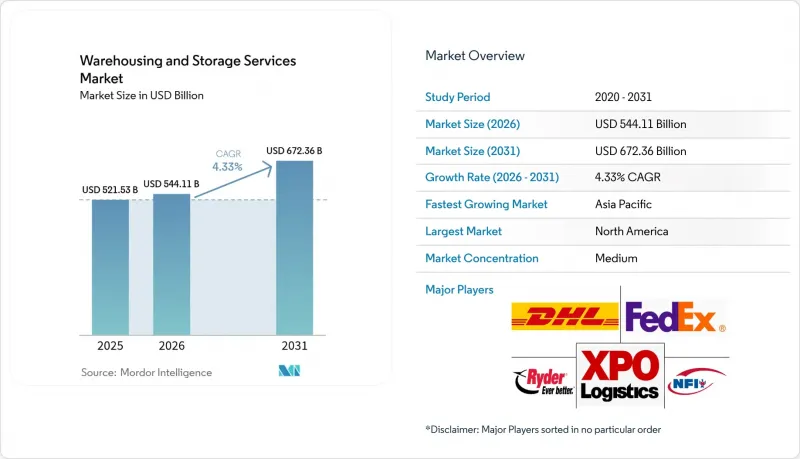
本報告按服務類型(普通倉儲、冷藏倉儲等)、所有權類型(自有倉庫等)、儲存期限(短期儲存、長期儲存)、終端用戶產業(製造業、消費品業等)和地區進行細分。市場預測以美元計價。
全球倉儲服務市場趨勢及洞察
全通路履約的需求不斷成長
零售商透過整合線上和線下門市的庫存池,並為客戶提供靈活的提貨和配送選項,推動了對即時庫存可見性和多通路訂單處理的需求。企業透過將倉庫選址在靠近高密度消費區域的地區,提高了最後一公里配送效率並縮短了配送時間。公共倉庫也從中受益,因為共用節點可以支援多家銷售不足以支撐專屬倉庫的零售商。早期採用者透過整合預測分析來自動重新分配庫存,從而減少了缺貨和降價。技術驅動的物流中心透過快速重新配置揀貨區以應對不斷變化的需求模式,從而鞏固了自身的競爭力。
電子商務主導倉儲需求激增
線上零售持續推動前所未有的訂單量湧入履約中心,小包裹趨勢顯示小批量、高周轉率訂單不斷增加,這需要自動化分類和「產品到人」的機器人技術。食品和藥品線上銷售的成長推動了冷鏈設施的擴張,促使企業對冷凍控制和狀態監控進行大量投資。在人口密集的大都會圈,面積小於10,000平方英尺的微型倉配中心正在迅速增加,不僅提高了當日送達能力,也縮短了運輸距離。靈活的合約安排正受到品牌商的關注,因為他們需要應對季節性波動和促銷帶來的需求激增。隨著企業傾向於採用輕庫存模式,將到貨貨物直接運送到出貨碼頭,越庫作業區也不斷擴大。
前期投資和維護成本較高
全自動化倉庫的初始投資可能超過5000萬美元,由於複雜的機電一體化系統和軟體支持,年度維護成本通常佔營運預算的15%至20%。冷藏設施需要隔熱板、氨氣或二氧化碳系統以及緊急發電機,因此比常溫儲存成本更高。利率上升提高了新建設的獲利標準,導致一些營運商推遲專案或選擇租賃而非購買。機器人即服務(RaaS)合約減輕了現金流壓力,但增加了長期支出。抵押品不足的中小型企業難以獲得資金籌措,導致倉儲服務市場的技術普及速度放緩。
細分市場分析
以普通倉儲為主導的倉儲服務市場預計到2025年將達到2,719.8億美元,佔總營收的52.15%。雖然冷藏設施的絕對值較小,但預計其複合年成長率將達到5.36%,成為成長最快的領域,這主要得益於生物製藥、冷凍食品和食材自煮包服務等行業的持續需求。由於出口型農產品需要受控的空氣環境以防止變質,農業倉儲在倉儲服務市場中的佔有率保持穩定。冷鏈營運商正在投資低填充氨製冷系統以降低冷媒風險,而自動化托盤穿梭貨架則透過消除通道需求和降低單箱能耗來提高儲存密度。
北美老舊冷庫的平均使用年限已達37年,許多冷庫缺乏高層儲存所需的淨空高度。因此,目前正在進行現代化維修,整合氧氣減少型滅火系統和數位化溫度測繪技術。 Lineage 物流和Americold等公司正在投資建造與鐵路支線和港口碼頭相連的多租戶設施,強調多式聯運的便利性,並將其作為一項差異化優勢。醫藥級冷庫正在獲得良好分銷規範(GDP)認證,因此能夠實現高於標準儲存價格兩倍以上的收費系統。總體而言,專業的溫控技術正在推動增值成長,而標準冷庫則維持倉儲服務市場的基本規模。
基於共用基礎設施對需求波動較大的企業具有顯著的經濟優勢,預計到2025年,公共倉庫將佔總銷售額的46.88%。同時,隨著製造商和零售商將庫存管理內部化並利用機器人技術實現大規模生產力提升,自動化私人倉庫預計將以4.83%的複合年成長率成為成長最快的領域。公共倉儲服務市場依然龐大,可提供靈活的剩餘容量以應對需求激增。保稅倉庫的目標客戶是希望延期支付關稅的進口商,在邊境附近和自由貿易區的運轉率表現強勁。
在永續發展理念的驅動下,私人投資者正尋求符合企業氣候目標的LEED認證物業,並擴大安裝屋頂太陽能發電系統,以抵消自動駕駛汽車的充電負載。同時,公共事業公司正努力透過增加配套服務和逆向物流等附加價值服務來保持競爭力。混合模式正在興起:將關鍵庫存單位(SKU)存放在自動化私有倉庫中,而將滯銷商品存放在公共空間,這清楚地展現了倉儲服務市場中一種成熟的投資組合策略。
區域分析
預計2025年,北美將維持31.45%的倉儲服務市佔率。這得益於成熟的電子商務網路和完善的第三方物流(3PL)生態系統,後者能夠確保大多數主要大都會圈實現當日送達。製造商將生產遷回美國以及將生產轉移到墨西哥近岸地區,正在推動美國南部邊境地區的需求。在該地區,由於跨境物流的流動,拉雷多和埃爾帕索正成為倉庫建設的主要區域。現有建築在電網連接方面落後於自動化水平,因此,現場太陽能發電和微電網的應用日益普及。
預計亞太地區將錄得最高成長率,到2031年複合年成長率將達7.21%。這主要得益於印度預計到2025年將新增超過3億平方英尺的A級物業,以及鼓勵物流園區發展的政策誘因。中國開發商正順應內陸地區的消費需求,而「一帶一路」計劃的鐵路走廊正在擴大區域間的互聯互通。越南和馬來西亞等東南亞國家正吸引尋求多元化經營、擺脫單一國家依賴的跨國公司在當地物流中心。例如,位於馬來西亞武吉拉惹(Bukit Raja)的Omega 1大型自動化倉庫,面積達180萬平方英尺,其設計概念以電子商務的成長為核心,體現了尖端技術。
歐洲業者正面臨土地稀缺和嚴格的區域規劃法規等挑戰,這些挑戰延長了授權流程,但同時也使空置率低於全球平均水準。永續發展法規,尤其是企業租戶要求簽訂碳中和契約,正在推動採用熱泵和屋頂太陽能發電系統的維修。東歐樞紐因其接近性西歐消費者和較低的工資水平而備受關注,與荷蘭和比利時強大的港口中心叢集形成互補。儘管南美洲和中東及非洲仍是發展中地區,但對保稅區和食品安全設施的投資不斷增加,正在擴大其在全球倉儲服務市場中的地位。
其他好處:
- Excel格式的市場預測(ME)表
- 3個月的分析師支持
目錄
第1章:引言
- 研究假設和市場定義
- 調查範圍
第2章:調查方法
第3章執行摘要
第4章 市場狀況
- 市場概覽
- 市場促進因素
- 透過全通路履約的需求日益成長
- 電子商務主導倉儲需求激增
- 第三方物流外包業務的擴張
- 按需微型倉庫網路的成長
- 維修為節能型倉庫,重點關注 ESG(環境、社會和治理)方面。
- AI驅動的動態插槽佈局提高了儲存密度。
- 市場限制因素
- 大量資本支出和維護成本
- 熟練倉庫工人短缺
- 由於電網堵塞,自動化所需的電力供應有限。
- 與整合雲端和倉庫管理系統 (WMS) 相關的網路安全風險
- 產業供應鏈分析
- 監理情勢
- 技術展望
- 波特五力分析
- 市場宏觀經濟趨勢的評估
第5章 市場規模與成長預測
- 按服務類型
- 普通倉庫/存儲
- 冷藏倉庫和存儲
- 農產品的倉儲儲存與保藏
- 依所有權類型
- 私人倉庫
- 公共倉庫
- 保稅倉庫
- 按儲存期間
- 短期儲存
- 長期儲存
- 按最終用戶行業分類
- 製造業
- 消費品
- 食品/飲料
- 零售與電子商務
- 醫療和製藥
- 其他終端用戶產業
- 按地區
- 北美洲
- 美國
- 加拿大
- 墨西哥
- 南美洲
- 巴西
- 阿根廷
- 其他南美國家
- 歐洲
- 德國
- 英國
- 法國
- 義大利
- 西班牙
- 其他歐洲國家
- 亞太地區
- 中國
- 日本
- 印度
- 韓國
- ASEAN
- 其他亞太國家
- 中東和非洲
- 中東
- 沙烏地阿拉伯
- 阿拉伯聯合大公國
- 其他中東國家
- 非洲
- 南非
- 埃及
- 其他非洲國家
- 中東
- 北美洲
第6章 競爭情勢
- 市場集中度
- 策略趨勢
- 市佔率分析
- 公司簡介
- DHL International GmbH
- XPO Logistics Inc.
- Ryder System Inc.
- NFI Industries Inc.
- FedEx Corp
- Americold Logistics LLC
- Lineage Logistics Holding LLC
- NF Global Logistics Ltd
- APM Terminals BV
- DSV A/S
- Kane Is Able Inc.
- Mediterranean Shipping Co.(MSC)
- Amazon.com Inc.
- CH Robinson Worldwide Inc.
- CEVA Logistics
- GEODIS SA
- GXO Logistics Inc.
- DB Schenker
- CJ Logistics Corp.
- Kerry Logistics Network Ltd.
第7章 市場機會與未來展望
According to Mordor Intelligence, the warehousing and storage services market size was valued at USD 521.53 billion in 2025 and estimated to grow from USD 544.11 billion in 2026 to reach USD 672.36 billion by 2031, at a CAGR of 4.33% during the forecast period (2026-2031).
This report is Segmented by Type (General Warehousing and Storage, Refrigerated Warehousing and Storage, and More), Ownership (Private Warehouses, and More), Duration of Storage (Short-Term Storage and Long-Term Storage), End-User Industry (Manufacturing, Consumer Goods, and More), and Geography. The Market Forecasts are Provided in Terms of Value (USD).
Global Warehousing And Storage Services Market Trends and Insights
Rising Omnichannel Fulfillment Requirements
Retailers blend online and in-store inventory pools to give customers flexible pick-up and delivery options, elevating demand for real-time inventory visibility and multi-channel order processing. Operators position facilities closer to dense consumer zones, shrinking delivery windows, and boosting last-mile efficiency. Public warehouses benefit because shared nodes support multiple retailers that lack sufficient volume for a dedicated site. Early adopters integrate predictive analytics that reposition stock automatically, cutting stockouts and markdowns. Technology-enabled hubs quickly reconfigure pick zones to align with shifting demand patterns, solidifying competitiveness.
E-commerce-led Warehouse Demand Boom
Online retail continues to push unprecedented throughput into fulfillment centers, and parcel profiles skew toward smaller, higher-velocity orders requiring automated sorters and goods-to-person robotics. Cold-chain nodes grow because digital grocery and pharmaceutical sales rise, prompting sizable investments in refrigeration controls and condition monitoring. Micro-fulfillment sites below 10,000 square feet proliferate in dense metros, enhancing same-day delivery capabilities while trimming transport miles. Flexible contracts become attractive as brands confront seasonality and promotional spikes. Cross-docking areas expand because businesses favor inventory-light models that move inbound cases directly to outbound docks.
High Capital and Maintenance Outlay
Fully automated warehouses can exceed USD 50 million in initial spend, and annual maintenance often consumes 15-20% of operating budgets because of complex mechatronics and software support. Refrigerated sites require insulated panels, ammonia or CO2 systems, and backup generators, inflating cost profiles relative to dry storage. Rising interest rates elevate hurdle rates for new builds, causing some operators to delay projects or lease instead of own. Robotics-as-a-service contracts ease cash flow but raise long-term expense commitments. Smaller firms lacking collateral struggle to secure financing, thereby slowing technology diffusion across the broader warehousing and storage services market.
Other drivers and restraints analyzed in the detailed report include:
- Expansion of 3PL Outsourcing
- Growth of On-Demand Micro-warehousing Networks
- Shortage of Skilled Warehouse Labor
For complete list of drivers and restraints, kindly check the Table Of Contents.
Segment Analysis
The warehousing and storage services market size attributed to general warehousing stood at USD 271.98 billion in 2025, reflecting a 52.15% share of overall revenues. Refrigerated facilities, while smaller in absolute value, posted the strongest 5.36% CAGR outlook, signaling durable demand from biopharma, frozen foods, and meal-kit services. The warehousing and storage services market share commanded by farm-product warehouses remains stable as export-oriented agriculture requires controlled atmospheres that reduce spoilage. Cold-chain players invest in low-charge ammonia systems that limit refrigerant risk, and automated pallet shuttle racking widens aisle-free storage density, trimming per-case energy usage.
Aging North American cold stores average 37 years and often lack high-bay clearances, prompting modern rebuilds that integrate oxygen-reduction fire systems and digital temperature mapping. Lineage Logistics and Americold funnel capital into multi-tenant facilities linked to rail spurs and port terminals, highlighting intermodal connections as a differentiator. Pharma-grade warehouses secure Good Distribution Practice certification, unlocking premium rate structures that can exceed dry storage tariffs by 2X. Altogether, specialized temperature control underpins value-accretive growth while general warehousing sustains the volume foundation of the warehousing and storage services market.
Public warehouses represented 46.88% of 2025 revenues, anchored by shared-infrastructure economics that appeal to companies with variable demand. Yet the private automated subset expects the fastest 4.83% CAGR as manufacturers and retailers internalize inventory control and extract productivity from robotics at scale. The warehousing and storage services market size for public sites remains significant and provides flexible overflow capacity during demand spikes. Bonded warehouses target importers seeking duty deferral; their occupancy stays resilient near border crossings and free-trade zones.
Sustainability commitments spur private investors to pursue LEED-certified builds that align with corporate climate targets, often adding rooftop solar that offsets autonomous vehicle charging loads. Public operators respond by layering value-added services, such as kitting and reverse logistics, to maintain relevance. Hybrid models emerge where core SKUs sit in automated private hubs while slower movers reside in public space, illustrating nuanced portfolio strategies within the warehousing and storage services market.
Complete Report Scope:
- By Service Type
- General Warehousing and Storage
- Refrigerated Warehousing and Storage
- Farm-Product Warehousing and Storage
- By Ownership
- Private Warehouses
- Public Warehouses
- Bonded Warehouses
- By Duration of Storage
- Short-Term Storage
- Long-Term Storage
- By End-user Industry
- Manufacturing
- Consumer Goods
- Food and Beverage
- Retail and E-commerce
- Healthcare and Pharma
- Other End-user Industries
- By Geography
- North America
- United States
- Canada
- Mexico
- South America
- Brazil
- Argentina
- Rest of South America
- Europe
- Germany
- United Kingdom
- France
- Italy
- Spain
- Rest of Europe
- Asia-Pacific
- China
- Japan
- India
- South Korea
- ASEAN
- Rest of Asia-Pacific
- Middle East and Africa
- Middle East
- Saudi Arabia
- United Arab Emirates
- Rest of Middle East
- Africa
- South Africa
- Egypt
- Rest of Africa
- Middle East
- North America
Geography Analysis
North America retained 31.45% warehousing and storage services market share in 2025, sustained by mature e-commerce networks and dense 3PL ecosystems that assure same-day delivery in most metropolitan areas. Manufacturers' re-shoring to the United States and near-shoring into Mexico intensify demand along the southern border, where cross-border flows make Laredo and El Paso prime warehouse construction zones. Grid connections lag behind automation uptake in legacy buildings, motivating on-site solar installations and micro-grids.
Asia Pacific delivers the fastest 7.21% CAGR through 2031, propelled by India's forecast of more than 300 million square feet of Grade A stock by 2025 and policy incentives that promote logistics parks. Chinese developers follow consumer demand inland, while Belt and Road rail corridors extend regional connectivity. Southeast Asian nations such as Vietnam and Malaysia attract multinational distribution centers that diversify away from single-country dependence. Automated mega-warehouses like the 1.8 million-square-foot Omega 1 Bukit Raja in Malaysia showcase cutting-edge designs hardwired for e-commerce growth.
European operators navigate land scarcity and strict zoning, which lengthen entitlement timelines but also keep vacancy below global averages. Sustainability mandates spur retrofits featuring heat pumps and rooftop photovoltaics as corporate tenants seek carbon-neutral contracts. Eastern European hubs gain traction because of proximity to Western consumers and lower wage bases, complementing resilient port-centric clusters in the Netherlands and Belgium. South America and the Middle East & Africa remain nascent but rising investment in bonded-free zones and food security facilities widens their role in the worldwide warehousing and storage services market.
- DHL International GmbH
- XPO Logistics Inc.
- Ryder System Inc.
- NFI Industries Inc.
- FedEx Corp
- Americold Logistics LLC
- Lineage Logistics Holding LLC
- NF Global Logistics Ltd
- APM Terminals BV
- DSV A/S
- Kane Is Able Inc.
- Mediterranean Shipping Co. (MSC)
- Amazon.com Inc.
- C.H. Robinson Worldwide Inc.
- CEVA Logistics
- GEODIS SA
- GXO Logistics Inc.
- DB Schenker
- CJ Logistics Corp.
- Kerry Logistics Network Ltd.
Additional Benefits:
- The market estimate (ME) sheet in Excel format
- 3 months of analyst support
TABLE OF CONTENTS
1 INTRODUCTION
- 1.1 Study Assumptions and Market Definition
- 1.2 Scope of the Study
2 RESEARCH METHODOLOGY
3 EXECUTIVE SUMMARY
4 MARKET LANDSCAPE
- 4.1 Market Overview
- 4.2 Market Drivers
- 4.2.1 Rising omnichannel fulfilment requirements
- 4.2.2 E-commerce-led warehouse demand boom
- 4.2.3 Expansion of 3PL outsourcing
- 4.2.4 Growth of on-demand micro-warehousing networks
- 4.2.5 ESG-driven retrofitting for energy-efficient warehouses
- 4.2.6 AI-powered dynamic slotting to raise storage densities
- 4.3 Market Restraints
- 4.3.1 High capital and maintenance outlay
- 4.3.2 Shortage of skilled warehouse labour
- 4.3.3 Grid-congestion limiting power availability for automation
- 4.3.4 Cyber-security risks from cloud WMS convergence
- 4.4 Industry Supply-Chain Analysis
- 4.5 Regulatory Landscape
- 4.6 Technological Outlook
- 4.7 Porter's Five Forces Analysis
- 4.7.1 Bargaining Power of Suppliers
- 4.7.2 Bargaining Power of Buyers
- 4.7.3 Threat of New Entrants
- 4.7.4 Threat of Substitutes
- 4.7.5 Intensity of Competitive Rivalry
- 4.8 Assessment of Macro-economic Trends on the Market
5 MARKET SIZE AND GROWTH FORECASTS (VALUE)
- 5.1 By Service Type
- 5.1.1 General Warehousing and Storage
- 5.1.2 Refrigerated Warehousing and Storage
- 5.1.3 Farm-Product Warehousing and Storage
- 5.2 By Ownership
- 5.2.1 Private Warehouses
- 5.2.2 Public Warehouses
- 5.2.3 Bonded Warehouses
- 5.3 By Duration of Storage
- 5.3.1 Short-Term Storage
- 5.3.2 Long-Term Storage
- 5.4 By End-user Industry
- 5.4.1 Manufacturing
- 5.4.2 Consumer Goods
- 5.4.3 Food and Beverage
- 5.4.4 Retail and E-commerce
- 5.4.5 Healthcare and Pharma
- 5.4.6 Other End-user Industries
- 5.5 By Geography
- 5.5.1 North America
- 5.5.1.1 United States
- 5.5.1.2 Canada
- 5.5.1.3 Mexico
- 5.5.2 South America
- 5.5.2.1 Brazil
- 5.5.2.2 Argentina
- 5.5.2.3 Rest of South America
- 5.5.3 Europe
- 5.5.3.1 Germany
- 5.5.3.2 United Kingdom
- 5.5.3.3 France
- 5.5.3.4 Italy
- 5.5.3.5 Spain
- 5.5.3.6 Rest of Europe
- 5.5.4 Asia-Pacific
- 5.5.4.1 China
- 5.5.4.2 Japan
- 5.5.4.3 India
- 5.5.4.4 South Korea
- 5.5.4.5 ASEAN
- 5.5.4.6 Rest of Asia-Pacific
- 5.5.5 Middle East and Africa
- 5.5.5.1 Middle East
- 5.5.5.1.1 Saudi Arabia
- 5.5.5.1.2 United Arab Emirates
- 5.5.5.1.3 Rest of Middle East
- 5.5.5.2 Africa
- 5.5.5.2.1 South Africa
- 5.5.5.2.2 Egypt
- 5.5.5.2.3 Rest of Africa
- 5.5.5.1 Middle East
- 5.5.1 North America
6 COMPETITIVE LANDSCAPE
- 6.1 Market Concentration
- 6.2 Strategic Moves
- 6.3 Market Share Analysis
- 6.4 Company Profiles (includes Global level Overview, Market level overview, Core Segments, Financials as available, Strategic Information, Market Rank/Share for key companies, Products and Services, and Recent Developments)
- 6.4.1 DHL International GmbH
- 6.4.2 XPO Logistics Inc.
- 6.4.3 Ryder System Inc.
- 6.4.4 NFI Industries Inc.
- 6.4.5 FedEx Corp
- 6.4.6 Americold Logistics LLC
- 6.4.7 Lineage Logistics Holding LLC
- 6.4.8 NF Global Logistics Ltd
- 6.4.9 APM Terminals BV
- 6.4.10 DSV A/S
- 6.4.11 Kane Is Able Inc.
- 6.4.12 Mediterranean Shipping Co. (MSC)
- 6.4.13 Amazon.com Inc.
- 6.4.14 C.H. Robinson Worldwide Inc.
- 6.4.15 CEVA Logistics
- 6.4.16 GEODIS SA
- 6.4.17 GXO Logistics Inc.
- 6.4.18 DB Schenker
- 6.4.19 CJ Logistics Corp.
- 6.4.20 Kerry Logistics Network Ltd.
7 MARKET OPPORTUNITIES AND FUTURE OUTLOOK
- 7.1 White-space and Unmet-Need Assessment


