


 |
市場調查報告書
商品編碼
2123415
物聯網專業服務:市場佔有率分析、產業趨勢與統計、成長預測(2026-2031)IoT Professional Services - Market Share Analysis, Industry Trends & Statistics, Growth Forecasts (2026 - 2031) |
||||||

※ 本網頁內容可能與最新版本有所差異。詳細情況請與我們聯繫。
據 Mordor Intelligence 稱,物聯網專業服務市場在 2025 年的價值為 1448.4 億美元,預計到 2031 年將達到 2140.8 億美元,而 2026 年為 1545.8 億美元,預測期(2026-2031 年)的複合年成長率為 6.73%。
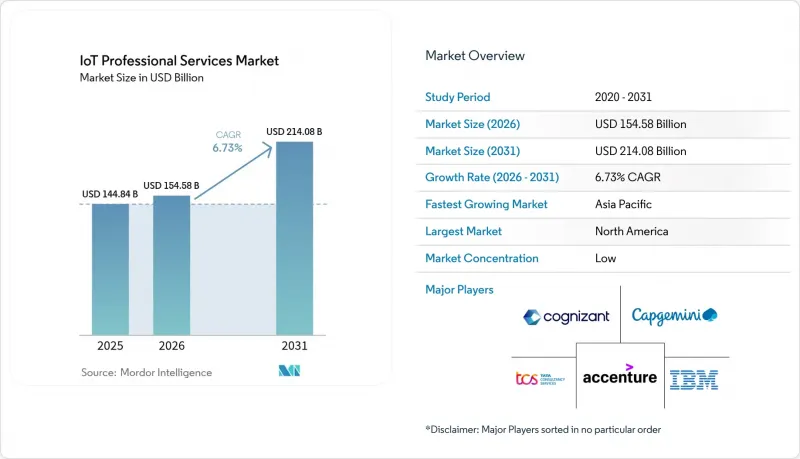
本報告按服務類型(物聯網諮詢、物聯網基礎設施服務等)、組織規模(中小企業和大型企業)、部署模式(雲端、本地部署、混合部署)、最終用戶產業(製造業、零售業等)和地區進行細分。市場預測以美元計價。
全球物聯網專業服務市場趨勢與洞察
互聯設備和感測器成本的快速成長
隨著全球連網設備數量達到188億,企業管理各種硬體、韌體和通訊協定的能力正面臨極限挑戰。儘管感測器價格的下降使得大規模部署在經濟上可行,但設備異質性的增加也加劇了生命週期管理的複雜性。因此,專業服務合作夥伴需要設計能夠處理多廠商設備叢集的配置、部署和監控框架。輕量級M2M、零接觸接入和安全元件認證正作為最佳實踐藍圖受到越來越多的關注。預計到2028年,邊緣運算領域的投資將達到3,780億美元,這將進一步推動對能夠平衡本地處理和雲端分析的整合服務的需求。
企業數位轉型藍圖
董事會越來越將物聯網數據視為戰略資產,並將互聯設備相關項目整合到更廣泛的數位化核心項目的趨勢也日益明顯。 IBM報告稱,其與數位轉型相關的顧問收入達49.6億美元,反映出企業正從孤立的先導計畫轉向全公司範圍的現代化。服務供應商的價值如今取決於其將營運關鍵績效指標 (KPI) 與感測器架構和分析管道相連接的能力,從而實現可衡量的投資回報率 (ROI)。隨著買家要求獲得運作、成本節約或收入成長的保證,基於結果的定價模式正變得越來越受歡迎。隨著數位化核心的日趨成熟,對能夠持續最佳化設備、網路和應用程式效能的託管服務的需求也日益成長。
對資料隱私和網路安全的擔憂
根據Ordr的研究,醫療保健產業82%的物聯網環境至少存在一個關鍵漏洞,導致董事會層級更加擔憂勒索軟體、安全風險和監管罰款。這就需要多層防禦,從安全啟動晶片到加密資料管道和微隔離網路。所需技能涵蓋嵌入式安全、OT協定和雲端身分與存取管理(IAM),但大多數IT團隊仍人手不足。投資於「安全營運中心即服務」(SOCaaS)、紅隊測試和零信任參考架構的服務供應商最有能力將安全疑慮轉化為多年的長期服務協議。
細分市場分析
預計到2025年,物聯網諮詢將維持32.10%的收入佔有率。這反映出市場對廠商中立策略、投資報酬率建模和商業案例檢驗的持續需求。同時,隨著企業將發展藍圖轉向涉及複雜中間件、資料湖和分析編配的生產部署,系統設計和整合正以7.05%的複合年成長率快速成長。服務提供者正透過領域加速器、參考架構和基於結果的合約來凸顯自身優勢,這些合約將報酬與工廠車間運轉率和能源效率的提升掛鉤。隨著5G和邊緣運算專案從試點階段過渡到全面部署,物聯網設計和整合領域的專業服務市場預計將快速擴張。
此外,市場對結合設備監控、預測性維護和遠端更新編配的託管服務需求日益成長。供應商透過基於平台訂閱和服務等級協定 (SLA) 的營運中心捆綁銷售,確保持續收入並加強客戶忠誠度。隨著整合複雜性的增加,投資於韌體持續整合/持續配置(CI/CD) 工具、數位孿生模擬和人工智慧驅動的測試自動化,對於在物聯網專業服務市場中保持競爭力至關重要。
大型企業憑藉多元化的業務組合、全球供應鏈和大規模現代化預算,將在2025年佔據63.05%的支出佔有率。同時,中小企業(SME)是成長最快的買家群體,年複合成長率(CAGR)達7.28%,這主要得益於按需付費雲端平台的普及,這些平台能夠降低計量收費並縮短部署時間。對於中小企業而言,服務合作夥伴需要提供打包好的入門套件、模組化定價和資金籌措支持,以使成本與短期現金流相匹配。能夠根據資源有限的團隊需求客製化管治範本、安全基準和投資報酬率(ROI)儀錶板的供應商,將在物聯網專業服務市場這一快速成長的細分領域中獲得決定性優勢。
對於大型客戶而言,隨著交易規模的擴大,會湧現出涵蓋諮詢、整合和營運管理等多個領域的複雜專案。這些專案通常涉及分階段的全球部署,並透過混合交付中心進行協調。相較之下,中小企業 (SME) 的專案則更注重快速實現價值、與 ERP 和 CRM 系統預先配置的整合,以及冷鏈監控和能源分錶計量等行業特定模板。這種兩極化迫使供應商採取雙重打入市場策略:一方面在整個物聯網專業服務市場中標準化面向中小企業的快速專案交付,另一方面保持對財富 500 強客戶的深厚專業知識。
區域分析
預計到2025年,北美將佔全球收入的36.95%,這得益於先進的5G網路普及、強勁的創業融資以及聯邦政府主導的各項舉措,例如美國國家標準與技術研究院(NIST)的國家物聯網戰略。美國企業優先考慮零信任安全和人工智慧驅動的分析,推動複雜的多塔項目,而這些項目更有利於擁有端到端解決方案的供應商。加拿大受益於近岸外包趨勢和工業IoT的現代化,而墨西哥則利用依賴即時供應鏈可視性的跨境製造走廊。
亞太地區是成長最快的地區,複合年成長率達7.88%。中國正大力投資智慧城市建設,並積極推動工業物聯網(IIoT)平台的發展,以實現製造業的數位轉型。日本的「Society 5.0」計畫和新加坡的「智慧國家」舉措正在推動該地區對合規且擴充性解決方案的需求。印度的半導體和人工智慧政策進一步擴大了目標市場。為了在物聯網專業服務市場中把握這一發展勢頭,服務供應商必須在成本競爭力、文化相容性和本地語言支援之間取得平衡。
在歐洲,GDPR、歐盟網路安全法和各國工業4.0框架正在創造並維持對以管治主導的諮詢和認證支援的需求。德國、法國和英國正在大力投資數位孿生項目,而東歐國家則利用歐盟資金實現基礎設施現代化。中東和非洲地區仍在發展中,但海灣國家正基於「2030願景」加速推進智慧城市建設,這催生了對承包專業服務的需求,並展現出良好的未來前景。
其他好處:
- Excel格式的市場預測(ME)表
- 3個月的分析師支持
目錄
第1章:引言
- 研究假設和市場定義
- 調查範圍
第2章:調查方法
第3章執行摘要
第4章 市場狀況
- 市場概覽
- 市場促進因素
- 連網型設備的激增和感測器成本的降低
- 企業數位轉型藍圖
- 5G和邊緣運算的部署
- 工業4.0和智慧基礎設施的監管舉措
- 物聯網服務的基於績效的定價模式
- AI驅動的AIOps平台正在推動對整合的需求。
- 市場限制因素
- 資料隱私和網路安全問題
- 標準的互通性和碎片化
- 物聯網熟練人員短缺
- 仔細審視超大規模雲端工作負載的碳足跡
- 供應鏈分析
- 監理情勢
- 物聯網生態系分析
- 技術展望
- 波特五力分析
- 供應商的議價能力
- 買方的議價能力
- 新進入者的威脅
- 替代品的威脅
- 競爭公司之間的競爭
- 宏觀經濟因素對市場的影響
第5章 市場規模與成長預測
- 按服務類型
- 物聯網諮詢
- 物聯網基礎設施服務
- 系統設計與整合
- 其他
- 按組織規模
- 中小企業
- 大公司
- 部署模式
- 基於雲端的
- 現場
- 混合
- 按最終用戶行業分類
- 製造業
- 零售
- 衛生保健
- 能源公用事業
- 運輸/物流
- 其他行業
- 按地區
- 北美洲
- 美國
- 加拿大
- 墨西哥
- 南美洲
- 巴西
- 阿根廷
- 其他南美國家
- 歐洲
- 德國
- 英國
- 法國
- 義大利
- 西班牙
- 俄羅斯
- 其他歐洲國家
- 亞太地區
- 中國
- 日本
- 印度
- 韓國
- 澳洲
- 其他亞太國家
- 中東和非洲
- 中東
- GCC
- 土耳其
- 以色列
- 其他中東國家
- 非洲
- 南非
- 奈及利亞
- 其他非洲國家
- 中東
- 北美洲
第6章 競爭情勢
- 市場集中度
- 策略趨勢
- 市佔率分析
- 公司簡介
- IBM Corporation
- Accenture PLC
- ATandT Inc.
- Oracle Corporation
- Cognizant Technology Solutions
- Capgemini SE
- General Electric Company
- DXC Technology Company
- Tata Consultancy Services
- Wipro Ltd.
- Virtusa Corp.
- Infosys Ltd.
- Huawei Technologies
- Siemens AG
- Bosch.IO GmbH
- Tech Mahindra Ltd.
- PwC
- HCLTech Ltd.
- KPMG International
- Deloitte
第7章 市場機會與未來展望
According to Mordor Intelligence, the IoT professional services market size was valued at USD 144.84 billion in 2025 and estimated to grow from USD 154.58 billion in 2026 to reach USD 214.08 billion by 2031, at a CAGR of 6.73% during the forecast period (2026-2031).
This report is Segmented by Service Type (IoT Consulting, Iot Infrastructure Services, and More), Organization Size (SMEs and Large Enterprises), Deployment Mode (Cloud-Based, On-Premises, and Hybrid), End-User Industry (Manufacturing, Retail, and More), and by Geography. The Market Forecasts are Provided in Terms of Value (USD).
Global IoT Professional Services Market Trends and Insights
Proliferation of Connected Devices and Falling Sensor Costs
Global connected-device volumes climbed to 18.8 billion units, stretching enterprise capacity to manage diverse hardware, firmware, and communication protocols. Lower sensor prices make large-scale rollouts financially viable, yet device heterogeneity magnifies lifecycle-management complexity. Professional-service partners are therefore asked to design provisioning, configuration, and monitoring frameworks that accommodate multivendor fleets. Lightweight M2M, Zero-Touch onboarding, and secure element authentication are gaining traction as best-practice blueprints. Edge-computing investment, projected to total USD 378 billion by 2028, further amplifies demand for integration services that balance on-premises processing with cloud analytics.
Enterprise Digital-Transformation Roadmaps
Boards increasingly treat IoT data as a strategic asset, folding connected-device projects into broader digital-core programs. IBM reported USD 4.96 billion in consulting revenue tied to digital-transformation engagements, underscoring the shift from isolated pilots to enterprise-wide modernization.Service providers are now evaluated on their ability to map operational KPIs to sensor architectures and analytics pipelines that deliver measurable ROI. Outcome-based pricing is gaining favor as buyers demand guarantees on uptime, cost savings, or revenue uplift. As digital cores mature, demand rises for managed-service wraps that continuously optimize device, network, and application performance.
Data-Privacy and Cyber-Security Concerns
Ordr found 82% of healthcare IoT environments host at least one serious vulnerability, fuelling board-level anxiety over ransomware, safety risks, and regulatory fines. Enterprises therefore require layered defenses ranging from secure-boot chips to encrypted data pipelines and micro-segmented networks. The skills needed cut across embedded security, OT protocols, and cloud IAM, yet most IT teams remain understaffed. Service providers investing in SOC-as-a-service, red-team testing, and zero-trust reference architectures are best placed to convert security fears into multi-year retainer contracts.
Other drivers and restraints analyzed in the detailed report include:
- 5G and Edge-Computing Rollout
- Regulatory Push for Industry 4.0 and Smart Infrastructure
- Interoperability and Standards Fragmentation
For complete list of drivers and restraints, kindly check the Table Of Contents.
Segment Analysis
IoT consulting retained 32.10% revenue share in 2025, reflecting sustained demand for vendor-neutral strategy, ROI modeling, and business-case validation. System design and integration, however, is expanding at a 7.05% CAGR as enterprises convert roadmaps into production rollouts that involve complex middleware, data lake, and analytics orchestration. Providers differentiate via domain accelerators, reference architectures, and outcome-based contracts that link fees to plant-floor uptime or energy-efficiency gains. The IoT professional services market size for design and integration is projected to widen sharply as 5G and edge projects graduate from pilot to scale.
Momentum is also building in managed-service wraps that combine device monitoring, predictive maintenance, and remote-update orchestration. Suppliers bundle platform subscriptions with SLA-backed operations centers to secure annuity revenue and deepen client lock-in. As integration complexity rises, tooling investments in CI/CD for firmware, digital twin simulation, and AI-driven test automation become table stakes for staying competitive in the IoT professional services market.
Large enterprises generated 63.05% of 2025 spending due to diversified portfolios, global supply chains, and sizeable modernization budgets. Yet SMEs are the fastest-growing buyer group at a 7.28% CAGR, enabled by pay-as-you-go cloud platforms that cut capital outlay and compress deployment timelines. For SMEs, service partners must offer packaged starter kits, modular pricing, and financing bridges that align costs with near-term cash flows. Providers that tailor governance templates, security baselines, and ROI dashboards to resource-constrained teams gain decisive advantage within this swelling sub-segment of the IoT professional services market.
In larger accounts, volume scale yields multi-tower engagements that span advisory, integration, and managed run operations. Projects often feature phased global rollouts coordinated through hybrid delivery centers. In contrast, SME deals emphasize rapid time to value, pre-configured integrations with ERP and CRM, and vertical templates such as cold-chain monitoring or energy sub-metering. This bifurcation forces suppliers to run dual go-to-market motions, preserving depth for Fortune 500 clients while industrializing delivery for high-velocity SME opportunities across the IoT professional services market.
Complete Report Scope:
- By Service Type
- IoT Consulting
- IoT Infrastructure Services
- System Design and Integration
- Others
- By Organization Size
- Small and Medium Enterprises (SMEs)
- Large Enterprises
- By Deployment Mode
- Cloud-based
- On-premises
- Hybrid
- By End-user Industry
- Manufacturing
- Retail
- Healthcare
- Energy and Utilities
- Transportation and Logistics
- Other Industries
- By Geography
- North America
- United States
- Canada
- Mexico
- South America
- Brazil
- Argentina
- Rest of South America
- Europe
- Germany
- United Kingdom
- France
- Italy
- Spain
- Russia
- Rest of Europe
- Asia-Pacific
- China
- Japan
- India
- South Korea
- Australia
- Rest of Asia-Pacific
- Middle East and Africa
- Middle East
- GCC
- Turkey
- Israel
- Rest of Middle East
- Africa
- South Africa
- Nigeria
- Rest of Africa
- Middle East
- North America
Geography Analysis
North America retained 36.95% of 2025 revenue, supported by advanced 5G coverage, robust venture funding, and federal initiatives such as NIST's national IoT strategy. Enterprises in the United States prioritize zero-trust security and AI-enabled analytics, driving complex multi-tower engagements that favor providers with end-to-end portfolios. Canada benefits from near-shoring trends and industrial IoT modernization, while Mexico leverages cross-border manufacturing corridors that rely on real-time supply-chain visibility.
Asia-Pacific is the fastest-growing region at an 7.88% CAGR. China allocates sizable smart-city budgets and promotes Industrial Internet platforms to digitize manufacturing. Japan's Society 5.0 program and Singapore's Smart Nation initiatives reinforce regional demand for compliance-ready, scalable solutions. India's semiconductor and AI policies further expand the addressable base. Providers must balance cost-competitive delivery with deep cultural alignment and local-language support to capitalize on this momentum in the IoT professional services market.
Europe maintains steady growth underpinned by GDPR, the EU Cybersecurity Act, and national Industry 4.0 frameworks that create governance-driven demand for consulting and certification support. Germany, France, and the United Kingdom invest heavily in digital-twin programs, while Eastern European economies leverage EU funds to modernize infrastructure. Middle East and Africa remain nascent but show promise as Gulf states accelerate Vision 2030 smart-city portfolios that require turnkey professional-service engagement.
- IBM Corporation
- Accenture PLC
- ATandT Inc.
- Oracle Corporation
- Cognizant Technology Solutions
- Capgemini SE
- General Electric Company
- DXC Technology Company
- Tata Consultancy Services
- Wipro Ltd.
- Virtusa Corp.
- Infosys Ltd.
- Huawei Technologies
- Siemens AG
- Bosch.IO GmbH
- Tech Mahindra Ltd.
- PwC
- HCLTech Ltd.
- KPMG International
- Deloitte
Additional Benefits:
- The market estimate (ME) sheet in Excel format
- 3 months of analyst support
TABLE OF CONTENTS
1 INTRODUCTION
- 1.1 Study Assumptions and Market Definition
- 1.2 Scope of the Study
2 RESEARCH METHODOLOGY
3 EXECUTIVE SUMMARY
4 MARKET LANDSCAPE
- 4.1 Market Overview
- 4.2 Market Drivers
- 4.2.1 Proliferation of connected devices and falling sensor costs
- 4.2.2 Enterprise digital-transformation roadmaps
- 4.2.3 5G and edge-computing rollout
- 4.2.4 Regulatory push for Industry 4.0 and smart infrastructure
- 4.2.5 Outcome-based pricing models for IoT services
- 4.2.6 AI-driven AIOps platforms creating integration demand
- 4.3 Market Restraints
- 4.3.1 Data-privacy and cyber-security concerns
- 4.3.2 Interoperability and standards fragmentation
- 4.3.3 Shortage of skilled IoT talent
- 4.3.4 Carbon-footprint scrutiny of hyperscale cloud workloads
- 4.4 Supply-Chain Analysis
- 4.5 Regulatory Landscape
- 4.6 IoT Ecosystem Analysis
- 4.7 Technological Outlook
- 4.8 Porter's Five Force Analysis
- 4.8.1 Bargaining Power of Suppliers
- 4.8.2 Bargaining Power of Buyers
- 4.8.3 Threat of New Entrants
- 4.8.4 Threat of Substitutes
- 4.8.5 Intensity of Competitive Rivalry
- 4.9 Impact of Macro Economic Factors on the Market
5 MARKET SIZE AND GROWTH FORECASTS (VALUE)
- 5.1 By Service Type
- 5.1.1 IoT Consulting
- 5.1.2 IoT Infrastructure Services
- 5.1.3 System Design and Integration
- 5.1.4 Others
- 5.2 By Organization Size
- 5.2.1 Small and Medium Enterprises (SMEs)
- 5.2.2 Large Enterprises
- 5.3 By Deployment Mode
- 5.3.1 Cloud-based
- 5.3.2 On-premises
- 5.3.3 Hybrid
- 5.4 By End-user Industry
- 5.4.1 Manufacturing
- 5.4.2 Retail
- 5.4.3 Healthcare
- 5.4.4 Energy and Utilities
- 5.4.5 Transportation and Logistics
- 5.4.6 Other Industries
- 5.5 By Geography
- 5.5.1 North America
- 5.5.1.1 United States
- 5.5.1.2 Canada
- 5.5.1.3 Mexico
- 5.5.2 South America
- 5.5.2.1 Brazil
- 5.5.2.2 Argentina
- 5.5.2.3 Rest of South America
- 5.5.3 Europe
- 5.5.3.1 Germany
- 5.5.3.2 United Kingdom
- 5.5.3.3 France
- 5.5.3.4 Italy
- 5.5.3.5 Spain
- 5.5.3.6 Russia
- 5.5.3.7 Rest of Europe
- 5.5.4 Asia-Pacific
- 5.5.4.1 China
- 5.5.4.2 Japan
- 5.5.4.3 India
- 5.5.4.4 South Korea
- 5.5.4.5 Australia
- 5.5.4.6 Rest of Asia-Pacific
- 5.5.5 Middle East and Africa
- 5.5.5.1 Middle East
- 5.5.5.1.1 GCC
- 5.5.5.1.2 Turkey
- 5.5.5.1.3 Israel
- 5.5.5.1.4 Rest of Middle East
- 5.5.5.2 Africa
- 5.5.5.2.1 South Africa
- 5.5.5.2.2 Nigeria
- 5.5.5.2.3 Rest of Africa
- 5.5.5.1 Middle East
- 5.5.1 North America
6 COMPETITIVE LANDSCAPE
- 6.1 Market Concentration
- 6.2 Strategic Moves
- 6.3 Market Share Analysis
- 6.4 Company Profiles (includes Global level Overview, Market level overview, Core Segments, Financials as available, Strategic Information, Market Rank/Share for key companies, Products and Services, and Recent Developments)
- 6.4.1 IBM Corporation
- 6.4.2 Accenture PLC
- 6.4.3 ATandT Inc.
- 6.4.4 Oracle Corporation
- 6.4.5 Cognizant Technology Solutions
- 6.4.6 Capgemini SE
- 6.4.7 General Electric Company
- 6.4.8 DXC Technology Company
- 6.4.9 Tata Consultancy Services
- 6.4.10 Wipro Ltd.
- 6.4.11 Virtusa Corp.
- 6.4.12 Infosys Ltd.
- 6.4.13 Huawei Technologies
- 6.4.14 Siemens AG
- 6.4.15 Bosch.IO GmbH
- 6.4.16 Tech Mahindra Ltd.
- 6.4.17 PwC
- 6.4.18 HCLTech Ltd.
- 6.4.19 KPMG International
- 6.4.20 Deloitte
7 MARKET OPPORTUNITIES AND FUTURE OUTLOOK
- 7.1 White-space and Unmet-Need Assessment

 物聯網專業服務市場:全球市場預測,2026-2032年
 全球物聯網通訊服務市場:機會與策略展望(至2035年)
 Frost Radar™:物聯網專業及託管服務,2026 年全球物聯網通訊服務市場規模、佔有率、趨勢和成長分析報告(2026-2034年)物聯網 (IoT) 通訊服務市場:按連接技術、服務類型、網路類型、最終用戶和部署模式分類-2026-2032 年全球市場預測物聯網 (IoT)專業服務市場:按服務類型、組織規模、部署類型、合約模式和最終用戶產業分類-2026-2032 年全球市場預測2026年全球物聯網專業服務市場報告
 物聯網專業服務市場分析及預測(至2035年):按類型、產品類型、服務、技術、組件、應用、部署類型、最終用戶、功能和解決方案分類物聯網通訊服務市場分析及預測(至2035年):按類型、產品類型、服務、技術、組件、應用、部署類型、最終用戶和解決方案分類全球物聯網專業服務市場規模、佔有率、趨勢和成長分析報告(2026-2034年)