


 |
市場調查報告書
商品編碼
2123407
智慧馬達:市場佔有率分析、產業趨勢與統計、成長預測(2026-2031)Smart Motors - Market Share Analysis, Industry Trends & Statistics, Growth Forecasts (2026 - 2031) |
||||||

※ 本網頁內容可能與最新版本有所差異。詳細情況請與我們聯繫。
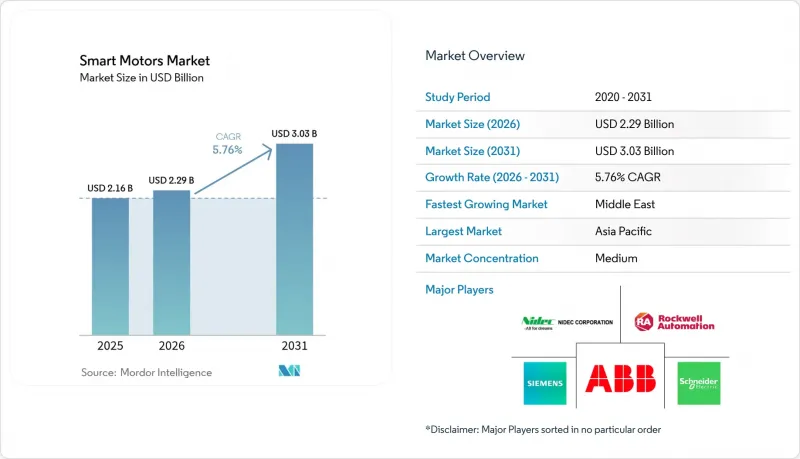
據 Mordor Intelligence 稱,2025 年智慧馬達市值為 21.6 億美元,預計到 2031 年將從 2026 年的 22.9 億美元成長至 30.3 億美元,預測期(2026-2031 年)複合年成長率為 5.76%。
本報告按組件(變頻驅動器、馬達、整合式馬達驅動器)、額定功率(小於1 kW、1–10 kW、大於10 kW)、通訊協定(乙太網路/IP等)、應用領域(工業、商業、汽車、航太與國防)以及地區(北美、南美、歐洲、亞太、中東和非洲)進行細分。市場預測以美元計價。
全球智慧馬達市場趨勢及洞察
利用SiC/GaN功率元件降低整合式馬達驅動封裝的成本
寬能隙碳化矽 (SiC) 和氮化鎵 (GaN) 電晶體已將材料成本降低了約五分之一,使供應商能夠將馬達、逆變器和反饋感測器整合到單一機殼中,而無需額外成本。超過 100 kHz 的開關頻率可將被動元件的尺寸縮小 40%,從而製造出更輕的整合單元,更容易安裝在協作機器人和電動車冷卻迴路中。傳導損耗降低了 30-35%,這對於需要延長運作的電池供電移動機器人至關重要。到 2025 年,隨著 200 毫米 SiC 晶圓全球產量的增加以及模組價格從 85 美元降至 62 美元,整合封裝也將應用於中端工業驅動器。雖然北美和歐洲的採用速度最快,但中國晶圓廠在良率和可靠性方面仍落後 12-18 個月。
歐洲和中國的強制性工業能效標準
2025年7月,歐盟將IE4能源效率標準擴展至功率低於0.75千瓦的馬達;2024年1月,中國禁止在新計畫中使用IE2馬達。這標誌著全球法規趨於統一,將IE3或更高能源效率標準作為行業標竿。一台配備驅動裝置的75千瓦IE4馬達可降低8%至12%的能耗,以工業電費計算,額外投入的1800美元成本可在18個月內收回。因此,金屬、水泥和紙漿生產商紛紛在老舊馬達失效前將其淘汰,轉而選擇具有檢驗的能源效率曲線的承包整合機組。泰國已起草提案,擬於2027年強制推行IE3能源效率標準,越南也正在討論IE4能源效率目標,這預示著東協各國將受到波及。儘管面臨宏觀經濟逆風,但馬達更換週期的加速仍支撐著市場需求的成長。
網路連接馬達系統中的網路安全漏洞
2025年發現的14個韌體漏洞可能導致未經身份驗證的Modbus-TCP寫入,進而可能使智慧驅動器的緊急停止功能失效。 2025年出貨的產品中,僅有38%符合IEC 62443 SL2標準,而達到SL3標準(強制要求加密和基於角色的存取控制)的產品不足12%。 2024年,歐洲一家加工廠因未修補的PROFINET驅動器發生安全漏洞,此後,供水事業和煉油廠面臨最大的風險。實施增強安全措施、網路分段、簽章韌體和入侵偵測系統,每台馬達將增加300至800美元的成本,並且需要同時具備營運技術(OT)和安全技能的工程師,而64%的營運商缺乏此類技能。
細分市場分析
整合式馬達和驅動器組件的成長速度超過了整體智慧馬達市場,複合年成長率達到 6.31%。這主要歸功於用戶對安裝時間縮短 30-40% 以及減少電磁干擾故障排除的需求日益成長。即使到了 2025 年,獨立式變頻驅動器仍將佔據最大的市場佔有率,達到 44.56%。這是因為改裝專案通常只需要更換控制器,而無需更換馬達本身。然而,整合式設計在移動機器人和可清洗食品加工生產線領域正逐漸受到青睞,因為它們採用單機殼、符合 IP69K 防護等級的單元,可以避免不銹鋼外殼的成本。
這種轉變符合分散式控制的發展趨勢。對於需要40個伺服的包裝機而言,將驅動器整合到每個馬達軸上可以節省一整排控制櫃的空間。儘管由於亞太地區資本預算限制,傾向於分階段升級,因此對獨立驅動器的需求仍然很高,但中國的補貼政策正推動重工業領域的國有企業向500千瓦或以上的整合平台轉型。模組化架構仍在繼續應用,允許操作人員在發生故障時單獨更換馬達或驅動器。
隨著配備4至6個輪驅動馬達(每個馬達功率為0.2至0.5千瓦)的自主移動機器人被部署在電商倉庫中,功率低於1千瓦的馬達正以每年6.34%的速度成長。相較之下,功率在1至10千瓦之間的馬達將在2025年佔據38.72%的市場佔有率,成為工業泵浦和輸送機的主力。到2025年,0.5千瓦整合馬達的單價將降至180至240美元,使以往使用恆速感應馬達的應用能夠實現更智慧的控制。
在功率超過10千瓦的等級中,石油、天然氣和金屬加工廠更注重設備的耐用性而非能源效率,因此,預測性維護升級而非電機整體更換成為主流趨勢,導致其成長率低於市場平均水平。建築自動化正在推動低功率領域的需求。例如,一棟中型辦公大樓通常安裝了100個變風量(VAV)箱,每個箱都配備了一個0.1至0.3千瓦的智慧執行器。因此,預計在預測期內,功率低於1千瓦的智慧馬達市場規模將與中功率市場規模的差距縮小。
區域分析
預計到2025年,亞太地區將佔據智慧馬達市場39.74%的最大佔有率。這得歸功於中國3,000億元人民幣(約420億美元)的節能基金,該基金用於同年升級改造180萬台馬達。印度針對白色家電和空調的生產連結獎勵計畫計畫(PLI)將使2025年的年產能增加120萬台。同時,日本和韓國的伺服馬達產量也將增加,用於機器人和半導體製造工廠。當地供應商可根據國家標準客製化整合式馬達驅動組件,從而縮短政府專案的核准週期,進一步支撐了區域需求。隨著供應鏈擺脫對單一來源零件的依賴,跨國原始設備製造商(OEM)正在越南、泰國和印尼整合電子和馬達組裝線,以降低物流風險。這些投資鞏固了該地區作為全球貨運樞紐的地位。
預計2026年至2031年間,中東智慧馬達市場將以6.71%的複合年成長率成長,成為全球成長最快的市場。這主要得益於沙烏地阿拉伯公共投資基金(PIF)在NEOM工業城投資200億美元,該工業城強制要求使用IE4馬達並獲得ISO 50001認證。阿拉伯聯合大公國杜拜電力和水務局推出了分時電價系統,將離峰時段的電價降低了18%。這鼓勵工廠採用變速驅動器來驅動壓縮機、水泵和風扇陣列。在卡達,一項價值130億美元的石化產業擴張計畫規定使用功率高達500千瓦的防爆智慧馬達;而阿曼的海水淡化計畫則在高鹽度水泵中採用了耐腐蝕的整合單元。這些舉措共同推動了大規模基礎設施投資,進而帶動了對高耐用設備的訂單。
預計到2025年,北美將佔總銷售額的約24%,這主要得益於「通貨膨脹削減法案」的稅額扣抵,該政策可報銷工廠升級成本的30%,包括電池、半導體和製藥工廠的馬達更換。歐洲緊隨其後,佔比22%,這主要得益於嚴格的生態設計法規以及每年新增超過4吉瓦的離岸風力發電裝置容量,這些新增裝置容量需要槳距和偏航控制驅動裝置。南美和非洲合計佔總支出的14%,主要得益於巴西的採礦輸送機和南非的水處理泵,這兩項應用都受惠於可降低營運成本的再生驅動技術。跨境貿易協定和更嚴格的法規(要求提高在地採購率)正促使供應商將組裝授權給區域合作夥伴,從而確保服務網路並縮短前置作業時間。
其他好處:
- Excel格式的市場預測(ME)表
- 3個月的分析師支持
目錄
第1章:引言
- 研究假設和市場定義
- 調查範圍
第2章:調查方法
第3章執行摘要
第4章 市場狀況
- 市場概覽
- 市場促進因素
- 整合智慧型馬達控制和邊緣人工智慧,實現設備端最佳化。
- 歐洲和中國有關工業能源效率標準的法規
- 商業建築暖通空調系統的快速電氣化
- 自主移動機器人和AGV的應用範圍不斷擴大
- 離岸風力發電俯仰偏航系統的擴展
- 利用SiC/GaN功率元件降低整合式馬達驅動封裝的成本
- 市場限制因素
- 網路化馬達系統中的網路安全漏洞
- 通訊協定生態系統碎片化,限制了互通性。
- 電力電子元件長期供應鏈面臨的限制日益增加
- 州級維修分析的技能差距
- 產業價值鏈分析
- 監理情勢
- 技術展望
- 波特五力分析
- 宏觀經濟因素的影響
第5章 市場規模與成長預測
- 按組件
- 變速驅動
- 引擎
- 整合馬達驅動
- 額定功率
- 小於1千瓦
- 1~10 kW
- 超過10千瓦
- 透過通訊協定
- 乙太網路/IP
- PROFINET
- Modbus TCP
- 其他通訊協定
- 透過使用
- 產業
- 石油和天然氣
- 金屬和採礦
- 水和污水處理
- 食品/飲料
- 化學品
- 商業
- 暖通空調和建築自動化
- 資料中心
- 車
- 航太/國防
- 產業
- 按地區
- 北美洲
- 美國
- 加拿大
- 墨西哥
- 南美洲
- 巴西
- 阿根廷
- 其他南美國家
- 歐洲
- 英國
- 德國
- 法國
- 義大利
- 其他歐洲國家
- 亞太地區
- 中國
- 日本
- 印度
- 韓國
- 其他亞太國家
- 中東和非洲
- 中東
- 阿拉伯聯合大公國
- 沙烏地阿拉伯
- 其他中東國家
- 非洲
- 南非
- 埃及
- 其他非洲國家
- 中東
- 北美洲
第6章 競爭情勢
- 市場集中度
- 策略趨勢
- 市佔率分析
- 公司簡介
- ABB Ltd
- Siemens AG
- Schneider Electric SE
- Rockwell Automation Inc.
- Nidec Corporation
- Applied Motion Products Inc.
- Bonfiglioli Riduttori SpA
- Brook Crompton Holdings Ltd
- Dunkermotoren GmbH
- Emerson Electric Co.
- Fuji Electric Co. Ltd
- Moog Inc.
- Nanotec Electronic GmbH and Co. KG
- Parker Hannifin Corporation
- Regal Rexnord Corporation
- Safran Electrical and Power
- SEW-Eurodrive GmbH and Co KG
- Shanghai Moons'Electric Co. Ltd
- Turntide Technologies Inc.
- WEG SA
- Yaskawa Electric Corporation
第7章 市場機會與未來展望
According to Mordor Intelligence, the smart motors market size was valued at USD 2.16 billion in 2025 and estimated to grow from USD 2.29 billion in 2026 to reach USD 3.03 billion by 2031, at a CAGR of 5.76% during the forecast period (2026-2031).
This report is Segmented by Component (Variable Speed Drive, Motor, Integrated Motor-Drive), Power Rating (Below 1 KW, 1-10 KW, Above 10 KW), Communication Protocol (Ethernet/IP, and More), Application (Industrial, Commercial, Automotive, Aerospace and Defense), and Geography (North America, South America, Europe, Asia-Pacific, Middle East and Africa). The Market Forecasts are Provided in Terms of Value (USD).
Global Smart Motors Market Trends and Insights
Declining Cost of Integrated Motor-Drive Packages Due to SiC/GaN Power Devices
Wide-bandgap silicon carbide and gallium nitride transistors are reducing material costs by nearly one-fifth, enabling suppliers to house the motor, inverter, and feedback sensor in one enclosure without a premium. Switching frequencies above 100 kHz reduces passive component size by 40%, making integrated units lighter and easier to mount in collaborative robots and electric-vehicle coolant loops. Conduction losses fall by 30-35%, a critical gain for battery-powered mobile robots that must extend runtime between charges. Global wafer output for 200 mm SiC increased in 2025, driving module prices down from USD 85 to USD 62 and making integrated packages feasible for mid-range industrial drives. Adoption is fastest in North America and Europe, while Chinese fabs remain 12-18 months behind in yield and reliability benchmarks.
Mandates on Industrial Energy Efficiency Standards in Europe and China
The European Union extended IE4 requirements to motors below 0.75 kilowatts in July 2025, and China barred IE2 motors from new projects in January 2024, converging global rules around IE3-plus efficiency. A 75-kilowatt IE4 motor with a drive consumes 8-12% less power, recouping the USD 1,800 premium within 18 months at industrial electricity tariffs. Metals, cement, and pulp producers are thus retiring motors ahead of failure, favoring turnkey integrated units that ship with verified efficiency curves. Thailand drafted an IE3 mandate for 2027, and Vietnam is consulting on IE4 targets, signaling spillover across ASEAN. Accelerated replacement cycles underpin rising demand despite macroeconomic headwinds.
Cybersecurity Vulnerabilities in Networked Motor Systems
Fourteen firmware flaws exposed in 2025 enabled unauthenticated Modbus-TCP writes that could cause smart drives to turn off emergency stops. Only 38% of 2025 shipments met SL2 of IEC 62443, and fewer than 12% reached SL3, which mandates encryption and role-based access controls. Water utilities and refineries face the greatest risk after a 2024 breach at a European treatment plant via an unpatched PROFINET drive. Hardening steps, network segmentation, signed firmware, and intrusion detection add USD 300-800 per motor and require dual-skilled OT-security engineers, a resource that 64% of operators lack.
Other drivers and restraints analyzed in the detailed report include:
- Convergence of Smart Motor Controls with Edge AI for On-Device Optimization
- Rapid Electrification of HVAC Systems in Commercial Buildings
- Fragmented Communication Protocol Ecosystem Limiting Interoperability
For complete list of drivers and restraints, kindly check the Table Of Contents.
Segment Analysis
Integrated motor-drive packages are growing faster than the overall smart motors market, with a 6.31% CAGR, capturing users who value 30-40% shorter installation times and reduced electromagnetic interference troubleshooting. Standalone variable-speed drives still accounted for the largest 44.56% of revenue in 2025 because retrofit projects often only replace the controller, not the motor. Yet integrated designs are penetrating mobile robots and wash-down food lines, where single-housing IP69K units avoid the cost of stainless-steel enclosures.
The shift aligns with distributed control trends; a packaging machine needing 40 servo axes can free an entire cabinet row by mounting integrated drives on each motor shaft. Asia-Pacific retains an appetite for standalone drives, as capital budgets favor incremental upgrades, but China's subsidy programs are tipping state enterprises in heavy industries toward integrated platforms above 500 kilowatts. Modular architectures persist, allowing operators to replace either the motor or the drive independently after a fault.
Sub-1 kilowatt motors are advancing 6.34% each year as e-commerce warehouses deploy autonomous mobile robots that carry four to six 0.2-0.5 kilowatt wheel drives per unit. In contrast, the 1-10 kilowatt class retained 38.72% of 2025 revenue and constitutes the backbone of industrial pumps and conveyors. Integrated 0.5-kilowatt packages fell to USD 180-240 per unit in 2025, enabling smart control of applications that once used fixed-speed induction motors.
Above 10 kilowatts, growth trails the market average because oil, gas, and metals plants prioritize ruggedness over energy savings, opting for predictive maintenance upgrades rather than full motor replacement. Building automation adds volume at the low end: a mid-size office may contain 100 variable-air-volume boxes, each with a 0.1-0.3 kilowatt smart actuator. Consequently, the smart motors market size for sub-kilowatt solutions is poised to close the gap with mid-power units over the forecast period.
Complete Report Scope:
- By Component
- Variable Speed Drive
- Motor
- Integrated Motor-Drive
- By Power Rating
- Below 1 kW
- 1-10 kW
- Above 10 kW
- By Communication Protocol
- Ethernet/IP
- PROFINET
- Modbus TCP
- Other Communication Protocols
- By Application
- Industrial
- Oil and Gas
- Metal and Mining
- Water and Wastewater
- Food and Beverage
- Chemicals
- Commercial
- HVAC and Building Automation
- Data Centers
- Automotive
- Aerospace and Defense
- Industrial
- By Geography
- North America
- United States
- Canada
- Mexico
- South America
- Brazil
- Argentina
- Rest of South America
- Europe
- United Kingdom
- Germany
- France
- Italy
- Rest of Europe
- Asia Pacific
- China
- Japan
- India
- South Korea
- Rest of Asia Pacific
- Middle East and Africa
- Middle East
- United Arab Emirates
- Saudi Arabia
- Rest of Middle East
- Africa
- South Africa
- Egypt
- Rest of Africa
- Middle East
- North America
Geography Analysis
Asia-Pacific held the highest smart motors market share of 39.74% in 2025, supported by China's CNY 300 billion (USD 42 billion) energy-efficiency fund that upgraded 1.8 million motors during the year. India's Production Linked Incentive program for white goods and air conditioners added 1.2 million units of annual capacity in 2025, while Japan and South Korea pushed servo-motor output for robotics and semiconductor fabs. Regional demand is reinforced by local suppliers that tailor integrated motor-drive packages to national standards, shortening approval cycles for government projects. As supply chains diversify away from single-source components, multinational original-equipment manufacturers are co-locating electronics and motor assembly lines in Vietnam, Thailand, and Indonesia to contain logistics risk. Such investments keep the region firmly positioned as the volume anchor of global shipments.
The smart motors market size in the Middle East is projected to expand at a 6.71% CAGR between 2026 and 2031, the fastest worldwide, as Saudi Arabia's Public Investment Fund channels USD 20 billion into the NEOM industrial city, where IE4 motors and ISO 50001 certification are mandatory. The UAE's Dubai Electricity and Water Authority introduced time-of-use tariffs that cut off-peak power prices by 18%, persuading factories to retrofit variable-speed drives for compressors, pumps, and fan arrays. Qatar's USD 13 billion petrochemical expansion specifies explosion-proof smart motors up to 500 kilowatts, while Oman's desalination projects favor corrosion-resistant integrated units for high-salinity pumps. Collectively, these initiatives convert large-scale infrastructure spending into durable equipment orders.
North America accounted for roughly 24% of 2025 revenue, energized by the Inflation Reduction Act tax credits that reimburse 30% of plant upgrades, including motor replacements in battery, semiconductor, and pharmaceutical facilities. Europe followed with a 22% share, anchored by strict Ecodesign rules and more than 4 gigawatts of annual offshore wind additions that demand pitch- and yaw-control drives. South America and Africa together made up 14% of spending, led by Brazilian mining conveyors and South African water-treatment pumps, both of which benefit from regenerative drive technology that reduces operating costs. Cross-border trade agreements and rising local-content rules are prompting suppliers to license assembly to regional partners, ensuring service coverage and shorter lead times.
- ABB Ltd
- Siemens AG
- Schneider Electric SE
- Rockwell Automation Inc.
- Nidec Corporation
- Applied Motion Products Inc.
- Bonfiglioli Riduttori S.p.A.
- Brook Crompton Holdings Ltd
- Dunkermotoren GmbH
- Emerson Electric Co.
- Fuji Electric Co. Ltd
- Moog Inc.
- Nanotec Electronic GmbH and Co. KG
- Parker Hannifin Corporation
- Regal Rexnord Corporation
- Safran Electrical and Power
- SEW-Eurodrive GmbH and Co KG
- Shanghai Moons' Electric Co. Ltd
- Turntide Technologies Inc.
- WEG S.A.
- Yaskawa Electric Corporation
Additional Benefits:
- The market estimate (ME) sheet in Excel format
- 3 months of analyst support
TABLE OF CONTENTS
1 INTRODUCTION
- 1.1 Study Assumptions and Market Definition
- 1.2 Scope of the Study
2 RESEARCH METHODOLOGY
3 EXECUTIVE SUMMARY
4 MARKET LANDSCAPE
- 4.1 Market Overview
- 4.2 Market Drivers
- 4.2.1 Convergence of Smart Motor Controls with Edge AI for On-Device Optimization
- 4.2.2 Mandates on Industrial Energy Efficiency Standards in Europe and China
- 4.2.3 Rapid Electrification of HVAC Systems in Commercial Buildings
- 4.2.4 Increasing Adoption in Autonomous Mobile Robots and AGVs
- 4.2.5 Rising Deployment in Offshore Wind Turbine Pitch and Yaw Systems
- 4.2.6 Declining Cost of Integrated Motor-Drive Packages Due to SiC/GaN Power Devices
- 4.3 Market Restraints
- 4.3.1 Cybersecurity Vulnerabilities in Networked Motor Systems
- 4.3.2 Fragmented Communication Protocol Ecosystem Limiting Interoperability
- 4.3.3 Prolonged Supply Chain Constraints for Power Electronics Components
- 4.3.4 Skills Gap in Condition-Based Maintenance Analytics
- 4.4 Industry Value Chain Analysis
- 4.5 Regulatory Landscape
- 4.6 Technological Outlook
- 4.7 Porter's Five Forces Analysis
- 4.7.1 Bargaining Power of Suppliers
- 4.7.2 Bargaining Power of Buyers
- 4.7.3 Threat of New Entrants
- 4.7.4 Threat of Substitutes
- 4.7.5 Degree of Competition
- 4.8 Impact of Macroeconomic Factors
5 MARKET SIZE AND GROWTH FORECASTS (VALUE)
- 5.1 By Component
- 5.1.1 Variable Speed Drive
- 5.1.2 Motor
- 5.1.3 Integrated Motor-Drive
- 5.2 By Power Rating
- 5.2.1 Below 1 kW
- 5.2.2 1-10 kW
- 5.2.3 Above 10 kW
- 5.3 By Communication Protocol
- 5.3.1 Ethernet/IP
- 5.3.2 PROFINET
- 5.3.3 Modbus TCP
- 5.3.4 Other Communication Protocols
- 5.4 By Application
- 5.4.1 Industrial
- 5.4.1.1 Oil and Gas
- 5.4.1.2 Metal and Mining
- 5.4.1.3 Water and Wastewater
- 5.4.1.4 Food and Beverage
- 5.4.1.5 Chemicals
- 5.4.2 Commercial
- 5.4.2.1 HVAC and Building Automation
- 5.4.2.2 Data Centers
- 5.4.3 Automotive
- 5.4.4 Aerospace and Defense
- 5.4.1 Industrial
- 5.5 By Geography
- 5.5.1 North America
- 5.5.1.1 United States
- 5.5.1.2 Canada
- 5.5.1.3 Mexico
- 5.5.2 South America
- 5.5.2.1 Brazil
- 5.5.2.2 Argentina
- 5.5.2.3 Rest of South America
- 5.5.3 Europe
- 5.5.3.1 United Kingdom
- 5.5.3.2 Germany
- 5.5.3.3 France
- 5.5.3.4 Italy
- 5.5.3.5 Rest of Europe
- 5.5.4 Asia Pacific
- 5.5.4.1 China
- 5.5.4.2 Japan
- 5.5.4.3 India
- 5.5.4.4 South Korea
- 5.5.4.5 Rest of Asia Pacific
- 5.5.5 Middle East and Africa
- 5.5.5.1 Middle East
- 5.5.5.1.1 United Arab Emirates
- 5.5.5.1.2 Saudi Arabia
- 5.5.5.1.3 Rest of Middle East
- 5.5.5.2 Africa
- 5.5.5.2.1 South Africa
- 5.5.5.2.2 Egypt
- 5.5.5.2.3 Rest of Africa
- 5.5.5.1 Middle East
- 5.5.1 North America
6 COMPETITIVE LANDSCAPE
- 6.1 Market Concentration
- 6.2 Strategic Moves
- 6.3 Market Share Analysis
- 6.4 Company Profiles (includes Global Level Overview, Market Level Overview, Core Segments, Financials as available, Strategic Information, Market Rank/Share, Products and Services, Recent Developments)
- 6.4.1 ABB Ltd
- 6.4.2 Siemens AG
- 6.4.3 Schneider Electric SE
- 6.4.4 Rockwell Automation Inc.
- 6.4.5 Nidec Corporation
- 6.4.6 Applied Motion Products Inc.
- 6.4.7 Bonfiglioli Riduttori S.p.A.
- 6.4.8 Brook Crompton Holdings Ltd
- 6.4.9 Dunkermotoren GmbH
- 6.4.10 Emerson Electric Co.
- 6.4.11 Fuji Electric Co. Ltd
- 6.4.12 Moog Inc.
- 6.4.13 Nanotec Electronic GmbH and Co. KG
- 6.4.14 Parker Hannifin Corporation
- 6.4.15 Regal Rexnord Corporation
- 6.4.16 Safran Electrical and Power
- 6.4.17 SEW-Eurodrive GmbH and Co KG
- 6.4.18 Shanghai Moons' Electric Co. Ltd
- 6.4.19 Turntide Technologies Inc.
- 6.4.20 WEG S.A.
- 6.4.21 Yaskawa Electric Corporation
7 MARKET OPPORTUNITIES AND FUTURE OUTLOOK
- 7.1 White-Space and Unmet-Need Assessment

 智慧整合伺服馬達市場:全球市場預測(2026-2032年)
 智慧馬達市場規模、佔有率、趨勢及預測(按組件、產品、應用和地區分類),2026-2034年
 2026年全球機器人智慧馬達市場報告工業智慧馬達市場:2026-2032年全球市場預測(依產品類型、額定功率、技術、通訊協定、應用、銷售管道和最終用戶產業分類)智慧馬達市場:按馬達類型、電壓、功率等級、連接方式、最終用途和分銷管道分類-2026-2032年全球預測智慧整合馬達市場:依馬達類型、額定功率、終端用戶產業、控制技術和整合度分類,全球預測,2026-2032年日本智慧工業馬達市場規模、佔有率、趨勢及預測(按馬達類型、連接性和智慧化程度、額定功率、終端用戶產業和地區分類),2026-2034年
 智慧馬達:全球市場佔有率和排名、總收入和需求預測(2025-2031年)
 智慧汽車市場:2025-2030 年預測
 全球智慧馬達市場:2024年