


 |
市場調查報告書
商品編碼
2123401
真空包裝:市場佔有率分析、產業趨勢與統計、成長預測(2026-2031)Vacuum Packaging - Market Share Analysis, Industry Trends & Statistics, Growth Forecasts (2026 - 2031) |
||||||

※ 本網頁內容可能與最新版本有所差異。詳細情況請與我們聯繫。
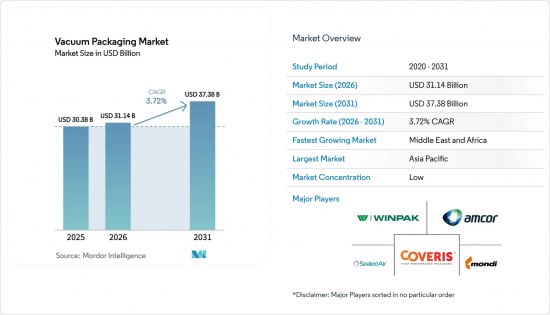
根據 Mordor Intelligence 預測,真空包裝市場規模將從 2025 年的 303.8 億美元和 2026 年的 311.4 億美元成長到 2031 年的 373.8 億美元,2026 年至 2031 年的年複合成長率(CAGR)為 3.72%。
本報告按包裝類型(軟包裝、硬包裝)、材料(聚乙烯、聚醯胺、聚丙烯等)、終端用戶行業(食品、醫療保健/製藥、工業產品等)、機器類型(熱成型機、腔式真空封口機、外/邊式真空封口機等)和地區進行細分。市場預測以美元計價。
全球真空包裝市場趨勢及洞察
包裝食品和簡便食品的需求不斷成長
預計到2025年,即食餐的銷售量將年增18%,這主要得益於真空包裝的蛋白質碗和酸麵包主菜在超市貨架上的普及。同期,食材自煮包公司利用已調整的包裝袋,使訂單頻率加倍。這種包裝袋無需冷凍即可保持長達10天的感官品質。如今,履約中心更傾向於選擇更大批量的合併出貨,這雖然可以降低單位物流成本約13%,但也使得包裝需要經歷更多次的搬運,而真空包裝則能承受這些搬運次數。雀巢已累計5億雷亞爾(約9,500萬美元)用於擴大其在巴西的冷藏食品產能,目標客戶是雙薪家庭,預計到2025年,雙薪家庭的消費滲透率將超過60%。消費者願意為便利的外帶20%至25%的溢價,儘管去年食品通膨有所緩解,但真空包裝產品類別仍維持了兩位數的成長。
零售商對食品安全合規性的關注度日益提高
監管機構正密切關注低酸、低氧產品中肉毒桿菌的風險。英國食品標準局 (FSA) 現要求保存期限超過 10 天的冷藏真空包裝產品必須達到 6 個對數單位的孢子減少率,或滿足其他要求,例如 pH 值低於 5.0。在美國,美國農業部食品安全檢驗局 (USDA FSIS) 根據《聯邦法規》第 9 篇第 318.300 條強制執行氣密性標準,並根據《聯邦法規》第 21 篇第 113 條強制要求進行熱處理驗證。零售商每季都會對供應商進行審核,並暫停與 30 天內不符合標準的供應商的交易。此舉有利於擁有微生物實驗室和保存期限測試設施的加工商。因此,一級供應商相對於缺乏投資驗證基礎設施資金的小規模本地企業的優勢進一步擴大。
工業真空機械的高昂資本成本
入門級腔式封口機的起價約為 15,000 美元,但完整的熱成型、灌裝和封口生產線造價超過 350 萬美元,南美和南亞的小規模合約包裝公司難以彌補這一價格差距。這些地區的資金籌措利率比已開發市場高出 300 至 500 個基點,導致投資回收期超過七年。國際金融公司 (IFC) 等發展金融機構已向巴西加工企業提供了 6,500 萬歐元(7,300 萬美元)的貸款,但這些項目僅惠及不到 5% 的符合條件的企業。供應商正在印度和印尼試點「按包裝收費」模式,但由於加工商擔心長期成本的不確定性,採用率仍低於 2%。
細分市場分析
到2025年,軟包裝將佔據真空包裝市場78.43%的佔有率,預計到2031年將以4.23%的複合年成長率成長。與托盤相比,軟包裝可減少高達50%的塑膠用量,從而在出口路線上節省近0.10美元/公斤的運費,並提高電器托特包的裝載效率。 2025年,舒爾軟包裝推出了可回收的單層聚乙烯包裝袋,可將切片熟食保鮮21天,並符合生產者延伸責任制(EPR)法規。硬質托盤維持了21.57%的市場佔有率,但由於模具成本上升阻礙了產品種類(SKU)的擴張,其成長率僅為2.8%。 Klockner Pentaplast 的 PET 托盤內建了清除器,可將紅肉的保存期限延長至 18 天,但其應用主要集中在高階自有品牌,這些品牌可以將 15% 的價格上漲轉嫁給消費者。
在電子商務領域,軟質包裝的優勢尤其顯著。與托盤相比,每個冷藏箱可容納的商品數量可增加30%,從而降低最後一公里配送成本並減少破損。根據CoverChair預測,2025年,食材自煮包的軟包裝解決方案預計將成長22%,而同類硬質包裝預計將下降3%,凸顯了不同銷售管道的偏好差異。 ISO 18601標準賦予單層軟膜比多層托盤更高的可回收性評分,這鼓勵品牌商選擇軟包裝袋。餐飲服務業仍是硬質托盤的最後堡壘,因為硬質托盤能夠承受高溫加熱,但這一細分市場僅佔真空包裝市場規模的不到10%。
到2025年,聚乙烯將佔據38.53%的市場佔有率,這主要得益於其低成本、寬廣的密封溫度範圍以及成熟的擠出生產基礎。聚丙烯適用於熱填充和蒸餾加工,而EVOH和聚醯胺則用於一些特定的氧氣阻隔應用。聚醯胺的成長速度最快,預計到2031年將以4.54%的年複合成長率(CAGR)。這是因為聚醯胺的氧氣阻隔性比聚乙烯高出七倍,使其成為熏肉和凍乾藥品等產品不可或缺的材料。
陶氏化學的「INNATE TF」樹脂系列計畫於2025年上市,旨在挑戰聚醯胺的市場主導地位,其無需層壓即可實現15 cc/m²/天的氧氣透過率。然而,由於其價格高出12-15%,目前的採用率僅為5%左右。北歐化工的「Borstar」系列樹脂具有更優異的抗穿刺性能,使加工商能夠將薄膜厚度減少約12%,從而降低每包成本0.02美元。醫療客戶正在推動聚醯胺的崛起,因為ISO 11607認證要求其在134 度C滅菌條件下保持性能。
區域分析
到2025年,亞太地區將佔全球銷售額的40.77%。這主要得益於中國480萬噸真空包裝肉類的出口以及印度冷鏈的發展。在日本,藥品包裝的即時GMP監控已成為強制性要求,加速了具備資料登錄功能的熱成型機的普及。在韓國,隨著單人家庭佔比超過30%,便利商店的真空包裝食品種類增加了18%。澳洲加工商已投資1.2億澳元(約7,800萬美元)用於建造阻隔包裝生產線,以滿足對中東和北美高階食品的出口需求。
中東和非洲是成長最快的地區,預計到2031年複合年成長率將達到5.22%。阿拉伯聯合大公國的《2050年糧食安全戰略》要求儲備10天的蛋白質,這促使超級市場越來越多採用真空包裝冷藏農產品,目前真空包裝產品已佔冷藏貨架的22%。沙烏地阿拉伯已撥款80億沙烏地里亞爾(約21億美元)用於2024年至2026年間的食品加工基礎建設。南非三大食品零售商佔了68%的市場佔有率,它們已強制要求自有品牌肉品採用真空包裝,以減少庫存損失。
北美和歐洲合計佔利樂公司2025年銷售額的45%,但成長率分別僅3.2%和2.9%。遵守美國FDA的21 CFR 113法規,每個SKU的成本高達8萬美元;而德國2024年《包裝方法》規定,對於不可回收的複合材料,生產者責任回收(EPR)費用為每公斤0.52歐元。由於加拿大擬議的一次性塑膠法規,投資時機尚不明朗。南美洲的成長率為4.1%,產能透過近岸外包和國際金融公司(IFC)支持的資本投資不斷擴大。利樂公司位於墨西哥墨西卡利工廠的設備升級,使北美近岸外包專案的熱成型產品產能提高了60%。
其他好處:
- Excel格式的市場預測(ME)表
- 3個月的分析師支持
目錄
第1章:引言
- 研究假設和市場定義
- 調查範圍
第2章:調查方法
第3章執行摘要
第4章 市場狀況
- 市場概覽
- 市場促進因素
- 包裝食品和簡便食品的需求不斷成長
- 零售商對食品安全合規性的關注度日益提高
- 食品業電子商務通路的快速擴張
- 高速熱成型生產線的自動化
- 整合式智慧感測器進行即時品質檢查
- 市場限制因素
- 工業真空設備的高額購置成本
- 多層塑膠薄膜引發的環境問題
- 對聚氯乙烯和其他鹵素基阻隔材料的監管壓力
- 受污染的軟性薄膜的回收管道有限。
- 產業價值鏈分析
- 監理情勢
- 技術展望
- 波特五力分析
- 宏觀經濟因素對市場的影響
- 投資分析
第5章 市場規模與成長預測
- 按包裝類型
- 軟包裝
- 硬包裝
- 材料
- 聚乙烯(PE)
- 聚醯胺(PA)
- 聚丙烯(PP)
- 其他材料
- 按最終用戶行業分類
- 食物
- 醫療和藥品
- 工業產品
- 其他終端用戶產業
- 按機器類型
- 熱成型機
- 腔真空封口機
- 外置/邊緣式真空封口機
- 其他機器類型
- 按地區
- 北美洲
- 美國
- 加拿大
- 墨西哥
- 南美洲
- 巴西
- 阿根廷
- 其他南美國家
- 歐洲
- 德國
- 英國
- 法國
- 義大利
- 西班牙
- 其他歐洲國家
- 亞太地區
- 中國
- 日本
- 印度
- 韓國
- 澳洲
- 其他亞太國家
- 中東和非洲
- 中東
- 沙烏地阿拉伯
- 阿拉伯聯合大公國
- 土耳其
- 其他中東國家
- 非洲
- 南非
- 埃及
- 奈及利亞
- 其他非洲國家
- 中東
- 北美洲
第6章 競爭情勢
- 市場集中度
- 策略趨勢
- 市佔率分析
- 公司簡介
- Amcor plc
- Sealed Air Corporation
- Mondi Group
- Winpak Ltd.
- Coveris Holdings SA
- Schur Flexibles Group
- Klockner Pentaplast Group
- Plastopil Ltd.
- Swiss Pac Pvt Ltd.
- Multivac Sepp Haggenmuller SE
- Ulma Packaging
- Wipak Oy
- Dow Inc.
- Bemis(An Amcor Brand)
- Constantia Flexibles
- ProAmpac LLC
- CVP Systems Inc.
- LINPAC Packaging
- Allfo Vakuumverpackungen
第7章 市場機會與未來展望
According to Mordor Intelligence, the vacuum packaging market size is projected to expand from USD 30.38 billion in 2025 and USD 31.14 billion in 2026 to USD 37.38 billion by 2031, registering a CAGR of 3.72% between 2026 to 2031.
This report is Segmented by Packaging Type (Flexible Packaging, and Rigid Packaging), Material (Polyethylene, Polyamide, Polypropylene, and More), End-User Industry (Food, Healthcare and Pharmaceutical, Industrial Goods, and More), Machinery Type (Thermoformers, Chamber Vacuum Sealers, External/ Edge Vacuum Sealers, and More), and Geography. The Market Forecasts are Provided in Terms of Value (USD).
Global Vacuum Packaging Market Trends and Insights
Growing Demand for Packaged and Convenience Foods
Ready-to-eat meal volumes increased 18% year-over-year in 2025, as vacuum-sealed protein bowls and sous-vide entrees secured a broader presence on grocery shelves. Meal-kit firms doubled the order frequency over the same period, relying on portion-controlled pouches that maintain sensory quality for up to 10 days without freezing. Fulfillment centers now favor larger, consolidated shipments, trimming logistics cost per unit by roughly 13% yet exposing packs to more handling cycles that vacuum formats withstand. Nestle has earmarked BRL 500 million (USD 95 million) to expand chilled-meal capacity in Brazil, targeting dual-income households, which were expected to surpass 60% penetration by 2025. Consumers are willing to accept a 20-25% price premium for grab-and-go convenience, supporting double-digit expansion in vacuum-packed offerings, even as food inflation moderated last year.
Increasing Focus on Food-Safety Compliance by Retailers
Regulators have zeroed in on Clostridium botulinum risk in low-acid, reduced-oxygen items. The UK Food Standards Agency now requires chilled vacuum packs marketed beyond 10 days to show a 6-log spore reduction or add hurdles such as pH below 5.0. In the United States, USDA FSIS enforces hermetic standards under 9 CFR 318.300, while 21 CFR 113 covers thermal validation. Retailers audit suppliers quarterly and delist non-conformers within 30 days, a move that favors converters owning microbiology labs and shelf-life chambers. As a result, tier-1 suppliers lengthen their lead over small regionals that lack capital for validation infrastructure.
High Capital Cost of Industrial Vacuum Machinery
Entry-level chamber sealers start at around USD 15,000, while full thermoform-fill-seal lines exceed USD 3.5 million, a gap that small co-packers in South America and South Asia struggle to bridge. Financing in those regions carries premiums of 300-500 bps above developed-market rates, pushing payback beyond seven years. Development lenders, such as the IFC, injected EUR 65 million (USD 73 million) into a Brazilian converter in 2025; however, such programs reach less than 5% of eligible firms. Vendors are piloting pay-per-pack fees in India and Indonesia, yet uptake stays below 2% because processors fear long-term cost uncertainty.
Other drivers and restraints analyzed in the detailed report include:
- Rapid Expansion of E-Commerce Grocery Channels
- Automation of High-Speed Thermoform Lines
- Environmental Concerns over Multi-Layer Plastic Films
For complete list of drivers and restraints, kindly check the Table Of Contents.
Segment Analysis
Flexible variants accounted for 78.43% of the vacuum packaging market share in 2025 and are projected to grow at a 4.23% CAGR through 2031. They use up to 50% less resin than trays, resulting in freight savings of nearly USD 0.10 per kilogram on export routes and enabling better cube utilization in e-commerce totes. Schur Flexibles launched a recyclable polyethylene mono-material pouch in 2025 that preserves sliced deli meats for 21 days while complying with Extended Producer Responsibility rules. Rigid trays kept a 21.57% share but grew only 2.8% as higher tooling costs hindered SKU proliferation. Klockner Pentaplast's PET tray with built-in scavengers now extends the color life of red meat to 18 days; however, adoption is concentrated in premium private labels willing to pass a 15% price increase to shoppers.
E-commerce accentuates the benefits of flexible packs, which stack 30% more units per refrigerated tote than trays, resulting in lower last-mile costs and fewer breakages. Coveris reported 22% growth in flexible solutions for meal kits in 2025, whereas rigid equivalents slipped 3%, underscoring channel preference. ISO 18601 assigns higher recyclability scores to mono-material flexible films than to multi-substrate trays, encouraging brand owners to opt for pouches. Foodservice remains the last stronghold for rigid trays because they endure high-heat reheating, a niche representing under 10% of vacuum packaging market size.
Polyethylene represented 38.53% of the market share in 2025, driven by its low cost, broad sealing window, and installed extrusion base. Polypropylene is suitable for hot-fill and retort duty, while niche oxygen-barrier jobs rely on EVOH and polyamide. Polyamide logs the quickest 4.54% CAGR through 2031, as its oxygen barrier is up to seven times tighter than polyethylene, making it essential for cured meats and lyophilized drugs.
Dow's 2025 INNATE TF resin family aims to dethrone polyamide by achieving 15 cc/m2/day oxygen rates without lamination; however, uptake currently sits at around 5% due to 12-15% price premiums. Borealis' Borstar line enhances puncture resistance, enabling converters to reduce film gauge by approximately 12%, resulting in a savings of USD 0.02 per pack. Healthcare customers underpin polyamide's rise because ISO 11607 validation counts on its toughness during 134 °C sterilization.
Complete Report Scope:
- By Packaging Type
- Flexible Packaging
- Rigid Packaging
- By Material
- Polyethylene (PE)
- Polyamide (PA)
- Polypropylene (PP)
- Other Materials
- By End-User Industry
- Food
- Healthcare and Pharmaceutical
- Industrial Goods
- Other End -user Industries
- By Machinery Type
- Thermoformers
- Chamber Vacuum Sealers
- External / Edge Vacuum Sealers
- Other Machinery Types
- By Geography
- North America
- United States
- Canada
- Mexico
- South America
- Brazil
- Argentina
- Rest of South America
- Europe
- Germany
- United Kingdom
- France
- Italy
- Spain
- Rest of Europe
- Asia-Pacific
- China
- Japan
- India
- South Korea
- Australia
- Rest of Asia-Pacific
- Middle East and Africa
- Middle East
- Saudi Arabia
- United Arab Emirates
- Turkey
- Rest of Middle East
- Africa
- South Africa
- Egypt
- Nigeria
- Rest of Africa
- Middle East
- North America
Geography Analysis
Asia-Pacific generated 40.77% of global revenue in 2025, fueled by China's 4.8 million-ton vacuum-packed meat exports and India's cold-chain build-out. Japan mandates real-time GMP monitoring in pharma packs, driving adoption of data-logging thermoformers. South Korea's convenience stores enlarged vacuum-meal offerings by 18% as single-person households topped 30% of dwellings. Australia's processors invested AUD 120 million (USD 78 million) in barrier lines to serve premium exports to the Middle East and North America.
The Middle East and Africa are the fastest risers, with a 5.22% CAGR through 2031. The UAE's Food Security Strategy 2050 requires a ten-day protein reserve, prompting supermarkets to vacuum-pack chilled produce, which now occupies 22% of their fridge space. Saudi Arabia allocated SAR 8 billion (USD 2.1 billion) to food-processing infrastructure between 2024 and 2026. South Africa's top three grocers, which control 68% of the trade, have mandated vacuum packs for private-label meats to reduce shrinkage.
North America and Europe together accounted for 45% of 2025 sales, but grew modestly at 3.2% and 2.9%, respectively. FDA 21 CFR 113 compliance adds up to USD 80,000 per SKU, while Germany's 2024 packaging law imposes EUR 0.52 per kilogram EPR fees on non-recyclable laminates. Canada's pending single-use plastics rules cloud investment timing. South America advances at 4.1% as nearshoring and IFC-backed capital inject capacity. Tetra Pak's Mexicali upgrade expands thermoform output 60% for North American nearshoring programs.
- Amcor plc
- Sealed Air Corporation
- Mondi Group
- Winpak Ltd.
- Coveris Holdings SA
- Schur Flexibles Group
- Klockner Pentaplast Group
- Plastopil Ltd.
- Swiss Pac Pvt Ltd.
- Multivac Sepp Haggenmuller SE
- Ulma Packaging
- Wipak Oy
- Dow Inc.
- Bemis (An Amcor Brand)
- Constantia Flexibles
- ProAmpac LLC
- CVP Systems Inc.
- LINPAC Packaging
- Allfo Vakuumverpackungen
Additional Benefits:
- The market estimate (ME) sheet in Excel format
- 3 months of analyst support
TABLE OF CONTENTS
1 INTRODUCTION
- 1.1 Study Assumptions and Market Definition
- 1.2 Scope of the Study
2 RESEARCH METHODOLOGY
3 EXECUTIVE SUMMARY
4 MARKET LANDSCAPE
- 4.1 Market Overview
- 4.2 Market Drivers
- 4.2.1 Growing Demand for Packaged and Convenience Foods
- 4.2.2 Increasing Focus on Food-Safety Compliance by Retailers
- 4.2.3 Rapid Expansion of E-Commerce Grocery Channels
- 4.2.4 Automation of High-Speed Thermoform Lines
- 4.2.5 Integration of Smart Sensors for Real-Time Quality Checks
- 4.3 Market Restraints
- 4.3.1 High Capital Cost of Industrial Vacuum Machinery
- 4.3.2 Environmental Concerns Over Multi-Layer Plastic Films
- 4.3.3 Regulatory Pressure on PVDC and Other Halogenated Barriers
- 4.3.4 Limited Recycling Streams for Contaminated Flexible Films
- 4.4 Industry Value Chain Analysis
- 4.5 Regulatory Landscape
- 4.6 Technological Outlook
- 4.7 Porter's Five Forces Analysis
- 4.7.1 Threat of New Entrants
- 4.7.2 Bargaining Power of Buyers
- 4.7.3 Bargaining Power of Suppliers
- 4.7.4 Threat of Substitutes
- 4.7.5 Intensity of Competitive Rivalry
- 4.8 Impact of Macroeconomic Factors on the Market
- 4.9 Investment Analysis
5 MARKET SIZE AND GROWTH FORECASTS (VALUE)
- 5.1 By Packaging Type
- 5.1.1 Flexible Packaging
- 5.1.2 Rigid Packaging
- 5.2 By Material
- 5.2.1 Polyethylene (PE)
- 5.2.2 Polyamide (PA)
- 5.2.3 Polypropylene (PP)
- 5.2.4 Other Materials
- 5.3 By End-User Industry
- 5.3.1 Food
- 5.3.2 Healthcare and Pharmaceutical
- 5.3.3 Industrial Goods
- 5.3.4 Other End -user Industries
- 5.4 By Machinery Type
- 5.4.1 Thermoformers
- 5.4.2 Chamber Vacuum Sealers
- 5.4.3 External / Edge Vacuum Sealers
- 5.4.4 Other Machinery Types
- 5.5 By Geography
- 5.5.1 North America
- 5.5.1.1 United States
- 5.5.1.2 Canada
- 5.5.1.3 Mexico
- 5.5.2 South America
- 5.5.2.1 Brazil
- 5.5.2.2 Argentina
- 5.5.2.3 Rest of South America
- 5.5.3 Europe
- 5.5.3.1 Germany
- 5.5.3.2 United Kingdom
- 5.5.3.3 France
- 5.5.3.4 Italy
- 5.5.3.5 Spain
- 5.5.3.6 Rest of Europe
- 5.5.4 Asia-Pacific
- 5.5.4.1 China
- 5.5.4.2 Japan
- 5.5.4.3 India
- 5.5.4.4 South Korea
- 5.5.4.5 Australia
- 5.5.4.6 Rest of Asia-Pacific
- 5.5.5 Middle East and Africa
- 5.5.5.1 Middle East
- 5.5.5.1.1 Saudi Arabia
- 5.5.5.1.2 United Arab Emirates
- 5.5.5.1.3 Turkey
- 5.5.5.1.4 Rest of Middle East
- 5.5.5.2 Africa
- 5.5.5.2.1 South Africa
- 5.5.5.2.2 Egypt
- 5.5.5.2.3 Nigeria
- 5.5.5.2.4 Rest of Africa
- 5.5.5.1 Middle East
- 5.5.1 North America
6 COMPETITIVE LANDSCAPE
- 6.1 Market Concentration
- 6.2 Strategic Moves
- 6.3 Market Share Analysis
- 6.4 Company Profiles (Includes Global Level Overview, Market Level Overview, Core Segments, Financials as Available, Strategic Information, Market Rank/Share, Products and Services, and Recent Developments)
- 6.4.1 Amcor plc
- 6.4.2 Sealed Air Corporation
- 6.4.3 Mondi Group
- 6.4.4 Winpak Ltd.
- 6.4.5 Coveris Holdings SA
- 6.4.6 Schur Flexibles Group
- 6.4.7 Klockner Pentaplast Group
- 6.4.8 Plastopil Ltd.
- 6.4.9 Swiss Pac Pvt Ltd.
- 6.4.10 Multivac Sepp Haggenmuller SE
- 6.4.11 Ulma Packaging
- 6.4.12 Wipak Oy
- 6.4.13 Dow Inc.
- 6.4.14 Bemis (An Amcor Brand)
- 6.4.15 Constantia Flexibles
- 6.4.16 ProAmpac LLC
- 6.4.17 CVP Systems Inc.
- 6.4.18 LINPAC Packaging
- 6.4.19 Allfo Vakuumverpackungen
7 MARKET OPPORTUNITIES AND FUTURE OUTLOOK
- 7.1 White-Space and Unmet-Need Assessment

 2026-2030年全球真空包裝市場
 真空包裝市場:2026-2032年全球市場預測(按組件、包裝材料、安裝類型、真空度、包裝形式、應用和銷售管道)
 真空包裝市場預測至2034年-全球分析(按包裝類型、技術、材料類型、分銷管道、應用、最終用戶和地區分類)
 真空包裝市場:按包裝類型、材料類型、最終用途行業和地區分類
 真空包裝市場報告:按製程、材料、機械、包裝類型、應用和地區分類(2026-2034 年)商用真空包裝機市場:2026-2032年全球市場預測(依產品類型、包裝類型、操作模式、整合度、安裝配置、幫浦類型、應用、最終用戶和分銷通路分類)吸塵器塵袋市場:依產品類型、材料、最終用戶、通路和地區分類。真空包裝袋及包裝市場:依產品類型、材質類型、袋體結構、封裝類型、厚度範圍及應用分類-2026-2032年全球預測真空密封膜市場:依材料類型、產品類型、真空密封技術、厚度和應用分類-2026-2032年全球預測非食品真空包裝市場:按材料類型、包裝類型、真空包裝技術、銷售管道和最終用途行業分類-2026-2032年全球預測