


 |
市場調查報告書
商品編碼
2123399
數位印刷:市場佔有率分析、產業趨勢與統計、成長預測(2026-2031)Digital Printing - Market Share Analysis, Industry Trends & Statistics, Growth Forecasts (2026 - 2031) |
||||||

※ 本網頁內容可能與最新版本有所差異。詳細情況請與我們聯繫。
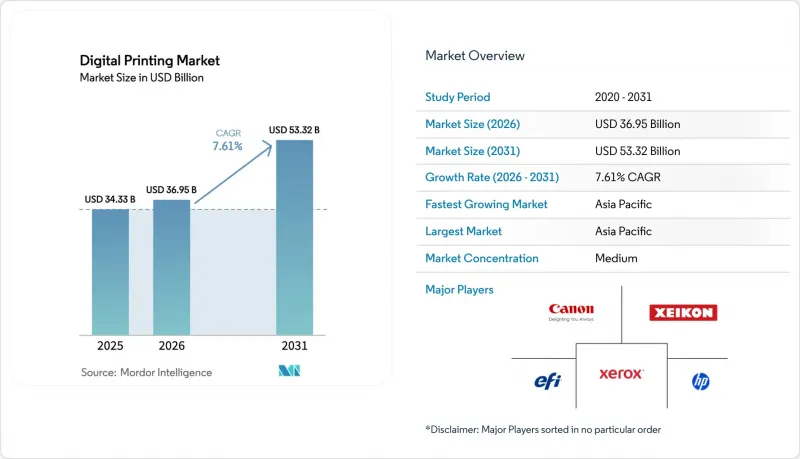
根據 Mordor Intelligence 預測,數位印刷市場預計將從 2025 年的 343.3 億美元成長到 2026 年的 369.5 億美元,到 2031 年達到 533.2 億美元,2026 年至 2031 年的複合年預計成長率為 7.61%。
本報告按印刷過程(靜電照相墨粉、噴墨)、油墨類型(水性顏料、溶劑型等)、印刷介質(紙/紙板、塑膠/薄膜、紡織品/織物等)、應用領域(書籍/出版、商業印刷、包裝、紡織品印刷等)和地區進行細分。市場預測以美元(USD)為單位。
全球數位印刷市場趨勢與洞察
對小批量客製化包裝的需求迅速成長。
隨著D2C(直接面對消費者)零售模式成為日常購物的重要組成部分,全球小包裹量持續成長,迫使包裝加工商採用能夠經濟高效地處理1000件以下包裝訂單的印表機。CanonvarioPrint iX系列印表機將設定時間縮短至3分鐘,使中型包裝盒製造商能夠在單班制下生產多達20種不同的設計版本。高混合、低批量生產模式使化妝品和營養補充劑品牌能夠在不積壓滯銷庫存的情況下測試季節性SKU。美國郵政服務(USPS)報告稱,2025年假期季節高峰期小包裹量激增23%,證實了短週期包裝並非曇花一現的趨勢。在SKU週轉速度加快的背景下,將快速設定與可變數據工作流程相結合的包裝加工商正在以電子商務為中心的品牌中贏得兩位數的市場佔有率。類比平版印刷需要製版成本和 90 分鐘的清洗過程,對於 5000 件以下的生產量來說,它不具備競爭力,這為數位印刷市場留下了持續成長的空間。
降低單位印刷成本,縮短交貨時間。
印刷機供應商降低了每次點擊成本並提高了生產效率,使其在2000至10000張訂單的成本效益方面,能夠與平版印刷相媲美。惠普的Indigo 200K配備了長壽命的Samba列印頭,更換前可列印超過20億次墨滴,每小時可生產4600張B2幅面,每張A4頁的成本低於0.02美元。一家印度標籤製造商透過部署EFI Jetrion UV單元,將訂單到出貨週期縮短至36小時,並實現了藥品序列化所需的即時圖稿修改。這些顯著的性能提升使得本地印刷商能夠承接曾經由跨國公司壟斷的業務,加劇了競爭,但也擴大了整個數位印刷市場。
高階印刷機需要大量的資金投入以及研發成本。
用於瓦楞紙板生產線的單一途徑噴墨系統成本在250萬美元至400萬美元之間,這構成了一道巨大的資金壁壘,如果沒有私募股權投資的支持,區域工廠很難跨越。以EFI的Nozomi C18000為例,在首次印刷之前,還需要額外投入50萬美元進行設備維修,包括加固地板和濕度控制等。雖然租賃協議可以減輕這一負擔,但每月3.5萬至5萬美元的租金對於年銷售額低於2000萬美元的工廠來說仍然難以負擔。這種資金籌措進一步加劇了一級加工商的優勢,他們壟斷了高利潤的品牌代工業務,阻礙了小規模印刷企業進入數位印刷市場。
細分市場分析
預計到2025年,噴墨列印將佔總銷售額的58.83%,並將以8.44%的複合年成長率持續成長至2031年。這主要得益於單一途徑架構,該架構能夠在40克/平方米的薄紙和600微米的紙板上實現每分鐘150米的列印速度。受噴墨列印普及的推動,數位印刷市場預計到2026年將超過210億美元。惠普Indigo 200K和佳能ProStream在中國和美國的部署表明,水性顏料墨水可以在塗佈紙上實現與平版印刷媲美的光澤度,同時還能在幾分鐘內完成作業切換。靜電照相列印在黑白交易印刷領域仍佔據主導地位。全錄的「Iridesse」透過添加金屬碳粉用於高階邀請函,保持了其在細分市場的地位。然而,基於碳粉的平台依賴加熱定影器,其能耗比LED-UV固化系統高出40%。這會帶來成本負擔,尤其是在能源價格波動較大的歐洲。 ISO正在修訂12647-2標準,以正式定義單一途徑的容差,預計這將有助於品牌審核並加速噴墨技術的應用。
由於永續性標準限制再生纖維中矽油的污染,靜電照相技術預計將成長約 6.2%。Ricoh無油 C9500 的維護週期已延長至 100 萬張,但可列印材料的限制仍然存在。Konica MinoltaAccurioPress C14000 在點擊率方面具有競爭力,但品牌所有者擴大選擇獲得森林管理委員會 (FSC) 和搖籃到搖籃認證的印刷機,這些認證目前更容易在水性系統中獲得。因此,噴墨印刷的多功能性和合規性使其在數位印刷市場中的佔有率持續擴大。
預計到2025年,UV固化油墨的銷售額將佔總銷售額的31.74%,年成長率為8.14%,主要得益於波長385-395奈米、可瞬間發光的LED陣列。FUJIFILMJet Press 750S高速印表機在2025年的測試中,與使用汞的舊型號相比,電力消耗量降低了60%,這使其成為歐洲印刷企業實現碳減排目標的捷徑。水性顏料油墨是瓦楞紙板和紡織品應用的主流選擇,完全不含揮發性有機化合物(VOC),且易於污水處理。乳膠油墨既符合室內空氣品質法規,又具有出色的戶外耐久性。惠普Latex 2700無需覆膜即可將戶外耐久性延長至5年,增強了圖形應用的耐用性。 Mimaki 的染料昇華噴墨產品,例如 Tiger-1800B MkII,每小時可實現 180平方公尺的列印速度,使運動服裝工廠能夠在 500 件以上服裝的生產批量中與旋轉絲網印刷競爭。
目前,溶劑型油墨主要應用於車身貼膜和戶外橫幅等領域,在這些領域,對乙烯基材料的附著力比環境法規更為重要。歐盟將於2027年生效的《永續產品生態設計條例》將強制要求紡織品貼上可回收標籤,引導消費者使用水性顏料。儘管這些變化正在豐富數位印刷市場的油墨類型,但LED-UV油墨憑藉其能源效率和合規性,仍佔據主導地位。
區域分析
預計到2025年,亞太地區將佔全球銷售額的38.73%,複合年成長率(CAGR)為8.32%。這主要得益於中國在2024年至2025年間新增200多條單一途徑板生產線,以滿足跨境運輸的需求。中國包裝集團公司預計,到2025年,瓦楞紙板產業的數位化滲透率將達到12%,是2023年的兩倍。印度的標籤產業正在快速數位化轉型,以符合食品安全標準局(FSSA)的QR碼法規。在越南和孟加拉國,隨著品牌將生產基地從中國轉移出去,服裝業的微型工廠正受到吸引;例如,Cornit於2025年初在胡志明市開設了一家培訓中心。北美地區約佔全球銷售額的28%,這主要得益於營養補充品和醫用大麻產品的軟質包裝需求,這些產品需要不斷變化的合規標籤。在加拿大,數位科技正被用於製作各省不同的毒品警告標籤;而在墨西哥,近岸外包的蓬勃發展推動了對電子產品組裝用即時 (JIT)瓦楞紙箱的需求增加。
在歐洲,歐盟綠色交易強調了永續性。 「數位產品護照」用於紡織品和包裝,需要進行單品級編碼,這項功能已無縫整合到高解析度噴墨生產線中。在德國的機械工程領域,印刷模組被整合到機器人後加工單元中;而法國的奢侈品行業則需要精準的專色再現和觸感光油飾面。在英國,創新產業對客製化、限量生產印刷品的需求,正推動中小企業購買緊湊型B2幅面噴墨印表機。這些區域趨勢共同鞏固了數位印刷市場在全球下一代製造業的核心地位。
歐洲佔據了相當大的銷售佔有率,其中德國和英國在高階噴墨印表機的應用方面處於領先地位。由於一次性塑膠製品法規的實施,投資正轉向預印紙托盤和模塑纖維,水性墨水的使用也不斷增加。法國和義大利的奢侈品牌正專注於小批量生產的數位紡織品和標籤生產線。西班牙和葡萄牙是按需服飾印刷的中心,支援向西歐隔天送達。儘管南美、中東和非洲的銷售額合計不到10%,但巴西的標籤產業正經歷兩位數的成長,阿拉伯聯合大公國正在為展會印刷商引入寬幅LED-UV設備。在南非,作為零售業總體規劃的一部分,服裝直接印刷試點項目正在進行中,這表明數位印刷市場正在穩步走向全球化。
其他好處:
- Excel格式的市場預測(ME)表
- 3個月的分析師支持
目錄
第1章:引言
- 研究假設和市場定義
- 調查範圍
第2章:調查方法
第3章執行摘要
第4章 市場狀況
- 市場概覽
- 市場促進因素
- 對交貨期短的客製化包裝的需求正在激增。
- 降低單位印刷成本,縮短交貨時間。
- 人工智慧驅動的微批量訂單快速工作流程自動化
- 歐盟和美國數位紡織微型工廠的擴張
- 對永續油墨和可回收基材的需求日益成長
- 電子商務推動了按需包裝和標籤印刷需求的激增。
- 市場限制因素
- 高階印刷機需要大量的資本投資和研發成本。
- 針對 PFAS 和溶劑型油墨的更嚴格規定導致重新認證延遲。
- 不同材料間色彩管理的持續複雜性。
- 工業噴墨印表機頭中的半導體供應瓶頸
- 產業價值鏈分析
- 監理情勢
- 技術展望
- 波特五力分析
第5章 市場規模與成長預測
- 透過印刷過程
- 靜電照相(墨粉)
- 噴墨
- 按墨水類型
- 水性顏料
- 溶劑型
- 紫外線固化型
- 乳膠
- 熱昇華
- 按基礎材料
- 紙張和紙板
- 塑膠和薄膜
- 紡織品/梭織布料
- 玻璃和陶瓷
- 金屬
- 透過使用
- 書籍和出版物
- 商業印刷
- 包裝
- 標籤
- 紙板包裝
- 紙盒
- 軟包裝
- 硬質塑膠包裝
- 金屬包裝
- 紡織印花
- 照片和產品
- 招牌和大尺寸圖形
- 按地區
- 北美洲
- 美國
- 加拿大
- 墨西哥
- 南美洲
- 巴西
- 阿根廷
- 其他南美國家
- 歐洲
- 德國
- 英國
- 法國
- 義大利
- 西班牙
- 其他歐洲國家
- 亞太地區
- 中國
- 日本
- 印度
- 韓國
- ASEAN
- 其他亞太國家
- 中東和非洲
- 中東
- 沙烏地阿拉伯
- 阿拉伯聯合大公國
- 其他中東國家
- 非洲
- 南非
- 奈及利亞
- 其他非洲國家
- 中東
- 北美洲
第6章 競爭情勢
- 市場集中度
- 策略趨勢
- 市佔率分析
- 公司簡介
- HP Inc.
- Canon Inc.
- Xerox Holdings Corporation
- Ricoh Company, Ltd.
- Electronics For Imaging, Inc.
- Konica Minolta, Inc.
- Xeikon NV
- WestRock Company
- Mondi plc
- DS Smith plc
- Amcor plc
- Multi-Color Corporation
- Avery Dennison Corporation
- Quad/Graphics, Inc.
- Durst Phototechnik AG
- Landa Digital Printing
- Domino Printing Sciences plc
- Screen Holdings Co., Ltd.
- Fujifilm Holdings Corporation
- Heidelberger Druckmaschinen AG
- Agfa-Gevaert NV
- Mimaki Engineering Co., Ltd.
- Seiko Epson Corporation
- Kornit Digital Ltd.
- OKI Data Corporation
- RR Donnelley and Sons Company
第7章 市場機會與未來展望
According to Mordor Intelligence, the digital printing market size is expected to increase from USD 34.33 billion in 2025 to USD 36.95 billion in 2026 and reach USD 53.32 billion by 2031, growing at a CAGR of 7.61% over 2026-2031.
This report is Segmented by Printing Process (Electrophotography Toner, and Inkjet), Ink Type (Water-Based Pigment, Solvent, and More), Substrate (Paper and Paperboard, Plastics and Films, Textiles/Fabrics, and More), Application (Books and Publishing, Commercial Printing, Packaging, Textile Printing, and More), and Geography. The Market Forecasts are Provided in Terms of Value (USD).
Global Digital Printing Market Trends and Insights
Booming Short-Run Customized Packaging Demand
Global parcel volumes keep rising as direct-to-consumer retail embeds itself in everyday shopping, driving converters toward press setups that economically handle sub-1,000-unit packaging jobs. Canon's varioPrint iX-series reduces changeover time to three minutes, allowing mid-size folding-carton plants to run up to 20 artwork versions during a single shift. High-mix production helps beauty and nutraceutical brands test seasonal SKUs without carrying dead inventory. The United States Postal Service logged a 23% spike in parcel volume during the 2025 holiday peak, reinforcing that quick-turn packaging is no passing trend. As SKU rotations accelerate, converters that marry fast makeready with variable-data workflows are seeing double-digit share gains among e-commerce-first brands. Analog offset, with its plate costs and 90-minute washups, cannot compete below 5,000 units, opening lasting headroom for the digital printing market.
Declining Per-Unit Print Cost and Faster Turnaround
Press vendors have trimmed click charges and raised productivity enough to match offset economics for 2,000-10,000-sheet orders. HP's Indigo 200K outputs 4,600 B2 sheets per hour at under USD 0.02 per A4 page, thanks to longer-life Samba printheads that exceed two billion drops before replacement. Label converters in India cut order-to-ship cycles to 36 hours after installing EFI Jetrion UV units, enabling real-time artwork changes required by pharmaceutical serialization. These performance jumps allow regional printers to win work once monopolized by multinational plants, boosting competition yet widening the overall digital printing market.
High Capex and R&D Outlays for High-End Presses
Single-pass inkjet systems for corrugated lines range from USD 2.5 million to USD 4 million, a capital wall that regional plants cannot scale without private-equity backing. EFI's Nozomi C18000 demands another USD 500,000 of site upgrades, from reinforced floors to humidity controls, before the first print fires. Lease deals soften the blow, yet USD 35,000-50,000 monthly notes remain untenable for plants with revenue under USD 20 million. The financing gap is pushing Tier-1 converters further ahead, consolidating high-margin brand contracts and restraining smaller shops from entering the digital printing market.
Other drivers and restraints analyzed in the detailed report include:
- Rapid AI-Enabled Workflow Automation for Micro-Batch Orders
- Expansion of Digital-Textile Micro-Factories in European Union and United States
- Stricter PFAS/Solvent-Ink Regulations Causing Re-Qualification Delays
For complete list of drivers and restraints, kindly check the Table Of Contents.
Segment Analysis
Inkjet secured 58.83% revenue in 2025 and is forecast at an 8.44% CAGR through 2031 as single-pass architectures deliver 150 meters-per-minute speeds on 40-GSM tissue and 600-micron board alike. The digital printing market size attributed to inkjet installations topped USD 21 billion in 2026. HP Indigo 200K and Canon ProStream placements in China and the United States prove that aqueous pigment lines now equal offset gloss on coated stock while switching jobs in minutes. Electrophotography still shines in monochrome transactional print; Xerox Iridesse adds metallic toner for premium invitations, sustaining its niche. Yet toner platforms rely on heated fusers that burn 40% more power than LED-UV curing, a cost penalty in Europe where energy prices remain volatile. ISO is updating standard 12647-2 to formalize single-pass tolerances, easing brand audits and accelerating inkjet adoption.
Electrophotography's growth will trail at roughly 6.2% as sustainability standards disfavor silicone-oil contamination in recycled fiber streams. Ricoh's oil-free C9500 doubles maintenance intervals to 1 million impressions, but substrate limits persist. Konica Minolta's AccurioPress C14000 competes on click rate, yet brand owners increasingly pick presses that carry Forest Stewardship Council and Cradle to Cradle seals, awards more easily earned by water-based systems. Therefore, inkjet's versatility and regulatory alignment continue to expand its share inside the digital printing market.
UV-curable formulations accounted for 31.74% of 2025 revenue and will grow at an 8.14% pace, boosted by LED arrays that fire at 385-395 nanometers and start instantly. Fujifilm Jet Press 750S High Speed demonstrated 60% lower electricity draw than mercury predecessors during 2025 tests, giving European printers a direct route to carbon-reduction targets. Water-based pigments dominate corrugated and textile applications, offering zero volatile organic compounds and straightforward wastewater treatment. Latex inks straddle indoor-air compliance and outdoor durability; HP Latex 2700 extends applied-graphics durability to a five-year outdoor life without lamination. Dye-sublimation lines such as Mimaki Tiger-1800B MkII reached 180 square meters per hour, allowing sportswear factories to compete with rotary screen at runs above 500 units.
Solvent inks now cluster in vehicle wraps and outdoor banners where adhesion to vinyl overrides environmental rules. The European Union Ecodesign for Sustainable Products Regulation, effective 2027, will obligate recyclability labeling on textiles, nudging buyers toward water-based pigments. Collectively, these shifts expand the ink type diversity in the digital printing market, but LED-UV remains the star for its energy and compliance profile.
Complete Report Scope:
- By Printing Process
- Electrophotography (Toner)
- Inkjet
- By Ink Type
- Water-based Pigment
- Solvent
- UV-Curable
- Latex
- Dye-Sublimation
- By Substrate
- Paper and Paperboard
- Plastics and Films
- Textiles / Fabrics
- Glass and Ceramics
- Metals
- By Application
- Books and Publishing
- Commercial Printing
- Packaging
- Labels
- Corrugated Packaging
- Cartons
- Flexible Packaging
- Rigid Plastic Packaging
- Metal Packaging
- Textile Printing
- Photographic and Merchandise
- Signage and Large-Format Graphics
- By Geography
- North America
- United States
- Canada
- Mexico
- South America
- Brazil
- Argentina
- Rest of South America
- Europe
- Germany
- United Kingdom
- France
- Italy
- Spain
- Rest of Europe
- Asia-Pacific
- China
- Japan
- India
- South Korea
- ASEAN
- Rest of Asia-Pacific
- Middle East and Africa
- Middle East
- Saudi Arabia
- United Arab Emirates
- Rest of Middle East
- Africa
- South Africa
- Nigeria
- Rest of Africa
- Middle East
- North America
Geography Analysis
Asia Pacific generated 38.73% of 2025 revenue and is on track for an 8.32% CAGR, anchored by more than 200 single-pass corrugated lines installed in China during 2024-2025 to serve cross-border shipments. The China National Packaging Corporation pegged digital penetration in corrugated at 12% in 2025, double 2023 levels. India's label sector is digitizing quickly to satisfy Food Safety and Standards Authority QR-code rules. Vietnam and Bangladesh attract garment micro-factories as brands diversify away from China, such as Kornit opened a Ho Chi Minh training hub in early 2025. North America captured roughly 28% of revenue, propelled by flexible packaging that serves nutraceutical and cannabis products requiring ever-changing compliance copy. Canada leverages digital for province-specific cannabis warnings, while Mexico's nearshoring boom demands just-in-time cartons for electronics assembly.
Europe emphasizes sustainability and circular-economy compliance under the EU Green Deal. The Digital Product Passport for textiles and packaging necessitates item-level encoding, a function naturally embedded within high-resolution inkjet lines. Germany's mechanical engineering base integrates print modules into robotized finishing cells, while France's luxury sector insists on exacting spot-color reproduction and tactile varnish effects. The United Kingdom exploits creative industries' demand for bespoke limited-run prints, encouraging SMEs to buy compact B2 inkjet units. Collectively, these regional dynamics reinforce the digital printing market as a cornerstone of next-generation manufacturing worldwide.
Europe held about a notable share of sales, with Germany and the United Kingdom leading installations of high-end inkjet presses. Single-Use Plastics restrictions channel investments into printed paper trays and molded fiber, favoring water-based inks. Luxury labels in France and Italy prize digital textile and label lines for limited runs. Spain and Portugal have become hubs for on-demand garment printing that meet next-day shipping into Western Europe. South America, Middle East, and Africa together form a sub-10% revenue block, yet Brazil shows double-digit label growth, and the United Arab Emirates equips exhibition printers with wide-format LED-UV units. South Africa tests direct-to-garment units under its retail master plan, indicating that the digital printing market's reach is progressively global.
- HP Inc.
- Canon Inc.
- Xerox Holdings Corporation
- Ricoh Company, Ltd.
- Electronics For Imaging, Inc.
- Konica Minolta, Inc.
- Xeikon NV
- WestRock Company
- Mondi plc
- DS Smith plc
- Amcor plc
- Multi-Color Corporation
- Avery Dennison Corporation
- Quad/Graphics, Inc.
- Durst Phototechnik AG
- Landa Digital Printing
- Domino Printing Sciences plc
- Screen Holdings Co., Ltd.
- Fujifilm Holdings Corporation
- Heidelberger Druckmaschinen AG
- Agfa-Gevaert NV
- Mimaki Engineering Co., Ltd.
- Seiko Epson Corporation
- Kornit Digital Ltd.
- OKI Data Corporation
- R.R. Donnelley and Sons Company
Additional Benefits:
- The market estimate (ME) sheet in Excel format
- 3 months of analyst support
TABLE OF CONTENTS
1 INTRODUCTION
- 1.1 Study Assumptions and Market Definition
- 1.2 Scope of the Study
2 RESEARCH METHODOLOGY
3 EXECUTIVE SUMMARY
4 MARKET LANDSCAPE
- 4.1 Market Overview
- 4.2 Market Drivers
- 4.2.1 Booming short-run customised packaging demand
- 4.2.2 Declining per-unit print cost and faster turnaround
- 4.2.3 Rapid AI-enabled workflow automation for micro-batch orders
- 4.2.4 Expansion of digital-textile micro-factories in EU and US
- 4.2.5 Rising demand for sustainable inks and recyclable substrates
- 4.2.6 E-commerce-led surge in on-demand packaging and label printing
- 4.3 Market Restraints
- 4.3.1 High CAPEX and RandD outlays for high-end presses
- 4.3.2 Stricter PFAS/solvent-ink regulations causing re-qualification delays
- 4.3.3 Persistent colour-management complexity across substrates
- 4.3.4 Semiconductor supply bottlenecks for industrial inkjet heads
- 4.4 Industry Value Chain Analysis
- 4.5 Regulatory Landscape
- 4.6 Technological Outlook
- 4.7 Porter's Five Forces Analysis
- 4.7.1 Bargaining Power of Suppliers
- 4.7.2 Bargaining Power of Buyers
- 4.7.3 Threat of New Entrants
- 4.7.4 Threat of Substitutes
- 4.7.5 Intensity of Competitive Rivalry
5 MARKET SIZE AND GROWTH FORECASTS (VALUE)
- 5.1 By Printing Process
- 5.1.1 Electrophotography (Toner)
- 5.1.2 Inkjet
- 5.2 By Ink Type
- 5.2.1 Water-based Pigment
- 5.2.2 Solvent
- 5.2.3 UV-Curable
- 5.2.4 Latex
- 5.2.5 Dye-Sublimation
- 5.3 By Substrate
- 5.3.1 Paper and Paperboard
- 5.3.2 Plastics and Films
- 5.3.3 Textiles / Fabrics
- 5.3.4 Glass and Ceramics
- 5.3.5 Metals
- 5.4 By Application
- 5.4.1 Books and Publishing
- 5.4.2 Commercial Printing
- 5.4.3 Packaging
- 5.4.3.1 Labels
- 5.4.3.2 Corrugated Packaging
- 5.4.3.3 Cartons
- 5.4.3.4 Flexible Packaging
- 5.4.3.5 Rigid Plastic Packaging
- 5.4.3.6 Metal Packaging
- 5.4.4 Textile Printing
- 5.4.5 Photographic and Merchandise
- 5.4.6 Signage and Large-Format Graphics
- 5.5 By Geography
- 5.5.1 North America
- 5.5.1.1 United States
- 5.5.1.2 Canada
- 5.5.1.3 Mexico
- 5.5.2 South America
- 5.5.2.1 Brazil
- 5.5.2.2 Argentina
- 5.5.2.3 Rest of South America
- 5.5.3 Europe
- 5.5.3.1 Germany
- 5.5.3.2 United Kingdom
- 5.5.3.3 France
- 5.5.3.4 Italy
- 5.5.3.5 Spain
- 5.5.3.6 Rest of Europe
- 5.5.4 Asia-Pacific
- 5.5.4.1 China
- 5.5.4.2 Japan
- 5.5.4.3 India
- 5.5.4.4 South Korea
- 5.5.4.5 ASEAN
- 5.5.4.6 Rest of Asia-Pacific
- 5.5.5 Middle East and Africa
- 5.5.5.1 Middle East
- 5.5.5.1.1 Saudi Arabia
- 5.5.5.1.2 United Arab Emirates
- 5.5.5.1.3 Rest of Middle East
- 5.5.5.2 Africa
- 5.5.5.2.1 South Africa
- 5.5.5.2.2 Nigeria
- 5.5.5.2.3 Rest of Africa
- 5.5.5.1 Middle East
- 5.5.1 North America
6 COMPETITIVE LANDSCAPE
- 6.1 Market Concentration
- 6.2 Strategic Moves
- 6.3 Market Share Analysis
- 6.4 Company Profiles (includes Global level Overview, Market level overview, Core Segments, Financials as available, Strategic Information, Market Rank/Share for key companies, Products and Services, and Recent Developments)
- 6.4.1 HP Inc.
- 6.4.2 Canon Inc.
- 6.4.3 Xerox Holdings Corporation
- 6.4.4 Ricoh Company, Ltd.
- 6.4.5 Electronics For Imaging, Inc.
- 6.4.6 Konica Minolta, Inc.
- 6.4.7 Xeikon NV
- 6.4.8 WestRock Company
- 6.4.9 Mondi plc
- 6.4.10 DS Smith plc
- 6.4.11 Amcor plc
- 6.4.12 Multi-Color Corporation
- 6.4.13 Avery Dennison Corporation
- 6.4.14 Quad/Graphics, Inc.
- 6.4.15 Durst Phototechnik AG
- 6.4.16 Landa Digital Printing
- 6.4.17 Domino Printing Sciences plc
- 6.4.18 Screen Holdings Co., Ltd.
- 6.4.19 Fujifilm Holdings Corporation
- 6.4.20 Heidelberger Druckmaschinen AG
- 6.4.21 Agfa-Gevaert NV
- 6.4.22 Mimaki Engineering Co., Ltd.
- 6.4.23 Seiko Epson Corporation
- 6.4.24 Kornit Digital Ltd.
- 6.4.25 OKI Data Corporation
- 6.4.26 R.R. Donnelley and Sons Company
7 MARKET OPPORTUNITIES AND FUTURE OUTLOOK
- 7.1 White-space and Unmet-Need Assessment

 數位印刷市場-2026-2032年全球市場預測
 數位印刷市場:產業趨勢及全球預測(至2035年)-按技術、油墨、印刷材料、印表機、列印速度、應用、經營模式、最終用戶、企業規模、解析度和主要地區分類
 數位印刷包裝市場預測至2034年—按包裝類型、油墨類型、印刷技術、應用、最終用戶和地區分類的全球分析
 全球數位印刷服務市場規模、佔有率、趨勢和成長分析報告(2026-2034年)
 2026-2030年全球包裝數位印刷市場
 數位印刷市場:按印字頭類型、墨水類型、應用、產品類型和地區分類
 數位印刷市場報告:按類型、油墨類型、應用和地區分類(2026-2034年)數位印刷市場規模、佔有率、成長及全球產業分析:按類型、應用和地區分類,並提供2026-2034年的洞察和預測
 陶瓷餐具數位印刷市場報告:趨勢、預測及競爭分析(至2035年)數位包裝和標籤市場:2026-2032年全球市場預測(按包裝類型、印刷技術、油墨類型、最終用途行業和應用分類)