


 |
市場調查報告書
商品編碼
2123375
ZigBee:市場佔有率分析、行業趨勢和統計數據、成長預測(2026-2031 年)ZigBee - Market Share Analysis, Industry Trends & Statistics, Growth Forecasts (2026 - 2031) |
||||||

※ 本網頁內容可能與最新版本有所差異。詳細情況請與我們聯繫。
據 Mordor Intelligence 稱,ZigBee 市場在 2025 年的價值為 51.3 億美元,預計到 2031 年將達到 73.3 億美元,而 2026 年為 54.7 億美元,預測期(2026-2031 年)的複合年成長率為 6.03%。
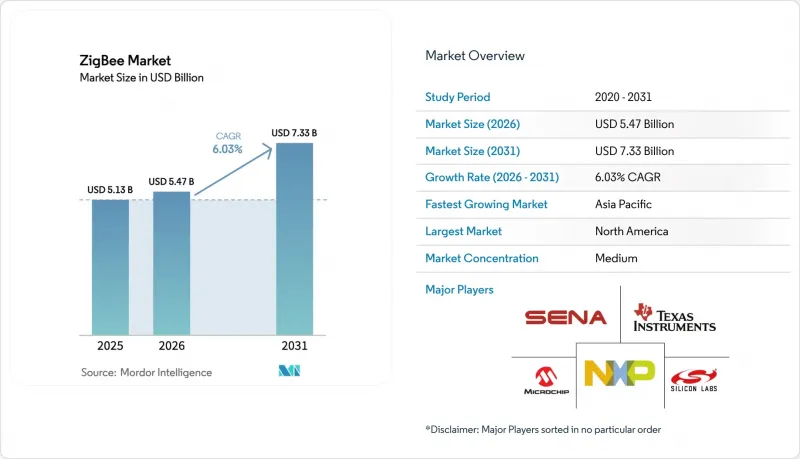
本報告按組件(晶片組、模組等)、終端用戶行業(住宅自動化、工業自動化等)、應用(照明控制、暖通空調和能源管理等)、標準/協議版本(ZigBee RF4CE等)、設備類型(協調器、路由器等)和地區進行細分。市場預測以美元(USD)計價。
全球 ZigBee 市場趨勢與洞察
在全球範圍內,智慧家居設備的普及率正在迅速提高。
2024年全球智慧家庭設備出貨量達到11億台,但具備ZigBee無線功能的產品出貨量佔比不到18%。 Matter橋接認證延長了現有ZigBee感測器的使用壽命,連接標準聯盟(CSA)截至2025年11月已認證了1800款支援Matter的產品。內建ZigBee集線器的Echo智慧音箱佔亞馬遜北美銷售額的31%,較2023年成長9個百分點。這顯示用戶對單閘道器配置的需求強勁。據一家美國物業管理公司稱,網狀網路的自癒功能使ZigBee照明網路部署的現場服務次數減少了60%,安裝人工成本減少了40%。美國聯邦通訊委員會(FCC)正在考慮將2.4 GHz頻段重新分配給5G小型基地台,但ZigBee 4.0中規定的自適應跳頻演算法旨在抵消此風險。
加速棕地工廠的工業4.0維修
2015年以前建造的工廠仍佔全球占地面積的78%,其中絕大多數缺乏無線感測器網路。西門子累計,2025會計年度基於ZigBee的感測器銷售額將達到3.4億歐元(3.8億美元),年增28%,這主要得益於預測性維護訂單的成長。德州儀器(TI)的CC2652R7無線模組透過直接從傳統的4-20 mA迴路取樣訊號,可將安裝時間縮短35%。工業乙太網升級(在2022年至2024年間新增了時間敏感網路(TSN)功能)現在利用ZigBee進行低優先級遙測,從而確保運動控制所需的頻寬。 2024年9月,國際電工委員會(IEC)修訂了IEC 62591標準,發布了ZigBee跳頻表,可將協議間干擾降低18 dB。
BLE、Wi-Fi 6 和 Matter 等技術的出現加劇了競爭。
Matter 技術抽象化了實體層,透過允許單一應用程式透過統一的 IP 協定堆疊管理 Thread、ZigBee 和 Wi-Fi 節點,從而緩解了 ZigBee 傳統上存在的廠商鎖定問題。蘋果在 iOS 18 中移除對原生 ZigBee 的支持,迫使配件製造商要么添加 Matter 網橋,要么採用 Thread。藍牙 5.4 增強的廣播功能提供了與之相當的電池續航時間和四倍的吞吐量,而售價低於 3 美元的 Wi-Fi 6E 晶片組的大規模生產也對 ZigBee 集線器的成本構成了挑戰。目前已有 68% 的 Matter 認證產品在網狀網路跳轉時優先使用 Thread,ZigBee 面臨著被淘汰為傳統終端協定的風險。
細分市場分析
到2025年,晶片組將佔據ZigBee市場佔有率的44%,因為無線組件仍然是材料清單(BOM)中最有價值的項目。然而,由於Telink和EBYTE等廠商大量推出低成本模組,2024年平均售價下降了11%。為了應對這項挑戰,供應商正將應用框架、網路分析器和雲端配置功能整合到免費工具鏈中,以提高用戶留存率。閘道器和集線器將以6.72%的複合年成長率推動市場成長,直到2031年。亞馬遜的Eero 6路由器和塗鴉智慧的Matter集線器將ZigBee的轉換功能與神經網路處理結合,透過本地佔用檢測將雲端延遲降低至85毫秒。將無線、天線和認證功能整合在一起的模組正在吸引那些缺乏射頻專業知識的消費性電子產品製造商。 Telink 報告稱,2024 年模組銷售額將達到 18 億元人民幣(2.5 億美元)。開發軟體正在從永久許可模式轉向訂閱模式,例如 NXP 於 2025 年 3 月將其 MCUXpresso SDK 的訂閱方案改為每年 499 美元。
隨著韌體支援 Matter 橋接和本地分析功能,閘道器、路由器和模組的利潤率預計將有所提高。訂閱式開發軟體將使營收趨於平穩,抵消半導體利潤率下降的影響,並縮短客戶的產品上市時間。同時,晶片供應商正在將超寬頻 (UWB) 和Sub-GHz頻段選項整合到同一晶片上,以確保設計的未來發展,隨著客戶對厘米級定位和遠端備份鏈路的需求增加,這一趨勢可能會在2027年之後略微推高平均售價(混合平均售價)。
到2025年,住宅自動化將佔ZigBee銷售額的38%,主要驅動力是照明和暖通空調(HVAC)維修,儘管成熟的獨棟住宅市場成長已趨於平緩。未來的成長將取決於多用戶住宅和設備密度較低的新興經濟體。隨著智慧電錶向分散式能源(DER)控制器演進,能源和公共產業產業預計將以8.23%的複合年成長率推動市場成長。 PG&E部署變壓器安裝式感測器表明,電網邊緣的通訊方式正從資料擷取轉向執行。在工業自動化領域(第二大收入來源),ZigBee路由器正被應用於棕地工廠,以將非關鍵資料從時間敏感網路(TSN)骨幹網路卸載。由於美國食品藥物管理局(FDA)建議使用需要許可才能用於生命維持監測的頻段,醫療產業的應用仍然有限。
支援直接IP尋址的公共產業營運商正傾向於使用ZigBee IP,這使得軟體的價值從專有協定堆疊轉向開放原始碼中間件。現有工廠的棕地製造商(OEM)正在將ZigBee與其現有PLC整合,以支援振動和環境監測,從而減少停機時間並最大限度地降低資本支出(CAPEX)。雖然零售和數位商務領域的應用案例(例如電子貨架標籤)正在緩慢擴展,但IT和通訊應用在戶外環境中正擴大遷移到LoRaWAN,這使得ZigBee的使用僅限於室內環境。
區域分析
北美地區在2025年佔全球銷售額的35%。這主要得益於2023年至2025年間加州和德克薩斯州安裝了1,800萬個支援ZigBee技術的智慧電錶終端,以及亞馬遜大規模分銷嵌入式集線器。根據美國能源資訊署(EIA)統計,目前美國有1.07億個智慧電錶運作中,其中近一半在家庭區域網路中使用ZigBee技術。在加拿大,由於各省能源法規不盡相同,智慧電錶的普及率仍維持在38%。在墨西哥,一項試點計畫正在進行中,計畫在2027年之前部署210萬個整合ZigBee需量反應功能的智慧電錶,並輔以屋頂太陽能發電獎勵。
亞太地區預計將成為所有地區中成長最快的地區,複合年成長率 (CAGR) 為 6.89%。中國的塗鴉智慧管理 3.1 億台設備,其自主研發的 SoC 比歐美同類產品便宜 35%。印度的「配電部門改革計畫」旨在到 2027 年安裝 2.5 億個智慧電錶,其中許多將整合 ZigBee 技術,用於家庭能源顯示器。日本修訂的《建築標準法》強制要求所有面積超過 300平方公尺的新建住宅安裝能源管理系統,這促使 820 萬戶現有住宅進行了維修。在韓國的松島和釜山智慧城市計畫中,已安裝了 140 萬個支援 ZigBee 的路燈和停車感應器,使市政能源消耗降低了 22%。
到2025年,歐洲將佔全球總量的28%,這主要得益於英國3,370萬個智慧電錶以及德國的節能貸款計畫。英國強制要求到2026年12月智慧電錶普及率達到75%,而德國則要求到2028年,年用電量超過6000千瓦時的家庭必須安裝電錶,這將推動對ZigBee技術的需求。法國已完成3500萬台Linky設備的安裝,這些設備使用電力線通訊(PLC)進行回程傳輸,同時保留ZigBee用於可選的室內顯示,從而為第三方設備創造了售後市場。
南美洲和中東及非洲合計佔總合佔有率的12%。巴西於2025年3月通過一項決議,要求2028年安裝1,000萬台配備ZigBee家庭區域網路的電錶,預計模組市場規模將達4.2億美元。在沙烏地阿拉伯的NEOM新城,已有34萬個ZigBee感測器運作,用於即時資源追蹤。南非於2025年1月就120萬台支援ZigBee的電錶進行競標,計劃於2027年在約翰尼斯堡和開普敦部署。
其他好處:
- Excel格式的市場預測(ME)表
- 3個月的分析師支持
目錄
第1章:引言
- 研究假設和市場定義
- 調查範圍
第2章:調查方法
第3章執行摘要
第4章 市場狀況
- 市場概覽
- 市場促進因素
- 全球智慧家庭設備的安裝數量正在爆炸式成長。
- 加速現有工廠向工業4.0的維修
- 北美和歐洲政府主導的智慧電錶部署
- 可降低物料清單成本的多重通訊協定SoC(ZigBee + BLE + Thread)。
- 利用 ZigBee 技術整合電動車充電器和家庭能源中心
- 利用 ZigBee 網狀網路在電力公司微電網中編配分散式能源 (DER) 的示範實驗
- 市場限制因素
- BLE、Wi-Fi 6 和 Matter 等技術的出現加劇了競爭。
- 不同廠商的技術堆疊之間一直存在著互通性差距。
- IEEE 802.15.4晶片晶圓代工廠產能長期短缺
- 城市中心 2.4 GHz ISM 頻段的重新分配迫在眉睫。
- 產業價值鏈分析
- 監理情勢
- 技術展望
- 宏觀經濟因素對市場的影響
- 波特五力分析
第5章 市場規模與成長預測
- 按組件
- 晶片組
- 模組
- 閘道器和集線器
- 開發工具和軟體
- 按最終用戶行業分類
- 智慧住宅系統
- 工業自動化
- 資訊科技/通訊
- 衛生保健
- 零售和數位商務
- 能源和公共產業(智慧電錶/智慧電網)
- 透過使用
- 照明控制
- 暖通空調和能源管理
- 安全和存取控制
- 資產和環境監測
- 其他(例如消費性電子設備的周邊設備)
- 標準/協議版本
- ZigBee RF4CE
- ZigBee PRO
- ZigBee 3.0
- ZigBee IP
- ZigBee 遙控器 2.0
- 依設備類型
- 協調員
- 路由器
- 終端設備/感測器
- 按地區
- 北美洲
- 美國
- 加拿大
- 墨西哥
- 南美洲
- 巴西
- 阿根廷
- 其他南美國家
- 歐洲
- 英國
- 德國
- 法國
- 義大利
- 俄羅斯
- 其他歐洲國家
- 亞太地區
- 中國
- 日本
- 印度
- 韓國
- 其他亞太國家
- 中東
- 沙烏地阿拉伯
- 阿拉伯聯合大公國
- 其他中東國家
- 非洲
- 南非
- 埃及
- 其他非洲國家
- 北美洲
第6章 競爭情勢
- 市場集中度
- 策略趨勢
- 市佔率分析
- 公司簡介
- Texas Instruments Incorporated
- Silicon Laboratories Inc.
- NXP Semiconductors NV
- Microchip Technology Inc.
- Digi International Inc.
- Nordic Semiconductor ASA
- Qualcomm Technologies Inc.
- Semiconductor Components Industries LLC(ON Semiconductor)
- Qorvo Inc.
- Telink Semiconductor(Shanghai)Co. Ltd.
- EBYTE Electronic Technology Co. Ltd.
- Tuya Smart
- Minew Technologies
- u-blox AG
- STMicroelectronics NV
- Renesas Electronics Corporation
- EnOcean GmbH
- GreenPeak Technologies(Qorvo)
- Telegesis Ltd.(Silicon Labs)
- Dresden Elektronik
第7章 市場機會與未來展望
According to Mordor Intelligence, the ZigBee market size was valued at USD 5.13 billion in 2025 and is estimated to grow from USD 5.47 billion in 2026 to reach USD 7.33 billion by 2031, at a CAGR of 6.03% during the forecast period (2026-2031).
This report is Segmented by Component (Chipsets, Modules, and More), End-User Industry (Residential Automation, Industrial Automation, and More), Application (Lighting Control, HVAC and Energy Management, and More), Standard/Protocol Version (ZigBee RF4CE, and More), Device Type (Coordinator, Router, and More), and Geography. The Market Forecasts are Provided in Terms of Value (USD).
Global ZigBee Market Trends and Insights
Explosive Smart-Home Device Installations Worldwide
Global smart-home device shipments reached 1.1 billion units in 2024, but fewer than 18% shipped with ZigBee radios. Matter bridge certification is now extending the life of existing ZigBee sensors, and the Connectivity Standards Alliance confirmed 1,800 Matter-compatible products by November 2025. Echo smart speakers that embed a ZigBee hub made up 31% of Amazon's North American sales, a nine-point jump from 2023, showing user appetite for single-gateway setups. Property-management firms in the United States reported 40% lower installation labor when deploying ZigBee lighting networks because mesh self-healing cut truck rolls by 60%. Although the Federal Communications Commission is considering reallocating 2.4 GHz spectrum for 5G small cells, adaptive frequency-hopping algorithms specified in ZigBee 4.0 are designed to offset that risk.
Accelerating Industry 4.0 Retrofits in Brown-Field Factories
Factories erected before 2015 still account for 78% of global floor space, and most lack wireless sensor grids. Siemens logged EUR 340 million (USD 380 million) in ZigBee-based sensor revenue in fiscal 2025, up 28% year on year, driven by predictive-maintenance orders. The CC2652R7 radio from Texas Instruments samples legacy 4-20 mA loops directly, trimming installation time by 35%. Industrial Ethernet upgrades that added Time-Sensitive Networking between 2022 and 2024 now lean on ZigBee for low-priority telemetry, freeing deterministic bandwidth for motion control. The IEC amended its IEC 62591 standard in September 2024 to publish ZigBee frequency-hopping tables that shrink cross-protocol interference by 18 dB.
Intensifying Competition from BLE, Wi-Fi 6 and Matter
Matter treats the physical layer as abstract, letting one app supervise Thread, ZigBee, and Wi-Fi nodes over a unified IP stack, which blunts ZigBee's historical lock-in. Apple withdrew native ZigBee support in iOS 18, compelling accessory makers to add a Matter bridge or adopt Thread. Bluetooth 5.4 extended advertising now offers comparable battery life and quadruple throughput, and Wi-Fi 6E chipsets below USD 3.00 at scale challenge ZigBee hubs on cost. As 68% of Matter-certified products already prefer Thread for the mesh hop, ZigBee risks being relegated to a legacy endpoint protocol.
Other drivers and restraints analyzed in the detailed report include:
- Government-Backed Smart-Meter Roll-outs in North America and Europe
- Multi-Protocol SoCs Lowering BOM Cost (ZigBee + BLE + Thread)
- Persistent Interoperability Gaps Across Vendor Stacks
For complete list of drivers and restraints, kindly check the Table Of Contents.
Segment Analysis
Chipsets owned 44% ZigBee market share in 2025 because the radio continues to be the most valuable line item in the bill of materials. Average selling prices, however, declined 11% in 2024 as Telink and EBYTE flooded low-cost modules. Vendors are countering by folding application frameworks, network analyzers, and cloud provisioning into free toolchains to reinforce stickiness. Gateways and hubs are the growth engine at a 6.72% CAGR through 2031. Amazon's Eero 6 router and Tuya Smart's Matter hub combine ZigBee translation with neural processing that runs presence detection locally, cutting cloud latency to 85 milliseconds. Modules attract appliance makers without RF know-how because the radio, antenna, and certifications are prepackaged, and Telink reported module revenue of CNY 1.8 billion (USD 250 million) in 2024. Development software is migrating from perpetual to subscription, as seen when NXP moved the MCUXpresso SDK to a USD 499 annual plan in March 2025.
Gateways, routers, and modules are expected to capture incremental margin because their firmware unlocks Matter bridges and local analytics. Development software's subscription shift smooths revenue, offsets margin erosion on silicon, and shortens customer time-to-market. Meanwhile, chip vendors are folding ultra-wideband and sub-GHz options onto the same die to future-proof designs, a trend that could lift blended average selling prices slightly after 2027 as customers demand centimeter-grade positioning and long-range backup links.
Residential automation in the ZigBee Market delivered 38% of 2025 revenue, primarily from lighting and HVAC retrofits, but its growth rate is plateauing in mature single-family markets. Expansion now hinges on multi-unit dwellings and emerging economies where device density is lower. Energy and utilities are forecast to lead with an 8.23% CAGR as smart meters evolve into distributed-energy resource controllers. PG and E's rollout of transformer-mounted sensors illustrates the pivot from data collection to grid-edge actuation. Industrial automation, the second-largest revenue contributor, is adopting ZigBee routers within brown-field plants to offload non-critical data from Time-Sensitive Networking backbones. Healthcare uptake remains modest because the United States Food and Drug Administration favors licensed spectrum for life-critical monitoring.
Utilities conferring direct IP addressability favor ZigBee IP, which means software value migrates from proprietary stacks to open source middleware. Original-equipment makers in brown-field factories are bundling ZigBee with existing PLCs to support vibration and ambient monitoring, reducing downtime and minimizing CAPEX. Retail and digital commerce use cases such as electronic shelf labels are expanding moderately, while IT and telecommunications applications increasingly retreat to LoRaWAN in outdoor settings, confining ZigBee to indoor environments.
Complete Report Scope:
- By Component
- Chipsets
- Modules
- Gateways and Hubs
- Development Tools and Software
- By End-User Industry
- Residential Automation
- Industrial Automation
- IT and Telecommunication
- Healthcare
- Retail and Digital Commerce
- Energy and Utilities (Smart Metering / Smart Grid)
- By Application
- Lighting Control
- HVAC and Energy Management
- Security and Access Control
- Asset and Environmental Monitoring
- Other Applications (Consumer Electronics Peripherals, and More)
- By Standard / Protocol Version
- ZigBee RF4CE
- ZigBee PRO
- ZigBee 3.0
- ZigBee IP
- ZigBee Remote Control 2.0
- By Device Type
- Coordinators
- Routers
- End-Devices / Sensors
- By Geography
- North America
- United States
- Canada
- Mexico
- South America
- Brazil
- Argentina
- Rest of South America
- Europe
- United Kingdom
- Germany
- France
- Italy
- Russia
- Rest of Europe
- Asia-Pacific
- China
- Japan
- India
- South Korea
- Rest of Asia-Pacific
- Middle East
- Saudi Arabia
- United Arab Emirates
- Rest of Middle East
- Africa
- South Africa
- Egypt
- Rest of Africa
- North America
Geography Analysis
North America contributed 35% revenue in 2025, powered by 18 million ZigBee-enabled smart-meter endpoints installed across California and Texas from 2023 to 2025 and by Amazon's mass distribution of embedded hubs. The United States Energy Information Administration counted 107 million smart meters in service, and nearly half use ZigBee for home-area networks. Canadian adoption lags at 38% penetration because energy regulation remains provincial. Mexico is piloting 2.1 million smart meters through 2027 that integrate ZigBee demand-response links, paired with rooftop solar incentives.
Asia-Pacific is paced for a 6.89% CAGR, the highest among regions. China's Tuya Smart controls 310 million devices, and its proprietary SoC undercuts Western rivals by 35%. India's Revamped Distribution Sector Scheme aims to install 250 million smart meters by 2027, many of which will embed ZigBee for in-home displays. Japan's Building Standard Law amendment requires energy-management systems in all new homes larger than 300 square meters, spurring retrofits across 8.2 million existing dwellings. South Korea's smart-city projects in Songdo and Busan have already installed 1.4 million ZigBee streetlights and parking sensors, which curbed municipal energy use by 22%.
Europe held 28% of the 2025 total, anchored by the United Kingdom's 33.7 million smart electricity meters and Germany's energy-efficiency loan program. The United Kingdom mandated 75% smart-meter coverage by December 2026, while Germany requires households above 6,000 kWh to deploy meters by 2028, boosting ZigBee demand. France completed 35 million Linky installations that rely on power-line for backhaul but keep ZigBee for optional in-home displays, creating an aftermarket for third-party devices.
South America, Middle East, and Africa combine for 12% share. Brazil's March 2025 ruling requires 10 million meters by 2028 with ZigBee home-area networks, worth an estimated USD 420 million module market. Saudi Arabia's NEOM city already operates 340,000 ZigBee sensors for real-time resource tracking. South Africa issued a tender for 1.2 million ZigBee-capable meters in January 2025, targeting Johannesburg and Cape Town rollouts by 2027.
- Texas Instruments Incorporated
- Silicon Laboratories Inc.
- NXP Semiconductors N.V.
- Microchip Technology Inc.
- Digi International Inc.
- Nordic Semiconductor ASA
- Qualcomm Technologies Inc.
- Semiconductor Components Industries LLC (ON Semiconductor)
- Qorvo Inc.
- Telink Semiconductor (Shanghai) Co. Ltd.
- EBYTE Electronic Technology Co. Ltd.
- Tuya Smart
- Minew Technologies
- u-blox AG
- STMicroelectronics N.V.
- Renesas Electronics Corporation
- EnOcean GmbH
- GreenPeak Technologies (Qorvo)
- Telegesis Ltd. (Silicon Labs)
- Dresden Elektronik
Additional Benefits:
- The market estimate (ME) sheet in Excel format
- 3 months of analyst support
TABLE OF CONTENTS
1 INTRODUCTION
- 1.1 Study Assumptions and Market Definition
- 1.2 Scope of the Study
2 RESEARCH METHODOLOGY
3 EXECUTIVE SUMMARY
4 MARKET LANDSCAPE
- 4.1 Market Overview
- 4.2 Market Drivers
- 4.2.1 Explosive Smart-Home Device Installations Worldwide
- 4.2.2 Accelerating Industrial 4.0 Retrofits in Brown-Field Factories
- 4.2.3 Government-Backed Smart-Meter Roll-outs in North America and Europe
- 4.2.4 Multi-Protocol SoCs Lowering BOM Cost (ZigBee + BLE + Thread)
- 4.2.5 EV-Charger to Home-Energy-Hub Integration Using ZigBee
- 4.2.6 Utility Micro-Grid DER Orchestration Pilots Leveraging ZigBee Mesh
- 4.3 Market Restraints
- 4.3.1 Intensifying Competition from BLE, Wi-Fi 6 and Matter
- 4.3.2 Persistent Interoperability Gaps Across Vendor Stacks
- 4.3.3 Chronic Shortage of IEEE 802.15.4 Chip Foundry Capacity
- 4.3.4 Looming Re-allocation of 2.4 GHz ISM Spectrum in Urban Cores
- 4.4 Industry Value Chain Analysis
- 4.5 Regulatory Landscape
- 4.6 Technological Outlook
- 4.7 Impact of Macroeconomic Factors on the Market
- 4.8 Porter's Five Forces Analysis
- 4.8.1 Bargaining Power of Suppliers
- 4.8.2 Bargaining Power of Buyers
- 4.8.3 Threat of New Entrants
- 4.8.4 Threat of Substitutes
- 4.8.5 Intensity of Competitive Rivalry
5 MARKET SIZE AND GROWTH FORECASTS (VALUE)
- 5.1 By Component
- 5.1.1 Chipsets
- 5.1.2 Modules
- 5.1.3 Gateways and Hubs
- 5.1.4 Development Tools and Software
- 5.2 By End-User Industry
- 5.2.1 Residential Automation
- 5.2.2 Industrial Automation
- 5.2.3 IT and Telecommunication
- 5.2.4 Healthcare
- 5.2.5 Retail and Digital Commerce
- 5.2.6 Energy and Utilities (Smart Metering / Smart Grid)
- 5.3 By Application
- 5.3.1 Lighting Control
- 5.3.2 HVAC and Energy Management
- 5.3.3 Security and Access Control
- 5.3.4 Asset and Environmental Monitoring
- 5.3.5 Other Applications (Consumer Electronics Peripherals, and More)
- 5.4 By Standard / Protocol Version
- 5.4.1 ZigBee RF4CE
- 5.4.2 ZigBee PRO
- 5.4.3 ZigBee 3.0
- 5.4.4 ZigBee IP
- 5.4.5 ZigBee Remote Control 2.0
- 5.5 By Device Type
- 5.5.1 Coordinators
- 5.5.2 Routers
- 5.5.3 End-Devices / Sensors
- 5.6 By Geography
- 5.6.1 North America
- 5.6.1.1 United States
- 5.6.1.2 Canada
- 5.6.1.3 Mexico
- 5.6.2 South America
- 5.6.2.1 Brazil
- 5.6.2.2 Argentina
- 5.6.2.3 Rest of South America
- 5.6.3 Europe
- 5.6.3.1 United Kingdom
- 5.6.3.2 Germany
- 5.6.3.3 France
- 5.6.3.4 Italy
- 5.6.3.5 Russia
- 5.6.3.6 Rest of Europe
- 5.6.4 Asia-Pacific
- 5.6.4.1 China
- 5.6.4.2 Japan
- 5.6.4.3 India
- 5.6.4.4 South Korea
- 5.6.4.5 Rest of Asia-Pacific
- 5.6.5 Middle East
- 5.6.5.1 Saudi Arabia
- 5.6.5.2 United Arab Emirates
- 5.6.5.3 Rest of Middle East
- 5.6.6 Africa
- 5.6.6.1 South Africa
- 5.6.6.2 Egypt
- 5.6.6.3 Rest of Africa
- 5.6.1 North America
6 COMPETITIVE LANDSCAPE
- 6.1 Market Concentration
- 6.2 Strategic Moves
- 6.3 Market Share Analysis
- 6.4 Company Profiles (includes Global Level Overview, Market Level Overview, Core Segments, Financials as available, Strategic Information, Market Rank/Share for Key Companies, Products and Services, and Recent Developments)
- 6.4.1 Texas Instruments Incorporated
- 6.4.2 Silicon Laboratories Inc.
- 6.4.3 NXP Semiconductors N.V.
- 6.4.4 Microchip Technology Inc.
- 6.4.5 Digi International Inc.
- 6.4.6 Nordic Semiconductor ASA
- 6.4.7 Qualcomm Technologies Inc.
- 6.4.8 Semiconductor Components Industries LLC (ON Semiconductor)
- 6.4.9 Qorvo Inc.
- 6.4.10 Telink Semiconductor (Shanghai) Co. Ltd.
- 6.4.11 EBYTE Electronic Technology Co. Ltd.
- 6.4.12 Tuya Smart
- 6.4.13 Minew Technologies
- 6.4.14 u-blox AG
- 6.4.15 STMicroelectronics N.V.
- 6.4.16 Renesas Electronics Corporation
- 6.4.17 EnOcean GmbH
- 6.4.18 GreenPeak Technologies (Qorvo)
- 6.4.19 Telegesis Ltd. (Silicon Labs)
- 6.4.20 Dresden Elektronik
7 MARKET OPPORTUNITIES AND FUTURE OUTLOOK
- 7.1 White-Space and Unmet-Need Assessment

 ZigBee照明市場規模、佔有率和成長分析:按產品類型、安裝類型、應用、分銷管道、最終用戶和地區分類-2026-2033年產業預測
 2026年全球Jigbee自動化市場報告
 全球 ZigBee 市場(至2035年):產業趨勢與預測
 ZigBee市場分析及預測(至2035年):依類型、產品、服務、技術、組件、應用、最終用戶、部署及功能分類
 Zigbee市場-全球產業規模、佔有率、趨勢、機會、預測:按標準、設備類型、應用、地區和競爭格局分類,2021-2031年
 ZigBee市場規模、佔有率和成長分析(按標準、設備類型、應用和地區分類)-產業預測(2026-2033年)
 ZigBee全球市場
 2032 年 Zigbee 自動化市場預測:按組件、設備類型、拓撲、應用和地區進行的全球分析
 全球 ZigBee 市場規模(按硬體、軟體、應用、地區、範圍和預測)