


 |
市場調查報告書
商品編碼
2123355
電子競技:市場佔有率分析、產業趨勢與統計、成長預測(2026-2031)Esports - Market Share Analysis, Industry Trends & Statistics, Growth Forecasts (2026 - 2031) |
||||||

※ 本網頁內容可能與最新版本有所差異。詳細情況請與我們聯繫。
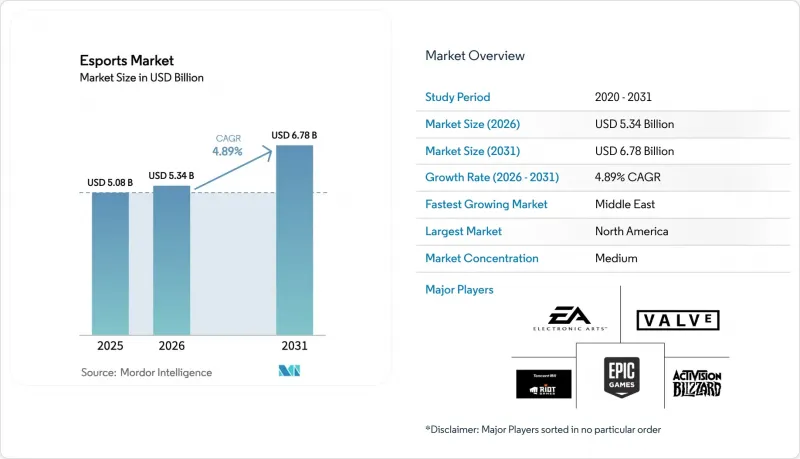
根據 Mordor Intelligence 預測,電競市場規模將從 2025 年的 50.8 億美元成長到 2026 年的 53.4 億美元,到 2031 年將達到 67.8 億美元,2026 年至 2031 年的複合年成長率為 4.89%。
本報告按收入模式(贊助、媒體版權、廣告、發行商費用/遊戲內收費、門票/周邊商品、博彩/夢幻體育)、串流平台(Twitch、YouTube Gaming、Facebook Gaming、虎牙等)、設備類型(PC、行動/掌機、主機)、遊戲類型(MOBA、FPS、生存遊戲等)和地區進行細分。市場預測以美元(USD)為單位。
全球電競市場趨勢與洞察
5G和光纖的部署將加速亞洲行動電競的商業化。
到2025年12月,韓國5G全國普及率達到行動用戶總數的68%。同時,中國移動透過獨立網路(SA)覆蓋95%的縣級城市,並將平均延遲降至20毫秒以下,為智慧型手機和個人電腦創造了公平的競爭環境。騰訊利用這些基礎設施的提升,於2025年舉辦了《王者榮耀》全球總決賽,並投資1,000萬美元。該賽事吸引了1.2億同時線上觀眾,並創造了24.5億美元的年收入。 Garena的《Free Fire》即使設備售價低於200美元,也保持著1.5億的日有效用戶,顯示價格親民的硬體正在開拓新的潛在客戶群。在印尼和菲律賓,政府主導的光纖到府(FTTH)計畫正在進一步擴大參與範圍,菲律賓資訊通訊技術部的目標是到2027年實現50%的家庭覆蓋率。這些連接性的改善帶來了行動串流媒體播放時間的增加、應用程式內收費轉換率的提高以及區域獎金池的擴大,所有這些因素共同促進了電子競技市場的成長前景。
基於區塊鏈的數位資產所有權將提升出版商的收入。
非同質化代幣(NFT) 允許觀眾和玩家交易經過驗證的錦標賽皮膚,發行商可以透過每次轉售賺取 5% 至 10% 的版稅,將一次性物品銷售轉化為持續收入。與 Immutable、GameStop 和 Ubisoft 的合作在推出後的六個月內,在二次性市場創造了 1800 萬美元的交易量。 Riot Games 於 2025 年 8 月獲得了美國區塊鏈檢驗物品所有權專利,為跨遊戲經濟系統奠定了基礎。雖然歐洲證券及市場管理局 (ESMA) 目前將某些代幣視為金融工具,但與終身版稅收入的潛在成長相比,合規註冊成本被認為是可以接受的。
由於歐洲數位廣告成長放緩,贊助支出減少。
2024年,歐洲數位廣告預算較去年同期下降8%,迫使英特爾和萬事達卡等產業巨頭削減約15%的電競宣傳活動。 2024年12月,英特爾終止了與Extreme Masters長達10年的冠名贊助協議,導致每年損失2000萬美元的贊助收入,迫使ESL FACEIT集團將廣告位轉向風險更高的收益分成合約。加密貨幣交易所FTX的倒閉造成了2億美元的贊助缺口,但到2025年,只有40%的缺口填補。 GDPR(一般資料保護規則)的嚴格執行降低了定向投放的精準度,Meta在2024年被罰款3.9億歐元便是一個例證。此外,電競直播的CPM溢價也在下降。品牌正在將預算分配給效果行銷,而電競營運商則被迫在標準化程度有限的情況下證明其投入的回報。
細分市場分析
2025年,贊助收入佔電子競技總收入的39.93%,而博彩和夢幻體育平台預計將以5.53%的複合年成長率成長至2031年,這反映了部分地區的合法化進程以及真錢賭博與串流媒體介面的融合。 2025年,DraftKings在美國推出了專屬的電競博彩市場,為《英雄聯盟》冠軍聯賽(LCS)和《反恐精英》Major賽事提供勝負盤、地圖讓分盤和滾球投注,並在上線後的前六個月創造了8500萬美元的交易額。媒體版權收入佔2025年總收入的18%,但隨著YouTube Gaming和Twitch從最低保證收入轉向收入分成協議,這部分收入正面臨萎縮的壓力。 Riot Games在2024年重新談判了其LCS轉播契約,將固定年費從3000萬美元降至1800萬美元,並將廣告位比例降低至25%。廣告收入預計到2025年將佔市場總值的15%,但由於程式化交易平台將電競直播歸類為對品牌不安全(因為其聊天環境缺乏監管),廣告收入的每千次展示成本(CPM)正在下降。平均CPM從2022年的8美元降至2025年的4.50美元。
2025年,發行商費用和遊戲內收費將佔總收入的22%,Valve的Dota 2勇士令狀預計將在2025年創造1.8億美元的收入,其中25%將用於國際邀請賽的獎金池。這形成了一個良性循環,粉絲的貢獻直接提升了賽事的聲望。門票和周邊商品銷售是佔總收入最小的部分,預計2025年僅佔5%,但在疫情後已呈現復甦跡象。 2025年在上海舉行的英雄聯盟全球總決賽,每日觀眾人數達4萬人,售價500美元的高級座位套餐在90分鐘內售罄。博彩和夢幻遊戲的激增主要集中在法律規範成熟的地區。安大略省的 iGaming 市場於 2022 年 4 月將單一運動賽事博彩合法化,預計到 2025 年,電競博彩金額將達到 5,200 萬加元(3,800 萬美元),佔體育博彩總額的 2.1%。
2025年,Twitch佔了串流平台收入的47.07%,但隨著Meta將電競直播整合到其核心社交圖譜中,並利用Instagram Reels發布精彩集錦,Facebook Gaming預計將在2031年之前以5.21%的複合年成長率快速成長。亞馬遜旗下的Twitch於2025年1月裁員500人(佔其員工總數的35%),並於2025年2月退出韓國市場,原因是當地網路服務供應商收取了過高的網路傳輸費用,導致其市場佔有率被YouTube Gaming和非洲串流平台Bigo Live蠶食。 YouTube Gaming預計到2025年將佔28%的平台收入,因為它將70%的超級留言收入分配給創作者,而Twitch的訂閱收入分成比例為50%。 YouTube Gaming已與Valkyrae和Ludwig等知名主播簽訂了多年獨家合約。儘管 Facebook Gaming 在 2022 年 10 月停止了其獨立的行動應用程式,但透過將比賽直播直接嵌入 Facebook 的新聞推送,並為好友群組提供零延遲的聯合直播,其 2025 年的觀看人數同比成長了 18%。
中國平台虎牙和鬥魚預計在2025年將佔據全球總收入的12%,但在2025年3月,它們面臨監管壓力。當時,中國國家廣播電視總局收緊了內容審核要求,強制要求廣播公司進行實名註冊,並禁止18歲以下用戶在晚上10點至早上8點之間收看節目。 2025年6月,虎牙和鬥魚宣布正在進行合併談判,旨在整合基礎設施成本並與發行商協商統一的授權協議,但中國國家市場監督管理總局尚未批准此交易。其他平台,包括Stake.com投資的Kick和騰訊旗下的Trovo,透過瞄準服務低度開發地區,在2025年佔據了8%的收入佔有率。 Kick在2025年獲得了巴西Free Fire職業聯賽的獨家轉播權,總決賽吸引了800萬同時在線觀眾。
區域分析
到2025年,北美將佔據全球電競市場價值的42.49%,主要基於特許經營聯賽和電競專屬贊助。同時,預計到2031年,中東地區的電子競技市場將以5.94%的複合年成長率成長。沙烏地阿拉伯公共投資基金(PIF)透過旗下Savvy Games Group投資380億美元,用於收購賽事組織者、戰隊和發行商的股份。 2024年1月,Savvy Games Group以15億美元收購了ESL FACEIT集團,獲得了英特爾極限大師賽(Intel Extreme Masters)、ESL One和BLAST Premier三大賽事的營運權。到2025年,這些賽事將共舉辦85場頂級賽事。 2024年在利雅德舉行的電競世界盃共發放了6,000萬美元的獎金,涵蓋21個遊戲項目,創下了史上最高的多遊戲獎金池紀錄。儘管人權組織呼籲各參賽隊伍抵制該賽事,但它仍然吸引了15,000名國際選手參賽。歐洲預計2025年貢獻28%的收入,但目前正面臨贊助減少和監管碎片化等不利因素。不過,德國聯邦數位和交通部已撥款5,000萬歐元(約5,400萬美元)用於2025年的電競基礎建設,以應對私營部門的撤離。
到2025年,亞太地區將佔全球電競市場價值的22%。中國國家體育總局已於2024年正式將電子競技列為體育項目,上海也將舉辦2025年英雄聯盟全球總決賽,預計將為該地區帶來12億元人民幣(約1.68億美元)的經濟效益。韓國文化體育觀光部已撥款150億韓元(約1100萬美元)給韓國電子競技協會,用於LCK聯賽的運營和青少年發展項目,以確保韓國在人均電子競技消費方面保持領先地位。南美洲預計到2025年將佔全球電競收入的5%。巴西的Free Fire職業聯盟在2025年吸引了1,200萬同時線上觀眾,但由於可支配收入較低且信用卡普及率有限,其人均收入比北美標準低70%。非洲將在 2025 年佔全球市場價值的 3%,正在崛起為行動優先的地區。南非的 Mettlestate 電競錦標賽系列賽已獲得 MTN 集團的贊助,將在 2025 年撥出 500 萬蘭特(27 萬美元)的獎金。
其他好處:
- Excel格式的市場預測(ME)表
- 3個月的分析師支持
目錄
第1章:引言
- 研究假設和市場定義
- 調查範圍
第2章:調查方法
第3章執行摘要
第4章 市場狀況
- 市場概覽
- 市場促進因素
- 5G和光纖的部署將促進亞洲行動電競的商業化。
- 擁有基於區塊鏈的數位資產正在提升出版商的收入。
- 吸引傳統運動投資者的特許經營聯賽模式
- 歐洲和中國政府對電子競技的認可和資助
- 人工智慧驅動的個人化訓練工具正在提高運動員的參與度。
- 沙烏地阿拉伯主導的巨額獎金池正在推動賽事日程的全球化。
- 市場限制因素
- 隨著歐洲數位廣告成長放緩,贊助支出也在減少。
- 智慧財產權所有權的分散阻礙了標準化聯盟結構的建立。
- 球員薪資成長速度超過了收入成長速度。
- 監管機構對戰利箱的打擊力道正在限制遊戲內收費。
- 宏觀經濟因素對市場的影響
- 產業價值鏈分析
- 監理展望
- 技術展望
- 波特五力分析
第5章 市場規模與成長預測
- 按收入模式
- 贊助
- 媒體版權
- 廣告
- 發行商費用和遊戲內收費
- 門票和商品
- 夢幻博彩(新)
- 透過串流媒體平台
- Twitch
- YouTube Gaming
- Facebook Gaming
- Huya
- DouYu
- 其他
- 依設備類型
- PC
- 移動/手持設備
- 主機
- 遊戲類型
- MOBA
- FPS
- 生存遊戲
- 運動賽車
- 格鬥遊戲
- 戰略及其他
- 按地區
- 北美洲
- 美國
- 加拿大
- 墨西哥
- 南美洲
- 巴西
- 阿根廷
- 其他南美國家
- 歐洲
- 德國
- 英國
- 法國
- 義大利
- 西班牙
- 其他歐洲國家
- 亞太地區
- 中國
- 日本
- 韓國
- 印度
- 其他亞太國家
- 中東和非洲
- 中東
- 阿拉伯聯合大公國
- 沙烏地阿拉伯
- 土耳其
- 其他中東國家
- 非洲
- 南非
- 埃及
- 其他非洲國家
- 中東
- 北美洲
第6章 競爭情勢
- 市場集中度
- 策略趨勢
- 市佔率分析
- 公司簡介
- Tencent Holdings Ltd(Riot Games)
- Activision Blizzard Inc
- Electronic Arts Inc
- Epic Games Inc
- Valve Corporation
- Modern Times Group(ESL FACEIT Group)
- Gfinity PLC
- Capcom Co Ltd
- Ubisoft Entertainment SA
- Take-Two Interactive Software Inc
- Krafton Inc
- Garena Online(Sea Ltd)
- Nintendo Co Ltd
- Bandai Namco Holdings Inc
- NetEase Inc
- Sony Interactive Entertainment LLC
- Cloud9 Esports Inc
- Team Liquid Enterprises BV
- 100 Thieves LLC
- Fnatic Ltd
- OG Esports A/S
第7章 市場機會與未來展望
According to Mordor Intelligence, the esports market size is expected to grow from USD 5.08 billion in 2025 to USD 5.34 billion in 2026 and is forecast to reach USD 6.78 billion by 2031 at 4.89% CAGR over 2026-2031.
This report is Segmented by Revenue Model (Sponsorship, Media Rights, Advertising, Publisher Fees and In-Game Purchases, Tickets and Merchandise, Betting and Fantasy), Streaming Platform (Twitch, Youtube Gaming, Facebook Gaming, Huya, and More), Device Type (PC, Mobile/Handheld, Console), Game Genre (MOBA, FPS, Battle-Royale, and More), and Geography. Market Forecasts are Provided in Terms of Value (USD).
Global Esports Market Trends and Insights
5G & Fiber Roll-outs Enabling Mobile Esports Monetization in Asia
Nationwide 5G penetration reached 68% of South Korean mobile subscriptions by December 2025, while China Mobile covered 95% of prefecture-level cities with standalone 5G, lowering average latency below 20 milliseconds and leveling competitive conditions between smartphone and PC contestants. Tencent leveraged these upgrades by funding a USD 10 million Honor of Kings World Championship in 2025 that attracted 120 million concurrent viewers and generated USD 2.45 billion in annual revenue. Garena's Free Fire retained 150 million daily active users on devices priced below USD 200, demonstrating the addressable audience unlocked by affordable hardware. Government-backed fiber-to-home programs in Indonesia and the Philippines are widening participation further, with the Philippine Department of Information and Communications Technology targeting 50% household coverage by 2027. These connectivity gains amplify mobile streaming hours, fuel in-app purchase conversion, and expand regional prize pools, collectively lifting the esports market growth outlook.
Blockchain-Based Digital Asset Ownership Boosting Publisher Revenues
Non-fungible tokens allow viewers and players to trade verified tournament skins, and publishers capture 5%-10% royalties on each resale, transforming one-time item sales into recurring revenue. Immutable's partnership with GameStop and Ubisoft drove USD 18 million in secondary-market volume within six months of launch. Riot Games secured a U.S. patent in August 2025 covering blockchain-verified item ownership, laying groundwork for cross-game economies. Although the European Securities and Markets Authority now treats certain tokens as financial instruments, compliance registration costs appear manageable relative to lifetime royalty upside.
Sponsorship Spend Compression amid Digital-Ad Slow-down in Europe
European digital-advertising budgets fell 8% year-over-year in 2024, driving endemic sponsors such as Intel and Mastercard to trim esports campaigns by roughly 15%. Intel ended its decade-long Extreme Masters title sponsorship in December 2024, eliminating an annual USD 20 million guarantee and forcing ESL FACEIT Group to convert inventory into at-risk revenue-share deals. The collapse of cryptocurrency exchange FTX left a USD 200 million sponsorship gap that was only 40% filled by 2025. Stricter GDPR enforcement cut precision targeting, evidenced by Meta's EUR 390 million fine in 2024, weakening CPM premiums for esports streams. Brands are reallocating to performance marketing, leaving properties to prove return on engagement with limited standardization.
Other drivers and restraints analyzed in the detailed report include:
- Franchise League Models Attracting Traditional Sports Investors
- Government Recognition and Funding of Esports in Europe and China
- Escalating Player Salary Inflation Outpacing Revenue Growth
For complete list of drivers and restraints, kindly check the Table Of Contents.
Segment Analysis
Sponsorship commanded 39.93% of esports revenue in 2025, yet betting and fantasy platforms are expanding at 5.53% CAGR through 2031, reflecting jurisdictional legalization and the integration of real-money wagering into streaming interfaces. DraftKings launched esports-specific betting markets in 12 US states during 2025, offering moneyline, map-handicap, and in-play wagers on League of Legends Championship Series and Counter-Strike Major tournaments, generating USD 85 million in handle within the first six months. Media rights, which accounted for 18% of 2025 revenue, face compression as YouTube Gaming and Twitch shift from guaranteed minimum payments to revenue-share arrangements; Riot Games renegotiated its LCS broadcast deal in 2024, reducing the fixed annual fee from USD 30 million to USD 18 million plus 25% of advertising inventory. Advertising revenue, representing 15% of 2025 market value, suffers from declining cost-per-mille rates as programmatic exchanges classify esports streams as "brand-unsafe" due to unmoderated chat environments, with average CPMs falling from USD 8 in 2022 to USD 4.50 in 2025.
Publisher fees and in-game purchases contributed 22% of 2025 revenue, with Valve's Dota 2 Battle Pass generating USD 180 million in 2025 by allocating 25% of proceeds to The International prize pool, creating a virtuous cycle where fan contributions directly fund competitive prestige. Tickets and merchandise, the smallest segment at 5% of 2025 revenue, are rebounding post-pandemic as in-person attendance at the 2025 League of Legends World Championship in Shanghai reached 40,000 per day, with premium seating packages priced at USD 500 selling out within 90 minutes. The betting and fantasy surge is concentrated in jurisdictions with mature regulatory frameworks; Ontario's iGaming market, which legalized single-event sports wagering in April 2022, recorded CAD 52 million (USD 38 million) in esports betting handle during 2025, representing 2.1% of total sports wagering.
Twitch retained 47.07% of streaming-platform revenue in 2025, but Facebook Gaming is accelerating at 5.21% CAGR through 2031 as Meta integrates live esports into its core social graph and leverages Instagram Reels for highlight distribution. Amazon-owned Twitch laid off 500 employees in January 2025, representing 35% of its workforce, and exited the South Korean market in February 2025 due to prohibitive network-transit costs imposed by local internet service providers, ceding ground to YouTube Gaming and African streaming platform Bigo Live. YouTube Gaming captured 28% of 2025 platform revenue by offering creators 70% of Super Chat proceeds compared to Twitch's 50% subscription split, attracting high-profile streamers including Valkyrae and Ludwig to exclusive multi-year contracts. Facebook Gaming, despite shuttering its standalone mobile app in October 2022, grew watch-time 18% year-over-year in 2025 by embedding tournament streams directly into Facebook News Feed and offering zero-latency co-streaming for friend groups.
Chinese platforms Huya and DouYu, which collectively held 12% of 2025 global revenue, faced regulatory pressure as China's National Radio and Television Administration imposed stricter content-moderation requirements in March 2025, mandating real-name registration for streamers and prohibiting broadcasts between 10 PM and 8 AM for users under 18. Huya and DouYu announced merger discussions in June 2025 to consolidate infrastructure costs and negotiate unified licensing agreements with publishers, though China's State Administration for Market Regulation has not yet approved the transaction. The remaining platforms, including Kick (backed by Stake.com) and Trovo (owned by Tencent), captured 8% of 2025 revenue by targeting underserved geographies; Kick secured exclusive rights to broadcast Brazil's Free Fire Pro League in 2025, reaching 8 million concurrent viewers during the grand finals.
Complete Report Scope:
- By Revenue Model
- Sponsorship
- Media Rights
- Advertising
- Publisher Fees and In-Game Purchases
- Tickets and Merchandise
- Betting & Fantasy (New)
- By Streaming Platform
- Twitch
- YouTube Gaming
- Facebook Gaming
- Huya
- DouYu
- Rest of Streaming Platforms
- By Device Type
- PC
- Mobile / Handheld
- Console
- By Game Genre
- MOBA
- First-Person Shooter (FPS)
- Battle-Royale
- Sports and Racing
- Fighting
- Strategy and Others Game Genre
- By Geography
- North America
- United States
- Canada
- Mexico
- South America
- Brazil
- Argentina
- Rest of South America
- Europe
- Germany
- United Kingdom
- France
- Italy
- Spain
- Rest of Europe
- Asia Pacific
- China
- Japan
- South Korea
- India
- Rest of Asia Pacific
- Middle East and Africa
- Middle East
- United Arab Emirates
- Saudi Arabia
- Turkey
- Rest of Middle East
- Africa
- South Africa
- Egypt
- Rest of Africa
- Middle East
- North America
Geography Analysis
North America held 42.49% of esports market value in 2025, anchored by franchised leagues and endemic sponsorships, yet the Middle East is expanding at 5.94% CAGR through 2031 as Saudi Arabia's Public Investment Fund channels USD 38 billion through Savvy Games Group to acquire tournament organizers, teams, and publishing stakes. Savvy Games Group acquired ESL FACEIT Group for USD 1.5 billion in January 2024, gaining control of the Intel Extreme Masters, ESL One, and BLAST Premier circuits that collectively hosted 85 tier-one tournaments in 2025. The 2024 Esports World Cup in Riyadh distributed USD 60 million across 21 titles, the largest multi-game prize pool in history, and attracted 15,000 international attendees despite human-rights organizations urging teams to boycott the event. Europe, representing 28% of 2025 revenue, faces headwinds from sponsorship compression and regulatory fragmentation, with Germany's Federal Ministry for Digital and Transport allocating EUR 50 million (USD 54 million) to esports infrastructure in 2025 to counteract private-sector retrenchment.
Asia-Pacific contributed 22% of 2025 market value, with China's General Administration of Sport recognizing esports as an official sport in 2024 and Shanghai hosting the 2025 League of Legends World Championship, which generated CNY 1.2 billion (USD 168 million) in local economic impact. South Korea's Ministry of Culture, Sports and Tourism funded the Korea Esports Association with KRW 15 billion (USD 11 million) in 2025 to operate the LCK and develop youth training programs, maintaining the nation's status as a per-capita esports leader. South America, accounting for 5% of 2025 revenue, saw Brazil's Free Fire Pro League attract 12 million concurrent viewers in 2025, yet monetization per viewer remained 70% below North American benchmarks due to lower disposable incomes and limited credit-card penetration. Africa, representing 3% of 2025 market value, is emerging as a mobile-first region, with South Africa's Mettlestate Esports Championship Series distributing ZAR 5 million (USD 270,000) in prizes during 2025 and securing sponsorship from MTN Group.
- Tencent Holdings Ltd (Riot Games)
- Activision Blizzard Inc
- Electronic Arts Inc
- Epic Games Inc
- Valve Corporation
- Modern Times Group (ESL FACEIT Group)
- Gfinity PLC
- Capcom Co Ltd
- Ubisoft Entertainment SA
- Take-Two Interactive Software Inc
- Krafton Inc
- Garena Online (Sea Ltd)
- Nintendo Co Ltd
- Bandai Namco Holdings Inc
- NetEase Inc
- Sony Interactive Entertainment LLC
- Cloud9 Esports Inc
- Team Liquid Enterprises BV
- 100 Thieves LLC
- Fnatic Ltd
- OG Esports A/S
Additional Benefits:
- The market estimate (ME) sheet in Excel format
- 3 months of analyst support
TABLE OF CONTENTS
1 INTRODUCTION
- 1.1 Study Assumptions and Market Definition
- 1.2 Scope of the Study
2 RESEARCH METHODOLOGY
3 EXECUTIVE SUMMARY
4 MARKET LANDSCAPE
- 4.1 Market Overview
- 4.2 Market Drivers
- 4.2.1 5G and Fiber Roll-outs Enabling Mobile Esports Monetization in Asia
- 4.2.2 Blockchain-based Digital Asset Ownership Boosting Publisher Revenues
- 4.2.3 Franchise League Models Attracting Traditional Sports Investors
- 4.2.4 Government Recognition and Funding of Esports in Europe and China
- 4.2.5 AI-powered Personalised Training Tools Enhancing Player Engagement
- 4.2.6 Saudi-Led Mega Prize Pools Globalising Tournament Calendars
- 4.3 Market Restraints
- 4.3.1 Sponsorship Spend Compression amid Digital-Ad Slow-down in Europe
- 4.3.2 Fragmented IP Ownership Restricting Standardised League Structures
- 4.3.3 Escalating Player Salary Inflation Outpacing Revenue Growth
- 4.3.4 Regulatory Crackdowns on Loot Boxes Limiting In-Game Monetisation
- 4.4 Impact of Macroeconomic Factors on the Market
- 4.5 Industry Value Chain Analysis
- 4.6 Regulatory Outlook
- 4.7 Technological Outlook
- 4.8 Porter's Five Forces Analysis
- 4.8.1 Threat of New Entrants
- 4.8.2 Bargaining Power of Buyers
- 4.8.3 Bargaining Power of Suppliers
- 4.8.4 Threat of Substitutes
- 4.8.5 Intensity of Competitive Rivalry
5 MARKET SIZE & GROWTH FORECASTS (VALUE)
- 5.1 By Revenue Model
- 5.1.1 Sponsorship
- 5.1.2 Media Rights
- 5.1.3 Advertising
- 5.1.4 Publisher Fees and In-Game Purchases
- 5.1.5 Tickets and Merchandise
- 5.1.6 Betting & Fantasy (New)
- 5.2 By Streaming Platform
- 5.2.1 Twitch
- 5.2.2 YouTube Gaming
- 5.2.3 Facebook Gaming
- 5.2.4 Huya
- 5.2.5 DouYu
- 5.2.6 Rest of Streaming Platforms
- 5.3 By Device Type
- 5.3.1 PC
- 5.3.2 Mobile / Handheld
- 5.3.3 Console
- 5.4 By Game Genre
- 5.4.1 MOBA
- 5.4.2 First-Person Shooter (FPS)
- 5.4.3 Battle-Royale
- 5.4.4 Sports and Racing
- 5.4.5 Fighting
- 5.4.6 Strategy and Others Game Genre
- 5.5 By Geography
- 5.5.1 North America
- 5.5.1.1 United States
- 5.5.1.2 Canada
- 5.5.1.3 Mexico
- 5.5.2 South America
- 5.5.2.1 Brazil
- 5.5.2.2 Argentina
- 5.5.2.3 Rest of South America
- 5.5.3 Europe
- 5.5.3.1 Germany
- 5.5.3.2 United Kingdom
- 5.5.3.3 France
- 5.5.3.4 Italy
- 5.5.3.5 Spain
- 5.5.3.6 Rest of Europe
- 5.5.4 Asia Pacific
- 5.5.4.1 China
- 5.5.4.2 Japan
- 5.5.4.3 South Korea
- 5.5.4.4 India
- 5.5.4.5 Rest of Asia Pacific
- 5.5.5 Middle East and Africa
- 5.5.5.1 Middle East
- 5.5.5.1.1 United Arab Emirates
- 5.5.5.1.2 Saudi Arabia
- 5.5.5.1.3 Turkey
- 5.5.5.1.4 Rest of Middle East
- 5.5.5.2 Africa
- 5.5.5.2.1 South Africa
- 5.5.5.2.2 Egypt
- 5.5.5.2.3 Rest of Africa
- 5.5.5.1 Middle East
- 5.5.1 North America
6 COMPETITIVE LANDSCAPE
- 6.1 Market Concentration
- 6.2 Strategic Moves
- 6.3 Market Share Analysis
- 6.4 Company Profiles (includes Global Level Overview, Market Level Overview, Core Segments, Financials as available, Strategic Information, Market Rank/Share for key companies, Products & Services, and Recent Developments)
- 6.4.1 Tencent Holdings Ltd (Riot Games)
- 6.4.2 Activision Blizzard Inc
- 6.4.3 Electronic Arts Inc
- 6.4.4 Epic Games Inc
- 6.4.5 Valve Corporation
- 6.4.6 Modern Times Group (ESL FACEIT Group)
- 6.4.7 Gfinity PLC
- 6.4.8 Capcom Co Ltd
- 6.4.9 Ubisoft Entertainment SA
- 6.4.10 Take-Two Interactive Software Inc
- 6.4.11 Krafton Inc
- 6.4.12 Garena Online (Sea Ltd)
- 6.4.13 Nintendo Co Ltd
- 6.4.14 Bandai Namco Holdings Inc
- 6.4.15 NetEase Inc
- 6.4.16 Sony Interactive Entertainment LLC
- 6.4.17 Cloud9 Esports Inc
- 6.4.18 Team Liquid Enterprises BV
- 6.4.19 100 Thieves LLC
- 6.4.20 Fnatic Ltd
- 6.4.21 OG Esports A/S
7 MARKET OPPORTUNITIES & FUTURE OUTLOOK
- 7.1 White-Space and Unmet-Need Assessment

 2026年全球電競內容製作市場報告
 電子競技直播市場規模、佔有率和成長分析:按直播平台、收入模式、設備、遊戲類型、最終用戶和地區分類-2026-2033年產業預測
 2026-2030年全球電競市場
 電子競技市場-全球產業規模、佔有率、趨勢、機會和預測:按收入來源、受眾類型、設備、地區和競爭格局分類,2021-2031年
 電子競技市場規模、市場佔有率和成長率;全球產業分析;按類型、應用和地區進行的分析;以及未來預測(2026-2034 年)。2026年全球電競市場報告
 電子競技市場:2026-2032年全球市場預測(以交付方式、遊戲類型、發行方式及收入模式分類)
 電子競技市場分析及至2035年預測:類型、產品類型、服務、技術、組件、應用、最終用戶、解決方案、形式
 電子競技市場:依收入來源和地區分類
 電子競技市場規模、佔有率、趨勢和預測:收入模式、平台、遊戲和地區,2026-2034 年