


 |
市場調查報告書
商品編碼
2123349
行動電話半導體:市場佔有率分析、產業趨勢與統計及成長預測(2026-2031)Mobile Phone Semiconductor - Market Share Analysis, Industry Trends & Statistics, Growth Forecasts (2026 - 2031) |
||||||

※ 本網頁內容可能與最新版本有所差異。詳細情況請與我們聯繫。
據 Mordor Intelligence 稱,2026 年行動電話半導體市場規模估計為 418.2 億美元,高於 2025 年的 376.7 億美元,預計到 2031 年將達到 704.9 億美元。
預計 2026 年至 2031 年的複合年成長率為 11.03%。
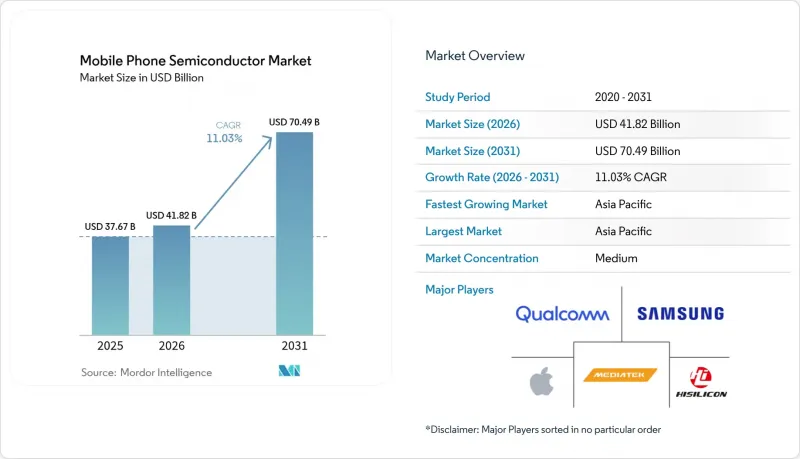
本報告按組件(行動處理器、記憶體IC、邏輯IC、類比IC、電源管理IC、射頻IC和連線IC、顯示驅動IC、音訊IC、感測器)、技術節點(28nm等)和地區細分。市場預測以美元(USD)為單位。
全球行動電話半導體市場趨勢及洞察
5G智慧型手機的普及
5G設備出貨量的激增推動行動電話半導體市場維持高速成長。高通的X85調變解調器峰值吞吐量可達10Gbps,並整合了人工智慧訊號處理功能,導致每個射頻前端模組的美元成本增加約20%。從4G過渡到5G需要多頻段功率放大器、6GHz以下和毫米波天線以及更嚴格的溫度控管,這些都會導致晶片面積增加。三星的Exynos Modem 5400在2024年引入了衛星回退功能,以確保偏遠地區的持續連接。這些需求促使調變解調器7nm製程和相關RF收發器器成熟的28nm製程的晶圓開工量增加,凸顯了單一行動電話SKU通常需要來自四個不同製程節點的晶圓。因此,亞太地區晶圓廠的產能運轉率仍然很高,維持了供應壓力,這對行動電話半導體市場產生了正面影響。
設備內人工智慧/機器學習技術的廣泛應用
為了降低延遲並保障隱私,人工智慧推理正逐漸向裝置內部轉移,這提高了應用處理器的運算密度要求。聯發科的MT6825晶片與基於雲端的推理相比,能耗降低了40%,凸顯了本地處理的成本優勢。神經網路引擎需要與CPU、GPU、影像訊號處理器和5G基頻整合在同一塊基板,這推動了基於晶片組的SoC設計的發展。蘋果最新的A系列處理器整合了可在本地運行大型語言模型的AI加速器,以因應安卓廠商轉向使用可實現45 TOPS運算能力的專用張量單元的趨勢。這種功能需要使用更多的SRAM和更快的晶片間互連,從而增加了對將邏輯和記憶體緊密排列的先進封裝技術的需求。因此,每個設備的矽晶片面積正在擴大,推動行動電話半導體市場持續保持兩位數的成長。
供應鏈週期性和價格壓力
記憶體和模擬半導體的周期性波動正在加劇行動電話半導體市場的波動。受DRAM價格下跌的影響,美光2025年第一季的銷售額下降了15%,這表明整個價值鏈的利潤率可能在一個季度內受到侵蝕。行動電話產量的季節性成長加劇了市場的繁榮與蕭條週期,並使二級供應商面臨庫存衝擊。產能擴張往往是在需求高峰期資金籌措的,而當需求恢復正常時,市場供應卻會迅速過剩。這種供應過剩會壓低平均售價,但同時也會引發產業重組,並隨著時間的推移提高市場集中度。
細分市場分析
到2025年,行動處理器將在行動電話半導體市場保持32.80%的市場佔有率,凸顯其作為架構核心的重要作用,這些架構在日益縮小的基板空間內協調人工智慧推理、5G連接、影像處理流程和感測器融合等功能。預計到2031年,與此類組件相關的行動電話半導體市場規模將以10.88%的複合年成長率成長,這主要得益於晶片組和先進封裝技術帶來的整合密度進一步提高。感測器領域將以12.60%的複合年成長率呈現最高成長,以滿足人工智慧助理對多模態生物識別、空氣品質追蹤和情境感知等日益成長的需求。
記憶體晶片透過高頻寬DRAM支援AI原生工作負載,而邏輯晶片則正在演變為特定領域的加速器,以減輕窄AI核心的負載。即使數位化進程加速,類比IC在訊號調理中仍然發揮著至關重要的作用。由於多標準快速充電和針對AI引擎客製化的動態電壓調節,電源管理晶片的複雜性日益增加。射頻和連線IC目前整合了Wi-Fi 7和藍牙5.4,並將很快整合衛星收發器,這將推高每個裝置的材料清單(BOM)成本。顯示驅動晶片具備可變更新率功能,音訊晶片則具備空間播放功能和片上降噪DSP,以適應電玩遊戲和身臨其境型媒體的發展趨勢。
區域分析
預計到2025年,亞太地區將佔據全球行動電話半導體市場53.90%的佔有率,這主要得益於其深厚的製造群、政府激勵政策以及與行動電話組裝基地的接近性。中國計劃在2024年將其28奈米製程的晶圓產能提高13%,達到每月860萬片,主要用於電源管理和連接裝置。台灣地區憑藉台積電在高效能邏輯晶片領域佔據主導地位,而韓國則憑藉三星和SK海力士在記憶體領域處於領先地位。印度作為大規模組裝中心的崛起,帶動了對本地測試和封裝的額外需求,預計該地區將以12.05%的複合年成長率成長,高於全球平均水平。
北美在行動電話半導體領域的地位取決於其在設計智慧財產權方面的領先地位以及《晶片法案》(CHIPS Act)推動的新晶圓廠投資。台積電位於亞利桑那州的工廠計劃於2025年初開始採用4奈米製程生產,為美國高階行動電話品牌提供產能。英特爾在俄亥俄州投資200億美元的擴建計畫旨在建立針對行動裝置最佳化的產能,儘管與亞洲競爭對手相比,它仍然面臨著相對較大的成本壓力。該地區受惠於更完善的智慧財產權管理以及設計中心與先進生產線之間較短的研發週期。
歐洲優先考慮戰略自主和環境永續性。歐盟的《晶片法案》旨在2030年實現20%的全球市場佔有率,並向汽車和工業晶片領域投入比行動電話晶片更多的資金。 GlobalFoundries和UMC的合併談判旨在整合全球10%的契約製造能,並打造一個地緣政治平衡的品牌。在中東和非洲,行動電話廠商的多元化為後端組裝企業帶來了發展機會。南美市場規模仍然較小,主要集中在最終組裝,但貿易協定的改善未來有望吸引測試和封裝企業。
其他好處:
- Excel格式的市場預測(ME)表
- 3個月的分析師支持
目錄
第1章:引言
- 研究假設和市場定義
- 調查範圍
第2章:調查方法
第3章執行摘要
第4章 市場狀況
- 市場概覽
- 市場促進因素
- 5G智慧型手機的普及
- 擴大設備內人工智慧/機器學習的應用
- 單位內存容量增加
- 高刷新率OLED顯示螢幕
- 衛星通訊的實現
- 採用扇出型晶圓級SiP
- 市場限制因素
- 供應鏈週期性和價格壓力
- 地緣政治出口限制
- 波長小於 5 奈米時的熱力學和良率的挑戰
- OEM整合降低了二級供應商的潛在市場規模。
- 產業價值鏈分析
- 監理情勢
- 技術展望
- 波特五力分析
- 宏觀經濟趨勢對市場的影響
第5章 市場規模與成長預測
- 按組件
- 行動處理器
- 記憶
- 邏輯積體電路
- 類比IC
- 電源管理積體電路
- 射頻積體電路和連線IC
- 顯示驅動IC
- 音訊積體電路
- 感測器(動作感測器、環境感測器、位置感測器、影像感測器、生物識別感測器等)
- 依技術節點
- 小於3奈米
- 3 nm
- 5 nm
- 7 nm
- 16 nm
- 28 nm
- >28 奈米
- 按地區
- 北美洲
- 美國
- 加拿大
- 墨西哥
- 南美洲
- 巴西
- 阿根廷
- 其他南美國家
- 歐洲
- 德國
- 英國
- 法國
- 義大利
- 西班牙
- 其他歐洲國家
- 亞太地區
- 中國
- 日本
- 韓國
- 印度
- 新加坡
- 澳洲
- 其他亞太國家
- 中東和非洲
- 中東
- 沙烏地阿拉伯
- 阿拉伯聯合大公國
- 土耳其
- 其他中東國家
- 非洲
- 南非
- 奈及利亞
- 埃及
- 其他非洲國家
- 中東
- 北美洲
第6章 競爭情勢
- 市場集中度
- 策略趨勢
- 市佔率分析
- 公司簡介
- Qualcomm Incorporated
- MediaTek Inc.
- Samsung Electronics Co., Ltd.
- Apple Inc.
- HiSilicon Technologies Co., Ltd.
- UNISOC Technologies Co., Ltd.
- Intel Corporation(Foundry Services)
- Advanced Micro Devices, Inc.
- NVIDIA Corporation
- Texas Instruments Incorporated
- Analog Devices, Inc.
- Skyworks Solutions, Inc.
- Qorvo, Inc.
- Murata Manufacturing Co., Ltd.
- NXP Semiconductors NV
- STMicroelectronics NV
- Infineon Technologies AG
- Micron Technology, Inc.
- SK hynix Inc.
- Kioxia Corporation
- Sony Semiconductor Solutions Corporation
- ON Semiconductor Corporation
- Dialog Semiconductor GmbH
- Cirrus Logic, Inc.
- Rohm Co., Ltd.
第7章 市場機會與未來展望
According to Mordor Intelligence, the mobile phone semiconductor market size in 2026 is estimated at USD 41.82 billion, growing from 2025 value of USD 37.67 billion with 2031 projections showing USD 70.49 billion, growing at 11.03% CAGR over 2026-2031.
This report is Segmented by Component (Mobile Processors, Memory ICs, Logic ICs, Analog ICs, Power Management ICs, RF ICs and Connectivity ICs, Display Driver ICs, Audio ICs, and Sensors), Technology Node ( 28 Nm), and Geography. The Market Forecasts are Provided in Terms of Value (USD).
Global Mobile Phone Semiconductor Market Trends and Insights
Proliferation of 5G Smartphones
Surging shipment volumes of 5G handsets continue to propel the mobile phone semiconductor market onto a high-growth trajectory. Qualcomm's X85 modem delivers 10 Gbps peak throughput and incorporates AI-assisted signal processing, increasing RF front-end module dollar content by nearly 20% per unit. The leap from 4G to 5G requires multi-band power amplifiers, sub-6 GHz and mmWave antennas, and tighter thermal management, each of which adds die area. Samsung's Exynos Modem 5400 introduced satellite fallback in 2024, ensuring continuous connectivity in remote areas. These requirements amplify wafer starts at 7 nm for modems and at mature 28 nm for companion RF transceivers, underlining how a single handset SKU often pulls wafers from four distinct process nodes. Consequently, fab utilization at APAC foundries remains elevated, sustaining supply pressure that benefits the mobile phone semiconductor market.
Rising Adoption of On-Device AI/ML
AI inferencing is migrating on-device to reduce latency and maintain privacy, thereby increasing compute density targets for application processors. MediaTek's MT6825 demonstrated 40% energy savings compared to cloud-based inference, highlighting the cost advantages associated with local processing. Neural engines must coexist with CPUs, GPUs, image signal processors, and 5G basebands on a single substrate, driving chiplet-based SoC designs. Apple's latest A-series processor integrates AI accelerators that execute large language models locally, prompting Android vendors to pivot toward dedicated tensor units that deliver 45 TOPS. This functionality utilizes more SRAM and high-speed inter-chip interconnects, driving demand for advanced packaging that keeps logic and memory in proximity. The outcome is a wider silicon footprint per handset, reinforcing double-digit revenue expansion for the mobile phone semiconductor market.
Supply-Chain Cyclicality and Pricing Pressure
Memory and analog cycles inject volatility into the mobile phone semiconductor market. Micron's Q1 2025 revenue slipped 15% as DRAM prices softened, showing how a single quarter can erode margins across the value chain. Seasonal handset ramps amplify boom-bust swings, leaving tier-2 suppliers exposed to inventory shocks. Capacity builds, often funded during peak demand, flood the market just as demand normalizes. The resultant oversupply compresses average selling prices, yet simultaneously sparks consolidation that nudges the market toward higher concentration ratios over time.
Other drivers and restraints analyzed in the detailed report include:
- Growing Memory Content Per Handset
- High-Refresh OLED Displays
- Geopolitical Export Restrictions
For complete list of drivers and restraints, kindly check the Table Of Contents.
Segment Analysis
Mobile processors retained a 32.80% market share of the mobile phone semiconductor market in 2025, underscoring their status as architectural hubs that coordinate AI inference, 5G connectivity, imaging pipelines, and sensor fusion within an increasingly compact board footprint. The mobile phone semiconductor market size associated with this component class is forecast to grow at an 10.88% CAGR through 2031, as chiplets and advanced packaging drive another wave of integration density. Sensors, the fastest-growing component group with a 12.60% CAGR, meet the rising demand for multimodal biometric authentication, air-quality tracking, and contextual awareness required by AI assistants.
Memory ICs anchor AI-native workloads through higher-bandwidth DRAM, while Logic ICs evolve into domain-specific accelerators that offload narrow AI kernels. Analog ICs still matter for signal conditioning even as digital take-over accelerates. Power management IC complexity increases with multi-standard fast charging and dynamic voltage scaling tailored to AI engines. RF and connectivity ICs now integrate Wi-Fi 7, Bluetooth 5.4, and soon satellite transceivers, swelling per-handset BOM. Display driver ICs incorporate variable refresh intelligence, and Audio ICs feature spatial playback and on-chip noise cancellation DSPs that align with trends in videogames and immersive media.
Complete Report Scope:
- By Component
- Mobile Processors
- Memory ICs
- Logic ICs
- Analog ICs
- Power Management ICs
- RF ICs and Connectivity ICs
- Display Driver ICs
- Audio ICs
- Sensors (Motion sensors, Environmental Sensors, Positioning Sensors, Image Sensors, Biometric Sensors, etc.)
- By Technology Node
- < 3 nm
- 3 nm
- 5 nm
- 7 nm
- 16 nm
- 28 nm
- > 28 nm
- By Geography
- North America
- United States
- Canada
- Mexico
- South America
- Brazil
- Argentina
- Rest of South America
- Europe
- Germany
- United Kingdom
- France
- Italy
- Spain
- Rest of Europe
- Asia-Pacific
- China
- Japan
- South Korea
- India
- Singapore
- Australia
- Rest of Asia-Pacific
- Middle East and Africa
- Middle East
- Saudi Arabia
- United Arab Emirates
- Turkey
- Rest of Middle East
- Africa
- South Africa
- Nigeria
- Egypt
- Rest of Africa
- Middle East
- North America
Geography Analysis
The Asia-Pacific region held 53.90% of the mobile phone semiconductor market in 2025, driven by its deeply entrenched manufacturing clusters, government incentives, and proximity to handset assembly centers. China increased its installed wafer capacity by 13% to 8.6 million wafers per month in 2024, primarily at 28 nm nodes that supply power-management and connectivity devices. Taiwan dominates high-performance logic via TSMC, while Korea leads memory through Samsung and SK Hynix. India's ascent as a large-scale assembly hub is creating adjacent demand for local test and packaging, stamping the region with a forecast 12.05% CAGR that exceeds the global baseline.
North America's mobile phone semiconductor footprint hinges on design IP leadership and new fab investments catalyzed by the CHIPS Act. TSMC's Arizona plant began 4 nm production in early 2025, offering capacity to premium U.S. handset brands. Intel's USD 20 billion Ohio expansion envisions mobile-optimized capacity, although cost headwinds remain relatively higher compared to its Asian peers. The region benefits from tighter IP control and shorter R&D loops between design centers and advanced manufacturing lines.
Europe prioritizes strategic autonomy and environmental sustainability. The EU Chips Act aims for a 20% global market share by 2030, allocating more funds toward automotive and industrial chips than handsets. GlobalFoundries-UMC merger talks aim to consolidate 10% of othe worldwide contract capacity, providing a brand with geopolitical balance. The Middle East and Africa offer prospects for back-end assembly as mobile phone vendors diversify. South America remains a modest participant, capped at final assembly, yet improving trade pacts could eventually draw test and package operations.
- Qualcomm Incorporated
- MediaTek Inc.
- Samsung Electronics Co., Ltd.
- Apple Inc.
- HiSilicon Technologies Co., Ltd.
- UNISOC Technologies Co., Ltd.
- Intel Corporation (Foundry Services)
- Advanced Micro Devices, Inc.
- NVIDIA Corporation
- Texas Instruments Incorporated
- Analog Devices, Inc.
- Skyworks Solutions, Inc.
- Qorvo, Inc.
- Murata Manufacturing Co., Ltd.
- NXP Semiconductors N.V.
- STMicroelectronics N.V.
- Infineon Technologies AG
- Micron Technology, Inc.
- SK hynix Inc.
- Kioxia Corporation
- Sony Semiconductor Solutions Corporation
- ON Semiconductor Corporation
- Dialog Semiconductor GmbH
- Cirrus Logic, Inc.
- Rohm Co., Ltd.
Additional Benefits:
- The market estimate (ME) sheet in Excel format
- 3 months of analyst support
TABLE OF CONTENTS
1 INTRODUCTION
- 1.1 Study Assumptions and Market Definition
- 1.2 Scope of the Study
2 RESEARCH METHODOLOGY
3 EXECUTIVE SUMMARY
4 MARKET LANDSCAPE
- 4.1 Market Overview
- 4.2 Market Drivers
- 4.2.1 Proliferation of 5G smartphones
- 4.2.2 Rising adoption of on-device AI/ML
- 4.2.3 Growing memory content per handset
- 4.2.4 High-refresh OLED displays
- 4.2.5 Satellite connectivity enablement
- 4.2.6 Fan-out wafer-level SiP adoption
- 4.3 Market Restraints
- 4.3.1 Supply-chain cyclicality and pricing pressure
- 4.3.2 Geopolitical export restrictions
- 4.3.3 Sub-5 nm thermal/yield challenges
- 4.3.4 OEM consolidation trimming TAM for tier-2 vendors
- 4.4 Industry Value Chain Analysis
- 4.5 Regulatory Landscape
- 4.6 Technological Outlook
- 4.7 Porter's Five Forces Analysis
- 4.7.1 Threat of New Entrants
- 4.7.2 Bargaining Power of Buyers
- 4.7.3 Bargaining Power of Suppliers
- 4.7.4 Threat of Substitutes
- 4.7.5 Intensity of Competitive Rivalry
- 4.8 Impact of Macroeconomic Trends on the Market
5 MARKET SIZE AND GROWTH FORECASTS (VALUES)
- 5.1 By Component
- 5.1.1 Mobile Processors
- 5.1.2 Memory ICs
- 5.1.3 Logic ICs
- 5.1.4 Analog ICs
- 5.1.5 Power Management ICs
- 5.1.6 RF ICs and Connectivity ICs
- 5.1.7 Display Driver ICs
- 5.1.8 Audio ICs
- 5.1.9 Sensors (Motion sensors, Environmental Sensors, Positioning Sensors, Image Sensors, Biometric Sensors, etc.)
- 5.2 By Technology Node
- 5.2.1 < 3 nm
- 5.2.2 3 nm
- 5.2.3 5 nm
- 5.2.4 7 nm
- 5.2.5 16 nm
- 5.2.6 28 nm
- 5.2.7 > 28 nm
- 5.3 By Geography
- 5.3.1 North America
- 5.3.1.1 United States
- 5.3.1.2 Canada
- 5.3.1.3 Mexico
- 5.3.2 South America
- 5.3.2.1 Brazil
- 5.3.2.2 Argentina
- 5.3.2.3 Rest of South America
- 5.3.3 Europe
- 5.3.3.1 Germany
- 5.3.3.2 United Kingdom
- 5.3.3.3 France
- 5.3.3.4 Italy
- 5.3.3.5 Spain
- 5.3.3.6 Rest of Europe
- 5.3.4 Asia-Pacific
- 5.3.4.1 China
- 5.3.4.2 Japan
- 5.3.4.3 South Korea
- 5.3.4.4 India
- 5.3.4.5 Singapore
- 5.3.4.6 Australia
- 5.3.4.7 Rest of Asia-Pacific
- 5.3.5 Middle East and Africa
- 5.3.5.1 Middle East
- 5.3.5.1.1 Saudi Arabia
- 5.3.5.1.2 United Arab Emirates
- 5.3.5.1.3 Turkey
- 5.3.5.1.4 Rest of Middle East
- 5.3.5.2 Africa
- 5.3.5.2.1 South Africa
- 5.3.5.2.2 Nigeria
- 5.3.5.2.3 Egypt
- 5.3.5.2.4 Rest of Africa
- 5.3.5.1 Middle East
- 5.3.1 North America
6 COMPETITIVE LANDSCAPE
- 6.1 Market Concentration
- 6.2 Strategic Moves
- 6.3 Market Share Analysis
- 6.4 Company Profiles (includes Global level Overview, Market level overview, Core Segments, Financials as available, Strategic Information, Market Rank/Share for key companies, Products and Services, and Recent Developments)
- 6.4.1 Qualcomm Incorporated
- 6.4.2 MediaTek Inc.
- 6.4.3 Samsung Electronics Co., Ltd.
- 6.4.4 Apple Inc.
- 6.4.5 HiSilicon Technologies Co., Ltd.
- 6.4.6 UNISOC Technologies Co., Ltd.
- 6.4.7 Intel Corporation (Foundry Services)
- 6.4.8 Advanced Micro Devices, Inc.
- 6.4.9 NVIDIA Corporation
- 6.4.10 Texas Instruments Incorporated
- 6.4.11 Analog Devices, Inc.
- 6.4.12 Skyworks Solutions, Inc.
- 6.4.13 Qorvo, Inc.
- 6.4.14 Murata Manufacturing Co., Ltd.
- 6.4.15 NXP Semiconductors N.V.
- 6.4.16 STMicroelectronics N.V.
- 6.4.17 Infineon Technologies AG
- 6.4.18 Micron Technology, Inc.
- 6.4.19 SK hynix Inc.
- 6.4.20 Kioxia Corporation
- 6.4.21 Sony Semiconductor Solutions Corporation
- 6.4.22 ON Semiconductor Corporation
- 6.4.23 Dialog Semiconductor GmbH
- 6.4.24 Cirrus Logic, Inc.
- 6.4.25 Rohm Co., Ltd.
7 MARKET OPPORTUNITIES AND FUTURE OUTLOOK
- 7.1 White-space and Unmet-Need Assessment

 半導體類比晶片市場分析及預測(至2035年):類型、產品、技術、組件、應用、材料類型、裝置、製程、最終用戶、功能
 智慧型手機半導體市場:未來預測(至2034年)-按組件、智慧型手機類型、網路世代、最終用戶和地區分類的全球分析
 2026年全球非接觸式IC卡市場報告
 半導體晶片市場 - 全球產業規模、佔有率、趨勢、機會、預測(按組件、節點尺寸、應用、地區和競爭格局分類),2021-2031年2026年全球非接觸式積體電路(IC)卡晶片市場報告
 2026-2030年全球儲存控制器市場
 無線傳輸晶片市場報告:趨勢、預測和競爭分析(至2035年)2026年全球常運作感測器集線器市場報告2026年全球穿戴式感測器中心市場報告
 感測器集線器市場規模、佔有率和成長分析(按感測器類型、處理器類型、應用、最終用途和地區分類)—2026-2033年產業預測