


 |
市場調查報告書
商品編碼
2123329
高能量雷射:市場佔有率分析、行業趨勢和統計數據、成長預測(2026-2031 年)High Energy Lasers - Market Share Analysis, Industry Trends & Statistics, Growth Forecasts (2026 - 2031) |
||||||

※ 本網頁內容可能與最新版本有所差異。詳細情況請與我們聯繫。
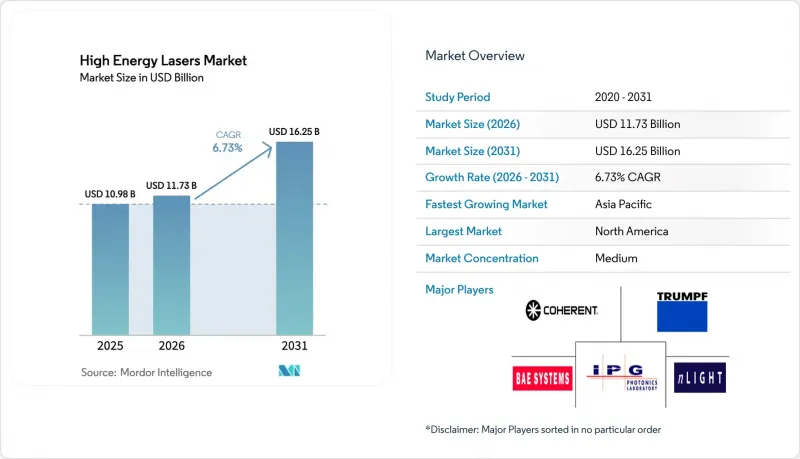
據 Mordor Intelligence 稱,高能量雷射市場預計將從 2025 年的 109.8 億美元成長到 2026 年的 117.3 億美元,到 2031 年達到 162.5 億美元,預計 2026 年至 2031 年的複合年成長率為 6.73%。
本報告按應用領域(切割、焊接、鑽孔等)、雷射類型(氣體雷射、化學雷射、準分子雷射、固體雷射等)、功率輸出(10 kW 以下、11–50 kW、51–100 kW、100 kW 以上)、平台(陸地系統、船艦系統等)、最終用戶(國防、工業製造、航太)和地區進行區進行細分。市場預測以美元計價。
全球高能量雷射市場趨勢及洞察
主要國家定向能國防預算的擴張
由於飛彈庫已被廉價的無人機和火箭所飽和,世界各國國防部正將採購資金轉向雷射技術。 2024年4月,美國向以色列的「鐵束」(Iron Beam)攔截系統累計12億美元,這筆金額超過了許多其他攔截系統的預算。印度正在為其海軍和邊防安全資助30千瓦和300千瓦的原型機,而韓國則訂購了價值1.32億美元的20千瓦Block I型系統用於批量生產。這些預算撥款正在為高能量雷射市場建立一個穩固的多年期專案資金籌措體系,使其不再局限於零星的演示。
與傳統彈藥相比,市場對每發彈藥成本降低的需求。
雷射技術正在徹底改變軍事經濟,大幅降低飛彈成本,從每枚飛彈數萬美元降至每枚飛彈的個位數功率成本。例如,「鐵穹」系統每枚飛彈的成本約為5萬美元,而「鐵束」系統的攔截成本估計僅為2美元左右。同樣,英國的「龍火」雷射武器系統也展現出類似的成本效益,每枚飛彈的成本僅為個位數。營運成本的顯著降低引起了廣泛關注,尤其是在中東地區,這些國家正面臨無人機群攻擊關鍵基礎設施的持續挑戰。部署經濟高效的雷射系統能夠為應對這些威脅提供戰略優勢。此外,由於海軍艦艇擁有短供應鏈和大量彈藥儲備的優勢,雷射武器對它們來說尤其具有吸引力。這些艦艇經常在高頻交戰場景中執行任務,彈藥耗盡可能會危及任務的成功,因此採用雷射技術至關重要。
限制高濕度或多塵環境下的熱致花粉爆發
在高濕度條件下,大氣湍流會導致5-8公里高度範圍內光束強度顯著降低,降幅可達40%。這種光束強度的大幅降低給操作人員帶來了挑戰,迫使他們配備備用攔截器以確保系統的可靠性和有效性。自適應光學技術可以透過補償湍流的影響來緩解這個問題,但其引入會增加系統的重量和成本。這些額外因素最終會降低系統的整體機動性和效率,對操作人員施加更大的限制。
細分市場分析
到2025年,切割、焊接和鑽孔將佔據高能量雷射市場42.70%的主導地位,這主要得益於汽車和航太製造商採用光纖光束對合金材料進行精確修整。該領域的崛起凸顯了高能量雷射在工業應用中實現精度和效率方面發揮的關鍵作用。同時,通訊平台正以8.12%的複合年成長率成長。這一成長表明衛星運營商正在尋求Terabit特級的交聯,從而避開擁擠的無線電頻率並提高數據傳輸能力。這些變化不僅凸顯了產業的轉型,也使供應商的收入來源更加多元化,擺脫了對傳統製造週期的依賴。這種收入來源的多元化有望在長期內為市場相關人員帶來穩定性和成長機會。
隨著通訊技術的廣泛應用,對窄線寬發射器和磷化銦調製器等組件的需求日益成長。這些組件是實現高性能光系統的關鍵,而高性能光系統在現代通訊網路中的重要性與日俱增。特別是,為了滿足激增的需求,相干公司已計劃在2025年將其關鍵組件的產量提高三倍。此外,軍事領域的頻寬需求也推動了這一趨勢。光終端如今發揮著至關重要的作用,能夠在短短幾秒鐘內將來自近地軌道衛星群的偵察資料傳輸給地面負責人。這種能力透過縮短殺傷鍊和加快決策流程,顯著提高了軍事行動的效率。民用和軍事應用的融合進一步凸顯了高能量雷射技術在滿足市場多樣化需求方面的戰略重要性。
預計到2025年,光纖雷射將佔據高能量雷射市場55.71%的佔有率,並預計在2031年之前以7.23%的複合年成長率持續成長。這主要得益於其超過40%的電光轉換效率,超越了傳統的燃氣雷射和化學雷射。頻譜耦合技術使得整合商無需更改物理設計即可堆疊模組,從而降低了非迭代設計成本。
由於體積和毒性等挑戰,自由電子雷射和化學雷射等替代技術在實驗室中仍屬於小眾領域。由於它們尚未達到實用化水平,採購負責人正將目光轉向光纖雷射器,這有助於提高規模經濟效益,並降低工業客戶的每瓦價格。
區域分析
到2025年,北美將佔據高能量雷射市場40.01%的佔有率。這主要得益於美國國防部的舉措,例如海軍的「赫利俄斯」(HELIOS)系統和陸軍的「間接火力防護能力」(Indirect Fire Protection Capability)。該地區高能量雷射的工業應用在中西部和東南部尤為顯著,中西部地區汽車車身本體焊接是其主要應用領域,而東南部地區則以渦輪機加工為主。同時,加拿大策略家們正在考慮在北極地區建立雷射基地,以應對在廣袤偏遠地區為攔截器系統提供補給所面臨的後勤挑戰。
亞太地區以7.47%的複合年成長率(CAGR)位居全球成長之首,主要得益於中國具成本效益的光纖生產以及印度自主研發的30千瓦和300千瓦武器系統(投資額達2億美元)。韓國計劃於2024年推出20千瓦雷射器,進一步凸顯了該地區的快速擴張,也彰顯了其技術優勢。此外,日本電子製造商正擴大將雷射應用於自動化領域,此舉旨在解決勞動力短缺問題,同時確保對高能量雷射系統穩定可靠的基本負載需求。
在歐洲,各種趨勢正在出現。德國工具機出口商在支撐工業銷售方面發揮著至關重要的作用,而英國的「龍火」(Dragonfire)系統於2025年成功完成海上試驗,標誌著該地區國防能力的顯著提升。然而,南歐國家的預算限制和嚴格的出口管制正在減緩該地區高能量雷射市場的整體發展勢頭。在中東,高能量雷射技術的應用正在迅速加速,以色列於2025年開始運行「鐵束」(Iron Beam)系統,海灣國家也對部署類似的先進防禦系統表現出越來越濃厚的興趣。在非洲和南美洲,市場發展仍處於起步階段,但巴西快速發展的航太產業被視為雷射驅動積層製造技術未來極具潛力的中心,並有望在未來幾年為該地區的工業成長做出重大貢獻。
其他好處:
- Excel格式的市場預測(ME)表
- 3個月的分析師支持
目錄
第1章:引言
- 研究假設和市場定義
- 調查範圍
第2章:調查方法
第3章執行摘要
第4章 市場狀況
- 市場概覽
- 市場促進因素
- 主要國家定向能國防預算的擴張
- 光束耦合和溫度控管技術的快速發展
- 與傳統彈藥相比,市場對每發彈藥成本降低的需求。
- 海軍艦隊現代化計畫採用高能量雷射近程防禦武器系統。
- 整合人工智慧驅動的目標定位技術,以提高精度並減少附帶損害。
- 商業太空產業對雷射通訊中繼的興趣
- 市場限制因素
- 限制高濕度或多塵環境下的熱致花粉爆發
- 對定向能技術實施嚴格的出口管制制度
- 光學元件在高功率循環下的脆弱性。
- 前沿部署中的電網電力和平台電力供應限制
- 產業價值鏈分析
- 監理情勢
- 技術展望
- 波特五力分析
第5章 市場規模與成長預測
- 透過使用
- 切割、焊接、鑽孔
- 軍事/國防
- 溝通
- 其他
- 雷射型
- 氣體
- 化學
- 準分子
- 固體的
- 纖維
- 自由電子
- 其他
- 依輸出類型
- 10千瓦或以下
- 11~50 kW
- 51~100 kW
- 超過100千瓦
- 按平台
- 陸基系統
- 海軍系統
- 航空航太系統
- 天基系統
- 最終用戶
- 防禦
- 工業製造
- 航太航太
- 研究機構
- 溝通
- 其他
- 按地區
- 北美洲
- 美國
- 加拿大
- 墨西哥
- 南美洲
- 巴西
- 阿根廷
- 其他南美國家
- 歐洲
- 德國
- 英國
- 法國
- 義大利
- 西班牙
- 其他歐洲國家
- 亞太地區
- 中國
- 日本
- 韓國
- 印度
- 澳洲
- 紐西蘭
- 其他亞太國家
- 中東和非洲
- 中東
- 阿拉伯聯合大公國
- 沙烏地阿拉伯
- 土耳其
- 其他中東國家
- 非洲
- 南非
- 奈及利亞
- 肯亞
- 其他非洲國家
- 中東
- 北美洲
第6章 競爭情勢
- 市場集中度
- 策略趨勢
- 市佔率分析
- 公司簡介
- TRUMPF Pvt. Ltd.
- IPG Photonics Corporation
- Coherent Corp.
- nLIGHT, Inc.
- BAE Systems plc
- ALLTEC GmbH
- Lockheed Martin Corporation
- Applied Companies, Inc.
- The Boeing Company
- Lumentum Holdings Inc.
- Bystronic Laser AG
- Wuhan Raycus Fiber Laser Technologies Co., Ltd.
- Raytheon Technologies Corporation
- Northrop Grumman Corporation
- Han's Laser Technology Industry Group Co., Ltd.
- General Atomics
- Rheinmetall AG
- Thales Group
- MBDA
- Leonardo SpA
第7章 市場機會與未來展望
According to Mordor Intelligence, the high energy lasers market size is expected to increase from USD 10.98 billion in 2025 to USD 11.73 billion in 2026 and reach USD 16.25 billion by 2031, growing at a CAGR of 6.73% over 2026-2031.
This report is Segmented by Application (Cutting, Welding and Drilling, and More), Laser Type (Gas, Chemical, Excimer, Solid State, and More), Power Output (Up To 10 KW, 11-50 KW, 51-100 KW, and Above 100 KW), Platform (Land, Naval, Airborne, and Space), End User (Defense, Industrial, Aerospace, Research, Telecom, and More), and Geography. The Market Forecasts are Provided in Value (USD).
Global High Energy Lasers Market Trends and Insights
Escalating Directed-Energy Defense Budgets Among Major Powers
Defense ministries are reallocating procurement funds toward lasers because inexpensive drones and rockets saturate missile magazines. The United States appropriated USD 1.2 billion for Israel's Iron Beam in April 2024, a figure that eclipses many interceptor line items.India is financing 30 kW and 300 kW prototypes for naval and border security, while South Korea placed a USD 132 million order for serial production of its 20 kW Block I system. These budgets position the High Energy Lasers Market for steady multi-year program funding rather than sporadic demonstrations.
Demand for Cost-Per-Shot Reduction Compared to Conventional Munitions
Lasers are revolutionizing military economics, significantly reducing costs from tens of thousands of dollars per missile to mere single-digit electricity expenses per shot. For example, each round of the Iron Dome system costs approximately USD 50,000, whereas interceptions carried out by the Iron Beam system are estimated to cost just about USD 2. Similarly, the UK's DragonFire laser weapon system demonstrates comparable single-digit cost efficiency. This dramatic reduction in operational expenses has garnered significant interest from Middle-Eastern nations, particularly due to their ongoing challenges with persistent drone swarms targeting critical infrastructure. The ability to deploy cost-effective and efficient laser systems offers a strategic advantage in addressing these threats. Additionally, the benefits of short supply chains and enhanced magazine depth make lasers an especially compelling option for naval ships. These vessels often operate in high-tempo engagement scenarios where the risk of ammunition depletion could compromise mission success, making the adoption of laser technology a critical consideration.
Thermal Blooming Limitations in High-Humidity or Dusty Environments
Under high humidity conditions, atmospheric turbulence can significantly reduce beam intensity by as much as 40% at altitudes ranging between 5-8 km. This substantial reduction in beam intensity creates operational challenges, compelling operators to maintain backup interceptors to ensure system reliability and effectiveness. Although adaptive optics can help address this issue by compensating for the effects of turbulence, their implementation introduces additional weight and cost to the system. These added factors ultimately compromise the mobility and efficiency of the overall setup, posing further constraints for operators.
Other drivers and restraints analyzed in the detailed report include:
- Rapid Advancements in Beam-Combining and Thermal Management Techniques
- Integration of AI-Enabled Targeting for Precision and Low-Collateral Damage
- Stringent Export Control Regimes on Directed-Energy Technologies
For complete list of drivers and restraints, kindly check the Table Of Contents.
Segment Analysis
In 2025, cutting, welding and drilling held a dominant 42.70% share of the High Energy Lasers Market, driven by automakers and aerospace fabricators turning to fiber beams for precise alloy trimming. This segment's prominence highlights the critical role of high-energy lasers in achieving precision and efficiency in industrial applications. Meanwhile, communications platforms are on the rise, boasting an 8.12% CAGR. This growth underscores satellite operators' pursuit of terabit cross-links, allowing them to bypass congested radio frequencies and improve data transmission capabilities. Such a shift not only highlights the evolving landscape but also broadens revenue streams for suppliers, moving away from the traditional cyclical manufacturing reliance. The diversification of revenue pools is expected to provide stability and growth opportunities for market players in the long term.
The growing adoption of communications is bolstering the demand for components like narrow-linewidth emitters and indium phosphide modulators. These components are essential for enabling high-performance optical systems, which are increasingly critical in modern communication networks. Notably, Coherent ramped up its output of these critical components threefold in 2025 to meet the surging demand. Furthermore, military bandwidth requirements underscore this trend; optical terminals are now pivotal, transmitting reconnaissance data from low-Earth-orbit constellations to ground analysts in mere seconds. This capability significantly enhances the efficiency of military operations by compressing kill chains and enabling faster decision-making processes. The crossover between commercial and military applications further emphasizes the strategic importance of high-energy laser technologies in addressing diverse market needs.
Fiber lasers secured 55.71% High Energy Lasers Market share in 2025 and will expand at 7.23% CAGR through 2031 as electrical-to-optical conversion efficiencies above 40% outclass legacy gas and chemical units.Spectral combining lets integrators stack modules without physics rewrites, trimming non-recurring engineering costs.
Free-electron and chemical alternatives linger in laboratory niches because of size and toxicity hurdles. Their limited field readiness keeps procurement officers centered on fiber pathways, reinforcing economies of scale that lower price per watt for industrial customers.
Complete Report Scope:
- By Application
- Cutting, Welding and Drilling
- Military and Defense
- Communications
- Other Applications
- By Laser Type
- Gas Lasers
- Chemical Lasers
- Excimer Lasers
- Solid State Lasers
- Fiber Lasers
- Free-Electron Lasers
- Other Laser Types
- By Power Output
- Up to 10 kW
- 11-50 kW
- 51-100 kW
- Above 100 kW
- By Platform
- Land-Based Systems
- Naval Systems
- Airborne Systems
- Space-Based Systems
- By End User
- Defense
- Industrial Manufacturing
- Aerospace and Aviation
- Research Institutions
- Telecommunications
- Other End-Users
- By Geography
- North America
- United States
- Canada
- Mexico
- South America
- Brazil
- Argentina
- Rest of South America
- Europe
- Germany
- United Kingdom
- France
- Italy
- Spain
- Rest of Europe
- Asia Pacific
- China
- Japan
- South Korea
- India
- Australia
- New Zealand
- Rest of Asia-Pacific
- Middle East and Africa
- Middle East
- United Arab Emirates
- Saudi Arabia
- Turkey
- Rest of Middle East
- Africa
- South Africa
- Nigeria
- Kenya
- Rest of Africa
- Middle East
- North America
Geography Analysis
In 2025, North America secured 40.01% of the High Energy Lasers Market revenue, bolstered by Pentagon initiatives like the Navy's HELIOS and the Army's Indirect Fire Protection Capability. The region's industrial adoption of high-energy lasers is particularly evident in the Midwest, where automotive body-in-white welding has become a focal point, and in the Southeast, where turbine machining activities are thriving. Meanwhile, Canadian strategists are exploring the establishment of Arctic laser sites to address the logistical challenges associated with resupplying interceptors across vast and remote distances.
Asia-Pacific, led by China's cost-effective fiber production and India's self-funded 30 kW and 300 kW weapons (backed by a USD 200 million investment), boasts the world's fastest growth at a 7.47% CAGR. The region's rapid expansion is further highlighted by South Korea's deployment of a 20 kW laser in 2024, which underscores the increasing technological capabilities within the area. Additionally, Japanese electronics firms are increasingly turning to lasers for automation purposes, a strategic move aimed at countering labor shortages while ensuring a steady and reliable base-load demand for high-energy laser systems.
Europe presents a mixed bag of trends. Germany's machine-tool exporters play a significant role in underpinning industrial sales, while the United Kingdom's DragonFire successfully completed sea trials in 2025, marking a notable achievement in the region's defense capabilities. However, Southern Europe's budget constraints and stringent export regulations have tempered the overall momentum of the high-energy lasers market in the region. In the Middle East, Israel's operationalization of the Iron Beam in 2025, along with Gulf states' increasing interest in acquiring similar advanced defense systems, signals a rapid acceleration in the adoption of high-energy laser technologies. Africa and South America remain in the nascent stages of market development; however, Brazil's burgeoning aerospace sector shows promise as a potential future hub for laser-driven additive manufacturing, which could significantly contribute to the region's industrial growth in the coming years.
- TRUMPF Pvt. Ltd.
- IPG Photonics Corporation
- Coherent Corp.
- nLIGHT, Inc.
- BAE Systems plc
- ALLTEC GmbH
- Lockheed Martin Corporation
- Applied Companies, Inc.
- The Boeing Company
- Lumentum Holdings Inc.
- Bystronic Laser AG
- Wuhan Raycus Fiber Laser Technologies Co., Ltd.
- Raytheon Technologies Corporation
- Northrop Grumman Corporation
- Han's Laser Technology Industry Group Co., Ltd.
- General Atomics
- Rheinmetall AG
- Thales Group
- MBDA
- Leonardo S.p.A.
Additional Benefits:
- The market estimate (ME) sheet in Excel format
- 3 months of analyst support
TABLE OF CONTENTS
1 INTRODUCTION
- 1.1 Study Assumptions and Market Definition
- 1.2 Scope of the Study
2 RESEARCH METHODOLOGY
3 EXECUTIVE SUMMARY
4 MARKET LANDSCAPE
- 4.1 Market Overview
- 4.2 Market Drivers
- 4.2.1 Escalating Directed-Energy Defense Budgets Among Major Powers
- 4.2.2 Rapid Advancements in Beam-Combining and Thermal Management Techniques
- 4.2.3 Demand for Cost-Per-Shot Reduction Compared to Conventional Munitions
- 4.2.4 Naval Fleet Modernization Programs Adopting High Energy Laser CIWS
- 4.2.5 Integration of AI-Enabled Targeting for Precision and Low-Collateral Damage
- 4.2.6 Commercial Space Industry Interest in Laser-Based Communication Relays
- 4.3 Market Restraints
- 4.3.1 Thermal Blooming Limitations in High-Humidity or Dusty Environments
- 4.3.2 Stringent Export Control Regimes on Directed-Energy Technologies
- 4.3.3 Fragility of Optical Components Under High-Power Cycling
- 4.3.4 Grid Power and Platform Power Supply Constraints in Forward Deployments
- 4.4 Industry Value-Chain Analysis
- 4.5 Regulatory Landscape
- 4.6 Technological Outlook
- 4.7 Porter's Five Forces Analysis
- 4.7.1 Bargaining Power of Buyers
- 4.7.2 Bargaining Power of Suppliers
- 4.7.3 Threat of New Entrants
- 4.7.4 Threat of Substitutes
- 4.7.5 Competitive Rivalry
5 MARKET SIZE AND GROWTH FORECASTS (VALUE)
- 5.1 By Application
- 5.1.1 Cutting, Welding and Drilling
- 5.1.2 Military and Defense
- 5.1.3 Communications
- 5.1.4 Other Applications
- 5.2 By Laser Type
- 5.2.1 Gas Lasers
- 5.2.2 Chemical Lasers
- 5.2.3 Excimer Lasers
- 5.2.4 Solid State Lasers
- 5.2.5 Fiber Lasers
- 5.2.6 Free-Electron Lasers
- 5.2.7 Other Laser Types
- 5.3 By Power Output
- 5.3.1 Up to 10 kW
- 5.3.2 11-50 kW
- 5.3.3 51-100 kW
- 5.3.4 Above 100 kW
- 5.4 By Platform
- 5.4.1 Land-Based Systems
- 5.4.2 Naval Systems
- 5.4.3 Airborne Systems
- 5.4.4 Space-Based Systems
- 5.5 By End User
- 5.5.1 Defense
- 5.5.2 Industrial Manufacturing
- 5.5.3 Aerospace and Aviation
- 5.5.4 Research Institutions
- 5.5.5 Telecommunications
- 5.5.6 Other End-Users
- 5.6 By Geography
- 5.6.1 North America
- 5.6.1.1 United States
- 5.6.1.2 Canada
- 5.6.1.3 Mexico
- 5.6.2 South America
- 5.6.2.1 Brazil
- 5.6.2.2 Argentina
- 5.6.2.3 Rest of South America
- 5.6.3 Europe
- 5.6.3.1 Germany
- 5.6.3.2 United Kingdom
- 5.6.3.3 France
- 5.6.3.4 Italy
- 5.6.3.5 Spain
- 5.6.3.6 Rest of Europe
- 5.6.4 Asia Pacific
- 5.6.4.1 China
- 5.6.4.2 Japan
- 5.6.4.3 South Korea
- 5.6.4.4 India
- 5.6.4.5 Australia
- 5.6.4.6 New Zealand
- 5.6.4.7 Rest of Asia-Pacific
- 5.6.5 Middle East and Africa
- 5.6.5.1 Middle East
- 5.6.5.1.1 United Arab Emirates
- 5.6.5.1.2 Saudi Arabia
- 5.6.5.1.3 Turkey
- 5.6.5.1.4 Rest of Middle East
- 5.6.5.2 Africa
- 5.6.5.2.1 South Africa
- 5.6.5.2.2 Nigeria
- 5.6.5.2.3 Kenya
- 5.6.5.2.4 Rest of Africa
- 5.6.5.1 Middle East
- 5.6.1 North America
6 COMPETITIVE LANDSCAPE
- 6.1 Market Concentration
- 6.2 Strategic Moves
- 6.3 Market Share Analysis
- 6.4 Company Profiles (includes Global Level Overview, Market Level Overview, Core Segments, Financials as available, Strategic Information, Market Rank/Share, Products and Services, Recent Developments)
- 6.4.1 TRUMPF Pvt. Ltd.
- 6.4.2 IPG Photonics Corporation
- 6.4.3 Coherent Corp.
- 6.4.4 nLIGHT, Inc.
- 6.4.5 BAE Systems plc
- 6.4.6 ALLTEC GmbH
- 6.4.7 Lockheed Martin Corporation
- 6.4.8 Applied Companies, Inc.
- 6.4.9 The Boeing Company
- 6.4.10 Lumentum Holdings Inc.
- 6.4.11 Bystronic Laser AG
- 6.4.12 Wuhan Raycus Fiber Laser Technologies Co., Ltd.
- 6.4.13 Raytheon Technologies Corporation
- 6.4.14 Northrop Grumman Corporation
- 6.4.15 Han's Laser Technology Industry Group Co., Ltd.
- 6.4.16 General Atomics
- 6.4.17 Rheinmetall AG
- 6.4.18 Thales Group
- 6.4.19 MBDA
- 6.4.20 Leonardo S.p.A.
7 MARKET OPPORTUNITIES AND FUTURE OUTLOOK
- 7.1 White-Space and Unmet-Need Assessment


