


 |
市場調查報告書
商品編碼
2123320
皇冠帽:市場佔有率分析、行業趨勢和統計數據、成長預測(2026-2031)Crown Caps - Market Share Analysis, Industry Trends & Statistics, Growth Forecasts (2026 - 2031) |
||||||

※ 本網頁內容可能與最新版本有所差異。詳細情況請與我們聯繫。
根據 Mordor Intelligence 預測,皇冠帽市場規模將從 2025 年的 17.9 億美元成長到 2026 年的 18.7 億美元,到 2031 年將達到 23.3 億美元,2026 年至 2031 年的複合年成長率為 4.48%。
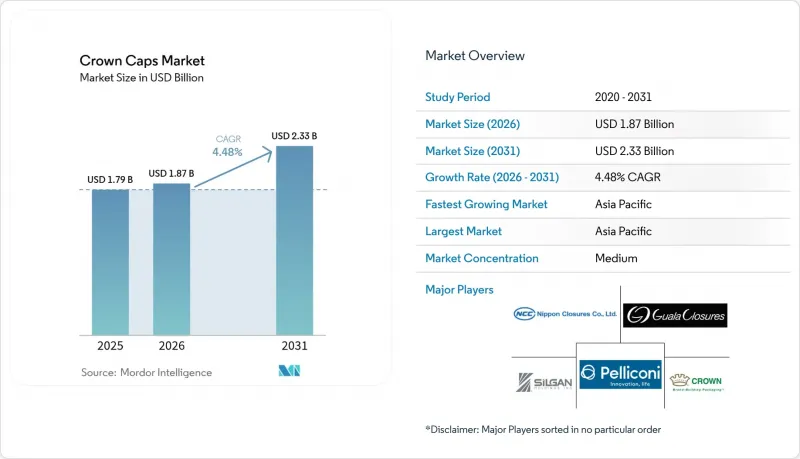
本報告按材質(鋁、鋼、鍍錫鋼)、瓶蓋類型(折疊式、旋蓋式)、內襯類型(PVC、無PVC)、應用領域(飲料、食品、藥品/營養補充劑等)和地區(北美、南美、歐洲等)進行細分。市場預測以美元計價。
全球皇冠帽市場趨勢與洞察
精釀啤酒小型釀酒廠的擴張
到2024年,美國將有超過9,000家啤酒廠,比2023年成長15%。幾乎所有啤酒廠都使用可拆卸式金屬皇冠蓋,因為即使在小批量生產中,這種蓋子也能可靠地密封二氧化碳。德國、比利時和英國的歐洲小型釀酒廠也呈現出類似的成長勢頭,這促使加工商開發定製印刷的皇冠蓋,以保持其獨特的風味特徵。隨著分銷管道從酒吧擴展到零售店,小型釀酒廠對氧氣透過率更低、防篡改功能更清晰的內襯提出了更高的要求。此外,對於該領域價格較高的產品,使用輕質鋁材也更有意義,既能凸顯永續性,又能提升產品在商店的吸引力。
向無PVC襯墊的過渡是由法規驅動的。
全球食品接觸材料法規正在加速PVC向EPE和TPE內襯的轉變。美國食品藥物管理局(FDA)對塑化劑的持續重新評估以及歐盟的《包裝和包裝廢棄物法規》(PPWR)正迫使飲料品牌逐步採用可回收、無氯的解決方案。雖然這一轉變涉及生產線改造、樹脂檢驗以及原料成本的增加,但先驅者憑藉著符合法規且環保的瓶蓋佔據了市場領先地位。在預測期內,隨著監管力度的增加和品牌所有者擴大生命週期審核範圍,擴大無PVC產能的供應商預計將獲得更大的市場佔有率。
輕質寶特瓶和塑膠螺旋蓋
瓶裝產品製造商目前提供的PET包裝比同類玻璃容器輕60-70%,並配有符合歐盟一次性塑膠指令的繫繩式螺旋蓋。這正在蠶食先前由金屬皇冠蓋主導的成本敏感市場。 PET更低的物流成本和更優異的阻隔性性能正日益威脅著碳酸飲料這一細分市場,尤其是在新興經濟體,運輸成本在價值鏈中佔據很大比例。皇冠蓋供應商正透過強調其傳統美感、可回收性和高階定位來降低被替代的風險,而這些特性是PET難以複製的。
細分市場分析
2025年,鋼製瓶蓋憑藉其低成本和在高速生產線上的耐用性,仍將維持48.40%的市場佔有率。儘管鋼製瓶蓋的市場規模預計將略有成長,但部分佔有率將被鋁製瓶蓋蠶食。鋁製瓶蓋憑藉5.56%的減重目標和卓越的耐腐蝕性,正引領複合年成長率的成長。精釀烈酒生產商青睞鋁製瓶蓋的可回收性和高階外觀,並以此為溢價來彌補材料成本的差異。供應商正在測試3104和5052合金,這些合金可在不影響瓶蓋剛性的前提下,將瓶蓋重量減輕高達20%。
鍍錫鋼等二線材料滿足了對拋光錶面和高阻隔性能有較高要求的細分市場需求,但由於原料成本波動,其價格非常敏感。為了平衡成本和商店吸引力,採用鋼製內殼搭配鋁製裙邊的混合設計正在興起。在預測期內,材料的演變可能取決於主要飲料集團的「從搖籃到搖籃 (C2C)」審核,而廢舊產品的回收率將成為關鍵的差異化因素。
預計到2025年,折疊式瓶蓋將佔據61.75%的市場佔有率,反映出其在主流啤酒市場的廣泛應用。然而,旋蓋預計將以5.89%的複合年成長率超越這一趨勢,這主要得益於老齡化人口對易開瓶性的日益重視,以及高階非酒精飲料品牌為滿足多種飲用場合的需求而採用可重複密封的設計。皇冠蓋市場採用螺紋成型技術,即使反覆開合也能保持密封壓力。雖然精密模具和視覺測試的投資會增加單位成本,但加工商正透過產品差異化和增值定價來彌補這些成本。
這種混合設計結合了旋擰式開啟機制和可見的防篡改封條,旨在滿足製藥業監管機構的嚴格審查。此外,東協地區的啤酒廠正在試驗使用拉環式包裝,將便利性作為新的成長驅動力。在該領域取得成功的供應商將整合模具的柔軟性,從而能夠在層壓式和旋擰式包裝產品之間快速切換,而不會造成長時間的停機時間。
區域分析
預計到2025年,亞太地區將以40.10%的市佔率佔據全球領先地位,複合年成長率達7.05%,成為皇冠蓋市場規模最大、成長最快的地區。中國、印度、印尼和越南等國可支配所得的成長推動了人均啤酒和軟性飲料消費量的成長,同時,外商對啤酒廠建設的直接投資也支撐了對瓶蓋的需求。各地區的加工商正將瓶蓋本體壓制和內襯複合加工集中在裝瓶廠附近,以確保供應鏈的韌性,並最大限度地降低運輸成本和海關風險。中國東部各省的政府激勵措施進一步加速了鋁製瓶蓋的生產,並提升了出口競爭力。
北美憑藉著超過9000家啤酒廠和蓬勃發展的精釀啤酒文化,保持著強勁的地位。強制使用不含PVC內襯的法規正在加速其普及,這有利於那些在實施期限前就已擴大合規產品生產規模的國內供應商。 2022年從加拿大進口的價值40.8億美元的鋁材,凸顯了該地區一體化的金屬市場對瓶蓋生產的支持作用。
在歐洲,高階飲品和嚴格的回收目標支撐著市場需求,使其保持穩定。押金返還制度的實施引發了人們對可拆卸瓶蓋所造成廢棄物的關注,迫使灌裝商轉向使用繫繩式或可重複密封的皇冠蓋。製造商們正在透過改進瓶蓋形狀來應對這項挑戰,以便在不影響傳統設計特性的前提下,方便回收使用過的瓶蓋。同時,德國和比利時的啤酒廠正在試驗拉環式瓶蓋,以提升消費者的便利性。
南美洲、中東和非洲正在崛起為新的成長支柱。在巴西,成熟的啤酒市場支撐著瓶蓋的穩定消費;而在墨西哥,龍舌蘭酒的出口推動了對客製化防篡改皇冠蓋的需求。在非洲,都市化加速了瓶裝碳酸飲料的普及,但價格敏感度加劇了與寶特瓶的競爭。那些實現生產線本地化或與當地飲料集團合作的製造商,正透過降低進口關稅和縮短前置作業時間,為長期市場滲透奠定基礎。
其他好處:
- Excel格式的市場預測(ME)表
- 3個月的分析師支持
目錄
第1章:引言
- 研究假設和市場定義
- 調查範圍
第2章:調查方法
第3章執行摘要
第4章 市場狀況
- 市場概覽
- 市場促進因素
- 生產精釀啤酒的本地啤酒廠數量正在增加。
- 由於法規要求,過渡到使用不含PVC的襯墊。
- 高級飲品玻璃容器的復興
- 帶有QR碼的互動式瓶蓋可增強品牌互動性。
- 康普茶和機能飲料的新需求
- 先進的防竄改瓶蓋設計
- 市場限制因素
- 輕質寶特瓶,附塑膠螺旋蓋
- 馬口鐵和鋁價格波動
- 關於一次性金屬瓶蓋的政策計劃
- 東南亞國協啤酒廠拉環式瓶蓋的普及程度
- 產業價值鏈分析
- 監理情勢
- 技術展望
- 波特五力分析
- 宏觀經濟因素對市場的影響
第5章 市場規模與成長預測
- 材料
- 鋁
- 鋼
- 鍍錫鋼
- 透過封閉法
- Pry-Off
- 擰開
- 襯裡類型
- PVC
- 不含聚氯乙烯(EPE/TPE)
- 透過使用
- 飲料
- 酒精飲料
- 啤酒
- 葡萄酒
- 烈酒
- 不含酒精的飲料
- 碳酸軟性飲料
- 機能飲料和能量飲料
- 其他非酒精飲料
- 酒精飲料
- 食物
- 藥品和營養保健品
- 其他用途
- 飲料
- 按地區
- 北美洲
- 美國
- 加拿大
- 墨西哥
- 南美洲
- 巴西
- 阿根廷
- 智利
- 其他南美國家
- 歐洲
- 英國
- 德國
- 法國
- 西班牙
- 義大利
- 其他歐洲國家
- 亞太地區
- 中國
- 印度
- 日本
- 澳洲
- 韓國
- 越南
- 其他亞太國家
- 中東和非洲
- 中東
- 沙烏地阿拉伯
- 阿拉伯聯合大公國
- 土耳其
- 其他中東國家
- 非洲
- 南非
- 奈及利亞
- 埃及
- 其他非洲國家
- 中東
- 北美洲
第6章 競爭情勢
- 市場集中度
- 策略趨勢
- 市佔率分析
- 公司簡介
- Crown Holdings Inc.
- Pelliconi & C. SpA
- Nippon Closures Co., Ltd.
- Silgan Holdings Inc.
- Guala Closures Group SpA
- Astir Vitogiannis Bros SA
- Finn-Korkki Oy
- Samhwa Crown & Closure Co., Ltd.
- AMD Industries Limited
- Avon Crowncaps & Containers Nigeria Ltd.
- Viscose Closures Ltd.
- Closure Systems International Inc.
- Berlin Packaging LLC
- O.Berk Company LLC
- Tapi SpA
- Evergreen Resources Ltd.
- Yantai Closures Co., Ltd.
- Standard Crown Caps(India)Pvt Ltd.
- SKS Bottle & Packaging Inc.
- Toyo Seikan Group Holdings, Ltd.
第7章 市場機會與未來展望
According to Mordor Intelligence, the crown caps market size is expected to grow from USD 1.79 billion in 2025 to USD 1.87 billion in 2026 and is forecast to reach USD 2.33 billion by 2031 at 4.48% CAGR over 2026-2031.
This report is Segmented by Material (Aluminum, Steel, and Tin-Plated Steel), Closure Type (Pry-Off, and Twist-Off), Liner Type (PVC, and PVC-Free), Application (Beverages, Food, Pharmaceuticals and Nutraceuticals, and More), and Geography (North America, South America, Europe, and More). The Market Forecasts are Provided in Terms of Value (USD).
Global Crown Caps Market Trends and Insights
Rising Craft-Beer Micro-Brewery Expansion
More than 9,000 breweries operated in the United States in 2024, up 15% from 2023, and nearly all specify pry-off metal crowns because they seal carbonation reliably at small batch scales. European microbreweries in Germany, Belgium, and the United Kingdom mirror this momentum, prompting converters to develop custom-printed crowns that preserve unique flavor profiles. As taproom-to-retail distribution widens, microbrewers demand liners with tighter oxygen transmission rates and overt tamper evidence. The segment's premium-priced offerings also justify the adoption of lightweight aluminum to reinforce sustainability claims and shelf impact.
Regulation-Driven Shift Toward PVC-Free Liners
Global food-contact legislation is accelerating the migration from PVC to EPE or TPE liners. The FDA's ongoing reassessment of plasticizers and the European Union's Packaging and Packaging Waste Regulation (PPWR) push beverage brands to phase in recyclable, non-chlorinated solutions. The transition entails production line retrofits, resin validation, and higher raw material outlays, yet early adopters secure premium positioning with compliant, eco-friendly closures. Over the forecast period, suppliers that scale PVC-free capacity are expected to gain share as regulators heighten enforcement and brand owners expand life-cycle auditing.
Lightweight PET Bottles with Plastic Screw Caps
Bottle manufacturers now deliver PET packs that weigh 60-70% less than comparable glass containers and integrate tethered screw caps that satisfy the EU Single-Use Plastics Directive, eroding cost-conscious segments traditionally served by metal crowns. PET's logistics savings and improved barrier resins increasingly threaten the carbonated soft drink niche, especially in emerging economies where freight expenses dominate value chains. Crown cap suppliers mitigate the substitution risk by emphasizing heritage aesthetics, recyclability, and premium positioning that PET struggles to replicate.
Other drivers and restraints analyzed in the detailed report include:
- Resurgence of Glass Packaging in Premium Beverages
- Interactive QR-Coded Crown Caps Boost Brand Engagement
- Volatility in Tin-Plate and Aluminum Pricing
For complete list of drivers and restraints, kindly check the Table Of Contents.
Segment Analysis
Steel retained 48.40% share of the crown caps market in 2025 due to its low cost and robustness on high-speed lines. The crown caps market size attributed to steel will edge higher but cede mix to aluminum, whose 5.56% brand lightweighting targets and superior corrosion resistance fuel CAGR. Aluminum recyclability and premium aesthetics appeal to craft distillers that command price premiums covering the material differential. Suppliers experiment with 3104 and 5052 alloys that lower shell mass by up to 20% without compromising cap rigidity.
Second-tier materials such as tin-plated steel serve niche segments requiring glossy finishes or elevated barrier performance but face price sensitivity amid raw-material volatility. Hybrid designs that marry a steel inner shell with an aluminum skirt are emerging to balance cost with shelf appeal. Over the forecast horizon, material evolution may hinge on cradle-to-cradle audits by major beverage groups, making post-consumer scrap recovery rates a critical differentiator.
Pry-off variants commanded 61.75% share in 2025, reflecting entrenched use in mainstream beer markets. Yet twist-offs are projected to outpace at 5.89% CAGR as aging demographics value easy opening and as premium non-alcoholic brands adopt resealability to support multi-serve consumption occasions. The crown caps market embraces thread-forming technologies that maintain seal pressure across repeated openings and closings. Investment in precision die sets and vision inspection drives unit costs higher, but converters recoup through product differentiation and value-added fees.
Hybrid formats combining twistability with overt tamper bands seek to satisfy regulatory scrutiny in pharmaceuticals. Additionally, the ring-pull derivatives pilot in ASEAN breweries, positioning convenience as an alternative growth lever. Suppliers successful in this segment will integrate tooling flexibility that permits rapid changeovers between pry-off and twist-off SKUs without protracted downtime.
Complete Report Scope:
- By Material
- Aluminum
- Steel
- Tin-Plated Steel
- By Closure Type
- Pry-Off
- Twist-Off
- By Liner Type
- PVC
- PVC-Free (EPE / TPE)
- By Application
- Beverages
- Alcoholic Beverages
- Beer
- Wine
- Spirits
- Non-Alcoholic Beverages
- Carbonated Soft Drinks
- Functional and Energy Drinks
- Other Non-Alcoholic Beverages
- Alcoholic Beverages
- Food
- Pharmaceuticals and Nutraceuticals
- Other Applications
- Beverages
- By Geography
- North America
- United States
- Canada
- Mexico
- South America
- Brazil
- Argentina
- Chile
- Rest of South America
- Europe
- United Kingdom
- Germany
- France
- Spain
- Italy
- Rest of Europe
- Asia-Pacific
- China
- India
- Japan
- Australia
- South Korea
- Vietnam
- Rest of Asia-Pacific
- Middle East and Africa
- Middle East
- Saudi Arabia
- United Arab Emirates
- Turkey
- Rest of Middle East
- Africa
- South Africa
- Nigeria
- Egypt
- Rest of Africa
- Middle East
- North America
Geography Analysis
Asia-Pacific led with a 40.10% share in 2025, and its 7.05% CAGR makes it the largest and fastest geography within the crown caps market. Rising disposable incomes in China, India, Indonesia, and Vietnam lift per-capita beer and soft-drink consumption, while foreign direct investment into brewery build-outs underpins closure volumes. Regional converters secure supply-chain resilience by co-locating shell stamping and liner compounding near bottling hubs, minimizing freight costs and customs exposure. Government incentives in China's eastern provinces further encourage aluminum cap manufacturing, bolstering export competitiveness.
North America retains a robust position, fueled by over 9,000 breweries and a strong craft-beer culture. Regulations pushing PVC-free liners prompt early adoption, rewarding domestic suppliers that scale compliant wads ahead of enforcement deadlines. Aluminum import volumes worth USD 4.08 billion from Canada in 2022 underscore the integrated regional metals market supporting closure production.
Europe shows stable demand, anchored by premium beverages and stringent recycling targets. Implementation of deposit-return systems sharpens focus on detachable closure waste, nudging fillers toward tethered or resealable crowns. Producers respond with shell geometry tweaks that allow post-consumer collection without compromising heritage design cues. Meanwhile, breweries in Germany and Belgium pilot ring-pull formats to enhance consumer convenience.
South America and the Middle East and Africa present emerging growth corridors. Brazil's established beer scene underpins steady closure consumption, whereas Mexico's tequila exports drive demand for customized, tamper-evident crowns. In Africa, urbanization accelerates bottled soda uptake, though price sensitivity fosters competition from PET. Manufacturers that localize stamping lines or partner with regional beverage groups reduce import duties and shorten lead times, building a platform for long-term penetration.
- Crown Holdings Inc.
- Pelliconi & C. SpA
- Nippon Closures Co., Ltd.
- Silgan Holdings Inc.
- Guala Closures Group S.p.A.
- Astir Vitogiannis Bros SA
- Finn-Korkki Oy
- Samhwa Crown & Closure Co., Ltd.
- A.M.D. Industries Limited
- Avon Crowncaps & Containers Nigeria Ltd.
- Viscose Closures Ltd.
- Closure Systems International Inc.
- Berlin Packaging LLC
- O.Berk Company LLC
- Tapi S.p.A.
- Evergreen Resources Ltd.
- Yantai Closures Co., Ltd.
- Standard Crown Caps (India) Pvt Ltd.
- SKS Bottle & Packaging Inc.
- Toyo Seikan Group Holdings, Ltd.
Additional Benefits:
- The market estimate (ME) sheet in Excel format
- 3 months of analyst support
TABLE OF CONTENTS
1 INTRODUCTION
- 1.1 Study Assumptions and Market Definition
- 1.2 Scope of the Study
2 RESEARCH METHODOLOGY
3 EXECUTIVE SUMMARY
4 MARKET LANDSCAPE
- 4.1 Market Overview
- 4.2 Market Drivers
- 4.2.1 Rising craft-beer micro-brewery expansion
- 4.2.2 Regulation-driven shift toward PVC-free liners
- 4.2.3 Resurgence of glass packaging in premium beverages
- 4.2.4 Interactive QR-coded crown caps boost brand engagement
- 4.2.5 Emerging demand from kombucha and functional drinks
- 4.2.6 Advanced tamper-evident cap designs
- 4.3 Market Restraints
- 4.3.1 Lightweight PET bottles with plastic screw caps
- 4.3.2 Volatility in tin-plate and aluminum pricing
- 4.3.3 Policy push against single-use metal closures
- 4.3.4 Penetration of ring-pull crowns in ASEAN breweries
- 4.4 Industry Value Chain Analysis
- 4.5 Regulatory Landscape
- 4.6 Technological Outlook
- 4.7 Porter's Five Forces Analysis
- 4.7.1 Bargaining Power of Suppliers
- 4.7.2 Bargaining Power of Consumers
- 4.7.3 Threat of New Entrants
- 4.7.4 Threat of Substitutes
- 4.7.5 Competitive Rivalry
- 4.8 Impact of Macroeconomic Factors on the Market
5 MARKET SIZE AND GROWTH FORECASTS (VALUE)
- 5.1 By Material
- 5.1.1 Aluminum
- 5.1.2 Steel
- 5.1.3 Tin-Plated Steel
- 5.2 By Closure Type
- 5.2.1 Pry-Off
- 5.2.2 Twist-Off
- 5.3 By Liner Type
- 5.3.1 PVC
- 5.3.2 PVC-Free (EPE / TPE)
- 5.4 By Application
- 5.4.1 Beverages
- 5.4.1.1 Alcoholic Beverages
- 5.4.1.1.1 Beer
- 5.4.1.1.2 Wine
- 5.4.1.1.3 Spirits
- 5.4.1.2 Non-Alcoholic Beverages
- 5.4.1.2.1 Carbonated Soft Drinks
- 5.4.1.2.2 Functional and Energy Drinks
- 5.4.1.2.3 Other Non-Alcoholic Beverages
- 5.4.1.1 Alcoholic Beverages
- 5.4.2 Food
- 5.4.3 Pharmaceuticals and Nutraceuticals
- 5.4.4 Other Applications
- 5.4.1 Beverages
- 5.5 By Geography
- 5.5.1 North America
- 5.5.1.1 United States
- 5.5.1.2 Canada
- 5.5.1.3 Mexico
- 5.5.2 South America
- 5.5.2.1 Brazil
- 5.5.2.2 Argentina
- 5.5.2.3 Chile
- 5.5.2.4 Rest of South America
- 5.5.3 Europe
- 5.5.3.1 United Kingdom
- 5.5.3.2 Germany
- 5.5.3.3 France
- 5.5.3.4 Spain
- 5.5.3.5 Italy
- 5.5.3.6 Rest of Europe
- 5.5.4 Asia-Pacific
- 5.5.4.1 China
- 5.5.4.2 India
- 5.5.4.3 Japan
- 5.5.4.4 Australia
- 5.5.4.5 South Korea
- 5.5.4.6 Vietnam
- 5.5.4.7 Rest of Asia-Pacific
- 5.5.5 Middle East and Africa
- 5.5.5.1 Middle East
- 5.5.5.1.1 Saudi Arabia
- 5.5.5.1.2 United Arab Emirates
- 5.5.5.1.3 Turkey
- 5.5.5.1.4 Rest of Middle East
- 5.5.5.2 Africa
- 5.5.5.2.1 South Africa
- 5.5.5.2.2 Nigeria
- 5.5.5.2.3 Egypt
- 5.5.5.2.4 Rest of Africa
- 5.5.5.1 Middle East
- 5.5.1 North America
6 COMPETITIVE LANDSCAPE
- 6.1 Market Concentration
- 6.2 Strategic Moves
- 6.3 Market Share Analysis
- 6.4 Company Profiles (includes Global level Overview, Market level overview, Core Segments, Financials as available, Strategic Information, Market Rank/Share for key companies, Products and Services, and Recent Developments)
- 6.4.1 Crown Holdings Inc.
- 6.4.2 Pelliconi & C. SpA
- 6.4.3 Nippon Closures Co., Ltd.
- 6.4.4 Silgan Holdings Inc.
- 6.4.5 Guala Closures Group S.p.A.
- 6.4.6 Astir Vitogiannis Bros SA
- 6.4.7 Finn-Korkki Oy
- 6.4.8 Samhwa Crown & Closure Co., Ltd.
- 6.4.9 A.M.D. Industries Limited
- 6.4.10 Avon Crowncaps & Containers Nigeria Ltd.
- 6.4.11 Viscose Closures Ltd.
- 6.4.12 Closure Systems International Inc.
- 6.4.13 Berlin Packaging LLC
- 6.4.14 O.Berk Company LLC
- 6.4.15 Tapi S.p.A.
- 6.4.16 Evergreen Resources Ltd.
- 6.4.17 Yantai Closures Co., Ltd.
- 6.4.18 Standard Crown Caps (India) Pvt Ltd.
- 6.4.19 SKS Bottle & Packaging Inc.
- 6.4.20 Toyo Seikan Group Holdings, Ltd.
7 MARKET OPPORTUNITIES AND FUTURE OUTLOOK
- 7.1 White-Space and Unmet-Need Assessment

 全球蓋子與封口裝置市場規模、佔有率、趨勢和成長分析報告(2026-2034年)
 易撕拉環蓋市場規模、佔有率和成長分析:按材料、蓋類型、應用、最終用途行業、封蓋方式和地區分類 - 行業預測,2026-2033年
 消毒瓶蓋市場:全球市場按產品類型、材料、應用、最終用戶和銷售管道分類的預測,2026-2032年蓋子與封口裝置市場:2026-2032年全球市場預測(按材料、類型、應用、最終用途和分銷管道分類)
 蓋子與封口裝置市場機會、成長促進因素、產業趨勢分析及 2026-2035 年預測。全球飲料瓶蓋市場:市場規模、佔有率、趨勢和成長分析(2026-2034)瓶蓋市場規模、佔有率、成長、全球產業分析、區域趨勢及2026年至2034年預測。
 消毒瓶蓋市場規模、佔有率和成長分析:按產品類型、應用、最終用戶、材料類型、滅菌狀態、分銷管道和地區分類-2026-2033年產業預測
 可重複密封拉鍊與滑塊市場規模、佔有率、成長、行業分析和預測:按類型、最終用戶和地區分類(至 2034 年)
 蓋子與封口裝置包裝市場預測至2034年-按材料類型、產品類型、封蓋技術、應用、最終用戶和地區分類的全球分析