


 |
市場調查報告書
商品編碼
2123305
冷鏈包裝:市場佔有率分析、產業趨勢與統計、成長預測(2026-2031)Cold Chain Packaging - Market Share Analysis, Industry Trends & Statistics, Growth Forecasts (2026 - 2031) |
||||||

※ 本網頁內容可能與最新版本有所差異。詳細情況請與我們聯繫。
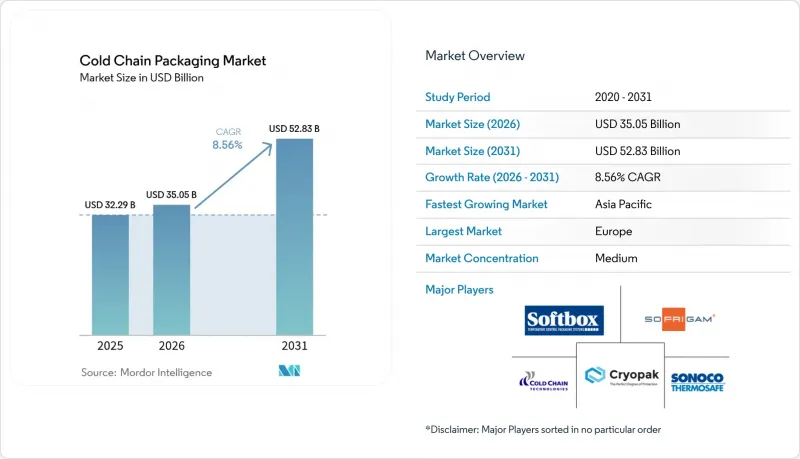
據 Mordor Intelligence 稱,2025 年冷鏈包裝市場價值為 322.9 億美元,預計到 2031 年將達到 528.3 億美元,而 2026 年為 350.5 億美元,預測期(2026-2031 年)的複合年成長率為 8.56%。
本報告按產品(保溫容器、保溫運輸箱、冷媒等)、包裝系統(主動式、被動式、混合式)、材料(EPS、PUR、VIP、EPP等)、應用(一次性、可重複使用)、應用領域(製藥和生物技術、臨床試驗和診斷等)以及地區進行細分。市場預測以美元計價。
全球冷鏈包裝市場趨勢與洞察
生物製藥和細胞/基因治療物流。
近一半的新藥需要溫度控制,許多先進療法更需要在低於-150 度C的低溫條件下進行。 2025年1月,Cryoport公司發布了“HV3運輸箱”,該運輸箱能夠長時間維持如此超低溫,標誌著該領域正朝著專業化設計方向發展。美國食品藥物管理局(FDA)的生技藥品許可要求提供運輸過程中穩定性的驗證檢驗,因此包裝合格對於產品核可至關重要。個人化醫療的發展趨勢正在增加運輸頻率和運輸貨物的價值,從而推動冷鏈包裝市場對高級產品的需求。
透過電子商務拓展雜貨和食材自煮包配送服務
隨著冷藏和冷凍食品的線上銷售量成長,對輕便、節省空間且能應對「最後一公里」配送過程中環境變化的保溫隔熱材料的需求日益成長。 HelloFresh 利用人工智慧技術,根據天氣和配送路線等資訊調整包裝配置,充分展現了數據驅動材料選擇的潛力。 Ranpak 於 2024 年 4 月推出的「climaliner Plus」保溫袋可作為生活垃圾回收利用,並提供長達 72 小時的保溫效果,滿足了消費者對永續性的期望。這些創新正在將冷鏈包裝市場拓展到傳統醫藥產業之外。
聚合物原料價格波動
聚乙烯和聚丙烯成本的上漲對加工商的利潤率帶來壓力,並可能延緩向可重複使用包裝的轉型,而這種轉型需要更高的初始投資。小規模生產者往往缺乏對沖手段,因此被迫重新評估產品系列,並將高價值的醫藥相關交易放在首位。
細分市場分析
保溫容器已成為運輸的基礎,到2025年,它們將佔冷鏈包裝市場35.02%的佔有率。儘管保溫容器佔據主導地位,但隨著供應鏈持續可視性需求的不斷成長,溫度監測設備預計將以12.44%的複合年成長率成長。諸如Timestrip的Semaglutide Index等智慧標籤正在提高高價值生技藥品的合規性,並被醫療保健機構廣泛採用。
物聯網晶片與低功耗網路的融合正在將被動式容器轉變為互聯資產。 SkyCell 的 1500X 混合容器擁有 270 小時的運作,並可即時傳輸資料。這正是將監控設備與絕緣基材整合以降低溫度偏差的絕佳例證。這些進步正吸引保險公司的關注,他們如今對經證實有效的風險降低方案給予獎勵,從而擴大了設備製造商在冷鏈包裝市場的潛在市場佔有率。
到2025年,被動式運輸容器仍將佔據冷鏈包裝市場54.88%的佔有率,其優勢在於操作簡單且易於遵守相關法規。另一方面,混合式容器透過在傳統容器中整合感測器和有限的電力輔助功能,實現了成本和控制之間的平衡,並以10.05%的複合年成長率位居市場前列。 Va-Q-Tec公司的「熱塗層」為傳統包裝箱增加了一層智慧層,從而減少了對全功率設備的依賴。
全球航空公司正收緊鋰離子電池裝載量的規定,將充電狀態 (SOC) 限制在 30% 以內,這限制了主動式貨櫃的使用。太陽能和超級電容的整合正在緩解這一障礙,推動製造商轉向被動-主動混合設計。隨著合規性審核的加強,具備內建追蹤功能的運輸貨櫃正成為採購重點,從而促進了整個冷鏈包裝市場混合型貨櫃的成長。
其他好處:
- Excel格式的市場預測(ME)表
- 3個月的分析師支持
目錄
第1章:引言
- 研究假設和市場定義
- 調查範圍
第2章:調查方法
第3章執行摘要
第4章 市場狀況
- 市場概覽
- 市場促進因素
- 生物製藥和細胞/基因治療物流。
- 擴大線上雜貨和食材自煮包
- 全球疫苗在新興國家的部署工作
- 分散式臨床試驗中對分區的需求
- 引入可重複使用的被動式托運人以實現ESG目標
- 保險公司主導智慧指標的引進。
- 市場限制因素
- 聚合物原料價格波動
- 歐盟關於循環經濟中EPS的法規
- 對於處理大件貨物的托運人來說,航空貨運能力面臨巨大壓力。
- 鋰電池在運作中系統中的局限性
- 供應鏈分析
- 監理展望
- 技術展望
- 波特五力分析
第5章 市場規模與成長預測
- 依產品
- 保溫容器
- 保溫運輸貨櫃
- 冷媒、凝膠包和相變材料(PCM)
- 溫度監測裝置
- 真空絕熱板
- 乾冰系統
- 透過包裝系統
- 主動系統
- 被動系統
- 混合系統
- 材料
- 發泡聚苯乙烯(EPS)
- 聚氨酯(PUR)
- 真空絕熱板(VIP)
- 發泡聚丙烯(EPP)
- 生物基相變材料(PCMs)
- 帶有阻隔襯墊的紙板
- 高性能發泡體(酚醛、聚異氰脲酸酯)
- 透過可用性
- 一次使用
- 可重複使用的
- 透過使用
- 製藥和生物技術
- 臨床試驗和診斷
- 乳製品和冷凍甜點
- 肉類和水產品
- 其他用途
- 按地區
- 北美洲
- 美國
- 加拿大
- 墨西哥
- 歐洲
- 德國
- 英國
- 法國
- 義大利
- 西班牙
- 俄羅斯
- 其他歐洲國家
- 亞太地區
- 中國
- 印度
- 日本
- 韓國
- 澳洲和紐西蘭
- 其他亞太國家
- 中東和非洲
- 中東
- 阿拉伯聯合大公國
- 沙烏地阿拉伯
- 土耳其
- 其他中東國家
- 非洲
- 南非
- 奈及利亞
- 埃及
- 其他非洲國家
- 中東
- 南美洲
- 巴西
- 阿根廷
- 其他南美國家
- 北美洲
第6章 競爭情勢
- 市場集中度
- 策略趨勢
- 市佔率分析
- 公司簡介
- Sonoco ThermoSafe
- Cold Chain Technologies
- Pelican BioThermal
- Softbox Systems
- Intelsius(DGP)
- Cryopak
- Sofrigam
- Tempack
- CSafe Global
- Va-Q-Tec
- SkyCell
- CrodaTherm
- Sealed Air Corp.
- DS Smith(International Paper)
- Storopack
- Cascades Inc.
- Cryoport
- Thermo King
- Marken
- Timestrip
第7章 市場機會與未來展望
According to Mordor Intelligence, the cold chain packaging market size was valued at USD 32.29 billion in 2025 and estimated to grow from USD 35.05 billion in 2026 to reach USD 52.83 billion by 2031, at a CAGR of 8.56% during the forecast period (2026-2031).
This report is Segmented by Product (Insulated Containers, Insulated Shippers, Refrigerants, and More), Packaging System (Active, Passive, Hybrid), Material (EPS, PUR, VIP, EPP, and More), Usability (Single-Use, Reusable), Application (Pharmaceuticals and Biotechnology, Clinical Trials and Diagnostics, and More), and Geography. The Market Forecasts are Provided in Terms of Value (USD).
Global Cold Chain Packaging Market Trends and Insights
Boom in Biologics and Cell-/Gene-Therapy Logistics
Nearly half of new pharmaceuticals require temperature control, and many advanced therapies need cryogenic conditions below -150 °C. In January 2025 Cryoport introduced the HV3 shipper that maintains such ultra-low levels for prolonged periods, illustrating the sector's shift toward specialised designs. The FDA's biologics licensing requirements demand validated evidence of stability throughout transit, making packaging qualification integral to product approval. Personalised medicine trends intensify shipment frequency and value, driving premium demand across the cold chain packaging market.
Expansion of E-commerce Grocery and Meal-Kit Delivery
Online grocery volumes for chilled and frozen foods increase the need for lightweight, space-efficient insulation that withstands last-mile variability. HelloFresh employs AI to adjust pack configuration to weather and route specifics, demonstrating how data drives material selection. Ranpak's curbside-recyclable climaliner Plus, launched April 2024, offers 72 hours of thermal protection and responds to consumers' sustainability expectations. These innovations expand the cold chain packaging market beyond traditional pharmaceutical lanes.
Polymer Feedstock Price Volatility
Upward swings in polyethylene and polypropylene costs compress converter margins and can delay switching to reusable packaging that carries higher upfront spend. Smaller producers often lack hedging mechanisms, prompting them to rationalise portfolios and prioritise high-value pharmaceutical accounts.
Other drivers and restraints analyzed in the detailed report include:
- Global Vaccine Initiatives in Emerging Nations
- Decentralized Clinical-Trial Parcel Demand
- EU Circular-Economy Limits on EPS
For complete list of drivers and restraints, kindly check the Table Of Contents.
Segment Analysis
Insulated containers provided the backbone of shipments and accounted for 35.02% of the cold chain packaging market in 2025. Despite this dominance, temperature-monitoring devices post a 12.44% CAGR as supply chains demand continuous visibility. Smart labels such as Timestrip's semaglutide indicator extend compliance to high-value biologics, capturing adoption across healthcare providers.
The convergence of IoT chips and low-power networks upgrades passive boxes into connected assets. SkyCell's 1500X hybrid container runs for 270 hours and transmits live data, illustrating how monitoring devices integrate with insulation substrates to limit excursions. These advances attract insurers that now reward proven risk reduction, expanding addressable volumes for device makers within the cold chain packaging market.
Passive shippers retained 54.88% share of the cold chain packaging market size in 2025, valued for simplicity and regulatory familiarity. Hybrid formats, however, post the fastest 10.05% CAGR by embedding sensors and limited power assistance inside traditional shells, thereby balancing cost and control. Va-Q-Tec's Thermal Coat adds an intelligent layer to legacy boxes and reduces reliance on fully powered units.
Global airlines tighten lithium-battery carriage rules, capping state-of-charge at 30%, which constrains active container usage. Solar harvesting and supercapacitor integration mitigate this hurdle and push manufacturers toward passive-active hybrids. As compliance audits intensify, shippers with built-in traceability gain procurement preference, strengthening hybrid growth across the cold chain packaging market.
Complete Report Scope:
- By Product
- Insulated Containers
- Insulated Shippers
- Refrigerants Gel Packs and PCMs
- Temperature-Monitoring Devices
- Vacuum-Insulated Panels
- Dry-Ice Systems
- By Packaging System
- Active Systems
- Passive Systems
- Hybrid Systems
- By Material
- Expanded Polystyrene (EPS)
- Polyurethane (PUR)
- Vacuum Insulation Panels (VIP)
- Expanded Polypropylene (EPP)
- Bio-based PCMs
- Corrugated Cardboard with Barrier Liners
- High-performance Foams (Phenolic, PIR)
- By Usability
- Single-use
- Reusable
- By Application
- Pharmaceuticals and Biotechnology
- Clinical Trials and Diagnostics
- Dairy and Frozen Desserts
- Meat and Seafood
- Other Application
- By Geography
- North America
- United States
- Canada
- Mexico
- Europe
- Germany
- United Kingdom
- France
- Italy
- Spain
- Russia
- Rest of Europe
- Asia-Pacific
- China
- India
- Japan
- South Korea
- Australia and New Zealand
- Rest of Asia-Pacific
- Middle East and Africa
- Middle East
- United Arab Emirates
- Saudi Arabia
- Turkey
- Rest of Middle East
- Africa
- South Africa
- Nigeria
- Egypt
- Rest of Africa
- Middle East
- South America
- Brazil
- Argentina
- Rest of South America
- North America
List of Companies Covered in this Report:
- Sonoco ThermoSafe
- Cold Chain Technologies
- Pelican BioThermal
- Softbox Systems
- Intelsius (DGP)
- Cryopak
- Sofrigam
- Tempack
- CSafe Global
- Va-Q-Tec
- SkyCell
- CrodaTherm
- Sealed Air Corp.
- DS Smith (International Paper)
- Storopack
- Cascades Inc.
- Cryoport
- Thermo King
- Marken
- Timestrip
Additional Benefits:
- The market estimate (ME) sheet in Excel format
- 3 months of analyst support
TABLE OF CONTENTS
1 INTRODUCTION
- 1.1 Study Assumptions and Market Definition
- 1.2 Scope of the Study
2 RESEARCH METHODOLOGY
3 EXECUTIVE SUMMARY
4 MARKET LANDSCAPE
- 4.1 Market Overview
- 4.2 Market Drivers
- 4.2.1 Boom in biologics and cell-/gene-therapy logistics
- 4.2.2 Expansion of e-commerce grocery and meal-kit delivery
- 4.2.3 Global vaccine initiatives in emerging nations
- 4.2.4 Decentralized clinical-trial parcel demand
- 4.2.5 Reusable passive shipper adoption for ESG targets
- 4.2.6 Insurer-driven smart indicator uptake
- 4.3 Market Restraints
- 4.3.1 Polymer feedstock price volatility
- 4.3.2 EU circular-economy limits on EPS
- 4.3.3 Air-freight capacity squeeze for bulky shippers
- 4.3.4 Lithium-battery limits on active systems
- 4.4 Supply-Chain Analysis
- 4.5 Regulatory Outlook
- 4.6 Technological Outlook
- 4.7 Porter's Five Forces Analysis
- 4.7.1 Threat of New Entrants
- 4.7.2 Bargaining Power of Buyers
- 4.7.3 Bargaining Power of Suppliers
- 4.7.4 Threat of Substitutes
- 4.7.5 Intensity of Competitive Rivalry
5 MARKET SIZE AND GROWTH FORECASTS (VALUE)
- 5.1 By Product
- 5.1.1 Insulated Containers
- 5.1.2 Insulated Shippers
- 5.1.3 Refrigerants Gel Packs and PCMs
- 5.1.4 Temperature-Monitoring Devices
- 5.1.5 Vacuum-Insulated Panels
- 5.1.6 Dry-Ice Systems
- 5.2 By Packaging System
- 5.2.1 Active Systems
- 5.2.2 Passive Systems
- 5.2.3 Hybrid Systems
- 5.3 By Material
- 5.3.1 Expanded Polystyrene (EPS)
- 5.3.2 Polyurethane (PUR)
- 5.3.3 Vacuum Insulation Panels (VIP)
- 5.3.4 Expanded Polypropylene (EPP)
- 5.3.5 Bio-based PCMs
- 5.3.6 Corrugated Cardboard with Barrier Liners
- 5.3.7 High-performance Foams (Phenolic, PIR)
- 5.4 By Usability
- 5.4.1 Single-use
- 5.4.2 Reusable
- 5.5 By Application
- 5.5.1 Pharmaceuticals and Biotechnology
- 5.5.2 Clinical Trials and Diagnostics
- 5.5.3 Dairy and Frozen Desserts
- 5.5.4 Meat and Seafood
- 5.5.5 Other Application
- 5.6 By Geography
- 5.6.1 North America
- 5.6.1.1 United States
- 5.6.1.2 Canada
- 5.6.1.3 Mexico
- 5.6.2 Europe
- 5.6.2.1 Germany
- 5.6.2.2 United Kingdom
- 5.6.2.3 France
- 5.6.2.4 Italy
- 5.6.2.5 Spain
- 5.6.2.6 Russia
- 5.6.2.7 Rest of Europe
- 5.6.3 Asia-Pacific
- 5.6.3.1 China
- 5.6.3.2 India
- 5.6.3.3 Japan
- 5.6.3.4 South Korea
- 5.6.3.5 Australia and New Zealand
- 5.6.3.6 Rest of Asia-Pacific
- 5.6.4 Middle East and Africa
- 5.6.4.1 Middle East
- 5.6.4.1.1 United Arab Emirates
- 5.6.4.1.2 Saudi Arabia
- 5.6.4.1.3 Turkey
- 5.6.4.1.4 Rest of Middle East
- 5.6.4.2 Africa
- 5.6.4.2.1 South Africa
- 5.6.4.2.2 Nigeria
- 5.6.4.2.3 Egypt
- 5.6.4.2.4 Rest of Africa
- 5.6.4.1 Middle East
- 5.6.5 South America
- 5.6.5.1 Brazil
- 5.6.5.2 Argentina
- 5.6.5.3 Rest of South America
- 5.6.1 North America
6 COMPETITIVE LANDSCAPE
- 6.1 Market Concentration
- 6.2 Strategic Moves
- 6.3 Market Share Analysis
- 6.4 Company Profiles {(includes Global level Overview, Market level overview, Core Segments, Financials as available, Strategic Information, Market Rank/Share for key companies, Products and Services, and Recent Developments)}
- 6.4.1 Sonoco ThermoSafe
- 6.4.2 Cold Chain Technologies
- 6.4.3 Pelican BioThermal
- 6.4.4 Softbox Systems
- 6.4.5 Intelsius (DGP)
- 6.4.6 Cryopak
- 6.4.7 Sofrigam
- 6.4.8 Tempack
- 6.4.9 CSafe Global
- 6.4.10 Va-Q-Tec
- 6.4.11 SkyCell
- 6.4.12 CrodaTherm
- 6.4.13 Sealed Air Corp.
- 6.4.14 DS Smith (International Paper)
- 6.4.15 Storopack
- 6.4.16 Cascades Inc.
- 6.4.17 Cryoport
- 6.4.18 Thermo King
- 6.4.19 Marken
- 6.4.20 Timestrip
7 MARKET OPPORTUNITIES AND FUTURE OUTLOOK
- 7.1 White-space and Unmet-Need Assessment

 RKN 貨櫃2026年全球市場報告
 冷鏈包裝市場:規模、佔有率、成長、全球產業分析、區域趨勢及2026年至2034年預測全球低溫運輸包裝市場規模、佔有率、趨勢和成長分析報告(2026-2034年)
 低溫低溫運輸包裝市場預測至2034年—按產品類型、溫度範圍、絕緣類型、監控類型、應用、最終用戶和地區分類的全球分析
 全球低溫運輸包裝市場:市場規模、佔有率、成長和行業分析:按材料類型、產品類型、應用和地區預測(至2034年)
 低溫運輸包裝市場規模、佔有率、趨勢和預測:按產品、最終用戶和地區分類,2026-2034年
 低溫運輸包裝市場:按產品類型、應用和地區分類
 低溫運輸包裝市場:依材料、溫度範圍、包裝類型、保溫類型及終端用戶產業分類-2026-2032年全球預測RKN冷藏貨櫃市場按類型、溫度範圍、應用和最終用戶分類,全球預測,2026-2032年低溫運輸包裝冷媒市場規模、佔有率、成長及全球產業分析:按類型、應用和地區的洞察,2026-2034年預測