


 |
市場調查報告書
商品編碼
2123301
LTE 和 5G 廣播:市場佔有率分析、行業趨勢和統計數據、成長預測(2026-2031 年)LTE And 5G Broadcast - Market Share Analysis, Industry Trends & Statistics, Growth Forecasts (2026 - 2031) |
||||||

※ 本網頁內容可能與最新版本有所差異。詳細情況請與我們聯繫。
據 Mordor Intelligence 稱,LTE 和 5G 廣播市場預計到 2026 年價值 11.6 億美元,高於 2025 年的 10.4 億美元,預計到 2031 年將達到 19.5 億美元。
預計從 2026 年到 2031 年,其複合年成長率將達到 11.06%。
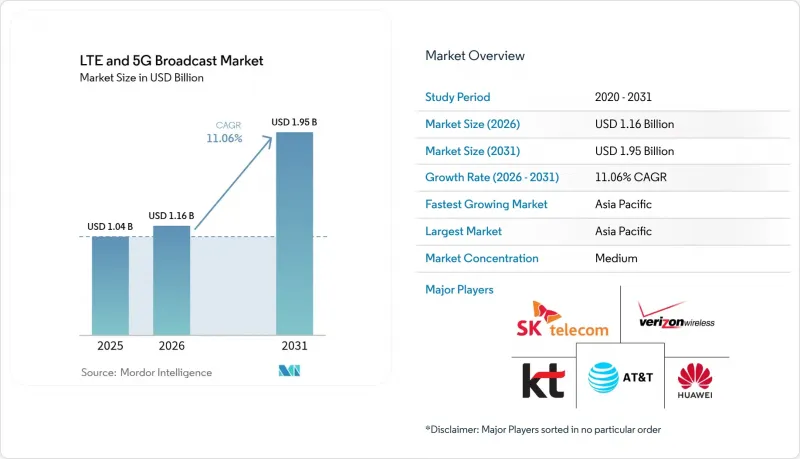
本報告按應用程式(公共安全、聯網汽車、廣告等)、廣播技術(LTE EMBMS、5G FeMBMS等)、頻段(Sub-6 GHz(6 GHz 以下)、 L波段(1-2 GHz)等)、最終用戶(行動網路營運商、汽車 OEM 等)和地區進行分類。
全球LTE及5G廣播市場趨勢及洞察
行動影片和實況活動的需求日益成長。
隨著行動用戶對 4K、360 度全景和擴增實境(AR) 內容的需求日益成長,電信業者正轉向多播以緩解單播擁塞。德國電信和愛立信在 2024 年歐洲盃上展示了多播在專業製作中的實用性,實現了低於 25 毫秒的延遲和無線攝影機 500 Mbps 的上行鏈路速度。馬來西亞利用網路切片 5G 連結直播了國慶閱兵式,即使在尖峰負載下也能確保穩定的影像品質。廣播公司現在要求每台攝影機始終保持 50 Mbps 的上行鏈路速度,而只有當多個用戶共用同一個多播串流時才能滿足這項要求。 Verizon 在其私人 5G 廣播套件中加入了基於人工智慧的觀眾密度感知功能,從而能夠即時微調位元率。
5G相容設備的滲透率迅速提高
NTT Docomo 使用 5G 獨立組網配置演示了 6.6 Gbps 的下行鏈路速度,表明終端已準備好接收高位元速率廣播。 BMW將為其所有 2025 年車型配備 5G 天線,以實現廣播內容的串流和同步韌體更新。中國強制要求高階智慧型手機支援 700 MHz 頻段,擴大了 FeMBMS 相容終端的用戶群體,並加速了服務的交付。雖然專用廣播晶片組仍然稀缺,但汽車資訊娛樂系統供應商正在引領潮流,將其整合到系統中,為消費者廣泛採用該技術奠定了基礎。
廣播相容升級需要大量資金投入
與僅用於資料通訊的 5G 相比,增加多播控制器、重新校準天線以及部署高密度毫米波小型基地台可能會使每個站點的成本增加 50%。諾基亞指出,由於營運商為了確保資金而推遲了廣播模組的部署,2024 年的設備訂單成長緩慢。毫米波廣播對於體育場館至關重要,它所需的基地台數量是 Sub-6 GHz 頻段的 1.5 到 2 倍,這進一步加劇了預算壓力。一些營運商正在採用分階段部署策略,僅在處理 70%尖峰時段影片流量的 10% 的小區上啟用廣播功能,但這種策略延長了實現全國覆蓋所需的時間。
細分市場分析
2025年,實況活動串流媒體仍佔總收入的27.32%,主要得益於對高品質直播要求較高的大型體育和文化活動的播出。同時,隨著汽車製造商致力於向數百萬輛汽車同步進行空中升級,預計到2031年,聯網汽車的複合年成長率將達到11.93%。單播網路難以實現這項規模化部署。 BMW全系搭載5G網路的車款以及特斯拉的工廠專用網路,都展現了廣播技術在生產分析和車載資訊娛樂的雙重作用。 LTE和5G廣播市場正在支援遠端診斷、V2X安全訊息以及無需用戶互動的地圖資料更新。
公共安全領域也湧現新的成長機會。 FirstNet 的升級增加了多播無人機影像和即時執法記錄器影像,從而提升了緊急應變人員的情境察覺。行動電視和隨選視訊服務依靠廣播來緩解突發堵塞期間(例如選舉之夜)的回程傳輸負載,而廣告網路則在嘗試基於位置的多播,將本地化的廣告訊息插入到全國性的影片串流中。這些多樣化的應用場景增強了應用層的多樣性,並提高了系統抵禦單段故障的能力。
憑藉領先的市場表現,LTE eMBMS預計在2025年將繼續佔據LTE和5G廣播市場60.25%的佔有率,而隨著營運商將Release 18軟體疊加到現有5G核心網路上,5G FeMBMS正以13.94%的年成長率成長。中國移動在100個城市的部署展現了FeMBMS的可擴展性,其到2025年將覆蓋範圍擴大三倍的計劃也清楚地體現了其雄心勃勃的發展規劃。營運商讚賞FeMBMS能夠在用戶數量達到一定閾值時無縫切換單播和多播,從而最佳化每兆赫茲的頻寬。
ATSC 3.0 混合廣播為地面電波媒體公司提供了進入行動傳輸的機會。巴西藍圖在 2026 年世界盃前在全國部署 ATSC 3.0,而美國 FCC 正在進行相關測試,這些都表明蜂窩網路和地面電波標準正在融合。 Release 18 中的 AI 調度器可減少小區邊緣的丟包率並提升移動性。這些優勢在 LTE 和 5G 部署中均可實現。隨著設備生態系統的日趨成熟,未來十年,過渡討論的焦點將從共存轉向逐步淘汰 LTE eMBMS 的計劃。
區域分析
預計到2025年,亞太地區將佔總營收的37.65%,複合年成長率(CAGR)為14.12%。中國、日本和韓國政府主導的5G-Advanced部署從一開始就融入了多播功能。中國移動目前已覆蓋100個城市,並計畫在2025年擴展到300個城市。基於該平台,中國移動提供超高清串流媒體、工業IoT和大規模警報分發服務。日本業者計劃在2024年將其基地台數量增加20%,結合中頻段和毫米波技術,在人口密集的都市區進行廣播。在韓國,除了面向消費者的服務外,該公司還在支援工廠私有5G的部署,加速製造業和物流業對廣播技術的應用。
北美位居第二,這主要得益於FirstNet管理局斥資80億美元製定的十年計劃,其中包括63億美元用於以廣播為重點的5G網路升級。汽車製造商(福特、通用、特斯拉)正在部署私有5G網路,以同步工廠中的機器人並實現軟體的夜間傳輸。儘管設備生態系統已經成熟,但資本支出上限阻礙了全國廣播能力的快速升級。
在歐洲,監管協調工作正在進行中。歐洲廣播聯盟(EBU)的5G與衛星混合試點計畫旨在解決電信覆蓋範圍的區域差異,同時遵守歐盟綠色交易的能源目標。德國在汽車行業的廣播融合方面處於領先地位,寶馬的5G連接計劃涵蓋了組裝和售後升級。中東、非洲和南美等小規模地區的5G部署進度與整體趨勢相似。在頻譜競標提前結束的地區,廣播試驗已在18個月內啟動,儘管規模較小。
其他好處:
- Excel格式的市場預測(ME)表
- 三個月的分析師支持
目錄
第1章:引言
- 研究假設和市場定義
- 調查範圍
第2章:調查方法
第3章執行摘要
第4章 市場狀況
- 市場概覽
- 市場促進因素
- 行動影片和實況活動的需求日益成長
- 5G相容設備的滲透率迅速提高
- 利用 5G FeMBMS多播提高頻譜效率
- 緊急呼叫系統強制性現代化改造(3GPP Rel-17+)
- 利用廣播頻道進行汽車OTA更新
- 混合衛星和移動(NTN)融合
- 市場限制因素
- 升級到廣播相容設備需要大量資金投入。
- 頻段分類與監理不確定性
- 對 FeMBMS 的晶片組/設備支援有限。
- 邊緣快取和Wi-Fi卸載會降低投資報酬率
- 價值鏈分析
- 監理情勢
- 技術展望
- 波特五力分析
- 投資和資金籌措趨勢
第5章 市場規模與成長預測
- 透過使用
- 公安
- 聯網汽車
- 實況活動直播
- 行動電視串流媒體
- 廣告
- 內容/數據分發
- 視訊點播
- 透過廣播技術
- LTE eMBMS
- 5G FeMBMS
- ATSC 3.0 混合廣播
- 按頻段
- 6 GHz 以下頻段(低於 6 GHz)
- L波段(1-2 GHz)
- 毫米波(24 GHz 以上)
- 最終用戶
- 行動電信商
- 媒體和娛樂公司
- 汽車OEM廠商
- 公共安全機構
- 其他
- 按地區
- 北美洲
- 美國
- 加拿大
- 南美洲
- 巴西
- 其他南美國家
- 歐洲
- 德國
- 英國
- 法國
- 其他歐洲國家
- 亞太地區
- 中國
- 日本
- 韓國
- 印度
- 其他亞太國家
- 中東和非洲
- 阿拉伯聯合大公國
- 沙烏地阿拉伯
- 南非
- 其他中東和非洲國家
- 北美洲
第6章 競爭情勢
- 市場集中度
- 策略趨勢
- 市佔率分析
- 公司簡介
- Huawei Technologies Co. Ltd.
- ZTE Corporation
- Ericsson AB
- Nokia Corp.
- Qualcomm Technologies Inc.
- Samsung Electronics Co. Ltd.
- KT Corporation
- Verizon Communications Inc.
- AT&T Inc.
- China Unicom(HK)Ltd.
- SK Telecom Co. Ltd.
- KDDI Corporation
- Telstra Corp. Ltd.
- Reliance Jio Infocomm Ltd.
- Rohde and Schwarz GmbH
- Enensys Technologies SA
- Harmonic Inc.
- Ateme SA
- MediaTek Inc.
- Rohde & Schwarz GmbH & Co KG
第7章 市場機會與未來展望
According to Mordor Intelligence, LTE and 5G broadcast market size in 2026 is estimated at USD 1.16 billion, growing from 2025 value of USD 1.04 billion with 2031 projections showing USD 1.95 billion, growing at 11.06% CAGR over 2026-2031.
This report is Segmented by Application (Public Safety, Connected Vehicles, Advertising, and More), Broadcast Technology (LTE EMBMS, 5G FeMBMS, and More), Frequency Band (Sub-6 GHz (less Than 6 GHz), L-Band (1-2 GHz), and More), End User (Mobile Network Operators, Automotive OEMs, and More), and Geography.
Global LTE And 5G Broadcast Market Trends and Insights
Rising demand for mobile video and live event streaming
Operators pivot to multicast to curb unicast congestion as mobile viewers demand 4K, 360-degree, and augmented-reality feeds. Deutsche Telekom and Ericsson delivered sub-25 ms latency and 500 Mbps uplinks for Euro 2024 wireless cameras, proving viability for professional production. Malaysia streamed its National Day parade over a network-sliced 5G link, ensuring stable quality even at peak load. Broadcasters now request 50 Mbps sustained uplink per camera, a requirement met only when several viewers share the same multicast flow. Verizon has added AI-based audience-density recognition inside its private 5G broadcast suite to fine-tune bitrate in real time.
Surge in 5G-enabled device penetration
NTT Docomo demonstrated 6.6 Gbps downlink on 5G Stand-Alone, signaling handset readiness for high-bitrate broadcast reception. BMW equips all 2025 models with 5G antennas to stream broadcast content and push simultaneous firmware updates. China's mandate that premium phones support 700 MHz expanded the installed base capable of FeMBMS reception, accelerating service availability. While broadcast-specific chipsets remain scarce, automotive infotainment suppliers are integrating them first, creating a beachhead for wider consumer adoption.
High CapEx for broadcast-capable upgrades
Adding multicast controllers, re-tuning antennas, and deploying dense mmWave small cells can raise per-site cost by 50% versus data-only 5G. Nokia noted weaker equipment orders in 2024 as operators deferred broadcast modules to preserve cash. mmWave broadcast, essential for stadiums, needs 1.5-2X more base stations than Sub-6 GHz, further stretching budgets. Some carriers adopt phased rollouts, enabling broadcast only on 10% of cells that carry 70% of peak video traffic, yet this tactic elongates nationwide coverage timelines.
Other drivers and restraints analyzed in the detailed report include:
- Spectrum-efficiency gains via 5G FeMBMS multicast
- Emergency-alert modernization mandates
- Limited chipset/device support for FeMBMS
For complete list of drivers and restraints, kindly check the Table Of Contents.
Segment Analysis
Live Event Streaming retained 27.32% of 2025 revenue by exploiting marquee sports and cultural broadcasts that demand guaranteed quality levels. Still, Connected Vehicles will post a 11.93% CAGR through 2031 as automotive OEMs push over-the-air updates to millions of cars simultaneously, a task unicast networks struggle to scale. BMW's fully 5G-equipped model line and Tesla's factory private networks show broadcast's dual role in production analytics and in-vehicle infotainment. The LTE and 5G broadcast market underpins remote diagnostics, V2X safety messages, and map data refresh without user intervention.
A second growth lane appears in public safety. FirstNet's upgrade adds multicast drone imagery and real-time body-camera feeds that improve situational awareness for first responders. Mobile TV and video on demand rely on broadcast to reduce backhaul in flash-crowd situations like election nights, while advertising networks test location-based multicast spots that insert local offers into a national video stream. These varied use cases cement application-layer diversity and maintain resilience against single-segment downturns.
LTE eMBMS still commands 60.25% of the LTE and 5G broadcast market share in 2025 on the strength of earlier deployments, yet 5G FeMBMS grows 13.94% annually as operators overlay Release 18 software onto existing 5G cores. China Mobile's 100-city launch validated FeMBMS scalability, and plans to triple coverage by 2025 illustrate aggressive timelines. Operators appreciate FeMBMS's seamless switch between unicast and multicast when audience thresholds are met, thereby optimizing every megahertz.
ATSC 3.0 hybrid broadcast gives terrestrial media companies an entry point to mobile distribution. Brazil's roadmap to nationwide ATSC 3.0 by the 2026 World Cup and ongoing FCC trials in the United States demonstrate convergent cellular-terrestrial standards. Release 18's AI schedulers cut cell-edge packet loss and boost mobility, benefits that accrue across both LTE and 5G implementations. As device ecosystems mature, the transition narrative will shift from coexistence to sunset planning for LTE eMBMS in the next decade.
Complete Report Scope:
- By Application
- Public Safety
- Connected Vehicles
- Live Event Streaming
- Mobile TV Streaming
- Advertising
- Content/Data Delivery
- Video on Demand
- By Broadcast Technology
- LTE eMBMS
- 5G FeMBMS
- ATSC 3.0 Hybrid Broadcast
- By Frequency Band
- Sub-6 GHz (<6 GHz)
- L-Band (1-2 GHz)
- mmWave (>24 GHz)
- By End User
- Mobile Network Operators
- Media and Entertainment Firms
- Automotive OEMs
- Public Safety Agencies
- Others
- By Geography
- North America
- United States
- Canada
- South America
- Brazil
- Rest of South America
- Europe
- Germany
- United Kingdom
- France
- Rest of Europe
- Asia Pacific
- China
- Japan
- South Korea
- India
- Rest of Asia Pacific
- Middle East and Africa
- United Arab Emirates
- Saudi Arabia
- South Africa
- Rest of Middle East and Africa
- North America
Geography Analysis
Asia Pacific commands 37.65% of 2025 revenue and grows at 14.12% CAGR. Government-backed 5G-Advanced rollouts in China, Japan, and South Korea embed multicast from day one. China Mobile's coverage of 100 cities, expanding to 300 in 2025, serves UHD streaming, industrial IoT, and mass alerts on the same platform. Japanese operators added 20% more base stations in 2024, pairing mid-band with mmWave for broadcast in dense metros. South Korea complements consumer focus with private 5G grants for factories, accelerating broadcast adoption in manufacturing and logistics.
North America ranks second, propelled by the FirstNet Authority's USD 8 billion ten-year plan, including USD 6.3 billion earmarked for broadcast-centric 5G enhancements. Automotive majors-Ford, GM, Tesla-install private 5G to synchronize plant robots and push software to vehicles overnight. The device ecosystem is mature, yet CapEx discipline tempers rapid nationwide broadcast upgrades.
Europe advances on regulatory harmonization. The European Broadcasting Union's hybrid 5G/satellite pilot reduces rural coverage gaps while complying with EU Green Deal energy targets. Germany leads automotive broadcast integration; BMW's 5G connectivity plan covers both assembly lines and post-sale updates. Smaller regions-Middle East, Africa, South America-mirror overall 5G timelines; where spectrum auctions conclude early, broadcast trials begin within 18 months, albeit at modest scale.
- Huawei Technologies Co. Ltd.
- ZTE Corporation
- Ericsson AB
- Nokia Corp.
- Qualcomm Technologies Inc.
- Samsung Electronics Co. Ltd.
- KT Corporation
- Verizon Communications Inc.
- AT&T Inc.
- China Unicom (HK) Ltd.
- SK Telecom Co. Ltd.
- KDDI Corporation
- Telstra Corp. Ltd.
- Reliance Jio Infocomm Ltd.
- Rohde and Schwarz GmbH
- Enensys Technologies SA
- Harmonic Inc.
- Ateme SA
- MediaTek Inc.
- Rohde & Schwarz GmbH & Co KG
Additional Benefits:
- The market estimate (ME) sheet in Excel format
- 3 months of analyst support
TABLE OF CONTENTS
1 INTRODUCTION
- 1.1 Study Assumptions and Market Definition
- 1.2 Scope of the Study
2 RESEARCH METHODOLOGY
3 EXECUTIVE SUMMARY
4 MARKET LANDSCAPE
- 4.1 Market Overview
- 4.2 Market Drivers
- 4.2.1 Rising demand for mobile video and live event streaming
- 4.2.2 Surge in 5G-enabled device penetration
- 4.2.3 Spectrum-efficiency gains via 5G FeMBMS multicast
- 4.2.4 Emergency-alert modernization mandates (3GPP Rel-17+)
- 4.2.5 Automotive OTA updates leveraging broadcast channels
- 4.2.6 Hybrid satellite-to-mobile (NTN) convergence
- 4.3 Market Restraints
- 4.3.1 High CapEx for broadcast-capable upgrades
- 4.3.2 Fragmented spectrum and regulatory uncertainty
- 4.3.3 Limited chipset/device support for FeMBMS
- 4.3.4 Edge-caching and Wi-Fi offload diluting ROI
- 4.4 Value Chain Analysis
- 4.5 Regulatory Landscape
- 4.6 Technological Outlook
- 4.7 Porter's Five Forces Analysis
- 4.7.1 Threat of New Entrants
- 4.7.2 Bargaining Power of Buyers
- 4.7.3 Bargaining Power of Suppliers
- 4.7.4 Threat of Substitutes
- 4.7.5 Competitive Rivalry
- 4.8 Investment and Funding Trends
5 MARKET SIZE AND GROWTH FORECASTS (VALUE)
- 5.1 By Application
- 5.1.1 Public Safety
- 5.1.2 Connected Vehicles
- 5.1.3 Live Event Streaming
- 5.1.4 Mobile TV Streaming
- 5.1.5 Advertising
- 5.1.6 Content/Data Delivery
- 5.1.7 Video on Demand
- 5.2 By Broadcast Technology
- 5.2.1 LTE eMBMS
- 5.2.2 5G FeMBMS
- 5.2.3 ATSC 3.0 Hybrid Broadcast
- 5.3 By Frequency Band
- 5.3.1 Sub-6 GHz (<6 GHz)
- 5.3.2 L-Band (1-2 GHz)
- 5.3.3 mmWave (>24 GHz)
- 5.4 By End User
- 5.4.1 Mobile Network Operators
- 5.4.2 Media and Entertainment Firms
- 5.4.3 Automotive OEMs
- 5.4.4 Public Safety Agencies
- 5.4.5 Others
- 5.5 By Geography
- 5.5.1 North America
- 5.5.1.1 United States
- 5.5.1.2 Canada
- 5.5.2 South America
- 5.5.2.1 Brazil
- 5.5.2.2 Rest of South America
- 5.5.3 Europe
- 5.5.3.1 Germany
- 5.5.3.2 United Kingdom
- 5.5.3.3 France
- 5.5.3.4 Rest of Europe
- 5.5.4 Asia Pacific
- 5.5.4.1 China
- 5.5.4.2 Japan
- 5.5.4.3 South Korea
- 5.5.4.4 India
- 5.5.4.5 Rest of Asia Pacific
- 5.5.5 Middle East and Africa
- 5.5.5.1 United Arab Emirates
- 5.5.5.2 Saudi Arabia
- 5.5.5.3 South Africa
- 5.5.5.4 Rest of Middle East and Africa
- 5.5.1 North America
6 COMPETITIVE LANDSCAPE
- 6.1 Market Concentration
- 6.2 Strategic Moves
- 6.3 Market Share Analysis
- 6.4 Company Profiles (includes Global level Overview, Market level overview, Core Segments, Financials as available, Strategic Information, Market Rank/Share for key companies, Products and Services, and Recent Developments)
- 6.4.1 Huawei Technologies Co. Ltd.
- 6.4.2 ZTE Corporation
- 6.4.3 Ericsson AB
- 6.4.4 Nokia Corp.
- 6.4.5 Qualcomm Technologies Inc.
- 6.4.6 Samsung Electronics Co. Ltd.
- 6.4.7 KT Corporation
- 6.4.8 Verizon Communications Inc.
- 6.4.9 AT&T Inc.
- 6.4.10 China Unicom (HK) Ltd.
- 6.4.11 SK Telecom Co. Ltd.
- 6.4.12 KDDI Corporation
- 6.4.13 Telstra Corp. Ltd.
- 6.4.14 Reliance Jio Infocomm Ltd.
- 6.4.15 Rohde and Schwarz GmbH
- 6.4.16 Enensys Technologies SA
- 6.4.17 Harmonic Inc.
- 6.4.18 Ateme SA
- 6.4.19 MediaTek Inc.
- 6.4.20 Rohde & Schwarz GmbH & Co KG
7 MARKET OPPORTUNITIES AND FUTURE OUTLOOK
- 7.1 White-space and Unmet-need Assessment

 LTE與5G廣播市場-2026-2032年全球市場預測
 LTE/5G廣播市場規模、佔有率和成長分析:按技術、組件、應用、部署類型、最終用戶、設備類型和地區分類-2026-2033年產業預測
 2026年全球長期演進(LTE)及5G廣播市場報告
 LTE 和 5G 廣播市場規模、佔有率、趨勢和預測:按技術、最終用戶和地區分類,2026-2034 年
 5G NR RAN市場:策略洞察與預測(2026-2031年)
 LTE 和 5G 廣播市場分析及預測(至 2035 年):按類型、產品類型、服務、技術、組件、應用、最終用戶、部署類型和設備分類
 全球 LTE 和 5G 廣播市場:市場規模、佔有率、趨勢、行業分析(依技術、最終用途和地區)、未來預測(2025-2034年)