


 |
市場調查報告書
商品編碼
2123288
5G企業:市佔率分析、產業趨勢與統計、成長預測(2026-2031年)5G Enterprise - Market Share Analysis, Industry Trends & Statistics, Growth Forecasts (2026 - 2031) |
||||||

※ 本網頁內容可能與最新版本有所差異。詳細情況請與我們聯繫。
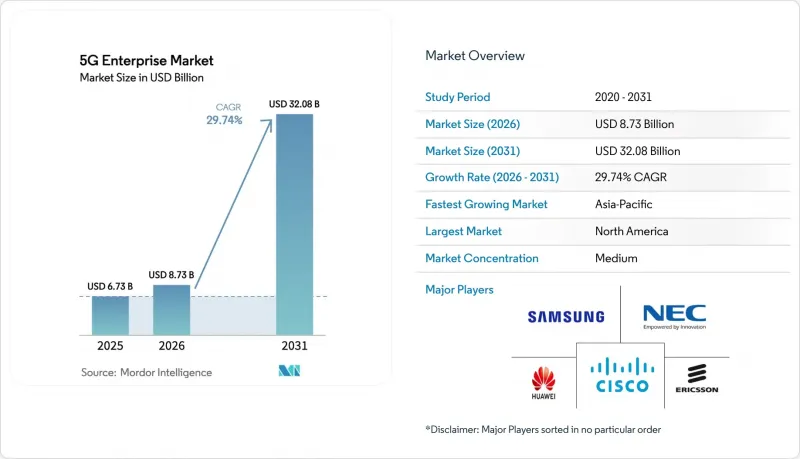
2025 年 5G 企業市值為 67.3 億美元,預計到 2031 年將達到 320.8 億美元,高於 2026 年的 87.3 億美元,預測期(2026-2031 年)複合年成長率為 29.74%。
本報告依通訊基礎設施類型(5G無線接取網路[RAN]、5G核心網路等)、部署模式(私人5G網路、公共5G網路等)、頻段授權模式(授權頻段、免許可/共用頻段、混合授權)、產業(IT與電信、銀行、金融服務和保險等)以及地區進行分類。市場預測以美元計價。
全球5G企業市場趨勢與洞察
開放免授權/共用頻段將徹底改變企業接取環境。
監管機構開放中波頻段,使得先前因頻率使用費而猶豫不決的企業也能部署私有5G網路。在美國,公民頻段無線電服務(CBRS)已支援超過25萬台工業設備的啟用,歐洲也在推廣類似的框架,用於3.8-4.2 GHz頻段。西門子預測,隨著監管協調的推進,到2025年,5G部署將從試點階段過渡到全面部署。更高的柔軟性將使工廠、物流中心和能源設施能夠自訂其覆蓋範圍,從而提高運作和安全性。共用頻譜也推動了「網路一體化解決方案」(Network-in-a-Box)供應商生態系統的發展,這些供應商將無線設備、邊緣核心網和管理工具打包成交承包套件。這些綜效將擴大進入5G企業市場的潛在客戶群,並縮短供應商實現獲利所需的時間。
邊緣運算和網路切片正在重新定義企業架構。
企業正在重構其網路,將對延遲敏感的工作負載部署在距離聯網資產幾公尺的範圍內。像T-Mobile這樣的營運商正在透過為緊急應變人員提供優先級網路切片來展示這一概念。目前,已有47家營運商正在標準化API,向開發人員公開網路切片配置訊息,從而減輕編配負擔。將專用網路切片與本地運算節點結合,使製造商能夠將決策週期縮短至亞毫秒級,從而實現同步機器人控制和視覺檢測。 Wray Castle的研究表明,網路切片可以將整體頻寬利用率提高40%。這些優勢直接轉化為營運成本(OpEx)的降低,從而增強了私有邊緣架構在5G企業市場的價值提案。
高昂的資本支出和複雜的整合流程會延緩產品推廣應用。
即使在中等規模的現有棕地接取網路(Open RAN)承諾帶來供應商多樣性,但正如《開放式無線接取網路整合手冊》所述,它也帶來了對新的互通性測試的需求。網路即服務(Network-as-a-Service)模式正在興起,旨在將支出從資本支出(CAPEX)轉向營運支出(OPEX),以緩解現金流高峰期的壓力,但服務等級保證方面的清晰度仍然不一致。這些財務和技術上的停滯正在阻礙利潤率極低的細分市場的早期成長。
細分市場分析
5G無線接取網路板塊在連接終端方面發揮至關重要的作用,預計到2025年將佔總營收的35.45%,成為最大的市場佔有率。這項基礎性投資使營運商和整合商在實現覆蓋義務變現方面佔據了領先地位。企業對確定性效能日益成長的需求,正推動人們對雲端原生5G核心網路的關注,預計其複合年成長率將達到31.88%。隨著獨立部署走出試點階段,5G企業市場核心解決方案的規模預計將迅速擴大。網路功能虛擬化(NFV)使企業能夠輕鬆部署低程式碼策略引擎、統一收費和AI驅動的保障,進而提高每個站點的平均每用戶收入(ARPU)。
傳輸和回程傳輸雖然絕對規模較小,但發展迅速。愛立信與瞻博網路、ECI Telecom 等公司的合作,凸顯了行動通訊基地台和資料中心之間對高容量分組傳輸的需求。 E 波段和新興的 W 波段鏈路能夠實現多Gigabit的吞吐量,與高密度工業園區的光纖網路形成互補。這些創新消除了曾經阻礙遠端視覺分析的瓶頸。因此,核心網和傳輸網正在緊密合作,總合擴大其在 5G 企業市場的佔有率。
預計到2025年,私有部署將佔總收入的37.60%,進一步強化了使用者對本地部署的偏好。受工廠、醫院和物流中心等對確定性服務品質(QoS)的優先考慮,私人部署的5G企業市場預計將以35.48%的複合年成長率加倍。根據2024年數位化世界調查,預計到2027年,全球私有5G收入將達60億美元。相較之下,公共5G更適合那些對覆蓋範圍要求高於低延遲要求的應用場景。
混合模式也日益受到關注。企業利用公共網路切片處理敏感度較低的流量,同時為機器人和AGV(自動導引車)預留園區級微核心網。中立主機解決方案允許設施所有者分攤基礎設施成本,並透過多租戶實現快速覆蓋部署。這種方法使電信業者無需重新部署全套技術堆疊即可進入新的垂直市場,並在整個5G企業市場拓展收入來源。
區域分析
由於早期頻段分配和蓬勃發展的系統整合生態系統,預計到2025年,北美將佔據最大的區域市場佔有率,達到37.10%。儘管美國76%的製造商計劃建造專用網路,但近期政策的變化已使短期內的熱情下降了11%。一項90億美元的公共資金提案旨在將5G寬頻擴展到農村地區,從而擴大基本客群。加拿大為工業4.0試驗平台提供了強而有力的獎勵。隨著北美電信基礎設施目標的逐步實現,這些努力將進一步鞏固其主導地位。
亞太地區正經歷最快成長,預計到2031年年複合成長率(CAGR)將達到32.88%。中國的「5G+智慧工廠」計畫已在提高生產效率和減少缺陷方面取得了顯著成效。日本和韓國正利用其長期累積的工業自動化經驗,將5G技術融入現有的精實生產單位。印度電信業存在超過240萬人的技能缺口,政策制定者正透過技能再培訓宣傳活動來解決這個問題。儘管人才短缺,但設備價格的下降正在推動中型企業採用新技術。
儘管覆蓋範圍不足,歐洲仍保持穩固的基礎。在德國,3.8–4.2 GHz頻段的頻率牌照直接競標給產業先驅,擴大了園區網路試點計畫的規模。歐盟範圍內的標準化簡化了設備認證流程,但總投資金額七年來首次下降至579億歐元。開放式無線存取網路(Open RAN)和邊緣雲端專案正在吸引新的參與企業,並使競爭格局更加多元化。全球行動通訊系統協會(GSMA)預測,到2030年,5G將為歐洲GDP貢獻超過1,600億歐元。這些數據凸顯了歐洲5G發展雖不均衡但穩定推進的態勢。
在中東和非洲,5G發展勢頭強勁,沙烏地阿拉伯的新頻段競標更是功不可沒,該拍賣使諾基亞2024年第四季的供應商營收成長了9%。拉丁美洲的5G部署仍處於早期階段,但已受益於利用衛星為採礦和農業提供的5G覆蓋範圍。整體而言,全球需求的多元化正為5G企業市場的廣泛擴張奠定基礎。
其他好處:
- Excel格式的市場預測(ME)表
- 3個月的分析師支持
目錄
第1章:引言
- 研究假設和市場定義
- 調查範圍
第2章:調查方法
第3章執行摘要
第4章 市場狀況
- 市場概覽
- 市場促進因素
- 面向工業場所開放的免許可/共用頻段。
- 邊緣運算和網路切片技術能夠實現超低延遲應用。
- 智慧製造工廠中工業IoT(IIoT) 的蓬勃發展
- 強制性淨零排放正在推動私有 5G 網路的發展,這些網路能夠即時最佳化能源效率。
- 將5G和TSN融合,用於現有設施中的確定性控制
- 5G非地面電波網路將擴大企業無縫通訊覆蓋範圍。
- 市場限制因素
- 巨額資本投資與整合的複雜性
- 5G/OT工程人員短缺
- 設備認證生態系碎片化
- 區域性頻段管制阻礙了跨國公司的擴張。
- 價值供應鏈分析
- 監理情勢
- 技術展望
- MEC和5G技術標準分析
- 波特五力分析
第5章 市場規模與成長預測
- 按通訊基礎設施類型分類
- 5G無線接取網路(RAN)
- 5G核心網
- 運輸/回程傳輸網路
- 按部署模式
- 專用5G網路
- 公共5G網路
- 混合/共用網路
- 按頻譜授權類型
- 授權頻段
- 無需許可證/共用(例如 CBRS、LAA)
- 混合許可
- 按行業分類的商業導向
- 資訊科技/通訊
- BFSI
- 製造業 - 個體生產類型
- 製造程序
- 零售與電子商務
- 衛生保健
- 能源公用事業
- 運輸/物流
- 其他行業
- 按地區
- 北美洲
- 美國
- 加拿大
- 墨西哥
- 南美洲
- 巴西
- 阿根廷
- 其他南美國家
- 歐洲
- 英國
- 德國
- 法國
- 義大利
- 西班牙
- 俄羅斯
- 其他歐洲國家
- 亞太地區
- 中國
- 印度
- 日本
- 韓國
- ASEAN
- 其他亞太國家
- 中東和非洲
- 沙烏地阿拉伯
- 阿拉伯聯合大公國
- 南非
- 奈及利亞
- 其他中東和非洲國家
- 北美洲
第6章 競爭情勢
- 市場集中度
- 策略趨勢
- 市佔率分析
- 公司簡介
- Cisco Systems
- Ericsson
- Huawei Technologies
- Nokia
- NEC Corporation
- Samsung Electronics
- ZTE Corporation
- Qualcomm
- Intel Corporation
- Hewlett Packard Enterprise(Aruba)
- Dell Technologies
- Juniper Networks
- Mavenir
- Rakuten Symphony
- CommScope
- ATandT
- Verizon Communications
- Deutsche Telekom AG
- Siemens AG
- Fujitsu
第7章 市場機會與未來展望
According to Mordor Intelligence, the 5G enterprise market size was valued at USD 6.73 billion in 2025 and estimated to grow from USD 8.73 billion in 2026 to reach USD 32.08 billion by 2031, at a CAGR of 29.74% during the forecast period (2026-2031).
This report is Segmented by Communication Infrastructure Type (5G Radio Access Networks [RAN], 5G Core Networks, and More), Deployment Mode (Private 5G Networks, Public 5G Networks, and More), Spectrum Licensing Type (Licensed Spectrum, Unlicensed/Shared, and Mixed Licensing), Enterprise Vertical (IT and Telecommunication, BFSI, and More), and Geography. The Market Forecasts are Provided in Terms of Value (USD).
Global 5G Enterprise Market Trends and Insights
Release of Unlicensed/Shared Spectrum Transforms Enterprise Access
Regulators opening mid-band frequencies have made private 5G viable for firms that once shied away from spectrum fees. In the United States, the Citizens Band Radio Service has already supported more than 250,000 industrial device activations, encouraging similar frameworks in Europe's 3.8-4.2 GHz band. Siemens anticipates deployments moving from pilots to scale during 2025 as harmonization progresses. Greater flexibility allows factories, logistics hubs, and energy sites to customize coverage footprints, improving uptime and security. Shared spectrum also stimulates a growing ecosystem of network-in-a-box vendors that package radios, edge cores, and management tools as turnkey kits. The cumulative effect is a wider funnel of prospects entering the 5G enterprise market, accelerating time to revenue for suppliers.
Edge Computing and Network Slicing Redefine Enterprise Architectures
Enterprises are refactoring networks so that latency-sensitive workloads sit within meters of connected assets. Operators such as T-Mobile illustrate the concept through priority slices for first responders. Forty-seven operator groups are now standardizing APIs that expose slice configuration to developers, lowering orchestration effort. Combining dedicated slices with on-premises compute nodes helps manufacturers push decision loops below 1 ms, enabling synchronous robotics and vision inspection. A Wray Castle study indicates network slicing can boost overall spectrum utilisation by 40%. These gains feed directly into OpEx savings, reinforcing the value proposition of private-edge architecture inside the 5G enterprise market.
High CAPEX and Integration Complexity Slow Adoption
Standalone 5G cores, multi-band radios, and industrial gateways can push a mid-sized brown-field deployment into multi-million-dollar territory. A 2024 Kyndryl survey showed many firms deferring projects until they blueprint migration paths for legacy SCADA and MES layers. Open RAN promises vendor diversity yet introduces fresh interoperability testing, as flagged by the Open RAN Integration Playbook. Network-as-a-Service models are emerging to smooth cash-flow peaks by shifting spend from capex to OpEx, but clarity around service-level commitments still varies. This financial and technical inertia trims early growth in segments with razor-thin margins.
Other drivers and restraints analyzed in the detailed report include:
- Industrial IoT Accelerates Manufacturing Transformation
- Net-Zero Mandates Drive Energy-Optimized Deployments
- Scarcity of 5G/OT Engineering Talent Creates Implementation Bottleneck
For complete list of drivers and restraints, kindly check the Table Of Contents.
Segment Analysis
The 5G Radio Access Network segment generated the largest slice of revenue in 2025 at 35.45%, reflecting its indispensable role in linking endpoints. This foundational investment gave operators and integrators a head starts in monetizing coverage obligations. Rising enterprise need for deterministic performance now shifts attention to cloud-native 5G cores, which are on course for a 31.88% CAGR. The 5G enterprise market size for core solutions is projected to expand sharply as standalone deployments move beyond trials. Network function virtualization lets firms bolt on low-code policy engines, converged charging, and AI-driven assurance, driving higher ARPU per site.
Transport and backhaul, though smaller in absolute terms, are evolving rapidly. Partnerships such as Ericsson with Juniper and ECI Telecom confirm demand for high-capacity packet transport between cell sites and data centers. E-band and emerging W-band links unlock multi-gigabit throughput, complementing fibre in dense industrial parks. These innovations reduce bottlenecks that once throttled remote-vision analytics. As a result, core and transport segments are becoming tightly coupled, expanding their combined wallet share inside the 5G enterprise market.
Private deployments captured 37.60% of revenue in 2025, reinforcing the preference for on-premises control. With a 35.48% CAGR, the 5G enterprise market size for private deployments is set to multiply, led by factories, hospitals, and logistics yards that value deterministic Quality of Service. A 2024 Digitalization World survey forecasts global private-5G revenues at USD 6 billion by 2027. Contrast that with public 5G, which suits use cases where coverage breadth outweighs micro latency needs.
Hybrid models are also standing out. Enterprises employ public slices for non-sensitive traffic while reserving a campus-wide micro-core for robotics or AGVs. Neutral-host solutions enable venue owners to share infrastructure costs, facilitating rapid multi-tenant coverage. This approach helps operators penetrate new verticals without redeploying full stacks, broadening addressable revenue streams across the 5G enterprise market.
Complete Report Scope:
- By Communication Infrastructure Type
- 5G Radio Access Networks (RAN)
- 5G Core Networks
- Transport/Backhaul Networks
- By Deployment Model
- Private 5G Networks
- Public 5G Networks
- Hybrid/Shared Networks
- By Spectrum Licensing Type
- Licensed Spectrum
- Unlicensed/Shared (e.g., CBRS, LAA)
- Mixed Licensing
- By Enterprise Vertical
- IT and Telecommunications
- BFSI
- Manufacturing - Discrete
- Manufacturing - Process
- Retail and E-commerce
- Healthcare
- Energy and Utilities
- Transportation and Logistics
- Other Verticals
- By Geography
- North America
- United States
- Canada
- Mexico
- South America
- Brazil
- Argentina
- Rest of South America
- Europe
- United Kingdom
- Germany
- France
- Italy
- Spain
- Russia
- Rest of Europe
- Asia-Pacific
- China
- India
- Japan
- South Korea
- ASEAN
- Rest of Asia-Pacific
- Middle East and Africa
- Saudi Arabia
- United Arab Emirates
- South Africa
- Nigeria
- Rest of Middle East and Africa
- North America
Geography Analysis
North America commanded the largest regional footprint at 37.10% revenue share in 2025, anchored by early spectrum releases and active systems-integration ecosystems. The United States sees 76% of manufacturers planning private networks, though a recent policy shift caused an 11% dip in short-term enthusiasm. Public funding proposals worth USD 9 billion aim to extend 5G broadband into rural zones, which will widen the customer base. Canada follows with strong incentives for Industry 4.0 testbeds. Together, these initiatives reinforce leadership even as North American coverage ambitions mature.
Asia-Pacific is the fastest climber with a 32.88% CAGR through 2031. China's 5G+ Smart Factory programs show quantifiable gains in throughput and defect reduction. Japan and South Korea exploit longstanding industrial automation cultures, layering 5G over existing lean-manufacturing cells. India's telecom-sector skills gap tops 2.4 million workers, which policy makers address via reskilling campaigns lightreading. Despite talent constraints, lower equipment prices bolster adoption among mid-tier enterprises.
Europe retains a solid foothold despite coverage gaps. Germany's auction of 3.8-4.2 GHz licenses directly to industry pioneers expanded campus network pilots. Pan-EU harmonization simplifies device certification, although total capital investment slid for the first time in seven years to EUR 57.9 billion. Open RAN and edge cloud projects attract new entrants, fueling competitive variety. GSMA expects 5G to contribute over EUR 160 billion to European GDP by 2030. These figures underscore steady, if uneven, progression.
The Middle East and Africa witness growing momentum led by Saudi Arabia's fresh spectrum auctions, driving vendor revenue up 9% in Q4 2024 for Nokia. Latin America remains in the early adoption phase but benefits from satellite-backed 5G coverage for mining and agriculture. Collectively, global demand diversity positions the 5G enterprise market for broad-based expansion.
- Cisco Systems
- Ericsson
- Huawei Technologies
- Nokia
- NEC Corporation
- Samsung Electronics
- ZTE Corporation
- Qualcomm
- Intel Corporation
- Hewlett Packard Enterprise (Aruba)
- Dell Technologies
- Juniper Networks
- Mavenir
- Rakuten Symphony
- CommScope
- ATandT
- Verizon Communications
- Deutsche Telekom AG
- Siemens AG
- Fujitsu
Additional Benefits:
- The market estimate (ME) sheet in Excel format
- 3 months of analyst support
TABLE OF CONTENTS
1 INTRODUCTION
- 1.1 Study Assumptions and Market Definition
- 1.2 Scope of the Study
2 RESEARCH METHODOLOGY
3 EXECUTIVE SUMMARY
4 MARKET LANDSCAPE
- 4.1 Market Overview
- 4.2 Market Drivers
- 4.2.1 Release of unlicensed/shared spectrum for industrial sites
- 4.2.2 Edge computing and network-slicing enable ultra-low-latency apps
- 4.2.3 Industrial-IoT boom in smart manufacturing plants
- 4.2.4 Net-zero mandates drive real-time energy-optimised private 5G
- 4.2.5 Convergence of 5G and TSN for deterministic control in brown-fields
- 4.2.6 5G non-terrestrial networks extend seamless enterprise coverage
- 4.3 Market Restraints
- 4.3.1 High CAPEX and integration complexity
- 4.3.2 Scarcity of 5G/OT engineering talent
- 4.3.3 Fragmented device-certification ecosystem
- 4.3.4 Local-spectrum rules hinder multi-national roll-outs
- 4.4 Value/Supply-Chain Analysis
- 4.5 Regulatory Landscape
- 4.6 Technological Outlook
- 4.7 MEC and 5G Technical Standards Analysis
- 4.8 Porter's Five Forces Analysis
- 4.8.1 Threat of New Entrants
- 4.8.2 Bargaining Power of Buyers
- 4.8.3 Bargaining Power of Suppliers
- 4.8.4 Threat of Substitutes
- 4.8.5 Competitive Rivalry
5 MARKET SIZE AND GROWTH FORECASTS (VALUE)
- 5.1 By Communication Infrastructure Type
- 5.1.1 5G Radio Access Networks (RAN)
- 5.1.2 5G Core Networks
- 5.1.3 Transport/Backhaul Networks
- 5.2 By Deployment Model
- 5.2.1 Private 5G Networks
- 5.2.2 Public 5G Networks
- 5.2.3 Hybrid/Shared Networks
- 5.3 By Spectrum Licensing Type
- 5.3.1 Licensed Spectrum
- 5.3.2 Unlicensed/Shared (e.g., CBRS, LAA)
- 5.3.3 Mixed Licensing
- 5.4 By Enterprise Vertical
- 5.4.1 IT and Telecommunications
- 5.4.2 BFSI
- 5.4.3 Manufacturing - Discrete
- 5.4.4 Manufacturing - Process
- 5.4.5 Retail and E-commerce
- 5.4.6 Healthcare
- 5.4.7 Energy and Utilities
- 5.4.8 Transportation and Logistics
- 5.4.9 Other Verticals
- 5.5 By Geography
- 5.5.1 North America
- 5.5.1.1 United States
- 5.5.1.2 Canada
- 5.5.1.3 Mexico
- 5.5.2 South America
- 5.5.2.1 Brazil
- 5.5.2.2 Argentina
- 5.5.2.3 Rest of South America
- 5.5.3 Europe
- 5.5.3.1 United Kingdom
- 5.5.3.2 Germany
- 5.5.3.3 France
- 5.5.3.4 Italy
- 5.5.3.5 Spain
- 5.5.3.6 Russia
- 5.5.3.7 Rest of Europe
- 5.5.4 Asia-Pacific
- 5.5.4.1 China
- 5.5.4.2 India
- 5.5.4.3 Japan
- 5.5.4.4 South Korea
- 5.5.4.5 ASEAN
- 5.5.4.6 Rest of Asia-Pacific
- 5.5.5 Middle East and Africa
- 5.5.5.1 Saudi Arabia
- 5.5.5.2 United Arab Emirates
- 5.5.5.3 South Africa
- 5.5.5.4 Nigeria
- 5.5.5.5 Rest of Middle East and Africa
- 5.5.1 North America
6 COMPETITIVE LANDSCAPE
- 6.1 Market Concentration
- 6.2 Strategic Moves
- 6.3 Market Share Analysis
- 6.4 Company Profiles {(includes Global level Overview, Market level overview, Core Segments, Financials as available, Strategic Information, Market Rank/Share, Products and Services, Recent Developments)}
- 6.4.1 Cisco Systems
- 6.4.2 Ericsson
- 6.4.3 Huawei Technologies
- 6.4.4 Nokia
- 6.4.5 NEC Corporation
- 6.4.6 Samsung Electronics
- 6.4.7 ZTE Corporation
- 6.4.8 Qualcomm
- 6.4.9 Intel Corporation
- 6.4.10 Hewlett Packard Enterprise (Aruba)
- 6.4.11 Dell Technologies
- 6.4.12 Juniper Networks
- 6.4.13 Mavenir
- 6.4.14 Rakuten Symphony
- 6.4.15 CommScope
- 6.4.16 ATandT
- 6.4.17 Verizon Communications
- 6.4.18 Deutsche Telekom AG
- 6.4.19 Siemens AG
- 6.4.20 Fujitsu
7 MARKET OPPORTUNITIES AND FUTURE OUTLOOK
- 7.1 White-space and Unmet-need Assessment

 5G企業市場:2026-2032年全球市場預測(依組件、網路架構、產業、企業規模及部署類型分類)
 5G企業市場報告:依頻率、頻段、網路類型、組織規模、產業及地區分類(2026-2034年)
 2026年5G企業資訊服務全球市場報告2026年第五代(5G)智慧型手機全球市場報告2026年第五代(5G)設備全球市場報告2026年全球5G企業市場報告2026年5G全球溫度控管市場報告
 5G企業市場規模、佔有率和成長分析(按網路類型、營運商模式、基礎設施、頻譜、頻段、應用、垂直行業和地區分類)—產業預測,2026-2033年
 5G企業市場規模、佔有率、趨勢分析報告:按網路類型、基礎設施、頻譜、頻寬、組織規模、產業垂直領域、地區、細分市場預測,2025-2030年