


 |
市場調查報告書
商品編碼
2123269
硬脂酸鎂:市場佔有率分析、產業趨勢與統計、成長預測(2026-2031)Magnesium Stearate - Market Share Analysis, Industry Trends & Statistics, Growth Forecasts (2026 - 2031) |
||||||

※ 本網頁內容可能與最新版本有所差異。詳細情況請與我們聯繫。
預計硬脂酸鎂市場將從 2025 年的 6.0227 億美元成長到 2026 年的 6.3672 億美元,然後在 2031 年達到 8.4073 億美元,2026 年至 2031 年的複合年成長率為 5.72%。
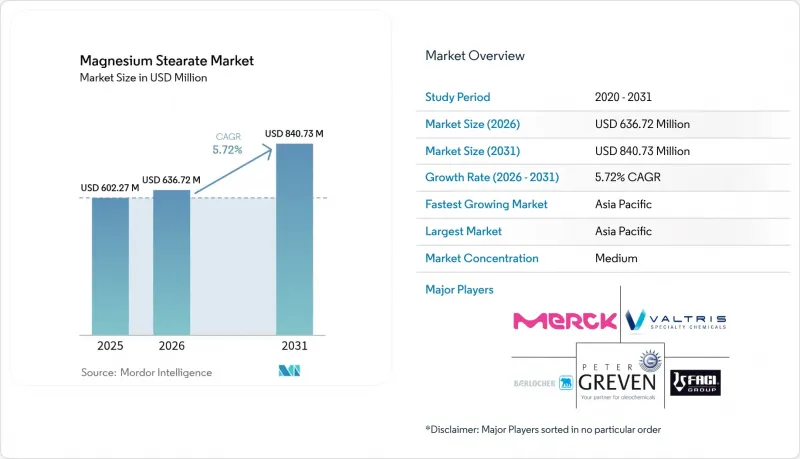
本報告按終端用戶產業(製藥、食品飲料、個人護理、塑膠及其他終端用戶產業)和地區(亞太、北美、歐洲、南美以及中東和非洲)進行細分。報告以銷售額(百萬美元)為單位,列出了上述所有細分市場的硬脂酸鎂市場規模和預測。
全球硬脂酸鎂市場趨勢及洞察
固態製劑領域向連續生產線的轉型正在加速。
輝瑞和禮來等大型製藥企業目前已運作商業化連續生產,在一體化撬裝設備中完成片劑的混合、壓片和包衣,從而消除了以往因停機而掩蓋輔料差異的情況。能夠確保粒徑分佈窄、脂肪酸比例穩定的硬脂酸鎂市場參與企業正鞏固其作為首選供應商的地位,因為任何偏差都會增加潤滑劑過量的風險,並對片劑的抗張強度產生不利影響。監管機構正在透過縮短連續生產裝置的核准週期來加速這一轉型,進一步鞏固了對高規格添加劑的需求。在連續生產過程中,每種投入對關鍵品質特性的影響都會被放大,因此頂級買家正在將供應商名單縮減至僅選擇那些擁有強大的隨線分析工具的公司。
推出純素/不含棕櫚油的等級產品,目標顧客為潔淨標示營養保健品。
消費者對輔料來源的關注程度與對活性成分的關注程度不相上下,這促使營養保健品開發商盡可能停止使用動物源或棕櫚源硬脂酸鹽。像Biogrund這樣的供應商已經將植物來源CompactCel LUB商業化,該產品在保持傳統潤滑性能的同時,符合純素標籤和永續棕櫚油圓桌會議(RSPO)的要求。雖然功能等效性降低了重組的門檻,但製造商仍在初步試驗中檢驗其流動性、可壓縮性和溶解度,這使得分析實驗室的檢測收入得以維持。零售商透過強制要求自有品牌膳食補充劑的輔料透明化來推動這一趨勢,這促使即使是對成本敏感的自有品牌製造商也轉向使用經過認證的純素成分。
嚴格的棕櫚油可追溯性法規推高了原料成本。
歐盟的森林砍伐法規,加上美國海關的同步審計,要求硬脂酸生產商記錄每一噸棕櫚油衍生的硬脂酸。合規需要衛星監測、同位素指紋圖譜和基於區塊鏈的記錄保存,這增加了採購成本,小規模煉油廠難以負擔。馬來西亞棕櫚油委員會等機構的分析要求導致檢測頻率更高、前置作業時間。然而,大型跨國公司正透過向優先考慮道德採購的個人護理品牌出售經認證的永續添加劑,以高價收回這些成本。
細分市場分析
至2025年,醫藥應用將佔硬脂酸鎂市場銷售額的43.62%。這得益於數十年的法規核准和其經濟高效的性能。雖然這種添加劑通常以低於2%的濃度添加到片劑、膠囊和顆粒劑中,但由於口服固體製劑的產量龐大,累積使用量仍然很高。品牌藥生產商和非專利生產商堅持使用現有的硬脂酸鎂等級,因為改變現有產品的配方需要新的生物等效性數據,從而保護了該領域免受短期替代風險的影響。同時,受壓製粉末和乾洗香波等新產品上市的推動,個人護理業務呈現最快的成長軌跡,複合年成長率達到6.12%。這一成長是由較小的基數和對高價化妝品級產品的需求所推動的。
食品和飲料製造商將這種粉末用作糖粉、烘焙混合物和粉狀飲料基料中的抗結塊劑和流化劑。即使在低濃度下,硬脂酸鎂在需要可靠控制水分的場合也至關重要,這不僅關係到輸送機的加工能力,也關係到消費者的傾倒便利性。塑膠加工商正在開發熱穩定聚氯乙烯(PVC) 的利基市場,尤其是在電動車引擎蓋下高溫環境下的線路。雖然其市佔率不大,但這項應用有助於實現收入來源多元化,並降低對醫藥市場波動的依賴。這些趨勢共同保護了整個硬脂酸鎂市場免受特定垂直市場需求突變的影響。
區域分析
預計亞太地區將在2025年佔據主導地位,佔全球銷售額的41.12%,並將在2031年之前以6.01%的複合年成長率持續成長,成為硬脂酸鎂市場的基石。中國金屬鎂產能預計在2024年將成長24.5%,超過102萬噸,為該地區的原料供應提供有力支撐。同時,印度的合約研發生產機構(CDMO)擴大了片劑生產規模,出口到非洲和拉丁美洲,進一步提振了對潤滑劑的需求。東南亞國家作為消費中心和二次加工樞紐也從中受益,其中越南和印尼提供具有成本競爭力的配製服務,供應鄰近的東協市場。
北美仍然是技術先鋒,擁有多家獲得FDA批准的大量生產工廠,並對輔料規格製定了嚴格的標準。買家要求完全符合美國食品藥物管理局(USP)、歐洲藥典(EP)和日本藥典(JP)的標準,迫使供應商保持統一的文檔包裝。在美國,「潔淨標示」的推廣更為顯著,天然產品零售商正在淘汰動物性硬脂酸酯,並鼓勵供應商轉型為經認證的純素產品線。歐洲也體現了這些品質要求,並加強了對永續性的審查,強制要求在購買決策前進行棕櫚油供應鏈審計和生命週期評估。
儘管南美洲、中東和非洲在全球學名藥市場中所佔佔有率較小,但其比例正在上升。巴西國家衛生監督局 (ANVISA) 擁有快速核准學名藥的機制,促進了片劑生產;沙烏地阿拉伯和南非在公開競標中盡可能優先在地採購。然而,分散的本地生產能力往往缺乏先進的分析設備,這為提供承包優質服務的跨國供應商創造了商機。儘管銷售量較低,但這些地區具有分散風險的潛力,隨著人均醫療保健支出的成長,預計這些地區將實現長期成長。
其他好處:
- Excel格式的市場預測(ME)表
- 3個月的分析師支持
目錄
第1章:引言
- 研究假設和市場定義
- 調查範圍
第2章:調查方法
第3章執行摘要
第4章 市場狀況
- 市場概覽
- 市場促進因素
- 固態製劑領域向連續生產線的轉型正在加速。
- 推出純素/不含棕櫚油的等級產品,目標顧客為潔淨標示營養保健品。
- 低收入國家口服固體製劑使用增加
- 電動車線束中聚氯乙烯(PVC)的熱穩定性需求。
- 化妝品用粉餅產品線迅速擴張。
- 市場限制因素
- 嚴格的棕櫚油可追溯性法規正在增加投入成本。
- 採用硬脂醯富馬酸酯作為高性能潔淨標示替代品。
- 小規模供應商帶來的品質波動風險
- 價值鏈分析
- 波特五力模型
第5章 市場規模與成長預測
- 按最終用戶行業分類
- 製藥
- 食品/飲料
- 個人護理
- 塑膠
- 其他終端用戶產業(油漆、塗料等)
- 按地區
- 亞太地區
- 中國
- 日本
- 印度
- 韓國
- 東南亞國協
- 其他亞太國家
- 北美洲
- 美國
- 加拿大
- 墨西哥
- 歐洲
- 德國
- 英國
- 法國
- 義大利
- 西班牙
- 俄羅斯
- 北歐國家
- 其他歐洲國家
- 南美洲
- 巴西
- 阿根廷
- 其他南美國家
- 中東和非洲
- 沙烏地阿拉伯
- 南非
- 其他中東和非洲國家
- 亞太地區
第6章 競爭情勢
- 市場集中度
- 策略趨勢
- 市佔率和排名分析
- 公司簡介
- Baerlocher GmbH
- FACI Corporate SpA
- Huzhou City Linghu Xinwang Chemical Co., Ltd
- IRRH Specialty Chemicals
- James M. Brown Ltd.
- Kemipex
- Kirsch Pharma GmbH
- Merck KGaA
- MLA Group of Industries
- NB Entrepreneurs
- Nimbasia
- Peter Greven GmbH & Co. KG
- Roquette Freres
- Struktol Company of America, LLC
- Thermo Fisher Scientific Inc.
- Valtris Specialty Chemicals
第7章 市場機會與未來展望
According to Mordor Intelligence, the magnesium stearate market size is expected to grow from USD 602.27 million in 2025 to USD 636.72 million in 2026 and is forecast to reach USD 840.73 million by 2031 at 5.72% CAGR over 2026-2031.
This report is Segmented by End-User Industry (Pharmaceutical, Food & Beverage, Personal Care, Plastics, and Other End-User Industries) and Geography (Asia-Pacific, North America, Europe, South America, and Middle-East and Africa). The Market Size and Forecasts for Magnesium Stearate Market are Provided in Revenue (USD Million) for all the Above Segments.
Global Magnesium Stearate Market Trends and Insights
Accelerated Shift to Continuous-manufacturing Lines in Solid-dose Pharma
Large producers such as Pfizer and Eli Lilly now run commercial continuous-manufacturing assets that blend, compress, and coat tablets in integrated skids, eliminating stoppages that once masked excipient variability. Magnesium stearate market participants able to guarantee narrow particle-size distributions and stable fatty-acid ratios secure preferred-supplier status because any deviation escalates the risk of lubrication overshoot that damages tensile strength. Regulators back the switch by shortening approval review times for continuous plants, further entrenching high-specification excipient demand. Continuous processing magnifies every input's contribution to critical-quality attributes, encouraging tier-one buyers to pare their vendor lists to firms with robust in-line analytical tools.
Emergence of Vegan / Palm-free Grades Targeting Clean-label Nutraceuticals
Consumers scrutinize excipient origins as closely as active ingredients, prompting nutraceutical formulators to abandon animal-derived or palm-based stearates where feasible. Suppliers such as Biogrund commercialized CompactCel LUB, a vegetable-sourced grade that matches traditional lubrication yet aligns with vegan labeling and Roundtable on Sustainable Palm Oil commitments . While functional equivalence lowers reformulation hurdles, manufacturers still validate flow, compressibility, and dissolution in pilot runs, sustaining testing revenues for analytical houses. Retailers amplify momentum by mandating excipient transparency for store-brand supplements, nudging even cost-sensitive private-labelers toward certified vegan inputs.
Stringent Palm-oil Traceability Regulations Increasing Input Costs
The European Union's deforestation regulation and parallel the United States Customs audits oblige stearate producers to document every tonne of palm-derived stearic acid. Compliance entails satellite monitoring, isotopic fingerprinting, and blockchain recordkeeping, driving procurement overheads that smaller mills struggle to absorb. Analytical mandates from bodies like the Malaysian Palm Oil Board have raised testing frequency, adding laboratory capital expense and elongating lead times . Larger multinationals, however, recoup costs by marketing certified-sustainable excipients at premiums to personal-care brands prioritizing ethical sourcing.
Other drivers and restraints analyzed in the detailed report include:
- Rising Intake of Oral-Solid-Dosage Forms in Low-income Economies
- Rapid Expansion of Cosmetic Pressed-powder Lines
- Adoption of Sodium Stearyl Fumarate as a High-performance Clean-label Alternative
For complete list of drivers and restraints, kindly check the Table Of Contents.
Segment Analysis
In 2025, pharmaceutical applications accounted for 43.62% of the Magnesium Stearate market revenue, underscoring decades of regulatory acceptance and cost-efficient performance. Tablets, capsules, and granules integrate the excipient at concentrations usually below 2%, yet cumulative volumes remain high due to sheer output of oral-solid doses. Because reformulating legacy products demands new bioequivalence dossiers, brand and generic manufacturers retain existing stearate grades, insulating this segment from short-term substitution risk. Meanwhile, the personal care business, anchored by pressed-powder and dry shampoo launches, shows the fastest trajectory at a 6.12% CAGR. This growth adds premium-priced, cosmetic-grade volumes, albeit from a smaller base.
Food and beverage formulators employ the powder as an anti-caking and flow agent in icing sugar, baking mixes, and powdered drink bases. Even at low inclusion rates, dependable moisture control renders magnesium stearate indispensable where conveyor throughput and consumer pour-ability intersect. Plastics processors have carved a niche in heat-stabilized Polyvinyl Chloride (PVC), particularly for electric-vehicle wiring that experiences higher under-hood temperatures. Although representing a modest slice, this outlet diversifies revenue streams and lowers reliance on pharmaceutical cycles. Collectively, these patterns safeguard the broader magnesium stearate market against demand shocks in any single vertical.
Complete Report Scope:
- By End-User Industry
- Pharmaceutical
- Food & Beverage
- Personal Care
- Plastics
- Other End-iser Industries (Paints & Coatings, etc.)
- By Geography
- Asia-Pacific
- China
- Japan
- India
- South Korea
- ASEAN Countries
- Rest of Asia-Pacific
- North America
- United States
- Canada
- Mexico
- Europe
- Germany
- United Kingdom
- France
- Italy
- Spain
- Russia
- NORDIC Countries
- Rest of Europe
- South America
- Brazil
- Argentina
- Rest of South America
- Middle East and Africa
- Saudi Arabia
- South Africa
- Rest of Middle East and Africa
- Asia-Pacific
Geography Analysis
Asia-Pacific led with 41.12% revenue in 2025 and is on track for a 6.01% CAGR through 2031, making it the linchpin of the magnesium stearate market. China's magnesium-metal capacity surged 24.5% in 2024, surpassing 1.02 Million tonnes and cushioning regional raw-material supply. Concurrently, India's contract-development and manufacturing organizations ramped tablet output for exports to Africa and Latin America, further lifting lubricant demand. Southeast Asian nations benefit as both consumption and secondary processing hubs, with Vietnam and Indonesia offering cost-advantaged blending services that feed neighboring Association of Southeast Asian Nations (ASEAN) markets.
North America remains a technology pacesetter, hosting several Food and Drug Administration (FDA)-approved continuous-manufacturing plants that set stringent excipient specification benchmarks. Buyers insist on full United States Pharmacopeia (USP), European Pharmacopoeia (EP), and Japanese Pharmacopoeia (JP) monograph compliance, compelling vendors to maintain harmonized documentation packs. Clean-label advocacy is more pronounced in the United States, where natural-product retailers blacklist animal-derived stearates, nudging suppliers toward certified vegan lines. Europe mirrors these quality demands and intensifies sustainability scrutiny, compelling palm-supply chain audits and life-cycle assessments before purchasing decisions.
South America, the Middle East, and Africa collectively contribute a smaller but rising parcel of global uptake. Brazil's Agencia Nacional de Vigilancia Sanitaria (ANVISA) fast-track for generic approvals fuels tablet output, while Saudi Arabian and South African public tenders prioritize local sourcing where feasible. However, fragmented local production capacity often lacks advanced analytical instruments, creating opportunity for multinational suppliers offering turnkey quality services. Despite lower volume, these geographies offer risk diversification and long-run upside as healthcare spend per capita climbs.
- Baerlocher GmbH
- FACI Corporate S.p.A.
- Huzhou City Linghu Xinwang Chemical Co., Ltd
- IRRH Specialty Chemicals
- James M. Brown Ltd.
- Kemipex
- Kirsch Pharma GmbH
- Merck KGaA
- MLA Group of Industries
- NB Entrepreneurs
- Nimbasia
- Peter Greven GmbH & Co. KG
- Roquette Freres
- Struktol Company of America, LLC
- Thermo Fisher Scientific Inc.
- Valtris Specialty Chemicals
Additional Benefits:
- The market estimate (ME) sheet in Excel format
- 3 months of analyst support
TABLE OF CONTENTS
1 Introduction
- 1.1 Study Assumptions & Market Definition
- 1.2 Scope of the Study
2 Research Methodology
3 Executive Summary
4 Market Landscape
- 4.1 Market Overview
- 4.2 Market Drivers
- 4.2.1 Accelerated Shift to Continuous-manufacturing Lines in Solid-dose Pharma
- 4.2.2 Emergence of Vegan/palm-free Grades Targeting Clean-label Nutraceuticals
- 4.2.3 Rising Intake of Oral Solid Dosage Forms in Low-income Economies
- 4.2.4 Polyvinyl Chloride (PVC) Heat-stabilization Demand in Electric-vehicle Wire Harnesses
- 4.2.5 Rapid Expansion of Cosmetic Pressed-powder Lines
- 4.3 Market Restraints
- 4.3.1 Stringent Palm-oil Traceability Regulations Increasing Input Costs
- 4.3.2 Adoption of Sodium Stearyl Fumarate as a High-performance Clean-label Alternative
- 4.3.3 Quality-variance Risk From Micro-scale Suppliers
- 4.4 Value Chain Analysis
- 4.5 Porter's Five Forces
- 4.5.1 Bargaining Power of Suppliers
- 4.5.2 Bargaining Power of Consumers
- 4.5.3 Threat of New Entrants
- 4.5.4 Threat of Substitute Products and Services
- 4.5.5 Degree of Competition
5 Market Size & Growth Forecasts (Value)
- 5.1 By End-User Industry
- 5.1.1 Pharmaceutical
- 5.1.2 Food & Beverage
- 5.1.3 Personal Care
- 5.1.4 Plastics
- 5.1.5 Other End-iser Industries (Paints & Coatings, etc.)
- 5.2 By Geography
- 5.2.1 Asia-Pacific
- 5.2.1.1 China
- 5.2.1.2 Japan
- 5.2.1.3 India
- 5.2.1.4 South Korea
- 5.2.1.5 ASEAN Countries
- 5.2.1.6 Rest of Asia-Pacific
- 5.2.2 North America
- 5.2.2.1 United States
- 5.2.2.2 Canada
- 5.2.2.3 Mexico
- 5.2.3 Europe
- 5.2.3.1 Germany
- 5.2.3.2 United Kingdom
- 5.2.3.3 France
- 5.2.3.4 Italy
- 5.2.3.5 Spain
- 5.2.3.6 Russia
- 5.2.3.7 NORDIC Countries
- 5.2.3.8 Rest of Europe
- 5.2.4 South America
- 5.2.4.1 Brazil
- 5.2.4.2 Argentina
- 5.2.4.3 Rest of South America
- 5.2.5 Middle East and Africa
- 5.2.5.1 Saudi Arabia
- 5.2.5.2 South Africa
- 5.2.5.3 Rest of Middle East and Africa
- 5.2.1 Asia-Pacific
6 Competitive Landscape
- 6.1 Market Concentration
- 6.2 Strategic Moves
- 6.3 Market Share(%)/Ranking Analysis
- 6.4 Company Profiles (includes Global level Overview, Market level overview, Core Segments, Financials as available, Strategic Information, Market Rank/Share for key companies, Products & Services, and Recent Developments)
- 6.4.1 Baerlocher GmbH
- 6.4.2 FACI Corporate S.p.A.
- 6.4.3 Huzhou City Linghu Xinwang Chemical Co., Ltd
- 6.4.4 IRRH Specialty Chemicals
- 6.4.5 James M. Brown Ltd.
- 6.4.6 Kemipex
- 6.4.7 Kirsch Pharma GmbH
- 6.4.8 Merck KGaA
- 6.4.9 MLA Group of Industries
- 6.4.10 NB Entrepreneurs
- 6.4.11 Nimbasia
- 6.4.12 Peter Greven GmbH & Co. KG
- 6.4.13 Roquette Freres
- 6.4.14 Struktol Company of America, LLC
- 6.4.15 Thermo Fisher Scientific Inc.
- 6.4.16 Valtris Specialty Chemicals
7 Market Opportunities & Future Outlook
- 7.1 White-space & Unmet-Need Assessment
- 7.2 Microencapsulation Technology Enhancing Magnesium Stearate's Performance


