


 |
市場調查報告書
商品編碼
2123256
熱昇華轉印:市場佔有率分析、產業趨勢與統計、成長預測(2026-2031)Dye Sublimation Printing - Market Share Analysis, Industry Trends & Statistics, Growth Forecasts (2026 - 2031) |
||||||

※ 本網頁內容可能與最新版本有所差異。詳細情況請與我們聯繫。
熱昇華轉印市場預計將從 2025 年的 152.2 億美元成長到 2026 年的 168.5 億美元,然後在 2031 年達到 280.5 億美元,2026 年至 2031 年的複合年成長率為 10.72%。
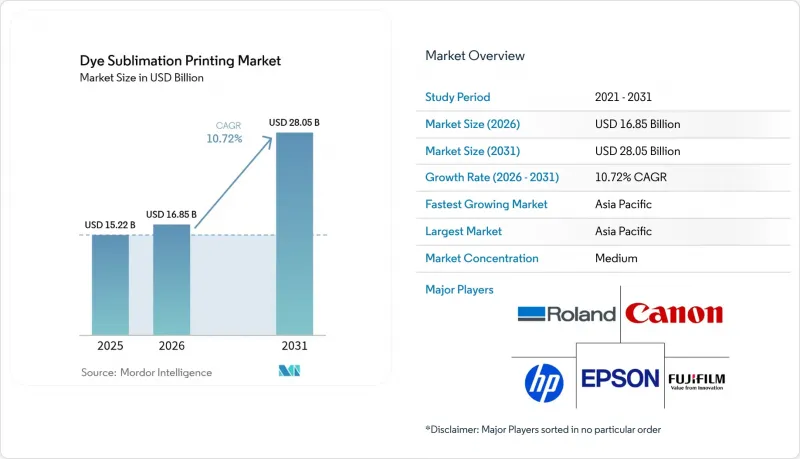
本報告按應用領域(服裝、工業紡織品等)、印表機類型(桌面型、寬幅型、工業型)、墨水類型(熱昇華墨水、直接昇華墨水等)、承印物類別(聚酯織物、聚合物塗層硬質介質等)和地區(北美、南美等)進行細分。市場預測以美元計價。
全球熱昇華轉印市場趨勢及洞察
訂製運動服和時尚服飾的蓬勃發展
隨著俱樂部、大學運動隊和獨立品牌轉向按需微型工廠模式,大幅降低庫存風險,客製化已從「錦上添花」轉變為「關鍵決策因素」。過去依賴網版印刷的契約製造廠商現在採用數位熱昇華轉印生產線,無需額外設定成本即可處理多色全頁影像。思科運動 (Cisco Athletic) 正是這一轉變的體現,它以固定費率提供無限的顏色和位置選擇,向買家證明複雜性不再意味著成本增加。運動團隊受益於僅需兩週的更短前置作業時間,而加工商則因減少廢棄物和退貨而獲得更高的利潤率。同樣的生產基礎設施現在也被用於時尚膠囊系列和網紅主導的限量發售,進一步擴大了熱昇華轉印設備的應用範圍。消費者研究表明,品牌忠誠度與環境透明度密切相關,按需生產也透過消除庫存積壓和二次運輸,幫助企業實現減排目標。
向節水型數位紡織製程轉型
隨著監管機構對濕式加工廠的壓力日益增大,無水熱昇華印花技術正成為企業更便捷遵守環保法規的捷徑。已實施封閉回路型熱回收系統的營運商報告稱,該系統顯著降低了能耗,並協同促進了節水。已發表的案例研究表明,透過最佳化佈局和能源利用,加工能力最多可提升30%。歐洲永續和循環紡織策略透過綠色政府採購評分獎勵企業採用該技術,從而加速了為全球品牌供貨的大型工廠的推廣應用。對於加工商而言,獲得bluesign和OEKO-TEX等認證,有助於他們與零售商簽訂高價值契約,而這些零售商必須披露其範圍3的水足跡。此外,消費者也願意為採用經認證的低環境影響印花技術生產的服裝產品支付更高的價格,這進一步鞏固了企業的競爭優勢。
資本密集型印刷機和後處理設備
工業熱昇華轉印生產線,包括熱壓壓平機、乾燥隧道和工作流程軟體,總成本仍超過20萬美元,對許多中小生產者來說是一個巨大的障礙。高利率推高了每月的租賃成本,近一半受訪的紡織企業由於資金籌措而推遲了2024年的擴張計劃。此外,設施維修高昂,因為壓平機需要穩定的濕度、先進的通風系統以及高溫運作所需的安全控制。為了應對這一問題,設備製造商推出了「按米計費」模式,將硬體、服務和油墨打包成按米計價,從而降低了新參與企業的初始成本。雖然該技術的應用正在不斷擴大,但資金壁壘仍限制著新進業者的數量,尤其是在信貸條件依然嚴格的新興經濟體。
細分市場分析
預計到2025年,服裝將佔總銷售額的62.31%,凸顯了團隊服裝、休閒和快時尚膠囊系列對熱昇華印花技術的依賴,該技術能夠實現色彩鮮豔、覆蓋整個表面的印花,且無需承擔庫存風險。相較之下,儘管技術紡織品市場規模較小,但隨著汽車製造商在車頂內襯、車門面板和座椅套等部件中採用輕質聚酯複合材料,預計將以10.98%的複合年成長率成長。隨著運動聯盟不斷縮短補貨週期,以及D2C(直接面對消費者)平台簡化訂單整合流程,服裝熱昇華轉印市場預計將穩定擴張。
技術紡織品的成長與電動車 (EV) 內裝的重新設計密切相關。在電動車內裝設計中,射出成型的部件正被織物覆蓋的部件所取代,從而減少了高達 25% 的碳足跡。製造商正在測試與熱昇華印刷相容的阻燃塗層,以滿足 FMVSS 302 標準,並開闢新的收入來源。汽車產業法規不斷擴大,要求使用 25% 的再生材料,這推動了聚酯基織物的發展,而聚酯基織物是熱昇華印刷的理想基材。由於監管機構訂定了鼓勵使用再生內部裝潢建材的信用獎勵機制,一級供應商正在洽談多年印刷契約,這使得加工商能夠獲得必要的產量信息,從而證明投資工業印刷機的合理性。
2025年,幅面小於74吋的寬幅印表機仍保持55.74%的銷售佔有率,其寬度適中,符合大多數卷對卷印後加工生產線的要求,並滿足時尚和室內裝飾加工商的中等批量生產需求。然而,受製造商對單一途徑效率和全班次處理能力的需求推動,預計到2031年,幅面大於74英吋的工業級列印平台將以11.76%的複合年成長率成長。熱昇華列印市場正受惠於印表機頭製造商透過新建廠將其產能擴大四倍,例如Epson在東北地區投資51億日元(約3,400萬美元)的擴建項目,該項目計劃於2025年9月竣工。
在工業生產線上,對稱的噴嘴佈置和即時墨滴監測系統可最大限度地減少油墨飛濺,從而降低每米油墨消耗。線上固定整合可確保捲筒在彈出時完全固定,以便進行檢驗和切割,從而進一步降低人事費用。與需要定位的兩階段工作流程相比,這些成本節約加起來可將總營運成本降低兩位數百分比。對於高人事費用地區的加工商而言,自動化可抵銷工資上漲的影響,並支持優先考慮快速本地交付的生產回流策略。
區域分析
亞太地區擁有密集的製造群、一體化的原料供應體系,以及優惠的設備進口關稅(越南等市場將降至0%),預計2025年將佔全球銷售額的40.11%。中國仍是服裝生產中心,2024年服飾產量達204.6億件,較去年同期成長4.22%。政府推行的數位轉型計畫旨在2025年實現70%紡織企業的數位轉型,該計畫鼓勵即使是小規模工廠也採用卷對捲熱昇華轉印機,從而加速了市場滲透。然而,不斷上漲的人事費用正在推動自動化投資,進而導致對高產能工業平台的需求增加。
北美仍然佔據著相當大的市場佔有率,這主要得益於大學和職業運動隊對快速個性化客製化和本土化生產的迫切需求,以滿足授權許可要求。該地區也較早採用了人工智慧驅動的工作流程軟體,從而縮短了設計週期,降低了印前作業的人事費用。 《貿易促進授權協定》(TPA)繼續對聚酯纖維服飾徵收進口關稅,這影響了將墨西哥定位為美國印刷商基材來源地的近岸外包策略。
歐洲嚴格的環境法規正在推動無水昇華印刷和不含PFAS塗層的應用,為昇華印刷市場創造了有利的監管環境。歐盟「地平線歐洲」(Horizon Europe)計畫已撥款1000萬歐元用於本地數位紡織品生產,這項津貼計畫降低了歐盟內部微型工廠的進入門檻。因此,總部位於該地區的品牌正在進行供應商審核,優先考慮取得bluesign、GOTS和ISO 14001認證的加工商。
中東和非洲正在崛起為新興市場,這主要得益於阿拉伯聯合大公國的時尚中心地位和南非促銷品市場的蓬勃發展。自由貿易區的基礎設施投資使得企業能夠免稅進入歐洲和亞洲市場,這使得該地區對全球品牌越來越具有吸引力,促使表面處理工程位置。拉丁美洲雖然銷售額相對較小,但由於足球商品行銷交易和國內體育聯賽的興起,其成長速度高於平均水平,為地域多角化開闢了新的方向。
其他好處:
- Excel格式的市場預測(ME)表
- 3個月的分析師支持
目錄
第1章:引言
- 研究假設和市場定義
- 調查範圍
第2章:調查方法
第3章執行摘要
第4章 市場狀況
- 市場概覽
- 市場促進因素
- 客製化運動和時尚服裝的蓬勃發展
- 向節水型數位紡織製程轉型
- 一款能夠降低總擁有成本的高速工業印表機已經發布。
- 從設計到印刷,全面應用人工智慧軟體。
- 電動汽車內裝用技術紡織品的需求正在激增。
- 生物基聚酯可實現永續昇華印花。
- 市場限制因素
- 資本密集型印刷機和後處理設備
- 僅聚酯基材的局限性
- 供應不穩定分散染料的成本
- 關於轉移紙的 PFAS 法規
- 產業價值鏈分析
- 波特五力分析
- 宏觀經濟因素對市場的影響
- 技術概述
第5章 市場規模與成長預測
- 透過使用
- 衣服
- 技術紡織品
- 家用紡織品
- 視覺傳達/軟指示牌
- 剛性基板
- 依印表機類型
- 桌上型電腦(44吋以下)
- 寬幅(44-74吋)
- 工業級(超過 74 吋)
- 按墨水類型
- 熱昇華轉印墨水
- 用於織物的直接昇華墨水
- 熱昇華碳粉墨水
- 依基板類型
- 聚酯纖維布料
- 聚合物塗層剛性介質
- 混紡/混合技術纖維
- 按地區
- 北美洲
- 美國
- 加拿大
- 墨西哥
- 南美洲
- 巴西
- 阿根廷
- 其他南美國家
- 歐洲
- 德國
- 英國
- 法國
- 義大利
- 西班牙
- 其他歐洲國家
- 亞太地區
- 中國
- 日本
- 印度
- 韓國
- 澳洲
- 其他亞太國家
- 中東和非洲
- 中東
- 阿拉伯聯合大公國
- 沙烏地阿拉伯
- 土耳其
- 其他中東國家
- 非洲
- 南非
- 肯亞
- 其他非洲國家
- 中東
- 北美洲
第6章 競爭情勢
- 市場集中度
- 策略趨勢
- 市佔率分析
- 公司簡介
- Seiko Epson Corporation
- Roland DG Corporation
- Fujifilm Holdings Corporation
- Canon Inc.
- HP Inc.
- Mimaki Engineering Co., Ltd.
- Mutoh Holdings Co., Ltd.
- Sawgrass Technologies, Inc.
- Durst Group AG
- Dover Corporation(MS Printing Solutions SRL)
- Kornit Digital Ltd.
- Electronics For Imaging, Inc.
- Ricoh Company, Ltd.
- Brother Industries, Ltd.
- ColorJet India Ltd.
- Gandy Digital Ltd.
- Klieverik Heli BV
- DGI Digital Graphic Inc.
- Shenzhen HOMER Textile Tech Co., Ltd.
- Sun Chemical Corp.
- DuPont de Nemours, Inc.
- SPGPrints BV
- Huntsman Corporation
第7章 市場機會與未來展望
According to Mordor Intelligence, the dye sublimation printing market size is expected to grow from USD 15.22 billion in 2025 to USD 16.85 billion in 2026 and is forecast to reach USD 28.05 billion by 2031 at 10.72% CAGR over 2026-2031.
This report is Segmented by Application (Garments, Technical Textiles, and More), Printer Type (Desktop, Wide-Format, Industrial), Ink Type (Transfer Sublimation Inks, Direct-To-Fabric Sublimation Inks, and More), Substrate Category (Polyester Fabrics, Polymer-Coated Rigid Media, and More), and Geography (North America, South America, and More). The Market Forecasts are Provided in Terms of Value (USD).
Global Dye Sublimation Printing Market Trends and Insights
Boom in customized sports and fashion apparel
Customization has moved from a nice-to-have to a purchase driver as clubs, collegiate teams, and independent brands commit to on-demand micro-factory models that slash inventory risk. Contract manufacturers that previously relied on screen printing are now adopting digital sublimation lines to handle full-coverage graphics in multiple colorways without incremental setup costs. Cisco Athletic exemplifies the shift by offering unlimited colors and placement options at a flat price, showing buyers that complexity no longer carries a penalty. Teams benefit from two-week lead times, while converters enjoy healthier margins due to lower waste and fewer returns. The same infrastructure is now serving fashion capsules and influencer-led drops, widening the installed base of sublimation equipment. As consumer surveys link brand loyalty to environmental transparency, on-demand production also supports corporate emissions goals by eliminating dead inventory and secondary transport legs.
Shift to water-efficient digital textile processes
Sublimation's water-free transfer mechanism has become an environmental-compliance shortcut as regulators escalate pressure on wet-processing mills. Operators integrating closed-loop heat recovery report energy savings that compound water reductions, and published case studies show up to 30% throughput gains after layout and energy optimization. Europe's Sustainable and Circular Textiles Strategy now incentivizes adopters through green-public-procurement scoring, accelerating uptake among large mills that supply global brands. For converters, the ability to secure certifications such as bluesign and OEKO-TEX unlocks premium contracts with retailers that must disclose Scope 3 water footprints. The competitive edge is further reinforced by consumer willingness to pay higher prices for apparel made with certified low-impact printing.
Capital-intensive presses and finishing equipment
Industrial-grade sublimation lines still command price tags that can top USD 200,000 when heat presses, drying tunnels, and workflow software are included, a hurdle that deters many small producers. High interest rates have pushed monthly leasing costs upward, and nearly half of the surveyed textile firms postponed expansion plans in 2024 due to financing constraints. Facility retrofits add further expense because presses require stable humidity, advanced ventilation systems, and safety controls for high-temperature operations. In response, equipment makers are rolling out click-charge models that bundle hardware, service, and ink into a single cost-per-linear-meter fee, lowering cash outlays for newcomers. Although adoption is growing, the capital barrier continues to suppress the number of new entrants, especially in emerging economies where credit terms remain tight.
Other drivers and restraints analyzed in the detailed report include:
- High-speed industrial printer launches, lowering TCO
- AI-driven design-to-print software adoption
- PFAS regulations on transfer papers
For complete list of drivers and restraints, kindly check the Table Of Contents.
Segment Analysis
Garments accounted for 62.31% of 2025 revenues, underscoring how teamwear, athleisure, and fast-fashion capsules rely on sublimation to execute vibrant all-over prints without inventory risk. Technical textiles, in contrast, represent a smaller base yet are forecast to grow at 10.98% CAGR as automakers adopt lightweight polyester composites for headliners, door panels, and seat covers. The dye sublimation printing market size for garments is projected to expand steadily because sports leagues continue to shorten replenishment cycles and because direct-to-consumer platforms streamline order aggregation.
Growth in technical textiles is tied to electric-vehicle interior redesigns that replace injection-molded parts with fabric-wrapped components, achieving up to 25% lower carbon footprint. Producers are trialing flame-retardant coatings compatible with sublimation to meet FMVSS 302 standards, opening new revenue streams. Broader automotive mandates that call for 25% recycled content favor polyester-based structures, a substrate sweet spot for sublimation. As regulatory credits incentivize recycled interiors, tier-1 suppliers are negotiating multi-year print contracts, giving converters the volume visibility needed to justify industrial press investments.
Wide-format units (<74") retained a 55.74% revenue share in 2025 because they match the width of most roll-to-roll finishing lines and address the mid-volume sweet spot of fashion and decor converters. However, industrial platforms exceeding 74" are expected to log an 11.76% CAGR through 2031, fueled by mills that want single-pass efficiency and full-shift throughput. The dye sublimation printing market benefits as printhead makers quadruple output capacity at new plants, such as Epson's JPY 5.1 billion (USD 34 million) expansion in Tohoku that targets September 2025 completion.
Industrial lines reduce per-meter ink consumption by leveraging symmetrical nozzle arrays and real-time drop-watch systems that cut overspray. Integration of inline fusing further trims labor because rolls exit completely fixed, ready for inspection and cutting. The combined savings can reduce total operating costs by double digits versus repositionable two-step workflows. For converters in high-labor-cost regions, automation offsets wage inflation and supports reshoring strategies that prioritize quick local delivery.
Complete Report Scope:
- By Application
- Garments
- Technical Textiles
- Household Textiles
- Visual Communication/Soft Signage
- Rigid Substrates
- By Printer Type
- Desktop (<44")
- Wide-Format (44"-74")
- Industrial (>74")
- By Ink Type
- Transfer Sublimation Inks
- Direct-to-Fabric Sublimation Inks
- Sublimation Toner Inks
- By Substrate Category
- Polyester Fabrics
- Polymer-Coated Rigid Media
- Blended/Hybrid Technical Textiles
- By Geography
- North America
- United States
- Canada
- Mexico
- South America
- Brazil
- Argentina
- Rest of South America
- Europe
- Germany
- United Kingdom
- France
- Italy
- Spain
- Rest of Europe
- Asia-Pacific
- China
- Japan
- India
- South Korea
- Australia
- Rest of Asia-Pacific
- Middle East and Africa
- Middle East
- United Arab Emirates
- Saudi Arabia
- Turkey
- Rest of Middle East
- Africa
- South Africa
- Kenya
- Rest of Africa
- Middle East
- North America
Geography Analysis
Asia-Pacific generated 40.11% of 2025 revenue, supported by dense manufacturing clusters, integrated feedstock supply, and favorable equipment import tariffs that drop to 0% in markets such as Vietnam. China remains the epicenter with 20.46 billion garment units produced in 2024, representing 4.22% year-over-year growth. Government programs promoting 70% digitalization of textile firms by 2025 are pushing even smaller mills to adopt roll-to-roll sublimation presses, accelerating penetration. Rising labor costs, however, are prompting automation investments that in turn boost demand for high-throughput industrial platforms.
North America retains a sizeable share, driven by collegiate and professional sports teams that require rapid personalization and domestic production for licensing compliance. The region is also early in adopting AI-driven workflow software, resulting in faster design cycles and reduced pre-press labor. Trade-promotion authority agreements continue to shape import duties on blank polyester garments, influencing near-shoring strategies that position Mexico as a substrate supplier to U.S. printers.
Europe's strict environmental regulations stimulate the adoption of water-free sublimation and PFAS-free coatings, giving the dye sublimation printing market a regulatory tailwind. Horizon Europe has earmarked EUR 10 million for local-for-local digital textile production, a grant line that lowers the capital barrier for micro-factories across the bloc. Brands headquartered in the region are therefore engaging in supplier audits that favor converters holding bluesign, GOTS, and ISO 14001 certifications.
The Middle East and Africa are emergent, led by the UAE's fashion hub and South Africa's promotional-product boom. Infrastructure investments in free-trade zones provide duty-free access to both European and Asian markets, making it attractive for global brands to locate finishing operations there. Latin America, while smaller in revenue, shows above-average growth due to soccer merchandising contracts and the rise of domestic sports leagues, adding another vector for regional diversification.
- Seiko Epson Corporation
- Roland DG Corporation
- Fujifilm Holdings Corporation
- Canon Inc.
- HP Inc.
- Mimaki Engineering Co., Ltd.
- Mutoh Holdings Co., Ltd.
- Sawgrass Technologies, Inc.
- Durst Group AG
- Dover Corporation (MS Printing Solutions SRL)
- Kornit Digital Ltd.
- Electronics For Imaging, Inc.
- Ricoh Company, Ltd.
- Brother Industries, Ltd.
- ColorJet India Ltd.
- Gandy Digital Ltd.
- Klieverik Heli B.V.
- DGI Digital Graphic Inc.
- Shenzhen HOMER Textile Tech Co., Ltd.
- Sun Chemical Corp.
- DuPont de Nemours, Inc.
- SPGPrints B.V.
- Huntsman Corporation
Additional Benefits:
- The market estimate (ME) sheet in Excel format
- 3 months of analyst support
TABLE OF CONTENTS
1 INTRODUCTION
- 1.1 Study Assumptions and Market Definition
- 1.2 Scope of the Study
2 RESEARCH METHODOLOGY
3 EXECUTIVE SUMMARY
4 MARKET LANDSCAPE
- 4.1 Market Overview
- 4.2 Market Drivers
- 4.2.1 Boom in customized sports and fashion apparel
- 4.2.2 Shift to water-efficient digital textile processes
- 4.2.3 High-speed industrial printer launches lowering TCO
- 4.2.4 AI-driven design-to-print software adoption
- 4.2.5 EV interior technical-textile demand surge
- 4.2.6 Bio-based polyester enabling sustainable sublimation
- 4.3 Market Restraints
- 4.3.1 Capital-intensive presses and finishing equipment
- 4.3.2 Polyester-only substrate limitation
- 4.3.3 Volatile disperse-dye supply costs
- 4.3.4 PFAS regulations on transfer papers
- 4.4 Industry Value Chain Analysis
- 4.5 Porter's Five Forces Analysis
- 4.5.1 Bargaining Power of Suppliers
- 4.5.2 Bargaining Power of Consumers
- 4.5.3 Threat of New Entrants
- 4.5.4 Threat of Substitutes
- 4.5.5 Intensity of Competitive Rivalry
- 4.6 Impact of Macroeconomic Factors on the Market
- 4.7 Technology Snapshot
5 MARKET SIZE AND GROWTH FORECASTS (VALUE)
- 5.1 By Application
- 5.1.1 Garments
- 5.1.2 Technical Textiles
- 5.1.3 Household Textiles
- 5.1.4 Visual Communication/Soft Signage
- 5.1.5 Rigid Substrates
- 5.2 By Printer Type
- 5.2.1 Desktop (<44")
- 5.2.2 Wide-Format (44"-74")
- 5.2.3 Industrial (>74")
- 5.3 By Ink Type
- 5.3.1 Transfer Sublimation Inks
- 5.3.2 Direct-to-Fabric Sublimation Inks
- 5.3.3 Sublimation Toner Inks
- 5.4 By Substrate Category
- 5.4.1 Polyester Fabrics
- 5.4.2 Polymer-Coated Rigid Media
- 5.4.3 Blended/Hybrid Technical Textiles
- 5.5 By Geography
- 5.5.1 North America
- 5.5.1.1 United States
- 5.5.1.2 Canada
- 5.5.1.3 Mexico
- 5.5.2 South America
- 5.5.2.1 Brazil
- 5.5.2.2 Argentina
- 5.5.2.3 Rest of South America
- 5.5.3 Europe
- 5.5.3.1 Germany
- 5.5.3.2 United Kingdom
- 5.5.3.3 France
- 5.5.3.4 Italy
- 5.5.3.5 Spain
- 5.5.3.6 Rest of Europe
- 5.5.4 Asia-Pacific
- 5.5.4.1 China
- 5.5.4.2 Japan
- 5.5.4.3 India
- 5.5.4.4 South Korea
- 5.5.4.5 Australia
- 5.5.4.6 Rest of Asia-Pacific
- 5.5.5 Middle East and Africa
- 5.5.5.1 Middle East
- 5.5.5.1.1 United Arab Emirates
- 5.5.5.1.2 Saudi Arabia
- 5.5.5.1.3 Turkey
- 5.5.5.1.4 Rest of Middle East
- 5.5.5.2 Africa
- 5.5.5.2.1 South Africa
- 5.5.5.2.2 Kenya
- 5.5.5.2.3 Rest of Africa
- 5.5.5.1 Middle East
- 5.5.1 North America
6 COMPETITIVE LANDSCAPE
- 6.1 Market Concentration
- 6.2 Strategic Moves
- 6.3 Market Share Analysis
- 6.4 Company Profiles (includes Global level Overview, Market level overview, Core Segments, Financials as available, Strategic Information, Market Rank/Share for key companies, Products and Services, and Recent Developments)
- 6.4.1 Seiko Epson Corporation
- 6.4.2 Roland DG Corporation
- 6.4.3 Fujifilm Holdings Corporation
- 6.4.4 Canon Inc.
- 6.4.5 HP Inc.
- 6.4.6 Mimaki Engineering Co., Ltd.
- 6.4.7 Mutoh Holdings Co., Ltd.
- 6.4.8 Sawgrass Technologies, Inc.
- 6.4.9 Durst Group AG
- 6.4.10 Dover Corporation (MS Printing Solutions SRL)
- 6.4.11 Kornit Digital Ltd.
- 6.4.12 Electronics For Imaging, Inc.
- 6.4.13 Ricoh Company, Ltd.
- 6.4.14 Brother Industries, Ltd.
- 6.4.15 ColorJet India Ltd.
- 6.4.16 Gandy Digital Ltd.
- 6.4.17 Klieverik Heli B.V.
- 6.4.18 DGI Digital Graphic Inc.
- 6.4.19 Shenzhen HOMER Textile Tech Co., Ltd.
- 6.4.20 Sun Chemical Corp.
- 6.4.21 DuPont de Nemours, Inc.
- 6.4.22 SPGPrints B.V.
- 6.4.23 Huntsman Corporation
7 MARKET OPPORTUNITIES AND FUTURE OUTLOOK
- 7.1 White-Space and Unmet-Need Assessment

 熱昇華印刷機市場規模、佔有率和成長分析:按型號配置、印刷技術、墨水類型相容性、應用和地區分類-產業預測,2026-2033年
 熱昇華轉印市場規模、佔有率和趨勢分析報告:按產品類型、印刷技術、應用、最終用途、地區和細分市場預測(2026-2033 年)
 2026年全球熱昇華印刷市場報告
 熱昇華紙市場按紙張類型、分銷管道、應用和最終用戶分類-全球預測,2026-2032年
 全球熱昇華印刷市場:市場規模分析(按產品類型、應用、基材類型、最終用戶產業、印刷技術和地區)和未來預測(2022-2032年)
 熱昇華印刷市場規模、佔有率、趨勢分析(按最終用戶、應用、產品類型、技術、地區、展望和預測,2025 年至 2032 年)
 昇華紙市場報告:趨勢、預測與競爭分析(至 2031 年)
 昇華印刷的全球市場的未來(~2029年)
 熱昇華紙市場:按產品類型、應用和地區分類