


 |
市場調查報告書
商品編碼
2123157
雲端無線接取網路:市場佔有率分析、產業趨勢與統計、成長預測(2026-2031)Cloud Radio Access Network - Market Share Analysis, Industry Trends & Statistics, Growth Forecasts (2026 - 2031) |
||||||

※ 本網頁內容可能與最新版本有所差異。詳細情況請與我們聯繫。
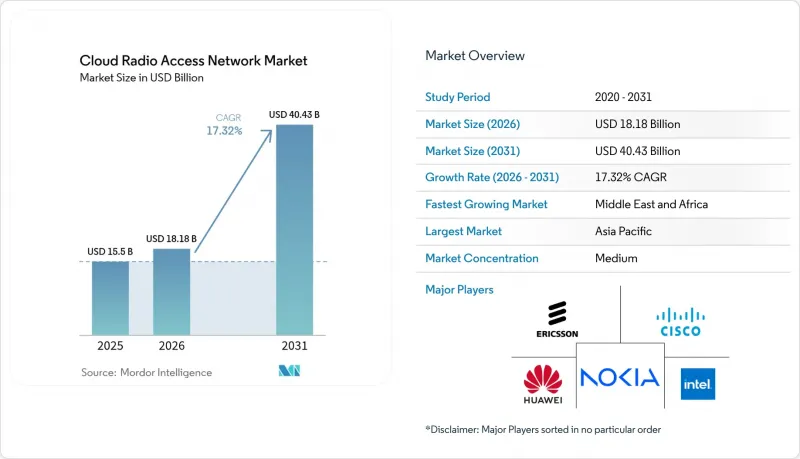
根據 Mordor Intelligence 預測,雲端無線接取網路(CRAN) 市場規模將從 2025 年的 155 億美元成長到 2026 年的 181.8 億美元,然後在 2031 年達到 404.3 億美元,2026 年至 2031 年的複合成長率為 17.32%。
本報告按組件(解決方案和服務)、網路類型(5G、4G、LTE、3G)、部署模式(集中式無線接取網路 [C-RAN]、虛擬化無線接取網路 [vRAN]、開放混合雲端接取網路)、最終用戶(行動網路營運商、企業、政府和公共安全部門、以及各式主機/公安部門、以及各地區主機/公安部門。市場預測以美元 (USD) 為單位。
全球雲端無線接取網路市場趨勢與洞察
5G的快速部署和日益密集的覆蓋範圍正在推動架構轉型。
全球電信業者正在運作頻段5G層,並增設小型基地台以填補覆蓋盲點。在此環境下,雲端無線接取網路市場提供了集中式運算資源池,用於管理數千個無線設備,避免硬體重複建置。東京、首爾和紐約的現場試驗表明,動態調整基頻工作負載可將利用率提高30%,並將小區尖峰時段吞吐量提高25%。商用5G獨立組網核心網路目前正將時間相關的調度與虛擬基頻功能結合,凸顯了雲端原生原則如何縮短功能發布週期。中國和美國的大規模部署表明,在同一雲端網站上託管多代無線設備是可行的,這有助於頻率重新分配決策並支援分階段遷移路徑。這些優勢正在推動持續投資,尤其是在室內覆蓋要求需要高密度無線網的地區。
降低資本支出和營運支出有助於實現商業目標。
虛擬化基頻池的經濟優勢顯而易見。池化減少了硬體冗餘,降低了設施成本,並簡化了升級。一家北美供應商的案例研究表明,一家電信業者將三個基頻整合到一個雲端叢集中,在部署的第一年就減少了近三分之一的資本支出。隨著自動化工具擴展預防性保養和遠端軟體更新,營運支出也將降低。人工智慧調度器透過在非尖峰時段將未充分利用的無線設備置於深度睡眠模式,提高網路電源效率並降低公用事業成本。這些成本節約為積極的 5G 擴展計劃奠定了基礎,尤其對於那些力求在支付股息和提升服務品質之間取得平衡的營運商而言更是如此。隨著基於使用量的定價模式在公共雲端中日益普及,營運商將擁有更大的柔軟性來根據流量高峰調整支出,從而進一步增強雲端架構的吸引力。
頻段不足和監管限制正在減緩其發展速度。
中波頻率的及時釋放和競標仍然是全國5G部署的瓶頸。美國聯邦通訊委員會(FCC)的競標權限將於2024年到期,這為未來的頻率釋放帶來了不確定性,並拖慢了部分營運商的投資週期。許多新興市場也面臨不透明或受政治因素驅動的頻率分配流程,這延緩了雲端無線接取網路(RAN)最佳化型5G層的承包部署。即使獲得了許可證,網路佈局也受到保護頻帶條件和功率上限的限制,迫使營運商依賴分散的頻率資源,並使無線規劃變得更加複雜。這些現實情況可能會減緩部署速度,並延後頻率池經濟效益顯現的時間。
細分市場分析
根據 Solutions 的數據,雲端無線接取網路市場預計到 2025 年將達到 112.2 億美元,佔該細分市場收入的 72.40%。然而,隨著多廠商環境逐漸成為標準,服務市場正以 18.02% 的複合年成長率 (CAGR) 加速擴張。早期的待開發區部署主要需要硬體和虛擬化基頻許可證,而目前的棕地升級則需要整合、網路最佳化和生命週期支援。歐洲營運商正在簽署多年期託管服務契約,將人工智慧驅動的效能分析與 DevOps 實施相結合,使內部團隊能夠優先設計新服務。諮詢團隊目前正在指導頻譜重組、功能分解選擇和遷移順序,這對於現有營運商平衡傳統 4G 流量和新興的 5G 私有應用場景至關重要。硬體供應商正在透過引入開放介面和參考自動化工作流程來應對這一變化,模糊了產品和專業服務之間的界限。因此,隨著 2031 年的臨近,這種整合將使服務業能夠在雲端無線接取網路市場的收入池中佔據更大的佔有率。
源源不絕的創新正在為解決方案業務注入活力。領先的半導體製造商推出了整合加速技術,用於波束成形和前向糾錯,與刀片式晶片相比,到 2023 年,每個框架單位的基頻容量將提升一倍以上。無線設備供應商也緊跟其後,提供針對屋頂和室內環境最佳化的輕量級大規模 MIMO 陣列。這些進步降低了整體擁有成本 (TCO),同時擴大了目標基本客群,從而支持解決方案領域收入的穩定成長。因此,一個平衡的市場環境正在形成,軟體、晶片和服務都在推動向集中編配無線層的轉型,從而促進現有營運商和企業在雲端無線接取網路市場的應用。
2025年,隨著營運商投資利用中頻段頻率,5G業務將佔雲端無線接取網路市場總營收的61.80%。營運商已迅速過渡到獨立組網(SA)架構,該架構支援切片和超低延遲流水線,這對工業4.0工作負載至關重要。虛擬化基頻池將允許非獨立網路(NSA)5G、LTE和NR在通用伺服器上運行,使營運商能夠逐步淘汰3G並專注於提升網路容量。雖然4G LTE仍能帶來可觀的收入,但隨著資料通訊密集型消費者轉向包含終端補貼的5G套餐,其市佔率正逐年下降。
開放式無線存取網(Open RAN)正處於最快的成長軌道上,預計到2031年將維持26.4%的年複合成長率(CAGR),這主要得益於北美和亞洲一級供應商為實現供應鏈多元化而做出的重大承諾。雖然該模式的開放介面有利於跨領域實現最佳組合,但整合相關的開銷仍然相當可觀。然而,達拉斯和首爾的運作網路初步試驗表明,透過統一的雲端平台編配,多廠商大規模MIMO協定堆疊可以實現與單體系統相媲美的頻譜效率。包括美國政府津貼項目在內的監管支持也進一步推動了其發展。這些因素共同作用,使開放式無線接取網路成為變革的關鍵驅動力,在擴大供應商多樣性的同時,也加劇了整個雲端無線接取網路市場的競爭。
區域分析
預計到2025年,亞太地區將主導雲端無線接取網路市場,佔38.60%的營收佔有率,並以22.4%的複合年成長率持續成長。中國、日本和韓國積極部署5G網路,其基礎是連接大規模區域資料中心的高密度小型基地台網路。深圳和首爾的電信業者已在主要商業區運營商用開放介面叢集,並在節慶高峰期展示了用於影片串流的即時頻率池化。各國政府正在提供支持性政策框架,例如對虛擬化投資進行頻率使用費報銷。以開放測試平台為核心的蓬勃發展的供應商生態系統,以及像OREX這樣的舉措拓展出口機會的合資企業,正在鞏固該地區的領先地位。
北美地區銷售額位居第二。美國電信業者累計數十億美元,並計劃在2026年前用開放式無線設備取代傳統硬體。根據《晶片與科學法案》,聯邦政府津貼正共同資助半導體研究,為基於人工智慧的調度引擎提供動力,從而增強國內供應鏈的韌性。拉斯維加斯和西雅圖的早期部署表明,GPU加速的雲端節點能夠滿足XR遊戲和工業自動化領域對毫秒延遲的嚴格要求。加拿大電信營運商與芬蘭和韓國的供應商建立的合作關係正在拓展區域創新領域,凸顯了支援更廣泛的雲端無線接取網路市場的跨境技術交流。
在歐洲,監管義務和市場競爭需求的雙重角色正在加速5G的部署。英國、德國和西班牙的電信業者已部署了首批商用5G開放式無線接取網路(RAN)宏基站,並由公共測試機構認證無線設備、基頻和管理系統之間的互通性。歐盟已撥款用於5G和6G網路的研發,並加強產學研合作,以培養RAN軟體人才。儘管獨立組網的5G覆蓋範圍仍落後於其他網路,但現有營運商正在加快無線層雲化的計劃,其主要驅動力是降低總體擁有成本(TCO)和加快服務創新。正在進行的基礎設施建設項目正在透過區域走廊升級光纖骨幹網,預計這將解決長期存在的瓶頸問題,並進一步擴大全部區域的雲端無線接取網路市場。
其他好處:
- Excel格式的市場預測(ME)表
- 3個月的分析師支持
目錄
第1章:引言
- 研究假設和市場定義
- 調查範圍
第2章:調查方法
第3章執行摘要
第4章 市場狀況
- 市場概覽
- 市場促進因素
- 5G的快速部署和網路密度的不斷提高
- 透過基頻集中化降低資本支出和營運支出。
- 行動數據快速成長
- 網路虛擬化和對軟體定義網路 (SDN) 的需求
- 引進人工智慧驅動的無線存取網最佳化
- 能源效率法規正在推動雲端無線存取網(RAN)的普及。
- 市場限制因素
- 頻寬不足和監管限制
- 去程傳輸光纖供不應求和延遲挑戰
- 集中式架構中的安全與隱私風險
- 新興市場投資報酬率不確定
- 價值供應鏈分析
- 監理情勢
- 技術展望
- 波特五力分析
- 投資分析
第5章 市場規模與成長預測
- 按組件
- 解決方案
- 服務
- 專業的
- 管理
- 依網路類型
- 5G
- 4G
- LTE
- 3G(EDGE)
- 按部署模式
- 集中式無線存取網(C-RAN)
- 虛擬化無線存取網(vRAN)
- Open RAN(O-RAN)
- 混合雲端存取網
- 最終用戶
- 行動電信商
- 公司
- 政府和公共安全
- 中立主機/塔樓公司
- 按地區
- 北美洲
- 美國
- 加拿大
- 墨西哥
- 歐洲
- 英國
- 德國
- 法國
- 其他歐洲國家
- 亞太地區
- 中國
- 日本
- 韓國
- 印度
- 其他亞太國家
- 南美洲
- 巴西
- 阿根廷
- 其他南美國家
- 中東和非洲
- 中東
- UAE
- 沙烏地阿拉伯
- 其他中東國家
- 非洲
- 南非
- 其他非洲國家
- 中東
- 北美洲
第6章 競爭情勢
- 市場集中度
- 策略趨勢
- 市佔率分析
- 公司簡介
- Huawei Technologies Co. Ltd.
- Nokia Corporation
- Telefonaktiebolaget LM Ericsson
- Cisco Systems Inc.
- Samsung Electronics Co. Ltd.
- ZTE Corporation
- Intel Corporation
- Fujitsu Limited
- NEC Corporation
- Mavenir Systems Inc.
- Parallel Wireless Inc.
- Rakuten Symphony
- Altiostar(Rakuten)
- CommScope Holding Co. Inc.
- Casa Systems Inc.
- Airspan Networks Inc.
- Hewlett Packard Enterprise(HPE)
第7章 市場機會與未來展望
According to Mordor Intelligence, the cloud radio access network market size is expected to grow from USD 15.5 billion in 2025 to USD 18.18 billion in 2026 and is forecast to reach USD 40.43 billion by 2031 at 17.32% CAGR over 2026-2031.
This report is Segmented by Component (Solution and Services), Network Type (5G, 4G, LTE, 3G ), Deployment Model (Centralised RAN [C-RAN], Virtualised RAN [vRAN], Open RAN [O-RAN], and Hybrid Cloud RAN), End User (Mobile Network Operators, Enterprises, Government and Public-Safety, and Neutral Host/TowerCos) and Geography. The Market Forecasts are Provided in Terms of Value (USD).
Global Cloud Radio Access Network Market Trends and Insights
Rapid 5G Rollouts and Densification Drive Architectural Change
Global operators are lighting up mid-band 5G layers and adding small cells to fill coverage gaps. In this environment, the cloud radio access network market delivers the centralized compute pools needed to manage thousands of radios without duplicating hardware. Field trials in Tokyo, Seoul, and New York show that dynamically shifting baseband workloads can raise utilisation by 30% and boost peak cell throughput by 25%. Commercial 5G standalone cores are now coordinating time-sensitive scheduling with virtual baseband functions, underscoring how cloud-native principles shorten feature release cycles. Large-scale deployments in China and the United States reveal that the same cloud site can host multiple radio generations, easing spectrum-refarming decisions and supporting progressive migration paths. These advantages spur continued investment, particularly where indoor coverage obligations require dense radio grids.
CAPEX and OPEX Savings Sustain the Business Case
The economic attraction of virtualized baseband pools is immediate: pooling reduces hardware duplication, trims real-estate expense, and simplifies upgrades. Vendor case studies from North America indicate that operators consolidating three legacy baseband types into a single cloud cluster recorded CAPEX cuts nearing one-third during year-one rollouts. OPEX declines follow as automation tools scale preventive maintenance and remote software updates. Energy bills fall when AI schedulers place lightly loaded radios in deep-sleep modes during off-peak periods, improving the network's power-efficiency profile. These savings underpin aggressive 5G expansion plans, especially for carriers balancing dividend commitments with the need to enhance the quality of service. As consumption-based pricing models for public cloud gain traction, operators gain added flexibility to align spending with traffic peaks, reinforcing the appeal of cloud architecture.
Spectrum Scarcity and Regulatory Limits Dent Momentum
Timely clearance and auction of mid-band spectrum remains a gating factor for nationwide 5G builds. The expiry of auction authority at the United States Federal Communications Commission in 2024 introduced uncertainty around future releases, slowing some carrier investment cycles. Many emerging markets also grapple with opaque or politically driven allocation processes that delay turnkey deployment of 5G layers optimized for cloud RAN. Even where licenses are in place, guard-band conditions and power-level caps can restrict network layouts, forcing operators to rely on fragmented holdings that complicate radio planning. These realities moderate roll-out velocity and can postpone the point when pooling economics become compelling.
Other drivers and restraints analyzed in the detailed report include:
- Exponential Mobile-Data Growth Necessitates Architectural Innovation
- Network Virtualization and SDN Adoption Reshape Strategies
- Limited Fronthaul Fibre and Latency Challenges Constrain Deployment
For complete list of drivers and restraints, kindly check the Table Of Contents.
Segment Analysis
The cloud radio access network market size derived from Solutions hit USD 11.22 billion in 2025, equal to 72.40% of segment revenue. Yet the Services market is expanding faster at an 18.02% CAGR as multi-vendor environments become the norm. Early greenfield installations chiefly required hardware and virtualized baseband licenses, but current brownfield upgrades demand integration, network optimization, and lifecycle support. Operators in Europe are signing multi-year managed-service contracts that bundle AI-driven performance analytics with DevOps enablement, letting internal teams prioritise new-service design. Consulting teams now guide spectrum-refarming, functional-split selection, and migration sequencing, roles critical for incumbent carriers balancing legacy 4G traffic and emerging private 5G use cases. Hardware providers respond by embedding open interfaces and reference automation workflows, blurring the line between product and professional service. In turn, this mix pushes the Services slice to account for a deeper share of the cloud radio access network market revenue pool as 2031 approaches.
A steady flow of innovation keeps the Solutions business vibrant. Silicon majors introduced integrated acceleration for beamforming and forward-error correction, lifting baseband capacity per rack unit by over 2X compared with 2023 blades. Radio suppliers complement these gains with lightweight Massive MIMO arrays tailored for rooftop and indoor settings. Such advancements compress the total cost of ownership while widening the addressable customer base, supporting consistent though moderate revenue growth on the Solutions side. The net result is a balanced landscape where software, silicon, and services each reinforce the transition to centrally orchestrated radio layers, widening adoption across incumbent and enterprise segments of the cloud radio access network market.
In 2025, the 5G tier commanded 61.80% of the overall cloud radio access network market revenue as carriers devoted capital to harness mid-band spectrum. Operators pivoted quickly to standalone architectures, which permit slicing and ultra-low-latency pipelines critical for Industry 4.0 workloads. Virtualized baseband pools make it feasible to run non-standalone 5G, LTE, and NR on common servers, letting carriers phase out 3G in favor of capacity upgrades. While 4G LTE still generates meaningful returns, its share declines each year as data-heavy consumer usage gravitates toward 5G bundles with subsidized devices.
Open RAN exhibits the fastest trajectory at a 26.4% CAGR through 2031, buoyed by high-profile commitments from North American and Asian tier-ones keen to diversify supply chains. The model's open interfaces encourage best-of-breed combinations, but integration overhead remains considerable. Nevertheless, pilot results from live networks in Dallas and Seoul show that multi-vendor Massive MIMO stacks can reach spectral-efficiency parity with monolithic systems when orchestrated from a unified cloud platform. Regulatory support, such as grant programs from the United States government, offers added momentum. Collectively, these forces position Open RAN as a key disruptor, widening supplier diversity while intensifying competitive dynamics across the cloud radio access network market.
Complete Report Scope:
- By Component
- Solution
- Services
- Professional
- Managed
- By Network Type
- 5G
- 4G
- LTE
- 3G (EDGE)
- By Deployment Model
- Centralised RAN (C-RAN)
- Virtualised RAN (vRAN)
- Open RAN (O-RAN)
- Hybrid Cloud RAN
- By End User
- Mobile Network Operators
- Enterprises
- Government and Public-Safety
- Neutral Host/TowerCos
- By Geography
- North America
- United States
- Canada
- Mexico
- Europe
- United Kingdom
- Germany
- France
- Rest of Europe
- Asia-Pacific
- China
- Japan
- South Korea
- India
- Rest of Asia-Pacific
- South America
- Brazil
- Argentina
- Rest of South America
- Middle East and Africa
- Middle East
- UAE
- Saudi Arabia
- Rest of the Middle East
- Africa
- South Africa
- Rest of Africa
- Middle East
- North America
Geography Analysis
Asia Pacific dominates the cloud radio access network market with 38.60% revenue share in 2025 and leads in growth with a 22.4% CAGR. Aggressive 5G rollouts in China, Japan, and South Korea rely on high-density small-cell grids linked to large regional data centres. Operators in Shenzhen and Seoul already operate commercial open-interface clusters in core business districts, showcasing real-time spectrum pooling for video streaming during peak festivals. Governments provide supportive policy frameworks, such as spectrum fee rebates for virtualisation investments. Vendor ecosystems flourish around open testbeds, and joint ventures like the OREX initiative target export opportunities, cementing the region's leadership.
North America ranks second in terms of revenue. United States carriers earmarked multibillion-dollar budgets to swap legacy hardware for open-capable radios by 2026. Federal grants under the CHIPS and Science Act co-fund silicon research that empowers AI-based scheduling engines, giving domestic supply chains greater resilience. Early deployments in Las Vegas and Seattle prove that GPU-accelerated cloud nodes can meet stringent millisecond-level latency targets for XR gaming and industrial automation. Canadian operator collaborations with Finnish and Korean vendors extend the regional innovation sphere, highlighting cross-border technology exchange that supports the wider cloud radio access network market.
Europe accelerates adoption through a blend of regulatory mandates and competitive necessity. Operators in the United Kingdom, Germany, and Spain rolled out the first commercial 5G Open RAN macro sites, supported by public test labs that certify interoperability among radios, basebands, and management systems. The European Union dedicates funding tranches to 5G and 6G network R&D, which bolsters an academic-industry pipeline for RAN software talent. Despite lagging standalone 5G coverage, incumbents pursue fast-track plans to cloudify their radio layers, citing lower total cost of ownership and faster service innovation as key motivators. Ongoing infrastructure programs upgrade fibre backbones through rural corridors, which will remove a historic bottleneck and further expand the cloud radio access network market footprint across the region.
- Huawei Technologies Co. Ltd.
- Nokia Corporation
- Telefonaktiebolaget LM Ericsson
- Cisco Systems Inc.
- Samsung Electronics Co. Ltd.
- ZTE Corporation
- Intel Corporation
- Fujitsu Limited
- NEC Corporation
- Mavenir Systems Inc.
- Parallel Wireless Inc.
- Rakuten Symphony
- Altiostar (Rakuten)
- CommScope Holding Co. Inc.
- Casa Systems Inc.
- Airspan Networks Inc.
- Hewlett Packard Enterprise (HPE)
Additional Benefits:
- The market estimate (ME) sheet in Excel format
- 3 months of analyst support
TABLE OF CONTENTS
1 INTRODUCTION
- 1.1 Study Assumptions and Market Definition
- 1.2 Scope of the Study
2 RESEARCH METHODOLOGY
3 EXECUTIVE SUMMARY
4 MARKET LANDSCAPE
- 4.1 Market Overview
- 4.2 Market Drivers
- 4.2.1 Rapid 5G rollout and densification
- 4.2.2 CAPEX-OPEX savings via centralized baseband
- 4.2.3 Exponential mobile-data growth
- 4.2.4 Network virtualization and SDN demand
- 4.2.5 AI-driven RAN optimisation adoption
- 4.2.6 Energy-efficiency regulations push cloud RAN
- 4.3 Market Restraints
- 4.3.1 Spectrum scarcity and regulatory limits
- 4.3.2 Limited fronthaul fibre and latency challenges
- 4.3.3 Security and privacy risks in centralised architecture
- 4.3.4 Uncertain ROI in emerging markets
- 4.4 Value/Supply-Chain Analysis
- 4.5 Regulatory Landscape
- 4.6 Technological Outlook
- 4.7 Porter's Five Forces Analysis
- 4.7.1 Threat of New Entrants
- 4.7.2 Bargaining Power of Buyers
- 4.7.3 Bargaining Power of Suppliers
- 4.7.4 Threat of Substitute Products
- 4.7.5 Intensity of Competitive Rivalry
- 4.8 Investment Analysis
5 MARKET SIZE AND GROWTH FORECASTS (VALUE)
- 5.1 By Component
- 5.1.1 Solution
- 5.1.2 Services
- 5.1.2.1 Professional
- 5.1.2.2 Managed
- 5.2 By Network Type
- 5.2.1 5G
- 5.2.2 4G
- 5.2.3 LTE
- 5.2.4 3G (EDGE)
- 5.3 By Deployment Model
- 5.3.1 Centralised RAN (C-RAN)
- 5.3.2 Virtualised RAN (vRAN)
- 5.3.3 Open RAN (O-RAN)
- 5.3.4 Hybrid Cloud RAN
- 5.4 By End User
- 5.4.1 Mobile Network Operators
- 5.4.2 Enterprises
- 5.4.3 Government and Public-Safety
- 5.4.4 Neutral Host/TowerCos
- 5.5 By Geography
- 5.5.1 North America
- 5.5.1.1 United States
- 5.5.1.2 Canada
- 5.5.1.3 Mexico
- 5.5.2 Europe
- 5.5.2.1 United Kingdom
- 5.5.2.2 Germany
- 5.5.2.3 France
- 5.5.2.4 Rest of Europe
- 5.5.3 Asia-Pacific
- 5.5.3.1 China
- 5.5.3.2 Japan
- 5.5.3.3 South Korea
- 5.5.3.4 India
- 5.5.3.5 Rest of Asia-Pacific
- 5.5.4 South America
- 5.5.4.1 Brazil
- 5.5.4.2 Argentina
- 5.5.4.3 Rest of South America
- 5.5.5 Middle East and Africa
- 5.5.5.1 Middle East
- 5.5.5.1.1 UAE
- 5.5.5.1.2 Saudi Arabia
- 5.5.5.1.3 Rest of the Middle East
- 5.5.5.2 Africa
- 5.5.5.2.1 South Africa
- 5.5.5.2.2 Rest of Africa
- 5.5.5.1 Middle East
- 5.5.1 North America
6 COMPETITIVE LANDSCAPE
- 6.1 Market Concentration
- 6.2 Strategic Moves
- 6.3 Market Share Analysis
- 6.4 Company Profiles (includes Global level Overview, Market level overview, Core Segments, Financials as available, Strategic Information, Market Rank/Share for key companies, Products and Services, and Recent Developments)
- 6.4.1 Huawei Technologies Co. Ltd.
- 6.4.2 Nokia Corporation
- 6.4.3 Telefonaktiebolaget LM Ericsson
- 6.4.4 Cisco Systems Inc.
- 6.4.5 Samsung Electronics Co. Ltd.
- 6.4.6 ZTE Corporation
- 6.4.7 Intel Corporation
- 6.4.8 Fujitsu Limited
- 6.4.9 NEC Corporation
- 6.4.10 Mavenir Systems Inc.
- 6.4.11 Parallel Wireless Inc.
- 6.4.12 Rakuten Symphony
- 6.4.13 Altiostar (Rakuten)
- 6.4.14 CommScope Holding Co. Inc.
- 6.4.15 Casa Systems Inc.
- 6.4.16 Airspan Networks Inc.
- 6.4.17 Hewlett Packard Enterprise (HPE)
7 MARKET OPPORTUNITIES AND FUTURE OUTLOOK
- 7.1 White-space and unmet-need assessment

 2026-2034年全球雲端無線接取網路(C-RAN)市場規模、佔有率、趨勢及成長分析報告
 雲端無線接取網路市場:依組件、架構類型、網路類型、最終用戶和部署模式分類-2026-2032年全球市場預測
 C-RAN市場規模、佔有率和成長分析:按組件、架構、網路類型、部署模式、應用、最終用戶和地區分類-2026-2033年產業預測
 雲端無線接取網路(C-RAN) 市場分析及至 2035 年預測:類型、產品、服務、技術、元件、應用、部署、最終用戶、功能
 2026年全球雲端無線接取網路市場報告
 全球宏蜂窩無線電單元/主動天線單元 (RU/AAU) 市場分析與預測 (2024-2029) (第七版)全球雲端無線存取網 (C-RAN) 市場:市場規模、佔有率、成長率、產業分析、依類型、應用和地區劃分的分析、未來預測 (2026-2034)
 全球雲端無線接取網路市場,2026-2030年
 雲端無線接取網路(C-RAN) 市場規模、佔有率和成長分析(按元件、網路類型、架構類型、最終用戶和地區分類)-2026-2033 年產業預測全球雲端無線接取網路市場規模(按技術、網路類型、部署區域、區域範圍和預測)