


 |
市場調查報告書
商品編碼
2123156
可調式雷射:市場佔有率分析、產業趨勢與統計、成長預測(2026-2031)Tunable Laser - Market Share Analysis, Industry Trends & Statistics, Growth Forecasts (2026 - 2031) |
||||||

※ 本網頁內容可能與最新版本有所差異。詳細情況請與我們聯繫。
根據 Mordor Intelligence 預測,可調式雷射市場規模將從 2025 年的 155.9 億美元和 2026 年的 171.6 億美元成長到 2031 年的 260.3 億美元,2026 年至 2031 年的年複合成長率(CAGR)為 8.69%。
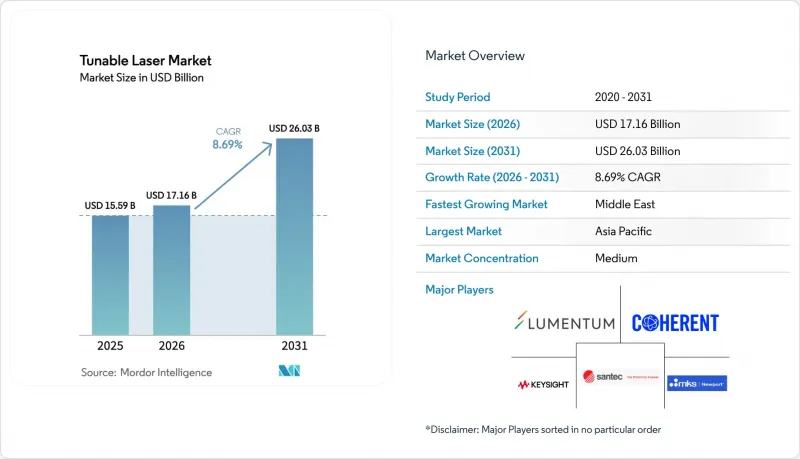
本報告依光源類型(C波雷射、外共振器雷射等)、終端用戶產業(製造業、通訊及網路設備、科研院所等)、波長範圍(可見光、近紅外線光等)、波長調諧方法(電流調諧、MEMS調諧等)及地區進行分類。市場預測以美元(USD)計價。
全球可調式雷射市場趨勢及洞察
可調諧二極體雷射氣體分析儀的應用日益廣泛
為了滿足日益嚴格的甲烷和揮發性有機化合物(VOC)排放標準,工業排放源正擴大轉向原位光譜分析。可調諧二極體雷射吸收光譜技術(TDLAS)能夠直接測量微量氣體,即使在高溫、高腐蝕性的廢氣中也能進行測量,無需像傳統探頭那樣進行樣品製備。美國環保署(EPA)2024年的甲烷排放法規已引發煉油廠和LNG接收站的設備更新換代。在中東地區的營運商符合ISO 14001標準後,橫河馬達2024年的TDLAS訂單較上年增加了35%。目前,該技術也被應用於半導體製造廠,用於將原子層沉積系統中的氧濃度控制在亞ppm級別,凸顯了其日益成長的跨行業需求。
生命科學領域對光譜分析技術的需求日益成長
製藥業的大量生產依賴於即時分析來無損地檢驗活性成分濃度。 FDA 2025 年發布的指導意見加速了線上拉曼和中紅外線紅外線與可調式雷射的結合應用。掃描 3–8 µm 波長範圍的量子級聯裝置能夠實現癌症篩檢中脂質代謝的無標定成像,將檢查時間從數天縮短至數小時。由 100 kHz 垂直腔可調式雷射驅動的掃頻源光學共振器斷層光學同調斷層掃描,其臨床應用範圍正從眼科擴展到循環系統科。
系統設計與功能複雜性
相干公司的400G模組要求在40 度C的溫度波動範圍內,波長精度達到±1.8 GHz,這需要採用封閉回路型壓電或基於MEMS的共振器控制。缺乏先進模擬和環境測試設施的新興企業很難通過IEC 61300-3-35可靠性測試。一家大型收發器供應商在2024年召回的產品,經查明是控制環路過衝導致溫度循環過程中出現模式跳變所致。此類故障會延長認證流程,並使小型製造商無法獲得大批量合約。
細分市場分析
預計到2025年,C波段元件將在可調式雷射市場佔據33.57%的領先佔有率。這反映了鉺放大器在利用1530-1565 nm增益平台的高密度分波多工(DWDM)系統中的成熟應用。電信營運商青睞這些組件,因為升級改造允許他們維護現有的擴大機鏈路並縮短資本投資週期。外部共振器雷射能夠實現線寬低於100 kHz的長距離連貫傳輸,並支援跨洋傳輸的64-QAM格式。光參量振盪器雖然出貨量較小,但預計將以9.21%的複合年成長率成長,這主要得益於中紅外線(mid-IR)防禦對抗和藥物分析領域的需求,表明存在著與現有C波段市場不同的、尚未開發的巨大潛力。其他變體,如分散佈拉格反射器和垂直共振器,適用於短距離資料中心鏈路,在這些鏈路中,面積和組件成本比調諧範圍更重要。
據報道,2025 年將推出一款基於矽的 III-V 族混合原型裝置,旨在透過將磷化銦放大晶片與矽光子光電波導管共封裝來降低成本。如果良率穩定,預計這種方法將使裝置類型偏好轉向與 CMOS晶圓代工廠合作的整合外部共振器,從而提高可調式雷射市場的整體效率。國防部門對使用雙可調諧雷射器進行兆赫光混頻的資助預示著,從長遠觀點,「其他類型」的可調式雷射將改變市場格局,儘管泵浦雷射的輸出功率和晶體溫度穩定性仍然是技術瓶頸。
2025年,製造業和工業領域持續佔銷售額的42.89%,這主要得益於連續排放氣體監測和燃燒控制系統的應用。調諧二極體雷射光譜儀現已成為新型燃氣渦輪機的標準配置,鞏固了設備現代化進程。同時,受跳頻測距儀、天基光鏈路和早期定向能演示裝置的推動,航太和國防領域預計到2031年將維持9.47%的複合年成長率。洛克希德·馬丁公司2024年簽訂的用於衛星終端的1550奈米窄頻雷射器契約,清晰地體現了這一轉變。
儘管通訊和網路設備佔據了C波段產品的大部分市場佔有率,但可插拔連貫模組日益成長的多功能性正對利潤率構成壓力。在醫療領域,垂直血管造影術(這項新的檢查將於2024年起納入美國醫療保險和醫療補助服務中心(CMS)的醫保報銷範圍)。研究機構仍在不斷探索量子點和微梳等技術,這些技術最終將實現量產,從而鞏固學術界作為創新試驗場的地位。
區域分析
2025年,亞太地區佔總銷售額的47.92%。這主要得益於中國磷化銦外延技術的垂直整合,使得連貫模組的價格較2023年降低了25%。國內供應商積極回應華為2024年推出的400G連貫產品,但其窄線寬良率比全球平均低10-15個百分點。日本憑藉其在精密MEMS和光學技術方面的專長,已將大規模出貨業務拱手讓給成本更低的中國當地晶圓廠,轉而專注於子系統的出口。
北美正受益於超大規模雲端的建設以及國防和航太計畫的推進。 Lumentum計劃於2026年在加州擴建晶圓產能,預計將使產能提高40%,以解決磷化銦長期供不應求。儘管《晶片法案》(CHIPS Act)為封裝領域的研發提供了資金,但對光電領域前端製程的補貼仍不足,導致該地區仍依賴晶圓原物料進口。加拿大和墨西哥正在吸收能源走廊對分散式聲波感測(DAS)的溢出需求,從而支持區域多元化發展。
歐洲的成長將主要集中在汽車領域雷射雷達(LiDAR)的普及應用。一家德國一級供應商已與相干公司(Coherent)簽署了一項多年供應協議,將為電動車平台提供MEMS調諧的1550奈米光源,預計於2027年投入使用。歐盟「地平線歐洲」計畫的12億歐元光電預算正在支持混合整合試點項目,這些項目預計從2028年起縮小與亞太地區的成本差距。中東地區雖然規模仍然較小,但預計其複合年成長率將達到9.44%,這主要得益於沙烏地阿拉伯的NEOM光纖專案和阿拉伯聯合大公國的10G-PON競標,後者需要採用軟體定義波分複用(WDM)和可調式雷射。南美洲和非洲仍然面臨成本限制,但巴西和南非遍遠地區密集波分複用(DWDM)骨幹網路的試點計畫表明,隨著光纖的普及,該地區具有潛在的成長空間。
其他好處:
- Excel格式的市場預測(ME)表
- 3個月的分析師支持
目錄
第1章:引言
- 市場分析與定義的前提條件
- 分析範圍
第2章 分析方法
第3章執行摘要
第4章 市場狀況
- 市場概覽
- 市場促進因素
- 可調諧二極體雷射氣體分析儀的應用日益廣泛
- 生命科學領域對光譜分析的需求日益成長
- 光纖網路的擴展
- 擴大 5G 和連貫光纖通訊在資料中心的部署
- 可調式雷射在量子計算的應用
- 採用晶片級LiDAR模組進行高階駕駛輔助系統(ADAS)
- 市場限制因素
- 系統設計與功能複雜性
- 窄線寬可調式雷射的高初始投資成本
- 特種半導體材料供應鏈的限制因素
- 惡劣環境下熱漂移和波長穩定性的挑戰
- 產業價值鏈分析
- 宏觀經濟因素對市場的影響
- 技術展望
- 監理情勢
- 波特五力分析
第5章:預測市場規模與成長率
- 依光源類型
- C-wave
- 外共振器雷射
- 光學參量振盪器
- 其他類型的光源
- 按最終用戶行業分類
- 製造業和工業
- 通訊及網路設備
- 醫療保健
- 航太/國防
- 研究和學術機構
- 按波長範圍
- 可見光(400-700奈米)
- 近紅外線(700-1500奈米)
- 短波紅外線(1500-2500奈米)
- 中紅外線(2500奈米或以上)
- 透過調節機制
- 溫度可調
- 目前可調
- MEMS可調
- 透過機械格柵進行調節
- 按地區
- 北美洲
- 美國
- 加拿大
- 墨西哥
- 歐洲
- 德國
- 英國
- 法國
- 俄羅斯
- 其他歐洲國家
- 亞太地區
- 中國
- 日本
- 印度
- 韓國
- 澳洲
- 其他亞太國家
- 中東和非洲
- 中東
- 沙烏地阿拉伯
- 阿拉伯聯合大公國
- 其他中東國家
- 非洲
- 南非
- 埃及
- 其他非洲國家
- 中東
- 南美洲
- 巴西
- 阿根廷
- 其他南美國家
- 北美洲
第6章 競爭情勢
- 市場集中度
- 策略趨勢
- 市佔率分析
- 公司簡介
- Lumentum Operations LLC
- Coherent Inc.
- EKSPLA UAB
- EXFO Inc.
- Keysight Technologies Inc.
- HUBNER GmbH and Co. KG
- Sacher Lasertechnik GmbH
- Newport Corporation
- Santec Corporation
- Thorlabs Inc.
- TOPTICA Photonics AG
- Finisar Corporation
- Luna Innovations Incorporated
- NeoPhotonics Corporation
- NKT Photonics A/S
- ID Photonics GmbH
- Jenoptik AG
- EMCORE Corporation
- TeraXion Inc.
- APE Angewandte Physik & Elektronik GmbH
第7章 市場機會與未來展望
According to Mordor Intelligence, the tunable laser market size is projected to expand from USD 15.59 billion in 2025 and USD 17.16 billion in 2026 to USD 26.03 billion by 2031, registering a CAGR of 8.69% between 2026 to 2031.
This report is Segmented by Source Type (C-Wave, External Cavity Lasers, and More), End-User Industry (Manufacturing and Industrial, Telecommunication and Networking Devices, Research and Academia, and More), Wavelength Range (Visible, Near-Infrared, and More), Tuning Mechanism (Current-Tuned, MEMS-Tuned, and More), and Geography. The Market Forecasts are Provided in Terms of Value (USD).
Global Tunable Laser Market Trends and Insights
Increased Adoption of Tunable Diode Laser Gas Analyzers
Industrial emitters are upgrading to in-situ spectroscopy to comply with tighter methane and VOC limits. Tunable diode laser absorption spectroscopy measures trace gases directly in hot, corrosive stacks, eliminating sample conditioning that hampers legacy probes. The U.S. Environmental Protection Agency's 2024 methane rule triggered a replacement cycle across refineries and LNG terminals. Yokogawa recorded a 35% year-over-year jump in 2024 TDLAS orders as Middle Eastern operators aligned with ISO 14001 requirements. Semiconductor fabs now use the same technique to control oxygen at sub-ppm levels in atomic-layer deposition tools, underlining cross-industry pull.
Growing Demand for Spectroscopy in Life Sciences
Continuous manufacturing in pharmaceuticals depends on real-time analytics that non-destructively verify active ingredient concentration. FDA's 2025 guidance accelerated the deployment of inline Raman and mid-IR sensors linked to tunable lasers. Quantum-cascade devices scanning the 3-8 µm region enable label-free imaging of lipid metabolism in oncology screening, cutting assay times from days to hours. Swept-source optical coherence tomography, powered by 100 kHz vertical-cavity tunables, is moving beyond ophthalmology into cardiology suites, broadening the clinical installed base.
Complexity in System Design and Function
Coherent 400 G modules require wavelength accuracy within +-1.8 GHz over a 40 °C temperature swing, requiring closed-loop piezo or MEMS cavity control. Start-ups lacking advanced simulation and environmental test assets struggle to pass IEC 61300-3-35 reliability trials. A 2024 field return at a top transceiver vendor traced to control-loop overshoot that induced mode hops during temperature cycling. Such missteps prolong qualification and lock smaller players out of volume contracts.
Other drivers and restraints analyzed in the detailed report include:
- Expansion of Fiber-Optic Communication Networks
- Rising Deployment in 5 G and Data-Center Coherent Optics
- High Capital Cost of Narrow-Linewidth Tunable Lasers
For complete list of drivers and restraints, kindly check the Table Of Contents.
Segment Analysis
C-wave devices held the leading 33.57% share of the tunable laser market in 2025, reflecting entrenched use in dense wavelength-division multiplexing systems that ride the 1530-1565 nm gain plateau of erbium amplifiers. Telecom operators favor these parts because upgrades preserve existing amplifier chains, shrinking capex cycles. External-cavity lasers enable long-haul coherent transport with <=100 kHz linewidth, supporting 64-QAM formats over oceanic spans. Optical parametric oscillators, while niche in shipment volume, are set for a 9.21% CAGR driven by mid-IR defense countermeasure and pharma analytics pull, revealing white space away from C-band incumbency. Other variants, such as distributed Bragg reflector and vertical-cavity sources, address short-reach data-center links where footprint and BOM cost outweigh the tuning range.
Hybrid III-V-on-silicon prototypes recorded in 2025 aim to reduce costs by co-packaging indium phosphide gain chips with silicon photonics passive waveguides. Once yields mature, the approach could shift type preferences toward integrated external cavities that dovetail with CMOS foundries, boosting overall efficiency in the tunable laser market. Defense funding for terahertz photomixing using dual-wavelength tunables foreshadows a longer-horizon "other types" disruption, yet pump-laser power and crystal temperature stability remain engineering bottlenecks.
Manufacturing and industrial retained 42.89% of 2025 revenue thanks to continuous-emissions monitoring and combustion control deployments. Tunable diode laser spectroscopy is now standard on new gas turbines, cementing a steady equipment-replacement cadence. Aerospace and defense, however, is projected to compound at 9.47% through 2031, powered by frequency-hopping rangefinders, space-based optical links, and early directed-energy demonstrators. Lockheed Martin's 2024 contract for 1550 nm ultra-narrow lasers on satellite terminals underscores this shift.
Telecommunication and networking devices absorb the bulk of C-band output, yet margin pressure mounts as pluggable coherent modules commoditize. Healthcare relies on vertical-cavity swept-source designs that deliver 100 kHz scans for ophthalmic angiography, a procedure newly reimbursed by the U.S. CMS since 2024. Research institutes continue to pioneer quantum-dot and microcomb approaches that later migrate into volume segments, preserving academia's role as an innovation testbed.
Complete Report Scope:
- By Source Type
- C-wave
- External Cavity Lasers
- Optical Parametric Oscillators
- Other Source Types
- By End-User Industry
- Manufacturing and Industrial
- Telecommunication and Networking Devices
- Healthcare
- Aerospace and Defense
- Research and Academia
- By Wavelength Range
- Visible (400-700 nm)
- Near-Infrared (700-1500 nm)
- Short-Wave Infrared (1500-2500 nm)
- Mid-Infrared (Above 2500 nm)
- By Tuning Mechanism
- Temperature-Tuned
- Current-Tuned
- MEMS-Tuned
- Mechanical Grating-Tuned
- By Geography
- North America
- United States
- Canada
- Mexico
- Europe
- Germany
- United Kingdom
- France
- Russia
- Rest of Europe
- Asia-Pacific
- China
- Japan
- India
- South Korea
- Australia
- Rest of Asia-Pacific
- Middle East and Africa
- Middle East
- Saudi Arabia
- United Arab Emirates
- Rest of Middle East
- Africa
- South Africa
- Egypt
- Rest of Africa
- Middle East
- South America
- Brazil
- Argentina
- Rest of South America
- North America
Geography Analysis
Asia-Pacific accounted for 47.92% of 2025 revenue, as China vertically integrated indium phosphide epitaxy and lowered coherent module pricing by 25% versus 2023 levels. Domestic suppliers met Huawei's 400 G coherent launch in 2024, though reported narrow-linewidth yields trail global averages by 10-15 points. Japan leverages precision MEMS and optics know-how yet cedes volume shipments to lower-cost mainland fabs, focusing instead on subsystem exports.
North America benefits from hyperscale cloud builds and defense space programs. Lumentum's California wafer expansion slated for 2026 adds 40% capacity against chronic indium-phosphide shortages. The CHIPS Act funds packaging R&D but remains thin on photonic front-end subsidies, thereby preserving reliance on imports for raw wafers. Canada and Mexico absorb spillover demand for distributed acoustic sensing in energy corridors, anchoring regional diversification.
Europe's growth centers on automotive LiDAR adoption. Germany's tier-1 suppliers locked multi-year commitments with Coherent for MEMS-tuned 1550 nm sources that will ship into 2027 electric platforms. Horizon Europe's EUR 1.2 billion photonics budget backs hybrid integration pilots that could equalize cost with Asia-Pacific post-2028. The Middle East, while starting from a smaller base, is set for a 9.44% CAGR thanks to Saudi Arabia's NEOM fiber plan and the UAE's 10 G-PON tender, which specifies software-defined WDM enabled by tunable lasers. South America and Africa remain cost-constrained, yet pilot rural DWDM backbones in Brazil and South Africa preview latent upside once fiber penetration matures.
- Lumentum Operations LLC
- Coherent Inc.
- EKSPLA UAB
- EXFO Inc.
- Keysight Technologies Inc.
- HUBNER GmbH and Co. KG
- Sacher Lasertechnik GmbH
- Newport Corporation
- Santec Corporation
- Thorlabs Inc.
- TOPTICA Photonics AG
- Finisar Corporation
- Luna Innovations Incorporated
- NeoPhotonics Corporation
- NKT Photonics A/S
- ID Photonics GmbH
- Jenoptik AG
- EMCORE Corporation
- TeraXion Inc.
- APE Angewandte Physik & Elektronik GmbH
Additional Benefits:
- The market estimate (ME) sheet in Excel format
- 3 months of analyst support
TABLE OF CONTENTS
1 INTRODUCTION
- 1.1 Study Assumptions and Market Definition
- 1.2 Scope of the Study
2 RESEARCH METHODOLOGY
3 EXECUTIVE SUMMARY
4 MARKET LANDSCAPE
- 4.1 Market Overview
- 4.2 Market Drivers
- 4.2.1 Increased Adoption of Tunable Diode Laser Gas Analyzers
- 4.2.2 Growing Demand for Spectroscopy in Life Sciences
- 4.2.3 Expansion of Fiber-Optic Communication Networks
- 4.2.4 Rising Deployment in 5G and Data-Center Coherent Optics
- 4.2.5 Emergence of Tunable Lasers for Quantum Computing
- 4.2.6 Adoption in Chip-Scale LiDAR Modules for ADAS
- 4.3 Market Restraints
- 4.3.1 Complexity in System Design and Function
- 4.3.2 High Capital Cost of Narrow-Linewidth Tunable Lasers
- 4.3.3 Supply-Chain Constraints for Specialty Semiconductor Materials
- 4.3.4 Thermal Drift and Wavelength Stability Challenges in Harsh Environments
- 4.4 Industry Value Chain Analysis
- 4.5 Impact of Macroeconomic Factors on the Market
- 4.6 Technological Outlook
- 4.7 Regulatory Landscape
- 4.8 Porter's Five Forces Analysis
- 4.8.1 Bargaining Power of Suppliers
- 4.8.2 Bargaining Power of Buyers
- 4.8.3 Threat of New Entrants
- 4.8.4 Threat of Substitutes
- 4.8.5 Intensity of Competitive Rivalry
5 MARKET SIZE AND GROWTH FORECASTS (VALUE)
- 5.1 By Source Type
- 5.1.1 C-wave
- 5.1.2 External Cavity Lasers
- 5.1.3 Optical Parametric Oscillators
- 5.1.4 Other Source Types
- 5.2 By End-User Industry
- 5.2.1 Manufacturing and Industrial
- 5.2.2 Telecommunication and Networking Devices
- 5.2.3 Healthcare
- 5.2.4 Aerospace and Defense
- 5.2.5 Research and Academia
- 5.3 By Wavelength Range
- 5.3.1 Visible (400-700 nm)
- 5.3.2 Near-Infrared (700-1500 nm)
- 5.3.3 Short-Wave Infrared (1500-2500 nm)
- 5.3.4 Mid-Infrared (Above 2500 nm)
- 5.4 By Tuning Mechanism
- 5.4.1 Temperature-Tuned
- 5.4.2 Current-Tuned
- 5.4.3 MEMS-Tuned
- 5.4.4 Mechanical Grating-Tuned
- 5.5 By Geography
- 5.5.1 North America
- 5.5.1.1 United States
- 5.5.1.2 Canada
- 5.5.1.3 Mexico
- 5.5.2 Europe
- 5.5.2.1 Germany
- 5.5.2.2 United Kingdom
- 5.5.2.3 France
- 5.5.2.4 Russia
- 5.5.2.5 Rest of Europe
- 5.5.3 Asia-Pacific
- 5.5.3.1 China
- 5.5.3.2 Japan
- 5.5.3.3 India
- 5.5.3.4 South Korea
- 5.5.3.5 Australia
- 5.5.3.6 Rest of Asia-Pacific
- 5.5.4 Middle East and Africa
- 5.5.4.1 Middle East
- 5.5.4.1.1 Saudi Arabia
- 5.5.4.1.2 United Arab Emirates
- 5.5.4.1.3 Rest of Middle East
- 5.5.4.2 Africa
- 5.5.4.2.1 South Africa
- 5.5.4.2.2 Egypt
- 5.5.4.2.3 Rest of Africa
- 5.5.4.1 Middle East
- 5.5.5 South America
- 5.5.5.1 Brazil
- 5.5.5.2 Argentina
- 5.5.5.3 Rest of South America
- 5.5.1 North America
6 COMPETITIVE LANDSCAPE
- 6.1 Market Concentration
- 6.2 Strategic Moves
- 6.3 Market Share Analysis
- 6.4 Company Profiles (includes Global Level Overview, Market Level Overview, Core Segments, Financials as available, Strategic Information, Market Rank/Share for Key Companies, Products and Services, and Recent Developments)
- 6.4.1 Lumentum Operations LLC
- 6.4.2 Coherent Inc.
- 6.4.3 EKSPLA UAB
- 6.4.4 EXFO Inc.
- 6.4.5 Keysight Technologies Inc.
- 6.4.6 HUBNER GmbH and Co. KG
- 6.4.7 Sacher Lasertechnik GmbH
- 6.4.8 Newport Corporation
- 6.4.9 Santec Corporation
- 6.4.10 Thorlabs Inc.
- 6.4.11 TOPTICA Photonics AG
- 6.4.12 Finisar Corporation
- 6.4.13 Luna Innovations Incorporated
- 6.4.14 NeoPhotonics Corporation
- 6.4.15 NKT Photonics A/S
- 6.4.16 ID Photonics GmbH
- 6.4.17 Jenoptik AG
- 6.4.18 EMCORE Corporation
- 6.4.19 TeraXion Inc.
- 6.4.20 APE Angewandte Physik & Elektronik GmbH
7 MARKET OPPORTUNITIES AND FUTURE OUTLOOK
- 7.1 White-Space and Unmet-Need Assessment

 可調式雷射市場-全球預測,2026-2032年
 全球可調式雷射市場:依調變方式、技術、應用、波長範圍、最終用戶、國家及地區分類-產業分析、市場規模、佔有率及預測(2025-2032年)
 可調式雷射市場分析及預測(至2035年):按類型、產品、服務、技術、組件、應用、最終用戶、功能、安裝類型和設備分類通訊用可調式雷射市場分析及至2035年的預測:按類型、產品、技術、應用、組件、最終用戶、功能、安裝類型、設備和解決方案
 可調諧雷射市場規模、佔有率和成長分析(按類型、頻率、應用、垂直產業和地區分類)-2026-2033年產業預測可調諧半導體雷射市場報告:2031 年趨勢、預測與競爭分析