


 |
市場調查報告書
商品編碼
2123152
檔案傳輸管理:市場佔有率分析、行業趨勢和統計數據、成長預測(2026-2031 年)Managed File Transfer - Market Share Analysis, Industry Trends & Statistics, Growth Forecasts (2026 - 2031) |
||||||

※ 本網頁內容可能與最新版本有所差異。詳細情況請與我們聯繫。
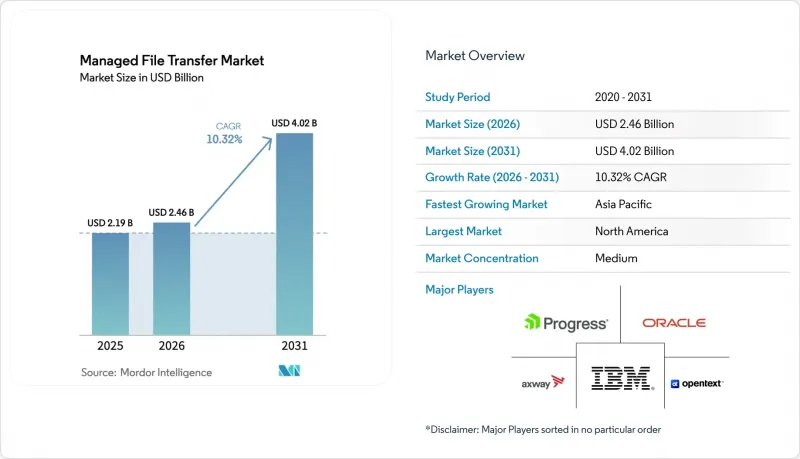
根據 Mordor Intelligence 預測,檔案傳輸管理市場規模將從 2025 年的 21.9 億美元成長到 2026 年的 24.6 億美元,到 2031 年將達到 40.2 億美元,2026 年至 2031 年的複合年成長率為 10.32%。
本報告按組織規模(大型企業、中小企業)、部署類型(雲端、本地部署)、傳輸類型(系統中心檔案傳輸等)、解決方案(即時監控、應用傳輸自動化等)、最終用戶產業(醫療保健、零售等)和地區進行細分。市場預測以美元計價。
全球託管檔案傳輸市場趨勢與洞察
向零信任架構的過渡正在加速。
美國網路安全與基礎設施安全局 (CISA) 發布的 2024 年「利用現有資源 (LOTL)」技術建議強調了攻擊者如何利用可信任檔案傳輸工具繞過邊界防禦。因此,各組織機構要求平台能夠消除隱式信任區域,並對所有文件實施持續身份檢驗、設備健康檢查和內容檢查。託管檔案傳輸 ( MFT) 市場的供應商正在整合策略引擎,這些引擎可與身分識別提供者和資料防洩漏 (DLP) 工具協同工作,從而實現自適應存取控制,且不會產生中介延遲。網路保險公司現在要求提供零信任證明,這進一步加快了平台更新周期。已實施零信任 MFT 的公司已能夠將平均檢測時間從幾天縮短到幾分鐘,最大限度地減少資料外洩的影響,並降低保險費。
大幅提高違規。
Uber 和 TikTok 因違反 GDPR 而被處以創紀錄的罰款,這表明跨境資料傳輸管治不力可能導致最高級別的處罰。美國聯邦貿易委員會 (FTC) 修訂的《健康資料揭露通知規則》擴大了 HIPAA 未涵蓋機構的揭露義務,並強制要求醫療保健應用程式維護和加密審計追蹤。各公司正積極回應,採用預裝 GDPR、HIPAA、SOC 2 和 ISO 27001 模板的平台,從而縮短認證時間。即時日誌記錄和自動化事件回應降低了資料外洩通知的成本,並保護了品牌價值。這正在推動受監管行業的需求,並重振檔案傳輸管理市場。
安全自動化工作流程的技能差距
ISC2 2024 年的一項調查顯示,網路安全專業人員缺口高達 480 萬,並指出 92% 的公司缺乏自動化技能。複雜的腳本編寫、API編配和策略調整正在減緩 MFT 的普及。中小企業通常採用預設設置,從而削弱了自身控制力,或支付高額諮詢費用,延長了投資回報期。儘管供應商正在簡化介面並提供託管服務計劃,但經常性費用會降低成本效益,從而減緩檔案傳輸管理市場的短期成長。
細分市場分析
預計中小企業 (SME) 將以 10.07% 的複合年成長率成長,超過託管檔案傳輸市場的整體成長率。德勤研究顯示,68% 的中小企業面臨預算限制,但預計到 2025 年,網路安全支出將增加 15%。基於訂閱的 MFTPaaS 無需伺服器和高達六位數的授權費用,即使是小規模IT 團隊也能在幾天內完成部署。將於 2025 年 10 月推出的 Automate MFT 正是針對這個細分市場,承諾降低 50% 的整體擁有成本 (TCO)。大型企業由於其成熟的本地部署環境,仍保持著 70.24% 的市場佔有率,但隨著它們採用混合策略,正在加速轉型為 SaaS 連接器。隨著中型企業採用率的提高,託管檔案傳輸市場正在擴展到先前無力承擔企業級安全解決方案的新客戶群。
財富 500 強企業正在利用 MFTPaaS 實現無縫的雲端到雲端遷移,同時保留用於大型主機連接的本地閘道器。這種策略組合確保了策略執行的一致性和全球部署,並符合資料居住法規。這種適應性支撐了託管檔案傳輸市場的穩健性,即使在經濟波動的情況下也是如此。
2025年,本地部署佔總營收的64.69%,而雲端部署預計到2031年將維持10.13%的複合年成長率。彈性擴展使公司能夠應對假期季節零售需求的激增和醫療保健行業註冊人數的高峰,從而降低30-40%的容量開銷。 OMB備忘錄M-24-15強制要求獲得FedRAMP認證,顯示機構層級正在接受安全的雲端服務。
Kiteworks 於 2024 年獲得 FedRAMP High 認證,這表明 MFTPaaS 可以滿足嚴格的管理要求。在資料本地化法律嚴格的地區,例如中國和俄羅斯,本地部署中心仍然是首選。然而,結合區域閘道器和雲端協作的混合架構可以緩解合規性方面的挑戰。這種遷移生態系統將擴大檔案傳輸管理市場,同時將收入來源重新分配給定期訂閱。
區域分析
到2025年,北美將佔全球收入的37.82%。這主要得益於嚴格的監管措施、網路保險的普及以及人們對網路安全威脅日益增強的認知。為了應對美國網路安全和基礎設施安全局(CISA)對「本地入侵(LOCL)」攻擊的重視,聯邦機構已採取重要措施,對其FTP環境進行現代化改造,並加強安全性和合規性。加拿大銀行業監管機構也採取了類似的措施,實施了完善的網路安全框架;墨西哥近岸外包產業的製造商也正在採取先進措施保護其業務運作。總而言之,這些進展正在推動該地區應對網路安全挑戰的勢頭。
亞太地區預計將以11.46%的複合年成長率實現最高成長。受「數位印度」和日本改革議程的推動,雲端運算投資需要安全的混合傳輸。然而,中國的《個人資料保護法》和俄羅斯的在地化法都要求資料儲存在國內,這促使供應商轉向國內資料中心。在歐洲,企業在擴張的同時面臨巨大的合規壓力。對Uber和TikTok的罰款表明了執法部門毫不妥協的立場,這也推動了對可審計平台的需求。歐盟-美國的資料隱私框架提供了一定的緩解,但仍面臨法律審查。
沙烏地阿拉伯2024年《個人資料保護法》與GDPR高度一致,而巴西則加強了對LGPD的執行力度並提高了處罰。隨著中東、非洲和南美洲新興市場的崛起,這些地區的基礎設施差異日益凸顯,對雲端解決方案的依賴也越來越強。這一趨勢為在這些地區擁有存取點(PoP)的供應商打開了大門,使其能夠進入先前尚未開發的託管檔案傳輸市場領域。
其他好處:
- Excel格式的市場預測(ME)表
- 3個月的分析師支持
目錄
第1章:引言
- 研究假設和市場定義
- 調查範圍
第2章:調查方法
第3章執行摘要
第4章 市場狀況
- 市場概覽
- 市場促進因素
- 向零信任架構的轉變正在加速。
- 加大違規的罰款力度
- 對多重雲端和混合整合的需求正在激增。
- 基於人工智慧的檔案傳輸威脅偵測
- 即時供應鏈資料同步需求
- 中型企業對 MFTPaaS 的採用率不斷提高
- 市場限制因素
- 安全自動化工作流程的技能差距
- 舊有系統鎖定和整合複雜性
- 跨境資料在地化面臨的障礙日益增多
- 宏觀經濟波動下中小企業的預算約束
- 宏觀經濟因素對市場的影響
- 產業價值鏈分析
- 監理情勢
- 技術展望
- 投資分析
- 波特五力分析
第5章 市場規模與成長預測
- 按組織規模
- 大公司
- 小型企業
- 部署模式
- 基於雲端的
- 現場
- 透過傳輸法
- 以系統為中心的檔案傳輸
- 以使用者為中心的檔案傳輸
- 極限檔案傳輸
- 透過解決方案
- 即時監控與控制
- 快速入職並與合作夥伴協作
- 應用程式傳輸自動化
- 其他解決方案
- 按最終用戶行業分類
- BFSI
- 資訊科技/通訊
- 衛生保健
- 零售
- 媒體與娛樂
- 政府/公共部門
- 按地區
- 北美洲
- 美國
- 加拿大
- 墨西哥
- 歐洲
- 德國
- 英國
- 法國
- 俄羅斯
- 其他歐洲國家
- 亞太地區
- 中國
- 日本
- 印度
- 韓國
- 澳洲
- 其他亞太國家
- 中東和非洲
- 中東
- 沙烏地阿拉伯
- 阿拉伯聯合大公國
- 其他中東國家
- 非洲
- 南非
- 埃及
- 其他非洲國家
- 中東
- 南美洲
- 巴西
- 阿根廷
- 其他南美國家
- 北美洲
第6章 競爭情勢
- 市場集中度
- 策略趨勢
- 市佔率分析
- 公司簡介
- IBM Corporation
- Axway Software SA
- OpenText Corporation
- Progress Software Corporation
- Fortra, LLC
- Oracle Corporation
- TIBCO Software Inc.
- Cleo Communications Inc.
- QlikTech(Attunity)
- Coviant Software
- Seeburger AG
- Signiant Inc.
- JSCAPE LLC
- Primeur Group
- Software AG
- Micro Focus International plc
- Broadcom Inc.(CA XCOM)
- Kiteworks(Accellion)
- South River Technologies
- Safe-T Group
第7章 市場機會與未來展望
According to Mordor Intelligence, the managed file transfer market size is expected to grow from USD 2.19 billion in 2025 to USD 2.46 billion in 2026 and is forecast to reach USD 4.02 billion by 2031 at 10.32% CAGR over 2026-2031.
This report is Segmented by Organization Size (Large Enterprises, and Small and Medium Enterprises), Deployment Mode (Cloud-Based, and On-Premise), Transfer Type (System-Centric File Transfer, and More), Solution (Real-Time Monitoring and Control, Automate Application Transfers, and More), End-User Industry (Healthcare, Retail, and More), and Geography. Market Forecasts are Provided in Value (USD).
Global Managed File Transfer Market Trends and Insights
Accelerated Shift to Zero-Trust Architectures
CISA's 2024 advisory on living-off-the-land techniques highlighted how attackers exploit trusted file-transfer utilities to circumvent perimeter defenses. As a result, organizations are dismantling implicit-trust zones and demanding platforms that enforce continuous identity validation, device-posture checks, and content inspection for every file. Managed file transfer market vendors embed policy engines tied to identity providers and DLP tools, delivering adaptive access controls without the latency of middleware. Cyber-insurance carriers now require zero-trust attestations, further accelerating platform refresh cycles. Enterprises that adopted zero-trust MFT reduced mean-time-to-detect from days to minutes, limiting breach impact and lowering premiums.
Escalating Financial Penalties for Non-Compliance
The record GDPR fines imposed on Uber and TikTok demonstrate that weak governance around cross-border transfers can trigger top-tier penalties. The FTC's updated Health Breach Notification Rule extended disclosure mandates to non-HIPAA entities, making audit trails and encryption-at-rest mandatory for health apps. Enterprises respond by adopting platforms pre-loaded with GDPR, HIPAA, SOC 2, and ISO 27001 templates, cutting certification timelines. Real-time logs and automated incident response reduce breach-notification costs and protect brand equity, which lifts demand across regulated industries and bolsters the managed file transfer market.
Skills Gap in Secure Automation Workflows
The 2024 ISC2 study highlighted a 4.8 million-person cybersecurity shortfall, with 92% of firms lacking automation skills. Complex scripting, API orchestration, and policy tuning slow MFT rollouts. SMEs often accept default settings, weakening controls, or pay for costly consultants that prolong payback periods. Vendors simplify interfaces and launch managed-services tiers, but recurring fees erode the cost benefits, tempering the near-term growth of the managed file transfer market.
Other drivers and restraints analyzed in the detailed report include:
- Multi-Cloud and Hybrid Integration Demand Surge
- AI-Powered Threat Detection in File Transfers
- Legacy System Lock-In and Integration Complexity
For complete list of drivers and restraints, kindly check the Table Of Contents.
Segment Analysis
Small and medium enterprises are forecast to grow at a 10.07% CAGR, outstripping the overall managed file transfer market. Deloitte found 68% of SMEs face budget pressure, yet cybersecurity spend climbed 15% in 2025. Subscription MFTPaaS eliminates servers and six-figure licenses, letting lean IT teams deploy within days. The October 2025 launch of Automate MFT targets this cohort with a promised 50% TCO cut. Large enterprises retain a 70.24% share due to entrenched on-premises estates, but hybrid strategies signal a gradual pivot toward SaaS connectors. As mid-market adoption increases, the managed file transfer market expands into greenfield accounts that were previously priced out of enterprise-grade security.
Fortune 500 companies are harnessing MFTPaaS for seamless cloud-to-cloud transitions, all the while upholding on-premises gateways for their mainframe connections. This strategic combination ensures uniform policy application and a worldwide presence, all while adhering to data-residency regulations. This adaptability underscores the managed file transfer market's robustness, even amidst economic fluctuations.
On-premises installations accounted for 64.69% of 2025 revenue, while cloud deployments are expected to register a 10.13% CAGR through 2031. Elastic scaling addresses holiday retail surges and healthcare open enrollment peaks, trimming 30-40% of capacity overhead. OMB Memorandum M-24-15 now mandates FedRAMP authorization, signaling institutional acceptance of secure cloud services.
Kiteworks' FedRAMP High certification in 2024 proved that MFTPaaS can satisfy stringent controls. Regions with strict localization laws, notably China and Russia, still favor on-premises hubs; yet, hybrid architectures with regional gateways and cloud orchestration mitigate compliance friction. This transition ecosystem widens the managed file transfer market size while rebalancing revenue streams toward recurring subscriptions.
Complete Report Scope:
- By Organization Size
- Large Enterprises
- Small and Medium Enterprises
- By Deployment Mode
- Cloud-Based
- On-Premise
- By Transfer Type
- System-Centric File Transfer
- People-Centric File Transfer
- Extreme File Transfer
- By Solution
- Real-Time Monitoring and Control
- Fast Partner Onboarding and Collaboration
- Automate Application Transfers
- Other Solutions
- By End-User Industry
- BFSI
- IT and Telecommunications
- Healthcare
- Retail
- Media and Entertainment
- Government and Public Sector
- By Geography
- North America
- United States
- Canada
- Mexico
- Europe
- Germany
- United Kingdom
- France
- Russia
- Rest of Europe
- Asia-Pacific
- China
- Japan
- India
- South Korea
- Australia
- Rest of Asia-Pacific
- Middle East and Africa
- Middle East
- Saudi Arabia
- United Arab Emirates
- Rest of Middle East
- Africa
- South Africa
- Egypt
- Rest of Africa
- Middle East
- South America
- Brazil
- Argentina
- Rest of South America
- North America
Geography Analysis
In 2025, North America captured 37.82% of the revenue, driven by strict regulatory measures, increasing adoption of cyber-insurance, and heightened awareness of cybersecurity threats. Responding to CISA's emphasis on "living-off-the-land" attacks, federal agencies took significant steps to modernize their FTP estates, ensuring enhanced security and compliance. This trend is mirrored by Canada's banking regulator, which has implemented robust cybersecurity frameworks, and manufacturers in Mexico's nearshoring sector, who are adopting advanced measures to safeguard their operations. These developments collectively reinforce the region's momentum in addressing cybersecurity challenges.
Asia-Pacific is forecast to post the fastest 11.46% CAGR. Cloud investments driven by Digital India and Japan's reform agenda demand secure hybrid transfers. However, China's PIPL and Russia's localization laws enforce domestic storage, nudging vendors toward in-country data centers. Europe balances expansion with high compliance pressure. Uber and TikTok fines illustrate uncompromising enforcement that fuels demand for audit-ready platforms. The EU-U.S. Data Privacy Framework offers partial relief yet faces legal scrutiny.
Saudi Arabia's 2024 Personal Data Protection Law aligns closely with the GDPR, and Brazil intensifies its LGPD enforcement with heightened fines. As the Middle East, Africa, and South America emerge as new frontiers, infrastructure gaps in these regions are increasingly leaning towards cloud solutions. This trend is paving the way for vendors with regional Points of Presence (PoPs) to tap into the previously uncharted segments of the managed file transfer market.
- IBM Corporation
- Axway Software SA
- OpenText Corporation
- Progress Software Corporation
- Fortra, LLC
- Oracle Corporation
- TIBCO Software Inc.
- Cleo Communications Inc.
- QlikTech (Attunity)
- Coviant Software
- Seeburger AG
- Signiant Inc.
- JSCAPE LLC
- Primeur Group
- Software AG
- Micro Focus International plc
- Broadcom Inc. (CA XCOM)
- Kiteworks (Accellion)
- South River Technologies
- Safe-T Group
Additional Benefits:
- The market estimate (ME) sheet in Excel format
- 3 months of analyst support
TABLE OF CONTENTS
1 INTRODUCTION
- 1.1 Study Assumptions and Market Definition
- 1.2 Scope of the Study
2 RESEARCH METHODOLOGY
3 EXECUTIVE SUMMARY
4 MARKET LANDSCAPE
- 4.1 Market Overview
- 4.2 Market Drivers
- 4.2.1 Accelerated Shift to Zero-Trust Architectures
- 4.2.2 Escalating Financial Penalties for Non-Compliance
- 4.2.3 Multi-Cloud and Hybrid Integration Demand Surge
- 4.2.4 AI-Powered Threat Detection in File Transfers
- 4.2.5 Real-Time Supply-Chain Data Synchronization Needs
- 4.2.6 Growing Adoption of MFTPaaS by Mid-Market Firms
- 4.3 Market Restraints
- 4.3.1 Skills Gap in Secure Automation Workflows
- 4.3.2 Legacy System Lock-In and Integration Complexity
- 4.3.3 Rising Cross-Border Data-Localization Barriers
- 4.3.4 Budget Constraints for SMEs Amid Macroeconomic Volatility
- 4.4 Impact of Macroeconomic Factors on the Market
- 4.5 Industry Value Chain Analysis
- 4.6 Regulatory Landscape
- 4.7 Technological Outlook
- 4.8 Investment Analysis
- 4.9 Porter's Five Forces Analysis
- 4.9.1 Threat of New Entrants
- 4.9.2 Bargaining Power of Buyers
- 4.9.3 Bargaining Power of Suppliers
- 4.9.4 Threat of Substitutes
- 4.9.5 Intensity of Competitive Rivalry
5 MARKET SIZE AND GROWTH FORECASTS (VALUE)
- 5.1 By Organization Size
- 5.1.1 Large Enterprises
- 5.1.2 Small and Medium Enterprises
- 5.2 By Deployment Mode
- 5.2.1 Cloud-Based
- 5.2.2 On-Premise
- 5.3 By Transfer Type
- 5.3.1 System-Centric File Transfer
- 5.3.2 People-Centric File Transfer
- 5.3.3 Extreme File Transfer
- 5.4 By Solution
- 5.4.1 Real-Time Monitoring and Control
- 5.4.2 Fast Partner Onboarding and Collaboration
- 5.4.3 Automate Application Transfers
- 5.4.4 Other Solutions
- 5.5 By End-User Industry
- 5.5.1 BFSI
- 5.5.2 IT and Telecommunications
- 5.5.3 Healthcare
- 5.5.4 Retail
- 5.5.5 Media and Entertainment
- 5.5.6 Government and Public Sector
- 5.6 By Geography
- 5.6.1 North America
- 5.6.1.1 United States
- 5.6.1.2 Canada
- 5.6.1.3 Mexico
- 5.6.2 Europe
- 5.6.2.1 Germany
- 5.6.2.2 United Kingdom
- 5.6.2.3 France
- 5.6.2.4 Russia
- 5.6.2.5 Rest of Europe
- 5.6.3 Asia-Pacific
- 5.6.3.1 China
- 5.6.3.2 Japan
- 5.6.3.3 India
- 5.6.3.4 South Korea
- 5.6.3.5 Australia
- 5.6.3.6 Rest of Asia-Pacific
- 5.6.4 Middle East and Africa
- 5.6.4.1 Middle East
- 5.6.4.1.1 Saudi Arabia
- 5.6.4.1.2 United Arab Emirates
- 5.6.4.1.3 Rest of Middle East
- 5.6.4.2 Africa
- 5.6.4.2.1 South Africa
- 5.6.4.2.2 Egypt
- 5.6.4.2.3 Rest of Africa
- 5.6.4.1 Middle East
- 5.6.5 South America
- 5.6.5.1 Brazil
- 5.6.5.2 Argentina
- 5.6.5.3 Rest of South America
- 5.6.1 North America
6 COMPETITIVE LANDSCAPE
- 6.1 Market Concentration
- 6.2 Strategic Moves
- 6.3 Market Share Analysis
- 6.4 Company Profiles (includes Global Level Overview, Market Level Overview, Core Segments, Financials as Available, Strategic Information, Market Rank/Share for Key Companies, Products and Services, and Recent Developments)
- 6.4.1 IBM Corporation
- 6.4.2 Axway Software SA
- 6.4.3 OpenText Corporation
- 6.4.4 Progress Software Corporation
- 6.4.5 Fortra, LLC
- 6.4.6 Oracle Corporation
- 6.4.7 TIBCO Software Inc.
- 6.4.8 Cleo Communications Inc.
- 6.4.9 QlikTech (Attunity)
- 6.4.10 Coviant Software
- 6.4.11 Seeburger AG
- 6.4.12 Signiant Inc.
- 6.4.13 JSCAPE LLC
- 6.4.14 Primeur Group
- 6.4.15 Software AG
- 6.4.16 Micro Focus International plc
- 6.4.17 Broadcom Inc. (CA XCOM)
- 6.4.18 Kiteworks (Accellion)
- 6.4.19 South River Technologies
- 6.4.20 Safe-T Group
7 MARKET OPPORTUNITIES AND FUTURE OUTLOOK
- 7.1 White-Space and Unmet-Need Assessment

 檔案傳輸管理市場規模、佔有率和趨勢分析:按組件、部署、傳輸類型、企業規模、最終用途、地區和細分市場預測(2026-2033 年)
 全球安全檔案傳輸市場:機會與策略展望(至2035年)
 全球安全檔案傳輸(SFT) 市場(至 2031 年):按解決方案(檔案傳輸管理(MFT)、資料二極體傳輸系統、安全文件閘道)、服務(MFTaaS)和傳輸類型(系統到系統、用戶到系統、個人到個人)分類2026年全球B2B中間件(B2B整合)市場報告2026年全球檔案傳輸管理市場報告2026年全球雲端MFT(檔案傳輸管理)服務市場報告
 安全檔案傳輸市場報告:按類型、部署模式、企業、最終用戶和地區分類(2026-2034 年)
 檔案傳輸管理(MFT) 市場分析及至 2035 年預測:按類型、產品類型、服務、技術、組件、應用、部署類型、最終用戶和功能分類
 全球檔案傳輸管理市場:按組織規模、部署方式、解決方案類型、最終用戶行業、用例和地區分類——市場規模、行業趨勢、機會分析和未來預測(2026-2035 年)
 檔案傳輸管理市場規模、佔有率和成長分析(按組件、部署模型、組織規模、應用程式和地區分類)-2026-2033年產業預測