


 |
市場調查報告書
商品編碼
2123128
防火牆即服務:市場佔有率分析、產業趨勢與統計及成長預測(2026-2031 年)Firewall-as-a-Service - Market Share Analysis, Industry Trends & Statistics, Growth Forecasts (2026 - 2031) |
||||||

※ 本網頁內容可能與最新版本有所差異。詳細情況請與我們聯繫。
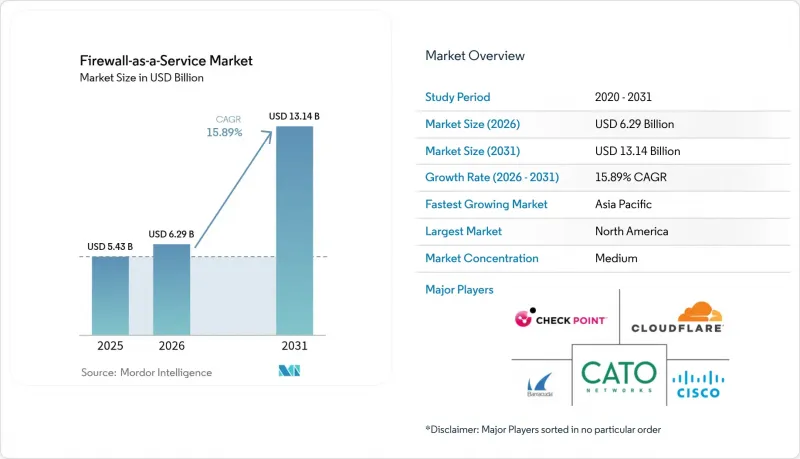
據 Mordor Intelligence 稱,防火牆即服務 (FWaaS) 市場在 2025 年的價值為 54.3 億美元,預計到 2031 年將達到 131.4 億美元,而 2026 年為 62.9 億美元,預測期(2026-2031 年)的複合年成長率為 15.89%。
本報告按服務模式(SaaS、IaaS、PaaS)、部署模式(公共雲端、私有雲端、混合雲端)、最終用戶公司規模(大型企業、中小企業)、行業(銀行、金融服務和保險 (BFSI)、IT 和電信、其他)、安全類型(下一代防火牆、虛擬防火牆、其他)以及地區進行細分。市場預測以美元 (USD) 為單位。
全球防火牆即服務 (FWaaS) 市場趨勢與洞察
多重雲端和SaaS的普及推動了爆炸性成長。
目前,78% 的企業運行混合雲端或多重雲端環境,這種複雜性給硬體防火牆帶來了壓力,因為它們無法在 AWS、Azure 和 Google Cloud 工作負載之間應用統一的策略。隨著雲端託管應用程式繞過傳統邊界,企業被迫採用彈性 API 驅動的控制措施,以確保無論工作負載位於何處都能保持穩定運作。因此,防火牆即服務 (FaaS) 市場正受益於企業對能夠跟上 DevOps 速度的單螢幕策略編配的需求。 SaaS 的普及進一步增加了需求的複雜性,引入了數千個獨立的資料流,每個資料流都需要一致的管治。隨著 Microsoft Azure 成為 2025 年使用最廣泛的超大規模平台,與供應商身分和遙測堆疊的原生整合能力將帶來競爭優勢。
基於雲端的資料外洩成本和頻率不斷增加。
Gigamon 2024 年的研究顯示,前一年發生的攻擊中有三分之一未被偵測到。這比前一年增加了 20%,凸顯了傳統檢測方法的不足。由於雲端環境中的橫向移動會使補救成本翻倍,因此資料外洩的成本如今已超過本地安全事件。攻擊者正在利用人工智慧繞過基於特徵碼的控制措施,迫使企業投資於即時威脅情報和整合到雲端防火牆中的自動化回應功能。日益成長的監管風險進一步加劇了這種緊迫性。隨著 GDPR 罰款和即將實施的 NIS2 指令的生效,雲端控制措施不足會帶來財務和聲譽風險,使得防火牆即服務 (FWaaS) 的部署成為董事會層面的強制性要求,而不僅僅是可選項。
將FWaaS和傳統設備整合所帶來的複雜性
企業通常在園區、分店和託管機房等不同環境中運行異質防火牆,而在此基礎上部署雲端防火牆會為策略同步帶來挑戰。流量路由、高可用性容錯移轉和統一日誌管理都需要重新設計架構,這可能會延長專案週期。針對本地設備最佳化的 VLAN 配置經常與 FWaaS 部署模型衝突,迫使網路團隊重新評估其網路分段。儘管長期收益依然可觀,但這些障礙會增加切換到 FWaaS 的成本,並阻礙短期成長潛力。
細分市場分析
預計到2025年,以SaaS模式交付的防火牆將佔總收入的46.75%,並迅速受到尋求無需額外基礎設施投入即可完成承包的企業的青睞。這一細分市場構成了防火牆即服務(FaaS)市場的經濟基礎,提供預先已調整的策略、彈性擴展以及自動更新的整合威脅情報來源,且客戶介入極少。對於面臨縮短部署週期並同時維持審計合規性壓力的受監管產業的IT團隊而言,這種模式尤其具有吸引力。供應商正透過雲端存取安全仲介(CASB)和安全Web閘道器(SWG)等加值功能捆綁到整合的SaaS訂閱中來滿足這項需求。
平台即服務 (PaaS) 雖然規模仍然較小,但隨著面向 DevOps 的組織對以程式碼為中心的安全工作流程的需求不斷成長,其複合年成長率 (CAGR) 也達到了 17.08%。 API 優先的 PaaS傳輸。這些模式代表了「控制」和「便利」之間的連續統一體,影響防火牆即服務 (Firewall-as-Service) 市場的購買決策。
至2025年,公共雲端仍將維持其主導地位,佔據防火牆即服務(Firewall-as-a-Service)市場57.95%的佔有率。超大規模架構、整合身分和存取管理(IAM)以及預先對等連線的存在簡化了部署。然而,隨著企業追求毫秒延遲和合規性,混合部署正以16.84%的複合年成長率快速成長,其目標是透過與本地環境共存來實現這一目標。這一趨勢表明,企業在雲端選擇上的決策正從非此即彼的二元選擇轉變為取決於工作負載的部署方式。
成功的服務提供者現在正在對策略編配進行抽象化處理,以確保無論流量是流經雲端、邊緣還是園區站點,都適用同一套規則。私有雲端繼續用於建構自主資料儲存庫和超低延遲工業控制系統,這進一步增加了對可攜式許可和聯合管理主機的需求。
區域分析
預計到2025年,北美將佔全球收入的35.72%。這反映了雲端運算應用的成熟、強大的供應商生態系統以及聯邦網路安全指令對持續監控的強制要求。企業受益於豐富的本地超大規模資料中心,這些資料中心降低了與韌體即服務 (FWaaS) 存取點的延遲,而強勁的風險投資則推動了產品創新。此外,美國和歐盟資料隱私框架下的跨境資料流動也減輕了跨國公司的合規負擔。
亞太地區是成長最快的地區,預計到2031年將維持17.74%的複合年成長率。政府主導的數位化舉措、5G骨幹網路的擴展以及勒索軟體攻擊風險的上升,正在推動印度、澳洲、日本和東南亞國協的支出成長。 AWS、Azure和阿里雲在亞太地區的超大規模擴張顯著提高了存取點(PoP)密度,使服務供應商能夠在人口密集的城市滿足資料在地化和延遲要求。區域運營商之間將防火牆即服務(FWaaS)與託管式SD-WAN捆綁銷售的競爭,進一步推動了FWaaS的普及。
在歐洲,隨著GDPR和即將推出的NIS2指令日益重視檢驗的網路安全措施,網路安全領域正穩步推進。包括Gaia-X和主權雲端區域在內的本地雲端策略正在影響服務供應商的部署計劃,供應商紛紛在法蘭克福、巴黎和馬德里開設新的資料中心。儘管英國脫歐帶來了暫時的採購不確定性,但英國企業仍在繼續投資防火牆即服務(FWaaS),以實現《2025年國家網路戰略》的目標。
南美洲、中東和非洲正成為新興的需求叢集。巴西、墨西哥、南非和海灣合作理事會(GCC)國家的雲端採用率正在快速成長,但由於本地接入點(PoP)數量有限以及價格敏感性,短期成長正在放緩。因此,全球供應商正與區域網路服務供應商(ISP)合作,提供滿足主權要求且無需巨額資本支出(CapEx)的邊緣託管偵測服務。隨著這些經濟體向供應鏈數位化轉型,這種在地化措施對於確保長期獲利能力至關重要。
其他好處:
- Excel格式的市場預測(ME)表
- 3個月的分析師支持
目錄
第1章:引言
- 研究假設和市場定義
- 調查範圍
第2章:調查方法
第3章執行摘要
第4章 市場狀況
- 市場概覽
- 市場促進因素
- 多重雲端和SaaS解決方案的採用正在爆炸性成長。
- 透過雲端發生資料外洩的成本和頻率不斷增加。
- 需要分散式安全性的混合/遠端員工
- 2025 年以後硬體防火牆供應鏈面臨的限制因素
- 人工智慧驅動的政策自動化降低了中小企業的整體擁有成本 (TCO)。
- 將採購獎勵整合到雲端市場中
- 市場限制因素
- 將FWaaS和傳統設備整合所帶來的複雜性
- 受監管領域中對延遲和數據主權的擔憂
- 公共雲端的出站通訊費用不斷上漲,正在削弱營運支出模式的優勢。
- 首席資訊安全長們對供應商平台整合越來越感到厭倦。
- 產業價值鏈分析
- 監理情勢
- 技術展望
- 波特五力分析
- 宏觀經濟因素對市場的影響
第5章 市場規模與成長預測
- 按服務模式
- SaaS
- IaaS
- PaaS
- 按部署模式
- 公共雲端
- 私有雲端
- 混合雲端
- 按最終用戶公司規模分類
- 大公司
- 中小企業
- 按行業分類
- BFSI
- 資訊科技/通訊
- 衛生保健
- 零售與電子商務
- 工業與國防
- 能源公用事業
- 製造業
- 其他工業部門
- 按安全類型
- 新一代防火牆(NGFW)
- 網路應用程式防火牆(WAF)
- 分散式/微隔離防火牆
- 虛擬防火牆(vFW)
- 按地區
- 北美洲
- 美國
- 加拿大
- 墨西哥
- 南美洲
- 巴西
- 阿根廷
- 智利
- 其他南美國家
- 歐洲
- 德國
- 英國
- 法國
- 義大利
- 西班牙
- 其他歐洲國家
- 亞太地區
- 中國
- 印度
- 日本
- 韓國
- 馬來西亞
- 新加坡
- 澳洲
- 其他亞太國家
- 中東和非洲
- 中東
- 阿拉伯聯合大公國
- 沙烏地阿拉伯
- 土耳其
- 其他中東國家
- 非洲
- 南非
- 奈及利亞
- 其他非洲國家
- 中東
- 北美洲
第6章 競爭情勢
- 市場集中度
- 策略趨勢
- 市佔率分析
- 公司簡介
- Barracuda Networks Inc.
- Cato Networks Ltd.
- Check Point Software Technologies Ltd.
- Cisco Systems Inc.
- Cloudflare Inc.
- Forcepoint LLC
- Fortinet Inc.
- Hillstone Networks Co. Ltd.
- IntraSystems Inc.
- Juniper Networks Inc.
- Microsoft Corporation
- Netskope Inc.
- Open Systems AG
- Palo Alto Networks Inc.
- Perimeter 81 Ltd.
- SonicWall Inc.
- Sophos Ltd.
- Sprout Technologies Ltd.
- Tufin Software Technologies Ltd.
- Versa Networks Inc.
- VMware Inc.
- Vocus Communications Ltd.
- WatchGuard Technologies Inc.
- Zscaler Inc.
第7章 市場機會與未來展望
According to Mordor Intelligence, the firewall-as-a-Service market size was valued at USD 5.43 billion in 2025 and estimated to grow from USD 6.29 billion in 2026 to reach USD 13.14 billion by 2031, at a CAGR of 15.89% during the forecast period (2026-2031).
This report is Segmented by Service Model (SaaS, Iaas, and PaaS), Deployment Model (Public Cloud, Private Cloud, and Hybrid Cloud), End-User Enterprise Size (Large Enterprises and Small and Medium-Sized Enterprises), Industry Vertical (BFSI, IT and Telecom, and More), Security Type (Next-Generation Firewall, Virtual Firewall, and More), and Geography. The Market Forecasts are Provided in Terms of Value (USD).
Global Firewall-as-a-Service Market Trends and Insights
Explosive Growth of Multi-Cloud and SaaS Adoption
Seventy-eight percent of enterprises now run hybrid or multi-cloud estates, a complexity that strains hardware firewalls, unable to enforce uniform policies across AWS, Azure, and Google Cloud workloads. Cloud-hosted applications bypass legacy perimeters, compelling organizations to adopt elastic, API-driven controls that follow workloads wherever they reside. The Firewall-as-a-Service market, therefore, benefits from enterprises seeking single-pane policy orchestration that aligns with DevOps velocity. SaaS proliferation compounds requirements by introducing thousands of discrete data flows, each demanding consistent governance. As Microsoft Azure becomes the most widely consumed hyperscale platform in 2025, the vendor's ability to integrate natively with its identity and telemetry stack confers a competitive advantage.
Escalating Cost and Frequency of Cloud-Borne Data Breaches
Gigamon's 2024 survey found one-third of attacks went undetected in the prior year, a 20% uptick that underscores gaps in legacy detection. Breach costs have overtaken on-prem incidents because lateral movement inside cloud fabrics multiplies remediation expense. Attackers are weaponizing AI to bypass signature-based controls, prompting enterprises to invest in real-time threat intelligence and automated response embedded in cloud firewalls. Regulatory exposure heightens urgency: GDPR fines and the incoming NIS2 directive make inadequate cloud controls a financial and reputational risk, turning FWaaS adoption into a board-level mandate rather than an optional enhancement.
Complexity Integrating FWaaS with Legacy Appliances
Enterprises often run heterogeneous firewall estates across campuses, branches, and co-location sites, creating policy-sync challenges when layering in cloud firewalls. Traffic steering, high-availability failover, and unified logging demand architectural redesign that can inflate project timelines. VLAN schemes optimized for on-prem equipment frequently conflict with FWaaS deployment models, obliging network teams to rethink segmentation. These hurdles raise switching costs and dampen short-term growth potential in the Firewall-as-a-Service market even as long-term benefits remain compelling.
Other drivers and restraints analyzed in the detailed report include:
- Hybrid/Remote Workforces Demanding Distributed Security
- AI-Driven Policy Automation Lowering SME TCO
- Latency and Data-Sovereignty Concerns in Regulated Sectors
For complete list of drivers and restraints, kindly check the Table Of Contents.
Segment Analysis
SaaS-delivered firewalls captured 46.75% of 2025 revenue, demonstrating immediate appeal among enterprises seeking turnkey deployment without infrastructure overhead. This segment forms the economic backbone of the Firewall-as-a-Service market, offering pre-tuned policies, elastic scaling, and integrated threat-intel feeds that auto-update with minimal customer intervention. The model resonates with IT teams under pressure to shorten provisioning cycles while maintaining audit readiness, especially in heavily regulated verticals. Vendors capitalize by bundling value-added features such as cloud access security broker (CASB) and secure web gateway (SWG) into a unified SaaS subscription.
Platform-as-a-Service, though smaller, is growing at a 17.08% CAGR as DevOps-oriented organizations demand code-centric security workflows. API-first PaaS firewalls integrate with CI/CD pipelines, enabling "security as code" and automating posture checks pre-deployment. Infrastructure-as-a-Service retains a niche for customers requiring granular control over kernel modules or custom forwarding paths. Together, these models illustrate a continuum of control versus convenience that shapes purchasing decisions across the Firewall-as-a-Service market.
Public cloud remained dominant in 2025 with a 57.95% share of the Firewall-as-a-Service market size; hyperscale fabric presence, integrated IAM, and pre-peered connectivity simplify onboarding. However, hybrid deployments are expanding at a 16.84% CAGR as organizations chase millisecond-level latency and regulatory compliance through on-prem coexistence. This trajectory signals a move away from binary cloud decisions toward workload-specific placement.
Successful providers now abstract policy orchestration so that a single ruleset follows traffic whether it traverses cloud, edge, or campus sites. Private cloud persists for sovereign data repositories and ultra-low-latency industrial controls, reinforcing the need for portable licensing and federated management consoles.
Complete Report Scope:
- By Service Model
- SaaS
- IaaS
- PaaS
- By Deployment Model
- Public Cloud
- Private Cloud
- Hybrid Cloud
- By End-user Enterprise Size
- Large Enterprises
- Small and Medium-sized Enterprises (SMEs)
- By Industry Vertical
- BFSI
- IT and Telecom
- Healthcare
- Retail and E-commerce
- Industrial and Defense
- Energy and Utilities
- Manufacturing
- Other Industry Verticals
- By Security Type
- Next-Generation Firewall (NGFW)
- Web Application Firewall (WAF)
- Distributed / Micro-segmentation Firewall
- Virtual Firewall (vFW)
- By Geography
- North America
- United States
- Canada
- Mexico
- South America
- Brazil
- Argentina
- Chile
- Rest of South America
- Europe
- Germany
- United Kingdom
- France
- Italy
- Spain
- Rest of Europe
- Asia-Pacific
- China
- India
- Japan
- South Korea
- Malaysia
- Singapore
- Australia
- Rest of Asia-Pacific
- Middle East and Africa
- Middle East
- United Arab Emirates
- Saudi Arabia
- Turkey
- Rest of Middle East
- Africa
- South Africa
- Nigeria
- Rest of Africa
- Middle East
- North America
Geography Analysis
North America generated 35.72% of global 2025 revenue, a reflection of mature cloud adoption, a dense vendor ecosystem, and federal cybersecurity directives that mandate continuous monitoring. Enterprises benefit from abundant local hyperscale regions that reduce latency to FWaaS PoPs and from robust venture investment fueling product innovation. Cross-border data flows under the U.S.-EU Data Privacy Framework also ease compliance for multinationals.
Asia-Pacific is the fastest-growing region with an 17.74% CAGR projected through 2031. Government-funded digital initiatives, expanding 5G backbones, and rising ransomware exposure are together catalyzing spend across India, Australia, Japan, and ASEAN economies. Local hyperscale expansions by AWS, Azure, and Alibaba Cloud multiply PoP density, allowing providers to meet data-localization mandates and latency requirements in heavily populated metros. Competitive entry by regional telcos bundling FWaaS inside managed SD-WAN further lifts adoption curves.
Europe advances steadily as GDPR and the forthcoming NIS2 directive intensify focus on verifiable cyber-controls. Local-cloud strategies, including Gaia-X and sovereign cloud zones, influence provider footprint planning, prompting vendors to open additional data centers in Frankfurt, Paris, and Madrid. While Brexit caused temporary procurement uncertainty, United Kingdom enterprises continue investing in FWaaS to comply with the National Cyber Strategy 2025 objectives.
South America and the Middle East, and Africa represent emerging demand clusters. Cloud adoption curves in Brazil, Mexico, South Africa, and the Gulf Cooperation Council are steep; however, limited local PoPs and price sensitivity slow near-term growth. Global vendors are therefore partnering with regional ISPs to offer edge-hosted inspection that satisfies sovereignty requirements without massive CapEx. This localization effort will be pivotal for capturing long-term revenue as these economies digitize supply chains.
- Barracuda Networks Inc.
- Cato Networks Ltd.
- Check Point Software Technologies Ltd.
- Cisco Systems Inc.
- Cloudflare Inc.
- Forcepoint LLC
- Fortinet Inc.
- Hillstone Networks Co. Ltd.
- IntraSystems Inc.
- Juniper Networks Inc.
- Microsoft Corporation
- Netskope Inc.
- Open Systems AG
- Palo Alto Networks Inc.
- Perimeter 81 Ltd.
- SonicWall Inc.
- Sophos Ltd.
- Sprout Technologies Ltd.
- Tufin Software Technologies Ltd.
- Versa Networks Inc.
- VMware Inc.
- Vocus Communications Ltd.
- WatchGuard Technologies Inc.
- Zscaler Inc.
Additional Benefits:
- The market estimate (ME) sheet in Excel format
- 3 months of analyst support
TABLE OF CONTENTS
1 INTRODUCTION
- 1.1 Study Assumptions and Market Definition
- 1.2 Scope of the Study
2 RESEARCH METHODOLOGY
3 EXECUTIVE SUMMARY
4 MARKET LANDSCAPE
- 4.1 Market Overview
- 4.2 Market Drivers
- 4.2.1 Explosive growth of multi-cloud and SaaS adoption
- 4.2.2 Escalating cost and frequency of cloud-borne data breaches
- 4.2.3 Hybrid/remote workforces demanding distributed security
- 4.2.4 Post-2025 hardware-firewall supply-chain constraints
- 4.2.5 AI-driven policy-automation lowering SME TCO
- 4.2.6 Cloud-marketplace-embedded procurement incentives
- 4.3 Market Restraints
- 4.3.1 Complexity integrating FWaaS with legacy appliances
- 4.3.2 Latency and data-sovereignty concerns in regulated sectors
- 4.3.3 Rising public-cloud egress fees eroding OPEX advantage
- 4.3.4 Vendor-platform consolidation fatigue among CISOs
- 4.4 Industry Value Chain Analysis
- 4.5 Regulatory Landscape
- 4.6 Technological Outlook
- 4.7 Porter's Five Forces Analysis
- 4.7.1 Threat of New Entrants
- 4.7.2 Bargaining Power of Buyers
- 4.7.3 Bargaining Power of Suppliers
- 4.7.4 Threat of Substitutes
- 4.7.5 Intensity of Competitive Rivalry
- 4.8 Impact of Macroeconomic Factors on the Market
5 MARKET SIZE AND GROWTH FORECASTS (VALUES)
- 5.1 By Service Model
- 5.1.1 SaaS
- 5.1.2 IaaS
- 5.1.3 PaaS
- 5.2 By Deployment Model
- 5.2.1 Public Cloud
- 5.2.2 Private Cloud
- 5.2.3 Hybrid Cloud
- 5.3 By End-user Enterprise Size
- 5.3.1 Large Enterprises
- 5.3.2 Small and Medium-sized Enterprises (SMEs)
- 5.4 By Industry Vertical
- 5.4.1 BFSI
- 5.4.2 IT and Telecom
- 5.4.3 Healthcare
- 5.4.4 Retail and E-commerce
- 5.4.5 Industrial and Defense
- 5.4.6 Energy and Utilities
- 5.4.7 Manufacturing
- 5.4.8 Other Industry Verticals
- 5.5 By Security Type
- 5.5.1 Next-Generation Firewall (NGFW)
- 5.5.2 Web Application Firewall (WAF)
- 5.5.3 Distributed / Micro-segmentation Firewall
- 5.5.4 Virtual Firewall (vFW)
- 5.6 By Geography
- 5.6.1 North America
- 5.6.1.1 United States
- 5.6.1.2 Canada
- 5.6.1.3 Mexico
- 5.6.2 South America
- 5.6.2.1 Brazil
- 5.6.2.2 Argentina
- 5.6.2.3 Chile
- 5.6.2.4 Rest of South America
- 5.6.3 Europe
- 5.6.3.1 Germany
- 5.6.3.2 United Kingdom
- 5.6.3.3 France
- 5.6.3.4 Italy
- 5.6.3.5 Spain
- 5.6.3.6 Rest of Europe
- 5.6.4 Asia-Pacific
- 5.6.4.1 China
- 5.6.4.2 India
- 5.6.4.3 Japan
- 5.6.4.4 South Korea
- 5.6.4.5 Malaysia
- 5.6.4.6 Singapore
- 5.6.4.7 Australia
- 5.6.4.8 Rest of Asia-Pacific
- 5.6.5 Middle East and Africa
- 5.6.5.1 Middle East
- 5.6.5.1.1 United Arab Emirates
- 5.6.5.1.2 Saudi Arabia
- 5.6.5.1.3 Turkey
- 5.6.5.1.4 Rest of Middle East
- 5.6.5.2 Africa
- 5.6.5.2.1 South Africa
- 5.6.5.2.2 Nigeria
- 5.6.5.2.3 Rest of Africa
- 5.6.5.1 Middle East
- 5.6.1 North America
6 COMPETITIVE LANDSCAPE
- 6.1 Market Concentration
- 6.2 Strategic Moves
- 6.3 Market Share Analysis
- 6.4 Company Profiles (includes Global level Overview, Market level overview, Core Segments, Financials as available, Strategic Information, Market Rank/Share, Products and Services, and Recent Developments)
- 6.4.1 Barracuda Networks Inc.
- 6.4.2 Cato Networks Ltd.
- 6.4.3 Check Point Software Technologies Ltd.
- 6.4.4 Cisco Systems Inc.
- 6.4.5 Cloudflare Inc.
- 6.4.6 Forcepoint LLC
- 6.4.7 Fortinet Inc.
- 6.4.8 Hillstone Networks Co. Ltd.
- 6.4.9 IntraSystems Inc.
- 6.4.10 Juniper Networks Inc.
- 6.4.11 Microsoft Corporation
- 6.4.12 Netskope Inc.
- 6.4.13 Open Systems AG
- 6.4.14 Palo Alto Networks Inc.
- 6.4.15 Perimeter 81 Ltd.
- 6.4.16 SonicWall Inc.
- 6.4.17 Sophos Ltd.
- 6.4.18 Sprout Technologies Ltd.
- 6.4.19 Tufin Software Technologies Ltd.
- 6.4.20 Versa Networks Inc.
- 6.4.21 VMware Inc.
- 6.4.22 Vocus Communications Ltd.
- 6.4.23 WatchGuard Technologies Inc.
- 6.4.24 Zscaler Inc.
7 MARKET OPPORTUNITIES AND FUTURE OUTLOOK
- 7.1 White-space and Unmet-need Assessment

 防火牆即服務 (FWaaS) 市場:2026-2032 年全球市場預測(按服務類型、服務模型、部署模式、組織規模和最終用戶行業分類)
 2026年全球虛擬防火牆市場報告雲端防火牆管理市場:按組件、服務、安全類型、部署方式、組織規模和最終用戶分類-2026-2032年全球市場預測
 防火牆即服務 (FWaaS) 市場分析及至 2035 年預測:類型、產品、服務、技術、組件、應用、部署、最終用戶、安裝模式、解決方案2026年全球防火牆即服務市場報告
 防火牆即服務市場-全球產業規模、佔有率、趨勢、機會和預測(2021-2031 年),按服務類型、服務模式、部署類型、組織規模、最終用戶、地區和競爭格局分類
 雲端防火牆市場 - 2026-2031 年預測
 防火牆即服務 (FWaaS) 市場規模、佔有率和成長分析(按服務類型、服務模式、樞紐模式、組織規模和地區分類)—產業預測 (2026-2033)
 FWaaS(Firewall as a Service的)全球市場:各類服務,模式,各終端用戶產業,各地區,機會,預測,2018年~2032年
 全球短訊服務防火牆市場