


 |
市場調查報告書
商品編碼
2123107
掌靜脈生物識別:市場佔有率分析、產業趨勢與統計、成長預測(2026-2031)Palm Vein Biometrics - Market Share Analysis, Industry Trends & Statistics, Growth Forecasts (2026 - 2031) |
||||||

※ 本網頁內容可能與最新版本有所差異。詳細情況請與我們聯繫。
根據 Mordor Intelligence 預測,手掌認證市場規模將從 2025 年的 17 億美元成長到 2026 年的 19.9 億美元,然後在 2031 年達到 44.2 億美元,2026 年至 2031 年的複合年成長率為 17.28%。
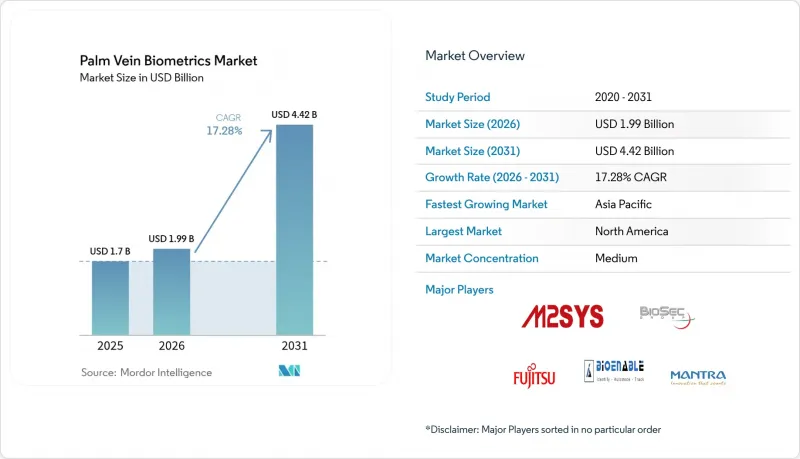
本報告按組件(硬體、軟體及解決方案、服務)、技術(近熱成像成像、混合成像)、終端用戶產業(銀行和金融機構、醫療機構、政府機構、商業和工業企業)以及地區進行細分。市場預測以美元計價。
全球掌靜脈生物識別市場趨勢與洞察
擴大非接觸式認證在銀行、金融服務和保險 (BFSI) 行業的應用
銀行正將手掌掃描功能直接整合到POS終端中,以實現亞秒級的交易速度並杜絕刷卡詐騙。摩根大通在體育場進行的先導計畫中,在2024年邁阿密大獎賽期間,所有支付均在不到一秒的時間內完成。萬事達卡於2024年6月在其位於烏拉圭的Tienda Inglésua門店引入了手掌支付,這是該項目首次採用手掌識別技術,此前該項目一直依賴臉部認證。 2024年4月,美國信用合作社的支付處理商PSCU和Co-op Solutions在經過八週的推廣期後,幫助4,000家發卡機構添加了手掌支付功能。阿拉伯聯合大公國監理機關的目標是到2026年將Palm ID打造為該地區公共交通和ATM機的實際身分驗證方式。金融領域的這種轉變意味著手掌認證不再只是一種防詐騙工具,而是被定位為一種個人化資產,旨在提升客戶忠誠度。
嚴格的資料隱私法規要求進行生物識別升級。
根據歐盟的《一般資料保護規範》(GDPR)、中國的《個人資訊保護法》(PIPL)和印度的《資料保護與資料保護法》(DPDPA),血管模式被歸類為敏感數據,跨境傳輸時需要獲得明確同意、資料最小化以及額外的加密措施。 Schrems II裁決使歐盟-美國隱私權盾協議失效,迫使歐洲公司採用本地或主權雲端儲存。中國的《個人資訊保護法》規定,涉及超過一百萬資料主體的資料傳輸必須由電腦網路空間辦公室進行安全評估。 ISO/IEC TS 22604:2024為企業提供了模板保護的藍圖,並建議轉向裝置上的加密匹配。 Amazon One採用了這種模式,將簽章儲存在安全的AWS域中,而不是儲存在讀取器本身。因此,合規壓力正在加速從密碼系統轉向加密生物識別的轉變。
高昂的初始硬體和整合成本
近紅外線感測器陣列的成本是通用指紋辨識器的三到五倍。高通和Telpo聯合推出的P105終端整合了雙RGB+紅外線攝影機和生物辨識光學元件,定位為高階設備,小規模零售商必須透過降低詐欺防範成本來證明其採用的合理性。此外,如果舊有系統缺少血管認證驅動程序,整合該設備還需額外支付5000至20000美元的專業服務費,這使得新興市場利潤微薄的企業難以負擔。
細分市場分析
到2025年,硬體將佔掌紋生物生物識別市場佔有率的67.52%,因為每個認證點都需要一個專用的讀取器。數百台設備將部署在醫院、機場和體育場館,硬體收入與部署規模成正比。同時,服務業的複合年成長率預計將達到18.77%,這反映了模板資料庫的維護、演算法調整和合規性審計等成本。 Digital Sense為萬事達卡在烏拉圭部署的支付系統所做的整合工作,展示了中間件如何彌合掌紋讀取器和傳統POS軟體手掌。雖然雲端平台正在將收入轉向經常性訂閱,但讀取器在高吞吐量閘道器仍然至關重要,預計到2031年,硬體銷售額仍將佔50%以上。
軟體版稅收入也在成長。供應商按設備授權其匹配引擎,並且 ISO/IEC 30107-3:2023“呈現攻擊檢測”標準要求定期更新韌體。由於小規模零售商缺乏能夠排查誤拒問題和進行隱私影響評估的訓練有素的員工,託管服務供應商蓬勃發展。即使是 SaaS 服務,企業也需要支付月費,用於日誌審查、加密金鑰輪換以及在適用資料本地化法律的主權雲端上進行託管,這進一步鞏固了這些服務的成長。
區域分析
預計到2025年,北美將佔據掌紋生物識別市場39.78%的佔有率。這主要得益於亞馬遜One在500家全食超市和150家第三方商家的部署,該系統已完成超過800萬筆交易,復購率高達80%。 PYMNTS的一份報告顯示,美國消費者對生物識別的接受度很高, 52%的消費者更傾向於使用生物辨識而非密碼。在加拿大,掌紋支付正在一些連鎖超市進行試點;在墨西哥城,地鐵閘門也考慮採用這項技術。該地區得益於靈活的監管政策,優先考慮資訊揭露而非明確同意,從而降低了生物辨識技術的普及門檻。
亞太地區是成長最快的地區,預計到2031年將達到17.62%的複合年成長率。日立的「SAKULaLa」已擴展到包括零售店和鐵路在內的100多個地點,而騰訊的「PalmAI服務」據稱在北京機場快線、深圳大學和7-Eleven便利店等場所擁有1億用戶。中國的《個人資訊保護法》使跨境資料流動變得複雜,但中國境內的資料量遠超過西方市場。印度的新資料保護法允許跨境資料傳輸,只要資料不在黑名單上,這為雲端SaaS供應商創造了機會。然而,金融和醫療保健行業的監管機構可能會制定更嚴格的規定。韓國、澳洲和新加坡的銀行和醫院正在進行試點項目,而印尼正在考慮引入掌紋掃描技術,以改善其2.7億公民的國民身分證系統。
由於GDPR的限制,歐洲在生物辨識技術方面進展緩慢。生物識別資料屬於GDPR第9條規定的「特殊類別」保護範圍,需要明確同意。 Visa和Feedzai的一項調查發現,40%的英國消費者願意在銀行交易中使用生物識別,但Schrems II裁決迫使美國雲端供應商使用歐盟境內的資料中心,增加了成本。法國、德國和義大利正在醫院和機場試點手掌辨識設備,但模板儲存僅限於這些國家境內。中東地區則展現出令人鼓舞的跡象。阿拉伯聯合大公國的目標是在2026年之前建立覆蓋全國的手掌識別基礎設施,總部位於杜拜的AstraTech公司於2024年推出了Palm Pay,這是一種零售支付服務,只需揮動手掌即可完成付款。沙烏地阿拉伯正在考慮開展邊境管制試點項目,這表明沿岸地區在生物辨識技術方面正蓬勃發展。
在非洲和南美洲,這項技術仍處於早期應用階段。巴西的《個人資料保護法》(LGPD)將生物識別資訊歸類為機密訊息,並強制要求資料傳輸採用標準合約條款;而南非正在考慮引入掌紋認證技術來核實難民身分。資金短缺和硬體成本阻礙了這項技術的廣泛應用,但萬事達卡在烏拉圭的試點計畫預計將在全部區域引發關注。
其他好處:
- Excel格式的市場預測(ME)表
- 3個月的分析師支持
目錄
第1章:引言
- 研究假設和市場定義
- 調查範圍
第2章:調查方法
第3章執行摘要
第4章 市場狀況
- 市場概覽
- 市場促進因素
- 擴大非接觸式認證在銀行、金融服務和保險 (BFSI) 行業的應用
- 嚴格的資料隱私法規要求對生物識別系統進行升級。
- 後疫情時代醫療環境中對衛生、非接觸式病患身分識別的需求。
- 基於雲端的 Palm ID SaaS 模式正在降低中小企業的整體擁有成本。
- 利用智慧型手機進行遠端註冊,可以實現去中心化的用戶獲取。
- 受關稅影響,感測器生產的近岸外包正在降低供應鏈風險。
- 市場限制因素
- 高昂的初始硬體和整合成本
- 不同廠商之間的互通性標準有限。
- 根據《數據主權法案》,加強生物識別雲端儲存的監控
- 大規模靜脈模板資料庫中的擴展延遲問題
- 產業價值鏈分析
- 監理情勢
- 技術展望
- 宏觀經濟因素對市場的影響
- 波特五力分析
第5章 市場規模與成長預測
- 按組件
- 硬體
- 軟體和解決方案
- 服務
- 透過技術
- 近紅外線成像
- 光學成像
- 熱成像
- 混合成像
- 按最終用戶行業分類
- 銀行和金融機構
- 醫療服務提供方
- 政府機構
- 商業和工業企業
- 按地區
- 北美洲
- 美國
- 加拿大
- 墨西哥
- 歐洲
- 英國
- 德國
- 法國
- 義大利
- 其他歐洲國家
- 亞太地區
- 中國
- 日本
- 印度
- 韓國
- 其他亞洲國家
- 中東
- 以色列
- 沙烏地阿拉伯
- 阿拉伯聯合大公國
- 土耳其
- 其他中東國家
- 非洲
- 南非
- 埃及
- 其他非洲國家
- 南美洲
- 巴西
- 阿根廷
- 其他南美國家
- 北美洲
第6章 競爭情勢
- 市場集中度
- 策略趨勢
- 市佔率分析
- 公司簡介
- Fujitsu Limited
- Hitachi Ltd.
- NEC Corporation
- M2SYS Technology LLC
- BioSec Group Ltd.
- BioEnable Technologies Private Limited
- Imprivata Inc.
- Mantra Softech(India)Private Limited
- IdentyTech Solutions Ltd.
- Matrix Comsec Private Limited
- Keyo Inc.
- Tencent Cloud Computing(Beijing)Company Limited
- Amazon Web Services, Inc.
- ZKTECO Co., Ltd.
- Idemia France SAS
- Recogtech BV
- Shenzhen Huifan Technology Co., Ltd.
- Hikvision Digital Technology Co., Ltd.
- Thales Group
- Mofiria Corporation
第7章 市場機會與未來展望
According to Mordor Intelligence, the palm vein biometrics market size is expected to grow from USD 1.7 billion in 2025 to USD 1.99 billion in 2026 and is forecast to reach USD 4.42 billion by 2031 at 17.28% CAGR over 2026-2031.
This report is Segmented by Component (Hardware, Software and Solution, Services), Technology (Near-Infrared Imaging, Optical Imaging, Thermal Imaging, and Hybrid Imaging), End-User Industry (Banking and Financial Institutions, Healthcare Providers, Government Agencies, and Commercial and Industrial Enterprises), and Geography. The Market Forecasts are Provided in Terms of Value (USD).
Global Palm Vein Biometrics Market Trends and Insights
Rising Adoption of Contactless Authentication in BFSI Sector
Banks are embedding palm scans directly into point-of-sale rails to hit sub-one-second transaction times and eliminate card-present fraud. J.P. Morgan's stadium-based pilot completed every payment in under a second during the 2024 Formula 1 Miami Grand Prix. Mastercard rolled out palm checkout in Uruguay's Tienda Inglesa stores in June 2024, its first palm deployment in the program that had relied on facial recognition. U.S. credit-union processors PSCU and Co-op Solutions enabled 4,000 issuers to add pay-by-palm in April 2024 with eight-week implementation timelines. UAE regulators aim to make Palm ID the region's de-facto metro and ATM credential by 2026. The financial sector's pivot frames palm authentication as a loyalty-driven personalization asset rather than a narrow fraud-control tool.
Stringent Data Privacy Regulations Mandating Biometric Upgrades
The EU's GDPR, China's PIPL, and India's DPDPA classify vascular templates as sensitive data that require explicit consent, data minimization, and, where cross-border transfers occur, supplementary encryption measures. Schrems II invalidated the EU-U.S. Privacy Shield, forcing European companies to adopt local or sovereign-cloud storage. China's PIPL mandates the Cyberspace Administration of China security assessments for transfers that involve over 1 million data subjects. ISO/IEC TS 22604:2024 now provides enterprises with a template-protection blueprint and encourages moves toward encrypted on-device matching, a model Amazon One follows by storing signatures within a secure AWS domain rather than on the reader itself. Compliance pressure, therefore, accelerates the migration from password systems to cryptographically protected biometrics.
High Upfront Hardware and Integration Costs
Near-infrared sensor arrays cost three-to-five times more than commodity fingerprint readers. Qualcomm and Telpo's P105 terminal integrate dual RGB + IR cameras plus liveness optics, positioning it as a premium device that small retailers must justify through fraud savings. Integration adds USD 5,000-20,000 in professional services when legacy systems lack vascular drivers, locking out low-margin merchants in emerging markets.
Other drivers and restraints analyzed in the detailed report include:
- Post-Pandemic Demand for Hygienic Touch-Free Patient Identification in Healthcare
- Cloud-Based Palm ID SaaS Models Shrinking Total Cost of Ownership for SMEs
- Limited Interoperability Standards Across Vendors
For complete list of drivers and restraints, kindly check the Table Of Contents.
Segment Analysis
Hardware captured 67.52% of palm vein biometrics market share in 2025 as every authentication point needs a dedicated reader. Hospitals, airports, and stadiums deploy hundreds of units, keeping hardware revenue proportional to footprint. Services, however, will log a 18.77% CAGR, reflecting template-database maintenance, algorithm retuning, and compliance audits. Digital Sense's integration work for Mastercard's Uruguay checkout launch demonstrates how middleware bridges palm readers to legacy POS software. Cloud platforms shift value toward recurring subscriptions, yet readers remain indispensable for high-throughput gates, ensuring hardware stays above 50% of revenue through 2031.
Software royalties are also rising. Vendors license matching engines under per-device fees, and ISO/IEC 30107-3:2023 presentation-attack-detection mandates guarantee constant firmware refreshes. Managed-service providers flourish because small retailers lack staff trained to troubleshoot false rejects or conduct privacy-impact assessments. Even with SaaS, enterprises pay monthly for log review, encryption-key rotation, and sovereign-cloud hosting where data-localization laws apply, locking in services growth.
Complete Report Scope:
- By Component
- Hardware
- Software and Solution
- Services
- By Technology
- Near-Infrared Imaging
- Optical Imaging
- Thermal Imaging
- Hybrid Imaging
- By End-User Industry
- Banking and Financial Institutions
- Healthcare Providers
- Government Agencies
- Commercial and Industrial Enterprises
- By Geography
- North America
- United States
- Canada
- Mexico
- Europe
- United Kingdom
- Germany
- France
- Italy
- Rest of Europe
- Asia-Pacific
- China
- Japan
- India
- South Korea
- Rest of Asia
- Middle East
- Israel
- Saudi Arabia
- United Arab Emirates
- Turkey
- Rest of Middle East
- Africa
- South Africa
- Egypt
- Rest of Africa
- South America
- Brazil
- Argentina
- Rest of South America
- North America
Geography Analysis
North America held a 39.78% palm vein biometrics market share in 2025, underpinned by Amazon One's rollout to 500 Whole Foods stores and 150 third-party venues that have logged more than 8 million transactions with an 80% repeat rate. U.S. consumers show high biometric acceptance, with PYMNTS reporting 52% prefer biometrics over passwords. Canada pilots palm payments in grocery chains, while Mexico City explores the modality for metro fare gates. The region benefits from permissive regulations that rely on disclosure rather than explicit consent, lowering deployment friction.
Asia Pacific is the fastest-growing geography, posting a 17.62% CAGR toward 2031. Hitachi's SAKULaLa expanded to 100 plus venues across retail and rail, and Tencent's PalmAI Service claims 100 million users across Beijing Airport Express, Shenzhen University, and 7-Eleven stores. China's PIPL complicates cross-border data flows, yet domestic volumes dwarf Western markets. India's new data law allows cross-border transfers unless on a blacklist, creating opportunity for cloud SaaS vendors, although sectoral regulators may issue tighter rules for finance or health. South Korea, Australia, and Singapore run pilots in banks and hospitals, while Indonesia studies palm scans for its 270 million-citizen national ID upgrade.
Europe trails due to GDPR constraints; biometric data sits under Article 9's special-category protections requiring explicit consent. Visa and Feedzai found 40% of UK consumers willing to use biometrics for banking, but Schrems II forces U.S. cloud vendors to adopt EU data centers, inflating costs. France, Germany, and Italy test palm readers in hospitals and airports but keep template storage local. The Middle East emerges as a bright spot: the UAE targets nationwide palm infrastructure by 2026, and Dubai-based AstraTech launched Palm Pay in 2024 for hover-to-pay retail checkouts. Saudi Arabia explores border-control pilots, signalling Gulf-wide momentum.
Africa and South America remain nascent. Brazil's LGPD classifies biometrics as sensitive and requires standard contractual clauses for transfers, while South Africa studies palm vein for refugee identity. Funding gaps and hardware costs restrain volume, though Mastercard's Uruguay pilot may seed regional interest.
- Fujitsu Limited
- Hitachi Ltd.
- NEC Corporation
- M2SYS Technology LLC
- BioSec Group Ltd.
- BioEnable Technologies Private Limited
- Imprivata Inc.
- Mantra Softech (India) Private Limited
- IdentyTech Solutions Ltd.
- Matrix Comsec Private Limited
- Keyo Inc.
- Tencent Cloud Computing (Beijing) Company Limited
- Amazon Web Services, Inc.
- ZKTECO Co., Ltd.
- Idemia France SAS
- Recogtech B.V.
- Shenzhen Huifan Technology Co., Ltd.
- Hikvision Digital Technology Co., Ltd.
- Thales Group
- Mofiria Corporation
Additional Benefits:
- The market estimate (ME) sheet in Excel format
- 3 months of analyst support
TABLE OF CONTENTS
1 INTRODUCTION
- 1.1 Study Assumptions and Market Definition
- 1.2 Scope of the Study
2 RESEARCH METHODOLOGY
3 EXECUTIVE SUMMARY
4 MARKET LANDSCAPE
- 4.1 Market Overview
- 4.2 Market Drivers
- 4.2.1 Rising Adoption of Contactless Authentication in BFSI Sector
- 4.2.2 Stringent Data Privacy Regulations Mandating Biometric Upgrades
- 4.2.3 Post-Pandemic Demand for Hygienic Touch-Free Patient Identification in Healthcare
- 4.2.4 Cloud-Based Palm ID SaaS Models Shrinking Total Cost of Ownership for SMEs
- 4.2.5 Smartphone-Enabled Remote Enrollment Unlocking Decentralized User Acquisition
- 4.2.6 Tariff-Driven Nearshoring of Sensor Production Lowering Supply-Chain Risk
- 4.3 Market Restraints
- 4.3.1 High Upfront Hardware and Integration Costs
- 4.3.2 Limited Interoperability Standards Across Vendors
- 4.3.3 Rising Scrutiny of Biometric Cloud Storage by Data Sovereignty Laws
- 4.3.4 Scaling Latency Issues in Large-Scale Vein Template Databases
- 4.4 Industry Value Chain Analysis
- 4.5 Regulatory Landscape
- 4.6 Technological Outlook
- 4.7 Impact of Macroeconomic Factors on the Market
- 4.8 Porter's Five Forces Analysis
- 4.8.1 Threat of New Entrants
- 4.8.2 Bargaining Power of Buyers
- 4.8.3 Bargaining Power of Suppliers
- 4.8.4 Threat of Substitute Products
- 4.8.5 Intensity of Competitive Rivalry
5 MARKET SIZE AND GROWTH FORECASTS (VALUE)
- 5.1 By Component
- 5.1.1 Hardware
- 5.1.2 Software and Solution
- 5.1.3 Services
- 5.2 By Technology
- 5.2.1 Near-Infrared Imaging
- 5.2.2 Optical Imaging
- 5.2.3 Thermal Imaging
- 5.2.4 Hybrid Imaging
- 5.3 By End-User Industry
- 5.3.1 Banking and Financial Institutions
- 5.3.2 Healthcare Providers
- 5.3.3 Government Agencies
- 5.3.4 Commercial and Industrial Enterprises
- 5.4 By Geography
- 5.4.1 North America
- 5.4.1.1 United States
- 5.4.1.2 Canada
- 5.4.1.3 Mexico
- 5.4.2 Europe
- 5.4.2.1 United Kingdom
- 5.4.2.2 Germany
- 5.4.2.3 France
- 5.4.2.4 Italy
- 5.4.2.5 Rest of Europe
- 5.4.3 Asia-Pacific
- 5.4.3.1 China
- 5.4.3.2 Japan
- 5.4.3.3 India
- 5.4.3.4 South Korea
- 5.4.3.5 Rest of Asia
- 5.4.4 Middle East
- 5.4.4.1 Israel
- 5.4.4.2 Saudi Arabia
- 5.4.4.3 United Arab Emirates
- 5.4.4.4 Turkey
- 5.4.4.5 Rest of Middle East
- 5.4.5 Africa
- 5.4.5.1 South Africa
- 5.4.5.2 Egypt
- 5.4.5.3 Rest of Africa
- 5.4.6 South America
- 5.4.6.1 Brazil
- 5.4.6.2 Argentina
- 5.4.6.3 Rest of South America
- 5.4.1 North America
6 COMPETITIVE LANDSCAPE
- 6.1 Market Concentration
- 6.2 Strategic Moves
- 6.3 Market Share Analysis
- 6.4 Company Profiles (includes Global Level Overview, Market Level Overview, Core Segments, Financials as available, Strategic Information, Market Rank/Share for key companies, Products and Services, and Recent Developments)
- 6.4.1 Fujitsu Limited
- 6.4.2 Hitachi Ltd.
- 6.4.3 NEC Corporation
- 6.4.4 M2SYS Technology LLC
- 6.4.5 BioSec Group Ltd.
- 6.4.6 BioEnable Technologies Private Limited
- 6.4.7 Imprivata Inc.
- 6.4.8 Mantra Softech (India) Private Limited
- 6.4.9 IdentyTech Solutions Ltd.
- 6.4.10 Matrix Comsec Private Limited
- 6.4.11 Keyo Inc.
- 6.4.12 Tencent Cloud Computing (Beijing) Company Limited
- 6.4.13 Amazon Web Services, Inc.
- 6.4.14 ZKTECO Co., Ltd.
- 6.4.15 Idemia France SAS
- 6.4.16 Recogtech B.V.
- 6.4.17 Shenzhen Huifan Technology Co., Ltd.
- 6.4.18 Hikvision Digital Technology Co., Ltd.
- 6.4.19 Thales Group
- 6.4.20 Mofiria Corporation
7 MARKET OPPORTUNITIES AND FUTURE OUTLOOK
- 7.1 White-Space and Unmet-Need Assessment

 手掌辨識掃描器市場-2026-2032年全球市場預測
 手掌認證市場規模、佔有率和成長分析:按類型、技術、應用、最終用戶、分銷管道和地區分類 - 行業預測,2026-2033年
 2026年全球掌靜脈生物識別市場報告手掌認證市場:按組件、設備類型、終端用戶產業和應用分類-2026-2032年全球預測生物識別掌靜脈掃描器市場:按組件、部署模式、認證類型和最終用戶產業分類,2026-2032年全球預測
 手掌生物生物識別市場規模、佔有率、趨勢和預測:按組件、應用和地區分類,2026-2034年
 手掌辨識生物辨識市場-全球產業規模、佔有率、趨勢、機會及預測(按類型、組件、技術、應用、最終用戶、地區和競爭格局分類),2021-2031年掌靜脈掃描器市場-全球產業規模、佔有率、趨勢、機會和預測,依產品、功能、最終用戶、地區和競爭格局分類,2021-2031年預測