


 |
市場調查報告書
商品編碼
2123103
行為生物生物識別:市場佔有率分析、產業趨勢與統計、成長預測(2026-2031)Behavioral Biometrics - Market Share Analysis, Industry Trends & Statistics, Growth Forecasts (2026 - 2031) |
||||||

※ 本網頁內容可能與最新版本有所差異。詳細情況請與我們聯繫。
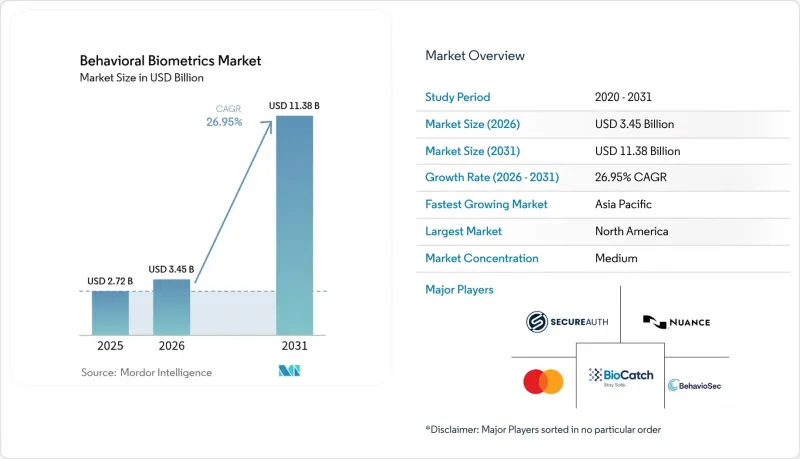
根據 Mordor Intelligence 預測,行為生物生物識別市場將從 2025 年的 27.2 億美元成長到 2026 年的 34.5 億美元,然後在 2031 年達到 113.8 億美元,2026 年至 2031 年的複合年成長率為 26.95%。
本報告按類型(簽名分析、按鍵動態等)、部署模式(本地部署、雲端部署)、應用領域(身份驗證、持續認證、風險管理與合規、詐欺檢測與預防)、最終用戶(零售與電子商務、醫療保健、政府與公共部門等)以及地區進行細分。市場預測以美元計價。
全球行為生物辨識市場趨勢及洞察
行動銀行被動生物辨識技術的普及
行動銀行融合了被動式生物識別功能,透過監測打字節奏、觸控壓力和設備操作來驗證用戶身份,無需用戶進行任何明確互動。已實施這些功能的金融機構報告稱,誤報率降低了高達 85%,並且由於簡化了註冊流程,客戶滿意度也得到了提升。由於實施成本可被減少的詐欺損失和多因素身份驗證帶來的許多不便所抵消,北美和歐洲的銀行正積極致力於將行為分析技術整合到其原生應用程式中。
電子商務帳戶劫持詐騙激增
預計到2024年,全球電子商務詐欺損失將超過64億美元,迫使經銷商採用行為分析技術,在毫秒內偵測異常的滑鼠行動和結帳流程。據報道,整合行為生物辨識技術的平台已將撞人員編制攻擊減少了70%,同時在購物旺季保持了轉換率,凸顯了該技術在保護收入方面的價值。
GDPR和CCPA下的消費者隱私訴訟案件數量增加。
由於行為數據構成生物識別訊息,因此需要獲得明確同意並嚴格遵守最小化原則。 2024年,不當處理此類資料可能導致超過5,000萬歐元的罰款,這促使規避風險的公司推遲實施,直到完成隱私影響評估並獲得資料保護官的批准。合規措施會增加專案工期和成本,尤其是在跨國營運中。
細分市場分析
預計到2025年,擊鍵動態識別技術將佔總收入的39.25%,反映出該技術的成熟度以及與現有鍵盤和觸控螢幕的兼容性。隨著企業將打字分析與風險管理引擎整合到網路和行動管道中,擊鍵行為生物辨識市場持續擴張。由於無需硬體升級,且演算法在企業資料集中的誤報率已低於2%,因此該市場成長穩健。
步態分析預計將成為成長最快的生物辨識技術,到2031年複合年成長率將達到27.45%。智慧型手機的加速感應器和穿戴式裝置現在可以在正常活動中獲得穩定的步態特徵,從而實現行動錢包、票務系統和安全門禁等應用程式中的被動身份驗證。供應商正在將步態特徵與語音和打字特徵融合,以防止身份冒用並降低環境噪音的影響,這推動了整個行為生物生物識別市場採用多模態方法。
隨著各組織機構向持續更新、跨區域可擴展的SaaS身份驗證遷移,雲端平台在2025年將佔總營收的55.85%。微服務架構和API閘道器簡化了在數位銀行、零售和醫療入口網站的部署,預計雲端部署中行為生物生物識別的市場佔有率將持續成長。訂閱模式降低了資本支出,並能夠根據全球詐欺偵測數據快速調整演算法。
對於需要對生物識別資料擁有完全控制權的政府機構和高度監管產業而言,本地部署解決方案仍然至關重要。為了平衡隱私和效能,混合設計方案正在興起:在本地處理原始事件的同時,將匿名化特徵傳送到雲端進行威脅關聯分析。這種平衡的方法既保留了本地部署解決方案的重要性,也突顯了雲端供應商為行為生物辨識市場帶來的成本和靈活性優勢。
區域分析
北美地區得益於早期應用和積極的網路安全法規,預計到2025年將佔全球收入的37.20%。美國金融監管機構建議將行為指標作為多層防禦體系的一部分,這推動了銀行、保險公司和卡片組織等機構更多地採用該技術。聯邦機構正在將擊鍵和滑鼠模式整合到特權存取工作站中,這反映了政府對持續身份驗證的承諾。在加拿大,該技術的應用重點在於醫療保健現代化和基於雲端的身份驗證,以保護隱私。
預計亞太地區將以27.10%的複合年成長率(CAGR)實現最高成長,直至2031年。中國的超級應用正在將步態和語音分析技術整合到基於QR碼的支付系統中,而印度的金融科技熱潮則利用動態擊鍵分析來保障統一支付介面(UPI)交易的安全。新加坡、韓國和澳洲政府正在為基於行動裝置和物聯網感測器收集的行為訊號的數位身分研發提供津貼。日本電子製造商正在其旗艦智慧型手機中預先安裝行為分析SDK,為行為生物辨識市場在該地區擴張提供硬體基礎設施。
在歐洲,PSD2 和 GDPR 的實施支撐著強勁的成長。銀行正在整合行為認證技術,以滿足嚴格的客戶規則,同時又不影響用戶體驗;電信業者則在 SIM 卡註冊中添加行為特徵信息,以防止欺詐。儘管隱私訴訟風險減緩了技術的普及速度,但供應商正透過符合區域標準的裝置端處理和隱私增強型加密技術來應對這項挑戰。德國和英國在金融、零售和公共服務領域主導企業試點計畫。
其他好處:
- Excel格式的市場預測(ME)表
- 3個月的分析師支持
目錄
第1章:引言
- 研究假設和市場定義
- 調查範圍
第2章:調查方法
第3章執行摘要
第4章 市場狀況
- 市場概覽
- 市場促進因素
- 被動式生物辨識技術在行動銀行。
- 電子商務帳戶劫持詐騙激增
- 將行為生物特徵技術整合到無密碼身份驗證標準(FIDO2)中
- 遠距辦公的普及和零信任安全的引入。
- 推動歐洲和亞洲加強客戶身份驗證的法規
- 邊緣人工智慧晶片處理能力的提升,使得即時行為分析成為可能。
- 市場限制因素
- GDPR和CCPA下的消費者隱私訴訟案件數量增加。
- 多元文化使用者中較高的誤拒率
- 中小企業安全團隊缺乏安全意識
- 與傳統身分驗證基礎架構整合的複雜性
- 產業價值鏈分析
- 宏觀經濟因素的影響
- 技術展望
- 監理情勢
- 波特五力分析
- 投資分析
第5章 市場規模與成長預測
- 按類型
- 特徵分析
- Keystroke Dynamics
- 語音辨識
- 步態分析
- 不同的發展
- 現場
- 雲端
- 透過使用
- 身份驗證
- 持續身份驗證
- 風險與合規
- 詐欺檢測與預防
- 最終用戶
- BFSI
- 零售與電子商務
- 衛生保健
- 政府/公共部門
- 其他最終用戶
- 按地區
- 北美洲
- 美國
- 加拿大
- 墨西哥
- 歐洲
- 德國
- 英國
- 法國
- 義大利
- 西班牙
- 其他歐洲國家
- 亞太地區
- 中國
- 日本
- 印度
- 韓國
- 澳洲
- 其他亞太國家
- 中東和非洲
- 中東
- 沙烏地阿拉伯
- 阿拉伯聯合大公國
- 其他中東國家
- 非洲
- 南非
- 埃及
- 其他非洲國家
- 中東
- 南美洲
- 巴西
- 阿根廷
- 其他南美國家
- 北美洲
第6章 競爭情勢
- 市場集中度
- 策略趨勢
- 市佔率分析
- 公司簡介
- BioCatch Ltd.
- Mastercard Incorporated(NuData Security)
- Nuance Communications Inc.
- SecureAuth Corporation
- BehavioSec Inc.
- ThreatMark SRO
- UnifyID Inc.
- Zighra Inc.
- Plurilock Security Solutions Inc.
- SecuredTouch Inc.
- TypingDNA Inc.
- Callsign Inc.
- Deepnet Security Ltd.
- DataVisor Inc.
- Experian PLC(CrossCore)
- OneSpan Inc.
- IBM Corporation
- NEC Corporation
- Samsung SDS Co. Ltd.
- HID Global Corporation
第7章 市場機會與未來展望
According to Mordor Intelligence, the behavioral biometrics market size is expected to grow from USD 2.72 billion in 2025 to USD 3.45 billion in 2026 and is forecast to reach USD 11.38 billion by 2031 at 26.95% CAGR over 2026-2031.
This report is Segmented by Type (Signature Analysis, Keystroke Dynamics, and More), Deployment (On-Premise, and On-Cloud), Application (Identity Proofing, Continuous Authentication, Risk and Compliance, Fraud Detection and Prevention), End-User (Retail and E-Commerce, Healthcare, Government and Public Sector, and More), and Geography. The Market Forecasts are Provided in Terms of Value (USD).
Global Behavioral Biometrics Market Trends and Insights
Proliferation of passive liveness detection in mobile banking
Mobile banks embed passive liveness detection that observes typing cadence, touch pressure, and device handling to confirm identity without explicit user action. Financial institutions deploying these capabilities cite up to 85% cuts in false positive alerts and smoother onboarding that enhances customer satisfaction. Deployment costs are offset by lower fraud losses and reduced multi-factor friction, encouraging banks across North America and Europe to incorporate behavioral analysis into native apps.
Surge in account takeover fraud in e-commerce
Global e-commerce fraud losses exceeded USD 6.4 billion in 2024, pushing merchants to adopt behavioral analytics that flags anomalous mouse paths and checkout flows in milliseconds. Platforms integrating behavioral biometrics report 70% reductions in credential-stuffing attacks during peak shopping seasons while preserving conversion rates, underscoring the technology's revenue-protection value.
Rising consumer privacy litigation under GDPR and CCPA
Behavioral data qualifies as biometric information, demanding explicit consent and strict minimization. Fines surpassing EUR 50 million were imposed in 2024 for mishandling such data, prompting risk-averse firms to delay rollouts until privacy impact assessments and data officer sign-offs conclude. Compliance steps inflate timelines and project costs, especially for multinational deployments.
Other drivers and restraints analyzed in the detailed report include:
- Integration of behavioral biometrics into passwordless authentication standards (FIDO2)
- Expansion of remote workforce and zero trust security adoption
- High false rejection rates in multi-cultural user bases
For complete list of drivers and restraints, kindly check the Table Of Contents.
Segment Analysis
Keystroke dynamics held 39.25% of 2025 revenue, underscoring its maturity and compatibility with existing keyboards and touchscreens. The behavioral biometrics market size for keystroke solutions continues to grow as enterprises integrate typing analytics into web and mobile channels alongside risk engines. Growth is steady because retrofitting requires no hardware upgrades and algorithms already achieve sub-2% false accept rates on enterprise datasets.
Gait analysis posts the highest 27.45% CAGR through 2031. Smartphone accelerometers and wearables now capture stable gait signatures during normal movements, enabling passive verification for mobile wallets, ticketing, and secure facility access. Vendors fuse gait with voice or typing traits to curb spoofing and to mitigate environmental noise, propelling multimodal adoption within the broader behavioral biometrics market.
Cloud platforms commanded 55.85% of 2025 revenue as organizations pivot to SaaS authentication that updates continuously and scales across geographies. The behavioral biometrics market share for cloud deployment is projected to climb as microservices architectures and API gateways simplify rollout within digital banking, retail, and health portals. Subscription models cut capital expenditure and allow rapid tuning of algorithms based on global fraud telemetry.
On-premise solutions remain vital to governments and highly regulated sectors that demand sovereign control over biometric data. Hybrid designs emerge to reconcile privacy and performance, processing raw events locally while sending anonymized features to cloud analytics for threat correlation. This balanced approach sustains on-premise relevance yet underscores the cost and agility advantage cloud vendors deliver to the behavioral biometrics market.
Complete Report Scope:
- By Type
- Signature Analysis
- Keystroke Dynamics
- Voice Recognition
- Gait Analysis
- By Deployment
- On-premise
- On-cloud
- By Application
- Identity Proofing
- Continuous Authentication
- Risk and Compliance
- Fraud Detection and Prevention
- By End-User
- BFSI
- Retail and E-commerce
- Healthcare
- Government and Public Sector
- Other End-User
- By Geography
- North America
- United States
- Canada
- Mexico
- Europe
- Germany
- United Kingdom
- France
- Italy
- Spain
- Rest of Europe
- Asia-Pacific
- China
- Japan
- India
- South Korea
- Australia
- Rest of Asia-Pacific
- Middle East and Africa
- Middle East
- Saudi Arabia
- United Arab Emirates
- Rest of Middle East
- Africa
- South Africa
- Egypt
- Rest of Africa
- Middle East
- South America
- Brazil
- Argentina
- Rest of South America
- North America
Geography Analysis
North America generated 37.20% of 2025 revenue on the back of early adoption and proactive cybersecurity mandates. U.S. financial regulators endorse behavioral metrics within layered defenses, spurring banks, insurers, and card networks to scale deployments. Federal agencies incorporate keystroke and mouse patterns into privileged-access workstations, illustrating government commitment to continuous verification. Canadian adoption centers on healthcare modernization and privacy-preserving cloud authentication.
Asia-Pacific displays the steepest 27.10% CAGR through 2031. China's super-apps fuse gait and voice analytics into QR-based payments, while India's fintech boom leverages keystroke dynamics to secure Unified Payments Interface transactions. Governments in Singapore, South Korea, and Australia issue grants for digital identity R and D that rely on behavioral signals collected via mobile devices and IoT sensors. Japanese electronics makers preinstall behavioral SDKs on flagship smartphones, providing a hardware base for regional expansion of the behavioral biometrics market.
Europe upholds strong growth owing to PSD2 and GDPR. Banks integrate behavioral authentication to satisfy strong customer rules without sacrificing user convenience, and telecom operators add behavioral profiles to SIM registration for fraud control. Privacy litigation risk moderates adoption speed, yet vendors counter with on-device processing and privacy-enhancing cryptography that comply with regional standards. Germany and the United Kingdom spearhead enterprise pilots across funding, retail, and public services.
- BioCatch Ltd.
- Mastercard Incorporated (NuData Security)
- Nuance Communications Inc.
- SecureAuth Corporation
- BehavioSec Inc.
- ThreatMark S.R.O.
- UnifyID Inc.
- Zighra Inc.
- Plurilock Security Solutions Inc.
- SecuredTouch Inc.
- TypingDNA Inc.
- Callsign Inc.
- Deepnet Security Ltd.
- DataVisor Inc.
- Experian PLC (CrossCore)
- OneSpan Inc.
- IBM Corporation
- NEC Corporation
- Samsung SDS Co. Ltd.
- HID Global Corporation
Additional Benefits:
- The market estimate (ME) sheet in Excel format
- 3 months of analyst support
TABLE OF CONTENTS
1 INTRODUCTION
- 1.1 Study Assumptions and Market Definition
- 1.2 Scope of the Study
2 RESEARCH METHODOLOGY
3 EXECUTIVE SUMMARY
4 MARKET LANDSCAPE
- 4.1 Market Overview
- 4.2 Market Drivers
- 4.2.1 Proliferation of Passive Liveness Detection in Mobile Banking
- 4.2.2 Surge in Account Takeover Fraud in E-Commerce
- 4.2.3 Integration of Behavioral Biometrics into Passwordless Authentication Standards (FIDO2)
- 4.2.4 Expansion of Remote Workforce and Zero Trust Security Adoption
- 4.2.5 Regulatory Push for Strong Customer Authentication in Europe and Asia
- 4.2.6 Increased Processing Power of Edge AI Chips Enabling Real-Time Behavioral Analytics
- 4.3 Market Restraints
- 4.3.1 Rising Consumer Privacy Litigation Under GDPR and CCPA
- 4.3.2 High False Rejection Rates in Multi-Cultural User Bases
- 4.3.3 Limited Awareness Among SME Security Teams
- 4.3.4 Integration Complexity with Legacy Authentication Infrastructure
- 4.4 Industry Value Chain Analysis
- 4.5 Impact of Macroeconomic Factors
- 4.6 Technological Outlook
- 4.7 Regulatory Landscape
- 4.8 Porter's Five Forces Analysis
- 4.8.1 Threat of New Entrants
- 4.8.2 Bargaining Power of Buyers/Consumers
- 4.8.3 Bargaining Power of Suppliers
- 4.8.4 Threat of Substitute Products
- 4.8.5 Intensity of Competitive Rivalry
- 4.9 Investment Analysis
5 MARKET SIZE AND GROWTH FORECASTS (VALUE)
- 5.1 By Type
- 5.1.1 Signature Analysis
- 5.1.2 Keystroke Dynamics
- 5.1.3 Voice Recognition
- 5.1.4 Gait Analysis
- 5.2 By Deployment
- 5.2.1 On-premise
- 5.2.2 On-cloud
- 5.3 By Application
- 5.3.1 Identity Proofing
- 5.3.2 Continuous Authentication
- 5.3.3 Risk and Compliance
- 5.3.4 Fraud Detection and Prevention
- 5.4 By End-User
- 5.4.1 BFSI
- 5.4.2 Retail and E-commerce
- 5.4.3 Healthcare
- 5.4.4 Government and Public Sector
- 5.4.5 Other End-User
- 5.5 By Geography
- 5.5.1 North America
- 5.5.1.1 United States
- 5.5.1.2 Canada
- 5.5.1.3 Mexico
- 5.5.2 Europe
- 5.5.2.1 Germany
- 5.5.2.2 United Kingdom
- 5.5.2.3 France
- 5.5.2.4 Italy
- 5.5.2.5 Spain
- 5.5.2.6 Rest of Europe
- 5.5.3 Asia-Pacific
- 5.5.3.1 China
- 5.5.3.2 Japan
- 5.5.3.3 India
- 5.5.3.4 South Korea
- 5.5.3.5 Australia
- 5.5.3.6 Rest of Asia-Pacific
- 5.5.4 Middle East and Africa
- 5.5.4.1 Middle East
- 5.5.4.1.1 Saudi Arabia
- 5.5.4.1.2 United Arab Emirates
- 5.5.4.1.3 Rest of Middle East
- 5.5.4.2 Africa
- 5.5.4.2.1 South Africa
- 5.5.4.2.2 Egypt
- 5.5.4.2.3 Rest of Africa
- 5.5.4.1 Middle East
- 5.5.5 South America
- 5.5.5.1 Brazil
- 5.5.5.2 Argentina
- 5.5.5.3 Rest of South America
- 5.5.1 North America
6 COMPETITIVE LANDSCAPE
- 6.1 Market Concentration
- 6.2 Strategic Moves
- 6.3 Market Share Analysis
- 6.4 Company Profiles (includes Global level Overview, Market level overview, Core Segments, Financials as available, Strategic Information, Market Rank/Share for key companies, Products and Services, and Recent Developments)
- 6.4.1 BioCatch Ltd.
- 6.4.2 Mastercard Incorporated (NuData Security)
- 6.4.3 Nuance Communications Inc.
- 6.4.4 SecureAuth Corporation
- 6.4.5 BehavioSec Inc.
- 6.4.6 ThreatMark S.R.O.
- 6.4.7 UnifyID Inc.
- 6.4.8 Zighra Inc.
- 6.4.9 Plurilock Security Solutions Inc.
- 6.4.10 SecuredTouch Inc.
- 6.4.11 TypingDNA Inc.
- 6.4.12 Callsign Inc.
- 6.4.13 Deepnet Security Ltd.
- 6.4.14 DataVisor Inc.
- 6.4.15 Experian PLC (CrossCore)
- 6.4.16 OneSpan Inc.
- 6.4.17 IBM Corporation
- 6.4.18 NEC Corporation
- 6.4.19 Samsung SDS Co. Ltd.
- 6.4.20 HID Global Corporation
7 MARKET OPPORTUNITIES AND FUTURE OUTLOOK
- 7.1 White-space and Unmet-need Assessment

 擊鍵動態市場報告:按元件、身份驗證類型、部署模型、應用程式、組織規模、最終用戶和地區分類(2026-2034 年)
 行為生物辨識市場預測至2034年:按組件、類型、部署模式、組織規模、應用、最終用戶和地區分類的全球分析
 行為生物辨識市場:依身分驗證類型、解決方案組件、部署模式、最終用戶產業和應用分類-2026-2032年全球市場預測
 2026年全球行為生物生物識別市場報告
 全球行為生物辨識市場規模、佔有率、趨勢和成長分析報告(2026-2034年)日本行為生物辨識市場報告:按組件、類型、應用、部署類型、公司規模、最終用戶產業和地區分類,2026-2034年
 全球行為生物辨識市場:依組件、類型、部署方式、應用、組織規模、垂直產業和地區劃分 - 市場規模、產業趨勢、機會分析和預測(2025-2033 年)
 行為生物辨識市場-全球產業規模、佔有率、趨勢、機會和預測,按組件、類型、應用、最終用戶、地區和競爭細分,2020-2030 年
 行為生物辨識市場規模、佔有率、成長分析、按組件、按類型、按應用、按部署、按公司規模、按最終用途、按地區 - 行業預測 2025-2032
 擊鍵動態市場規模、佔有率和成長分析(按組件、身份驗證類型、部署模型、應用、組織規模、最終用戶和地區)- 產業預測 2025-2032