


 |
市場調查報告書
商品編碼
2123091
室內無線:市場佔有率分析、行業趨勢和統計數據、成長預測(2026-2031 年)In Building Wireless - Market Share Analysis, Industry Trends & Statistics, Growth Forecasts (2026 - 2031) |
||||||

※ 本網頁內容可能與最新版本有所差異。詳細情況請與我們聯繫。
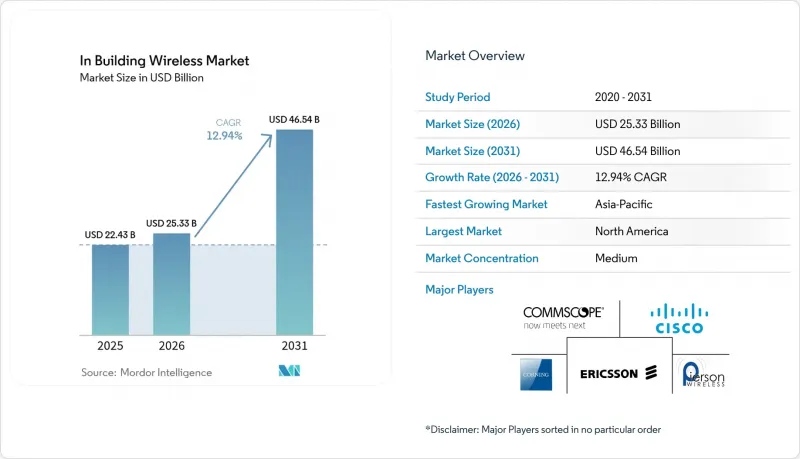
根據 Mordor Intelligence 預測,室內無線市場規模將從 2025 年的 224.3 億美元成長到 2026 年的 253.3 億美元,然後在 2031 年達到 465.4 億美元,2026 年至 2031 年的複合年成長率為 12.94%。
本報告按組件類型(天線、分散式天線系統、電纜、中繼器、小型基地台)、技術(4G/LTE、5G NR、Wi-Fi 6/6E、Wi-Fi 7)、頻段(1 GHz 以下、1-6 GHz、6 GHz 以上)、最終用戶產業(商業、住宅、工業、公共安全/政府)和地區進行分類。
全球室內無線市場趨勢與洞察
室內行動數據消耗量增加
目前,約80%的行動流量來自室內,傳統Wi-Fi難以滿足影片、AR培訓或高密度物聯網工作負載的激增需求。像Tractor Supply這樣的零售連鎖店已在超過2000家門市部署了5G網路,因為Wi-Fi無法支援即時庫存管理和客戶參與應用程式。在醫療保健領域,一家兒童醫院部署了900個TriRadio AP,以確保遠端醫療和影像流量的穩定運行,同時不影響病患照護。這清楚地表明,室內5G和Wi-Fi 6E的組合正在填補容量缺口。視訊協作和邊緣分析工作負載的不斷成長將進一步推高室內無線市場的需求,並提升其營收前景。
室內使用5G頻段的分配
監管機構正在確保專用室內頻段的分配,企業的設計也從室內外疊加網路轉向從一開始就採用專用蜂巢解決方案。在美國,CBRS競標吸引了46億美元的投資,用於3.5 GHz頻段的企業和設施部署,其中一家大型營運商就投入了18.9億美元。在歐洲,6 GHz頻段的480-500 MHz頻段已獲得許可,使得體育場館、機場和大學等場所能夠使用320 MHz頻寬頻道。中國移動撥款4.16億美元,用於在300個城市部署5G-Advanced網路,以加速大規模工廠自動化。這些頻段分配確保了長期的頻率可用性,並增強了整個室內無線市場的信心和資本投資意願。
對資料隱私和網路安全的擔憂
企業仍然對將營運流量暴露給更廣泛的蜂窩生態系統保持謹慎。遵守 GDPR(一般資料保護規則)導致歐洲對位置追蹤功能的審查日益嚴格,延長了智慧辦公室專案的採購週期。由於患者資料透過同一無線介面傳輸,醫療保健機構在批准新的無線設備之前,強制要求使用保護性管理框架 (PMF) 和高級加密技術。美國針對不安全設備的「拆除更換」規則雖然會帶來意想不到的更換成本,但最終將增強室內無線市場的安全態勢。
細分市場分析
預計到2025年,分散式天線系統(DAS)將佔銷售額的37.45%,憑藉其在體育場館、機場和A級辦公大樓等場所的高滲透率,奠定室內無線市場的基礎。同時,私有5G小型基地台正以13.52%的複合年成長率快速成長,顯示企業正向可自主擁有和管理的敏捷蜂巢式網路轉型。光纖和同軸電纜價格的上漲促使系統整合商傾向於採用主動DAS和小型基地台架構,這些架構能夠最大限度地縮短佈線距離並方便遠端軟體升級。
在天線技術創新方面,重點在於多頻段、多載波設計,它將Wi-Fi和蜂窩網路覆蓋整合到單一外形規格中,從而減少屋頂空間佔用。隨著小型叢集能夠在不加劇射頻噪聲的情況下提供更強的上行鏈路,中繼器的使用正在減少。供應商整合,例如小型基地台以21億美元收購康普的行動業務資產,正在整合電纜、連接器和無線組件,簡化採購流程。隨著對中立主機需求的成長,能夠同時傳輸公共和私有網路切片的單一骨幹基礎設施將重塑整個室內無線市場的資本配置模式。
憑藉成熟的設備生態系統和在語音及資料通訊久經考驗的穩定性,4G/LTE 在 2025 年仍保持 64.20% 的市場佔有率。同時,5G NR 正以 14.10% 的複合年成長率快速成長,這主要得益於工業自動化專案對低於 10 毫秒確定性延遲的需求。 Wi-Fi 6E 也正在迅速發展,而 Wi-Fi 7 引入了 320 MHz 頻道、多鏈路操作和 4K-QAM 技術,為企業利用非蜂窩網路方式實現超高速吞吐量鋪平了道路。
結合5G和Wi-Fi 7的混合部署正在成為醫院、智慧工廠和高等院校的標準架構。在製造工廠中,5G用於行動機器人和安全關鍵型遙測,而Wi-Fi則負責處理平板電腦和筆記型電腦的大量資料分流。中國部署的「5G-Advanced」展現了該技術處理室內寬頻的能力,從而提升了對有源DAS和小型基地台供應商的組件需求。隨著更多私有許可證的發放,室內無線市場正進一步從營運商主導轉向企業主導。
區域分析
到2025年,北美將引領室內無線市場,佔33.60%的營收佔有率。這主要得益於CBRS頻段的開放以及FirstNet公司80億美元的公共安全投資,該投資用於建設1000個新的基地台。美國企業正在採用中立主機架構,以鞏固與營運商的關係並建立面向未來的專用網路。雖然多家廠商部署Wi-Fi 7正在加速升級週期,但加拿大和墨西哥正利用汽車和航太產業的叢集,為在工廠內部署專用蜂巢式網路提供論證。
到2031年,亞太地區的年複合成長率將達到14.12%。中國目前已擁有440萬個5G基地台,並計劃在預測期內隨著製造業和物流數位轉型的推進,將這一數字提升至450萬以上。日本的授權制度支持智慧工廠中混合的6GHz以下頻段和毫米波配置,而韓國政府則為半導體工廠的園區網路提供獎勵。印度電子製造業的進步得益於本地天線生產夥伴關係關係,這些合作關係降低了進口成本並縮短了部署前置作業時間。
在歐洲,由於資料隱私和建築排放氣體方面的嚴格監管,5G技術的普及正在穩步推進。 6GHz頻段的分配正在擴大人口密集區域的Wi-Fi容量,在法國城市,專用5G的成本優勢已在城市攝影機的回程傳輸通訊中得到體現。德國、英國和法國的公司在部署方面處於領先地位,而中歐和東歐的製造商正在試點專用5G以支援「工業4.0」。嚴格的GDPR(一般資料保護規則)合規要求正促使買家轉向本地核心網路和安全設備ID框架,從而在室內無線市場形成「安全至上」的理念。
其他好處:
- Excel格式的市場預測(ME)表
- 3個月的分析師支持
目錄
第1章:引言
- 研究假設和市場定義
- 調查範圍
第2章:調查方法
第3章執行摘要
第4章 市場狀況
- 市場概覽
- 市場促進因素
- 室內移動數據使用量增加
- 5G室內頻段分配
- 企業對不間斷連結的需求日益成長。
- 智慧建築中強制部署Gigabit級Wi-Fi。
- 企業淨零排放目標正在推動低功耗、中立主機資料接取系統 (DAS) 的普及。
- 一個零售媒體網路,旨在透過分析門店客流量來實現盈利。
- 市場限制因素
- 資料隱私和網路安全問題
- DAS 的引進需要大量資本投資,涉及多家電信業者。
- CBRS/私有5G整合領域熟練勞動力短缺
- 關於歷史建築中射頻滲透性的規定
- 價值供應鏈分析
- 監理情勢
- 技術展望
- 波特五力分析
- 投資分析
第5章 市場規模與成長預測
- 依組件類型
- 天線
- 分散式天線系統(有源DAS、無源DAS)
- 電纜(同軸電纜、光纖電纜)
- 回頭客
- 小型基地台(毫微微基地台、微微型基地台、微細胞)
- 透過技術
- 4G/LTE
- 5G NR
- Wi-Fi 6/6E
- Wi-Fi 7
- 按頻段
- 低於 1 GHz(低頻寬)
- 1–6 GHz(中波頻段,包括CBRS)
- 6 GHz 以上(毫米波)
- 按最終用戶行業分類
- 商業
- 辦公室
- 零售
- 衛生保健
- 飯店業
- 住宅
- MDU
- 獨立式住宅
- 產業
- 製造業
- 倉儲業
- 石油和天然氣
- 公共安全/政府
- 商業
- 按地區
- 北美洲
- 美國
- 加拿大
- 墨西哥
- 南美洲
- 巴西
- 阿根廷
- 其他南美國家
- 歐洲
- 德國
- 英國
- 法國
- 義大利
- 西班牙
- 俄羅斯
- 其他歐洲國家
- 亞太地區
- 中國
- 日本
- 韓國
- 印度
- 其他亞太國家
- 中東
- 沙烏地阿拉伯
- 阿拉伯聯合大公國
- 土耳其
- 其他中東國家
- 非洲
- 南非
- 埃及
- 奈及利亞
- 其他非洲國家
- 北美洲
第6章 競爭情勢
- 市場集中度
- 策略趨勢
- 市佔率分析
- 公司簡介
- CommScope Holding Co.
- Cisco Systems Inc.
- Corning Inc.
- Ericsson AB
- Nokia Corp.
- ATandT Inc.
- Verizon Communications Inc.
- Pierson Wireless Corp.
- Cobham PLC
- Cambium Networks
- TE Connectivity Ltd.
- Dali Wireless Inc.
- Airspan Networks
- American Tower Corp.
- Boingo Wireless Inc.
- Extreme Networks Inc.
- Juniper Networks Inc.
- HPE(Aruba Networks)
- Samsung Electronics(Co. Networks)
- Huawei Technologies Co. Ltd.
第7章 市場機會與未來展望
According to Mordor Intelligence, the in building wireless market size is expected to grow from USD 22.43 billion in 2025 to USD 25.33 billion in 2026 and is forecast to reach USD 46.54 billion by 2031 at 12.94% CAGR over 2026-2031.
This report is Segmented by Component Type (Antenna, Distributed Antenna Systems, Cables, Repeaters, and Small Cells), Technology (4G/LTE, 5G NR, Wi-Fi 6/6E, and Wi-Fi 7), Frequency Band (Less Than 1 GHz, 1 - 6 GHz, and More Than 6 GHz), End-User Industry (Commercial, Residential, Industrial, and Public-Safety and Government), and Geography.
Global In Building Wireless Market Trends and Insights
Rising mobile-data consumption indoors
Roughly 80% of all mobile traffic now originates inside buildings, overwhelming legacy Wi-Fi whenever video, AR training, or high-density IoT workloads spike. Retail chains such as Tractor Supply adopted 5G across more than 2,000 outlets after Wi-Fi could not support real-time inventory and customer-engagement applications. In healthcare, a single children's hospital installed 900 tri-radio APs to safeguard tele-medicine and imaging traffic without patient disruption, underscoring the capacity gap that indoor 5G plus Wi-Fi 6E is filling. Growing video collaboration and edge analytics workloads will intensify the demand curve, reinforcing the revenue outlook for the In-Building Wireless market.
5G spectrum allocations for indoor use
Regulators are carving out dedicated indoor spectrum, shifting enterprise design from outdoor-to-indoor overlay to private cellular from day one. In the United States, the CBRS auction channelled USD 4.6 billion into 3.5 GHz licences aimed at enterprise and venue deployments, with one Tier-1 carrier alone spending USD 1.89 billion. Europe authorised 480-500 MHz in the 6 GHz band, enabling 320 MHz-wide channels critical for stadiums, airports, and universities. China Mobile earmarked USD 416 million for 5G-Advanced rollouts across 300 cities to accelerate factory automation at scale. Such allocations ensure long-term spectrum certainty, lifting confidence and capex commitment across the In-Building Wireless market.
Data-privacy and cybersecurity concerns
Enterprises remain cautious about exposing operational traffic to broader cellular ecosystems. GDPR compliance elevates scrutiny of location-tracking functions in Europe, prolonging procurement cycles for smart-office projects. Healthcare providers mandate Protected Management Frames and advanced encryption before approving new radios because patient data moves over the same air interface. The US "rip-and-replace" rules for insecure equipment add unexpected swap-out costs but ultimately harden the security posture of the In-Building Wireless market.
Other drivers and restraints analyzed in the detailed report include:
- Demand for uninterrupted enterprise connectivity
- Smart-building mandates for gigabit Wi-Fi
- High capex of multi-operator DAS deployments
For complete list of drivers and restraints, kindly check the Table Of Contents.
Segment Analysis
Distributed Antenna Systems held 37.45% of 2025 revenue, anchoring the In-Building Wireless market through deep penetration in stadiums, airports, and Class-A offices. Private-5G small cells, however, are advancing at a 13.52% CAGR, signaling a pivot toward agile cellular networks that enterprises can own and manage. Rising fibre and coax prices push integrators to favour active DAS or small-cell architectures that minimise cabling runs and facilitate remote software upgrades.
Antenna innovation now prioritises multi-band, multi-operator designs that collapse Wi-Fi and cellular coverage into one form factor, trimming roof-space requirements. Repeater use is declining as small-cell clusters deliver stronger uplinks without RF noise penalties. Vendor consolidation, illustrated by Amphenol's USD 2.1 billion acquisition of CommScope's mobility assets, bundles cabling, connectors, and radio components to streamline procurement. As neutral-host demand grows, single backbone infrastructures capable of carrying public and private slices simultaneously will reshape capital-allocation patterns across the In-Building Wireless market.
4G/LTE retained 64.20% share in 2025, underpinned by a mature device ecosystem and proven stability for voice and data. Yet 5G NR is expanding at a 14.10% CAGR, driven by industrial automation projects that need deterministic latency below 10 ms. Wi-Fi 6E is also scaling, but Wi-Fi 7 introduces 320 MHz channels, multi-link operation, and 4K-QAM, giving enterprises a non-cellular path to ultra-high throughput.
Hybrid deployments blending 5G and Wi-Fi 7 are emerging as the reference architecture in hospitals, smart factories, and higher-education campuses. Manufacturing plants use 5G for mobile robotics and safety-critical telemetry, while Wi-Fi handles bulk data offload for tablets and laptops. China's 5G-Advanced roll-out validates the technology's readiness for indoor broadband, fuelling component demand from active DAS and small-cell vendors. With each additional private licence granted, the In-Building Wireless market deepens its shift from operator-led to enterprise-controlled networks.
Complete Report Scope:
- By Component Type
- Antenna
- Distributed Antenna Systems (Active DAS, Passive DAS)
- Cables (Coax, Fiber)
- Repeaters
- Small Cells (Femtocell, Picocell, Microcell)
- By Technology
- 4G/LTE
- 5G NR
- Wi-Fi 6/6E
- Wi-Fi 7
- By Frequency Band
- Less than 1 GHz (Low-band)
- 1 - 6 GHz (Mid-band incl. CBRS)
- More than 6 GHz (mmWave)
- By End-user Industry
- Commercial
- Offices
- Retail
- Healthcare
- Hospitality
- Residential
- MDU
- Single-family
- Industrial
- Manufacturing
- Warehousing
- Oil and Gas
- Public-Safety and Government
- Commercial
- By Geography
- North America
- United States
- Canada
- Mexico
- South America
- Brazil
- Argentina
- Rest of South America
- Europe
- Germany
- United Kingdom
- France
- Italy
- Spain
- Russia
- Rest of Europe
- Asia-Pacific
- China
- Japan
- South Korea
- India
- Rest of Asia-Pacific
- Middle East
- Saudi Arabia
- United Arab Emirates
- Turkey
- Rest of Middle East
- Africa
- South Africa
- Egypt
- Nigeria
- Rest of Africa
- North America
Geography Analysis
North America led the In-Building Wireless market with 33.60% revenue share in 2025, aided by CBRS spectrum liberalisation and FirstNet's USD 8 billion public-safety investment that funded 1,000 new cell sites. Enterprises in the United States adopt neutral-host architectures to consolidate carrier relationships and future-proof private-network ambitions. Wi-Fi 7 launches from multiple vendors accelerate refresh cycles, while Canada and Mexico leverage their automotive and aerospace clusters to justify private cellular rollouts inside plants.
Asia-Pacific is expanding at a 14.12% CAGR to 2031. China already hosts 4.4 million 5G base stations and plans to exceed 4.5 million within the forecast horizon as it digitalises manufacturing and logistics. Japan's licence regime supports sub-6 and mmWave hybrids in smart factories, and South Korea channels state incentives into campus networks at semiconductor fabs. India's electronic-manufacturing drive is supported by antenna localisation partnerships that trim import costs and shorten deployment lead times.
Europe shows steady uptake influenced by regulatory stringency around data privacy and building emissions. The 6 GHz allocation enlarges Wi-Fi capacity for dense venues, and French cities demonstrate the cost advantage of private 5G for municipal camera backhaul. German, British, and French enterprises lead adoption, while Central-Eastern manufacturers pilot private 5G to support Industry 4.0. Strict GDPR compliance requirements nudge buyers toward on-premises core networks and secure device-identity frameworks, shaping a security-first approach within the In-Building Wireless market.
- CommScope Holding Co.
- Cisco Systems Inc.
- Corning Inc.
- Ericsson AB
- Nokia Corp.
- ATandT Inc.
- Verizon Communications Inc.
- Pierson Wireless Corp.
- Cobham PLC
- Cambium Networks
- TE Connectivity Ltd.
- Dali Wireless Inc.
- Airspan Networks
- American Tower Corp.
- Boingo Wireless Inc.
- Extreme Networks Inc.
- Juniper Networks Inc.
- HPE (Aruba Networks)
- Samsung Electronics (Co. Networks)
- Huawei Technologies Co. Ltd.
Additional Benefits:
- The market estimate (ME) sheet in Excel format
- 3 months of analyst support
TABLE OF CONTENTS
1 INTRODUCTION
- 1.1 Study Assumptions and Market Definition
- 1.2 Scope of the Study
2 RESEARCH METHODOLOGY
3 EXECUTIVE SUMMARY
4 MARKET LANDSCAPE
- 4.1 Market Overview
- 4.2 Market Drivers
- 4.2.1 Rising mobile data consumption indoors
- 4.2.2 5G spectrum allocations for indoor use
- 4.2.3 Growing demand for uninterrupted enterprise connectivity
- 4.2.4 Smart-building mandates for gigabit-grade Wi-Fi
- 4.2.5 Corporate net-zero targets driving low-power neutral-host DAS
- 4.2.6 Retail media networks monetising in-store footfall analytics
- 4.3 Market Restraints
- 4.3.1 Data-privacy and cybersecurity concerns
- 4.3.2 High capex of multi-operator DAS deployments
- 4.3.3 Skilled-labour shortage for CBRS/Private-5G integration
- 4.3.4 Radio-frequency transparency rules in heritage buildings
- 4.4 Value/Supply-Chain Analysis
- 4.5 Regulatory Landscape
- 4.6 Technological Outlook
- 4.7 Porter's Five Forces Analysis
- 4.7.1 Bargaining Power of Suppliers
- 4.7.2 Bargaining Power of Buyers
- 4.7.3 Threat of New Entrants
- 4.7.4 Threat of Substitutes
- 4.7.5 Intensity of Competitive Rivalry
- 4.8 Investment Analysis
5 MARKET SIZE AND GROWTH FORECASTS (VALUE)
- 5.1 By Component Type
- 5.1.1 Antenna
- 5.1.2 Distributed Antenna Systems (Active DAS, Passive DAS)
- 5.1.3 Cables (Coax, Fiber)
- 5.1.4 Repeaters
- 5.1.5 Small Cells (Femtocell, Picocell, Microcell)
- 5.2 By Technology
- 5.2.1 4G/LTE
- 5.2.2 5G NR
- 5.2.3 Wi-Fi 6/6E
- 5.2.4 Wi-Fi 7
- 5.3 By Frequency Band
- 5.3.1 Less than 1 GHz (Low-band)
- 5.3.2 1 - 6 GHz (Mid-band incl. CBRS)
- 5.3.3 More than 6 GHz (mmWave)
- 5.4 By End-user Industry
- 5.4.1 Commercial
- 5.4.1.1 Offices
- 5.4.1.2 Retail
- 5.4.1.3 Healthcare
- 5.4.1.4 Hospitality
- 5.4.2 Residential
- 5.4.2.1 MDU
- 5.4.2.2 Single-family
- 5.4.3 Industrial
- 5.4.3.1 Manufacturing
- 5.4.3.2 Warehousing
- 5.4.3.3 Oil and Gas
- 5.4.4 Public-Safety and Government
- 5.4.1 Commercial
- 5.5 By Geography
- 5.5.1 North America
- 5.5.1.1 United States
- 5.5.1.2 Canada
- 5.5.1.3 Mexico
- 5.5.2 South America
- 5.5.2.1 Brazil
- 5.5.2.2 Argentina
- 5.5.2.3 Rest of South America
- 5.5.3 Europe
- 5.5.3.1 Germany
- 5.5.3.2 United Kingdom
- 5.5.3.3 France
- 5.5.3.4 Italy
- 5.5.3.5 Spain
- 5.5.3.6 Russia
- 5.5.3.7 Rest of Europe
- 5.5.4 Asia-Pacific
- 5.5.4.1 China
- 5.5.4.2 Japan
- 5.5.4.3 South Korea
- 5.5.4.4 India
- 5.5.4.5 Rest of Asia-Pacific
- 5.5.5 Middle East
- 5.5.5.1 Saudi Arabia
- 5.5.5.2 United Arab Emirates
- 5.5.5.3 Turkey
- 5.5.5.4 Rest of Middle East
- 5.5.6 Africa
- 5.5.6.1 South Africa
- 5.5.6.2 Egypt
- 5.5.6.3 Nigeria
- 5.5.6.4 Rest of Africa
- 5.5.1 North America
6 COMPETITIVE LANDSCAPE
- 6.1 Market Concentration
- 6.2 Strategic Moves
- 6.3 Market Share Analysis
- 6.4 Company Profiles (includes Global level Overview, Market level overview, Core Segments, Financials as available, Strategic Information, Market Rank/Share, Products and Services, Recent Developments)
- 6.4.1 CommScope Holding Co.
- 6.4.2 Cisco Systems Inc.
- 6.4.3 Corning Inc.
- 6.4.4 Ericsson AB
- 6.4.5 Nokia Corp.
- 6.4.6 ATandT Inc.
- 6.4.7 Verizon Communications Inc.
- 6.4.8 Pierson Wireless Corp.
- 6.4.9 Cobham PLC
- 6.4.10 Cambium Networks
- 6.4.11 TE Connectivity Ltd.
- 6.4.12 Dali Wireless Inc.
- 6.4.13 Airspan Networks
- 6.4.14 American Tower Corp.
- 6.4.15 Boingo Wireless Inc.
- 6.4.16 Extreme Networks Inc.
- 6.4.17 Juniper Networks Inc.
- 6.4.18 HPE (Aruba Networks)
- 6.4.19 Samsung Electronics (Co. Networks)
- 6.4.20 Huawei Technologies Co. Ltd.
7 MARKET OPPORTUNITIES AND FUTURE OUTLOOK
- 7.1 White-space and Unmet-need Assessment

 室內無線市場-2026-2032年全球市場預測
 2026年全球室內無線市場報告
 室內無線市場:依組件、應用、部署模式、技術、最終用戶、國家及地區分類-全球市場分析、市場規模、市場佔有率及2026年至2033年預測
 室內無線市場規模、佔有率和成長分析(按組件、系統類型、技術、部署類型、最終用戶產業和地區分類)-2026-2033年產業預測無線演示與協作系統市場:按組件類型、部署類型、連接技術、組織規模和最終用戶行業分類 - 全球預測(2026-2032 年)室內蜂窩系統無線 BMS 解決方案市場(按組件、拓撲、電池類型、連接性和應用)- 2025-2030 年全球預測
 室內無線市場:全球按產品、技術、經營模式、建築規模、網路類型、最終用戶和地區分類 - 預測至 2030 年
 無線簡報解決方案市場按技術、經營模式、安裝類型和最終用戶行業分類的室內覆蓋市場 - 2025 年至 2030 年全球預測