


 |
市場調查報告書
商品編碼
2123083
進階分析:市場佔有率分析、產業趨勢和統計數據、成長預測(2026-2031 年)Advanced Analytics - Market Share Analysis, Industry Trends & Statistics, Growth Forecasts (2026 - 2031) |
||||||

※ 本網頁內容可能與最新版本有所差異。詳細情況請與我們聯繫。
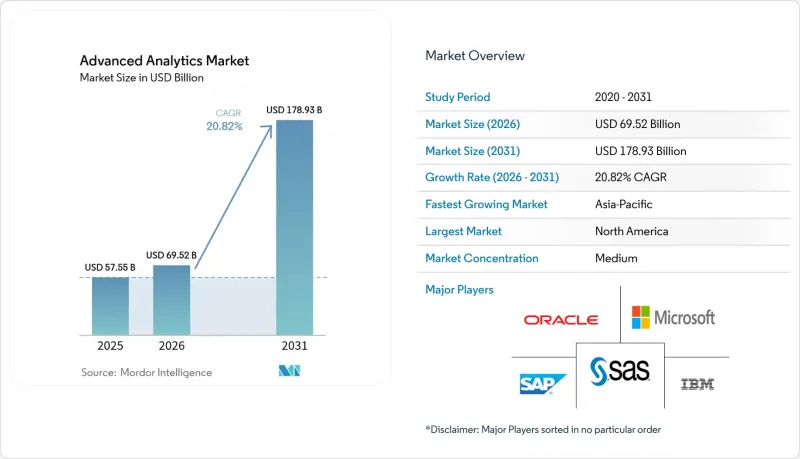
根據 Mordor Intelligence 估計,到 2026 年,進階分析市值將達到 695.2 億美元,高於 2025 年的 575.5 億美元,預計到 2031 年將達到 1789.3 億美元。
預計2026年至2031年複合年成長率將達20.82%。
本報告按類型(統計分析、文字分析等)、部署模式(本地部署、雲端部署、混合部署)、元件(解決方案和服務)、業務職能(銷售和行銷、財務和風險等)、最終用戶產業、組織規模(大型企業、中小企業)和地區進行細分。市場預測以美元(USD)計價。
全球高階分析市場趨勢與洞察
對詐欺偵測的需求日益成長
金融機構正面臨日益複雜的詐欺威脅,而基於規則的系統已無法有效應對。美國監管機構建議採用人工智慧驅動的監控,機器學習模型已將偵測準確率提高了 40%,同時將誤報率降低了一半。 IBM 的研究表明,在近乎即時地分析大規模交易資料時,分類準確率可達 95%。混合雲端邊緣架構能夠滿足亞秒延遲要求,並為服務供應商創造機會,將詐欺分析、合規性儀表板和模型管治整合到統一的平台中。
巨量資料規模和複雜性的爆炸性成長
到2024年,企業每天將產生3.2877億TB的數據,遠遠超出傳統商業智慧工具的處理能力。目前,近一半的企業正在採用混合式儲存和資料架構方法來整合孤立的資料來源,為部署進階分析解決方案做好準備。預計到2025年,超過50%的關鍵處理將在傳統資料中心之外進行,這凸顯了自動化資料準備和增強型分析日益成長的需求,這些工具即使對於不具備技術專長的業務用戶也能提供洞察。
數據整合和連接差距
碎片化的架構常常將資料困在老舊的本機系統、雲端和營運技術 (OT) 系統中。企業將 64% 的工程時間用於整合而非分析,這減緩了投資回報,並阻礙了大型專案的開展。製造企業面臨專有協議的挑戰,這些協議使分析整合變得複雜,從而導致對資料架構和無程式碼整合解決方案的需求不斷成長。
細分市場分析
邊緣分析因其在對延遲要求極高的物聯網場景中的作用而備受關注,預計到2031年將保持27.35%的複合年成長率。相較之下,預測分析作為主流的預測方法,截至2025年仍佔高階分析市場24.05%的佔有率。邊緣設備透過在本地執行推理,降低網路成本並確保資料主權,這對於高度監管的行業至關重要。汽車、能源和製造業的公司正在採用緊湊型推理晶片來實現異常檢測和自主控制迴路。供應商正透過聯邦學習功能來脫穎而出,這些功能無需向外部發送原始資料即可訓練全域模型。在非結構化資料量激增的情況下,文字和視覺化分析的應用依然強勁,而規範性分析和風險分析則受到最佳化和情境建模需求的驅動。
隨著 5G 覆蓋範圍的擴大,邊緣分析的高級分析市場預計將快速成長。關鍵基礎設施的所有者正在從集中式雲端轉向分散式網狀網路,將決策邏輯分佈到渦輪機、變電站和車輛等各個環節。同時,現有的預測平台正在整合即時資料流以避免過時,這表明市場正在向混合雲邊緣架構發展。
受銀行和政府機構青睞的本地部署架構預計到2025年將佔總收入的53.40%,這主要是由於資料主權法規的限制。然而,隨著企業尋求可擴展能源和付費使用制的經濟模式,雲端運算的採用率正以23.95%的複合年成長率成長。儘管超大規模資料中心業者優先考慮擴展其GPU集群,但間歇性的容量短缺為專業分析雲端和託管邊緣混合雲創造了機會。
透過改善安全性和敏感計算服務,客戶的擔憂正逐步解決。隨著可自動執行漂移偵測、版本控制和管治的託管 ModelOps 套件的推出,雲端工作負載高階分析的市場規模正在進一步擴大。混合方案將敏感的本地資料處理與雲端突發訓練週期結合,從而在確保合規性的同時,又不限制創新。區域資料居住法正在影響服務提供者的基礎設施擴展,尤其是在歐盟和亞太地區,各國的資料駐留區域都在遵守隱私法規。
區域分析
2025年,北美將繼續佔據高階分析市場40.65%的收入佔有率。創業投資已向人工智慧領域投入1,091億美元,其中339億美元用於產生模型、新創企業生態系統拓展和企業實驗。美國超大規模資料中心業者正透過部署新的GPU叢集來解決傳統的容量限制問題,亞馬遜在賓州斥資200億美元擴建基礎設施,充分展現了這項投資的規模。監管措施眾多,但仍較為分散,這推動了對管治相關附加元件的需求,以解讀不同的聯邦和州級法規要求。
亞太地區(APAC)以22.40%的複合年成長率(CAGR)領跑,主要得益於製造業自動化、5G部署和政府智慧城市津貼。中國人工智慧模型的進步正在催生具有競爭力的本土替代解決方案,而印度的IT服務出口則為當地製造商提供了實施這些解決方案所需的人才。日本和韓國正大力推動邊緣分析應用在工業機器人和自動駕駛領域的應用。東南亞國家的高階分析市場正在擴張,並整合電子商務、金融科技和物流平台,這主要得益於整體擁有成本(TCO)的降低和公共部門數位化政策的推動。
在歐洲,市場在日益嚴格的政策下穩步成長。歐盟人工智慧法案正在加速可解釋平台的普及,以滿足透明度法規的要求,尤其是在關鍵領域。德國汽車和機械製造商正在採用預測性和指示性分析分析技術來實現工業4.0,而北歐公共產業則正在實施永續性分析以最佳化可再生能源的使用。英國金融機構正投資於脫歐後的風險模型管治。歐洲高級分析市場的規模受益於跨境資料空間計劃,這些計劃協調了成員國之間的資料共用標準,但合規負擔延長了引進週期。
其他好處:
- Excel格式的市場預測(ME)表
- 3個月的分析師支持
目錄
第1章:引言
- 研究假設和市場定義
- 調查範圍
第2章:調查方法
第3章執行摘要
第4章 市場狀況
- 市場概覽
- 市場促進因素
- 對詐欺偵測的需求日益成長
- 巨量資料規模和複雜性的爆炸性成長
- 企業數位轉型浪潮
- 人工智慧/機器學習的快速普及和雲端運算成本的下降
- 用於即時決策的邊緣分析
- 監管部門為實現可解釋人工智慧所做的努力
- 市場限制因素
- 數據整合和連接差距
- 資料科學人才短缺
- 計算能源的永續性
- 供應商鎖定導致超大規模雲
- 價值供應鏈分析
- 監理情勢
- 技術展望
- 波特五力分析
第5章 市場規模與成長預測
- 按類型
- 統計分析
- 文字分析
- 風險分析
- 預測分析
- 指示性分析
- 視覺化分析
- 網路分析
- 地理空間分析
- 社群媒體分析
- 邊緣分析
- 其他類型
- 部署模式
- 現場
- 雲
- 混合
- 按組件
- 解決方案
- 服務
- 諮詢
- 託管服務
- 業務職能
- 銷售與行銷
- 金融與風險
- 營運和供應鏈
- 人力資源
- 客戶支援
- 按最終用戶行業分類
- BFSI
- 零售和消費品
- 醫療保健和生命科學
- 資訊科技/通訊
- 運輸/物流
- 政府/國防
- 製造業
- 能源公用事業
- 媒體與娛樂
- 其他行業
- 按組織規模
- 大公司
- 中小企業
- 按地區
- 北美洲
- 美國
- 加拿大
- 墨西哥
- 南美洲
- 巴西
- 阿根廷
- 其他南美國家
- 歐洲
- 英國
- 德國
- 法國
- 義大利
- 其他歐洲國家
- 亞太地區
- 中國
- 日本
- 印度
- 韓國
- 其他亞太國家
- 中東
- 以色列
- 沙烏地阿拉伯
- 阿拉伯聯合大公國
- 土耳其
- 其他中東國家
- 非洲
- 南非
- 埃及
- 其他非洲國家
- 北美洲
第6章 競爭情勢
- 市場集中度
- 策略趨勢
- 市佔率分析
- 公司簡介
- IBM Corporation
- Microsoft Corporation
- SAS Institute Inc.
- SAP SE
- Oracle Corporation
- Amazon Web Services(AWS)
- Google LLC
- Salesforce Inc.(Tableau)
- Teradata Corporation
- QlikTech International AB
- MicroStrategy Incorporated
- Alteryx Inc.
- KNIME AG
- RapidMiner Inc.
- TIBCO Software Inc.
- Altair Engineering Inc.
- Sisense Inc.
- Domo Inc.
- Fair Isaac Corporation(FICO)
- Avanade Inc.
第7章 市場機會與未來展望
According to Mordor Intelligence, the advanced analytics market size in 2026 is estimated at USD 69.52 billion, growing from 2025 value of USD 57.55 billion with 2031 projections showing USD 178.93 billion, growing at 20.82% CAGR over 2026-2031.
This report is Segmented by Type (Statistical Analysis, Text Analytics, and More), Deployment Mode (On-Premises, Cloud, Hybrid), Component (Solutions and Services), Business Function (Sales & Marketing, Finance & Risk, and More), End-User Industry, Organization Size (Large Enterprises, Smes), and Geography. The Market Forecasts are Provided in Terms of Value (USD).
Global Advanced Analytics Market Trends and Insights
Escalating Fraud-Detection Needs
Financial institutions face highly sophisticated fraud threats that outpace rule-based systems. U.S. regulators urge AI-driven monitoring, and machine-learning models already lift detection accuracy by 40% while halving false positives. IBM research shows 95% classification accuracy when large-scale transaction data is analysed in near real time. Hybrid cloud-edge architectures satisfy sub-second latency requirements and create opportunities for providers bundling fraud analytics, compliance dashboards, and model governance into unified platforms.
Big-Data Volume & Complexity Explosion
Enterprises generated 328.77 million TB daily in 2024, overwhelming traditional BI tooling. Nearly half now employ hybrid storage and data-fabric approaches to integrate siloed sources for advanced analytics market deployments. By 2025, more than 50% of critical processing is expected outside conventional data centers, reinforcing the need for automated data preparation and augmented analytics that expose insights to non-technical business users.
Data Integration & Connectivity Gaps
Fragmented architectures often trap data across aging on-premises, cloud, and operational-technology systems. Organizations allocate 64% of engineering time to integration rather than analysis, delaying returns and dampening enthusiasm for large-scale projects. Industrial firms battle proprietary protocols that complicate analytics linkages, reinforcing the premium placed on data-fabric and no-code integration solutions.
Other drivers and restraints analyzed in the detailed report include:
- Enterprise Digital-Transformation Wave
- Regulatory Push for Explainable AI
- Shortage of Data-Science Talent
For complete list of drivers and restraints, kindly check the Table Of Contents.
Segment Analysis
Edge Analytics owns a 27.35% CAGR to 2031, reflecting its role in latency-critical IoT scenarios. In contrast, Predictive Analytics retained 24.05% advanced analytics market share in 2025 as the mainstream choice for forecasting. Edge devices perform localized inference, cutting network costs and ensuring data sovereignty, which is vital for regulated verticals. Automotive, energy, and manufacturing players are embedding compact inference chips to enable anomaly detection and autonomous control loops. Vendors differentiate through federated-learning capabilities that train global models without raw-data egress. Text and Visual Analytics hold steady adoption as unstructured data volumes balloon, while Prescriptive and Risk Analytics are spurred by demand for optimization and scenario modelling.
The advanced analytics market size for Edge Analytics is poised to expand rapidly as 5G coverage broadens. Critical infrastructure owners shift from centralized clouds to distributed mesh fabrics that push decision logic to turbines, substations, and vehicles. Meanwhile, established predictive platforms are integrating real-time data streams to avoid obsolescence, illustrating the market's pivot toward hybrid cloud-edge designs
On-Premises architectures, favored by banks and public agencies, accounted for 53.40% revenue in 2025 largely due to data-sovereignty mandates. Still, Cloud deployment is rising at 23.95% CAGR as enterprises pursue elastic scaling and pay-as-you-go economics. Hyperscalers prioritize GPU fleet expansion, though intermittent capacity shortfalls create openings for specialized analytics clouds and colocation-edge hybrids.
Security improvements and confidential-compute services steadily erode customer objections. The advanced analytics market size for cloud workloads gains further lift from managed model-ops suites that automate drift detection, versioning, and governance. Hybrid scenarios blend sensitive on-premises data processing with burst-to-cloud training cycles, ensuring compliance without capping innovation. Regional data-residency laws now shape provider buildouts, particularly in the EU and APAC, where in-country zones address privacy statutes.
Complete Report Scope:
- By Type
- Statistical Analysis
- Text Analytics
- Risk Analytics
- Predictive Analytics
- Prescriptive Analytics
- Visual Analytics
- Network Analytics
- Geospatial Analytics
- Social Media Analytics
- Edge Analytics
- Other Types
- By Deployment Mode
- On-Premise
- Cloud
- Hybrid
- By Component
- Solutions
- Services
- Consulting
- Managed Services
- By Business Function
- Sales and Marketing
- Finance and Risk
- Operations and Supply-Chain
- Human Resources
- Customer Support
- By End-User Industry
- BFSI
- Retail and Consumer Goods
- Healthcare and Life Sciences
- IT and Telecommunication
- Transportation and Logistics
- Government and Defense
- Manufacturing
- Energy and Utilities
- Media and Entertainment
- Other Industries
- By Organization Size
- Large Enterprises
- Small and Mid-Sized Enterprises (SMEs)
- By Geography
- North America
- United States
- Canada
- Mexico
- South America
- Brazil
- Argentina
- Rest of South America
- Europe
- United Kingdom
- Germany
- France
- Italy
- Rest of Europe
- Asia-Pacific
- China
- Japan
- India
- South Korea
- Rest of Asia-Pacific
- Middle East
- Israel
- Saudi Arabia
- United Arab Emirates
- Turkey
- Rest of Middle East
- Africa
- South Africa
- Egypt
- Rest of Africa
- North America
Geography Analysis
North America continued to command 40.65% of advanced analytics market revenue in 2025. Venture capital channelled USD 109.1 billion into AI, including USD 33.9 billion for generative models, expanding startup ecosystems and enterprise experimentation. U.S. hyperscalers address prior capacity constraints by injecting new GPU clusters, with Amazon's USD 20 billion Pennsylvania build-out illustrating the scale of investment. Regulatory initiatives, though numerous, remain fragmented, prompting demand for governance add-ons that interpret divergent federal and state requirements.
APAC posts the highest 22.40% CAGR, propelled by manufacturing automation, 5G rollouts, and government smart-city grants. Chinese AI-model enhancements create competitive domestic alternatives, while India's IT-services exports deliver implementation talent to regional manufacturers. Japan and South Korea push deep into edge-analytics applications for industrial robotics and autonomous mobility. Lower total-cost-of-ownership and public-sector digitalization policies expand the advanced analytics market across Southeast Asian nations integrating ecommerce, fintech, and logistics platforms.
Europe grows steadily under rigorously evolving policy. The EU AI Act accelerates purchases of explainable platforms to satisfy transparency rules, especially in critical sectors. Germany's automotive and machinery firms adopt predictive and prescriptive analytics for Industry 4.0, while Nordic utilities embed sustainability analytics to optimize renewables. United Kingdom financial institutions invest in risk-model governance post-Brexit. The advanced analytics market size in Europe benefits from cross-border data-space initiatives that harmonize sharing standards among member states, yet compliance workloads elongate deployment cycles.
- IBM Corporation
- Microsoft Corporation
- SAS Institute Inc.
- SAP SE
- Oracle Corporation
- Amazon Web Services (AWS)
- Google LLC
- Salesforce Inc. (Tableau)
- Teradata Corporation
- QlikTech International AB
- MicroStrategy Incorporated
- Alteryx Inc.
- KNIME AG
- RapidMiner Inc.
- TIBCO Software Inc.
- Altair Engineering Inc.
- Sisense Inc.
- Domo Inc.
- Fair Isaac Corporation (FICO)
- Avanade Inc.
Additional Benefits:
- The market estimate (ME) sheet in Excel format
- 3 months of analyst support
TABLE OF CONTENTS
1 INTRODUCTION
- 1.1 Study Assumptions and Market Definition
- 1.2 Scope of the Study
2 RESEARCH METHODOLOGY
3 EXECUTIVE SUMMARY
4 MARKET LANDSCAPE
- 4.1 Market Overview
- 4.2 Market Drivers
- 4.2.1 Escalating fraud-detection needs
- 4.2.2 Big-data volume and complexity explosion
- 4.2.3 Enterprise digital-transformation wave
- 4.2.4 Rapid AI/ML and cloud cost declines
- 4.2.5 Edge analytics for real-time decisions
- 4.2.6 Regulatory push for explainable AI
- 4.3 Market Restraints
- 4.3.1 Data integration and connectivity gaps
- 4.3.2 Shortage of data-science talent
- 4.3.3 Sustainability limits on compute energy
- 4.3.4 Vendor lock-in to hyperscale clouds
- 4.4 Value / Supply-Chain Analysis
- 4.5 Regulatory Landscape
- 4.6 Technological Outlook
- 4.7 Porter's Five Forces Analysis
- 4.7.1 Bargaining Power of Suppliers
- 4.7.2 Bargaining Power of Consumers
- 4.7.3 Threat of New Entrants
- 4.7.4 Threat of Substitutes
- 4.7.5 Intensity of Competitive Rivalry
5 MARKET SIZE AND GROWTH FORECASTS (VALUE)
- 5.1 By Type
- 5.1.1 Statistical Analysis
- 5.1.2 Text Analytics
- 5.1.3 Risk Analytics
- 5.1.4 Predictive Analytics
- 5.1.5 Prescriptive Analytics
- 5.1.6 Visual Analytics
- 5.1.7 Network Analytics
- 5.1.8 Geospatial Analytics
- 5.1.9 Social Media Analytics
- 5.1.10 Edge Analytics
- 5.1.11 Other Types
- 5.2 By Deployment Mode
- 5.2.1 On-Premise
- 5.2.2 Cloud
- 5.2.3 Hybrid
- 5.3 By Component
- 5.3.1 Solutions
- 5.3.2 Services
- 5.3.2.1 Consulting
- 5.3.2.2 Managed Services
- 5.4 By Business Function
- 5.4.1 Sales and Marketing
- 5.4.2 Finance and Risk
- 5.4.3 Operations and Supply-Chain
- 5.4.4 Human Resources
- 5.4.5 Customer Support
- 5.5 By End-User Industry
- 5.5.1 BFSI
- 5.5.2 Retail and Consumer Goods
- 5.5.3 Healthcare and Life Sciences
- 5.5.4 IT and Telecommunication
- 5.5.5 Transportation and Logistics
- 5.5.6 Government and Defense
- 5.5.7 Manufacturing
- 5.5.8 Energy and Utilities
- 5.5.9 Media and Entertainment
- 5.5.10 Other Industries
- 5.6 By Organization Size
- 5.6.1 Large Enterprises
- 5.6.2 Small and Mid-Sized Enterprises (SMEs)
- 5.7 By Geography
- 5.7.1 North America
- 5.7.1.1 United States
- 5.7.1.2 Canada
- 5.7.1.3 Mexico
- 5.7.2 South America
- 5.7.2.1 Brazil
- 5.7.2.2 Argentina
- 5.7.2.3 Rest of South America
- 5.7.3 Europe
- 5.7.3.1 United Kingdom
- 5.7.3.2 Germany
- 5.7.3.3 France
- 5.7.3.4 Italy
- 5.7.3.5 Rest of Europe
- 5.7.4 Asia-Pacific
- 5.7.4.1 China
- 5.7.4.2 Japan
- 5.7.4.3 India
- 5.7.4.4 South Korea
- 5.7.4.5 Rest of Asia-Pacific
- 5.7.5 Middle East
- 5.7.5.1 Israel
- 5.7.5.2 Saudi Arabia
- 5.7.5.3 United Arab Emirates
- 5.7.5.4 Turkey
- 5.7.5.5 Rest of Middle East
- 5.7.6 Africa
- 5.7.6.1 South Africa
- 5.7.6.2 Egypt
- 5.7.6.3 Rest of Africa
- 5.7.1 North America
6 COMPETITIVE LANDSCAPE
- 6.1 Market Concentration
- 6.2 Strategic Moves
- 6.3 Market Share Analysis
- 6.4 Company Profiles (includes Global level Overview, Market level overview, Core Segments, Financials as available, Strategic Information, Market Rank/Share for key companies, Products and Services, and Recent Developments)
- 6.4.1 IBM Corporation
- 6.4.2 Microsoft Corporation
- 6.4.3 SAS Institute Inc.
- 6.4.4 SAP SE
- 6.4.5 Oracle Corporation
- 6.4.6 Amazon Web Services (AWS)
- 6.4.7 Google LLC
- 6.4.8 Salesforce Inc. (Tableau)
- 6.4.9 Teradata Corporation
- 6.4.10 QlikTech International AB
- 6.4.11 MicroStrategy Incorporated
- 6.4.12 Alteryx Inc.
- 6.4.13 KNIME AG
- 6.4.14 RapidMiner Inc.
- 6.4.15 TIBCO Software Inc.
- 6.4.16 Altair Engineering Inc.
- 6.4.17 Sisense Inc.
- 6.4.18 Domo Inc.
- 6.4.19 Fair Isaac Corporation (FICO)
- 6.4.20 Avanade Inc.
7 MARKET OPPORTUNITIES AND FUTURE OUTLOOK
- 7.1 White-space and Unmet-Need Assessment

 全球高階分析市場規模、佔有率、趨勢和成長分析報告(2026-2034年)
 高階分析市場-2026-2032年全球市場預測
 事件流處理解決方案市場預測至 2034 年—按組件、部署類型、組織規模、最終用戶和地區分類的全球分析即時分析平台市場預測至 2034 年—按組件、部署類型、組織規模、應用、最終用戶和地區進行全球分析。
 進階分析市場規模、佔有率、趨勢和預測:按組件、類型、部署模式、業務功能、企業規模、行業和地區分類,2026-2034 年
 2026-2030年全球水風險情報軟體市場
 2026年全球高階分析市場報告
 進階分析市場分析及預測(至 2035 年):按類型、產品、服務、技術、組件、應用、部署、最終用戶、功能和解決方案分類
 全球高階分析市場依產品及交付方式分類-預測至2031年進階分析市場規模、佔有率、成長及全球產業分析:按類型、應用和地區分類,並提供 2026-2034 年的洞察和預測