


 |
市場調查報告書
商品編碼
2123072
智慧空間:市場佔有率分析、產業趨勢與統計、成長預測(2026-2031)Smart Spaces - Market Share Analysis, Industry Trends & Statistics, Growth Forecasts (2026 - 2031) |
||||||

※ 本網頁內容可能與最新版本有所差異。詳細情況請與我們聯繫。
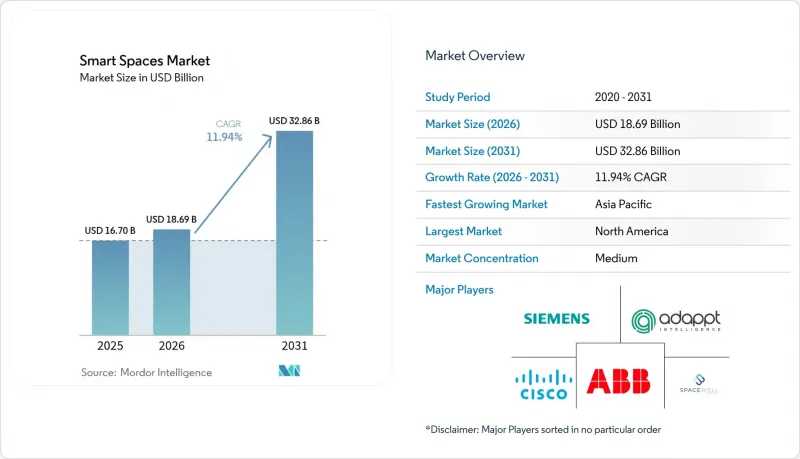
根據 Mordor Intelligence 預測,智慧空間市場規模將從 2025 年的 167 億美元成長到 2026 年的 186.9 億美元,然後在 2031 年達到 328.6 億美元,2026 年至 2031 年的複合年成長率為 11.94%。
[1] Thread Group,“Thread 1.4 產品認證數量突破 6.7 億”,threadgroup.org。這一上升趨勢的形成得益於物聯網感測器價格的下降,從而促進了大規模部署;強制性的淨零建築標準加速了數位化維修;以及混合辦公模式推動了即時空間最佳化。該報告按類型(解決方案和服務)、最終用戶行業(商業和住宅)、應用(能源管理、佔用率和空間分析、照明和暖通空調控制等)、連接技術(Wi-Fi、Zigbee、Z-Wave 等)以及地區進行細分。
全球智慧空間市場趨勢與洞察
物聯網設備的普及和感測器價格的下降
由於半導體供應過剩,自 2023 年以來,感測器的平均售價已下降兩位數,使得建築業主能夠在物業各處安裝人員佔用、空氣品質和電錶節點,並將詳細數據發送到雲端進行分析。到 2025 年初,已有超過 670 款通過 Thread 認證的設備出貨,這清楚地表明,供應商現在將多廠商互通性視為必備條件。 Milesight 總部部署了 352 個感測器,每年節省能源成本 4.5 萬美元,這一案例已成為設施管理人員的熱門話題。邊緣 AI 晶片記憶頻寬的提升消除了延遲的負面影響,並支援即時控制迴路,但與現有設施的整合仍然取決於傳統的佈線和控制系統。隨著資本成本的下降,決策越來越受節能性能而非硬體價格的驅動,這種轉變使智慧空間市場保持需求主導的週期性成長。
為適應混合辦公模式而進行的辦公室重新設計正在加速。
隨著混合辦公模式的引入,工作日員工人數波動,傳統的基於時間的暖通空調(HVAC)編程方式已不再適用。江森自控在2025年第一季收到的自適應控制系統訂單增加了16%,這些系統能夠根據實際入住率而非歷史平均值來調節氣流和照明。在華盛頓特區的一棟辦公大樓中,用多感測器入住數據取代固定設置,並指示冷卻器根據需求曲線運行,最終實現了33%的節能效果。人工智慧驅動的通風模型在將二氧化碳濃度維持在1000 ppm以下的同時,將通風能耗降低了12.5%,從而實現了員工健康和收入目標。商業房地產所有者正在嘗試“動態租金”,這種租金可以根據實際使用情況靈活調整,將數據排放轉化為收入來源。然而,即時分析需要網路安全和安全的資料湖,以根據GDPR和CCPA保護租戶隱私。
現有建築的初期維修成本很高
老舊建築通常採用專有的暖通空調和照明系統,難以與開放協議相容。 QuadReal 需要一個 3000 萬平方英尺的被動光纖骨幹網路來整合其異構子系統,這項資本項目之所以合理,僅僅是因為預計營運成本將降低 50% 至 70%。 Limbach 對 20 個採用不同年代暖通空調系統的設施進行數位化改造時,發現資料粒度不一致,導致分析複雜化。像 PHOENIX 這樣的試驗計畫實現了 39% 至 61% 的顯著效率提升,但需要客製化中間件來標準化遙測資料。雖然可以透過利用能源服務公司 (ESCO) 的資金籌措和基於績效的租賃將初始投資轉化為服務費用,但當相關人員必須在同一專案章程下協調機械、電氣和 IT 升級時,決策週期仍然很長。
細分市場分析
到2025年,解決方案板塊將佔據最大的收入佔有率,達到67.35%,代表112.5億美元的智慧空間市場規模。雖然硬體設備和監控軟體構成了數位化基礎,但終端用戶擴大將最佳化任務外包給第三方。服務板塊預計將實現13.61%的複合年成長率,這反映出市場對持續性能驗證、遠距離診斷和人工智慧驅動的決策支援的需求日益成長。 2024年3月,BrainBox AI發表了一款生成式建築助手,能夠就能源異常進行對話式查詢並提供相應的調整建議。特靈科技迅速將這項功能整合到其售後市場產品組合中,將自主式暖通空調控制系統與基於結果的合約捆綁在一起,從而保證兩位數的能源成本降低。託管服務供應商透過向演算法提供數據,使冷卻器保持在狹窄的設定點範圍內,從而減少磨損並降低碳排放,進而透過每小時遙測數據獲得收入。由於內部設施管理團隊的活動受到人手不足的限制,經營團隊將外部專業知識視為防止績效下降風險的保障。
從長遠來看,隨著設備韌體、分析模型和安全性修補程式的持續更新,混合雲端架構將模糊產品和服務之間的界限。同時擁有邊緣設備和雲端平台的供應商無需現場服務即可提供空中下載 (OTA) 功能增強,這既能增強供應商的鎖定效應,又能將僅提供硬體的競爭對手拒之門外。因此,在智慧空間市場,那些從一次性安裝轉向生命週期管理的公司將更有價值,服務業的成長溢價也將更加顯著。
2025年,商業不動產、醫療保健、旅館及零售四大產業合計佔智慧空間市場規模的58.40%,總額達97.5億美元。辦公室正在尋求靈活的座位安排,這需要可分析的使用率數據;醫院則在追蹤通風和設備的運作,以控制感染。然而,住宅領域的需求,尤其是多用戶住宅的需求,預計將以13.28%的複合年成長率成長。 Logical Buildings公司正在透過在其所多用戶住宅住宅中運營一座價值1.1億美元的虛擬電廠,展示大規模住宅系統的經濟效益,從而實現需量反應的貨幣化。 2024年12月,SmartRent公司累計1,000萬美元,用於擴大房東對其自助式租戶入口網站、門禁系統和分錶計量系統的採用。在電力市場自由化的地區,公用事業公司正在為與抑低尖峰負載計畫掛鉤的智慧恆溫器提供現金獎勵,以平衡住宅的利益和電網的穩定性。儘管消費者對價格的敏感度仍然是阻礙因素,但寬頻和能源套餐的結合降低了普及的門檻,到 2030 年,智慧家庭市場將朝著各行業需求平衡的方向發展。
此外,監管機構正在推動家庭能源管理,歐盟部分地區和美國某些州強制要求新建公寓大樓安裝分錶。雖然這項政策推動了住宅市場規模的擴大,但每戶收入仍低於商業平均水準。供應商正透過在涵蓋安防、健康和老年護理監控等平台的多產品交叉銷售來應對利潤率下降的問題。隨著服務組合的豐富,住宅市場的成長曲線正在縮小與商業領域老牌企業的差距,這印證了智慧空間產業正在發展成為一種無所不在的基礎設施。
區域分析
2025年,北美地區佔總銷售額的36.40%,主要得益於各州嚴格的能源法規以及混合工作分析技術的早期應用。加州嚴格的標準和聯邦稅額扣抵正在推動大規模的維修,而物流園區中由私營企業主導的5G試點項目則展現了對延遲敏感的應用場景的有效性。Honeywell2025年第一季建築自動化產品線實現了8%的內部成長,這主要得益於美國市場對雲端原生儀錶板的需求。網路安全法規的實施正在加速企業採用託管服務,因為企業會將合規任務外包給值得信賴的供應商。雖然老舊建築的維修成本正在減緩部署速度,但將報酬與實際節省的成本掛鉤的績效合約使得企業能夠採用更為保守的預算,從而確保智慧空間市場保持穩健的成長勢頭。
亞太地區年複合成長率達13.06%,在全球市場中所佔佔有率將日益成長。中國已在2024年預算中撥款45億美元用於智慧城市試點項目,並強制要求所有新建市政建築實施數位孿生技術。日本的「社會5.0」藍圖將智慧建築與機器人和行動網路等更廣泛的領域融合,而印度的「智慧城市計畫」涵蓋了8,000個正在進行的項目,總投資額達196.7億美元。企業投資也與公共部門的努力並進。例如,豐田在富士山附近打造的「編織城市」就是一個私人試驗平台,用於實驗性地建構一個感測器密集分佈的城市景觀。儘管監管差異使跨國擴張變得複雜,但城市化、能源安全和人口老化等通用挑戰正在推動全部區域的需求。在氣候政策的推動下,歐洲保持穩定成長。歐盟的零排放政策確保了低效率控制系統的市場需求,而《一般資料保護規則》(GDPR)則保證了「隱私權設計」功能需要支付更高的價格。西門子投資7.5億歐元,利用數位孿生技術改造柏林西門子城,展現了其對智慧園區模式的信心。儘管中東和非洲地區的應用速度相對滯後,但大型計畫正吸引人們的注意。沙烏地阿拉伯的Neom和阿拉伯聯合大公國的Masdar城均採用了完全數位化的建築結構,堪稱區域典範。由於預算波動和政治風險,智慧空間的應用往往傾向於政府支持的項目,但其已證實的盈利正逐步吸引私人投資者加入,從而推動目標智慧空間市場的擴張。
其他好處:
- Excel格式的市場預測(ME)表
- 3個月的分析師支持
目錄
第1章:引言
- 研究假設和市場定義
- 調查範圍
第2章:調查方法
第3章執行摘要
第4章 市場狀況
- 市場概覽
- 市場促進因素
- 物聯網設備的普及和感測器價格的下降
- 隨著新冠疫情後混合辦公模式的興起,辦公室重新設計正在加速進行。
- 強制性綠建築/淨零排放法規
- 在商業設施中快速部署5G專用網路
- 人工智慧驅動的職場分析可降低房地產營運成本 (OPEX)。
- 基於使用量的保險和租賃模式的興起
- 市場限制因素
- 維修現有建築物的初期成本很高。
- 關於網路安全和資料隱私的法律責任
- 供應商之間的互通性差距和標準碎片化
- 商業地產估值波動
- 價值鏈分析
- 監理情勢
- 技術展望
- 波特五力分析
第5章 市場規模與成長預測
- 按類型
- 解決方案
- 軟體平台
- 硬體和邊緣設備
- 服務
- 專業服務
- 託管服務
- 解決方案
- 按最終用戶行業分類
- 商業的
- 辦公室和共享辦公空間
- 零售和購物中心
- 醫療機構
- 飯店及休閒
- 住宅
- 獨立式住宅
- 多用戶住宅
- 商業的
- 透過使用
- 能源管理
- 運轉率和空間分析
- 照明和空調控制
- 安全和存取管理
- 設施自動化整合平台
- 透過連接技術
- Wi-Fi
- Bluetooth Low Energy(BLE)
- Zigbee
- Thread/Matter
- Z-Wave
- NB-IoT 和 LoLightWAN
- 有線(乙太網路/PoE)
- 按地區
- 北美洲
- 美國
- 加拿大
- 墨西哥
- 南美洲
- 阿根廷
- 巴西
- 其他南美國家
- 歐洲
- 英國
- 法國
- 德國
- 其他歐洲國家
- 亞太地區
- 中國
- 日本
- 印度
- 韓國
- 其他亞太國家
- 中東和非洲
- 中東
- 沙烏地阿拉伯
- 阿拉伯聯合大公國
- 土耳其
- 其他中東國家
- 非洲
- 奈及利亞
- 南非
- 其他非洲國家
- 中東
- 北美洲
第6章 競爭情勢
- 市場集中度
- 策略趨勢
- 市佔率分析
- 公司簡介
- ABB Ltd
- Siemens AG
- Cisco Systems Inc.
- Schneider Electric SE
- IBM Corporation
- Microsoft Corporation
- Honeywell International Inc.
- Johnson Controls International
- Huawei Technologies Co. Ltd.
- Hitachi Vantara LLC
- ICONICS Inc.
- Spacewell(Nemetschek Group)
- SmartSpace Software PLC
- Ubisense Ltd.
- Adappt Intelligence Inc.
- Enlighted Inc.(Siemens)
- Bosch Building Technologies
- Legrand SA
- Crestron Electronics Inc.
- Verkada Inc.
第7章 市場機會與未來展望
According to Mordor Intelligence, the smart spaces market size is expected to grow from USD 16.70 billion in 2025 to USD 18.69 billion in 2026 and is forecast to reach USD 32.86 billion by 2031 at 11.94% CAGR over 2026-2031.
[1] Thread Group, "Thread 1.4 Product Certifications Pass 670 Milestone," threadgroup.org The upward trajectory is shaped by falling IoT sensor prices that simplify large-scale deployment, mandatory net-zero building codes that accelerate digital retrofits, and hybrid-work policies that reward real-time space optimisation. This report is Segmented by Type (Solutions and Services), End-User Industry (Commercial and Residential), Application (Energy Management, Occupancy and Space Analytics, Lighting and HVAC Control, and More), Connectivity Technology (Wi-Fi, Zigbee, Z-Wave, and More), and Geography.
Global Smart Spaces Market Trends and Insights
IoT-enabled device proliferation and falling sensor prices
Semiconductor oversupply has pushed sensor average selling prices down by double-digits since 2023, allowing building owners to blanket properties with occupancy, air-quality and power-meter nodes that feed granular data to cloud analytics. More than 670 Thread-certified devices shipped by early 2025, a clear signal that vendors now view multi-vendor interoperability as table stakes. A 352-sensor deployment at Milesight's headquarters cut annual utilities by USD 45,000, a case that has circulated widely among facilities managers. Expanded memory bandwidth in edge AI chips eliminates latency penalties and supports real-time control loops, yet brownfield integration still varies by legacy wiring and controls. As capital costs decline, decisions hinge on energy-saving proof points rather than hardware affordability, a pivot that keeps the Smart space market in a demand-led cycle.
Accelerated hybrid-work redesign of offices
Hybrid scheduling fluctuates weekday headcounts, making legacy time-of-day HVAC programming obsolete. Johnson Controls logged 16% order growth in Q1 2025 for adaptive controls that modulate airflow and lighting to actual presence rather than historical averages. A Washington D.C. office building realised 33% energy savings after replacing static set-points with multi-sensor occupancy data that instructs chillers to follow demand curves. AI ventilation models have kept CO2 concentrations below 1,000 ppm while trimming ventilation energy by 12.5%, aligning wellness goals with bottom-line targets. The commercial landlord community is experimenting with dynamic rent that flexes by verified utilisation, turning data exhaust into revenue streams. Real-time analytics, however, require cyber-hardened networks and secure data lakes to protect tenant privacy under GDPR and CCPA.
High upfront retrofit costs for brown-field buildings
Older properties often contain proprietary HVAC or lighting systems that resist open-protocol overlays. QuadReal required a passive optical backbone across 30 million sq ft to unify disparate subsystems, a capital project justifiable only by projected 50-70% operational savings. Limbach's digitisation of 20 sites spanning multiple HVAC vintages exposed inconsistent data granularity that complicated analytics. Pilot programmes such as PHOENIX delivered headline efficiency gains of 39-61% but demanded customised middleware to normalise telemetry. Energy-service-company financing and outcome-based leases help convert cash outlays into service fees, yet decision cycles still elongate when stakeholders must coordinate mechanical, electrical, and IT upgrades under one project charter.
Other drivers and restraints analyzed in the detailed report include:
- Mandatory green-building / net-zero regulations
- Rapid 5G private-network rollouts in commercial estates
- Cyber-security and data-privacy liabilities
For complete list of drivers and restraints, kindly check the Table Of Contents.
Segment Analysis
Solutions retained the lion's share at 67.35% of 2025 revenue, equal to USD 11.25 billion of the Smart space market size. Hardware devices and supervisory software form the digital backbone, yet end-users increasingly outsource optimisation to third parties. Services are set to post a 13.61% CAGR, reflecting appetite for continuous commissioning, remote diagnostics, and AI-driven decision support. BrainBox AI launched its generative building assistant in March 2024, enabling conversational queries about energy anomalies and prescriptive adjustments. Trane Technologies quickly folded the capability into its aftermarket portfolio, bundling autonomous HVAC controls inside outcome-based contracts that guarantee double-digit utility cuts. Managed-service vendors monetise hourly telemetry by feeding algorithms that keep chillers within narrow set-point bands, reducing wear and curbing carbon fees. As labour shortages constrain in-house facility teams, executives view external expertise as risk insurance against performance penalties.
In the long run, hybrid cloud architectures will blur product and service boundaries because device firmware, analytics models, and security patches update continuously. Vendors that own both edge devices and cloud platforms can push over-the-air enhancements without onsite visits, deepening lock-in while squeezing pure-play hardware rivals. The Smart space market therefore rewards firms that pivot from one-and-done installations toward lifecycle stewardship, reinforcing the Services growth premium.
Commercial real estate, healthcare, hospitality and retail collectively generated 58.40% of 2025 revenue, or USD 9.75 billion of the Smart space market size. Offices pursue flexible seating that demands analytics-ready occupancy data, whereas hospitals track air exchange and device uptime for infection control. Yet residential demand, especially in multi-dwelling units, is forecast to rise at a 13.28% CAGR. Logical Buildings is orchestrating a USD 110 million virtual power plant across multifamily stock to monetise demand response, demonstrating fleet-scale residential economics. SmartRent earmarked USD 10 million in December 2024 to widen landlord adoption of self-service resident portals, access control, and sub-metering. Utilities in deregulated markets offer cash incentives for smart thermostats linked to peak-shave programmes, aligning homeowner interests with grid stability. While consumer price sensitivity remains a restraint, bundled broadband plus energy packages lower acquisition friction, tilting the Smart space market toward balanced demand across sectors by 2030.
Regulators also push home energy management via mandatory sub-meters in new apartments across parts of the EU and select US states. This policy tailwind elevates residential volumes, though per-unit revenue lags commercial averages. Vendors combat margin dilution through platform multiproduct cross-sales spanning security, wellness and eldercare monitoring. As service portfolios deepen, the residential curve narrows its gap with commercial incumbents, confirming the Smart space industry's evolution into a ubiquitous infrastructure layer.
Complete Report Scope:
- By Type
- Solutions
- Software Platforms
- Hardware and Edge Devices
- Services
- Professional Services
- Managed Services
- Solutions
- By End-user Industry
- Commercial
- Offices and Co-working Spaces
- Retail and Malls
- Healthcare Facilities
- Hospitality and Leisure
- Residential
- Single-family Homes
- Multi-dwelling Units
- Commercial
- By Application
- Energy Management
- Occupancy and Space Analytics
- Lighting and HVAC Control
- Security and Access Management
- Facility Automation Integration Platforms
- By Connectivity Technology
- Wi-Fi
- Bluetooth Low Energy (BLE)
- Zigbee
- Thread / Matter
- Z-Wave
- NB-IoT and LoRaWAN
- Wired (Ethernet / PoE)
- By Geography
- North America
- United States
- Canada
- Mexico
- South America
- Argentina
- Brazil
- Rest of South America
- Europe
- United Kingdom
- France
- Germany
- Rest of Europe
- Asia Pacific
- China
- Japan
- India
- South Korea
- Rest of Asia Pacific
- Middle East and Africa
- Middle East
- Saudi Arabia
- United Arab Emirates
- Turkey
- Rest of Middle East
- Africa
- Nigeria
- South Africa
- Rest of Africa
- Middle East
- North America
Geography Analysis
North America contributed 36.40% of 2025 revenue, driven by stringent state-level energy codes and early adoption of hybrid-work analytics. California's aggressive standards and federal tax credits support deep retrofits, while private 5G pilots in logistics parks validate latency-sensitive use cases. Honeywell recorded 8% organic growth across its building automation lines in Q1 2025, underpinned by US demand for cloud-native dashboards. Cyber-security regulation accelerates managed-service uptake as firms outsource compliance tasks to trusted vendors. Retrofit costs for ageing stock temper rollout pace, but outcome-based contracts that tie fees to measured savings unlock conservative budgets, keeping the Smart space market on a solid expansion path.
Asia Pacific is on track for a 13.06% CAGR and will increasingly tilt global volume. China allocated USD 4.5 billion to smart city pilots in its 2024 budget, stipulating that all new municipal buildings integrate digital twins. Japan's Society 5.0 roadmap bundles smart buildings with wider robotics and mobility networks, while India's Smart Cities Mission spans 8,000 live projects worth USD 19.67 billion. Corporate investments match the public push: Toyota's Woven City near Mount Fuji serves as a private testbed for sensor-dense neighbourhoods. Heterogeneous regulatory landscapes complicate multinational scaling, but common motivations-urban density, energy security and ageing populations-sustain demand across the region. Europe maintains disciplined growth on the back of climate policy. The EU's zero-emission mandate guarantees a replacement market for inefficient controls, and GDPR ensures that privacy-by-design features carry premium pricing. Siemens committed EUR 750 million to regenerate Berlin's Siemensstadt with digital twins, reflecting confidence in smart campus models. Middle East and Africa trail in adoption but showcase showcase megaprojects: Saudi Arabia's Neom and the UAE's Masdar City rely on fully digital building fabrics, serving as regional proof points. Budget volatility and political risk keep deployment skewed to government-backed ventures, yet demonstrable returns draw private co-investors over time, widening the addressable Smart spaces market.
- ABB Ltd
- Siemens AG
- Cisco Systems Inc.
- Schneider Electric SE
- IBM Corporation
- Microsoft Corporation
- Honeywell International Inc.
- Johnson Controls International
- Huawei Technologies Co. Ltd.
- Hitachi Vantara LLC
- ICONICS Inc.
- Spacewell (Nemetschek Group)
- SmartSpace Software PLC
- Ubisense Ltd.
- Adappt Intelligence Inc.
- Enlighted Inc. (Siemens)
- Bosch Building Technologies
- Legrand SA
- Crestron Electronics Inc.
- Verkada Inc.
Additional Benefits:
- The market estimate (ME) sheet in Excel format
- 3 months of analyst support
TABLE OF CONTENTS
1 INTRODUCTION
- 1.1 Study Assumptions and Market Definition
- 1.2 Scope of the Study
2 RESEARCH METHODOLOGY
3 EXECUTIVE SUMMARY
4 MARKET LANDSCAPE
- 4.1 Market Overview
- 4.2 Market Drivers
- 4.2.1 IoT-enabled device proliferation and falling sensor prices
- 4.2.2 Accelerated post-COVID hybrid-work redesign of offices
- 4.2.3 Mandatory green-building / net-zero regulations
- 4.2.4 Rapid 5G private-network roll-outs in commercial estates
- 4.2.5 AI-driven workplace analytics reducing real-estate OPEX
- 4.2.6 Rise of occupancy-based insurance and leasing models
- 4.3 Market Restraints
- 4.3.1 High upfront retro-fit costs for brown-field buildings
- 4.3.2 Cyber-security and data-privacy liabilities
- 4.3.3 Inter-vendor interoperability gaps and standards fragmentation
- 4.3.4 Volatility in commercial real-estate valuations
- 4.4 Value Chain Analysis
- 4.5 Regulatory Landscape
- 4.6 Technological Outlook
- 4.7 Porter's Five Forces Analysis
- 4.7.1 Threat of New Entrants
- 4.7.2 Bargaining Power of Buyers/Consumers
- 4.7.3 Bargaining Power of Suppliers
- 4.7.4 Threat of Substitute Products
- 4.7.5 Intensity of Competitive Rivalry
5 MARKET SIZE AND GROWTH FORECASTS (VALUE)
- 5.1 By Type
- 5.1.1 Solutions
- 5.1.1.1 Software Platforms
- 5.1.1.2 Hardware and Edge Devices
- 5.1.2 Services
- 5.1.2.1 Professional Services
- 5.1.2.2 Managed Services
- 5.1.1 Solutions
- 5.2 By End-user Industry
- 5.2.1 Commercial
- 5.2.1.1 Offices and Co-working Spaces
- 5.2.1.2 Retail and Malls
- 5.2.1.3 Healthcare Facilities
- 5.2.1.4 Hospitality and Leisure
- 5.2.2 Residential
- 5.2.2.1 Single-family Homes
- 5.2.2.2 Multi-dwelling Units
- 5.2.1 Commercial
- 5.3 By Application
- 5.3.1 Energy Management
- 5.3.2 Occupancy and Space Analytics
- 5.3.3 Lighting and HVAC Control
- 5.3.4 Security and Access Management
- 5.3.5 Facility Automation Integration Platforms
- 5.4 By Connectivity Technology
- 5.4.1 Wi-Fi
- 5.4.2 Bluetooth Low Energy (BLE)
- 5.4.3 Zigbee
- 5.4.4 Thread / Matter
- 5.4.5 Z-Wave
- 5.4.6 NB-IoT and LoRaWAN
- 5.4.7 Wired (Ethernet / PoE)
- 5.5 By Geography
- 5.5.1 North America
- 5.5.1.1 United States
- 5.5.1.2 Canada
- 5.5.1.3 Mexico
- 5.5.2 South America
- 5.5.2.1 Argentina
- 5.5.2.2 Brazil
- 5.5.2.3 Rest of South America
- 5.5.3 Europe
- 5.5.3.1 United Kingdom
- 5.5.3.2 France
- 5.5.3.3 Germany
- 5.5.3.4 Rest of Europe
- 5.5.4 Asia Pacific
- 5.5.4.1 China
- 5.5.4.2 Japan
- 5.5.4.3 India
- 5.5.4.4 South Korea
- 5.5.4.5 Rest of Asia Pacific
- 5.5.5 Middle East and Africa
- 5.5.5.1 Middle East
- 5.5.5.1.1 Saudi Arabia
- 5.5.5.1.2 United Arab Emirates
- 5.5.5.1.3 Turkey
- 5.5.5.1.4 Rest of Middle East
- 5.5.5.2 Africa
- 5.5.5.2.1 Nigeria
- 5.5.5.2.2 South Africa
- 5.5.5.2.3 Rest of Africa
- 5.5.5.1 Middle East
- 5.5.1 North America
6 COMPETITIVE LANDSCAPE
- 6.1 Market Concentration
- 6.2 Strategic Moves
- 6.3 Market Share Analysis
- 6.4 Company Profiles (includes Global level Overview, Market level overview, Core Segments, Financials as available, Strategic Information, Market Rank/Share for key companies, Products and Services, and Recent Developments)
- 6.4.1 ABB Ltd
- 6.4.2 Siemens AG
- 6.4.3 Cisco Systems Inc.
- 6.4.4 Schneider Electric SE
- 6.4.5 IBM Corporation
- 6.4.6 Microsoft Corporation
- 6.4.7 Honeywell International Inc.
- 6.4.8 Johnson Controls International
- 6.4.9 Huawei Technologies Co. Ltd.
- 6.4.10 Hitachi Vantara LLC
- 6.4.11 ICONICS Inc.
- 6.4.12 Spacewell (Nemetschek Group)
- 6.4.13 SmartSpace Software PLC
- 6.4.14 Ubisense Ltd.
- 6.4.15 Adappt Intelligence Inc.
- 6.4.16 Enlighted Inc. (Siemens)
- 6.4.17 Bosch Building Technologies
- 6.4.18 Legrand SA
- 6.4.19 Crestron Electronics Inc.
- 6.4.20 Verkada Inc.
7 MARKET OPPORTUNITIES AND FUTURE OUTLOOK
- 7.1 White-space and Unmet-need Assessment

 智慧空間市場:策略洞察與預測(2026-2031年)
 智慧空間市場-2026-2032年全球市場預測全球智慧空間市場規模、佔有率、趨勢和成長分析報告(2026-2034)
 全球智慧空間市場
 智慧空間市場規模、佔有率、趨勢和預測:按組件、空間類型、應用、最終用戶和地區分類,2026-2034 年
 智慧空間市場:依空間類型、設施類型和區域分類
 2026年全球智慧空間市場報告全球智慧空間市場:市場規模、佔有率、成長率、產業分析、依類型、應用和地區劃分的分析以及未來預測(2026-2034)
 智慧空間市場-全球產業規模、佔有率、趨勢、機會、預測:按組件、應用、設施類型、地區和競爭對手分類,2021-2031年
 智慧空間市場規模、佔有率及成長分析(按類型、組件、應用和地區分類)-2026-2033年產業預測