


 |
市場調查報告書
商品編碼
2123046
儲糧殺蟲劑:市場佔有率分析、產業趨勢與統計及成長預測(2026-2031 年)Stored Grain Insecticides - Market Share Analysis, Industry Trends & Statistics, Growth Forecasts (2026 - 2031) |
||||||

※ 本網頁內容可能與最新版本有所差異。詳細情況請與我們聯繫。
根據 Mordor Intelligence 預測,儲糧殺蟲劑的市場規模預計將從 2025 年的 19 億美元成長到 2026 年的 20.1 億美元,然後從 2026 年到 2031 年以 5.72% 的複合年成長率成長,到 2031 億美元達到 26.5 億美元。
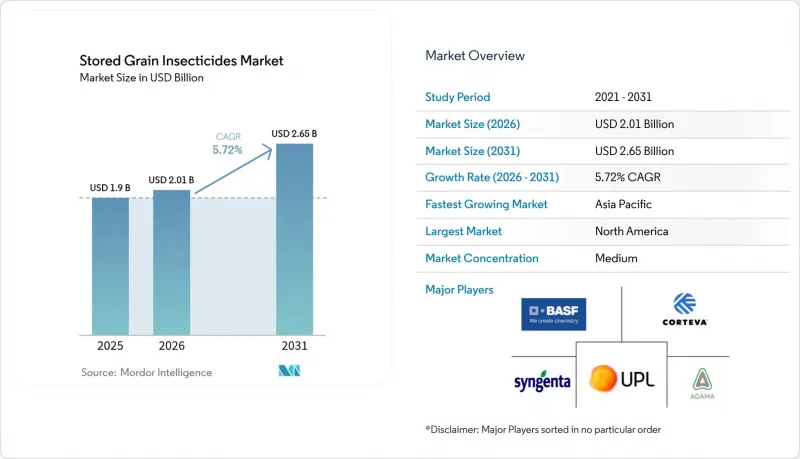
本報告按產品類型(除蟲菊精類、燻蒸劑等)、應用領域(種子儲存等)、製劑形式(液體濃縮液、氣霧劑等)、作用機制(內吸性活性成分、燻蒸氣等)、分銷管道(直接銷售給農民等)和地區(北美、歐洲、亞太等)進行細分。市場預測以美元計價。
全球儲糧農藥市場趨勢及洞察
全球糧食產量激增和商業筒倉容量擴張
創紀錄的豐收和加速的糧倉建設直接導致了化學品需求的成長。儘管預計到2024年玉米產量將超過12億噸,但倉儲能力的擴張速度卻比產量成長落後近五分之一,導致儲存時間延長,蟲害加劇。安德森公司於2024年11月收購了Skyland Grain,新增了1.74億蒲式耳的倉儲能力,顯示產業重組正在推動化學品項目的規模化應用。商業業者越來越傾向於選擇殘留效果持續90天的配方,以避免成本高昂的重複燻蒸。因此,倉儲用殺蟲劑市場在專業經銷商中獲得了穩定的支出基礎。
更嚴格的全球最大殘留限量(MRL)
監管機構如今對糧食運輸合規性的審查力度空前嚴格。澳洲糧食研發公司(GRDC)警告稱,即使僅一次拒收,也可能導致數百萬美元的利潤損失。這一現實促使糧食儲存商選擇能夠最佳化殘留量的優質產品。據SGS稱,自2020年以來,進口國的農藥殘留限量(MRL)標準提高了40%,這使得農藥的選擇更加複雜。因此,能夠抑制殘留累積的複合產品售價更高,從而支撐了糧食儲存農藥市場的長期價值。
透過監管逐步淘汰劇毒有機磷農藥
2024年12月,美國環保署(EPA)提案撤銷大部分毒死蜱的食品用途申請,這將使該產品目前的用量減少約70%。加拿大和歐洲也出現了類似的舉措,迫使製劑生產商轉向成本更高的替代品,導致價格上漲15%至25%,訂單週期暫時放緩。雖然監管改革最終將刺激創新,但短期摩擦正在減緩糧食殺蟲劑儲備市場的成長。
細分市場分析
即使到了2025年,有機磷殺蟲劑預計仍將維持42.12%的市場佔有率,鞏固其在儲糧殺蟲劑市場的穩固地位。生物來源殺蟲劑預計將以12.44%的複合年成長率成長,這主要得益於環境、社會和治理(ESG)資金的支持以及有利的監管環境。昆蟲生長調節劑雖然目前僅佔2.33%的市場佔有率,但由於其與抗藥性管理方案的兼容性,其市場成長迅速。
隨著各公司推出雙效組合藥物,該領域的競爭日益激烈。科迪華的「Conserve Plus」結合了多殺菌素和S-METHOPRENE,既能有效防治抗性害蟲,又能符合殘留物法規。創業投資資金正湧入RNAi和微生物路徑研究領域,人們預期從中發現能夠逆轉抗藥性的新作用機制。那些能夠平衡傳統產品與創新產品線的供應商,將在儲備穀物殺蟲劑市場中保持其地位。
隨著預防性處理在一體糧食處理鏈中廣泛應用,非農場糧倉的需求量目前佔總需求量的37.65%。為遵守殘留物標準,需要符合各國不同監管要求的高品質產品,這使得出口量以9.58%的複合年成長率快速成長。預計與出口相關的儲糧殺蟲劑市場規模將從2026年的3.726億美元成長到2031年的近5.894億美元。隨著小規模農戶增加糧倉數量,農場儲糧的需求也不斷增加。
一體化供應鏈中運輸距離的延長導致害蟲暴露時間延長,從而增加了對長效製劑的需求。在運輸貨櫃和鐵路貨車中進行精準噴灑的趨勢也在成長,創造了雖不顯著但意義重大的附加價值。因此,出口領域仍是儲糧殺蟲劑市場推出新型複合產品的重點。
區域分析
北美地區持續保持其最大市場地位,預計2025年將佔據31.45%的銷售佔有率。糧食倉儲設施營運商之間的整合正在農藥採購中創造規模經濟效益。安德森公司收購斯凱蘭穀物公司凸顯了對基礎設施系統性保護日益成長的需求。美國環保署的逐步淘汰計畫正在加速向低毒性混合農藥的過渡,從而維持了高額收入來源。美國和加拿大物聯網應用率最高,也推動了糧食倉儲殺蟲劑市場優質化的趨勢。
亞太地區預計將成為成長最快的地區,到2031年複合年成長率將達到6.82%,這主要得益於密封筒倉安裝量的激增以及磷化氫抗藥性日益普遍。研究表明,在肯亞使用金屬筒倉可將糧食儲存期延長1.8個月,印度和菲律賓也出現了類似的趨勢。隨著抗藥性的蔓延,用戶正轉向使用雙效產品,從而擴大了市場規模。各國糧食安全計畫正在進一步增加對現代化倉儲設施的補貼,這進一步提高了儲糧殺蟲劑的市場滲透率。
歐洲的複合年成長率 (CAGR) 為 3.74%,這主要得益於永續性法規,這些法規對高全球暖化潛勢 (GWP) 的燻蒸劑施加了懲罰。德國關於減少氟磺醯的指南就是監管方向的一個很好的例子。南美洲的複合年成長率為 5.69%,巴西和阿根廷正在擴大大豆和玉米出口的糧倉容量。內河物流的投資導致運輸時間延長,因此需要更持久的防護措施。
其他好處:
- Excel格式的市場預測(ME)表
- 3個月的分析師支持
目錄
第1章:引言
- 研究假設和市場定義
- 調查範圍
第2章:調查方法
第3章執行摘要
第4章 市場狀況
- 市場概覽
- 市場促進因素
- 全球糧食產量激增和商業筒倉容量擴張
- 全球強制性最大殘留限量(MRL)的收緊
- 對磷化氫的耐受性日益增強,加速了複合化學技術的發展。
- 亞太地區小規模農場密封儲存技術的快速普及
- 基於物聯網的儲存監控正在推動對資料關聯保護解決方案的需求。
- ESG投資正流入生物農藥的研發和商業化領域。
- 市場限制因素
- 透過監管逐步淘汰劇毒有機磷農藥
- 多種除蟲菊精類的交叉抗性會縮短產品的生命週期。
- 預測性感測器分析正在減少預防性化學噴灑的需求。
- 碳足跡審計將對溫室氣體排放量高的燻蒸劑處以罰款。
- 監理情勢
- 技術展望
- 波特五力模型
第5章 市場規模與成長預測
- 依產品類型
- 有機磷農藥
- Pyrethroids
- 燻蒸劑(金屬磷化物、氟化硫醯)
- 生物來源殺蟲劑
- 昆蟲生長調節劑
- 協同複合產品
- 其他
- 透過使用
- 農場內儲存
- 農業用途以外的商業電梯
- 出口貨運量
- 綜合物流和運輸
- 種子儲存/種子庫
- 緊急生命維持
- 配方
- 濃縮液
- 粉末和乾燥流動性
- 氣霧劑/霧化劑
- 片劑和顆粒劑
- 用於懸浮液的懸浮液溶液
- 微膠囊化
- 透過作用機制
- 接觸性神經毒素
- 系統活性成分
- 燻蒸氣機
- 保幼激素類似物(IGR)
- 透過分銷管道
- 農戶直銷
- 農業用品經銷商和合作社
- 糧倉服務供應商
- 線上農業用品平台
- 按地區
- 北美洲
- 美國
- 加拿大
- 墨西哥
- 其他北美國家
- 南美洲
- 巴西
- 阿根廷
- 其他南美國家
- 歐洲
- 德國
- 法國
- 英國
- 西班牙
- 義大利
- 俄羅斯
- 其他歐洲國家
- 亞太地區
- 中國
- 印度
- 日本
- 澳洲
- 其他亞太國家
- 中東
- 土耳其
- 沙烏地阿拉伯
- 其他中東國家
- 非洲
- 南非
- 奈及利亞
- 其他非洲國家
- 北美洲
第6章 競爭情勢
- 市場集中度
- 策略趨勢
- 市佔率分析
- 公司簡介
- Syngenta AG
- Corteva Agriscience
- UPL Limited
- BASF SE
- Adama Agricultural Solutions Ltd.
- Nufarm Limited
- Envu GmbH
- Degesch America Inc.
- Douglas Products & Packaging Co., LLC
- FMC Corporation
- Sumitomo Chemical Co., Ltd.
- Central Life Sciences, Inc.
- AMVAC Chemical Corporation
- Rentokil Initial plc
- Industrial Fumigant Company, LLC
第7章 市場機會與未來展望
According to Mordor Intelligence, the stored grain insecticide market size is expected to grow from USD 1.90 billion in 2025 to USD 2.01 billion in 2026 and is forecast to reach USD 2.65 billion by 2031 at 5.72% CAGR over 2026-2031.
This report is Segmented by Product Type (Pyrethroids, Fumigants, and More), Application (Seed Storage, and More), Formulation (Liquid Concentrate, Aerosol, and More), Mode of Action (Systemic Active, Fumigant Gases, and More), Distribution Channel (Direct-To-Farm Sales, and More), and Geography (North America, Europe, Asia-Pacific, and More). The Market Forecasts are Provided in Terms of Value (USD).
Global Stored Grain Insecticides Market Trends and Insights
Surging Global Grain Output and Larger Commercial Silo Capacity
Record crop volumes and faster elevator buildouts translate directly into higher chemical demand. Maize alone topped 1.2 billion tons in 2024, while storage capacity expansion trails harvest growth by nearly one-fifth, forcing longer hold periods and increased pest pressure. The Andersons added 174 million bushels of capacity through its November 2024 Skyland Grain purchase, demonstrating how consolidation scales chemical programs. Commercial operators increasingly favor residual formulations with ninety-day efficacy to avoid costly re-fumigation cycles. Consequently, the stored grain insecticide market gains a stable spending base among professional handlers.
Mandatory Maximum Residue Limits (MRLs) Tightening Worldwide
Regulators now scrutinize shipment compliance more closely than ever. The Australian GRDC warns that single cargo rejections can erase multimillion-dollar margins, a reality prompting elevators to choose premium, residue-optimized products. SGS notes a 40% rise in distinct MRL levels across importing nations since 2020, complicating chemical selection. Combination products that suppress residue build-up, therefore command premium pricing, supporting the long-term value of the stored grain insecticide market.
Regulatory Phase-Outs of High-Toxicity Organophosphates
The December 2024 EPA proposal to revoke most chlorpyrifos food uses removes roughly 70% of its former volume. Similar moves in Canada and Europe drive formulators toward costlier replacements, raising prices 15-25% and temporarily slowing order cycles. While reforms ultimately push innovation, near-term friction trims growth in the stored grain insecticide market.
Other drivers and restraints analyzed in the detailed report include:
- Escalating Phosphine Resistance is Accelerating Combination Chemistries
- Rapid Adoption of On-Farm Sealed Storage in the Asia-Pacific Smallholder Sector
- Cross-Resistance to Multiple Pyrethroids Reducing Product Life Cycles
For complete list of drivers and restraints, kindly check the Table Of Contents.
Segment Analysis
Organophosphates retained a 42.12% share in 2025, underlining their entrenched role within the stored grain insecticide market. Bio-insecticides are forecast at a 12.44% CAGR, fueled by ESG funding and favorable regulation. Insect growth regulators, although at a 2.33% share, grow briskly due to compatibility with resistance stewardship programs.
The segment's competitive intensity heightens as firms launch dual-mode blends. Corteva's Conserve Plus unites spinosad with S-methoprene, targeting resistant insects while remaining residue-friendly. Venture money channels into RNAi and microbial pathways, promising fresh modes of action that may reset resistance clocks. Suppliers balancing legacy volumes with innovative lines will defend their position in the stored grain insecticide market.
Off-farm elevators account for 37.65% of demand as integrated handling chains institutionalize prophylactic treatments. Export shipments grow the fastest at 9.58% CAGR because residue compliance dictates premium products that clear diverse national limits. The stored grain insecticide market size tied to export channels is projected to climb from USD 372.6 million in 2026 to nearly USD 589.4 million in 2031. On-farm storage demand gains momentum as smallholder silos multiply.
Longer transit distances in consolidated supply chains increase insect exposure time, thereby elevating demand for extended residual formulations. Precision fogging inside shipping containers and railcars also rises, adding value despite modest volume. The export segment, therefore, remains a focal point for new combination offerings within the stored grain insecticide market.
Complete Report Scope:
- By Product Type
- Organophosphates
- Pyrethroids
- Fumigants (Metal Phosphides, Sulfuryl Fluoride)
- Bio-insecticides
- Insect Growth Regulators
- Synergized Combination Products
- Others
- By Application
- On-farm Storage
- Off-farm Commercial Elevators
- Export Shipments
- Integrated Logistics and Transit
- Seed Storage/Seed Banks
- Emergency Rescue Treatments
- By Formulation
- Liquid Concentrate
- Dust and Dry Flowables
- Aerosol/Fogging Agents
- Tablets & Pellets
- Suspension Concentrate
- Micro-encapsulated
- By Mode of Action
- Contact Neurotoxins
- Systemic Actives
- Fumigant Gases
- Juvenile Hormone Analogs (IGRs)
- By Distribution Channel
- Direct-to-Farm Sales
- Ag Retailers and Cooperatives
- Grain Elevator Service Providers
- Online Ag Input Platforms
- By Geography
- North America
- United States
- Canada
- Mexico
- Rest of North America
- South America
- Brazil
- Argentina
- Rest of South America
- Europe
- Germany
- France
- United Kingdom
- Spain
- Italy
- Russia
- Rest of Europe
- Asia-Pacific
- China
- India
- Japan
- Australia
- Rest of Asia-Pacific
- Middle East
- Turkey
- Saudi Arabia
- Rest of Middle East
- Africa
- South Africa
- Nigeria
- Rest of Africa
- North America
Geography Analysis
North America retains the largest regional position supported by 31.45% revenue share in 2025. Consolidation among elevator operators creates scale economies in chemical purchasing. The Andersons' acquisition of Skyland Grain underscores infrastructure expansion that demands systematic protection. EPA phase-outs encourage shifts to lower-toxicity blends, keeping premium revenue streams alive. IoT adoption is also highest in the United States and Canada, reinforcing the premiumization trend in the stored grain insecticide market.
Asia-Pacific represents the fastest-growing geography at 6.82% CAGR through 2031, thanks to booming sealed silo installations and widespread phosphine resistance. Research confirms 1.8 additional months of grain security from metal silos in Kenya, a pattern repeated in India and the Philippines. As resistance spreads, users gravitate toward dual-mode products, expanding market value. National food security programs further subsidize modern storage, deepening penetration of the stored grain insecticide market.
Europe grows at a 3.74% CAGR, driven by sustainability mandates that penalize high-GWP fumigants. Germany's guidance on sulfuryl fluoride reductions exemplifies regulatory direction. South America advances 5.69% CAGR, with Brazil and Argentina adding elevator capacity for soybean and corn exports. Investments in river logistics translate into longer transit windows that need durable protection.
- Syngenta AG
- Corteva Agriscience
- UPL Limited
- BASF SE
- Adama Agricultural Solutions Ltd.
- Nufarm Limited
- Envu GmbH
- Degesch America Inc.
- Douglas Products & Packaging Co., LLC
- FMC Corporation
- Sumitomo Chemical Co., Ltd.
- Central Life Sciences, Inc.
- AMVAC Chemical Corporation
- Rentokil Initial plc
- Industrial Fumigant Company, LLC
Additional Benefits:
- The market estimate (ME) sheet in Excel format
- 3 months of analyst support
TABLE OF CONTENTS
1 Introduction
- 1.1 Study Assumptions and Market Definition
- 1.2 Scope of the Study
2 Research Methodology
3 Executive Summary
4 Market Landscape
- 4.1 Market Overview
- 4.2 Market Drivers
- 4.2.1 Surging global grain output and larger commercial silo capacity
- 4.2.2 Mandatory maximum residue limits (MRLs) tightening worldwide
- 4.2.3 Escalating phosphine resistance accelerating combination chemistries
- 4.2.4 Rapid adoption of on-farm sealed storage in Asia-Pacific smallholder sector
- 4.2.5 IoT-enabled storage monitoring driving demand for data-linked protectants
- 4.2.6 ESG investment flows into bio-insecticide R&D and commercialization
- 4.3 Market Restraints
- 4.3.1 Regulatory phase-outs of high-toxicity organophosphates
- 4.3.2 Cross-resistance to multiple pyrethroids reducing product life cycles
- 4.3.3 Predictive sensor analytics lowering prophylactic chemical applications
- 4.3.4 Carbon-footprint audits penalizing fumigants with high GHG load
- 4.4 Regulatory Landscape
- 4.5 Technological Outlook
- 4.6 Porter's Five Forces
- 4.6.1 Bargaining Power of Suppliers
- 4.6.2 Bargaining Power of Buyers
- 4.6.3 Threat of New Entrants
- 4.6.4 Threat of Substitutes
- 4.6.5 Intensity of Competitive Rivalry
5 Market Size and Growth Forecasts (Value)
- 5.1 By Product Type
- 5.1.1 Organophosphates
- 5.1.2 Pyrethroids
- 5.1.3 Fumigants (Metal Phosphides, Sulfuryl Fluoride)
- 5.1.4 Bio-insecticides
- 5.1.5 Insect Growth Regulators
- 5.1.6 Synergized Combination Products
- 5.1.7 Others
- 5.2 By Application
- 5.2.1 On-farm Storage
- 5.2.2 Off-farm Commercial Elevators
- 5.2.3 Export Shipments
- 5.2.4 Integrated Logistics and Transit
- 5.2.5 Seed Storage/Seed Banks
- 5.2.6 Emergency Rescue Treatments
- 5.3 By Formulation
- 5.3.1 Liquid Concentrate
- 5.3.2 Dust and Dry Flowables
- 5.3.3 Aerosol/Fogging Agents
- 5.3.4 Tablets & Pellets
- 5.3.5 Suspension Concentrate
- 5.3.6 Micro-encapsulated
- 5.4 By Mode of Action
- 5.4.1 Contact Neurotoxins
- 5.4.2 Systemic Actives
- 5.4.3 Fumigant Gases
- 5.4.4 Juvenile Hormone Analogs (IGRs)
- 5.5 By Distribution Channel
- 5.5.1 Direct-to-Farm Sales
- 5.5.2 Ag Retailers and Cooperatives
- 5.5.3 Grain Elevator Service Providers
- 5.5.4 Online Ag Input Platforms
- 5.6 By Geography
- 5.6.1 North America
- 5.6.1.1 United States
- 5.6.1.2 Canada
- 5.6.1.3 Mexico
- 5.6.1.4 Rest of North America
- 5.6.2 South America
- 5.6.2.1 Brazil
- 5.6.2.2 Argentina
- 5.6.2.3 Rest of South America
- 5.6.3 Europe
- 5.6.3.1 Germany
- 5.6.3.2 France
- 5.6.3.3 United Kingdom
- 5.6.3.4 Spain
- 5.6.3.5 Italy
- 5.6.3.6 Russia
- 5.6.3.7 Rest of Europe
- 5.6.4 Asia-Pacific
- 5.6.4.1 China
- 5.6.4.2 India
- 5.6.4.3 Japan
- 5.6.4.4 Australia
- 5.6.4.5 Rest of Asia-Pacific
- 5.6.5 Middle East
- 5.6.5.1 Turkey
- 5.6.5.2 Saudi Arabia
- 5.6.5.3 Rest of Middle East
- 5.6.6 Africa
- 5.6.6.1 South Africa
- 5.6.6.2 Nigeria
- 5.6.6.3 Rest of Africa
- 5.6.1 North America
6 Competitive Landscape
- 6.1 Market Concentration
- 6.2 Strategic Moves
- 6.3 Market Share Analysis
- 6.4 Company Profiles (Includes Global level Overview, Market level overview, Core Segments, Financials as available, Strategic Information, Market Rank/Share, Products and Services, Recent Developments)
- 6.4.1 Syngenta AG
- 6.4.2 Corteva Agriscience
- 6.4.3 UPL Limited
- 6.4.4 BASF SE
- 6.4.5 Adama Agricultural Solutions Ltd.
- 6.4.6 Nufarm Limited
- 6.4.7 Envu GmbH
- 6.4.8 Degesch America Inc.
- 6.4.9 Douglas Products & Packaging Co., LLC
- 6.4.10 FMC Corporation
- 6.4.11 Sumitomo Chemical Co., Ltd.
- 6.4.12 Central Life Sciences, Inc.
- 6.4.13 AMVAC Chemical Corporation
- 6.4.14 Rentokil Initial plc
- 6.4.15 Industrial Fumigant Company, LLC
7 Market Opportunities and Future Outlook

 2026年磷胺類殺蟲劑全球市場報告
 Buprofezin市場規模、佔有率和成長分析:按類型、製劑形式、應用、目標害蟲、最終用戶、分銷管道和地區分類-2026-2033年產業預測
 高效能Permethrin市場規模、佔有率和成長分析:按產品類型、應用方法、目標害蟲、最終用途產業和地區分類-2026-2033年產業預測
 儲糧農藥市場規模、佔有率及成長分析:依產品衍生類型、來源、最終用途產業、銷售管道、分銷管道及地區分類-2026-2033年產業預測
 儲糧殺蟲劑市場報告:按產品類型、應用和地區分類(2026-2034年)
 Buprofezin市場:2026-2032年全球市場預測(按劑型、作物、應用方法、最終用戶和銷售管道)Chlorantraniliprole市場:全球市場按作物類型、劑型、應用方法和最終用戶分類的預測-2026-2032年克百威市場:按劑型、作物類型、最終用戶、分銷管道和應用分類-2026-2032年全球預測高效能Cypermethrin市場:按製劑類型、銷售管道和應用分類-2026-2032年全球預測二唑唑市場:依作物類型、劑型、應用方法、最終用戶和分銷管道分類-2026-2032年全球預測