


 |
市場調查報告書
商品編碼
2123039
生質塑膠包裝:市場佔有率分析、產業趨勢與統計、成長預測(2026-2031)Bioplastics Packaging - Market Share Analysis, Industry Trends & Statistics, Growth Forecasts (2026 - 2031) |
||||||

※ 本網頁內容可能與最新版本有所差異。詳細情況請與我們聯繫。
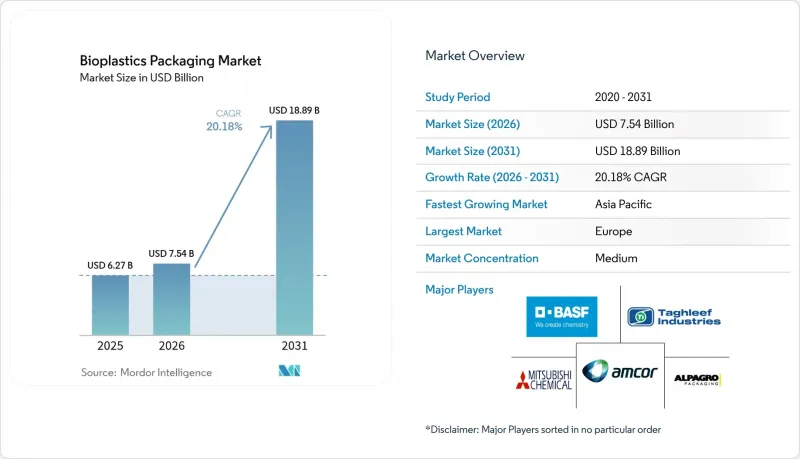
根據 Mordor Intelligence 預測,生質塑膠包裝市場將從 2025 年的 62.7 億美元成長到 2026 年的 75.4 億美元,然後在 2031 年達到 188.9 億美元,2026 年至 2031 年的複合年成長率為 20.18%。
本報告按材料類型(不可生物分解生質塑膠、可生物分解生質塑膠)、產品類型(硬質包裝、軟質包裝)、終端用戶行業(食品、飲料、藥品、個人護理及化妝品以及其他終端用戶行業)、分銷管道(直銷、間接銷售)和地區進行細分。市場預測以美元(USD)為單位。
全球生質塑膠包裝市場趨勢與洞察
全球EPR方法促進生物基包裝的採用
加州、歐盟和肯亞的強制性生產者延伸責任制 (EPR) 計劃,透過將最終使用成本內部化,為從傳統塑膠轉向可再生替代品提供了直接的經濟獎勵。生產商現在需要根據產品的可回收性、可堆肥性和再生材料含量繳納不同的費率,這使得生質塑膠材料在生質塑膠包裝市場中更具成本競爭力。自 2025 年 3 月起實施的統一報告截止日期簡化了跨境合規流程,並鼓勵跨國品牌所有者採用標準化的永續包裝形式。對不可回收基材進行處罰的費率調整政策進一步擴大了生物塑膠包裝的潛在市場。隨著監管時間表與泰國和阿拉伯聯合大公國大規模PLA 工廠的運作相吻合,可預測的供應和價格下降將進一步加速生質塑膠的普及。
跨國連鎖餐廳的需求激增。
各大餐飲品牌正加速推進可堆肥包裝的試點和全面推廣,在生質塑膠包裝市場掀起了一股新的需求浪潮。麥當勞的杯子現在採用50%的生物聚合物混合物,星巴克也在美國多個州擴大了模塑纖維冷飲杯的試點計畫。這些公司正利用其採購規模優勢降低單位樹脂成本,同時檢驗消費者的接受度。簡化分類、降低掩埋成本和提升品牌價值等營運優勢正在推動持續採購。這種快速普及向加工商表明,生質塑膠可以達到與傳統基材相同的加工能力,而無需因設備變更而造成瓶頸。
生物基原料長期短缺
巴西乙醇產量創歷史新高,加上美國可再生燃料標準(RFS)的實施導致供應增加,加劇了原料競爭。這推高了玉米和糖的價格,而玉米和糖正是聚乳酸(PLA)和生物基聚對苯二甲酸乙二醇酯(bio-PET)生產的基礎原料。生質燃料生產商通常憑藉法律規定的需求配額和稅額扣抵,在原料分配競爭中勝出。儘管NatureWorks公司正在探索以木薯和木質纖維素為原料的方法,但在非農業原料達到足夠規模之前,原料短缺仍將是生質塑膠包裝市場面臨的結構性阻力。
細分市場分析
到2025年,生物基PET將佔據生質塑膠包裝市場39.10%的佔有率。這主要得益於生產商利用現有的PET回收流程,實現了快速的直接替代方案。該領域受益於ISCC PLUS認證的生質能衍生PTA供應鏈。可口可樂公司在歐洲投入1.8億歐元進行轉型,這推動了生質塑膠包裝市場的穩定擴張,因為大型買家對樹脂溢價施加了下行壓力。 PHA目前市佔率較小,但隨著產業重組的逐步完成以及特種等級產品瞄準海洋生物分解應用領域,預計其複合年成長率將達到21.65%。
在可生物分解聚合物中,澱粉混合物仍佔生產主導地位,其以玉米、馬鈴薯和木薯為原料,確保了價格對沖的柔軟性。泰國和阿拉伯聯合大公國的PLA產能提升了區域供應,而PBAT和PBS在薄膜領域發展勢頭強勁,該領域需要在較低的加工溫度下實現更高的韌性。雙重採購策略可保護加工商免受樹脂價格波動的影響,生質塑膠包裝市場對價格衝擊仍具有強大的抵抗力。
預計到2025年,軟包裝將佔銷售額的57.62%,推動市場以21.05%的複合年成長率成長。薄膜、包裝膜和軟包裝袋非常適合PLA和生物基PE的機械性能和阻隔性。雀巢投資1.2億瑞士法郎用於歐洲設備升級,顯示轉型所需的資金投入,同時也顯示消費者對軟包裝的高度接受度,抵銷了樹脂價格上漲的影響。 Acredo的甘蔗基軟包裝袋系列突顯了其減少碳排放的優勢,從而促進了採購決策。
由於硬質容器對熱變形溫度的要求較高,其普及速度一直較為緩慢,而多層PLA-纖維素材料的氧氣阻隔性性能正逐漸接近室溫儲存所需的水平。從軟性包裝向硬質包裝的技術轉變正在縮小性能差距,並為更廣泛的生質塑膠包裝市場開闢新的收入來源。
區域分析
到2025年,歐洲將佔生質塑膠包裝市場37.95%的佔有率,並繼續保持最大區域貢獻。這主要得益於《包裝和包裝廢棄物法規》,該法規要求到2030年實現所有包裝材料均可回收,並禁止在食品接觸材料中使用全氟烷基和多氟烷基物質(PFAS)。德國包裝法(VerpackG)將於2024年徵收21億歐元的生產者責任延伸(EPR)費用,鼓勵品牌商選擇可享30%費用折扣的生物基包裝形式。南歐市場正在快速推廣用於生鮮食品的薄膜包裝,而北歐市場則專注於符合冷鏈規範的硬質優格杯。
亞太地區是成長最快的地區,預計到2031年年複合成長率(CAGR)將達到21.93%。政策支持和投資促進措施與印度的可追溯性法規、中國的GB 43352-2023標準以及日本政府對可生物分解替代品的採購一致。 NatureWorks和Balrampur Chini Mills為國內加工商供貨,降低了運輸成本並規避了外匯波動風險。由於接近性農業原料產地,東南亞國協已成為對歐盟高需求市場的戰略出口樞紐,從而擴大了該地區生質塑膠包裝市場的規模。
在北美,加州、奧勒岡州和科羅拉多正展現出強勁的發展勢頭,它們最終敲定了生產者責任延伸(EPR)收費系統,並將逐年提高收費標準。麥當勞和星巴克等餐飲服務業的試驗計畫正在加速下游加工商的認證進程。一項用於開發堆肥設施的7,500萬美元聯邦津貼表明,基礎設施標準化指日可待,這將成為生質塑膠包裝市場向沿海城市以外地區滲透的關鍵驅動力。加拿大和墨西哥正在採用統一的標籤標準,以保護跨境供應鏈並確保整合品牌推廣的監管清晰性。
其他好處:
- Excel格式的市場預測(ME)表
- 3個月的分析師支持
目錄
第1章:引言
- 研究假設和市場定義
- 調查範圍
第2章:調查方法
第3章執行摘要
第4章 市場狀況
- 市場概覽
- 市場促進因素
- 全球生產者責任延伸制度正在推動生物基包裝的普及。
- 跨國連鎖餐廳採用可堆肥包裝,導致生質塑膠包裝的需求激增。
- 亞太地區的政策轉變正在推動生質塑膠包裝的發展勢頭。
- 全球生物基PET和PLA生產的擴張降低了採用這些材料的成本門檻。
- 奢侈品和個人護理品牌擴大採用生質塑膠包裝
- 政府對堆肥基礎設施的投資正在加速下游產業對堆肥技術的採用。
- 市場限制因素
- 由於與生質燃料需求競爭,生質原料長期短缺。
- 工業堆肥基礎設施的不完全阻礙了對廢棄舊產品的索賠。
- 高溫應用中功能性能的局限性
- 供應鏈分析
- 生質塑膠創新
- 產業生態系分析
- 生質塑膠-當前生產狀況
- 行業標準和法規
- 波特五力分析
第5章 市場規模與成長預測
- 材料類型
- 不可生物分解的生質塑膠
- 生物PET
- 生物基聚乙烯
- 其他不可生物分解的生質塑膠
- 可生物分解的生質塑膠
- 澱粉混合物
- 聚乳酸(PLA)
- 聚(己二酸對苯二甲酸丁二醇酯)(PBAT)
- 聚丁二酸丁二醇酯(PBS)
- 聚羥基烷酯(PHA)
- 其他可生物分解的生質塑膠
- 不可生物分解的生質塑膠
- 依產品類型
- 硬包裝
- 瓶子和罐子
- 托盤和容器
- 其他硬質包裝
- 軟包裝
- 薄膜和包裝
- 小袋和袋子
- 其他軟包裝
- 硬包裝
- 按最終用途行業分類
- 食物
- 飲料
- 製藥
- 個人護理化妝品
- 其他終端用戶產業
- 透過分銷管道
- 直銷
- 間接銷售
- 按地區
- 北美洲
- 美國
- 加拿大
- 墨西哥
- 歐洲
- 德國
- 英國
- 法國
- 義大利
- 西班牙
- 俄羅斯
- 其他歐洲國家
- 亞太地區
- 中國
- 印度
- 日本
- 韓國
- 澳洲和紐西蘭
- 其他亞太國家
- 中東和非洲
- 中東
- 阿拉伯聯合大公國
- 沙烏地阿拉伯
- 土耳其
- 其他中東國家
- 非洲
- 南非
- 奈及利亞
- 埃及
- 其他非洲國家
- 中東
- 南美洲
- 巴西
- 阿根廷
- 其他南美國家
- 北美洲
第6章 競爭情勢
- 市場集中度
- 策略舉措和趨勢
- 市佔率分析
- 公司簡介
- BIO PACKAGING FILMS
- Folietec Kunststoffwerk AG
- HUBEI HYF PACKAGING CO., LTD.
- BIO FUTURA BV
- PLABOTTLES.EU(GLOBAL SOLUTIONS BV)
- FKUR KUNSTSTOFF GMBH
- PACTIV EVERGREEN INC.
- POUCH ME
- GS-Company
- GracePack
- NaKu eU
- Easy Green Eco Packaging Co., Ltd
- Amcor Plc
- PLAMFG
- COMPAC SRL
- Jarsking Group
- Zhejiang Sanle Plastic Co.,Ltd
- Shanghai COPAK Industry Co., LTD,
- Greendot Biopak Pvt. Ltd.
- Biogreen Biotech
第7章 市場機會與未來展望
According to Mordor Intelligence, the bioplastic packaging market size is expected to grow from USD 6.27 billion in 2025 to USD 7.54 billion in 2026 and is forecast to reach USD 18.89 billion by 2031 at 20.18% CAGR over 2026-2031.
This report is Segmented by Material Type (Non-Biodegradable Bioplastics, Biodegradable Bioplastics), Product Type (Rigid Packaging, Flexible Packaging), End-Use Industry (Food, Beverages, Pharmaceuticals, Personal Care and Cosmetics, Other End-Use Industry), Distribution Channel (Direct Sales, Indirect Sales), and Geography. The Market Forecasts are Provided in Terms of Value (USD).
Global Bioplastics Packaging Market Trends and Insights
Global EPR legislation driving bio-based packaging adoption
Mandatory EPR schemes in California, the European Union, and Kenya internalize end-of-life costs, creating direct financial incentives to switch from conventional plastics to renewable alternatives. Producers now face differentiated fees based on recyclability, compostability, and recycled content, making bioplastic materials more cost-competitive in the bioplastic packaging market. Harmonized reporting deadlines beginning March 2025 simplify cross-border compliance, encouraging multinational brand owners to standardize sustainable formats. Fee modulation policies that penalize non-recyclable substrates further enlarge the addressable bioplastic packaging market. As regulatory timelines converge with the start-up of large PLA plants in Thailand and the UAE, predictable supply and lower prices reinforce adoption momentum.
Demand surge from multinational food-service chains
Leading restaurant brands accelerated trials and roll-outs of compostable formats, catalyzing new volume streams in the bioplastic packaging market. McDonald's cups now use a 50% biopolymer blend, while Starbucks has extended molded-fiber cold-cup pilots across several US states. These firms leverage procurement scale to compress per-unit resin costs and validate consumer acceptance. Operational benefits-simpler sorting, reduced landfill fees, and brand equity gains-reinforce repeat purchasing. Their rapid adoption signals to converters that bioplastic stock-keeping units can match the throughput of conventional substrates without retooling bottlenecks.
Chronic shortage of bio-based feedstock
Record ethanol runs in Brazil and rising US Renewable Fuel Standard volumes intensify feedstock competition, inflating corn and sugar prices that underpin PLA and Bio-PET production. Biofuel producers often win allocation battles thanks to legislated demand quotas and tax credits. While NatureWorks explores cassava and lignocellulosic routes, feedstock scarcity remains a structural headwind to the bioplastic packaging market until non-crop inputs reach scale.
Other drivers and restraints analyzed in the detailed report include:
- Asia-Pacific policy shifts creating momentum
- Capacity expansion in Bio-PET and PLA
- Inconsistent industrial composting infrastructure
For complete list of drivers and restraints, kindly check the Table Of Contents.
Segment Analysis
Bio-PET held 39.10% share of the bioplastic packaging market in 2025 as producers leveraged existing PET recycling streams for rapid drop-in substitution. The segment benefits from biomass-based PTA supply chains certified under ISCC PLUS. Coca-Cola's EUR 180 million European transition illustrates how large buyers exert downward pressure on resin premiums, supporting stable bioplastic packaging market size expansion. PHA, while only a niche share today, is forecast at 21.65% CAGR as consolidation stabilizes and specialty grades target marine-degradable applications.
Starch blends remain the volume leader among biodegradable polymers, with maize, potato, and cassava feedstocks offering price hedging flexibility. PLA capacity from Thailand and the UAE boosts regional supply, while PBAT and PBS gain traction in films requiring enhanced toughness at lower processing temperatures. Dual-sourcing strategies protect converters from resin volatility, keeping the bioplastic packaging market resilient to price shocks.
Flexible formats commanded 57.62% of 2025 revenue and are projected to lead at a 21.05% CAGR. Films, wraps, and pouches align well with the mechanical and barrier properties of PLA and Bio-PE. Nestle's CHF 120 million European retrofit shows the capital needed to switch over but also demonstrates consumer acceptance premiums that offset higher resin prices. Accredo's sugarcane-based pouch series underscores carbon-reduction gains that drive procurement decisions.
Rigid containers lag due to higher heat-deflection standards, yet multilayer PLA-cellulose structures now approach oxygen barrier levels suitable for ambient sauces. Technology spillover from flexible to rigid applications is narrowing the performance delta, opening new revenue pockets inside the broader bioplastic packaging market.
Complete Report Scope:
- By Material Type
- Non-Biodegradable Bioplastics
- Bio-PET
- Bio-PE
- Other Non-Biodegradable Bioplastics
- Biodegradable Bioplastics
- Starch Blends
- Polylactic Acid (PLA)
- Poly(Butylene Adipate-co-Terephthalate) (PBAT)
- Polybutylene Succinate (PBS)
- Polyhydroxyalkanoates (PHA)
- Other Biodegradable Bioplastics
- Non-Biodegradable Bioplastics
- By Product Type
- Rigid Packaging
- Bottles and Jars
- Trays and Containers
- Other Rigid Packaging
- Flexible Packaging
- Films and Wraps
- Pouches and Bags
- Other Flexible Packaging
- Rigid Packaging
- By End-Use Industry
- Food
- Beverages
- Pharmaceuticals
- Personal Care and Cosmetics
- Other End - Use Industry
- By Distribution Channel
- Direct Sales
- Indirect Sales
- By Geography
- North America
- United States
- Canada
- Mexico
- Europe
- Germany
- United Kingdom
- France
- Italy
- Spain
- Russia
- Rest of Europe
- Asia-Pacific
- China
- India
- Japan
- South Korea
- Australia and New Zealand
- Rest of Asia-Pacific
- Middle East and Africa
- Middle East
- United Arab Emirates
- Saudi Arabia
- Turkey
- Rest of Middle East
- Africa
- South Africa
- Nigeria
- Egypt
- Rest of Africa
- Middle East
- South America
- Brazil
- Argentina
- Rest of South America
- North America
Geography Analysis
Europe remained the largest regional contributor with 37.95% of the bioplastic packaging market in 2025, driven by the Packaging and Packaging Waste Regulation that mandates universal recyclability by 2030 and bans PFAS in food contact articles. Germany's VerpackG imposed EUR 2.1 billion EPR fees in 2024, prompting brand owners to select bio-based formats that earn 30% fee discounts. Southern Europe witnesses swift adoption in fresh-produce films, while Northern markets focus on rigid yoghurt cups that meet cold-chain specifications.
Asia-Pacific is the fastest-growing region, projected at 21.93% CAGR through 2031. India's traceability rule, China's GB 43352-2023, and Japanese government procurement of biodegradable alternatives align policy levers with investment stimuli. NatureWorks and Balrampur Chini Mills supply domestic converters, cutting freight costs and hedging against currency swings. Proximity to agricultural feedstocks positions ASEAN nations as strategic export bases to high-demand EU markets, amplifying the bioplastic packaging market size in the region.
North America shows robust momentum as California, Oregon, and Colorado finalize EPR fee schedules that escalate annually. Food-service pilot programs at McDonald's and Starbucks accelerate downstream converter qualifications. Federal grants worth USD 75 million for composting build-outs signal impending infrastructure parity, a critical enabler for bioplastic packaging market penetration beyond coastal cities. Canada and Mexico adopt harmonized labeling to protect cross-border supply chains, ensuring regulatory clarity for integrated brand roll-outs.
- BIO PACKAGING FILMS
- Folietec Kunststoffwerk AG
- HUBEI HYF PACKAGING CO., LTD.
- BIO FUTURA B.V.
- PLABOTTLES.EU (GLOBAL SOLUTIONS B.V.)
- FKUR KUNSTSTOFF GMBH
- PACTIV EVERGREEN INC.
- POUCH ME
- GS-Company
- GracePack
- NaKu eU
- Easy Green Eco Packaging Co., Ltd
- Amcor Plc
- PLAMFG
- COMPAC SRL
- Jarsking Group
- Zhejiang Sanle Plastic Co.,Ltd
- Shanghai COPAK Industry Co., LTD,
- Greendot Biopak Pvt. Ltd.
- Biogreen Biotech
Additional Benefits:
- The market estimate (ME) sheet in Excel format
- 3 months of analyst support
TABLE OF CONTENTS
1 INTRODUCTION
- 1.1 Study Assumptions and Market Definition
- 1.2 Scope of the Study
2 RESEARCH METHODOLOGY
3 EXECUTIVE SUMMARY
4 MARKET LANDSCAPE
- 4.1 Market Overview
- 4.2 Market Drivers
- 4.2.1 Global EPR Legislation Driving Bio-Based Packaging Adoption
- 4.2.2 Demand for bioplastic packaging surges as multinational food-service chains embrace compostable packaging
- 4.2.3 Asia-Pacific Policy Shifts Creating Momentum for Bioplastic Packaging
- 4.2.4 Expansion of global Bio-PET and PLA production is lowering cost barriers to adoption
- 4.2.5 Increasing adoption of bioplastic packaging among Luxury and personal care brands
- 4.2.6 Government Investment in Composting Infrastructure Accelerating Downstream Adoption
- 4.3 Market Restraints
- 4.3.1 Chronic shortage of bio-based feedstock owing to competing biofuel demand
- 4.3.2 Inconsistent industrial composting infrastructure hindering end-of-life claims
- 4.3.3 Functional performance limitations in high-temperature applications
- 4.4 Supply-Chain Analysis
- 4.5 Innovations in Bioplastics
- 4.6 Industry Ecosystem Analysis
- 4.7 Bioplastic - Production Landscape
- 4.8 Industry Standards and Regulations
- 4.9 Porter's Five Forces Analysis
- 4.9.1 Bargaining Power of Suppliers
- 4.9.2 Bargaining Power of Buyers
- 4.9.3 Threat of New Entrants
- 4.9.4 Threat of Substitute Products
- 4.9.5 Intensity of Competitive Rivalry
5 MARKET SIZE AND GROWTH FORECASTS (VALUE)
- 5.1 By Material Type
- 5.1.1 Non-Biodegradable Bioplastics
- 5.1.1.1 Bio-PET
- 5.1.1.2 Bio-PE
- 5.1.1.3 Other Non-Biodegradable Bioplastics
- 5.1.2 Biodegradable Bioplastics
- 5.1.2.1 Starch Blends
- 5.1.2.2 Polylactic Acid (PLA)
- 5.1.2.3 Poly(Butylene Adipate-co-Terephthalate) (PBAT)
- 5.1.2.4 Polybutylene Succinate (PBS)
- 5.1.2.5 Polyhydroxyalkanoates (PHA)
- 5.1.2.6 Other Biodegradable Bioplastics
- 5.1.1 Non-Biodegradable Bioplastics
- 5.2 By Product Type
- 5.2.1 Rigid Packaging
- 5.2.1.1 Bottles and Jars
- 5.2.1.2 Trays and Containers
- 5.2.1.3 Other Rigid Packaging
- 5.2.2 Flexible Packaging
- 5.2.2.1 Films and Wraps
- 5.2.2.2 Pouches and Bags
- 5.2.2.3 Other Flexible Packaging
- 5.2.1 Rigid Packaging
- 5.3 By End-Use Industry
- 5.3.1 Food
- 5.3.2 Beverages
- 5.3.3 Pharmaceuticals
- 5.3.4 Personal Care and Cosmetics
- 5.3.5 Other End - Use Industry
- 5.4 By Distribution Channel
- 5.4.1 Direct Sales
- 5.4.2 Indirect Sales
- 5.5 By Geography
- 5.5.1 North America
- 5.5.1.1 United States
- 5.5.1.2 Canada
- 5.5.1.3 Mexico
- 5.5.2 Europe
- 5.5.2.1 Germany
- 5.5.2.2 United Kingdom
- 5.5.2.3 France
- 5.5.2.4 Italy
- 5.5.2.5 Spain
- 5.5.2.6 Russia
- 5.5.2.7 Rest of Europe
- 5.5.3 Asia-Pacific
- 5.5.3.1 China
- 5.5.3.2 India
- 5.5.3.3 Japan
- 5.5.3.4 South Korea
- 5.5.3.5 Australia and New Zealand
- 5.5.3.6 Rest of Asia-Pacific
- 5.5.4 Middle East and Africa
- 5.5.4.1 Middle East
- 5.5.4.1.1 United Arab Emirates
- 5.5.4.1.2 Saudi Arabia
- 5.5.4.1.3 Turkey
- 5.5.4.1.4 Rest of Middle East
- 5.5.4.2 Africa
- 5.5.4.2.1 South Africa
- 5.5.4.2.2 Nigeria
- 5.5.4.2.3 Egypt
- 5.5.4.2.4 Rest of Africa
- 5.5.4.1 Middle East
- 5.5.5 South America
- 5.5.5.1 Brazil
- 5.5.5.2 Argentina
- 5.5.5.3 Rest of South America
- 5.5.1 North America
6 COMPETITIVE LANDSCAPE
- 6.1 Market Concentration
- 6.2 Strategic Moves and Developments
- 6.3 Market Share Analysis
- 6.4 Company Profiles (includes Global level Overview, Market level overview, Core Segments, Financials as available, Strategic Information, Market Rank/Share for key companies, Products and Services, and Recent Developments)
- 6.4.1 BIO PACKAGING FILMS
- 6.4.2 Folietec Kunststoffwerk AG
- 6.4.3 HUBEI HYF PACKAGING CO., LTD.
- 6.4.4 BIO FUTURA B.V.
- 6.4.5 PLABOTTLES.EU (GLOBAL SOLUTIONS B.V.)
- 6.4.6 FKUR KUNSTSTOFF GMBH
- 6.4.7 PACTIV EVERGREEN INC.
- 6.4.8 POUCH ME
- 6.4.9 GS-Company
- 6.4.10 GracePack
- 6.4.11 NaKu eU
- 6.4.12 Easy Green Eco Packaging Co., Ltd
- 6.4.13 Amcor Plc
- 6.4.14 PLAMFG
- 6.4.15 COMPAC SRL
- 6.4.16 Jarsking Group
- 6.4.17 Zhejiang Sanle Plastic Co.,Ltd
- 6.4.18 Shanghai COPAK Industry Co., LTD,
- 6.4.19 Greendot Biopak Pvt. Ltd.
- 6.4.20 Biogreen Biotech
7 MARKET OPPORTUNITIES AND FUTURE OUTLOOK
- 7.1 White-space and Unmet-need Assessment

 全球甘蔗纖維包裝市場規模、佔有率、趨勢和成長分析報告(2026-2034年)
 藻類薄膜市場規模、佔有率、成長和行業分析:按原料、材料組成、功能、最終用途和區域預測至 2034 年。
 蘑菇菌絲包裝市場規模、佔有率和趨勢分析報告:按分銷管道、產品、基材、最終用途行業、地區和細分市場預測(2026-2033 年)菌絲體包裝市場規模、佔有率、成長和行業分析:按產品類型、按最終用途行業、按地區分類,並預測至 2034 年。
 零廢棄生物發酵市場:依產品類型、微生物、應用、最終用途、國家及地區分類-產業分析、市場規模、市場佔有率及2026年至2033年預測
 永續PET包裝市場預測至2034年-按材料類型、包裝形式、永續性承諾、分銷管道、應用和地區分類的全球分析生質塑膠包裝市場預測至2034年—按材料類型、包裝形式、製造流程、應用和地區分類的全球分析
 生質塑膠包裝市場規模、佔有率、趨勢和預測:按產品類型、包裝類型、最終用戶和地區分類,2026-2034年
 生質塑膠包裝市場:2026-2032年全球市場按產品類型、材料類型、應用和製造流程分類的預測竹製包裝市場規模、佔有率、成長及全球產業分析:按類型、應用和區域分類,預測2026-2034年