


 |
市場調查報告書
商品編碼
2122964
合成石墨:市場佔有率分析、產業趨勢與統計、成長預測(2026-2031)Synthetic Graphite - Market Share Analysis, Industry Trends & Statistics, Growth Forecasts (2026 - 2031) |
||||||

※ 本網頁內容可能與最新版本有所差異。詳細情況請與我們聯繫。
根據 Mordor Intelligence 估計,2026 年合成石墨市場價值為 36.4 億美元,預計到 2031 年將達到 50.7 億美元,在預測期(2026-2031 年)內複合年成長率為 6.85%。
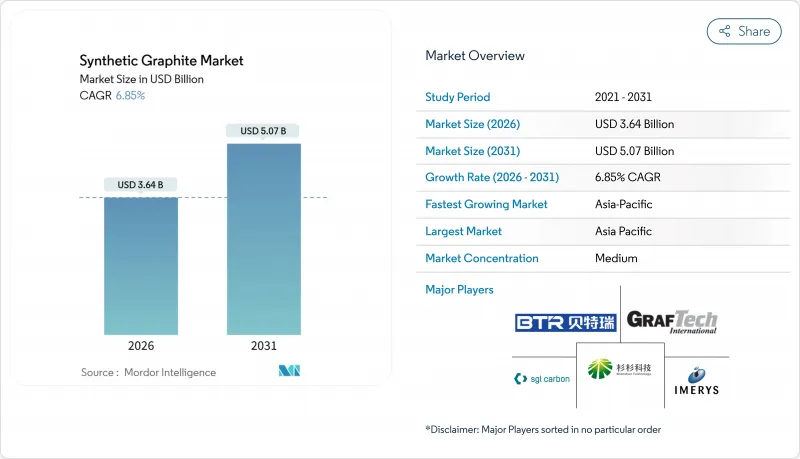
本報告按產品類型(石墨陽極、石墨塊、其他)、應用領域(電池、冶金、其他)、終端用戶產業(汽車、鋼鐵及金屬、能源及電力、其他)和地區(亞太地區、北美、歐洲、南美、中東和非洲)進行細分。市場預測以價值(美元)和數量(噸)表示。
全球合成石墨市場趨勢及洞察
電動車對鋰離子電池的需求不斷成長
用於電池的合成石墨必須滿足金屬雜質含量低於 50 ppm 的純度標準,且粒徑分佈在 10-20 μm 之間,這需要對塗層和精煉生產線進行大量投資才能達到這些標準。通用汽車 (GM) 與 Vianode 公司於 2024 年達成的一項啟動協議,確保每年從安大略超級工廠獲得 15 萬噸陽極材料,這表明這家原始設備製造商 (OEM) 願意為推出新的產能提供資金,以滿足「外國關注企業 (FEOC)」的合規要求。從2024年到2026年,已公佈的北美項目總產量將達到每年約20萬噸,考慮到該地區在2023年之前幾乎可以忽略不計的產能,這一規模令人矚目。像NanoGraf公司的「Onyx」這樣的矽-石墨複合複合材料提高了純石墨必須遵循的性能標準,在維持超過1000次完全等效循環壽命的同時,還能將單位重量能量密度提高30%。價格兩極化依然存在。用於快充電池組的高純度塗層石墨每噸價格為12000至15000美元,而通用材料的價格為每噸8000至9000美元。符合美國《通貨膨脹控制法案》(該法案將分別於2025年和2027年把含量標準提高到60%和80%)的合成石墨在北美地區的需求正在成長。
擴大高功率(UHP)電弧爐(EAF)在煉鋼的應用
高功率(UHP)焊條可將出鋼間隔時間縮短至40分鐘以內,從而降低每座爐的石墨消耗量;然而,隨著加工能力的提升,焊條的年總需求量持續成長。浦項鋼鐵計畫在2026年實現300毫米UHP焊條年產2萬噸,顯示鋼鐵企業正努力規避中國出口不確定性和運費波動帶來的風險。在全球範圍內,熱膨脹係數(CTE)為1.0 × 10⁻⁶ 度C或更低的針狀焦認證供應商少於10家,這一限制使得該領域的定價權得以維持。印度最大的兩家生產商Graphite India和HEG每年供應約30萬噸針狀焦,但由於中國進口產品價格低15-20%,它們的利潤空間持續受到擠壓。監管合規性仍然嚴格,領先的鋼鐵製造商普遍要求獲得 ISO 9001 和 ASTM C1028 認證。
高製造成本和能源強度
合成石墨的生產過程(石墨化製程)在2800-3000 度C下進行,每噸石墨消耗10-15兆瓦時電力。預計到2024年,歐洲工業用電平均價格將達到每兆瓦時150-180歐元,能源成本目前佔現金成本的40-45%,而中國這一比例為25-30%。 SGL Carbon公司報告稱,由於能源價格飆升和固定價格合約的影響,其2024年的利潤率將下降12%。設備製造商伊梅里斯(Imerys)和梅爾森(Mersen)正在進行感應爐的示範運行,該感應爐可將能耗降低15-20%,但每噸模組5000萬-6000萬歐元的資本投資成本阻礙了其推廣應用。原物料供應仍緊張,目前只有不到10家煉油廠生產符合規格的針狀焦,產能擴張速度比市場需求落後約兩年。由於歐盟碳價約為每噸二氧化碳 80-90 歐元,沒有二氧化碳捕集解決方案的生產商每噸將額外承擔 1200-1500 美元的成本。
細分市場分析
「其他」板塊(包括核能、半導體和軟性材料)佔55.87%的市場佔有率,這得益於較長的認證週期。預計到2025年,石墨陽極將佔總銷售額的約25%,複合年成長率(CAGR)為8.27%,是產品類型中成長率最高的。陽極供應商的塗層級產品EBITDA獲利率EBITDA獲利率18-22%,而電極製造商由於來自中國的進口壓力,利潤率則被限制在8-12%。 Group14位於摩西湖的工廠生產的矽-石墨複合材料將在2025年取代4000噸傳統陽極,這反映出高階電動車正在削弱對純石墨的需求。
儘管核能石墨市場仍屬於小眾市場(年產量不到5,000噸),但隨著英國和加拿大大力推動小型模組化反應器(SMR)項目,該市場利潤豐厚。雖然ASTM D7219多環芳烴標準和歐盟REACH法規構成合規障礙,但大多數主要生產商已符合這些標準。
區域分析
預計到2025年,亞太地區將佔全球銷售額的55.58%,並在2031年之前以7.73%的複合年成長率成長。儘管中國對石墨出口許可證的限制收緊了全球供應,但2024年的運轉率仍維持在50-60%,凸顯了國內產能過剩的問題。日本和韓國正在擴大其陽極材料產能,但兩國仍是針狀焦的淨進口國,這瓶頸使得中國在上游領域保持主導地位。 2024年,由於從中國進口的針狀焦價格比國內價格低15-20%,印度電極製造商提起反傾銷申訴,迫使兩家公司轉向利潤更高的特種等級產品。東南亞本土陽極工廠尚未跟上電池組裝的快速成長,大部分合成石墨仍依賴進口。
北美地區佔據了石墨消費的很大一部分,在《通膨控制法案》的推動下,需求還在不斷成長。預計到2026年,Superior Graphite位於阿肯色州的年產能2.4萬噸的工廠、Novonix位於查塔努加的工廠擴建項目以及Syrah位於維達利亞的生產線將新增約5萬噸的年產能。加拿大Vianode公司投資32億加元,並與通用汽車簽訂了長期契約,目標是到2028年實現年產15萬噸。隨著美國聯邦出口信貸局(FEOC)的法規於2025年生效,中國石墨將不再享有7,500美元的消費者稅額扣抵,這將促使美國國內採購量增加。
儘管能源成本飆升帶來不利影響,歐洲的需求仍持續成長。德國的SGL Carbon和Graphit Kropfmuhl則專注於特種牌號,而Imerys和Mersen則涵蓋核能和化學應用領域。由於挪威強大的水力發電能力,Vianode公司年產量2萬噸的小型生產線碳排放量低於5公斤二氧化碳/公斤,而中國燃煤生產的碳排放量則高達15-20公斤二氧化碳/公斤。自2022年制裁以來,俄羅斯針狀焦出口量下降了30-40%,加劇了歐洲原料供應緊張的局面。預計南美、中東和非洲的需求將顯著成長,這主要得益於各地區工業化的推進,尤其是鋼鐵和汽車產業的擴張。
其他好處
- Excel格式的市場預測(ME)表
- 3個月的分析師支持
目錄
第1章:引言
- 研究假設和市場定義
- 調查範圍
第2章:調查方法
第3章執行摘要
第4章 市場狀況
- 市場概覽
- 市場促進因素
- 電動車對鋰離子電池的需求不斷成長
- 擴大高功率(UHP)電弧爐(EAF)在煉鋼的應用
- 高階電動車車型需要超高純度陽極材料以實現超快速充電。
- 政府對本地陽極材料超級工廠的激勵措施
- 矽-石墨複合材料陽極在下一代電池中的廣泛應用
- 市場限制因素
- 高製造成本和能源強度
- 由於與天然石墨的價格差異,混合陽極材料已廣泛應用。
- 鈉離子電池的早期商業化將導致石墨需求下降。
- 價值鏈分析
- 波特五力模型
第5章 市場規模與成長預測
- 依產品類型
- 鹼性陽極
- 石墨塊
- 其他
- 透過使用
- 電池
- 冶金
- 零件和組件
- 核能
- 其他
- 按最終用途行業分類
- 車
- 鋼鐵和金屬
- 能源和發電
- 電子與電機工程
- 化工/石油化工
- 航太/國防
- 其他
- 按地區
- 亞太地區
- 中國
- 印度
- 日本
- 韓國
- 印尼
- 馬來西亞
- 泰國
- 越南
- 其他亞太國家
- 北美洲
- 美國
- 加拿大
- 墨西哥
- 歐洲
- 德國
- 英國
- 法國
- 義大利
- 西班牙
- 北歐的
- 俄羅斯
- 其他歐洲國家
- 南美洲
- 巴西
- 阿根廷
- 哥倫比亞
- 中東和非洲
- 沙烏地阿拉伯
- 阿拉伯聯合大公國
- 南非
- 奈及利亞
- 埃及
- 其他中東和非洲國家
- 亞太地區
第6章 競爭情勢
- 市場集中度
- 策略趨勢
- 市佔率和排名分析
- 公司簡介
- Anovion LLC
- Asbury Carbons
- BTR New Material Group Co., Ltd.
- Fengda Carbon New Material Co., Ltd.
- GrafTech International
- Graphit Kropfmuhl GmbH
- Graphite India Limited
- HEG Limited
- Imerys
- Mersen
- Mitsubishi Chemical Group Corporation
- Nippon Carbon Co Ltd.
- NOVONIX Ltd.
- Resonac Holdings Corporation
- SEC CARBON, LIMITED.
- SGL Carbon
- Shanghai PTL New Energy Technology Co., Ltd.
- Shanghai Shanshan Technology Co., Ltd.
- Superior Graphite
- Tokai COBEX GmbH
- Vianode
第7章 市場機會與未來展望
According to Mordor Intelligence, the synthetic graphite market size is estimated at USD 3.64 billion in 2026, and is expected to reach USD 5.07 billion by 2031, at a CAGR of 6.85% during the forecast period (2026-2031).
This report is Segmented by Product Type (Graphite Anode, Graphite Block, and Other Types), Application (Batteries, Metallurgy, and More ), End-User Industry (Automotive, Steel and Metals, Energy and Power, and More), and Geography (Asia-Pacific, North America, Europe, South America, and Middle-East and Africa). The Market Forecasts are Provided in Terms of Value (USD) and Volume (Tons).
Global Synthetic Graphite Market Trends and Insights
Increasing Demand for Electric-Vehicle Li-ion Batteries
Battery-grade synthetic graphite must meet purity below 50 ppm metallic impurities and particle-size distributions of 10-20 μm, standards that are drawing sizeable investment into coating and purification lines. General Motors' 2024 offtake agreement with Vianode locks in 150,000 t p.a. of anode material from the Ontario gigafactory, demonstrating OEM willingness to underwrite greenfield capacity for foreign-entity-of-concern (FEOC) compliance. Announced North American projects total roughly 200,000 t p.a. for 2024-2026, dwarfing the region's negligible pre-2023 capacity. Silicon-graphite composites such as NanoGraf's Onyx deliver 30% higher gravimetric energy density while keeping cycle life above 1,000 full equivalents, raising performance benchmarks that pure graphite must match. Pricing remains bifurcated: coated, high-purity grades used in fast-charging packs command USD 12,000-15,000 per tonne, versus USD 8,000-9,000 per tonne for commodity material. U.S. Inflation Reduction Act content thresholds-60% in 2025, rising to 80% in 2027-further amplify the regional pull for compliant synthetic graphite.
Growing Utilization of Ultra-High-Power EAFs in Steelmaking
UHP electrodes allow tap-to-tap times below 40 minutes, so even with lower graphite consumption intensity per heat, total annual electrode demand still climbs as throughput accelerates. POSCO's plan to localize 20,000 t p.a. of 300 mm UHP electrodes by 2026 illustrates how steelmakers are hedging against Chinese export uncertainties and freight volatility. Qualified suppliers of sub-1.0 X 10⁻⁶ °C-1 CTE needle coke remain fewer than ten globally, a constraint that preserves some pricing power in this segment. India's twin producers, Graphite India and HEG, together supply about 300,000 t p.a., yet Chinese imports priced 15-20% lower continue to squeeze margins. Compliance remains stringent; ISO 9001 and ASTM C1028 are universally demanded by tier-one steel producers.
High Manufacturing Cost and Energy Intensity
Synthetic graphite production consumes 10-15 MWh of electricity per tonne owing to graphitization at 2,800-3,000 °C. European industrial power averaged EUR 150-180 per MWh in 2024, so energy now absorbs 40-45% of cash costs versus 25-30% in China. SGL Carbon reported a 12% margin decline in 2024, citing energy inflation and fixed price contracts. Equipment makers Imerys and Mersen are piloting induction furnaces that cut energy by 15-20%, but the capital costs of EUR 50-60 million per 10,000 t module slow adoption. Feedstock tightness also persists; fewer than ten refineries produce qualifying needle coke, and expansions lag market demand by about two years. EU carbon prices near EUR 80-90 per t CO2 add another USD 1,200-1,500 per tonne if producers lack capture solutions.
Other drivers and restraints analyzed in the detailed report include:
- Faster-Charging Premium EV Models Requiring Ultra-High-Purity Anodes
- Government Incentives for Local Anode Material Gigafactories
- Price Gap with Natural Graphite Prompting Blended Anodes
For complete list of drivers and restraints, kindly check the Table Of Contents.
Segment Analysis
The Others segment, covering nuclear-grade, semiconductor, and flexible grades, held a 55.87% share, anchored by lengthy qualification cycles. Graphite anode represented roughly 25% of 2025 revenue, is expanding at an 8.27% CAGR, the fastest among product categories. Anode suppliers are capturing 18-22% EBITDA margins on coated grades, whereas electrode makers posted only 8-12% amid Chinese import pressure. Silicon-graphite composites shipped from Group14's Moses Lake plant displaced 4,000 t of conventional anode during 2025, illustrating how premium EV models erode pure-graphite volumes.
Nuclear-grade graphite stays niche (<5,000 t p.a.) but commands higher revenue as the UK and Canada advance small-modular-reactor programs. ASTM D7219 and EU REACH rules on polycyclic aromatic hydrocarbons pose compliance hurdles, yet most major producers already meet these thresholds.
Complete Report Scope:
- By Product Type
- Graphite Anode
- Graphite Block
- Other Types
- By Application
- Batteries
- Metallurgy
- Parts and Components
- Nuclear
- Other Applications
- By End-Use Industry
- Automotive
- Steel and Metals
- Energy and Power
- Electronics and Electrical
- Chemical and Petrochemical
- Aerospace and Defense
- Other End-user Industries
- By Geography
- Asia-Pacific
- China
- India
- Japan
- South Korea
- Indonesia
- Malaysia
- Thailand
- Vietnam
- Rest of Asia-Pacific
- North America
- United States
- Canada
- Mexico
- Europe
- Germany
- United Kingdom
- France
- Italy
- Spain
- Nordics
- Russia
- Rest of Europe
- South America
- Brazil
- Argentina
- Colombia
- Middle-East and Africa
- Saudi Arabia
- United Arab Emirates
- South Africa
- Nigeria
- Egypt
- Rest of Middle-East and Africa
- Asia-Pacific
Geography Analysis
Asia-Pacific commanded 55.58% revenue in 2025 and is predicted to grow at a 7.73% CAGR through 2031. Chinese export-licensing on graphite tightened global supply, yet utilization still ran only 50-60% in 2024, revealing domestic overcapacity. Japan and South Korea are adding anode capacity, but both remain net importers of needle coke, a chokepoint that maintains China's upstream leverage. India's electrode makers filed anti-dumping petitions in 2024 after Chinese imports undercut domestic prices by 15-20%, pushing both firms toward higher-margin specialty grades. Local anode plants do not yet match Southeast Asia's cell-assembly boom, so most synthetic graphite is still imported.
North America accounts for significant consumption and is witnessing higher demand supported by the Inflation Reduction Act. Superior Graphite's 24,000 t Arkansas plant, NOVONIX's Chattanooga expansion, and Syrah's Vidalia line will add about 50,000 t p.a. by 2026. Canada's CAD 3.2 billion Vianode investment aims for 150,000 t p.a. by 2028, backed by a long-term General Motors agreement. U.S. FEOC rules beginning in 2025 exclude Chinese-origin graphite from the USD 7,500 consumer tax credit, accelerating domestic sourcing.
Europe is witnessing a continuously growing demand despite energy-cost headwinds. Germany's SGL Carbon and Graphit Kropfmuhl focus on specialty grades, while Imerys and Mersen cover nuclear and chemical uses. Norway's hydropower advantage gives Vianode's smaller 20,000 t line a carbon footprint below 5 kg CO2/kg, compared with 15-20 kg for coal-based Chinese output. Russian needle-coke exports fell 30-40% post-2022 sanctions, tightening European feedstock supply. South America, the Middle East, and Africa are expected to witness considerable growth rates supported by rising industrialization in the regions, mainly the expansion of the steel and automotive industry.
- Anovion LLC
- Asbury Carbons
- BTR New Material Group Co., Ltd.
- Fengda Carbon New Material Co., Ltd.
- GrafTech International
- Graphit Kropfmuhl GmbH
- Graphite India Limited
- HEG Limited
- Imerys
- Mersen
- Mitsubishi Chemical Group Corporation
- Nippon Carbon Co Ltd.
- NOVONIX Ltd.
- Resonac Holdings Corporation
- SEC CARBON, LIMITED.
- SGL Carbon
- Shanghai PTL New Energy Technology Co., Ltd.
- Shanghai Shanshan Technology Co., Ltd.
- Superior Graphite
- Tokai COBEX GmbH
- Vianode
Additional Benefits:
- The market estimate (ME) sheet in Excel format
- 3 months of analyst support
TABLE OF CONTENTS
1 Introduction
- 1.1 Study Assumptions and Market Definition
- 1.2 Scope of the Study
2 Research Methodology
3 Executive Summary
4 Market Landscape
- 4.1 Market Overview
- 4.2 Market Drivers
- 4.2.1 Increasing demand for electric-vehicle Li-ion batteries
- 4.2.2 Growing utilization of ultra-high-power (UHP) EAFs in steelmaking
- 4.2.3 Faster-charging premium EV models requiring ultra-high-purity anodes
- 4.2.4 Government incentives for local anode material gigafactories
- 4.2.5 Silicon-graphite composite anodes scaling in next-gen batteries
- 4.3 Market Restraints
- 4.3.1 High manufacturing cost and energy intensity
- 4.3.2 Price gap with natural graphite prompting blended anodes
- 4.3.3 Early commercialisation of sodium-ion batteries reducing graphite demand
- 4.4 Value Chain Analysis
- 4.5 Porter's Five Forces
- 4.5.1 Bargaining Power of Suppliers
- 4.5.2 Bargaining Power of Buyers
- 4.5.3 Threat of New Entrants
- 4.5.4 Threat of Substitutes
- 4.5.5 Degree of Competition
5 Market Size and Growth Forecasts (Value and Volume)
- 5.1 By Product Type
- 5.1.1 Graphite Anode
- 5.1.2 Graphite Block
- 5.1.3 Other Types
- 5.2 By Application
- 5.2.1 Batteries
- 5.2.2 Metallurgy
- 5.2.3 Parts and Components
- 5.2.4 Nuclear
- 5.2.5 Other Applications
- 5.3 By End-Use Industry
- 5.3.1 Automotive
- 5.3.2 Steel and Metals
- 5.3.3 Energy and Power
- 5.3.4 Electronics and Electrical
- 5.3.5 Chemical and Petrochemical
- 5.3.6 Aerospace and Defense
- 5.3.7 Other End-user Industries
- 5.4 By Geography
- 5.4.1 Asia-Pacific
- 5.4.1.1 China
- 5.4.1.2 India
- 5.4.1.3 Japan
- 5.4.1.4 South Korea
- 5.4.1.5 Indonesia
- 5.4.1.6 Malaysia
- 5.4.1.7 Thailand
- 5.4.1.8 Vietnam
- 5.4.1.9 Rest of Asia-Pacific
- 5.4.2 North America
- 5.4.2.1 United States
- 5.4.2.2 Canada
- 5.4.2.3 Mexico
- 5.4.3 Europe
- 5.4.3.1 Germany
- 5.4.3.2 United Kingdom
- 5.4.3.3 France
- 5.4.3.4 Italy
- 5.4.3.5 Spain
- 5.4.3.6 Nordics
- 5.4.3.7 Russia
- 5.4.3.8 Rest of Europe
- 5.4.4 South America
- 5.4.4.1 Brazil
- 5.4.4.2 Argentina
- 5.4.4.3 Colombia
- 5.4.5 Middle-East and Africa
- 5.4.5.1 Saudi Arabia
- 5.4.5.2 United Arab Emirates
- 5.4.5.3 South Africa
- 5.4.5.4 Nigeria
- 5.4.5.5 Egypt
- 5.4.5.6 Rest of Middle-East and Africa
- 5.4.1 Asia-Pacific
6 Competitive Landscape
- 6.1 Market Concentration
- 6.2 Strategic Moves
- 6.3 Market Share(%)/Ranking Analysis
- 6.4 Company Profiles (includes Global level Overview, Market level overview, Core Segments, Financials as available, Strategic Information, Market Rank/Share for key companies, Products and Services, and Recent Developments)
- 6.4.1 Anovion LLC
- 6.4.2 Asbury Carbons
- 6.4.3 BTR New Material Group Co., Ltd.
- 6.4.4 Fengda Carbon New Material Co., Ltd.
- 6.4.5 GrafTech International
- 6.4.6 Graphit Kropfmuhl GmbH
- 6.4.7 Graphite India Limited
- 6.4.8 HEG Limited
- 6.4.9 Imerys
- 6.4.10 Mersen
- 6.4.11 Mitsubishi Chemical Group Corporation
- 6.4.12 Nippon Carbon Co Ltd.
- 6.4.13 NOVONIX Ltd.
- 6.4.14 Resonac Holdings Corporation
- 6.4.15 SEC CARBON, LIMITED.
- 6.4.16 SGL Carbon
- 6.4.17 Shanghai PTL New Energy Technology Co., Ltd.
- 6.4.18 Shanghai Shanshan Technology Co., Ltd.
- 6.4.19 Superior Graphite
- 6.4.20 Tokai COBEX GmbH
- 6.4.21 Vianode
7 Market Opportunities and Future Outlook
- 7.1 White-Space and Unmet-Need Assessment
- 7.2 Bio-graphite as a Sustainable Resource for Battery Material

 2026-2030年全球合成石墨市場
 2026年全球合成石墨材料市場報告
 2026年全球核級石墨材料市場研究報告
 人造石墨市場:按類型、應用和地區分類
 全球合成石墨市場規模、佔有率、趨勢和成長分析報告(2026-2034)合成石墨市場規模、佔有率、成長及全球產業分析:按類型和應用分類,區域洞察及2026-2034年預測
 合成石墨市場規模、佔有率及成長分析(按產品、應用、等級、最終用戶及地區分類)-2026-2033年產業預測
 美國合成石墨市場規模、佔有率和趨勢分析報告:按產品、應用和細分市場預測(2025-2033 年)合成石墨市場規模、佔有率、趨勢分析報告:按產品、應用、地區、細分市場預測,2025-2030 年