


 |
市場調查報告書
商品編碼
2122962
氫氧化鋰:市場佔有率分析、產業趨勢與統計、成長預測(2026-2031)Lithium Hydroxide - Market Share Analysis, Industry Trends & Statistics, Growth Forecasts (2026 - 2031) |
||||||

※ 本網頁內容可能與最新版本有所差異。詳細情況請與我們聯繫。
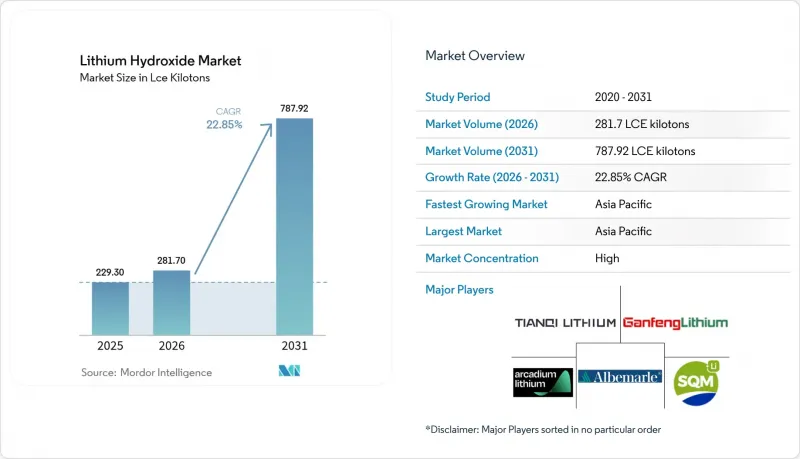
據 Mordor Intelligence 稱,2026 年氫氧化鋰市場規模估計為 281.7 千噸 LCE,高於 2025 年的 229.30 千噸 LCE,預計到 2031 年將達到 787.92 千噸 LCE。
預計 2026 年至 2031 年的複合年成長率為 22.85%。
本報告按應用(鋰離子電池、潤滑脂等)、最終用途行業(汽車、家用電子電器等)、等級(電池級、技術級、工業級)、形式(一水合物和無水物)以及地區(亞太地區、北美、歐洲、南美、中東和非洲)進行分類。
全球氫氧化鋰市場趨勢及洞察
電動工具的需求不斷成長
鋰離子電池正推動建築和工業維護領域無線電動工具的普及,因為它們具有更長的運作時間和更高的功率重量比,可以取代有線工具。製造商正在推出針對高放電循環次數最佳化的電池規格,這種特性非常適合富含氫氧化鋰的鎳鈷錳正極材料。在北美和歐洲的專業承包商中,無線工具的普及率尤其高,因為這些地區勞動市場緊張,需要提高生產效率。建築資訊模型 (BIM) 工作流程的持續應用進一步加速了無線工具的普及,因為現場工作人員需要更高的移動性。雖然目前無線工具的需求量還不及電動車,但對於供應特殊正極材料混合物的氫氧化物製造商而言,這個細分市場提供了高於平均水平的價格。
直接鋰提取(DLE)的商業化實現了低成本原料的取得。
IBAT位於猶他州的工廠採用模組化吸附柱,在數小時內即可實現80-90%的鋰回收率,而傳統的池塘蒸發法則需要數月時間。加州專案「ATLiS」獲得了13.6億美元的有條件貸款擔保,計劃每年利用地熱鹵水生產2萬噸氫氧化鋰,這體現了貸款方對DLE公司擴充性的信心。更高的產量降低了每噸產品的資本投入,使得缺水地區也能開展業務,因為許多離子交換和膜分離技術所需的補充水量比池塘系統更少。這些經濟優勢不僅支撐了氫氧化鋰市場的長期供應前景,也有助於減少對環境的影響。
高昂的生產成本
用於電池的氫氧化鋰工廠需要複雜的雜質控制和高成本的結晶迴路。雅寶公司已停止其位於澳洲凱默頓工廠的擴建計劃,將其計劃的額定產能減半,並裁員40%。由於多年的復甦期、嚴格的許可製度以及濕式冶金領域人才儲備有限,進入門檻仍然很高,這減緩了新建設速度,尤其是在能源成本高的地區。
細分市場分析
預計到2025年,鋰離子電池將佔氫氧化鋰市場需求的62.40%,並將以26.05%的複合年成長率成長至2031年。光是這一領域就佔據了氫氧化鋰市場規模的最大佔有率,且噸位增幅最大。鎳鈷錳(NCM)和鎳鈷鋁(NCA)等特定配方的化學成分需要使用氫氧化鋰而非碳酸鋰進行合成,這構成了結構性需求基礎。相較之下,潤滑脂、空氣淨化系統和特種合成領域的需求保持穩定,但對市場的貢獻仍有限。歐盟擴大回收義務預計將在預測期後半段創造二次供應管道,但這只會抑製而非取代一次需求。
儲能是成長最快的子應用領域。與可再生能源設施相連的大規模電池儲能電站需要長壽命的化學成分。例如,加州的多吉瓦時儲能設施計畫擴大指定使用高鎳含量的正極材料,從而推動了氫氧化鋰的消耗。隨著成本的降低,小規模商業和工業計量反向系統也開始進入市場,確保氫氧化鋰市場在固定式和移動式儲能領域中都能保持多元化的成長動力。
到2025年,電池級材料將佔據69.30%的市場佔有率,預計複合年成長率(CAGR)為24.90%,是該細分市場中成長最快的。對鈉、鈣和重金屬雜質的嚴格控制是其價格高於技術級材料的主要原因。像Livent這樣的製造商已投資建造額外的重結晶和離子交換模組,以確保總合濃度低於100 ppm。雖然這項投資增加了資本密集度,但也進一步鞏固了他們的競爭優勢。技術級材料主要供應給對雜質含量要求較為寬鬆的潤滑脂和陶瓷市場,而工業級材料則用於水處理和某些合成過程。
隨著OEM廠商規格要求日益細化,電池級氫氧化鋰的市佔率將持續成長。新一代固態固態電池和高矽負極設計對化學計量比和含水量要求極高,這些因素進一步提升了其品質溢價。採用鹽水和硬岩作為原料並進行內部提煉的垂直整合型生產商最有優勢攫取這部分利潤。
區域分析
預計到2025年,亞太地區將佔據39.60%的氫氧化鋰市場佔有率,這得益於其無可比擬的電池製造能力以及下游正極、負極和電池組組裝製造商的高度集中。中國目前的政策方向優先考慮國內採購,積極推動內陸鹽湖鹵水的開發利用,並鼓勵對外國企業的投資。同時,日本和韓國憑藉著在材料科學領域的長期積累,保持著競爭優勢。印度也加入了這場競爭,其「國家製造業計畫」以及在2025-2026會計年度聯邦預算中對關鍵礦產實行關稅豁免,將促進國內氫氧化鋰轉化項目的發展。
在北美地區的擴張得到了大規模資金籌措的支持。美國能源局向雅寶公司提供的1.5億美元津貼將用於支持其位於金斯山的鋰輝石精礦工廠,該工廠每年可為160萬輛電動車提供鋰輝石。現代汽車集團和SK-ON已批准在喬治亞建造一座價值50億美元的電池工廠,為該地區對正極材料的需求奠定了基礎,以取代當地生產的氫氧化物。這些措施旨在減少對亞洲供應鏈的依賴,並符合美國《通膨控制法案》規定的採購標準。
南美洲仍是重要的原料產地。智利的「國家鋰戰略」在保持國家監管的同時,鼓勵私營部門參與,新的地質調查已使蘊藏量估計值提高了28%。在阿根廷,力拓集團已投資25億美元用於採礦業,並與多家汽車製造商(OEM)達成了採購協議。在巴西,預計到2024年電動車銷量將激增85%,其中比亞迪佔70%的市場佔有率,這表明未來巴西國內對氫氧化鋰轉化過程的需求將持續成長。
在歐洲,嚴格的二氧化碳排放法規和全面的回收義務正在加速產能擴張。德國在下一代正極材料的研發方面處於主導,歐盟電池法規規定了從2025年起最低鋰回收配額。芬蘭、法國和葡萄牙計劃在2027年前投產數座新的氫氧化鋰轉化工廠,使氫氧化鋰市場的供應基礎多元化。歐盟計劃的戰略自主性可能會重塑貿易運作,尤其是在中國實施提案的技術出口限制的情況下。
其他好處:
- Excel格式的市場預測(ME)表
- 3個月的分析師支持
目錄
第1章:引言
- 研究假設和市場定義
- 調查範圍
第2章:調查方法
第3章執行摘要
第4章 市場狀況
- 市場概覽
- 市場促進因素
- 對電動車的需求不斷成長
- 電動工具的需求不斷成長
- 直接鋰萃取(DLE)的商業化使得低成本氫氧化物原料的取得成為可能。
- 原始設備製造商支持的長期合約可以降低拉丁美洲新增氫氧化物生產能力帶來的風險。
- 政府政策支持電池供應鏈
- 市場限制因素
- 高昂的生產成本
- 原物料價格波動阻礙了專案資金籌措。
- 人們越來越關注毒性問題
- 價值鏈分析
- 波特五力模型
第5章 市場規模及成長預測(數量與價值)
- 透過使用
- 鋰離子電池
- 潤滑脂
- 純化
- 其他應用(聚合物和特種化學品的合成)
- 按最終用途行業分類
- 車
- 家用電子產品
- 能源儲存系統
- 其他(工業和非道路機械)
- 按年級
- 電池等級(LiOH*H2O含量為56.5%或更高)
- 技術級
- 工業級
- 按形式
- 一水合物
- 無水
- 按地區
- 亞太地區
- 中國
- 日本
- 韓國
- 印度
- 其他亞太國家
- 北美洲
- 美國
- 加拿大
- 墨西哥
- 歐洲
- 德國
- 英國
- 法國
- 義大利
- 西班牙
- 北歐的
- 其他歐洲國家
- 南美洲
- 巴西
- 阿根廷
- 智利
- 其他南美國家
- 中東和非洲
- 沙烏地阿拉伯
- 南非
- 其他中東和非洲國家
- 亞太地區
第6章 競爭情勢
- 市場集中度
- 策略趨勢
- 市佔率分析
- 公司簡介
- Albemarle Corporation
- Arcadium Lithium
- Chengxin Lithium
- Ganfeng Lithium Group Co. Ltd.
- IGO Limited
- LevertonHELM Limited
- Nemaska Lithium(Investissement Quebec)
- Piedmont Lithium Inc.
- Shandong Ruifu Lithium Co., Ltd.
- Sinomine Resource Group
- SQM SA
- Tianqi Lithium Corporation
- Yahua Industrial Group Co.
第7章 市場機會與未來展望
According to Mordor Intelligence, lithium hydroxide market size in 2026 is estimated at 281.7 LCE kilotons, growing from 2025 value of 229.30 LCE kilotons with 2031 projections showing 787.92 LCE kilotons, growing at 22.85% CAGR over 2026-2031.
This report is Segmented by Application (Lithium-Ion Batteries, Lubricating Grease, and More), End-Use Industry (Automotive, Consumer Electronics, and More), Grade (Battery Grade, Technical Grade, and Industrial Grade), Form (Monohydrate and Anhydrous), and Geography (Asia-Pacific, North America, Europe, South America, and Middle East and Africa).
Global Lithium Hydroxide Market Trends and Insights
Increasing Demand for Power Tools
Cordless power tools are replacing corded alternatives in construction and industrial maintenance because lithium-ion packs deliver longer run-time and a superior power-to-weight ratio. Manufacturers have launched cell formats optimized for high-discharge cycles, a profile that favors lithium hydroxide-rich nickel-cobalt-manganese cathodes. Uptake is strongest among professional contractors in North America and Europe, where tight labor markets place a premium on productivity gains. Continuous adoption of building-information-modeling workflows further accelerates cordless tool penetration because crews require untethered mobility on-site. Though smaller than EV demand, this niche yields above-average price realization for hydroxide producers supplying specialty cathode blends.
Commercialization of Direct Lithium Extraction (DLE) Unlocking Low-Cost Feedstock
Field-scale success at IBAT's Utah plant, utilizing modular adsorption columns, demonstrated 80-90% lithium recovery in hours versus the months needed for conventional pond evaporation. Project ATLiS in California secured a USD 1.36 billion conditional loan guarantee to deliver 20,000 t/y of lithium hydroxide from geothermal brine, affirming lender confidence in DLE scalability. Higher yields cut capital intensity per ton and enable operations in water-stressed regions because many ion-exchange and membrane variants consume less make-up water than pond systems. These economics bolster the long-run supply outlook for the lithium hydroxide market while reducing environmental footprints.
High Production Costs
Battery-grade lithium hydroxide plants demand sophisticated impurity control and costly crystallization circuits. Albemarle halted expansion of its Kemerton facility in Australia, slicing planned nameplate capacity in half and reducing onsite headcount by 40%. Multiyear payback periods, strict environmental licensing, and a limited pool of hydro-metallurgical talent maintain high entry barriers and slow new-build momentum, especially in regions with elevated energy tariffs.
Other drivers and restraints analyzed in the detailed report include:
- OEM-Backed Long-Term Contracts De-Risking New Capacity in Latin America
- Government Policies Supporting Battery Supply Chains
- Feedstock Price Volatility Hindering Project Financing
For complete list of drivers and restraints, kindly check the Table Of Contents.
Segment Analysis
Lithium-ion batteries generated 62.40% of 2025 demand and are forecast to expand at 26.05% CAGR through 2031. This segment alone accounts for the largest slice of the lithium hydroxide market size and delivers the highest incremental tonnage. Range-oriented chemistries such as nickel-cobalt-manganese (NCM) and nickel-cobalt-aluminum (NCA) require lithium hydroxide for synthesis rather than carbonate, anchoring structural demand. In contrast, lubricating greases, purified-air systems, and specialty synthesis remain steady but modest contributors. Growing recycling mandates in the European Union are expected to generate a secondary supply channel later in the forecast period, tempering but not displacing primary demand.
Energy storage deployments form the fastest-rising sub-application. Large-scale battery farms linked to renewable assets need long cycle-life chemistries. Projects such as California's multi-gigawatt-hour installations increasingly specify nickel-rich cathodes, reinforcing hydroxide consumption. As costs decline, smaller commercial and industrial behind-the-meter systems join the opportunity set, ensuring the lithium hydroxide market retains a diversified growth engine across stationary and mobile domains.
Battery-grade material held a commanding 69.30% share in 2025 and posts a forecast 24.90% CAGR, the highest within this segmentation. Stringent impurity controls on sodium, calcium, and heavy metals underpin price differentials over technical grade. Manufacturers such as Livent have invested in additional recrystallization and ion-exchange modules to achieve less than 100 ppm aggregate impurity limits. That investment raises capital intensity but also deepens competitive moats. Technical grade serves grease and ceramic markets where tolerance thresholds are looser, while industrial grade addresses water treatment and select synthesis routes.
The lithium hydroxide market share for battery-grade will keep rising as OEM specification sheets lengthen. Next-generation solid-state and high-silicon-anode designs rely on precise stoichiometry and ultra-low moisture content, factors that amplify quality premiums. Producers with vertically integrated brine or hard-rock feedstock plus in-house purification are best placed to capture this margin pool.
Complete Report Scope:
- By Application
- Lithium-ion Batteries
- Lubricating Greases
- Purification
- Other Application (Polymer and Specialty Chemical Synthesis)
- By End-use Industry
- Automotive
- Consumer Electronics
- Energy Storage Systems
- Others (Industrial and Off-Road Machinery)
- By Grade
- Battery Grade (Greater than or equal to 56.5% LiOH*H2O)
- Technical Grade
- Industrial Grade
- By Form
- Monohydrate
- Anhydrous
- By Geography
- Asia-Pacific
- China
- Japan
- South Korea
- India
- Rest of Asia-Pacific
- North America
- United States
- Canada
- Mexico
- Europe
- Germany
- United Kingdom
- France
- Italy
- Spain
- Nordics
- Rest of Europe
- South America
- Brazil
- Argentina
- Chile
- Rest of South America
- Middle East and Africa
- Saudi Arabia
- South Africa
- Rest of Middle East and Africa
- Asia-Pacific
Geography Analysis
Asia-Pacific, with a 39.60% lithium hydroxide market share in 2025, benefits from unrivaled cell-manufacturing capacity and a dense cluster of downstream cathode, anode, and pack assemblers. Chinese policy directives now favor domestic sourcing, prompting active development of inland salt-lake brine as well as overseas equity stakes, while Japan and South Korea leverage long-standing material science expertise to stay competitive. India entered the fray with a National Manufacturing Mission and duty exemptions for critical minerals under the 2025-26 Union Budget, stimulating local hydroxide conversion proposals.
North America's expansion rests on large-scale funding packages. The DOE's USD 150 million grant to Albemarle supports a spodumene concentrator at Kings Mountain capable of feeding 1.6 million EVs annually. Hyundai Motor Group and SK On approved a USD 5 billion battery cell plant in Georgia, anchoring regional cathode demand for locally produced hydroxide. These initiatives aim to cut reliance on Asian supply chains and meet US Inflation Reduction Act sourcing thresholds.
South America remains the primary feedstock hub. Chile's National Lithium Strategy invites private participation while safeguarding state oversight, and new geological surveys lifted estimated reserves by 28%. Argentina attracted Rio Tinto's USD 2.5 billion mine investment and multiple OEM offtakes. Brazil saw EV sales jump 85% in 2024, led by BYD with 70% share, hinting at future domestic hydroxide conversion requirements.
Europe accelerates capacity with stringent CO2 regulations and comprehensive recycling mandates. Germany spearheads R&D on next-generation cathodes, while the EU Battery Regulation sets minimum lithium recovery quotas from 2025 onward. Several greenfield conversion plants in Finland, France, and Portugal are scheduled for commissioning by 2027, adding diversity to the lithium hydroxide market supply base. The bloc's push for strategic autonomy may reshape trade flows, especially if China enacts proposed technology export restrictions.
- Albemarle Corporation
- Arcadium Lithium
- Chengxin Lithium
- Ganfeng Lithium Group Co. Ltd.
- IGO Limited
- LevertonHELM Limited
- Nemaska Lithium (Investissement Quebec)
- Piedmont Lithium Inc.
- Shandong Ruifu Lithium Co., Ltd.
- Sinomine Resource Group
- SQM S.A.
- Tianqi Lithium Corporation
- Yahua Industrial Group Co.
Additional Benefits:
- The market estimate (ME) sheet in Excel format
- 3 months of analyst support
TABLE OF CONTENTS
1 Introduction
- 1.1 Study Assumptions and Market Definition
- 1.2 Scope of the Study
2 Research Methodology
3 Executive Summary
4 Market Landscape
- 4.1 Market Overview
- 4.2 Market Drivers
- 4.2.1 Increasing Demand for Electric Vehicles
- 4.2.2 Increasing Demand for Power Tools
- 4.2.3 Commercialisation of Direct Lithium Extraction (DLE) Unlocking Low-Cost Hydroxide Feedstock
- 4.2.4 OEM-Backed Long-Term Contracts De-Risking New Hydroxide Capacity in Latin America
- 4.2.5 Government Policies Supporting Battery Supply Chains
- 4.3 Market Restraints
- 4.3.1 High Production Costs
- 4.3.2 Feedstock Price Volatility Hindering Project Financing
- 4.3.3 Rising concern About the Toxicity
- 4.4 Value Chain Analysis
- 4.5 Porter's Five Forces
- 4.5.1 Bargaining Power of Suppliers
- 4.5.2 Bargaining Power of Buyers
- 4.5.3 Threat of New Entrants
- 4.5.4 Threat of Substitutes
- 4.5.5 Competitive Rivalry
5 Market Size and Growth Forecasts (Volume and Value)
- 5.1 By Application
- 5.1.1 Lithium-ion Batteries
- 5.1.2 Lubricating Greases
- 5.1.3 Purification
- 5.1.4 Other Application (Polymer and Specialty Chemical Synthesis)
- 5.2 By End-use Industry
- 5.2.1 Automotive
- 5.2.2 Consumer Electronics
- 5.2.3 Energy Storage Systems
- 5.2.4 Others (Industrial and Off-Road Machinery)
- 5.3 By Grade
- 5.3.1 Battery Grade (Greater than or equal to 56.5% LiOH*H2O)
- 5.3.2 Technical Grade
- 5.3.3 Industrial Grade
- 5.4 By Form
- 5.4.1 Monohydrate
- 5.4.2 Anhydrous
- 5.5 By Geography
- 5.5.1 Asia-Pacific
- 5.5.1.1 China
- 5.5.1.2 Japan
- 5.5.1.3 South Korea
- 5.5.1.4 India
- 5.5.1.5 Rest of Asia-Pacific
- 5.5.2 North America
- 5.5.2.1 United States
- 5.5.2.2 Canada
- 5.5.2.3 Mexico
- 5.5.3 Europe
- 5.5.3.1 Germany
- 5.5.3.2 United Kingdom
- 5.5.3.3 France
- 5.5.3.4 Italy
- 5.5.3.5 Spain
- 5.5.3.6 Nordics
- 5.5.3.7 Rest of Europe
- 5.5.4 South America
- 5.5.4.1 Brazil
- 5.5.4.2 Argentina
- 5.5.4.3 Chile
- 5.5.4.4 Rest of South America
- 5.5.5 Middle East and Africa
- 5.5.5.1 Saudi Arabia
- 5.5.5.2 South Africa
- 5.5.5.3 Rest of Middle East and Africa
- 5.5.1 Asia-Pacific
6 Competitive Landscape
- 6.1 Market Concentration
- 6.2 Strategic Moves
- 6.3 Market Share Analysis
- 6.4 Company Profiles (includes Global-level Overview, Market-level Overview, Core Segments, Financials as available, Strategic Information, Market Rank/Share, Products and Services, Recent Developments)
- 6.4.1 Albemarle Corporation
- 6.4.2 Arcadium Lithium
- 6.4.3 Chengxin Lithium
- 6.4.4 Ganfeng Lithium Group Co. Ltd.
- 6.4.5 IGO Limited
- 6.4.6 LevertonHELM Limited
- 6.4.7 Nemaska Lithium (Investissement Quebec)
- 6.4.8 Piedmont Lithium Inc.
- 6.4.9 Shandong Ruifu Lithium Co., Ltd.
- 6.4.10 Sinomine Resource Group
- 6.4.11 SQM S.A.
- 6.4.12 Tianqi Lithium Corporation
- 6.4.13 Yahua Industrial Group Co.
7 Market Opportunities and Future Outlook
- 7.1 White-space and Unmet-Need Assessment
- 7.2 Rising Demand for Portable Electronic Devices


