


 |
市場調查報告書
商品編碼
2122938
綠色包裝:市場佔有率分析、產業趨勢與統計、成長預測(2026-2031)Green Packaging - Market Share Analysis, Industry Trends & Statistics, Growth Forecasts (2026 - 2031) |
||||||

※ 本網頁內容可能與最新版本有所差異。詳細情況請與我們聯繫。
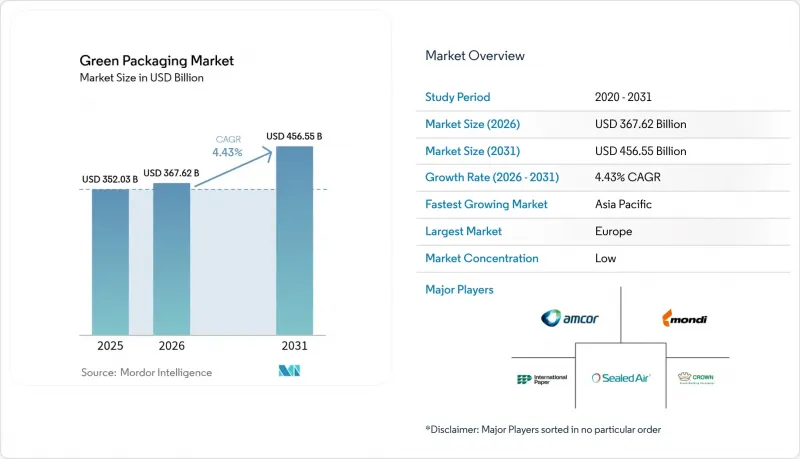
據 Mordor Intelligence 稱,綠色包裝市場預計到 2026 年價值 3,676.2 億美元,高於 2025 年的 3,520.3 億美元,預計到 2031 年將達到 4,565.5 億美元。
從 2026 年到 2031 年,市場預計將以 4.43% 的複合年成長率成長。這項穩定成長是由多種因素共同推動的,包括歐盟的《塑膠包裝廢棄物法規》(PPWR) 等法律法規、企業在其包裝領域設定的淨零排放目標,以及透過回收材料降低成本。
本報告按包裝類型(再生材料包裝、可重複使用包裝、可生物分解包裝)、材料(紙/紙板、玻璃、其他)、包裝功能(初級包裝、二級包裝、其他)、最終用戶行業(食品、飲料、其他)和地區(北美、歐洲、亞太地區、南美、中東和非洲)進行分類。
全球綠色包裝市場趨勢與洞察
對一次性塑膠製品實施嚴格監管
歐盟、印度和智利加速推進政策實施,顯著限制了傳統聚合物的使用,並推動了向可堆肥薄膜和高回收率PET的即時轉型。俄羅斯將在2025年9月禁止某些PET產品,歐盟也將全面禁止在食品接觸包裝中使用雙酚A,這些措施將淘汰整個材料類別,迫使加工商加速生物聚合物的商業化進程。印度法規規定,自2025年起,飲料瓶中必須含有30%的消費後回收材料,而智利的目標是到2060年將這一比例提高到70%,這將縮短創新週期,並刺激對海藻衍生材料和PHA混合物的資本投資。韓國的「海洋創新」計畫表明,這些法規正在扶持擁有海洋生質能材料專利的新創企業,並展示其市場可行性。加州的《生產者延伸責任法》規定了再利用義務,使材料替代成為一項競爭優勢,而不僅僅是一種品牌策略。
企業在環境、社會及公司治理 (ESG) 和淨零包裝方面的承諾
品牌擁有者如今正將永續性口號轉化為遠超過監管最低標準的訂單。波爾公司(Ball Corporation)的目標是到2030年將其再生材料的使用率提高到85%,並實現全球90%的鋁回收率,從而有效保障對再生提煉產品的需求。 2024年5月,聯合利華宣布承諾在2025年實現100%可回收、可重複使用或可堆肥包裝。這結合了設計改進和絕對的材料減量目標,給供應商帶來了越來越大的壓力。歐萊雅儘管目前的回收率僅為49%,但仍透過一項7,200萬歐元的基金支持與回收相關的新創企業,這表明資本正從漸進式改進轉向可擴展的解決方案。 Seven & i Holdings的「綠色挑戰2050」設定了2030年使用50%永續原料的目標,並在此基礎上達成了多項跨國收購協議,以建立專門用於生產PHA和生物基PE的生產線。當此類跨國公司製定標準規範時,二級供應商必須遵守這些標準才能繼續留在認可供應商名單上。
生物基原料供應受限
PLA、PHA 和澱粉衍生物依賴農業原料,而這些原料與食品和生質燃料的需求存在競爭。 SK Chemicals 和 NatureWorks 面臨玉米和糖價格波動的影響,這些波動會推高樹脂價格;當大宗商品價格飆升時,對生物聚合物的競爭就會減弱。北美和歐洲發酵和精煉設施的短缺是一個瓶頸,導致暫時的供不應求。這迫使加工商實現採購多元化或重新使用再生 PET。大規模產能擴張需要建造價值數億美元的工廠,折舊免稅額長達 10 年以上,阻礙了對需求激增的快速反應。季節性因素,例如收穫週期影響年度加工量,進一步增加了風險,並使庫存和現金流量管理更加複雜。
細分市場分析
2025年,在紙張、金屬、玻璃和PET等回收體系成熟的支持下,使用再生材料的解決方案將佔綠色包裝市場59.84%的佔有率。可生物分解材料雖然目前市佔率較小,但正以7.58%的複合年成長率成長,並受益於即將實施的一次性塑膠禁令。目前的綠色包裝市場正在推動對這兩個領域的投資,因為回收利用能夠帶來即時的成本效益,而可生物分解產品則為未來日益嚴格的廢棄物處理法規做好準備。日常消費品(FMCG)行業的主要企業正在使用再生PET構建瓶到瓶循環利用體系,而快餐連鎖店正在測試和採用可在海洋環境中分解的海藻吸管。工業領域的公司正在利用可重複使用的桶和箱子,這表明耐用性和材料循環性可以在同一個綠色包裝市場框架內共存。
在可重複使用物流領域,新創公司正在推出具有物聯網標籤的容器,這些容器在使用30次後即可回收,從而降低人口密集都市區的整體成本。以可重複使用系統為目標的綠色包裝市場預計將隨著德國「PFAND」計畫等大型零售商舉措的推進而擴張。同時,「Loop」和「Pa(fyll)」正在將其押金返還模式擴展到美妝和家居用品領域,這表明消費者便利性和循環經濟的要求可以兼得。總而言之,再生材料、可生物分解材料和可重複使用設計的結合,不僅使收入來源多元化,還能有效對沖原料價格的劇烈波動。
預計到2025年,可回收PET、HDPE和PP將佔總收入的67.71%,這主要得益於家庭垃圾收集網路的廣泛普及以及大型冷凍庫。紙張和紙板憑藉防油防水的奈米纖維素塗層正在重新奪回市場佔有率,為快餐店提供了一種替代含氟化學品的選擇。採用先進纖維基材的環保包裝市場預計將在電子商務通路中實現最快速的成長,因為在這些通路中,尺寸精度比視覺吸引力更為重要。
玻璃和金屬在高階飲料和化妝品領域佔據了獨特的市場地位,其品牌價值彌補了重量上的劣勢,因為它們具有無限的可回收性。鋁的使用量正在上升,波爾公司設定的85%再生材料含量目標確保了合約需求。同時,多層複合材料的市場佔有率正在下降,因為其拆卸成本超過了回收價值,這促使品牌所有者加速轉向單一材料的聚乙烯(PE)和聚丙烯(PP)解決方案。因此,關於材料替代的決策取決於在每個綠色包裝市場應用中,功能性、成本和法規遵循之間的平衡。
區域分析
2025年,歐洲維持了36.21%的市場佔有率,這主要得益於PPWR法規的推動。該法規要求在2030年實現完全可回收,且再生塑膠含量達30%。德國的押金返還率超過98%,確保了瓶到瓶循環利用所需的高品質PET。同時,法國2025年的《再利用法案》正在加速灌裝基礎設施的建設。北歐的創新者正在引入纖維基阻隔材料和數位浮水印技術,為該地區成熟的零售網路樹立功能性標竿。然而,複雜的跨境規流程給中小企業帶來了沉重的負擔,它們必須在27個不同的司法管轄區內協調標籤、再生塑膠含量和報告標準。
亞太地區預計將成為成長最快的地區,到2031年複合年成長率將達到7.95%,主要得益於人口密度和都市區消費的快速成長。印度的包裝產業目標是到2025年實現2,048.1億美元的市場規模,並強制推行QR碼溯源,以遏止非正規的回收行為。在日本,奢侈品牌正在採用生物基PET(生物基PET)生產化妝品瓶;而在韓國,食物廢棄物分類率超過90%,使得可堆肥包裝材料的處理成為可能。中國以出口為導向的加工企業正在積極推動符合歐盟法規的要求,以維持市場准入,而這些嚴格的規範正在區域供應鏈中蔓延。然而,生物基塑膠的快速普及導致其供應緊張,促使泰國和印尼等國成立合資企業,以實現PLA(聚乳酸)產能的在地化。
在北美,進展速度各不相同。加州的「生產者責任召回」(EPR)法規要求到2030年,50%的產品必須設計成可回收或可重複使用,並鼓勵大型零售商進行可回收產品試點計畫。加拿大的《塑膠公約》已實現了50%的可回收產品設計率,但在下游分類基礎設施建設方面仍面臨挑戰。同時,像Novolex和Pactiv Evergreen這樣的合併正在利用規模經濟來應對各州不同的法律法規。墨西哥融入美國供應鏈正在吸引對再生紙廠的投資,從而在成本和永續性之間取得平衡。這些發展使得北美大陸能夠選擇性地推進相關工作,領先中心集中在法規、消費者意識和基礎設施交匯的地區。
其他好處
- Excel格式的市場預測(ME)表
- 3個月的分析師支持
目錄
第1章:引言
- 研究假設和市場定義
- 調查範圍
第2章:調查方法
第3章執行摘要
第4章 市場狀況
- 市場概覽
- 市場促進因素
- 對一次性塑膠製品實施嚴格監管
- 企業在環境、社會及公司治理 (ESG) 和淨零包裝方面的承諾
- 透過減輕重量和回收來降低成本
- 數位浮水印技術可實現高速分類。
- 閉合迴路補給物流的快速發展
- 市場限制因素
- 生物基原料供應受限
- 與傳統包裝相比,單位成本增加
- 生物分解材料阻隔性能的限制因素
- 不均勻的堆肥和厭氧消化基礎設施
- 供應鏈分析
- 監理情勢
- 技術展望
- 波特五力分析
第5章 市場規模與成長預測
- 按包裝類型
- 包裝材料可回收利用
- 紙
- 金屬
- 塑膠
- 玻璃
- 可重複使用的包裝
- 鼓
- 塑膠週轉箱 - IBC
- 托盤墊材
- 可生物分解包裝
- 可堆肥生物聚合物
- 可食用且水溶性的薄膜
- 包裝材料可回收利用
- 材料
- 紙張和紙板
- 玻璃
- 金屬(鋁、鋼)
- 硬質和軟質可回收塑膠
- 生物聚合物(PLA、PHA、澱粉混合物)
- 按最終用戶行業分類
- 食物
- 飲料
- 製藥
- 個人護理和化妝品
- 電子商務與零售
- 其他
- 透過包裝功能
- 初級包裝
- 二級包裝
- 三級包裝/運輸
- 按地區
- 北美洲
- 美國
- 加拿大
- 墨西哥
- 歐洲
- 德國
- 英國
- 法國
- 義大利
- 西班牙
- 俄羅斯
- 其他歐洲國家
- 亞太地區
- 中國
- 印度
- 日本
- 韓國
- 澳洲和紐西蘭
- 其他亞太國家
- 中東和非洲
- 中東
- 阿拉伯聯合大公國
- 沙烏地阿拉伯
- 土耳其
- 其他中東國家
- 非洲
- 南非
- 奈及利亞
- 埃及
- 其他非洲地區
- 中東
- 南美洲
- 巴西
- 阿根廷
- 南美洲其他地區
- 北美洲
第6章 競爭情勢
- 市場集中度
- 策略趨勢
- 市佔率分析
- 公司簡介
- Amcor PLC
- Mondi Group
- Tetra Pak International SA
- International Paper Co.(DS Smith PLC)
- Smurfit WestRock
- Ball Corporation
- Crown Holdings Inc.
- Ardagh Group SA
- Sealed Air Corporation
- Sonoco Products Co.
- Uflex Ltd.
- Plastipak Holdings Inc.
- Brambles Ltd.(CHEP)
- IFCO Systems
- Menasha Corporation
- Emerald Packaging
- Elopak ASA
第7章 市場機會與未來展望
According to Mordor Intelligence, green packaging market size in 2026 is estimated at USD 367.62 billion, growing from 2025 value of USD 352.03 billion with 2031 projections showing USD 456.55 billion, growing at 4.43% CAGR over 2026-2031.This steady growth results from converging forces: binding regulations such as the European Union's PPWR, corporate net-zero packaging targets, and cost reduction from recycled feedstocks.
This report is Segmented by Packaging Type (Recycled Content Packaging, Reusable Packaging, Degradable Packaging), Material (Paper and Paperboard, Glass and More), Packaging Function (Primary, Secondary, and More), End User Industry (Food, Beverage, and More), and Geography (North America, Europe, Asia-Pacific, South America, Middle East and Africa).
Global Green Packaging Market Trends and Insights
Stringent bans on single-use plastics
Accelerated policy roll-outs across the European Union, India, and Chile sharply limit legacy polymers and stimulate immediate switches to compostable films and high-recycled-content PET. Russia's September 2025 prohibition on specific PET items and the EU's blanket ban on Bisphenol A in food contact packaging wipe out entire material categories, forcing converters to fast-track biopolymer commercialisation. Indian rules introduce 30% post-consumer recycled content for beverage bottles in 2025, while Chile pushes the requirement to 70% by 2060, compressing innovation cycles and redirecting CAPEX toward seaweed-based and PHA blends. South Korea's Marine Innovation illustrates how these rules nurture startups that hold patents for ocean-biomass substrates, proving market-ready viability. California's extended producer responsibility regime layers on reuse mandates, turning material substitution into a competitive necessity rather than a branding exercise.
Corporate ESG and net-zero packaging pledges
Brand owners now translate sustainability rhetoric into purchase orders that exceed regulatory floors. Ball Corporation is moving to 85% recycled content by 2030 and targets a 90% global aluminum recycling rate, effectively guaranteeing demand for secondary smelter output. Unilever's May 2024 pledge to achieve 100% recyclable, reusable, or compostable formats by 2025 combines design changes with absolute material reduction targets, amplifying pressure on suppliers. L'Oreal's EUR 72 million fund backs recycling start-ups despite the company only hitting 49% recyclability so far, indicating that capital is migrating toward scalable solutions rather than incremental tweaks. Seven & i Holdings' GREEN CHALLENGE 2050 specifies 50% sustainable inputs by 2030, anchoring multi-country offtake agreements that justify dedicated production lines for PHA or bio-PE. Once these multinationals set baseline specifications, tier-2 suppliers must comply to remain on approved vendor lists.
Bio-based feedstock supply constraints
PLA, PHA, and starch derivatives hinge on agricultural inputs that compete with food and biofuel demand. SK Chemicals and NatureWorks face corn and sugar price volatility that dictates resin pricing, making biopolymers less competitive during commodity spikes. Limited fermentation and purification assets in North America and Europe create bottlenecks that lead to spot shortages, forcing converters to dual-source or revert to recycled PET. Large-scale capacity additions require multi-hundred-million-dollar plants with decade-long depreciation, dampening rapid response to demand surges. Seasonality compounds risk as harvest cycles shape annual throughput, complicating inventory and cash-flow management.
Other drivers and restraints analyzed in the detailed report include:
- Cost savings from light-weighting and recycling
- Digital watermarking enabling high-speed sortation
- Higher unit costs vs. legacy packaging
For complete list of drivers and restraints, kindly check the Table Of Contents.
Segment Analysis
Recycled-content solutions retained 59.84% of the green packaging market in 2025, supported by mature collection systems for paper, metal, glass, and PET. Degradable formats, while smaller now, are pacing a 7.58% CAGR and benefit from imminent bans on single-use plastics. The current green packaging market supports investment in both streams because recycling delivers immediate cost advantages whereas degradables future-proof against stricter end-of-life rules. Primary adopters in FMCG select recycled PET for bottle-to-bottle loops, while QSR chains pilot seaweed-based straws that degrade in marine settings. Industrial players leverage reusable drums and crates, demonstrating that longevity and material circularity can coexist within a single green packaging market architecture.
Start-ups in refill logistics deploy IoT-tagged containers that cycle through 30 uses before refurbishment, driving total cost downward across high-density urban corridors. The green packaging market size for reusable systems is projected to climb alongside mass-retail initiatives such as Germany's PFAND scheme. In parallel, Loop and Pa(fyll) extend deposit-and-return models into beauty and household segments, evidence that consumer convenience can align with circularity mandates. Collectively, the interplay of recycled, degradable, and reusable designs diversifies revenue pools while creating hedges against raw-material shocks.
Recyclable PET, HDPE, and PP combine for 67.71% of 2025 revenue thanks to wide curbside coverage and bottle-grade rPET demand from beverage majors. Mechanical and chemical recycling expansions announced by Indorama and Eastman supply the feedstock required to reach EU recycled-content thresholds. However, PLA and PHA post an 8.06% CAGR, leveraged by policy bans, corporate pilots, and new blends that achieve freezer-grade barrier properties. Paper and paperboard regain share via nano-cellulose coatings that repel grease and water, giving quick-service restaurants an alternative to fluorinated chemistries. The green packaging market size for advanced fibre substrates is projected to expand fastest in e-commerce channels where dimensional quality outranks visual shelf appeal.
Glass and metal's infinite recyclability secures niche positions in premium beverages and cosmetics where brand equity offsets weight penalties. Aluminum trends up as Ball Corporation's 85% recycled-content target guarantees contracted demand. Conversely, multilayer laminates lose share because disassembly costs outweigh recycling value, propelling brand owners to mono-material PE or PP solutions. Material substitution decisions thus hinge on balancing functionality, cost, and compliance within each green packaging market application.
Complete Report Scope:
- By Packaging Type
- Recycled-Content Packaging
- Paper
- Metal
- Plastic
- Glass
- Reusable Packaging
- Drums
- Plastic Crates and IBCs
- Pallets and Dunnage
- Degradable Packaging
- Compostable Biopolymers
- Edible and Water-soluble Films
- Recycled-Content Packaging
- By Material
- Paper and Paperboard
- Glass
- Metals (Al, Steel)
- Rigid and Flexible Recyclable Plastics
- Biopolymers (PLA, PHA, Starch blends)
- By End-User Industry
- Food
- Beverage
- Pharmaceutical
- Personal Care and Cosmetics
- E-commerce and Retail
- Other End-User Industry
- By Packaging Function
- Primary
- Secondary
- Tertiary / Transport
- By Geography
- North America
- United States
- Canada
- Mexico
- Europe
- Germany
- United Kingdom
- France
- Italy
- Spain
- Russia
- Rest of Europe
- Asia-Pacific
- China
- India
- Japan
- South Korea
- Australia and New Zealand
- Rest of Asia-Pacific
- Middle East and Africa
- Middle East
- United Arab Emirates
- Saudi Arabia
- Turkey
- Rest of Middle East
- Africa
- South Africa
- Nigeria
- Egypt
- Rest of Africa
- Middle East
- South America
- Brazil
- Argentina
- Rest of South America
- North America
Geography Analysis
Europe maintained a 36.21% share in 2025, propelled by the PPWR mandate that compels full recyclability by 2030 and 30% recycled plastic content. Germany's deposit return rate surpasses 98%, ensuring high-quality PET for bottle-to-bottle loops, while France's 2025 reuse legislation accelerates refill infrastructure. Nordic innovators deploy fibre-based barriers and digital watermarks, setting functional benchmarks for the region's sophisticated retail networks. Complex cross-border compliance, however, burdens SMEs that must align labelling, recycled-content, and reporting standards across 27 jurisdictions.
Asia-Pacific delivers the fastest 7.95% CAGR through 2031 as population density and urban consumption surge. India's packaging sector aims for USD 204.81 billion by 2025 and enforces QR-code traceability to curb informal recycling practices. Japan's premium brands adopt bio-PET in cosmetic bottles, while South Korea records over 90% food-waste separation, enabling compostable packaging end-of-life processing. China's export-oriented converters move to meet EU compliance so they can retain market access, cascading stricter specifications through regional supply bases. Rapid uptake, though, strains bio-resin supply, fostering joint ventures in Thailand and Indonesia to localise PLA capacity.
North America shows mixed momentum. California's EPR rules mandate 50% recyclable or reusable design by 2030 and incentivise refill pilots from big-box retailers. Canada's Plastics Pact reaches 50% design-for-recycling but still struggles with downstream sorting infrastructure. Meanwhile, mergers such as Novolex-Pactiv Evergreen embed scale advantages in navigating disparate state laws. Mexico's integration into US supply chains draws investment in recycled-paper mills, aligning cost and sustainability imperatives. These dynamics position the continent to advance selectively, with leadership pockets clustered where regulation, consumer sentiment, and infrastructure intersect.
- Amcor PLC
- Mondi Group
- Tetra Pak International SA
- International Paper Co. (DS Smith PLC)
- Smurfit WestRock
- Ball Corporation
- Crown Holdings Inc.
- Ardagh Group SA
- Sealed Air Corporation
- Sonoco Products Co.
- Uflex Ltd.
- Plastipak Holdings Inc.
- Brambles Ltd. (CHEP)
- IFCO Systems
- Menasha Corporation
- Emerald Packaging
- Elopak ASA
Additional Benefits:
- The market estimate (ME) sheet in Excel format
- 3 months of analyst support
TABLE OF CONTENTS
1 INTRODUCTION
- 1.1 Study Assumptions and Market Definition
- 1.2 Scope of the Study
2 RESEARCH METHODOLOGY
3 EXECUTIVE SUMMARY
4 MARKET LANDSCAPE
- 4.1 Market Overview
- 4.2 Market Drivers
- 4.2.1 Stringent bans on single-use plastics
- 4.2.2 Corporate ESG and net-zero packaging pledges
- 4.2.3 Cost savings from light-weighting and recycling
- 4.2.4 Digital watermarking enabling high-speed sortation
- 4.2.5 Rapid roll-out of closed-loop refill logistics
- 4.3 Market Restraints
- 4.3.1 Bio-based feedstock supply constraints
- 4.3.2 Higher unit costs vs. legacy packaging
- 4.3.3 Barrier-property limitations in compostables
- 4.3.4 Patchy composting / anaerobic-digestion infra
- 4.4 Supply-Chain Analysis
- 4.5 Regulatory Landscape
- 4.6 Technological Outlook
- 4.7 Porter's Five Forces Analysis
- 4.7.1 Bargaining Power of Suppliers
- 4.7.2 Bargaining Power of Buyers
- 4.7.3 Threat of New Entrants
- 4.7.4 Threat of Substitutes
- 4.7.5 Intensity of Competitive Rivalry
5 MARKET SIZE AND GROWTH FORECASTS (VALUE)
- 5.1 By Packaging Type
- 5.1.1 Recycled-Content Packaging
- 5.1.1.1 Paper
- 5.1.1.2 Metal
- 5.1.1.3 Plastic
- 5.1.1.4 Glass
- 5.1.2 Reusable Packaging
- 5.1.2.1 Drums
- 5.1.2.2 Plastic Crates and IBCs
- 5.1.2.3 Pallets and Dunnage
- 5.1.3 Degradable Packaging
- 5.1.3.1 Compostable Biopolymers
- 5.1.3.2 Edible and Water-soluble Films
- 5.1.1 Recycled-Content Packaging
- 5.2 By Material
- 5.2.1 Paper and Paperboard
- 5.2.2 Glass
- 5.2.3 Metals (Al, Steel)
- 5.2.4 Rigid and Flexible Recyclable Plastics
- 5.2.5 Biopolymers (PLA, PHA, Starch blends)
- 5.3 By End-User Industry
- 5.3.1 Food
- 5.3.2 Beverage
- 5.3.3 Pharmaceutical
- 5.3.4 Personal Care and Cosmetics
- 5.3.5 E-commerce and Retail
- 5.3.6 Other End-User Industry
- 5.4 By Packaging Function
- 5.4.1 Primary
- 5.4.2 Secondary
- 5.4.3 Tertiary / Transport
- 5.5 By Geography
- 5.5.1 North America
- 5.5.1.1 United States
- 5.5.1.2 Canada
- 5.5.1.3 Mexico
- 5.5.2 Europe
- 5.5.2.1 Germany
- 5.5.2.2 United Kingdom
- 5.5.2.3 France
- 5.5.2.4 Italy
- 5.5.2.5 Spain
- 5.5.2.6 Russia
- 5.5.2.7 Rest of Europe
- 5.5.3 Asia-Pacific
- 5.5.3.1 China
- 5.5.3.2 India
- 5.5.3.3 Japan
- 5.5.3.4 South Korea
- 5.5.3.5 Australia and New Zealand
- 5.5.3.6 Rest of Asia-Pacific
- 5.5.4 Middle East and Africa
- 5.5.4.1 Middle East
- 5.5.4.1.1 United Arab Emirates
- 5.5.4.1.2 Saudi Arabia
- 5.5.4.1.3 Turkey
- 5.5.4.1.4 Rest of Middle East
- 5.5.4.2 Africa
- 5.5.4.2.1 South Africa
- 5.5.4.2.2 Nigeria
- 5.5.4.2.3 Egypt
- 5.5.4.2.4 Rest of Africa
- 5.5.4.1 Middle East
- 5.5.5 South America
- 5.5.5.1 Brazil
- 5.5.5.2 Argentina
- 5.5.5.3 Rest of South America
- 5.5.1 North America
6 COMPETITIVE LANDSCAPE
- 6.1 Market Concentration
- 6.2 Strategic Moves
- 6.3 Market Share Analysis
- 6.4 Company Profiles (includes Global level Overview, Market level overview, Core Segments, Financials as available, Strategic Information, Market Rank/Share for key companies, Products and Services, and Recent Developments)
- 6.4.1 Amcor PLC
- 6.4.2 Mondi Group
- 6.4.3 Tetra Pak International SA
- 6.4.4 International Paper Co. (DS Smith PLC)
- 6.4.5 Smurfit WestRock
- 6.4.6 Ball Corporation
- 6.4.7 Crown Holdings Inc.
- 6.4.8 Ardagh Group SA
- 6.4.9 Sealed Air Corporation
- 6.4.10 Sonoco Products Co.
- 6.4.11 Uflex Ltd.
- 6.4.12 Plastipak Holdings Inc.
- 6.4.13 Brambles Ltd. (CHEP)
- 6.4.14 IFCO Systems
- 6.4.15 Menasha Corporation
- 6.4.16 Emerald Packaging
- 6.4.17 Elopak ASA
7 MARKET OPPORTUNITIES AND FUTURE OUTLOOK
- 7.1 White-space and Unmet-Need Assessment

 單一材料包裝市場規模、佔有率、成長及產業分析:按材料類型、產品類型、應用和地區分類,並預測至2034年
 綠色包裝市場:依材料、包裝類型、功能、終端用戶產業及分銷管道分類-2026-2032年全球市場預測軟性綠色包裝市場:2026-2032年全球市場預測(依包裝類型、材料類型、結構類型、應用和銷售管道)
 2026-2034年全球包裝用再生聚丙烯市場規模、佔有率、趨勢和成長分析報告
 綠色包裝市場預測至2034年—按包裝類型、材料類型、包裝形式、應用和地區分類的全球分析碳中和包裝市場規模、佔有率、成長、產業分析和預測:按材料、產品類型、最終用戶和地區分類(至 2034 年)2034年循環經濟包裝市場預測:全球材料、包裝形式、產品類型、循環經濟策略、分銷管道、最終用戶和區域分析
 包裝用再生聚丙烯市場規模、佔有率和趨勢分析報告:按包裝類型、最終用途、地區和細分市場預測(2026-2033 年)
 植物來源包裝市場:按產品、包裝形式、產品類型、應用、標籤和品牌、分銷管道、尺寸、永續性特徵、包裝功能和地區分類。全球植物來源包裝市場:市場規模、佔有率、成長和行業分析:按材料類型、包裝類型、最終用途和區域預測(至2034年)