


 |
市場調查報告書
商品編碼
2122929
活性碳纖維:市場佔有率分析、產業趨勢與統計、成長預測(2026-2031)Activated Carbon Fiber - Market Share Analysis, Industry Trends & Statistics, Growth Forecasts (2026 - 2031) |
||||||

※ 本網頁內容可能與最新版本有所差異。詳細情況請與我們聯繫。
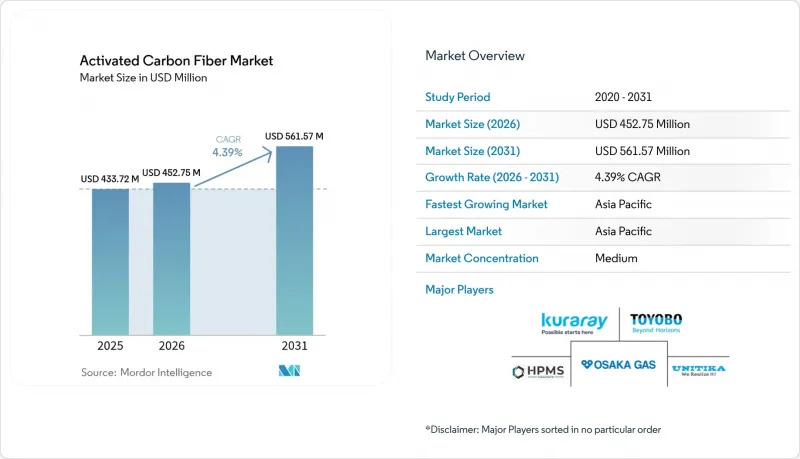
根據 Mordor Intelligence 預測,活性碳纖維市場規模將從 2025 年的 4.3372 億美元成長到 2026 年的 4.5275 億美元,然後在 2031 年達到 5.6157 億美元,2026 年至 2031 年的複合成長率為 4.39%。
本報告按原料(天然和合成)、應用領域(純化、化學分離和催化劑、防護衣、醫療、超級電容及其他應用)和地區(亞太地區、北美、歐洲、南美以及中東和非洲)進行細分。市場預測以美元計價。
全球活性碳纖維市場趨勢與洞察
更嚴格的全球排放標準正在加速工業界的採用。
全球監管機構目前呼籲進一步減少揮發性有機化合物 (VOC) 的排放,而活性碳纖維因其能夠捕獲顆粒碳無法捕獲的微量物質,正對市場產生積極影響。歐盟 (EU) 的溶劑安全標準 (STS) 最佳可行技術 (BAT) 結論將於 2025 年生效,適用於超過 50 萬家使用溶劑的企業,並正式將活性碳纖維指定為「最佳可行可用技術(BAT)」。此外,根據更嚴格的《國家有害空氣污染物排放標準》(NEHAP),美國的滅菌設施必須將環氧乙烷排放量減少 99.99%。與顆粒填充床相比,採用纖維系統的設施更青睞其更小的填充體積、更低的壓力損失和更少的再生循環次數。隨著監管實施進度加快,買家傾向於選擇能夠靈活應對未來可能更加嚴格的法規的解決方案。因此,監管需求推動了各區域市場高規格光纖模組銷售的兩位數成長。
優異的吸附動力學性能可實現製程強化。
活性碳纖維可在數分鐘內達到吸附平衡,而顆粒介質則需要數小時。這一差異顯著改變了連續運轉工廠的製程經濟性。實驗室測試表明,由於活性碳纖維具有易於接近的外表面(不受內部擴散限制),其吸附速率可提高 10 至 100 倍。半導體蝕刻工廠非常重視此速度,因為快速再生可實現持續捕獲全氟碳化合物,而無需中斷生產。化學企業透過維修到更小的接觸器,節省了占地面積並降低了輔助能耗。更短的循環週期還能減少解吸過程中的蒸氣用量,從而在燃料價格波動較大的市場中降低公用事業成本。隨著連續製造的日益普及,纖維的反應速率特性將有助於緊湊型模組化污染預防和分離系統的轉型。
前體物價格波動對生產獲利能力造成壓力。
聚丙烯腈 (PAN) 和石油瀝青佔成品纖維成本的 60% 之多,因此價格飆升正在擠壓利潤空間。 2025 年 5 月,美國碳和石墨產品生產者物價指數 (PPI) 上漲,顯示整個碳供應鏈普遍存在通膨。隨著服裝需求的復甦,用於紡織的 PAN 將流入主流布料市場,從而加劇工業纖維供應緊張。煉油廠為了提高運輸燃料的產量,正在減少瀝青產量,進一步加劇原料供應緊張。生產商正透過複製生產、避險和增加安全庫存來應對這種情況,但這些策略會增加營運成本密集度。木質素基替代品或許能帶來轉機,但擴大新型生物基製程的規模仍面臨技術挑戰。
細分市場分析
到 2025 年,合成前驅物將佔活性碳纖維市場的 93.72%,預計到 2031 年將以 4.42% 的複合年成長率成長。其中,聚丙烯腈纖維由於其對孔徑的精確控制和高拉伸強度,在淨化、醫療和半導體過濾領域表現出優異的性能。
瀝青基纖維滿足儲能領域客戶對導電基質的需求,而酚醛纖維則用於需要耐酸性的嚴苛化學環境。粘膠纖維衍生物目前仍處於小眾市場,但其精確的中孔分佈使其適用於特定的吸附應用。木質素和纖維素等天然原料正吸引著注重永續性的用戶,但由於品質不穩定和商業生產線有限,其總合佔有率仍然較小。對連續穩定化和碳化製程的投資旨在提高合成原料的產量並降低單位成本,預計這將進一步鞏固合成纖維在預測期內的主導地位。
區域分析
預計到2025年,亞太地區將佔據活性碳纖維市場42.74%的佔有率,並將在2031年之前保持4.96%的複合年成長率。中國憑藉其低成本的電力、熟練的勞動力以及接近性半導體製造工廠的優勢,吸引了大量資本,這有助於降低交付成本。日本企業如KURARAY CO. LTD.和東洋紡正利用其在吸附劑領域數十年的專業經驗,並專注於研發合作,以推動纖維製造流程向碳中和方向發展。
北美地區的特點是聯邦排放法規嚴格,同時半導體和電池供應鏈也在回流。美國環保署 (EPA) 的消毒法規正在加速醫療機構的維修項目,從而推高了對短週期過濾器的需求。由於跨國製造活動的擴張,加拿大和墨西哥的市場成長速度進一步加快。在歐洲,基於歐盟關於製藥、塗料和印刷業溶劑排放的STS最佳可行技術 (BAT) 結論,銷售量穩定成長。德國是整合溶劑回收裝置的先驅,該裝置結合了纖維床和熱變頻再生技術,以提高能源效率。在英國和法國,纖維正被用於垃圾焚化發電發電廠和特殊化學品製造地,以實現脫碳目標。在南歐,面對飆升的電力成本,纖維模組的低壓損特性因其降低營業成本而備受青睞。南美洲、中東和非洲仍在發展中,但被認為具有巨大的未來潛力。推動成長的因素包括煉油廠設備的升級改造、與採礦相關的空氣品質法規以及需要高流量吸附劑的市政飲用水項目。然而,價格敏感度和有限的本地生產限制了短期內的普及,導致區域市場佔有率保持在個位數。
其他好處:
- Excel格式的市場預測(ME)表
- 3個月的分析師支持
目錄
第1章:引言
- 研究假設和市場定義
- 調查範圍
第2章:調查方法
第3章執行摘要
第4章 市場狀況
- 市場概覽
- 市場促進因素
- 更嚴格的全球揮發性有機化合物和微量污染物排放標準
- 與顆粒活性碳(GAC)和顆粒活性碳(PAC)相比,具有更優異的吸附和解吸動力學性能。
- 高功率超級電容的產量正在激增。
- 半導體製造廠將安裝ACF洗滌器以回收全氟碳
- 穿戴式個人空氣淨化紡織品的成長
- 市場限制因素
- PAN、瀝青和酚類前驅物的價格和供應波動
- 低成本顆粒狀和粉末狀活性碳的競爭
- 缺乏大規模連續碳化能力
- 價值鏈分析
- 波特五力模型
第5章 市場規模與成長預測
- 按成分
- 天然來源(例如纖維素、木質素)
- 合成
- 音調系統
- PAN 類型
- 酚類
- 黏膠纖維
- 其他
- 透過使用
- 純化
- 化學分離和催化反應
- 防護衣
- 醫學領域
- 超級電容
- 其他用途
- 地區
- 亞太地區
- 中國
- 日本
- 韓國
- 印度
- 其他亞太國家
- 北美洲
- 美國
- 加拿大
- 墨西哥
- 歐洲
- 德國
- 英國
- 法國
- 義大利
- 其他歐洲國家
- 南美洲
- 巴西
- 阿根廷
- 其他南美國家
- 中東和非洲
- 沙烏地阿拉伯
- 南非
- 其他中東和非洲國家
- 亞太地區
第6章 競爭情勢
- 市場集中度
- 策略趨勢
- 市佔率和排名分析
- 公司簡介
- Anshan Sinocarb Carbon Fibers Co., Ltd.
- China Beihai Fiberglass Co. Ltd
- Evertech Envisafe Ecology Co. Ltd
- Hangzhou Nature Technology Co. Ltd
- HPMS Graphite
- Jiangsu Tongkang Activated Carbon Fiber Co. Ltd
- Kuraray Co. Ltd
- Nantong Yongtong Environmental Technology Co. Ltd
- Osaka Gas Co. Ltd(Daigas Group)
- Taiwan Carbon Technology Co., Ltd.
- TOYOBO CO. LTD
- UNITIKA LTD
第7章 市場機會與未來展望
According to Mordor Intelligence, the activated carbon fiber market size is expected to grow from USD 433.72 million in 2025 to USD 452.75 million in 2026 and is forecast to reach USD 561.57 million by 2031 at 4.39% CAGR over 2026-2031.
This report is Segmented by Raw Material (Natural and Synthetic), Application (Purification, Chemical Separation and Catalysis, Protective Clothing, Medical, Super Capacitors, and Other Applications), and Geography (Asia-Pacific, North America, Europe, South America, and Middle-East and Africa). The Market Forecasts are Provided in Terms of Value (USD).
Global Activated Carbon Fiber Market Trends and Insights
Tightening Global Emission Norms Drive Industrial Adoption
Regulators worldwide now require deeper cuts in volatile organic compound emissions, and the activated carbon fiber market benefits because the material can capture traces that escape granular carbons. The European Union's STS BAT Conclusions, effective 2025, apply to more than 500,000 solvent-using businesses and formally list activated carbon fiber as Best Available Technology. .S. sterilization plants must now achieve a 99.99% reduction in ethylene oxide discharges under tightened National Emission Standards for Hazardous Air Pollutants. Facilities switching to fiber systems appreciate smaller bed volumes, lower pressure drop, and fewer regeneration cycles than granular beds. As enforcement timetables compress, buyers lean toward solutions that provide headroom for even stricter future rules. The result is a regulatory pull that sustains double-digit volume gains for high-spec fiber modules across regional markets.
Superior Kinetics Enable Process Intensification
Activated carbon fiber attains equilibrium adsorption in minutes, while granular media require hours, a gap that transforms process economics in continuous plants. Laboratory trials show 10- to 100-fold faster uptake thanks to accessible external surfaces that avoid internal diffusion limits. Semiconductor etch shops value this speed because rapid regeneration keeps perfluorocarbon capture online without halting production. Chemical processors retrofit smaller contactors that free up floor space and reduce auxiliary energy consumption. Faster cycles also cut steam use in desorption, lowering utility bills during volatile fuel markets. As continuous manufacturing spreads, fiber kinetics underpin a shift toward compact, modular pollution-control and separation equipment.
Precursor Price Volatility Constrains Production Economics
Polyacrylonitrile and petroleum pitch account for up to 60% of finished fiber cost, so price spikes erode margins. The U.S. Producer Price Index for carbon and graphite products rose in May 2025, signaling broad inflation across carbon supply chains. Textile-grade PAN diverts toward mainstream fabric markets when apparel demand rebounds, squeezing availability for technical fibers. Refineries, chasing higher yields on transportation fuels, trim pitch output, and further tighten feedstock pools. Producers counter by dual-sourcing, hedging, and carrying larger safety stocks, but these strategies raise working-capital intensity. Lignin-based alternatives promise relief; however, scaling new biobased processes still faces technical hurdles.
Other drivers and restraints analyzed in the detailed report include:
- Semiconductor Industry Adopts Advanced Emission Control
- Growth of Wearable Personal Air-Filtration Textiles
- Cost Competition Limits Market Penetration
For complete list of drivers and restraints, kindly check the Table Of Contents.
Segment Analysis
Synthetic precursors accounted for 93.72% of the activated carbon fiber market share in 2025 and will record a 4.42% CAGR through 2031. Within this group, polyacrylonitrile fibers excel in purification, medical, and semiconductor filtration because they offer tight pore-size control and high tensile strength.
Pitch-based grades cater to energy-storage customers that require conductive matrices, while phenolic fibers serve in harsh chemical environments that demand acid resistance. Viscose derivatives, though still niche, present precise mesopore distributions that favor specialty adsorption. Natural feedstocks such as lignin and cellulose attract sustainability-minded users, yet inconsistent quality and limited commercial lines keep their combined share minor. Investment in continuous stabilization and carbonization aims to lift output and cut synthetic feedstock unit costs, reinforcing synthetic supremacy for the forecast horizon.
Complete Report Scope:
- By Raw Material
- Natural (e.g., cellulose, lignin)
- Synthetic
- Pitch-based
- PAN-based
- Phenolic-based
- Viscose-based
- Others
- By Application
- Purification
- Chemical Separation and Catalysis
- Protective Clothing
- Medical
- Super Capacitors
- Other Applications
- Geography
- Asia-Pacific
- China
- Japan
- South Korea
- India
- Rest of Asia-Pacific
- North America
- United States
- Canada
- Mexico
- Europe
- Germany
- United Kingdom
- France
- Italy
- Rest of Europe
- South America
- Brazil
- Argentina
- Rest of South America
- Middle-East and Africa
- Saudi Arabia
- South Africa
- Rest of Middle-East and Africa
- Asia-Pacific
Geography Analysis
Asia-Pacific captured 42.74% of the activated carbon fiber market share in 2025 and is set to post a 4.96% CAGR through 2031. China attracts capital because low-cost electric power, skilled labor, and proximity to semiconductor fabs lower delivered costs. Japanese firms such as Kuraray and Toyobo, with decades of adsorbent expertise, focus on research alliances that push fiber into carbon-neutral process routes.
North America is characterized by strict federal emissions rules converge with on-shoring of chip and battery supply chains. The EPA's sterilization rules accelerate retrofit programs in healthcare facilities, bolstering short-cycle filter demand. Canada and Mexico contribute incremental growth as cross-border manufacturing expands. Europe delivers steady volume gains under the EU's STS BAT Conclusions, which tighten solvent emissions across pharmaceuticals, coatings, and printing. Germany pioneers integrated solvent-recovery plants that pair fiber beds with thermal swing regeneration to improve energy efficiency. The United Kingdom and France use fiber to meet decarbonization targets in waste-to-energy and specialty chemical sites. Southern Europe, facing high electricity costs, values the lower pressure drop of fiber modules to reduce operating expenses. South America, the Middle East, and Africa remain embryonic but promising. Growth stems from refinery upgrades, mining-related air-quality mandates, and municipal drinking-water projects seeking high-flow-rate adsorbents. However, price sensitivity and limited local manufacturing constrain near-term penetration, keeping regional shares in the single digits.
- Anshan Sinocarb Carbon Fibers Co., Ltd.
- China Beihai Fiberglass Co. Ltd
- Evertech Envisafe Ecology Co. Ltd
- Hangzhou Nature Technology Co. Ltd
- HPMS Graphite
- Jiangsu Tongkang Activated Carbon Fiber Co. Ltd
- Kuraray Co. Ltd
- Nantong Yongtong Environmental Technology Co. Ltd
- Osaka Gas Co. Ltd (Daigas Group)
- Taiwan Carbon Technology Co., Ltd.
- TOYOBO CO. LTD
- UNITIKA LTD
Additional Benefits:
- The market estimate (ME) sheet in Excel format
- 3 months of analyst support
TABLE OF CONTENTS
1 Introduction
- 1.1 Study Assumptions and Market Definition
- 1.2 Scope of the Study
2 Research Methodology
3 Executive Summary
4 Market Landscape
- 4.1 Market Overview
- 4.2 Market Drivers
- 4.2.1 Tightening Global Emission Norms on VOCs and Micro-Contaminants
- 4.2.2 Superior Adsorption-Desorption Kinetics Versus GAC and PAC
- 4.2.3 Surge in High-Power Super-Capacitor Production
- 4.2.4 Semiconductor Fabs Adopting ACF Scrubbers for Perfluoro-Carbon Capture
- 4.2.5 Growth of Wearable Personal Air-Filtration Textiles
- 4.3 Market Restraints
- 4.3.1 Volatile Prices and Supply Of PAN, Pitch and Phenolic Precursors
- 4.3.2 Competition from Low-Cost Granular and Powdered Activated Carbon
- 4.3.3 Scarcity of Large-Scale Continuous Carbonization Capacity
- 4.4 Value Chain Analysis
- 4.5 Porter's Five Forces
- 4.5.1 Bargaining Power of Suppliers
- 4.5.2 Bargaining Power of Buyers
- 4.5.3 Threat of New Entrants
- 4.5.4 Threat of Substitutes
- 4.5.5 Degree of Competition
5 Market Size and Growth Forecasts (Value)
- 5.1 By Raw Material
- 5.1.1 Natural (e.g., cellulose, lignin)
- 5.1.2 Synthetic
- 5.1.2.1 Pitch-based
- 5.1.2.2 PAN-based
- 5.1.2.3 Phenolic-based
- 5.1.2.4 Viscose-based
- 5.1.2.5 Others
- 5.2 By Application
- 5.2.1 Purification
- 5.2.2 Chemical Separation and Catalysis
- 5.2.3 Protective Clothing
- 5.2.4 Medical
- 5.2.5 Super Capacitors
- 5.2.6 Other Applications
- 5.3 Geography
- 5.3.1 Asia-Pacific
- 5.3.1.1 China
- 5.3.1.2 Japan
- 5.3.1.3 South Korea
- 5.3.1.4 India
- 5.3.1.5 Rest of Asia-Pacific
- 5.3.2 North America
- 5.3.2.1 United States
- 5.3.2.2 Canada
- 5.3.2.3 Mexico
- 5.3.3 Europe
- 5.3.3.1 Germany
- 5.3.3.2 United Kingdom
- 5.3.3.3 France
- 5.3.3.4 Italy
- 5.3.3.5 Rest of Europe
- 5.3.4 South America
- 5.3.4.1 Brazil
- 5.3.4.2 Argentina
- 5.3.4.3 Rest of South America
- 5.3.5 Middle-East and Africa
- 5.3.5.1 Saudi Arabia
- 5.3.5.2 South Africa
- 5.3.5.3 Rest of Middle-East and Africa
- 5.3.1 Asia-Pacific
6 Competitive Landscape
- 6.1 Market Concentration
- 6.2 Strategic Moves
- 6.3 Market Share (%)/Ranking Analysis
- 6.4 Company Profiles (includes Global level Overview, Market level overview, Core Segments, Financials as available, Strategic Information, Market Rank/Share, Products and Services, Recent Developments)
- 6.4.1 Anshan Sinocarb Carbon Fibers Co., Ltd.
- 6.4.2 China Beihai Fiberglass Co. Ltd
- 6.4.3 Evertech Envisafe Ecology Co. Ltd
- 6.4.4 Hangzhou Nature Technology Co. Ltd
- 6.4.5 HPMS Graphite
- 6.4.6 Jiangsu Tongkang Activated Carbon Fiber Co. Ltd
- 6.4.7 Kuraray Co. Ltd
- 6.4.8 Nantong Yongtong Environmental Technology Co. Ltd
- 6.4.9 Osaka Gas Co. Ltd (Daigas Group)
- 6.4.10 Taiwan Carbon Technology Co., Ltd.
- 6.4.11 TOYOBO CO. LTD
- 6.4.12 UNITIKA LTD
7 Market Opportunities and Future Outlook
- 7.1 White-space and Unmet-need Assessment

 全球活性碳纖維市場規模、佔有率、趨勢和成長分析報告(2026-2034)
 活性碳纖維市場-2026-2032年全球市場預測
 活性碳纖維市場規模、佔有率和趨勢分析報告:按原料、應用、地區和細分市場預測(2026-2033 年)
 活性碳纖維市場報告:按原料、應用和地區分類(2026-2034年)
 活性碳纖維市場分析及預測(至2035年):類型、產品、應用、技術、最終用戶、形態、材質類型、功能、安裝類型
 活性碳纖維(ACF)市場規模、佔有率和成長分析(按來源、類型、應用、最終用戶產業和地區分類)—產業預測(2026-2033 年)
 活性碳纖維市場-全球產業規模、佔有率、趨勢、機會和預測,按類型(天然、合成)、按應用(空氣淨化、水處理、催化劑載體、其他)、按地區和競爭情況分類,2020-2030 年預測
 活性碳纖維市場,按類型、按應用、按最終用戶、按國家和地區——2025 年至 2032 年全球產業分析、市場規模、市場佔有率及預測
 活性碳纖維 (ACF) 市場機會、成長動力、產業趨勢分析及 2025 - 2034 年預測