


 |
市場調查報告書
商品編碼
2122919
紅外線檢測器:市場佔有率分析、產業趨勢與統計、成長預測(2026-2031)Infrared Detector - Market Share Analysis, Industry Trends & Statistics, Growth Forecasts (2026 - 2031) |
||||||

※ 本網頁內容可能與最新版本有所差異。詳細情況請與我們聯繫。
據 Mordor Intelligence 稱,紅外線檢測器市場預計將從 2025 年的 7 億美元成長到 2026 年的 7.4 億美元,到 2031 年達到 9.8 億美元,預計 2026 年至 2031 年的複合年成長率為 5.79%。
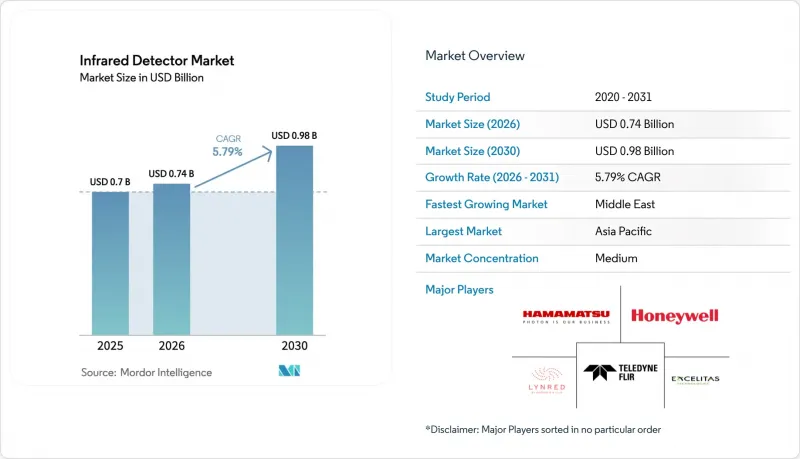
本報告按檢測器類型(熱檢測器、光子(量子)檢測器)、冷卻技術(非冷卻紅外線檢測器、冷卻紅外線檢測器)、材料(微測輻射熱計、InGaAs、MCT、熱電、熱電堆)、頻譜範圍(近紅外線 (NIR)、短波紅外線 (SWIR)、中音外長(FIR))、應用(人體/運動偵測、其他)、終端用戶產業(航太/國防、其他)和地區進行細分。市場預測以美元 (USD) 為單位。
全球紅外線檢測器市場趨勢與洞察
非製冷微測輻射熱計陣列的小型化將促進物聯網運動感測器在亞洲的普及。
預計到2025年,日本和韓國的供應商將出貨約800萬個像素間距為12微米或更小的焦面陣列陣列,用於電池供電的物聯網佔用感測器,年增35%。建築自動化整合商已採用較小的晶片,以滿足將暖通空調負荷與房間佔用情況檢驗的能源效率標準。同時,鏡頭直徑也已縮小,使得熱成像模組能夠整合到以前沒有空間容納17微米陣列的照明設備和牆壁開關中。每平方毫米的製造成本降低了約40%,使得將熱成像相機整合到中階智慧型手機中成為可能。採用被動式方法無需進行與主動式近紅外線照明相關的眼部安全評估,從而簡化了IEC 62471消費產品認證流程。
歐盟強制要求流程工業進行預測性維護熱成像檢測。
能源效率指令2023/1791強制要求煉油廠、化工廠和鋼鐵廠每季對馬達、開關設備和管線進行熱成像檢測。德國和法國於2024年將該指令的適用範圍擴大到中型設施,使相關設施數量增加兩倍,達到12,000家。在危險區域,解析度為度C的手持式和無人機搭載式熱像儀已取代了接觸式探頭。英國和荷蘭的保險公司目前對將連續熱成像資料上傳至資產管理雲端平台的工廠報銷5%至10%的年度保費。為了應對這項需求,熱像儀供應商開始捆綁銷售LTE模組和加密閘道器,這使得平均售價比離線式機器熱像儀高出約20%。
對高規格冷卻檢測器實施出口管制限制(類似ITAR)
美國《國際武器貿易條例》(ITAR) 和歐盟的兩用物項清單將解析度為 640x480 或更高、噪音水準低於 20mK 的冷卻陣列歸類為國防物品,導致許可期限長達 12 個月,且每次出貨的法律費用超過 10 萬美元。亞洲和中東的買家優先考慮採購速度,而犧牲了性能,轉而使用規格較低的微測輻射熱計,或尋求能夠規避監管閾值的國產冷卻檢測器。據歐美供應商稱,由於缺乏許可核准,預計 2025 年的國際訂單將比 2024 年減少 25%。該法規也擾亂了全球研發合作,因為跨境技術資料交換現在需要政府批准協議。新興的超晶格材料旨在降低最低監管標準,但預計至少還需要四年才能獲得廣泛認證。
細分市場分析
隨著汽車製造商將砷化銦鎵崩光二極體整合到高速公路雷射雷達中,並將碲鎘汞整合到夜視攝影機中,量子光學陣列預計將以11.80%的複合年成長率成長,幾乎是整體紅外線檢測器市場增速的兩倍。熱探測器在對成本高度敏感的工業和建築自動化領域佔據主導地位,預計到2025年,其銷售額將佔總銷售額的68.46%。在這些領域,被動運轉和對環境溫度的耐受性比量子裝置的速度優勢更為重要。成熟的微測輻射熱計供應鏈使得640x480陣列的生產成本低於50美元,這為熱探測器在量產市場樹立了價格標竿。然而,汽車產業向L3級自動駕駛的轉型正在增加每輛車的檢測器數量,從而推動了對量子檢測器的需求,並推高了紅外線檢測器市場的平均售價。
量子檢測器的發展依賴於在晶格匹配基板上高良率地外延生長砷化銦鎵和碲鎘汞,但這些基板仍然稀缺且昂貴。日本和台灣正在擴大200毫米外延反應器的規模以增加晶圓直徑,如果生產線良率超過60%,晶圓成本最多可降低30%。如果產能擴張順利進行,到2031年,用於汽車和光譜分析的量子陣列紅外線檢測器市場規模預計將達到3億美元。工業熱成像仍然是熱檢測器的主要應用領域,但隨著量子陣列的應用擴展到高速機器視覺和高光譜遙測生物成像,其市場佔有率預計將降至60%以下。因此,紅外線檢測器產業面臨兩極分化的未來:價格驅動的熱陣列和性能驅動的量子裝置將並存。
2025年,非冷凍設備佔總銷售額的83.71%。這是因為智慧型手機配件、駕駛監控攝影機和無人機雲台等產品需要低功耗和室溫運作。晶圓級封裝技術的應用進一步擴大了此細分市場的成本優勢,使組裝成本降低了40%,模組尺寸縮小至10毫米以下。同時,冷凍設備的年複合成長率(CAGR)為10.90%。這主要是由於國防領域和遠端邊境監控項目對靈敏度在20毫開爾文或以下的設備的需求。這些項目通常會採購單價超過2萬美元的高價製冷型鏡頭,因此,相對於銷量而言,製冷型設備對市場的影響顯著,並擴大了低溫紅外線檢測器市場的規模。
脈衝管和線性驅動斯特林冷卻器的技術進步已將平均故障間隔時間 (MTBF) 延長至 15,000 小時,從而減輕了維護負擔,而維護負擔曾是商業買家面臨的主要障礙。冷卻焦平面陣列也正被應用於科學儀器和天文觀測載荷中的中波光譜學領域。在該領域,熱噪聲必須低於檢測器的散粒噪聲。雖然冷卻產品在出貨量方面仍佔少數,但如果出口限制放寬,到 2031 年,其市佔率可能超過 22%。因此,儘管非冷卻架構仍將保持銷售主導,但冷卻細分市場將能夠在更廣泛的紅外線檢測器市場中重新獲得定價權。
區域分析
預計到2025年,亞太地區將佔全球銷售額的40.15%,這主要得益於中國900萬輛電動車的出貨量以及該地區對半導體測試的需求。隨著LiDAR在新車的搭載率達到30%,到2031年,亞太地區的紅外線檢測器市場規模預計將超過4億美元。日本是外延晶片的主要供應國,而韓國正在擴建其銦鎵砷(InGaAs)晶圓廠,以支持其國內晶圓代工廠的發展。東南亞新興的無人機製造商正在採用長波紅外線(LWIR)微測輻射熱計進行作物生長監測,從而拓展了該技術在全部區域的應用範圍。
在歐洲,流程工廠強制採用熱成像技術以及國防費用預計將在2025年占到冷卻式中波長系統的銷售額的約25%。 5-7年的更換週期帶來了可預測的基本負載需求,而更嚴格的工業排放法規則推動了銷售成長。法國和德國領先的檢測器製造商正利用其與北約主要需求方的地理接近性,為裝甲車輛瞄準器和單兵攜帶系統提供快速客製化服務。在東歐,為滿足歐盟更新的能源法規,建築自動化感測器的早期應用正在加速推進,預計對非冷卻式產品的需求將呈現分散但不斷成長的趨勢。
儘管預計到2025年,中東地區的銷售額將佔比不到8%,但隨著沙烏地阿拉伯和阿拉伯聯合大公國的氫能計畫將相關計劃轉化為實際採購,其複合年成長率預計將達到10.30%。每吉瓦電解槽容量大約需要500台中波和長波紅外線(LWIR)攝影機用於洩漏檢測,這一密度遠超傳統油氣設施。北美市場仍以國防領域為主導,陸軍和國防安全保障部多年計畫預計將帶來穩定的冷卻陣列訂單。由於資金籌措和政治風險阻礙了大規模部署,南美和非洲合計佔全球銷售額的不到10%。然而,巴西的農業領域和南非的採礦領域是具有良好成長潛力的細分市場。
其他好處
- Excel格式的市場預測(ME)表
- 3個月的分析師支持
目錄
第1章:引言
- 研究假設和市場定義
- 調查範圍
第2章:調查方法
第3章執行摘要
第4章 市場狀況
- 市場概覽
- 市場促進因素
- 非製冷微測輻射熱計陣列的小型化將促進物聯網運動感測器在亞洲的普及。
- 歐盟強制要求流程工業進行預測性維護熱成像檢測。
- 中國對用於自動駕駛和電動車平台的LiDAR級近紅外線檢測器的需求正在激增。
- 強制要求中東地區所有綠色氫氣工廠進行紅外線氣體洩漏檢測。
- 台灣和韓國對半導體製造廠檢測的短波紅外線相機的需求
- 美國和印度邊境監控現代化計劃
- 市場限制因素
- 對高性能冷卻檢測器的出口管制限制(類似ITAR)
- 被動式PIR元件價格下降
- 海上油氣設施的熱漂移和校準挑戰
- 新興市場仿冒品檢測設備的通路
- 產業價值鏈分析
- 監理情勢
- 技術展望
- 波特五力分析
第5章 市場規模與成長預測
- 檢測器類型
- 熱檢測器
- 光(量子)檢測器
- 按類型分類的冷卻技術
- 非冷凍紅外線檢測器
- 冷卻式紅外線檢測器
- 材料
- 微測輻射熱計
- InGaAs(砷化銦鎵)
- MCT(碲鎘汞)
- 熱電
- 熱電堆
- 按頻譜範圍
- 近紅外線(NIR)
- 短波紅外線(SWIR)
- 中波紅外線(MWIR)
- 長波紅外線(LWIR)
- 遠紅外線(FIR)
- 透過使用
- 人體/運動偵測
- 溫度測量和熱成像
- 工業製程監控
- 光譜學和生物醫學成像
- 火災和氣體偵測
- 汽車ADAS/雷射雷達
- 環境和農業監測
- 其他用途(建築和暖通空調自動化、智慧家庭、軍事和國防等)
- 按最終用途行業分類
- 航太/國防
- 工業製造
- 車
- 石油和天然氣能源
- 醫療保健和生命科學
- 家用電子產品
- 智慧基礎設施
- 其他
- 按地區
- 北美洲
- 美國
- 加拿大
- 墨西哥
- 南美洲
- 巴西
- 阿根廷
- 其他南美國家
- 歐洲
- 德國
- 英國
- 法國
- 義大利
- 西班牙
- 其他歐洲國家
- 亞太地區
- 中國
- 日本
- 韓國
- 印度
- 澳洲
- 紐西蘭
- 其他亞太國家
- 中東和非洲
- 中東
- 阿拉伯聯合大公國
- 沙烏地阿拉伯
- 土耳其
- 其他中東國家
- 非洲
- 南非
- 奈及利亞
- 肯亞
- 其他非洲地區
- 中東
- 北美洲
第6章 競爭情勢
- 市場集中度
- 策略趨勢
- 市佔率分析
- 公司簡介
- Teledyne FLIR
- Lynred(ULIS+Sofradir)
- Hamamatsu Photonics
- Excelitas Technologies
- Honeywell International
- Murata Manufacturing
- Texas Instruments
- Omron Corporation
- Raytheon Technologies
- Leonardo DRS
- SCD-SemiConductor Devices
- BAE Systems plc
- L3Harris Technologies
- InfraTec GmbH
- iRay Technology
- Hikmicro(Hangzhou)
- Guide Sensmart(Wuhan Guide)
- DALI Technology
- Emberion Oy
- Seek Thermal
第7章 市場機會與未來展望
According to Mordor Intelligence, the infrared detector market size is expected to increase from USD 0.70 billion in 2025 to USD 0.74 billion in 2026 and reach USD 0.98 billion by 2031, growing at a CAGR of 5.79% over 2026-2031.
This report is Segmented by Detector Type (Thermal, and Photo Quantum), Cooling Technology (Uncooled, and Cooled), Material (Microbolometer, Ingaas, MCT, Pyroelectric, and Thermopile), Spectral Range (NIR, SWIR, MWIR, LWIR, and FIR), Application(people and Motion Sensing, and More), End-Use Industry (Aerospace and Defense, and More), and Geography. The Market Forecasts are Provided in Terms of Value (USD).
Global Infrared Detector Market Trends and Insights
Miniaturization of Uncooled Micro-bolometer Arrays Empowering IoT Motion Sensors in Asia
Pixel pitches below 12 micrometers have allowed Japanese and South Korean suppliers to ship nearly 8 million focal-plane arrays for battery-powered IoT occupancy sensors in 2025, up 35% year on year. Building-automation integrators adopted the smaller die to satisfy energy-efficiency codes that tie HVAC loads to verified room presence. Lens diameters shrank in parallel, allowing thermal modules to fit into light fixtures and wall switches that previously lacked space for 17-micrometer arrays. Manufacturing cost per square millimeter dropped about 40%, opening mid-tier smartphones to embedded thermal cameras. Passive operation avoids the eye-safety reviews associated with active near-infrared illumination, easing consumer-product certification under IEC 62471.
Mandatory Predictive-Maintenance Thermography in EU Process Industries
The Energy Efficiency Directive 2023/1791 obliges refiners, chemical plants, and steel mills to run quarterly thermography on motors, switchgear, and piping. Germany and France extended the scope in 2024 to medium-sized sites, tripling the addressable facility count to 12,000. Handheld and drone-mounted cameras with 0.05 °C resolution displaced contact probes in hazardous zones. U.K. and Dutch insurers now rebate between 5% and 10% of annual premiums when plants upload continuous thermal data to asset-management clouds. Camera vendors responded by bundling LTE modules and encrypted gateways, features that raise average selling price by roughly 20% versus offline units.
Export-control (ITAR-like) Limits on High-spec Cooled Detectors
U.S. ITAR and EU dual-use lists classify cooled arrays above 640X480 resolution and below 20 mK noise as defense articles, adding up to 12 months for export licensing and legal fees over USD 100,000 per shipment. Asian and Middle Eastern buyers pivot to lower-spec microbolometers or seek domestically produced cooled detectors that skirt the threshold, trading performance for procurement speed. Western suppliers report 25% fewer international orders in 2025 compared with 2024 because of license denials. The restriction also fragments global R&D collaboration as cross-border technical-data exchanges now require government-approved agreements. Emerging superlattice materials aim to reset the regulatory floor, but widespread qualification remains at least four years away.
Other drivers and restraints analyzed in the detailed report include:
- Surge in LiDAR-grade Near-IR Detectors for Autonomous and EV Platforms in China
- IR Gas-Leak Detection Mandates for Green-Hydrogen Plants across Middle East
- Price Erosion in Passive PIR Components
For complete list of drivers and restraints, kindly check the Table Of Contents.
Segment Analysis
Photo quantum arrays are projected to expand at an 11.80% CAGR, nearly double the overall infrared detector market, as automakers embed indium-gallium-arsenide avalanche photodiodes in highway-range LiDAR and mercury-cadmium-telluride in night-vision cameras. Thermal detectors, holding 68.46% of 2025 revenue, dominate cost-sensitive industrial and building-automation roles where passive operation and ambient-temperature tolerance outweigh the speed advantages of quantum devices. Because mature microbolometer supply chains can fabricate 640X480 arrays for under USD 50, the thermal camp anchors mass-market pricing. Yet the automotive pivot toward Level 3 autonomy raises per-vehicle detector content, nudging volume into the quantum camp and lifting average selling prices inside the infrared detector market.
Quantum growth depends on high-yield epitaxy of indium-gallium-arsenide and mercury-cadmium-telluride on lattice-matched substrates that remain scarce and expensive. Japan and Taiwan are scaling 200-millimeter epitaxial reactors to widen wafer diameters, which could cut die cost by as much as 30% once line yields exceed 60%. If those capacity ramps stay on track, the infrared detector market size attributed to quantum arrays for automotive and spectroscopy may reach USD 0.30 billion by 2031. Industrial thermography retains a stronghold for thermal detectors, but their share will slip below 60% as quantum adoption broadens into high-speed machine vision and hyperspectral biomedical imaging. The infrared detector industry thus faces a two-track future in which price-led thermal arrays coexist with performance-driven quantum devices.
Uncooled devices captured 83.71% of 2025 revenue as smartphone add-ons, driver-monitoring cameras, and drone gimbals require low-power, room-temperature operation. The segment's cost advantage widened with wafer-level packaging that slashes assembly expense 40% and compresses module footprints below 10 millimeters. Cooled designs, however, are growing at a 10.90% CAGR because defense and long-range border-surveillance programs demand sub-20 millikelvin sensitivity. These programs procure high-price cooled cameras, often exceeding USD 20,000 each, and therefore punch above their unit volumes in dollar terms, enlarging the infrared detector market size for cryogenic systems.
Advances in pulse-tube and linear-drive Stirling coolers have extended the mean time between failures to 15,000 hours, easing maintenance burdens that once deterred commercial buyers. Scientific instruments and astronomy payloads are also adopting cooled focal-plane arrays for mid-wave spectroscopy, where thermal noise must be suppressed below detector shot noise. While cooled shipments remain a minority, their revenue share could top 22% by 2031 if export-control bottlenecks ease. The net result keeps uncooled architectures at volume leadership yet allows cooled niches to regain pricing leverage inside the broader infrared detector market.
Complete Report Scope:
- By Detector Type
- Thermal Detector
- Photo (Quantum) Detector
- By Cooling Technology
- Uncooled Infrared Detector
- Cooled Infrared Detector
- By Material
- Microbolometer
- InGaAs (Indium Gallium Arsenide)
- MCT (Mercury Cadmium Telluride)
- Pyroelectric
- Thermopile
- By Spectral Range
- Near-Wave Infrared (NIR)
- Short-Wave Infrared (SWIR)
- Mid-Wave Infrared (MWIR)
- Long-Wave Infrared (LWIR)
- Far-Infrared (FIR)
- By Application
- People and Motion Sensing
- Temperature Measurement / Thermography
- Industrial Process Monitoring
- Spectroscopy and Biomedical Imaging
- Fire and Gas Detection
- Automotive ADAS and LiDAR
- Environmental and Agriculture Monitoring
- Other Applications (Building and HVAC Automation, Smart Homes, Military and Defense, etc.)
- By End-Use Industry
- Aerospace and Defense
- Industrial Manufacturing
- Automotive
- Oil, Gas and Energy
- Healthcare and Life Sciences
- Consumer Electronics
- Smart Infrastructure
- Others
- By Geography
- North America
- United States
- Canada
- Mexico
- South America
- Brazil
- Argentina
- Rest of South America
- Europe
- Germany
- United Kingdom
- France
- Italy
- Spain
- Rest of Europe
- Asia Pacific
- China
- Japan
- South Korea
- India
- Australia
- New Zealand
- Rest of Asia-Pacific
- Middle East and Africa
- Middle East
- United Arab Emirates
- Saudi Arabia
- Turkey
- Rest of Middle East
- Africa
- South Africa
- Nigeria
- Kenya
- Rest of Africa
- Middle East
- North America
Geography Analysis
Asia-Pacific generated 40.15% of 2025 revenue, lifted by China's 9 million electric-vehicle shipments and regional semiconductor inspection demand. The infrared detector market size for Asia-Pacific could exceed USD 0.40 billion by 2031 if LiDAR attach rates reach 30% on new cars. Japan anchors epitaxial wafer supply, while South Korea scales indium-gallium-arsenide fabs to support domestic memory foundries. Emerging Southeast Asian drone makers are adopting LWIR microbolometers for crop-health surveys, broadening application footprints across the bloc.
Europe contributed roughly 25% of 2025 sales on the back of thermography mandates in process plants and defense spending on cooled mid-wave systems. Replacement cycles every five to seven years generate predictable base-load demand, while tightened industrial-emissions rules add incremental unit sales. Leading detector houses in France and Germany leverage proximity to NATO prime contractors, enabling rapid customization for armored-vehicle sights and soldier-borne systems. Eastern Europe shows early adoption of building-automation sensors to satisfy updated EU energy codes, offering a diffuse but rising tail for uncooled volumes.
The Middle East, though less than 8% of 2025 revenue, is forecast at a 10.30% CAGR as Saudi and Emirati hydrogen projects translate policy into procurement. Each gigawatt of electrolyzer capacity pulls in about 500 mid-wave and LWIR cameras for leak detection, a density far above that in legacy oil-and-gas facilities. North America remains defense-heavy, with multi-year Army and Homeland Security programs ensuring steady orders for cooled arrays. South America and Africa together account for less than 10% of global sales because limited financing and political risk slow large-scale deployments, though Brazilian agriculture and South African mining provide targeted growth niches.
- Teledyne FLIR
- Lynred (ULIS + Sofradir)
- Hamamatsu Photonics
- Excelitas Technologies
- Honeywell International
- Murata Manufacturing
- Texas Instruments
- Omron Corporation
- Raytheon Technologies
- Leonardo DRS
- SCD - SemiConductor Devices
- BAE Systems plc
- L3Harris Technologies
- InfraTec GmbH
- iRay Technology
- Hikmicro (Hangzhou)
- Guide Sensmart (Wuhan Guide)
- DALI Technology
- Emberion Oy
- Seek Thermal
Additional Benefits:
- The market estimate (ME) sheet in Excel format
- 3 months of analyst support
TABLE OF CONTENTS
1 INTRODUCTION
- 1.1 Study Assumptions and Market Definition
- 1.2 Scope of the Study
2 RESEARCH METHODOLOGY
3 EXECUTIVE SUMMARY
4 MARKET LANDSCAPE
- 4.1 Market Overview
- 4.2 Market Drivers
- 4.2.1 Miniaturisation of Uncooled Micro-bolometer Arrays Empowering IoT Motion Sensors in Asia
- 4.2.2 Mandatory Predictive-Maintenance Thermography in EU Process Industries
- 4.2.3 Surge in LiDAR-grade Near-IR Detectors for Autonomous and EV Platforms in China
- 4.2.4 IR Gas-Leak Detection Mandates for Green-Hydrogen Plants across Middle East
- 4.2.5 Semiconductor Fab Inspection Demand for SWIR Cameras in Taiwan and South Korea
- 4.2.6 Border-Surveillance Modernisation Programs in US and India
- 4.3 Market Restraints
- 4.3.1 Export-control (ITAR-like) Limits on High-spec Cooled Detectors
- 4.3.2 Price Erosion in Passive PIR Components
- 4.3.3 Thermal Drift and Calibration Issues in Offshore Oil-&-Gas Deployment
- 4.3.4 Counterfeit Detector Channels in Emerging Markets
- 4.4 Industry Value-Chain Analysis
- 4.5 Regulatory Landscape
- 4.6 Technological Outlook
- 4.7 Porter's Five Forces Analysis
- 4.7.1 Bargaining Power of Buyers
- 4.7.2 Bargaining Power of Suppliers
- 4.7.3 Threat of New Entrants
- 4.7.4 Threat of Substitutes
- 4.7.5 Competitive Rivalry
5 MARKET SIZE AND GROWTH FORECASTS (VALUE)
- 5.1 By Detector Type
- 5.1.1 Thermal Detector
- 5.1.2 Photo (Quantum) Detector
- 5.2 By Cooling Technology
- 5.2.1 Uncooled Infrared Detector
- 5.2.2 Cooled Infrared Detector
- 5.3 By Material
- 5.3.1 Microbolometer
- 5.3.2 InGaAs (Indium Gallium Arsenide)
- 5.3.3 MCT (Mercury Cadmium Telluride)
- 5.3.4 Pyroelectric
- 5.3.5 Thermopile
- 5.4 By Spectral Range
- 5.4.1 Near-Wave Infrared (NIR)
- 5.4.2 Short-Wave Infrared (SWIR)
- 5.4.3 Mid-Wave Infrared (MWIR)
- 5.4.4 Long-Wave Infrared (LWIR)
- 5.4.5 Far-Infrared (FIR)
- 5.5 By Application
- 5.5.1 People and Motion Sensing
- 5.5.2 Temperature Measurement / Thermography
- 5.5.3 Industrial Process Monitoring
- 5.5.4 Spectroscopy and Biomedical Imaging
- 5.5.5 Fire and Gas Detection
- 5.5.6 Automotive ADAS and LiDAR
- 5.5.7 Environmental and Agriculture Monitoring
- 5.5.8 Other Applications (Building and HVAC Automation, Smart Homes, Military and Defense, etc.)
- 5.6 By End-Use Industry
- 5.6.1 Aerospace and Defense
- 5.6.2 Industrial Manufacturing
- 5.6.3 Automotive
- 5.6.4 Oil, Gas and Energy
- 5.6.5 Healthcare and Life Sciences
- 5.6.6 Consumer Electronics
- 5.6.7 Smart Infrastructure
- 5.6.8 Others
- 5.7 By Geography
- 5.7.1 North America
- 5.7.1.1 United States
- 5.7.1.2 Canada
- 5.7.1.3 Mexico
- 5.7.2 South America
- 5.7.2.1 Brazil
- 5.7.2.2 Argentina
- 5.7.2.3 Rest of South America
- 5.7.3 Europe
- 5.7.3.1 Germany
- 5.7.3.2 United Kingdom
- 5.7.3.3 France
- 5.7.3.4 Italy
- 5.7.3.5 Spain
- 5.7.3.6 Rest of Europe
- 5.7.4 Asia Pacific
- 5.7.4.1 China
- 5.7.4.2 Japan
- 5.7.4.3 South Korea
- 5.7.4.4 India
- 5.7.4.5 Australia
- 5.7.4.6 New Zealand
- 5.7.4.7 Rest of Asia-Pacific
- 5.7.5 Middle East and Africa
- 5.7.5.1 Middle East
- 5.7.5.1.1 United Arab Emirates
- 5.7.5.1.2 Saudi Arabia
- 5.7.5.1.3 Turkey
- 5.7.5.1.4 Rest of Middle East
- 5.7.5.2 Africa
- 5.7.5.2.1 South Africa
- 5.7.5.2.2 Nigeria
- 5.7.5.2.3 Kenya
- 5.7.5.2.4 Rest of Africa
- 5.7.5.1 Middle East
- 5.7.1 North America
6 COMPETITIVE LANDSCAPE
- 6.1 Market Concentration
- 6.2 Strategic Moves
- 6.3 Market Share Analysis
- 6.4 Company Profiles (includes Global Level Overview, Market Level Overview, Core Segments, Financials as available, Strategic Information, Market Rank/Share, Products and Services, Recent Developments)
- 6.4.1 Teledyne FLIR
- 6.4.2 Lynred (ULIS + Sofradir)
- 6.4.3 Hamamatsu Photonics
- 6.4.4 Excelitas Technologies
- 6.4.5 Honeywell International
- 6.4.6 Murata Manufacturing
- 6.4.7 Texas Instruments
- 6.4.8 Omron Corporation
- 6.4.9 Raytheon Technologies
- 6.4.10 Leonardo DRS
- 6.4.11 SCD - SemiConductor Devices
- 6.4.12 BAE Systems plc
- 6.4.13 L3Harris Technologies
- 6.4.14 InfraTec GmbH
- 6.4.15 iRay Technology
- 6.4.16 Hikmicro (Hangzhou)
- 6.4.17 Guide Sensmart (Wuhan Guide)
- 6.4.18 DALI Technology
- 6.4.19 Emberion Oy
- 6.4.20 Seek Thermal
7 MARKET OPPORTUNITIES AND FUTURE OUTLOOK
- 7.1 White-Space and Unmet-Need Assessment

 紅外線光電導檢測器市場:全球市場預測,2026-2032年
 紅外線檢測器市場報告:按類型、波長範圍、技術、應用和地區分類(2026-2034 年)PIR運動偵測器市場按技術、安裝方式、電源、安裝方式、最終用戶和應用分類-全球預測,2026-2032年
 紅外線檢測器市場分析及預測(至2035年):按類型、產品類型、技術、應用、材質、最終用戶、功能、安裝類型、設備和模式分類被動式紅外線偵測器市場分析及預測(至2035年):按類型、產品類型、技術、組件、應用、形狀、材質、設備、部署模式和最終用戶分類工業用PIR探測器市場按技術、產品類型、安裝方式、終端用戶產業和銷售管道-全球預測,2026-2032年按類型、技術、最終用戶、應用程式和銷售管道分類的PbS紅外線檢測器陣列市場,全球預測,2026-2032年雙色紅外線檢測器市場:按檢測器類型、冷卻方式、波長範圍、應用和最終用戶行業分類——2026-2032年全球預測
 紅外線探測器市場-全球產業規模、佔有率、趨勢、機會及預測(依技術類型、光譜範圍、終端用戶產業、區域及競爭格局分類,2021-2031年預測)日本紅外線探測器市場報告(按類型、光譜範圍、技術(碲鎘汞、砷化銦鎵、熱釋電、熱電堆、微測輻射熱計及其他)、應用和地區分類,2026-2034年)