


 |
市場調查報告書
商品編碼
2122918
虹膜辨識:市場佔有率分析、產業趨勢與統計、成長預測(2026-2031)Iris Recognition - Market Share Analysis, Industry Trends & Statistics, Growth Forecasts (2026 - 2031) |
||||||

※ 本網頁內容可能與最新版本有所差異。詳細情況請與我們聯繫。
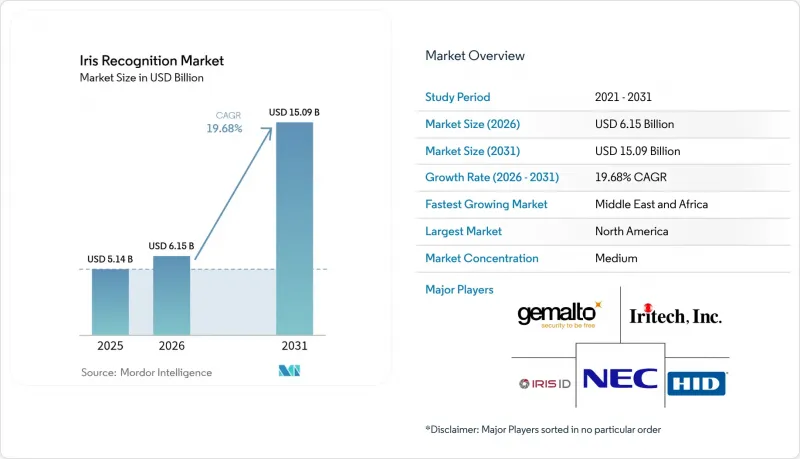
根據 Mordor Intelligence 預測,虹膜辨識市場規模將從 2025 年的 51.4 億美元成長到 2026 年的 61.5 億美元,然後在 2031 年達到 150.9 億美元,2026 年至 2031 年的複合年成長率為 19.68%。
本報告按組件(硬體、軟體)、認證模式(一對一檢驗、一對多識別)、應用(門禁/考勤管理、身份驗證/邊境管制、其他)、最終用戶行業(政府/執法機關、銀行、金融服務和保險業、其他)以及地區(北美、南美、歐洲、其他)進行細分。市場預測以美元計價。
全球虹膜辨識市場趨勢與洞察
亞洲國家身分證和電子護照計畫的擴展
亞太地區各國政府持續擴展具備虹膜辨識功能的數位身分平台,以簡化公共服務流程並促進普惠金融。印度的DigiLocker升級允許企業透過Aadhaar資料庫驗證員工身份,從而將服務範圍擴大到一般民眾之外。泰國公共衛生部門已為外籍勞工部署了多模態註冊自助終端,將虹膜掃描與疫苗接種和福利資格關聯起來。由於大規模生產,光學模組的成本已降至個位數美元水平,降低了預算緊張的機構採用該技術的門檻。隨著註冊勢頭持續增強,供應商預計將從維護合約和由性能標準提升驅動的定期感測器升級週期中獲得持續收入。
增加對中東主要路線的邊境管制支出
在海灣國家,虹膜辨識正在各大機場大規模應用,以平衡保全標準與旅客服務目標。阿拉伯聯合大公國與IDEMIA合作推出的「eGate」項目,採用遠端虹膜成像技術,無需居住者接觸入境櫃檯即可完成通關。沙烏地阿拉伯的「2030願景」工作小組正在強制要求所有新建航站樓採用多模態生物識別,這促使Invixium等供應商建立本地組裝,以實現快速客製化。因此,採購趨勢強調高容量掃描器和雲端配對引擎,這些設備每小時可處理數千名旅客,並記錄符合移民官員審計標準的證據。
在機場建造多模態生物識別中心需要大量資金
機場在對現有查核點進行改造,加裝配備虹膜、臉部和指紋辨識功能的多模態安檢艙時,前期投入成本龐大。雖然美國運輸安全管理局 (TSA) 的安檢作業已展現出旅客處理能力的提升,但這需要專用通道、LED 照明以及連接至中央匹配引擎的專用光纖回程傳輸。小規模的區域運輸安全管理局則延後實施,直到客流量達到足以收回投資的水平,導致採用率呈現兩極化的趨勢。供應商必須透過模組化、計量收費的定價模式來應對這種情況。
細分市場分析
到2025年,硬體將佔收入的72.25%,並將繼續作為虹膜辨識市場的基礎,這需要高精度光學元件、可控照明和堅固的機殼。然而,隨著雲端推理引擎提高識別速度並實現靈活的功能更新而無需大規模更換設備,成長的重點正在轉向軟體。據系統營運商稱,平均攝影機升級週期為4-5年,但為了應對不斷變化的用戶層,演算法修補程式正按季度部署,以提高識別準確率。
預計2026年至2031年間軟體產業的複合年成長率將達到22.05%,凸顯了其模式正從資本投資轉向訂閱模式,使得中小企業也能透過API按需計量收費地獲得企業級精度。這種分層架構允許在新隱私法規訂定時快速部署,這將對醫療保健和金融業的採購委員會產生重大影響。同時,組件供應商正在縮小紅外線LED陣列的體積,並採用汽車級耐溫技術,以擴大其在光照條件不穩定的戶外環境中的應用範圍。支援開放API的鏡頭能夠實現跨模態融合,使操作人員能夠將虹膜和臉部影像從單一感測器傳輸到通用後端。
預計到2025年,一對多模式將佔虹膜辨識市場規模的65.70%。這主要得益於邊境管制、選民登記和福利項目等需要對包含數百萬筆記錄的資料庫進行一對多搜尋的場景。各國政府在旅遊旺季期間投入大量運算預算,這充分體現了該架構對並發查詢的強大適應能力。
未來五年,一對一檢驗預計將以 20.15% 的複合年成長率成長。這是因為企業和行動錢包提供者優先考慮的是快速用戶身份驗證,而非全面的去重。這種便捷性在延遲必須保持在 250 毫秒以下以防止支付放棄的情況下尤為重要。歐洲一些率先採用該技術的銀行正在將虹膜掃描與動態2D碼令牌相結合,以關聯交易會話,從而在不顯著增加用戶負擔的情況下降低網路釣魚的風險。隨著這些解決方案的擴展,數據將被回饋到自適應閾值引擎中,從而改善不同文化背景使用者群體中誤接受和誤拒絕之間的平衡。
區域分析
預計到2025年,亞太地區將佔全球收入的35.60%。這主要得益於印度超過12億公民註冊了Aadhaar系統,以及智慧型手機的快速普及,使得生物識別成為日常生活的一部分。中國行動電話廠商正在將虹膜辨識作為旗艦機型的標準配置,以支援透過支付寶和微信支付進行轉帳。同時,日本NEC公司正將其Bio-IDiom技術套件商業化,應用於交通運輸和零售店的自助結帳系統系統。更清晰的監管、強大的行動資料通訊網路以及具有市場意識且精通技術的消費者群體,正在為生物識別技術的持續普及創造有利環境。
中東地區正處於最快的成長軌道上,預計到2031年將實現20.75%的年複合成長率(CAGR),這主要得益於海灣國家機場無縫旅客通道的引入以及各國數字身份識別系統的實施。阿拉伯聯合大公國決定逐步淘汰傳統的實體阿拉伯聯合大公國ID卡,轉而採用臉部認證和虹膜辨識辨識相結合的系統,這凸顯了其致力於超越傳統卡片系統的決心。沙烏地阿拉伯大力推動在地化,迫使供應商聯合生產掃描儀,該地區正逐漸成為需求中心和生產中心。
在歐洲和北美,我們看到市場需求曲線日趨成熟,但同時也受到政策的影響。 GDPR 的強制要求採用「隱私納入設計」架構,刺激了對國內雲端節點和加密技術的投資增加。在美國市場,聯邦政府正投入大量資金升級邊境檢查站和航空樞紐,海關與邊防安全(CBP) 也正在將虹膜辨識試點計畫擴展到更多邊境檢查站。由於公民自由倡導團體正在監督實施情況,因此,準確的生物識別檢測和透明的審計追蹤對於獲得公眾認可至關重要。
其他好處
- Excel格式的市場預測(ME)表
- 3個月的分析師支持
目錄
第1章:引言
- 研究假設和市場定義
- 調查範圍
第2章:調查方法
第3章執行摘要
第4章 市場狀況
- 市場概覽
- 市場促進因素
- 亞洲國家身分證和電子護照計畫的擴展
- 增加對中東主要路線的邊境管制支出
- 智慧型手機OEM廠商採用內建虹膜感應器
- 美國醫療保健產業強制推行非接觸式患者身分識別的規模擴大
- 歐盟的數位錢包計畫正在加速對電子身份驗證 (eKYC) 的需求。
- 銀行、金融服務和保險 (BFSI) 領域的跨境洗錢應對措施
- 市場限制因素
- 在機場建造多模態生物識別中心需要大量資金
- 在非合作捕獲場景中精度降低
- 資料主權和有關生物識別模板儲存的法規(歐盟GDPR)
- 北美公眾輿論及對公民自由的強烈反對
- 價值供應鏈分析
- 監管和技術展望
- 波特五力分析
- 投資分析
第5章 市場規模與成長預測
- 按組件
- 硬體
- 虹膜掃描儀
- 相機
- 整合式虹膜辨識系統
- 其他光學模組和照明
- 軟體
- 獨立匹配引擎
- SDK 中介軟體
- 基於雲端的平台
- 硬體
- 身份驗證模式
- 1:1檢驗
- 1:N 識別
- 透過使用
- 出入管理和考勤管理
- 身份驗證和邊境管制
- 交易和支付認證
- 病患識別與電子健康記錄(EMR) 整合
- 其他(KYC、監控、汽車資訊娛樂系統)
- 按最終用戶行業分類
- 政府和執法機關
- 銀行、金融服務和保險(BFSI)
- 醫療保健和生命科學
- 家用電子產品
- 軍事/國防
- 旅遊與移民
- 商業/企業
- 其他(教育、汽車OEM)
- 按地區
- 北美洲
- 美國
- 加拿大
- 墨西哥
- 南美洲
- 巴西
- 阿根廷
- 其他南美國家
- 歐洲
- 英國
- 德國
- 法國
- 義大利
- 西班牙
- 其他歐洲國家
- 亞太地區
- 中國
- 日本
- 韓國
- 印度
- 新加坡
- 澳洲
- 紐西蘭
- 其他亞太國家
- 中東和非洲
- 中東
- 沙烏地阿拉伯
- 阿拉伯聯合大公國
- 土耳其
- 其他中東國家
- 非洲
- 南非
- 奈及利亞
- 肯亞
- 其他非洲地區
- 中東
- 北美洲
第6章 競爭情勢
- 市場集中度
- 策略趨勢
- 市佔率分析
- 公司簡介
- NEC Corporation
- IDEMIA
- HID Global(ASSA ABLOY)
- Thales Group(Gemalto)
- Iris ID Inc.
- IriTech Inc.
- EyeLock LLC
- Princeton Identity Inc.
- BioEnable Technologies Pvt. Ltd.
- IrisGuard UK Ltd.
- Aware Inc.
- Vision-Box
- DERMALOG Identification Systems
- Cognitec Systems GmbH
- Smartmatic
- Samsung Electronics Co., Ltd.
- Fujitsu Limited
- CLEAR Inc.
- CMITech Company Ltd.
- SRI International
第7章 市場機會與未來展望
According to Mordor Intelligence, the iris recognition market size is expected to grow from USD 5.14 billion in 2025 to USD 6.15 billion in 2026 and is forecast to reach USD 15.09 billion by 2031 at 19.68% CAGR over 2026-2031.
This report is Segmented by Component (Hardware, Software), Authentication Mode (1:1 Verification, 1:N Identification), Application (Access Control and Time-Attendance, ID and Border Control, and More), End-User Industry (Government and Law-Enforcement, BFSI, and More), and Geography (North America, South America, Europe, and More). The Market Forecasts are Provided in Terms of Value (USD).
Global Iris Recognition Market Trends and Insights
Growing National-ID & e-Passport Programs in Asia
Asia-Pacific governments keep scaling iris-enabled digital identity platforms to streamline public-service delivery and financial inclusion. India's DigiLocker upgrade now allows corporate entities to verify staff credentials through the Aadhaar database, widening the addressable base beyond individual citizens.Thailand's public-health authorities have introduced multimodal enrolment kiosks for migrant workers, linking iris scans to vaccination and benefits eligibility. Optical module costs have fallen toward single-digit USD levels in high-volume production, giving budget-constrained agencies an entry point. As enrollment momentum continues, vendors see durable revenue from maintenance contracts and periodic sensor refresh cycles that follow increased performance standards.
Rising Border-Control Spending Across Middle-East Corridors
Gulf states deploy iris recognition at scale to balance security thresholds with passenger-flow targets in flagship airports. The UAE's eGate program, delivered with IDEMIA, employs iris-at-distance capture to process residents and visitors without touching immigration counters. Saudi Arabia's Vision 2030 task force mandates multimodal biometrics for all new terminals, prompting suppliers such as Invixium to commit to local assembly lines for quicker customization. The resulting procurement pipeline favors high-throughput scanners and cloud-ready matching engines that can clear several thousand travelers per hour while logging audit-grade evidence for immigration officials.
High CAPEX of Multimodal Biometric Hubs at Airports
Airports face steep upfront costs when retrofitting existing checkpoints with multimodal pods that include iris, face, and fingerprint options. U.S. Transportation Security Administration trials show passenger throughput gains yet require specialized lanes, LED-safe lighting, and dedicated fiber backhauls to central matching engines. Smaller regional airports postpone rollouts until passenger volumes justify the payback, creating a two-tier adoption curve that suppliers must navigate with modular, pay-per-use pricing models.
Other drivers and restraints analyzed in the detailed report include:
- Smartphone OEM Adoption of On-Device Iris Sensors
- Expansion of Contactless Patient-ID Mandates in U.S. Healthcare
- Data-Sovereignty & Biometric-Template Storage Regulations (EU GDPR)
For complete list of drivers and restraints, kindly check the Table Of Contents.
Segment Analysis
Hardware accounted for 72.25% of 2025 revenue and continues to anchor the iris recognition market, given the need for precision optics, controlled illumination, and rugged housings. Growth, however, shifts toward software as cloud inference engines raise recognition speeds and enable agile feature updates without forklift replacements. System operators report average upgrade cycles of four to five years for cameras, yet deploy quarterly algorithm patches to improve accuracy against evolving demographic mixes.
Software's 22.05% CAGR from 2026-2031 underscores the pivot from capital expenditure to subscription models, letting smaller enterprises trial enterprise-grade accuracy through pay-as-you-go APIs. The layered architecture supports quick rollouts when new privacy mandates emerge, a factor that materially influences procurement committees in health and finance. In parallel, component suppliers miniaturize infrared LED arrays and apply automotive-grade temperature ratings, expanding outdoor deployment windows where lighting is unpredictable. Open-API lenses invite cross-modality fusion, letting operators stream both iris and face images from a single sensor to common back ends.
The 1:N mode represented 65.70% iris recognition market size in 2025, supported by border-control, voter registry, and welfare-benefit rollouts requiring one-to-many searches against multimillion-record galleries. Governments reserve significant compute budgets for peak travel seasons, validating the architecture's resilience for concurrent queries.
Over the next five years, 1:1 verification is expected to record a 20.15% CAGR as corporates and mobile-wallet providers focus on rapid user validation rather than exhaustive de-duplication. The convenience angle resonates where latency must stay below 250 milliseconds to avoid checkout abandonment. Early adopter banks in Europe now pair iris scans with dynamic QR tokens to bind the transaction session, reducing phishing risk without noticeable user friction. As these point solutions scale, they feed data back into adaptive thresholding engines that improve false-accept/false-reject balances across culturally diverse user cohorts.
Complete Report Scope:
- By Component
- Hardware
- Iris Scanners
- Cameras
- Integrated Iris-Recognition Systems
- Other Optical Modules and Illumination
- Software
- Stand-alone Matching Engines
- SDKs and Middleware
- Cloud-based Platforms
- Hardware
- By Authentication Mode
- 1:1 Verification
- 1:N Identification
- By Application
- Access Control and Time-Attendance
- ID and Border Control
- Transaction and Payment Authentication
- Patient Identification and EMR Linkage
- Others (KYC, Surveillance, Automotive Infotainment)
- By End-user Industry
- Government and Law-Enforcement
- Banking, Financial Services and Insurance (BFSI)
- Healthcare and Life Sciences
- Consumer Electronics
- Military and Defense
- Travel and Immigration
- Commercial and Enterprise
- Others (Education, Automotive OEMs)
- By Geography
- North America
- United States
- Canada
- Mexico
- South America
- Brazil
- Argentina
- Rest of South America
- Europe
- United Kingdom
- Germany
- France
- Italy
- Spain
- Rest of Europe
- Asia Pacific
- China
- Japan
- South Korea
- India
- Singapore
- Australia
- New Zealand
- Rest of Asia Pacific
- Middle East and Africa
- Middle East
- Saudi Arabia
- United Arab Emirates
- Turkey
- Rest of Middle East
- Africa
- South Africa
- Nigeria
- Kenya
- Rest of Africa
- Middle East
- North America
Geography Analysis
Asia-Pacific held 35.60% of global revenue in 2025, underpinned by India's Aadhaar enrollment of over 1.2 billion citizens and rapid smartphone penetration that normalizes biometric interactions. Chinese handset vendors bundle iris unlock in flagship models to underpin Alipay and WeChat Pay transfers, while Japan's NEC commercializes its Bio-IDiom suite across transportation and retail self-checkout lanes. Regulatory clarity, strong mobile data coverage, and price-sensitive yet tech-savvy consumers create a fertile setting for sustained installation growth.
The Middle East records the fastest trajectory at 20.75% CAGR through 2031, fueled by Gulf airports' shift to seamless passenger corridors and national digital-ID roadmaps. The UAE's decision to retire physical Emirates ID cards in favor of a facial-and-iris credential highlights the policy's will to leapfrog legacy cards. Saudi Arabia's localization drives push vendors to co-manufacture scanners, positioning the region as both a demand hub and a production base.
Europe and North America display mature yet policy-shaped demand curves. GDPR obligations force privacy-by-design architectures, prompting greater investment in in-country cloud nodes and encryption overlays. The U.S. market banks on federal funding to update border checkpoints and aviation hubs, with Customs and Border Protection extending iris capture pilots to additional crossings. Civil-liberties groups monitor deployments, so accurate liveness detection and transparent audit trails are critical to winning public acceptance.
- NEC Corporation
- IDEMIA
- HID Global (ASSA ABLOY)
- Thales Group (Gemalto)
- Iris ID Inc.
- IriTech Inc.
- EyeLock LLC
- Princeton Identity Inc.
- BioEnable Technologies Pvt. Ltd.
- IrisGuard UK Ltd.
- Aware Inc.
- Vision-Box
- DERMALOG Identification Systems
- Cognitec Systems GmbH
- Smartmatic
- Samsung Electronics Co., Ltd.
- Fujitsu Limited
- CLEAR Inc.
- CMITech Company Ltd.
- SRI International
Additional Benefits:
- The market estimate (ME) sheet in Excel format
- 3 months of analyst support
TABLE OF CONTENTS
1 INTRODUCTION
- 1.1 Study Assumptions and Market Definition
- 1.2 Scope of the Study
2 RESEARCH METHODOLOGY
3 EXECUTIVE SUMMARY
4 MARKET LANDSCAPE
- 4.1 Market Overview
- 4.2 Market Drivers
- 4.2.1 Growing National-ID and e-Passport Programs in Asia
- 4.2.2 Rising Border-Control spending across Middle-East corridors
- 4.2.3 Smartphone OEM Adoption of On-Device Iris Sensors
- 4.2.4 Expansion of Contactless Patient ID mandates in U.S. Healthcare
- 4.2.5 EU Digital Wallet Initiatives accelerating e-KYC demand
- 4.2.6 Cross-Border Money-laundering Compliance in BFSI
- 4.3 Market Restraints
- 4.3.1 High CAPEX of Multimodal Biometric Hubs at Airports
- 4.3.2 Accuracy Degradation under Non-cooperative Capture Scenarios
- 4.3.3 Data-sovereignty and Biometric-template Storage Regulations (EU GDPR)
- 4.3.4 Public Perception and Civil-liberties Backlash in North America
- 4.4 Value / Supply-Chain Analysis
- 4.5 Regulatory and Technological Outlook
- 4.6 Porter's Five Forces Analysis
- 4.6.1 Bargaining Power of Suppliers
- 4.6.2 Bargaining Power of Buyers
- 4.6.3 Threat of New Entrants
- 4.6.4 Threat of Substitutes
- 4.6.5 Competitive Rivalry
- 4.7 Investment Analysis
5 MARKET SIZE AND GROWTH FORECASTS (VALUE)
- 5.1 By Component
- 5.1.1 Hardware
- 5.1.1.1 Iris Scanners
- 5.1.1.2 Cameras
- 5.1.1.3 Integrated Iris-Recognition Systems
- 5.1.1.4 Other Optical Modules and Illumination
- 5.1.2 Software
- 5.1.2.1 Stand-alone Matching Engines
- 5.1.2.2 SDKs and Middleware
- 5.1.2.3 Cloud-based Platforms
- 5.1.1 Hardware
- 5.2 By Authentication Mode
- 5.2.1 1:1 Verification
- 5.2.2 1:N Identification
- 5.3 By Application
- 5.3.1 Access Control and Time-Attendance
- 5.3.2 ID and Border Control
- 5.3.3 Transaction and Payment Authentication
- 5.3.4 Patient Identification and EMR Linkage
- 5.3.5 Others (KYC, Surveillance, Automotive Infotainment)
- 5.4 By End-user Industry
- 5.4.1 Government and Law-Enforcement
- 5.4.2 Banking, Financial Services and Insurance (BFSI)
- 5.4.3 Healthcare and Life Sciences
- 5.4.4 Consumer Electronics
- 5.4.5 Military and Defense
- 5.4.6 Travel and Immigration
- 5.4.7 Commercial and Enterprise
- 5.4.8 Others (Education, Automotive OEMs)
- 5.5 By Geography
- 5.5.1 North America
- 5.5.1.1 United States
- 5.5.1.2 Canada
- 5.5.1.3 Mexico
- 5.5.2 South America
- 5.5.2.1 Brazil
- 5.5.2.2 Argentina
- 5.5.2.3 Rest of South America
- 5.5.3 Europe
- 5.5.3.1 United Kingdom
- 5.5.3.2 Germany
- 5.5.3.3 France
- 5.5.3.4 Italy
- 5.5.3.5 Spain
- 5.5.3.6 Rest of Europe
- 5.5.4 Asia Pacific
- 5.5.4.1 China
- 5.5.4.2 Japan
- 5.5.4.3 South Korea
- 5.5.4.4 India
- 5.5.4.5 Singapore
- 5.5.4.6 Australia
- 5.5.4.7 New Zealand
- 5.5.4.8 Rest of Asia Pacific
- 5.5.5 Middle East and Africa
- 5.5.5.1 Middle East
- 5.5.5.1.1 Saudi Arabia
- 5.5.5.1.2 United Arab Emirates
- 5.5.5.1.3 Turkey
- 5.5.5.1.4 Rest of Middle East
- 5.5.5.2 Africa
- 5.5.5.2.1 South Africa
- 5.5.5.2.2 Nigeria
- 5.5.5.2.3 Kenya
- 5.5.5.2.4 Rest of Africa
- 5.5.5.1 Middle East
- 5.5.1 North America
6 COMPETITIVE LANDSCAPE
- 6.1 Market Concentration
- 6.2 Strategic Moves
- 6.3 Market Share Analysis
- 6.4 Company Profiles (includes Global level Overview, Market level overview, Core Segments, Financials as available, Strategic Information, Market Rank/Share for key companies, Products and Services, and Recent Developments)
- 6.4.1 NEC Corporation
- 6.4.2 IDEMIA
- 6.4.3 HID Global (ASSA ABLOY)
- 6.4.4 Thales Group (Gemalto)
- 6.4.5 Iris ID Inc.
- 6.4.6 IriTech Inc.
- 6.4.7 EyeLock LLC
- 6.4.8 Princeton Identity Inc.
- 6.4.9 BioEnable Technologies Pvt. Ltd.
- 6.4.10 IrisGuard UK Ltd.
- 6.4.11 Aware Inc.
- 6.4.12 Vision-Box
- 6.4.13 DERMALOG Identification Systems
- 6.4.14 Cognitec Systems GmbH
- 6.4.15 Smartmatic
- 6.4.16 Samsung Electronics Co., Ltd.
- 6.4.17 Fujitsu Limited
- 6.4.18 CLEAR Inc.
- 6.4.19 CMITech Company Ltd.
- 6.4.20 SRI International
7 MARKET OPPORTUNITIES AND FUTURE OUTLOOK
- 7.1 White-space and Unmet-Need Assessment

 虹膜辨識市場報告:趨勢、預測與競爭分析(至2035年)
 虹膜辨識市場-2026-2032年全球市場預測
 虹膜辨識市場:按組件、終端用戶行業和地區分類
 虹膜辨識市場報告:按組件、產品整合、最終用戶和地區分類,2026-2034 年
 2026年全球虹膜辨識市場報告
 虹膜辨識生物辨識市場分析及預測(至2035年):依類型、產品、服務、技術、組件、應用、最終用戶、安裝類型、解決方案及部署方式分類虹膜辨識模組市場:按組件、認證模式、部署方式、應用程式和最終用戶分類,全球預測(2026-2032年)
 虹膜辨識市場規模、佔有率和成長分析(按組件、產品、應用、垂直產業和地區分類)-2026-2033年產業預測
 虹膜辨識市場規模、佔有率、成長分析(按組件、按產品、按應用、按行業垂直和按地區)—2025 年至 2032 年行業預測
 虹膜辨識市場規模、佔有率、趨勢分析報告:按組件、應用、最終用途、地區和細分市場預測,2025 年至 2030 年