


 |
市場調查報告書
商品編碼
2122913
無線對講機:市場佔有率分析、產業趨勢與統計、成長預測(2026-2031)Wireless Intercoms - Market Share Analysis, Industry Trends & Statistics, Growth Forecasts (2026 - 2031) |
||||||

※ 本網頁內容可能與最新版本有所差異。詳細情況請與我們聯繫。
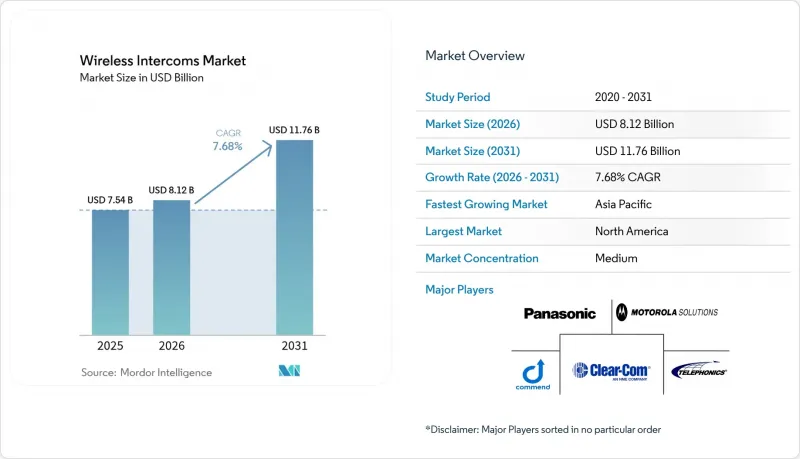
根據 Mordor Intelligence 預測,無線對講機市場規模將從 2025 年的 75.4 億美元成長到 2026 年的 81.2 億美元,然後在 2031 年達到 117.6 億美元,2026 年至 2031 年的複合年成長率為 7.68%。
本報告按應用(安全監控、事件管理、酒店、交通運輸和物流、醫療保健等)、技術(連接)(Wi-Fi/IP、DECT 6.0、數位 UHF/VHF(MURS、FRS 等)、LTE/5G 蜂窩網路、Zigbee/藍牙)、最終用戶領域(住宅、商業、企業園區、政府和公共安全等)以及區域進行公共安全。
全球無線對講機市場趨勢與洞察
安全監控解決方案的需求日益成長
在整合式對講平台中,語音串流現在直接傳輸到視訊分析主機,使控制室操作員能夠將語音指令與視覺警報關聯並進行驗證。在醫院中,Zenitel 系統透過內建語音引擎偵測到特定關鍵字,自動將緊急呼叫轉接給保全人員並鎖定指定門禁,從而展現了這種融合。在大型機場,愛立信的專用 LTE 骨幹網支援停機坪工作人員和塔台控制人員之間關鍵任務的隨按即說通訊,從而減少滑行時間偏差並提高事件可追溯性。 2024 年高供不應求鏈的脆弱性,促使設施所有者傾向於選擇無需重新認證整個系統即可更換的模組化設備。語音、影像和分析功能的緊密整合縮短了取證調查週期,這對面臨預算審查的營運商來說至關重要。因此,以安全為中心的資本投資與無線對講系統的部署之間正呈現出強烈的相關性。
基於Wi-Fi/IP的智慧家庭對講機的普及
住宅建築商正擴大將語音面板和門禁攝影機捆綁在同一Wi-Fi 6E網路上,從而簡化低電壓佈線方案並縮短試運行時間。 CableLabs的研究證實,6GHz頻段能夠緩解高密度多用戶住宅中常見的網路擁塞問題,進而降低語音品質。 AiphoneCloud允許安裝人員遠端排除設備故障,降低現場服務成本,並使訂閱模式對物業管理人員更具吸引力。酒店業也體現了這一IP驅動的趨勢。 Stryker的Vocera徽章與設施管理後端系統整合,使員工能夠以安全的語音提示接收客房服務指令,而無需透過行動應用程式進行螢幕互動。這些協同效應正在縮短傳統類比門禁系統的更換週期,並進一步推動無線對講市場的需求。
射頻干擾和頻段擁塞
在高層住宅中,6 吉赫 Wi-Fi 頻道已接近飽和,此問題可透過 CableLabs 的多層模擬進行視覺化呈現。模擬結果顯示,在對講語音等低延遲流量中會出現隊頭阻塞現象。共用頻譜措施雖然可以部分緩解這個問題,但會增加調整所需的開銷。在日本,「技術標準符合性認證」要求每個無線設備都必須通過 315 MHz、400 MHz、920 MHz 和 2.4 GHz頻寬的單獨檢測,導致核准週期漫長。美國的「國家頻段研究與開發計畫」強調動態感知是解決方案之一,但大規模部署仍需數年時間。目前,供應商正在採用無干擾天線,但這會增加組件成本。
細分市場分析
預計到2025年,安全和監控領域將佔無線對講市場37.60%的佔有率,凸顯了這種通訊方式在多層防禦架構中的核心作用。機場、醫院和資料中心等場所的門禁系統強制升級,使得語音認證與生物識別掃描結合,推動了該領域的成長。供應商透過整合降噪和人工智慧關鍵字偵測功能來提升產品差異化優勢,這些功能無需人工干預即可發出警報。活動管理雖然目前絕對收入較小,但預計將以9.14%的複合年成長率成長,這主要得益於全雙工網狀無線電的普及,該技術使演出總監能夠即時協調燈光訊號、煙火和廣播鏈路。在醫療保健領域,使用對講機的自動化工作流程正在不斷普及。 Zenitel的Turbinet單元可與護理人員呼叫中間件配合使用,使醫護人員能夠在病人進入隔離病房前進行分診,從而減少個人防護設備的使用。物流公司正在部署與稱重橋軟體整合的卡車對講系統,這顯著縮短了等待時間,並最大限度地減少了司機和裝卸碼頭負責人之間的溝通。 Zenitel 和 B-TEK 已在先導計畫中驗證了這項功能。
無線通訊在活動製作產業的普及程度顯而易見,許多多場館合約都明確規定了在禮堂、體育場和臨時帳篷等場所的漫遊功能。連鎖飯店正轉向使用與設施管理軟體整合的隱藏式徽章設備,使客房服務人員無需使用可能打擾住宿的雙向無線對講機無線電即可聯繫設施管理人員。重工業場所需要本質安全型機殼和連接到同一通訊通道的寬頻喇叭,INDUSTRONIC 公司以「一個網路,所有警報」的理念提供此類產品。教育機構則選擇整合通報系統功能,以便透過單一圖形使用者介面同時發布封鎖公告和優先對講呼叫。總而言之,應用領域的多元化使得多重通訊協定支援成為整個無線對講市場必不可少的功能。
區域分析
2025年,北美地區的銷售額佔全球總銷售額的35.70%。這得益於美國職業安全與健康管理局(OSHA)的嚴格監管以及成熟的室內覆蓋基礎設施,從而促進了5G專用對講系統的早期部署。領先的系統整合商已簽署長期維護契約,實現了持續升級。在2025會計年度的採購中,機場傾向優先考慮冗餘通訊頻道,此前美國聯邦航空管理局(FAA)曾發生多起飛機停飛事件,凸顯了語音通訊缺乏容錯能力。國家頻譜研發計畫對動態共用實驗的支持,提高了政策的確定性,並刺激了供應商的研發投入。
亞太地區以10.42%的複合年成長率領先。中國的「訊號升級」計畫已投入國家和私人資金,在12萬個場所建設室內行動通訊網路,為無線對講機的部署奠定了基礎。在印度,預計2024會計年度,通訊市場規模將達到2.4兆印度盧比(約290億美元)。監管機構引入品質評估工具,鼓勵建築業主提供高可用性連接,從而提高對講機的普及率。日本的合規性檢查確保了設備的低輻射排放,國內供應商也積極推廣干擾抑制濾波器的應用,這將成為未來的出口優勢。
在歐洲,受節能智慧建築維修,對講機市場呈現穩定成長。為實現2030年碳中和目標而製定的指令要求採用整合網路,以減少冗餘佈線。歐盟職業安全法規將全雙工語音通訊指定為高噪音區域的關鍵控制措施,從而帶動了ATEX認證對講機的需求成長。在南美洲、中東和非洲,交通基礎設施的現代化正在推動對講機的普及。聖保羅和利雅德的地鐵已強制要求在月台末端使用IP語音通訊,而與旅遊走廊相關的住宿設施的擴建也促進了對講機的需求。
其他好處
- Excel格式的市場預測(ME)表
- 3個月的分析師支持
目錄
第1章:引言
- 研究假設和市場定義
- 調查範圍
第2章:調查方法
第3章執行摘要
第4章 市場狀況
- 市場概覽
- 市場促進因素
- 安全監控解決方案的需求日益成長
- 基於Wi-Fi/IP的智慧家庭對講機的普及
- 智慧建築基礎設施現代化趨勢
- 全雙工網狀對講系統在實況活動。
- 職業安全與健康法規強制要求使用免持通訊。
- 適用於臨時工地的LTE/5G站點式系統
- 市場限制因素
- 射頻干擾和頻段擁塞
- IP設備中的網路安全漏洞
- 射頻資訊科技領域熟練安裝技術人員短缺
- 全球頻率許可證細分
- 價值供應鏈分析
- 監理情勢
- 技術展望
- 波特五力分析
- 投資分析
第5章 市場規模與成長預測
- 透過使用
- 安全監控
- 活動管理
- 飯店業
- 運輸/物流
- 衛生保健
- 工業和製造業
- 教育
- 其他
- 透過科技(連接)
- Wi-Fi/IP
- DECT 6.0
- 數位超高頻/甚高頻(MURS、FRS 等)
- LTE/5G蜂窩網路
- Zigbee/Bluetooth
- 按最終用途細分市場
- 住宅
- 商業的
- 企業園區
- 政府/公共安全
- 其他
- 按地區
- 北美洲
- 美國
- 加拿大
- 墨西哥
- 南美洲
- 阿根廷
- 巴西
- 其他南美國家
- 歐洲
- 德國
- 英國
- 法國
- 俄羅斯
- 其他歐洲國家
- 亞太地區
- 中國
- 日本
- 印度
- 韓國
- 其他亞太國家
- 中東和非洲
- 中東
- 沙烏地阿拉伯
- 阿拉伯聯合大公國
- 土耳其
- 其他中東國家
- 非洲
- 南非
- 其他非洲地區
- 中東
- 北美洲
第6章 競爭情勢
- 市場集中度
- 策略趨勢
- 市佔率分析
- 公司簡介
- Aiphone Co. Ltd
- Panasonic Corp.
- Clear-Com(HME)
- Motorola Solutions
- Zenitel NV
- Commend International GmbH
- RTS Intercom Systems(Bosch)
- Riedel Communications
- Sena Technologies
- Telephonics Corp.
- Axis Communications
- Dahua Technology
- Godrej Security Solutions
- Honeywell International
- Hytera Communications
- JVCKenwood Corp.
- 2N Telekomunikace(Axis)
- ButterflyMX
- DoorBird(Bird Home Automation)
- Alpha Communications
- Siedle and Sohne
- Akuvox
第7章 市場機會與未來展望
According to Mordor Intelligence, the wireless intercoms market size is expected to grow from USD 7.54 billion in 2025 to USD 8.12 billion in 2026 and is forecast to reach USD 11.76 billion by 2031 at 7.68% CAGR over 2026-2031.
This report is Segmented by Application (Security and Surveillance, Event Management, Hospitality, Transportation and Logistics, Healthcare, and More), Technology (Wi-Fi/IP, DECT 6. 0, Digital UHF/VHF [MURS, FRS, Etc. ], LTE/5G Cellular, and Zigbee/Bluetooth), End-Use Sector (Residential, Commercial, Enterprise/Corporate Campuses, Government and Public Safety, and Others), and Geography.
Global Wireless Intercoms Market Trends and Insights
Expanding demand for security and surveillance solutions
Integrated intercom platforms now feed audio streams directly into video analytics consoles so control-room operators can correlate spoken commands with visual alerts. Hospitals illustrate this convergence as Zenitel systems automatically escalate a distress call to security staff and lock designated access doors when embedded speech engines detect specific keywords. At major airports, Ericsson's private LTE backbone supports mission-critical push-to-talk between tarmac crews and tower staff, reducing taxi-time deviations and improving incident traceability. High-purity quartz shortages during 2024 highlighted supply-chain fragility, prompting facility owners to favor modular devices that can be swapped without re-certifying the entire array. Tight pairing of voice, video, and analytics shortens forensic investigation cycles, a decisive benefit for operators facing budget scrutiny. The result is a firm linkage between security-centric capital expenditure and wireless intercom adoption.
Proliferation of Wi-Fi/IP-based smart-home intercoms
Residential builders increasingly bundle voice panels with door cameras on the same Wi-Fi 6E network, simplifying low-voltage wiring plans and cutting commissioning time. CableLabs research confirms that the 6 GHz band alleviates earlier congestion that degraded voice quality in dense apartment blocks. AiphoneCloud lets installers troubleshoot devices remotely, lowering truck-roll costs and making subscription models more attractive to property managers. Hotels echo this IP trend; Stryker's Vocera badge integrates with property-management back-ends, allowing staff to receive housekeeping tasks as secure voice prompts rather than mobile app notifications that require screen interaction. The cumulative effect is faster refresh cycles for legacy analog door stations, reinforcing demand nodes for the wireless intercoms market.
RF interference and spectrum congestion
Six-gigahertz Wi-Fi channels are nearing saturation in high-rise dwellings, a problem visualized in CableLabs multi-floor simulations that reveal head-of-line blocking for low-latency traffic such as intercom voice. Shared-spectrum policies offer partial relief but add coordination overhead. Japan's Technical Regulations Conformity Certification requires each wireless appliance to pass separate band tests at 315 MHz, 400 MHz, 920 MHz, and 2.4 GHz, lengthening approval cycles. The US National Spectrum R&D Plan stresses dynamic sensing as a remedy, but large-scale deployment remains years away. In the interim, vendors integrate interference-rejection antennas that raise the bill of materials.
Other drivers and restraints analyzed in the detailed report include:
- Smart-building and infrastructure modernization wave
- Shift to full-duplex mesh intercoms in live events
- Cyber-security vulnerabilities in IP devices
For complete list of drivers and restraints, kindly check the Table Of Contents.
Segment Analysis
Security and surveillance accounted for 37.60% of the wireless intercoms market in 2025, underscoring the modality's central role in layered defense architectures. The segment benefits from mandatory access-control upgrades in airports, hospitals, and data centers, where voice verification now complements biometric scans. Suppliers differentiate by embedding noise cancellation and AI keyword spotting that escalate alerts without operator input. Event management, while smaller in absolute revenue, is forecast to post a 9.14% CAGR, propelled by full-duplex mesh radios that let show directors coordinate light cues, pyrotechnics, and broadcast links in real time. Healthcare keeps adopting intercom-driven workflow automation; Zenitel's turbine units integrate with nurse-call middleware so staff can triage before entering isolation wards, cutting personal-protective gear use. Logistics firms deploy truck-scale intercoms that pair with weigh-bridge software, slashing idle time and minimizing driver-dock interactions, a feature validated in Zenitel-B-TEK pilots.
Event production's embrace of wireless comms is visible in multi-venue contracts that specify roaming capability across auditoriums, stadiums, and temporary marquees. Hospitality chains gravitate toward discreet badge-style devices that mesh with property-management software, ensuring housekeeping can signal engineering without two-way radios that may disturb guests. Heavy-industry sites demand intrinsically safe housings and wide-area horns linked to the same talk paths, an offering INDUSTRONIC couches as a "one network, all alarms" proposition. Education campuses opt for mass-notification integration, enabling simultaneous lockdown announcements and intercom overrides from a single GUI. Collectively, application diversity cements multiprotocol compatibility as a must-have feature across the wireless intercoms market.
Complete Report Scope:
- By Application
- Security and Surveillance
- Event Management
- Hospitality
- Transportation and Logistics
- Healthcare
- Industrial and Manufacturing
- Education
- Others
- By Technology (Connectivity)
- Wi-Fi/IP
- DECT 6.0
- Digital UHF/VHF (MURS, FRS, etc.)
- LTE/5G Cellular
- Zigbee/Bluetooth
- By End-use Sector
- Residential
- Commercial
- Enterprise/Corporate Campuses
- Government and Public Safety
- Others
- By Geography
- North America
- United States
- Canada
- Mexico
- South America
- Argentina
- Brazil
- Rest of South America
- Europe
- Germany
- United Kingdom
- France
- Russia
- Rest of Europe
- Asia-Pacific
- China
- Japan
- India
- South Korea
- Rest of Asia-Pacific
- Middle East and Africa
- Middle East
- Saudi Arabia
- United Arab Emirates
- Turkey
- Rest of Middle East
- Africa
- South Africa
- Rest of Africa
- Middle East
- North America
Geography Analysis
North America generated 35.70% of 2025 revenue, buoyed by stringent OSHA mandates and mature indoor-coverage infrastructure that favors early adoption of private 5G intercoms. Large system integrators lock in long-term maintenance contracts, enabling sustained upgrade cycles. Fiscal 2025 procurement sees airports prioritizing redundant talk paths after FAA ground-stop incidents underscored voice resiliency gaps. The National Spectrum R&D Plan's backing for dynamic sharing experiments adds policy certainty that encourages vendor R&D spend.
Asia Pacific posts the fastest 10.42% CAGR. China's "Signal Upgrade" mission funnels state and private capital into indoor mobile coverage across 120,000 venues, creating a platform for wireless intercom rollouts. India's telecom sector, worth INR 2.4 trillion (USD 29.0 billion) in FY24, benefits from a regulatory quality-rating tool that prods landlords to install high-availability connectivity, lifting intercom attach rates. Japanese compliance testing ensures low emissions gear, spurring domestic suppliers to embed interference-mitigation filters that later become export advantages.
Europe registers steady growth on the back of energy-efficient smart-building retrofits. Directive-led targets for carbon neutrality by 2030 require converged networks that reduce cabling duplication. EU Worker Safety regulations classify full-duplex voice as a critical control measure in high-noise zones, energizing demand for ATEX-rated intercoms. South America and the Middle East & Africa see intercom adoption ride on transportation upgrades, metros in Sao Paulo and Riyadh specify IP voice along platform edges, and hospitality expansions linked to tourism corridors.
- Aiphone Co. Ltd
- Panasonic Corp.
- Clear-Com (HME)
- Motorola Solutions
- Zenitel NV
- Commend International GmbH
- RTS Intercom Systems (Bosch)
- Riedel Communications
- Sena Technologies
- Telephonics Corp.
- Axis Communications
- Dahua Technology
- Godrej Security Solutions
- Honeywell International
- Hytera Communications
- JVCKenwood Corp.
- 2N Telekomunikace (Axis)
- ButterflyMX
- DoorBird (Bird Home Automation)
- Alpha Communications
- Siedle and Sohne
- Akuvox
Additional Benefits:
- The market estimate (ME) sheet in Excel format
- 3 months of analyst support
TABLE OF CONTENTS
1 INTRODUCTION
- 1.1 Study Assumptions and Market Definition
- 1.2 Scope of the Study
2 RESEARCH METHODOLOGY
3 EXECUTIVE SUMMARY
4 MARKET LANDSCAPE
- 4.1 Market Overview
- 4.2 Market Drivers
- 4.2.1 Expanding demand for security and surveillance solutions
- 4.2.2 Proliferation of Wi-Fi/IP-based smart-home intercoms
- 4.2.3 Smart-building and infrastructure modernization wave
- 4.2.4 Shift to full-duplex mesh intercoms in live events
- 4.2.5 Occupational-safety rules mandating hands-free comms
- 4.2.6 LTE/5G site-based systems for temporary job sites
- 4.3 Market Restraints
- 4.3.1 RF interference and spectrum congestion
- 4.3.2 Cyber-security vulnerabilities in IP devices
- 4.3.3 Shortage of RF-IT skilled installers
- 4.3.4 Global spectrum-licence fragmentation
- 4.4 Value/Supply-Chain Analysis
- 4.5 Regulatory Landscape
- 4.6 Technological Outlook
- 4.7 Porter's Five Forces Analysis
- 4.7.1 Threat of New Entrants
- 4.7.2 Bargaining Power of Buyers
- 4.7.3 Bargaining Power of Suppliers
- 4.7.4 Threat of Substitutes
- 4.7.5 Competitive Rivalry
- 4.8 Investment Analysis
5 MARKET SIZE AND GROWTH FORECASTS (VALUE)
- 5.1 By Application
- 5.1.1 Security and Surveillance
- 5.1.2 Event Management
- 5.1.3 Hospitality
- 5.1.4 Transportation and Logistics
- 5.1.5 Healthcare
- 5.1.6 Industrial and Manufacturing
- 5.1.7 Education
- 5.1.8 Others
- 5.2 By Technology (Connectivity)
- 5.2.1 Wi-Fi/IP
- 5.2.2 DECT 6.0
- 5.2.3 Digital UHF/VHF (MURS, FRS, etc.)
- 5.2.4 LTE/5G Cellular
- 5.2.5 Zigbee/Bluetooth
- 5.3 By End-use Sector
- 5.3.1 Residential
- 5.3.2 Commercial
- 5.3.3 Enterprise/Corporate Campuses
- 5.3.4 Government and Public Safety
- 5.3.5 Others
- 5.4 By Geography
- 5.4.1 North America
- 5.4.1.1 United States
- 5.4.1.2 Canada
- 5.4.1.3 Mexico
- 5.4.2 South America
- 5.4.2.1 Argentina
- 5.4.2.2 Brazil
- 5.4.2.3 Rest of South America
- 5.4.3 Europe
- 5.4.3.1 Germany
- 5.4.3.2 United Kingdom
- 5.4.3.3 France
- 5.4.3.4 Russia
- 5.4.3.5 Rest of Europe
- 5.4.4 Asia-Pacific
- 5.4.4.1 China
- 5.4.4.2 Japan
- 5.4.4.3 India
- 5.4.4.4 South Korea
- 5.4.4.5 Rest of Asia-Pacific
- 5.4.5 Middle East and Africa
- 5.4.5.1 Middle East
- 5.4.5.1.1 Saudi Arabia
- 5.4.5.1.2 United Arab Emirates
- 5.4.5.1.3 Turkey
- 5.4.5.1.4 Rest of Middle East
- 5.4.5.2 Africa
- 5.4.5.2.1 South Africa
- 5.4.5.2.2 Rest of Africa
- 5.4.5.1 Middle East
- 5.4.1 North America
6 COMPETITIVE LANDSCAPE
- 6.1 Market Concentration
- 6.2 Strategic Moves
- 6.3 Market Share Analysis
- 6.4 Company Profiles (includes Global level Overview, Market level overview, Core Segments, Financials as available, Strategic Information, Market Rank/Share, Products and Services, Recent Developments)
- 6.4.1 Aiphone Co. Ltd
- 6.4.2 Panasonic Corp.
- 6.4.3 Clear-Com (HME)
- 6.4.4 Motorola Solutions
- 6.4.5 Zenitel NV
- 6.4.6 Commend International GmbH
- 6.4.7 RTS Intercom Systems (Bosch)
- 6.4.8 Riedel Communications
- 6.4.9 Sena Technologies
- 6.4.10 Telephonics Corp.
- 6.4.11 Axis Communications
- 6.4.12 Dahua Technology
- 6.4.13 Godrej Security Solutions
- 6.4.14 Honeywell International
- 6.4.15 Hytera Communications
- 6.4.16 JVCKenwood Corp.
- 6.4.17 2N Telekomunikace (Axis)
- 6.4.18 ButterflyMX
- 6.4.19 DoorBird (Bird Home Automation)
- 6.4.20 Alpha Communications
- 6.4.21 Siedle and Sohne
- 6.4.22 Akuvox
7 MARKET OPPORTUNITIES AND FUTURE OUTLOOK
- 7.1 White-space and Unmet-Need Assessment


