


 |
市場調查報告書
商品編碼
2122879
環境照明:市場佔有率分析、產業趨勢與統計、成長預測(2026-2031)Ambient Lighting - Market Share Analysis, Industry Trends & Statistics, Growth Forecasts (2026 - 2031) |
||||||

※ 本網頁內容可能與最新版本有所差異。詳細情況請與我們聯繫。
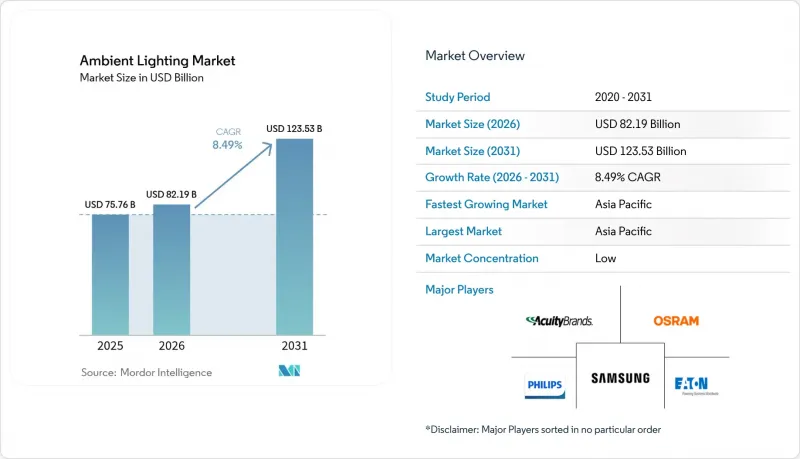
環境照明市場預計將從 2025 年的 757.6 億美元成長到 2026 年的 821.9 億美元,然後在 2031 年達到 1,235.3 億美元,2026 年至 2031 年的複合年成長率為 8.49%。
本報告按產品(燈具及照明設備、照明控制設備)、安裝階段(新建、維修/改造)、類型(吸頂燈、軌道燈等)、光通量(3000流明以下(住宅)等)、連接方式(有線、無線)、最終用戶(住宅、汽車等)和地區進行細分。市場預測以美元計價。
全球環境照明市場趨勢及洞察
歐盟和澳洲強制推行的LED維修正在加速商業設施的升級。
歐盟生態設計指令和澳洲國家建築規範等嚴格的政策框架正在推動老舊照明設備的逐步淘汰。目前,合規性比投資報酬率更為重要,建築業主面臨安裝符合最低能源效率標準的LED照明設備的壓力。這種強制性更換,加上對智慧互聯控制日益成長的需求,預計將推動商業照明市場從2024年的170.7億美元成長到2030年的273.8億美元。供應商正積極響應,推出“快速安裝燈”、“無驅動螢光管”和“現場可編程改裝套件”,以最大限度地減少停機時間和人事費用。
亞洲對智慧城市的投資正在推動連網路燈的維修。
在中國、印度和日本的國家級智慧城市計畫中,自適應路燈被視為核心數位基礎設施。地方政府正在用連網的LED燈取代傳統的高壓鈉燈,這些LED燈可以整合5G小型基地台、空氣品質感測器和交通攝影機。 Zigbee和BLE Mesh等無線協議無需鋪設新電纜即可實現擴充性,這對於人口密集的城市中心至關重要。隨著城市將照明與各種物聯網服務融合,提供開放API節點的硬體專家將佔據有利地位。
大規模LED燈帶安裝中因高湧入電流導致的故障
在多串燈系統中,數千個驅動器同時啟動會產生電流尖峰,可能損壞設備,進而導致斷路器跳脫和保固索賠。軟啟動電源和連續式控制器可以降低這種風險,但會增加成本。在物流樞紐中,線性照明通常綿延數百米,可靠性問題可能會延緩其應用。
細分市場分析
燈具和照明設備仍然是重要的收入來源,預計到2025年將維持70.45%的市場佔有率,這主要得益於螢光和鹵素燈向LED燈的大規模轉變。獲得能源之星認證的照明設備比白熾燈泡節能90%,使用壽命長15倍,顯著降低了維護成本和碳排放。儘管單價有所下降,但由於辦公室、住宅和倉庫的更換需求,市場需求仍保持穩定。
照明控制系統是推動市場成長的主要動力,預計年成長率將達到 9.02%。開放式 DALI 閘道、低功耗藍牙 (BLE) 網路和雲端控制面板整合了超越單純能源管理的資料洞察。昕諾飛 (Signify) 報告稱,到 2024 年,互聯系統和服務將佔其收入的 30%,這凸顯了客戶對以軟體為中心的提案日益成長的需求。隨著建築規範強制要求進行人員佔用檢測和利用自然光,互聯控制系統的環境照明市場預計將會擴大。
預計到2025年,62.35%的銷售額將來自維修和改造項目,這些項目涉及業主對大量老舊燈具的升級改造。 2022年,美國住宅翻新市場規模超過6,000億美元,其中34%的支出用於節能相關的升等改造,包括照明設備。紐約市第97號地方法律等城市碳排放上限措施,從2025年起對低效率行為處以罰款,進一步加劇了節能改造的迫切性。美國總務管理局(GSA)的指南將LED螢光、維修套件或整套燈具更換列為認可的改造方法,這推動了大規模更換需求的激增。
雖然新建建築照明市場規模相對較小,但預計將以 8.74% 的複合年成長率成長,超過維修市場。建築師現在會在設計初期就制定照明方案,整合感測器並簡化試運行,同時確保獲得 WELL 和 LEED 認證積分。在智慧商業園區中,連網照明設備正逐漸成為標配,加速了環境照明在綜合用途大樓、資料中心和醫療機構等場所的市場滲透。此外,規模經濟效應也推動了新建築環境照明市場的擴張,使得軟硬體捆綁式合約成為可能。
區域分析
預計到2025年,亞太地區將佔全球銷售額的45.65%,並在2031年之前以12.35%的複合年成長率成長,這主要得益於政府對節能照明的補貼、不斷擴大的住宅建設以及中國在全球LED元件生產領域的領先地位。中國憑藉其強大的製造能力和大規模的智慧城市示範項目,在滿足智慧路燈的需求方面發揮主導作用。印度的「百城計畫」和日本的「社會5.0」願景也提振了該地區對控制設備、感測器和平台整合產品的需求前景。
北美市場雖然成熟,但卻是個創新主導產業。根據昕諾飛(Signify)2024年的數據,美國市場規模達22億美元,約占公司全球銷售額的三分之一。儘管受新冠疫情后辦公室縮減的影響,部分維修項目有所延期,但住宅裝修需求依然強勁。 WELL和LEED認證的推廣應用,推動了以人性化的升等改造趨勢,也為高階照明設備和先進控制系統的應用提供了理論基礎。
歐洲是一個設計驅動且監管嚴格的市場。生態設計指令強制要求所有商業設施全面採用LED照明,而高顯色性產品正逐漸成為主流,這與該地區對視覺舒適度的重視不謀而合。德國和法國的汽車製造商正在將環境照明系統擴展到價格更低的車型中,這迫使零件供應商提供成本最佳化的RGB模組。
儘管南美、中東和非洲的總合市場佔有率較小,但正呈現穩定成長的態勢。在海灣合作理事會(GCC)國家,營造令人印象深刻的氛圍是飯店設施維修的首要任務;而在非洲,公共資金正被投入到高效節能的路燈建設中,這些路燈也成為了通往智慧城市的門戶。隨著世界各國政府推行綠建築標準並吸引外國直接投資,環境照明市場擁有長期成長空間。
其他好處:
- Excel格式的市場預測(ME)表
- 3個月的分析師支持
目錄
第1章:引言
- 研究假設和市場定義
- 調查範圍
第2章:調查方法
第3章執行摘要
第4章 市場狀況
- 市場概覽
- 市場促進因素
- 歐盟和澳洲強制推行LED照明維修。
- 亞洲對智慧城市的投資正在推動路燈被智慧路燈取代。
- 中階車型(亞洲和歐洲)的OEM主導環境套件
- WELL 和 LEED v4 標準正在推動美國辦公室採用人性化的照明。
- 酒店業的品牌更新周期導致用於改善酒店環境美觀的預算增加(海灣合作理事會成員國)。
- 隨著電子商務倉庫的快速擴張,對低眩光照明設備的需求也不斷成長。
- 市場限制因素
- 大規模LED燈帶安裝中因高湧入電流導致的故障
- 無線協定的碎片化推高了控制系統整合的成本。
- 由於 COVID-19 疫情後辦公空間縮減,維修工程減少(在北美和歐盟)。
- 稀土元素的供應鏈日益緊張,導致磷光體和驅動劑的價格上漲。
- 產業生態系分析
- 技術展望
- 波特五力分析
第5章 市場規模與成長預測
- 報價
- 燈具和照明設備
- 白熾燈泡
- 鹵素燈
- 螢光
- 發光二極體(LED)
- 照明控制
- 燈具和照明設備
- 實施階段
- 新建工程
- 維修和改造
- 按類型
- 表面黏著技術安裝照明
- 軌道燈
- 條形燈
- 吊掛式
- 嵌入式照明
- 按發光強度
- 小於 3,000 流明(住宅)
- 3,001~10,000 流明(商業用途)
- 10,000流明或以上(適用於工業和戶外用途)
- 連結性別
- 有線(DALI、KNX)
- 無線(Zigbee、BLE Mesh、Thread)
- 最終用戶
- 住宅
- 車
- 飯店和零售業
- 衛生保健
- 工業與物流
- 按地區
- 北美洲
- 美國
- 加拿大
- 墨西哥
- 歐洲
- 德國
- 英國
- 法國
- 義大利
- 西班牙
- 北歐的
- 其他歐洲國家
- 亞太地區
- 中國
- 日本
- 韓國
- 印度
- 東南亞
- 澳洲
- 其他亞太國家
- 南美洲
- 巴西
- 其他南美國家
- 中東和非洲
- 中東
- 阿拉伯聯合大公國
- 沙烏地阿拉伯
- 其他中東國家
- 非洲
- 南非
- 其他非洲國家
- 中東
- 北美洲
第6章 競爭情勢
- 市場集中度
- 策略趨勢
- Rest of Middle East and Africa
- 市佔率分析
- 公司簡介
- Signify NV(Philips Lighting)
- Acuity Brands, Inc.
- ams OSRAM AG
- Hubbell Incorporated
- Eaton Corporation plc(Cooper Lighting)
- Cree Lighting(Savant Systems)
- Zumtobel Group
- GE Lighting, a Savant company
- Panasonic Life Solutions
- Wipro Lighting
- Samsung Electronics(LED Division)
- LG Innotek
- Bridgelux, Inc.
- Helvar Oy
- Dialight plc
- Fagerhult Group
- Legrand SA
- Lutron Electronics
- SPI Lighting
- Amerlux, LLC
第7章 市場機會與未來展望
According to Mordor Intelligence, the ambient lighting market size is expected to grow from USD 75.76 billion in 2025 to USD 82.19 billion in 2026 and is forecast to reach USD 123.53 billion by 2031 at 8.49% CAGR over 2026-2031.
This report is Segmented by Offering (Lamps and Luminaires, and Lighting Controls), Installation Phase (New Construction, Retrofit and Renovation), Type (Surface-Mounted Light, Track Light, Sand More), Lumen Output (<=3 000 Lm (Residential), and More), Connectivity (Wired, and Wireless), End User (Residential, Automotive, and More), and Geography. The Market Forecasts are Provided in Terms of Value (USD).
Global Ambient Lighting Market Trends and Insights
LED retrofit mandates accelerating commercial upgrades in EU and Australia
Stringent policy frameworks such as the European Union Ecodesign Directive and Australia's National Construction Code are forcing the phase-out of legacy lamps. Compliance rather than payback is now the tipping point, pushing building owners to adopt LED fixtures that satisfy minimum efficacy thresholds. The commercial segment alone is projected to jump from USD 17.07 billion in 2024 to USD 27.38 billion by 2030 as mandated upgrades converge with rising demand for connected controls. Suppliers are responding with quick-fit lamps, driverless tubes, and field-programmed retrofit kits that minimize downtime and labor costs.
Smart-city investments driving connected street-light retrofits in Asia
National smart-city missions across China, India, and Japan place adaptive street lighting at the core of digital infrastructure. Municipalities are replacing conventional high-pressure sodium fixtures with networked LEDs that can host 5G small cells, air-quality sensors, and traffic cameras. Wireless protocols such as Zigbee and BLE Mesh offer scalability without trenching new cables, a decisive factor in dense urban cores. Hardware specialists that deliver open-API nodes are well-positioned as cities bundle lighting with broader IoT services.
High inrush-current failures in large-scale LED strip deployments
Multi-string strip systems can draw damaging current spikes when thousands of drivers power up simultaneously, triggering breaker trips and warranty claims. Soft-start power supplies and sequential controllers mitigate risk but add cost. Reliability concerns may delay rollouts in logistics hubs where linear lighting often spans hundreds of meters.
Other drivers and restraints analyzed in the detailed report include:
- OEM-triggered ambient packages in mid-segment autos
- WELL and LEED v4 standards pushing human-centric lighting in US offices
- Fragmented wireless protocols elevating control-system integration cost
For complete list of drivers and restraints, kindly check the Table Of Contents.
Segment Analysis
Lamps and luminaires remain the revenue cornerstone, holding 70.45% in 2025 thanks to the mass conversion from fluorescent and halogen to LED. ENERGY STAR-rated fixtures consume 90% less power than incandescent alternatives and last 15 times longer, slashing maintenance budgets and carbon footprints. Replacement activity across offices, homes, and warehouses keeps demand stable even as unit prices fall.
Lighting controls are the market's accelerant, forecast to grow 9.02% annually. Open DALI gateways, Bluetooth LE networks, and cloud dashboards embed data insights that extend beyond energy management. Signify reports that connected systems and services delivered 30% of company sales in 2024, confirming rising customer appetite for software-centric propositions. The ambient lighting market size for connected controls is set to widen as building codes mandate occupancy sensing and daylight harvesting.
Retrofit and renovation projects generated 62.35% of 2025 revenue as owners upgraded vast stocks of outdated fixtures. The United States residential remodeling market surpassed USD 600 billion in 2022, with 34% of spend flowing into energy-related upgrades that include lighting. City carbon caps such as New York Local Law 97 amplify urgency, imposing fines starting in 2025 for inefficiency breaches. Guidance from the U.S. General Services Administration lists LED tubes, retrofit kits, or full luminaire swaps as approved pathways, fueling a deep replacement funnel.
New construction accounts for a smaller base but will outpace retrofits at 8.74% CAGR. Architects now program lighting early in design workflows to capture WELL and LEED credits, integrate sensors, and streamline commissioning. Smart commercial campuses specify network-ready fixtures as baseline, propelling ambient lighting market penetration in mixed-use towers, data centers, and healthcare facilities. Ambient lighting market size gains in new builds are also supported by economies of scale that allow bundled hardware-plus-software contracts.
Complete Report Scope:
- By Offering
- Lamps and Luminaires
- Incandescent Lamps
- Halogen Lamps
- Fluorescent Lamps
- Light-Emitting Diode (LED)
- Lighting Controls
- Lamps and Luminaires
- By Installation Phase
- New Construction
- Retrofit and Renovation
- By Type
- Surface-mounted Light
- Track Light
- Strip Light
- Suspended Light
- Recessed Light
- By Lumen Output
- Sub 3 000 lm (Residential)
- 3 001 - 10 000 lm (Commercial)
- Above10 000 lm (Industrial and Outdoor)
- By Connectivity
- Wired (DALI, KNX)
- Wireless (Zigbee, BLE Mesh, Thread)
- By End User
- Residential
- Automotive
- Hospitality and Retail
- Healthcare
- Industrial and Logistics
- By Geography
- North America
- United States
- Canada
- Mexico
- Europe
- Germany
- United Kingdom
- France
- Italy
- Spain
- Nordics
- Rest of Europe
- Asia-Pacific
- China
- Japan
- South Korea
- India
- South East Asia
- Australia
- Rest of Asia-Pacific
- South America
- Brazil
- Rest of South America
- Middle East and Africa
- Middle East
- United Arab Emirates
- Saudi Arabia
- Rest of Middle East
- Africa
- South Africa
- Rest of Africa
- Middle East
- North America
Geography Analysis
Asia Pacific controls 45.65% of 2025 revenue and will grow at 12.35% CAGR through 2031, driven by state subsidies for efficient lighting, sprawling residential construction, and global leadership in LED component production. China spearheads both manufacturing prowess and giant smart-city pilots that anchor connected street-light demand. India's 100-city mission and Japan's Society 5.0 vision reinforce the regional pipeline for controls, sensors, and platform integration.
North America is a mature but innovation-led arena. Signify's 2024 data show that the United States contributed USD 2.20 billion, roughly one-third of its global sales. Residential remodels remain strong, yet office downsizing after COVID slows some retrofit schedules. WELL and LEED adoption maintains momentum for human-centric upgrades that justify premium fixtures and advanced controls.
Europe occupies a design-centric and regulation-heavy position. The Ecodesign Directive obliges LED transitions across commercial estates, and the region champions high color-rendering products that align with its emphasis on visual comfort. Automakers in Germany and France extend ambient packages downrange, spurring component suppliers to deliver cost-optimized RGB modules.
South America and the Middle East & Africa together contribute a smaller share but post healthy growth. GCC hospitality refurbishments prioritize dramatic ambience, while African infrastructure programs channel public funds into efficient street lighting that doubles as a smart-city gateway. The ambient lighting market gains long-term upside as governments apply green-building codes and attract foreign direct investment.
- Signify N.V. (Philips Lighting)
- Acuity Brands, Inc.
- ams OSRAM AG
- Hubbell Incorporated
- Eaton Corporation plc (Cooper Lighting)
- Cree Lighting (Savant Systems)
- Zumtobel Group
- GE Lighting, a Savant company
- Panasonic Life Solutions
- Wipro Lighting
- Samsung Electronics (LED Division)
- LG Innotek
- Bridgelux, Inc.
- Helvar Oy
- Dialight plc
- Fagerhult Group
- Legrand S.A.
- Lutron Electronics
- SPI Lighting
- Amerlux, LLC
Additional Benefits:
- The market estimate (ME) sheet in Excel format
- 3 months of analyst support
TABLE OF CONTENTS
1 INTRODUCTION
- 1.1 Study Assumptions and Market Definition
- 1.2 Scope of the Study
2 RESEARCH METHODOLOGY
3 EXECUTIVE SUMMARY
4 MARKET LANDSCAPE
- 4.1 Market Overview
- 4.2 Market Drivers
- 4.2.1 LED Retrofit Mandates Accelerating Commercial Up-grades in EU and Australia
- 4.2.2 Smart-city Investments Driving Connected Street-light Retrofits in Asia
- 4.2.3 OEM-Triggered Ambient Packages in Mid-segment Autos (Asia and Europe)
- 4.2.4 WELL and LEED v4 Standards Pushing Human-Centric Lighting in United States Offices
- 4.2.5 Hospitality Re-brand Cycles Increasing Aesthetic Ambient Budgets (Gulf Cooperation Council Countries)
- 4.2.6 Rapid e-commerce Warehouse Build-outs Needing Low-glare Luminaires
- 4.3 Market Restraints
- 4.3.1 High Inrush-Current Failures in Large-scale LED Strip Deployments
- 4.3.2 Fragmented Wireless Protocols Elevating Control-System Integration Cost
- 4.3.3 Post-COVID Office Downsizing Reducing Retrofit Pipelines (NA and EU)
- 4.3.4 Tight Rare-earth Supply Chain Inflating Phosphor and Driver Prices
- 4.4 Industry Ecosystem Analysis
- 4.5 Technological Outlook
- 4.6 Porter's Five Forces Analysis
- 4.6.1 Bargaining Power of Suppliers
- 4.6.2 Bargaining Power of Buyers
- 4.6.3 Threat of New Entrants
- 4.6.4 Threat of Substitutes
- 4.6.5 Competitive Rivalry
5 MARKET SIZE AND GROWTH FORECASTS (VALUES)
- 5.1 By Offering
- 5.1.1 Lamps and Luminaires
- 5.1.1.1 Incandescent Lamps
- 5.1.1.2 Halogen Lamps
- 5.1.1.3 Fluorescent Lamps
- 5.1.1.4 Light-Emitting Diode (LED)
- 5.1.2 Lighting Controls
- 5.1.1 Lamps and Luminaires
- 5.2 By Installation Phase
- 5.2.1 New Construction
- 5.2.2 Retrofit and Renovation
- 5.3 By Type
- 5.3.1 Surface-mounted Light
- 5.3.2 Track Light
- 5.3.3 Strip Light
- 5.3.4 Suspended Light
- 5.3.5 Recessed Light
- 5.4 By Lumen Output
- 5.4.1 Sub 3 000 lm (Residential)
- 5.4.2 3 001 - 10 000 lm (Commercial)
- 5.4.3 Above10 000 lm (Industrial and Outdoor)
- 5.5 By Connectivity
- 5.5.1 Wired (DALI, KNX)
- 5.5.2 Wireless (Zigbee, BLE Mesh, Thread)
- 5.6 By End User
- 5.6.1 Residential
- 5.6.2 Automotive
- 5.6.3 Hospitality and Retail
- 5.6.4 Healthcare
- 5.6.5 Industrial and Logistics
- 5.7 By Geography
- 5.7.1 North America
- 5.7.1.1 United States
- 5.7.1.2 Canada
- 5.7.1.3 Mexico
- 5.7.2 Europe
- 5.7.2.1 Germany
- 5.7.2.2 United Kingdom
- 5.7.2.3 France
- 5.7.2.4 Italy
- 5.7.2.5 Spain
- 5.7.2.6 Nordics
- 5.7.2.7 Rest of Europe
- 5.7.3 Asia-Pacific
- 5.7.3.1 China
- 5.7.3.2 Japan
- 5.7.3.3 South Korea
- 5.7.3.4 India
- 5.7.3.5 South East Asia
- 5.7.3.6 Australia
- 5.7.3.7 Rest of Asia-Pacific
- 5.7.4 South America
- 5.7.4.1 Brazil
- 5.7.4.2 Rest of South America
- 5.7.5 Middle East and Africa
- 5.7.5.1 Middle East
- 5.7.5.1.1 United Arab Emirates
- 5.7.5.1.2 Saudi Arabia
- 5.7.5.1.3 Rest of Middle East
- 5.7.5.2 Africa
- 5.7.5.2.1 South Africa
- 5.7.5.2.2 Rest of Africa
- 5.7.5.1 Middle East
- 5.7.1 North America
6 COMPETITIVE LANDSCAPE
- 6.1 Market Concentration
- 6.2 Strategic Moves
- 6.2.1 Rest of Middle East and Africa
- 6.3 Market Share Analysis
- 6.4 Company Profiles (includes Global-level Overview, Market-level Overview, Core Segments, Financials as available, Strategic Information, Market Rank/Share, Products and Services, Recent Developments)
- 6.4.1 Signify N.V. (Philips Lighting)
- 6.4.2 Acuity Brands, Inc.
- 6.4.3 ams OSRAM AG
- 6.4.4 Hubbell Incorporated
- 6.4.5 Eaton Corporation plc (Cooper Lighting)
- 6.4.6 Cree Lighting (Savant Systems)
- 6.4.7 Zumtobel Group
- 6.4.8 GE Lighting, a Savant company
- 6.4.9 Panasonic Life Solutions
- 6.4.10 Wipro Lighting
- 6.4.11 Samsung Electronics (LED Division)
- 6.4.12 LG Innotek
- 6.4.13 Bridgelux, Inc.
- 6.4.14 Helvar Oy
- 6.4.15 Dialight plc
- 6.4.16 Fagerhult Group
- 6.4.17 Legrand S.A.
- 6.4.18 Lutron Electronics
- 6.4.19 SPI Lighting
- 6.4.20 Amerlux, LLC
7 MARKET OPPORTUNITIES AND FUTURE OUTLOOK
- 7.1 White-space and Unmet-need Assessment

 2026-2030年全球環境照明市場
 環境照明市場:依產品類型、安裝類型、技術、控制類型、應用和分銷管道分類-全球預測,2026-2032年
 環境健康照明套件市場預測至2034年—按產品類型、安裝類型、技術、應用、分銷管道、最終用戶和地區分類的全球分析
 環境照明市場-全球產業規模、佔有率、趨勢、機會和預測:按產品類型、技術、最終用戶、地區和競爭對手分類,2021-2031年
 環境照明市場規模、佔有率和成長分析(按產品、類型、最終用戶和地區分類)-產業預測,2026-2033年低過敏性照明和音響解決方案市場預測至2032年:按解決方案類型、組件、部署類型、最終用戶和地區分類的全球分析
 2024 - 2032 年車內氛圍燈市場機會、成長動力、產業趨勢分析與預測