


 |
市場調查報告書
商品編碼
2122866
衛星天線:市場佔有率分析、產業趨勢與統計、成長預測(2026-2031)Satellite Antenna - Market Share Analysis, Industry Trends & Statistics, Growth Forecasts (2026 - 2031) |
||||||

※ 本網頁內容可能與最新版本有所差異。詳細情況請與我們聯繫。
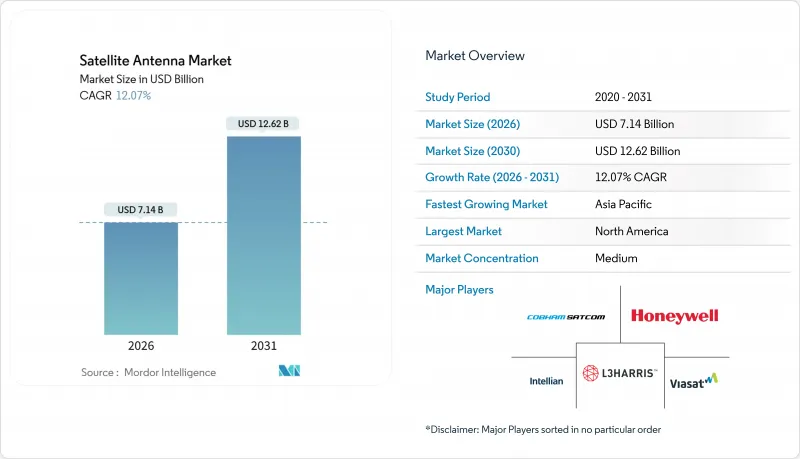
預計到 2026 年,衛星天線市場規模將達到 71.4 億美元,到 2031 年將達到 126.2 億美元,同期複合年成長率為 12.07%。
本報告按頻段(C波段、 X波段、 Ku波段、 Ka波段、L/S波段和VHF/UHF波段)、天線類型(拋物面反射器、平板ESA/RSA、喇叭天線、介質共振器、FRP天線罩和金屬衝壓)、應用領域(空間安裝、機載安裝、船載安裝和陸基安裝)、最終用戶(商業細分政府/國防)和地區進行地區安裝)、最終用戶(商業細分政府/國防)。市場預測以美元(USD)計價。
全球衛星天線市場趨勢與洞察
低地球軌道寬頻衛星星系正在迅速擴張。
2024年底,將有超過6,750顆星鏈衛星在軌道上運行;同年,歐洲通訊衛星公司(Eutelsat)旗下的OneWeb預計也將完成其由648顆衛星組成的第一代網路建置。亞馬遜的「柯伊伯計畫」(Project Kuiper)需要在2026年7月前將1663顆衛星送入軌道,以確保頻段的覆蓋。隨著這一里程碑的臨近,用戶終端的需求也日益成長。隨著這些龐大衛星群的部署,需要能夠追蹤多個快速移動目標的天線。電子掃描天線(ESA)正在航空航太、海事和陸地行動通訊領域中越來越廣泛的應用,逐漸取代拋物面天線。隨著產量的增加,指向平板天線的價格也越來越接近傳統天線,衛星群營運商也擴大提供硬體補貼以加速用戶。由此帶來的生態系統變革正在降低每兆位元的成本,並促使偏遠地區的營運商採用衛星回程傳輸來實現最後一公里寬頻存取。
太空快速軍事化(MilSATCOM)
2024年中期,美國空軍授予L3Harris公司一份價值12億美元的終端契約,凸顯了國防領域對多軌道容錯能力日益成長的需求。北約宣布了一項容錯衛星通訊框架,要求在商用衛星和軍用衛星之間進行毫秒終端切換,以避免干擾。亞洲國防機構也採取了類似的立場。印度將於2024年發射一顆專用通訊衛星,日本已在2025財政年度預算中累計建造新的X波段地面站。這些措施正在推動對具備加密功能、嵌入式網路安全性和抗干擾波形的X波段和Ka波段硬體的需求。儘管擁有敏感專案經驗的老牌大型製造商仍保持著市場主導地位,但平板顯示器創新者正透過與系統整合商合作而獲得發展動力。
ESA晶片組的出口限制成為瓶頸
美國工業與安全局 (BIS) 於 2024 年收緊了氮化鎵的出口限制,導致相位陣列晶片組交付推遲。中國隨即採取反制措施,限制鎵和鍺的出口,迫使中國以外的半導體製造商以更高的成本獲得替代供應鏈的認證。正如 Kymeta 在投資者資料中所揭露的那樣,《國際武器貿易條例》(ITAR) 的限制導致許多商業交易延遲 6 至 9 個月。韓華相控選擇在美國設立子公司以應對這些限制,但這導致工程資源重疊,並延長了產品藍圖。這些限制推高了價格敏感地區的終端價格,並使跨國部署計畫更加複雜。
細分市場分析
預計到2031年, Ka波段將以11.80%的年均成長率成長,成為衛星天線市場成長最快的頻段。 SES的「O3b mPOWER」和Viasat的「ViaSat-3」都採用可根據區域靈活調整的Ka波段點波束,這兩款產品的市場需求共同推動了雙頻段ESA的多年採購。相較之下,C波段在2025年仍將佔據衛星天線市場38.75%的佔有率,主要用於政府遠端傳送、災害復原節點以及對抗雨衰減效能要求較高的廣播上行鏈路。 KuKu波段仍然是直播到戶(DTH)和第一代航空通訊鏈路的主要頻段,但隨著容量向更高頻段轉移,其成長速度正在放緩。 L/S波段和VHF/UHF波段在行動衛星服務和傳統國防無線電領域發揮獨特的作用。
由於Ka頻譜效率更高,且在2023年世界無線電通訊大會上獲得了充足的監管配額,電信業者正在充分利用Ka波段。系統整合商目前採用雙頻段架構,結合自適應編碼來緩解赤道衰落,並在惡劣天氣條件下將流量重新導向到Ku波段,以維持服務品質。這種混合頻譜方案使豪華航空公司能夠保證客艙娛樂的串流質量,並使石油鑽井平台營運商即使在暴風雨中也能保持其SCADA網路的運作。由於Ka波段天線的單位成本較低,它們也正在滲透到小型商船和偏遠農業等低成本市場,在不影響C波段可靠性的前提下擴大了基本客群。
到2025年,拋物面反射器將佔總銷售量的44.10%,證明了其成熟的工作原理以及在固定安裝地點較低的初始成本。然而,平板天線設計正以34.2%的複合年成長率快速成長,憑藉其低剖面設計(可降低飛機空氣阻力並減少車輛中的移動部件),在衛星天線市場展現出強勁的成長勢頭,預計到2031年將持續保持這一成長。 Ball Aerospace與Flex合作,旨在透過將汽車表面黏著技術的成本效益引入其相位陣列產品線,從而將單價降低40%。 Kimeta的Osprey U8天線預計在2024年售價將低於9,000美元,這將顯著降低小型飛機的部署成本。喇叭天線、介質共振器天線、FRP天線罩和金屬衝壓成型天線等產品則作為專用輻射器或保護罩,在市場上發揮輔助作用。
製造商正透過混合解決方案實現產品線多元化。例如,Intellian 的「v240MT」將 2.4 公尺拋物面天線與軟體定義調變解調器結合,實現了地球靜止軌道 (GEO) 和低地球軌道 (LEO) 之間的靈活切換。 All.Space 的光束成形原型透過以液晶元件取代射頻移變速器,減少了 60% 的元件數量,提高了良率,並降低了功耗。同時,Greenerwave 的可重構智慧表面旨在無需使用主動式射頻元件即可控制波束,這可能為電池供電的陸地行動裝置帶來變革性的發展方向。
區域分析
預計到2025年,北美將佔總收入的41.50%,這主要得益於低地球軌道(LEO)早期部署、太空部隊的現代化藍圖以及美國聯邦航空管理局(FAA)流程的簡化。 L3Harris和Viasat等領先的國防公司正享受著多年期合約帶來的穩定,即便商用飛機維修加速,這些合約也起到了穩定國內需求的作用。此外,基本客群正在行動領域之外不斷擴展,加拿大透過其區域寬頻計畫採購了數千台固定終端。儘管隨著部署基礎的成熟,成長速度有所放緩,但售後市場對雙頻功能的升級仍在支撐銷售額。
預計到2031年,亞太地區衛星天線市場將以9.7%的複合年成長率成長,展現出該地區最強勁的成長動能。中國計畫在2030年將13,000顆衛星送入軌道,這將需要每年數萬個地面終端。為了減少對美國出口限制的依賴,中國正迅速推出國內氮化鎵(GaN)代工廠。印度的目標是到2033年實現440億美元的太空經濟規模,這推動了天線製造領域公私合營企業的蓬勃發展。日本準天頂衛星系統的擴張以及韓國對國防出口的雄心壯志也在提振市場需求。澳洲和印尼的監管機構目前正在預先批准星鏈(Starlink)終端的進口,這反映了全部區域政策的積極勢頭。
在歐洲,國家安全目標與商業性野心之間存在著平衡。歐洲太空總署 (ESA) 的安全連接衛星群IRIS2 將於 2024 年資金籌措1.5 億歐元,用於直接津貼關鍵基礎設施營運商的用戶終端採購。 OneWeb 已建造的網路為北海和地中海的海上營運商提供寬頻服務,需要雙頻天線才能在低地球軌道 (LEO) 和地球同步軌道 (GEO) 鏈路之間漫遊。在中東, Ka波段地面站的投資正在穩步推進,以支援月球門戶任務和偏遠油田的容錯通訊。雖然撒哈拉以南非洲和南美洲的投資相對滯後,但 Starlink 的「直接面對消費者」模式正在逐步刺激對低成本 ESA 設備的需求,該模式無需通過運營商合作夥伴,即可將自助安裝套件運送到農村家庭。
其他好處:
- Excel格式的市場預測(ME)表
- 3個月的分析師支持
目錄
第1章:引言
- 研究假設和市場定義
- 調查範圍
第2章:調查方法
第3章執行摘要
第4章 市場狀況
- 市場概覽
- 市場促進因素
- 低地球軌道寬頻衛星星系正在迅速擴張。
- 太空快速軍事化(MilSATCOM)
- 採用高通量衛星有效載荷
- 機上網路存取服務的蓬勃發展
- 根據歐洲太空總署的數據,平板太陽能板成本曲線呈下降趨勢。
- 月球及月球軌道任務中的通訊需求
- 市場限制因素
- 赤道地區Ku/Ka波段的雨致衰減
- 與相位陣列晶片組相關的出口管製瓶頸
- 太空碎片保險費飆升
- 新興市場電信業者面臨資本投資壓力
- 產業價值鏈分析
- 監理情勢
- 技術展望
- 宏觀經濟因素的影響
- 波特五力分析
第5章 市場規模與成長預測
- 按頻段
- C波段
- X波段
- Ku波段
- Ka波段
- L/S波段
- VHF/ UHF頻段
- 依天線類型
- 拋物面反射器
- 平面顯示器(ESA/RSA)
- 喇叭
- 介質共振器
- 玻璃纖維雷達罩
- 金屬印章
- 透過使用
- 太空安裝
- 機載
- 海上
- 陸地(移動式和固定式)
- 最終用戶
- 商業的
- 政府/國防
- 按地區
- 北美洲
- 美國
- 加拿大
- 墨西哥
- 歐洲
- 德國
- 英國
- 法國
- 義大利
- 西班牙
- 俄羅斯
- 其他歐洲國家
- 亞太地區
- 中國
- 日本
- 印度
- 韓國
- 澳洲
- 其他亞太國家
- 中東
- 沙烏地阿拉伯
- 阿拉伯聯合大公國
- 土耳其
- 其他中東國家
- 非洲
- 南非
- 奈及利亞
- 其他非洲國家
- 南美洲
- 巴西
- 阿根廷
- 其他南美國家
- 北美洲
第6章 競爭情勢
- 市場集中度
- 策略趨勢
- 市佔率分析
- 公司簡介
- Honeywell International Inc.
- CPI International Inc.
- Kymeta Corp.
- Norsat International Inc.
- Cobham SATCOM
- L3Harris Technologies Inc.
- Viasat Inc.
- Airbus Defence and Space
- Gilat Satellite Networks Ltd.
- Maxar Technologies
- Ball Aerospace
- Intellian Technologies
- Isotropic Systems(All.Space)
- Hanwha Phasor
- SES SA(O3b mPOWER User Terminals)
- Thales Alenia Space
- MT Mechatronics
- SatixFy Ltd.
- General Dynamics Mission Systems
- LEOcloud Inc.
- Hughes Network Systems
第7章 市場機會與未來展望
According to Mordor Intelligence, the satellite antenna market size reached USD 7.14 billion in 2026 and is on track to hit USD 12.62 billion by 2031, advancing at a 12.07% CAGR over the period.
This report is Segmented by Frequency Band (C Band, X Band, Ku Band, Ka Band, L/S Band, and VHF/UHF Band), Antenna Type (Parabolic Reflector, Flat-Panel ESA/RSA, Horn, Dielectric-Resonator, FRP-Radome, and Metal-Stamp), Application (Spaceborne, Airborne, Maritime, and Land), End-User (Commercial, Government and Defense), and Geography. Market Forecasts are Provided in Value (USD).
Global Satellite Antenna Market Trends and Insights
Proliferation of LEO Broadband Constellations
More than 6,750 Starlink spacecraft orbited by late-2024, with Eutelsat OneWeb completing its 648-satellite first-generation network the same year. Amazon's Project Kuiper must orbit 1,663 satellites by July 2026 to preserve spectrum, locking in demand for user terminals as milestones near. These mega-constellations oblige antennas that track multiple fast-moving targets, pushing ESAs over parabolic dishes in aviation, maritime, and land-mobile segments. Parity pricing on flat panels is emerging as volumes climb, and constellation operators often subsidize hardware to accelerate subscriber uptake. The resulting ecosystem shift compresses cost per megabit, encouraging telcos in remote regions to adopt satellite backhaul for last-mile broadband.
Rapid Militarization of Space (MilSATCOM)
The U.S. Department of the Air Force awarded L3Harris a USD 1.2 billion terminal contract in mid-2024, underscoring defense appetite for multi-orbit resiliency. NATO released a resilient SATCOM framework that mandates terminal agility between commercial and military satellites within milliseconds to avoid jamming . Asian defense agencies mirror this posture: India launched dedicated communications satellites in 2024 and Japan funded new X-band ground stations in its 2025 budget. These initiatives elevate demand for X- and Ka-band hardware with encryption, embedded cybersecurity, and anti-jam waveforms. Established primes with classified-program experience retain an edge, although flat-panel innovators are gaining traction by partnering with system integrators.
Export-Control Bottlenecks on ESA Chipsets
The Bureau of Industry and Security tightened export controls on gallium nitride in 2024, slowing phased-array chipset deliveries to Asia-Pacific buyers. China countered by restricting outbound gallium and germanium, prompting non-Chinese fabs to qualify alternative supply chains at higher cost. ITAR rules add six-to-nine-month delays for many commercial transactions, as Kymeta disclosed in investor materials. Hanwha Phasor chose to open a U.S. subsidiary to navigate the regime, duplicating engineering resources and elongating roadmaps. These constraints elevate terminal pricing in price-sensitive regions and complicate multinational deployment schedules.
Other drivers and restraints analyzed in the detailed report include:
- High Throughput Satellite Payload Adoption
- Commercial In-Flight Connectivity Boom
- Ku/Ka-Band Rain Fade in Equatorial Regions
For complete list of drivers and restraints, kindly check the Table Of Contents.
Segment Analysis
Ka Band is projected to record an 11.80% annual expansion to 2031, making it the fastest-growing slice of the satellite antenna market. SES O3b mPOWER and Viasat ViaSat-3 both rely on Ka spot beams that can be flexed regionally, and their combined demand anchors multiyear procurement of dual-band ESAs. In contrast, C Band retained a 38.75% satellite antenna market share in 2025, serving government teleports, disaster-recovery nodes, and broadcast uplinks that prize rain-fade resilience. Ku Band remains a workhorse for direct-to-home and first-generation aeronautical links, yet growth is slowing as capacity migrates upward in frequency. L/S and VHF/UHF bands hold niche roles in mobile satellite services and legacy defense radios.
Operators lean on Ka-band for higher spectral efficiency and abundant regulatory allocations secured at the 2023 World Radiocommunication Conference. Integrators now bundle adaptive coding to tame equatorial fade and employ dual-band architectures that steer traffic to Ku during severe weather, preserving quality of service. This mixed-spectrum approach allows premium airlines to guarantee streaming-grade inflight plans and lets oil-rig operators keep SCADA networks online during storms. As unit costs fall, Ka antennas move down-market into small merchant ships and remote agriculture, broadening the customer base without cannibalizing C-band reliability tiers.
Parabolic reflectors held 44.10% of 2025 revenue, a testament to proven mechanics and low upfront cost for fixed sites. Nonetheless, flat-panel designs are scaling at a 34.2% CAGR, the standout rate in the satellite antenna market through 2031, thanks to thin profiles that reduce drag on aircraft and eliminate moving parts on vehicles. Ball Aerospace partnered with Flex to bring automotive surface-mount economics to phased-array lines, targeting a 40% price cut per unit. Kymeta's Osprey u8 priced below USD 9,000 in 2024, slashing entry costs for small craft. Horn, dielectric-resonator, FRP-radome, and metal-stamp variants play supportive roles, either as specialty radiators or protective housings.
Manufacturers diversify with hybrid solutions, such as Intellian's v240MT that marries a 2.4 m parabolic dish with software-defined modems allowing agile GEO-LEO handoffs. Optical beamforming prototypes from All.Space replace radio-frequency phase shifters with liquid-crystal elements, trimming component counts by 60%, boosting yield, and lowering power draw. Meanwhile, Greenerwave's reconfigurable intelligent surfaces aim to steer beams without active RF components, a potentially transformative path for battery-powered land portable terminals.
Complete Report Scope:
- By Frequency Band
- C Band
- X Band
- Ku Band
- Ka Band
- L/S Band
- VHF/UHF Band
- By Antenna Type
- Parabolic Reflector
- Flat-Panel (ESA/RSA)
- Horn
- Dielectric-Resonator
- FRP-Radome
- Metal-Stamp
- By Application
- Spaceborne
- Airborne
- Maritime
- Land (Mobile and Fixed)
- By End-User
- Commercial
- Government and Defense
- By Geography
- North America
- United States
- Canada
- Mexico
- Europe
- Germany
- United Kingdom
- France
- Italy
- Spain
- Russia
- Rest of Europe
- Asia-Pacific
- China
- Japan
- India
- South Korea
- Australia
- Rest of Asia-Pacific
- Middle East
- Saudi Arabia
- United Arab Emirates
- Turkey
- Rest of Middle East
- Africa
- South Africa
- Nigeria
- Rest of Africa
- South America
- Brazil
- Argentina
- Rest of South America
- North America
Geography Analysis
North America anchored 41.50% of 2025 revenue, propelled by early LEO deployments, the Space Force's modernization roadmap, and streamlined FAA processes. Defense primes such as L3Harris and Viasat enjoy multi-year contracts that stabilize domestic demand even as commercial aviation retrofits accelerate. Canada's rural broadband programs also procure thousands of fixed terminals, expanding the customer base beyond mobility verticals. While growth slows as installed bases mature, aftermarket upgrades for dual-band capability sustain volumes.
Asia-Pacific is projected to advance at a 9.7% CAGR to 2031, the strongest regional trajectory in the satellite antenna market. China's plan to orbit 13,000 satellites by 2030 mandates tens of thousands of ground terminals each year, and the nation is spinning up domestic GaN foundries to reduce exposure to U.S. export controls. India targets a USD 44 billion space economy by 2033, catalyzing public-private joint ventures in antenna fabrication. Japan's quasi-zenith satellite expansion and South Korea's defense export ambitions add further pull. Regulatory bodies in Australia and Indonesia now pre-approve Starlink terminal imports, reflecting policy momentum across the region.
Europe balances sovereign security goals and commercial aspirations. The European Space Agency's IRIS2 secure-connectivity constellation received EUR 150 million in funding in 2024, directly subsidizing user-terminal procurements for critical infrastructure operators . OneWeb's completed network supplies broadband to maritime operators in the North Sea and Mediterranean, requiring dual-band antennas that roam between LEO and GEO links. The Middle East invests in Ka-band ground stations to support lunar gateway missions and resilient communication for remote oilfields. Sub-Saharan Africa and South America lag on capital outlays, yet Starlink's direct-to-consumer model circumvents telco partners, shipping self-install kits to rural households and sparking incremental demand for low-cost ESAs.
- Honeywell International Inc.
- CPI International Inc.
- Kymeta Corp.
- Norsat International Inc.
- Cobham SATCOM
- L3Harris Technologies Inc.
- Viasat Inc.
- Airbus Defence and Space
- Gilat Satellite Networks Ltd.
- Maxar Technologies
- Ball Aerospace
- Intellian Technologies
- Isotropic Systems (All.Space)
- Hanwha Phasor
- SES S.A. (O3b mPOWER User Terminals)
- Thales Alenia Space
- MT Mechatronics
- SatixFy Ltd.
- General Dynamics Mission Systems
- LEOcloud Inc.
- Hughes Network Systems
Additional Benefits:
- The market estimate (ME) sheet in Excel format
- 3 months of analyst support
TABLE OF CONTENTS
1 INTRODUCTION
- 1.1 Study Assumptions and Market Definition
- 1.2 Scope of the Study
2 RESEARCH METHODOLOGY
3 EXECUTIVE SUMMARY
4 MARKET LANDSCAPE
- 4.1 Market Overview
- 4.2 Market Drivers
- 4.2.1 Proliferation of LEO Broadband Constellations
- 4.2.2 Rapid Militarization of Space (MilSATCOM)
- 4.2.3 High Throughput Satellite Payload Adoption
- 4.2.4 Commercial In-Flight Connectivity Boom
- 4.2.5 ESA-Based Flat-Panel Cost Curve Deflation
- 4.2.6 Lunar and Cislunar Mission Communications Demand
- 4.3 Market Restraints
- 4.3.1 Ku-/Ka-Band Rain Fade in Equatorial Regions
- 4.3.2 Export-Control Bottlenecks on Phased-Array Chipsets
- 4.3.3 Mounting Orbital-Debris Insurance Premiums
- 4.3.4 CAPEX Crunch at Emerging-Market Telcos
- 4.4 Industry Value Chain Analysis
- 4.5 Regulatory Landscape
- 4.6 Technological Outlook
- 4.7 Impact of Macroeconomic Factors
- 4.8 Porter's Five Forces Analysis
- 4.8.1 Threat of New Entrants
- 4.8.2 Bargaining Power of Suppliers
- 4.8.3 Bargaining Power of Buyers
- 4.8.4 Threat of Substitutes
- 4.8.5 Competitive Rivalry
5 MARKET SIZE AND GROWTH FORECASTS (VALUE)
- 5.1 By Frequency Band
- 5.1.1 C Band
- 5.1.2 X Band
- 5.1.3 Ku Band
- 5.1.4 Ka Band
- 5.1.5 L/S Band
- 5.1.6 VHF/UHF Band
- 5.2 By Antenna Type
- 5.2.1 Parabolic Reflector
- 5.2.2 Flat-Panel (ESA/RSA)
- 5.2.3 Horn
- 5.2.4 Dielectric-Resonator
- 5.2.5 FRP-Radome
- 5.2.6 Metal-Stamp
- 5.3 By Application
- 5.3.1 Spaceborne
- 5.3.2 Airborne
- 5.3.3 Maritime
- 5.3.4 Land (Mobile and Fixed)
- 5.4 By End-User
- 5.4.1 Commercial
- 5.4.2 Government and Defense
- 5.5 By Geography
- 5.5.1 North America
- 5.5.1.1 United States
- 5.5.1.2 Canada
- 5.5.1.3 Mexico
- 5.5.2 Europe
- 5.5.2.1 Germany
- 5.5.2.2 United Kingdom
- 5.5.2.3 France
- 5.5.2.4 Italy
- 5.5.2.5 Spain
- 5.5.2.6 Russia
- 5.5.2.7 Rest of Europe
- 5.5.3 Asia-Pacific
- 5.5.3.1 China
- 5.5.3.2 Japan
- 5.5.3.3 India
- 5.5.3.4 South Korea
- 5.5.3.5 Australia
- 5.5.3.6 Rest of Asia-Pacific
- 5.5.4 Middle East
- 5.5.4.1 Saudi Arabia
- 5.5.4.2 United Arab Emirates
- 5.5.4.3 Turkey
- 5.5.4.4 Rest of Middle East
- 5.5.5 Africa
- 5.5.5.1 South Africa
- 5.5.5.2 Nigeria
- 5.5.5.3 Rest of Africa
- 5.5.6 South America
- 5.5.6.1 Brazil
- 5.5.6.2 Argentina
- 5.5.6.3 Rest of South America
- 5.5.1 North America
6 COMPETITIVE LANDSCAPE
- 6.1 Market Concentration
- 6.2 Strategic Moves
- 6.3 Market Share Analysis
- 6.4 Company Profiles (includes Global level Overview, Market level overview, Core Segments, Financials as available, Strategic Information, Market Rank/Share for key companies, Products and Services, and Recent Developments)
- 6.4.1 Honeywell International Inc.
- 6.4.2 CPI International Inc.
- 6.4.3 Kymeta Corp.
- 6.4.4 Norsat International Inc.
- 6.4.5 Cobham SATCOM
- 6.4.6 L3Harris Technologies Inc.
- 6.4.7 Viasat Inc.
- 6.4.8 Airbus Defence and Space
- 6.4.9 Gilat Satellite Networks Ltd.
- 6.4.10 Maxar Technologies
- 6.4.11 Ball Aerospace
- 6.4.12 Intellian Technologies
- 6.4.13 Isotropic Systems (All.Space)
- 6.4.14 Hanwha Phasor
- 6.4.15 SES S.A. (O3b mPOWER User Terminals)
- 6.4.16 Thales Alenia Space
- 6.4.17 MT Mechatronics
- 6.4.18 SatixFy Ltd.
- 6.4.19 General Dynamics Mission Systems
- 6.4.20 LEOcloud Inc.
- 6.4.21 Hughes Network Systems
7 MARKET OPPORTUNITIES AND FUTURE OUTLOOK
- 7.1 White-Space and Unmet-Need Assessment

 衛星天線市場:2026-2032年全球市場預測(依天線類型、行動類型、技術、平台、頻段、孔徑直徑、應用和最終用戶分類)
 汽車衛星天線市場規模、佔有率和成長分析:按天線架構、頻段、組件、應用、車輛類型、銷售管道和地區分類-2026-2033年產業預測
 2026年全球太空天氣監測衛星市場報告2026年全球衛星天線市場報告
 衛星天線市場規模、佔有率、趨勢和預測:按頻段、技術、天線類型、平台和地區分類,2026-2034年攜帶式衛星通訊終端市場:按最終用戶、應用、平台、頻段和類型分類,全球預測,2026-2032年
 衛星通訊與頻譜:理解監理格局的框架
 全球衛星天線市場:市場規模、佔有率、成長率、產業分析、依類型、應用和地區劃分的分析、未來預測(2026-2034)
 平板衛星天線:趨勢與預測(2024年~2034年)1.8米攜帶式天線市場(按類型、組件、頻段、應用和最終用戶)-全球預測(2025-2030)