


 |
市場調查報告書
商品編碼
2122861
空膠囊:市佔率分析、產業趨勢與統計、成長預測(2026-2031)Empty Capsule - Market Share Analysis, Industry Trends & Statistics, Growth Forecasts (2026 - 2031) |
||||||

※ 本網頁內容可能與最新版本有所差異。詳細情況請與我們聯繫。
據 Mordor Intelligence 稱,2025 年空膠囊市值為 36.8 億美元,預計到 2031 年將從 2026 年的 39.5 億美元成長至 56.2 億美元,預測期(2026-2031 年)的複合年成長率為 7.32%。
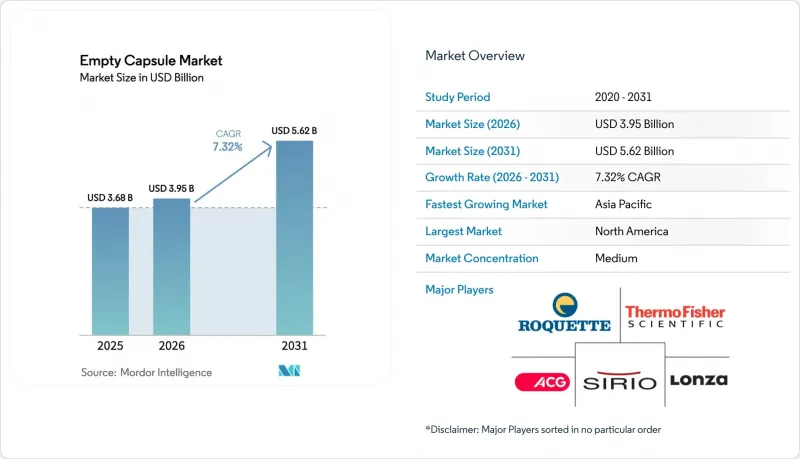
本報告按產品類型(明膠膠囊和非明膠膠囊)、原料來源(動物源性和植物/發酵源性)、功能(速釋膠囊等)、治療應用(抗生素和抗菌劑等)、最終用戶(製藥業等)以及地區(北美等)進行細分。市場預測以美元計價。
全球空膠囊市場趨勢及洞察
藥品產量增加
全球製藥公司計劃在2024年至2026年間投入超過1,000億美元用於擴建新的產能,將推動膠囊灌裝生產線的需求成長。與壓平機相比,膠囊灌裝生產線面積較小,且驗證速度較快。 2024年至2025年間,美國食品藥物管理局(FDA)在其新興技術計畫下批准了12項先進的連續膠囊填充技術,加速了採用即時品管閉合迴路製程的普及。在疫情引發的供不應求之後,供應鏈韌性的需求日益凸顯,而新的口服藥物研發計畫也正轉向更柔軟性的膠囊製劑。因此,腸溶膠囊和緩釋膠囊的供應商獲得了豐厚的利潤,因為這些製劑非常適合治療慢性疾病的複雜給藥方案。
營養保健品消費量增加
預計到2024年,全球膳食補充劑銷售額將達到1770億美元,膠囊的市場佔有率正在不斷擴大,因為消費者越來越傾向於將硬殼與劑量精準和高階定位聯繫起來。基於DNA的營養品牌預計,到2025年,客製化膠囊的訂單將年增22%,從而避免了小批量片劑生產中常見的模具成本。益生菌生產商也越來越依賴膠囊來保護益生菌免受胃酸侵蝕。與未包衣的片劑相比,膠囊菌株在模擬胃液中的存活率提高了40-60%。美國食品藥物管理局(FDA)最新的標籤指南強調生物有效性的透明度,這也鼓勵品牌轉向膠囊劑型,因為膠囊劑型簡化了溶離度測試。
明膠原料供應波動
目前膠囊生產商的庫存量相當於 60-90 天,是 2024 年之前的兩倍。這會佔用營運資金,在市場供應緊張的情況下,可能會使毛利率下降多達 300 個基點。
細分市場分析
預計到2031年,非明膠膠囊的複合年成長率將達到10.25%,比空膠囊市場高出近300個基點,這主要得益於消費者對清真認證、純素食產品的需求不斷成長,以及對益生菌穩定性的日益關注。由於成本低廉且溶解迅速,明膠膠囊在2025年仍將佔據65.56%的市場佔有率,但羥丙甲纖維素(HPMC)和普魯蘭膠如今已佔據高階細分市場。 HPMC膠囊含水量為4-6%,可延長益生菌的保存期限;而普魯蘭膠雖然價格高出40-50%,但其卓越的氧氣阻隔性有助於保護抗氧化劑。
軟膠囊對於親油性藥物成分(API)而言仍然至關重要,但由於密封過程中API損失率高達8%至12%,因此面臨嚴格的檢驗。目前正處於測試階段的澱粉基和改性澱粉殼具有更優異的防潮性能,預計將成為中期替代方案。一種由明膠和羥丙甲纖維素(HPMC)混合而成的膠囊殼,計劃於2025年上市,在認證和性能之間取得了良好的平衡,預示著未來產品種類將進一步整合。
預計到2025年,動物源明膠將佔據68.53%的市場佔有率,但受疾病導致的供應衝擊和倫理消費趨勢的影響,植物來源和發酵源明膠預計將以10.85%的複合年成長率成長。由於成本優勢,豬源明膠在穆斯林人口占多數的市場之外仍然佔據主導地位,而牛源明膠雖然價格高出15-20%,但符合清真要求。藥用級羥丙甲纖維素(HPMC)的供應仍然緊張,阻礙了快速轉型,但普魯蘭膠的透氧滲透性(0.5 cc/m²/天)使其在高價值營養補充劑領域獲得了訂單。澱粉和藻類多醣由於其脆性和產量波動性,落後於其他材料。
區域分析
預計到2025年,北美將佔全球銷售額的42.13%,這主要得益於FDA鼓勵國內連續生產的獎勵以及美國近期270億美元的製藥投資。然而,高昂的人事費用使得該地區的複合年成長率低於亞太地區。加拿大受益於臨床試驗的集中,而墨西哥正在崛起為近岸物流中心,以避免跨太平洋的物流運輸。遵守加州「65號提案」等環境法規會增加單位成本,但同時也能增強產品品質的差異化優勢。
預計到2025年,歐洲將佔全球需求的約29%。德國、法國和英國是消費的主要驅動力,但各國不同的監管規定延長了核准週期。為因應疫情期間的供不應求,生產回流到國內的趨勢加速發展,例如Lonza在瑞士投資1.5億瑞士法郎擴建工廠,以及Rocket在法國推出其HPMC生產線。為滿足歐盟和脫歐後英國的標準而進行的雙重庫存管理增加了複雜性,而南歐國家的緊縮措施則抑制了價格上漲。
亞太地區是成長的主要驅動力,預計到2031年將以10.51%的複合年成長率成長。中國和印度合計供該地區近70%的膠囊產品,並分別在國家藥品管理局(NMPA)和生產獎勵計畫(PLI)的獎勵下擴大產能。 Sirio Pharma的收購狂潮以及ACG在孟買斥資500億美元進行擴張,都清楚地表明了企業擴大規模的雄心。日本瞄準高階腸溶膠囊的細分市場,韓國致力於滿足素食者的需求,澳洲則充分利用其臨床試驗生態系統。中東和非洲地區將在2025年佔據較大佔有率,受益於海灣合作理事會(GCC)國家的清真法規和醫療保健支出,而南美洲儘管在巴西擁有業務,但仍受到外匯波動的影響。
其他好處:
- Excel格式的市場預測(ME)表
- 3個月的分析師支持
目錄
第1章:引言
- 研究假設和市場定義
- 調查範圍
第2章:調查方法
第3章執行摘要
第4章 市場狀況
- 市場概覽
- 市場促進因素
- 藥品產量增加
- 營養補充品消費量增加
- 膠囊填充技術的進步
- 過渡到單劑量包裝
- 數位健康科技的整合
- 連續製造基礎設施的擴展
- 市場限制因素
- 明膠原料供應的波動性
- 嚴格的宗教和飲食要求
- 藥用級羥丙基纖維素的供應有限。
- 氣候變遷導致供應鏈不穩定
- 供應鏈分析
- 監理情勢
- 技術展望
- 波特五力模型
第5章 市場規模與成長預測
- 依產品類型
- 明膠膠囊
- 硬明膠膠囊
- 軟膠囊
- 非明膠膠囊
- HPMC膠囊
- 普魯蘭膠膠囊
- 澱粉基膠囊
- 其他植物來源的膠囊
- 明膠膠囊
- 按原料來源
- 動物源性
- 豬源明膠
- 牛明膠
- 魚明膠
- 植物和發酵的起源
- HPMC
- 普魯蘭膠
- 澱粉
- 藻類多醣
- 動物源性
- 功能性別
- 即時發布
- 緩釋/持久釋放型
- 緩釋/腸溶包衣
- 其他類型(結腸靶向/pH響應型和雙/多階段釋放)
- 治療用途
- 抗生素和抗菌劑
- 維生素和營養補充劑
- 制酸劑和落葉劑
- 心血管治療
- 疼痛管理和中樞神經系統(CNS)
- 益生菌與腸道健康
- 代謝和內分泌疾病
- 其他用途
- 最終用戶
- 製藥業
- 營養保健品和機能性食品產業
- 化妝品和個人護理行業
- 合約研發生產組織(CDMO)
- 研究和學術機構
- 獸醫和動物健康領域
- 按地區
- 北美洲
- 美國
- 加拿大
- 墨西哥
- 歐洲
- 德國
- 英國
- 法國
- 義大利
- 西班牙
- 其他歐洲國家
- 亞太地區
- 中國
- 印度
- 日本
- 澳洲
- 韓國
- 其他亞太國家
- 中東和非洲
- GCC
- 南非
- 其他中東和非洲國家
- 南美洲
- 巴西
- 阿根廷
- 其他南美國家
- 北美洲
第6章 競爭情勢
- 市場集中度
- 市佔率分析
- 公司簡介
- ACG Worldwide
- Aenova Group
- Bright Pharma Caps Inc.
- CapsCanada Corporation
- Er-Kang Pharmaceutical Co. Ltd.
- Fujifilm Corp.(Fujicaps)
- HealthCaps India Ltd.
- Lonza Group(Capsugel)
- Medi-Caps Ltd.
- Natural Capsules Ltd.
- Nectar Lifesciences Ltd.
- Patheon(Thermo Fisher)
- Qingdao Yiqing Medicinal Capsules Co. Ltd.
- Qualicaps(Roquette)
- Shanxi Guangsheng Medicinal Capsules Co. Ltd.
- Shanxi JC Biological Technology Co. Ltd.
- Sirio Pharma Co., Ltd.
- Suheung Capsule Co., Ltd.
- Sunil Healthcare Ltd.
- Zhejiang Huangyan Gelatin Capsule Co. Ltd.
- Zhejiang Ruixin Capsules Co. Ltd.
第7章 市場機會與未來展望
According to Mordor Intelligence, the empty capsule market size was valued at USD 3.68 billion in 2025 and is estimated to grow from USD 3.95 billion in 2026 to reach USD 5.62 billion by 2031, at a CAGR of 7.32% during the forecast period (2026-2031).
This report is Segmented by Product (Gelatin Capsules and Non-Gelatin Capsules), Raw-Material Source (Animal-Based and Plant & Fermentation-Based), Functionality (Immediate-Release Capsules, and More), Therapeutic Application (Antibiotic & Antibacterial, and More), End User (Pharmaceutical Industry, and More), Geography (North America, and More). The Market Forecasts are Provided in Terms of Value (USD).
Global Empty Capsule Market Trends and Insights
Growing Pharmaceutical Manufacturing Volume
Global drug makers earmarked more than USD 100 billion for new capacity between 2024 and 2026, amplifying demand for encapsulation lines that occupy less floor space and reach validation faster than tablet presses. The FDA cleared 12 advanced continuous capsule-filling applications under its Emerging Technology Program during 2024-2025, accelerating adoption of closed-loop processes with real-time quality control. Redundant plants across multiple regions address supply-chain-resilience mandates that surfaced after pandemic shortages, tilting new oral dose programs toward flexible capsule formats. As a result, suppliers of enteric-coated and sustained-release shells capture premium margins because these formats align with complex dosing regimens in chronic care.
Rising Nutraceutical Consumption
Global supplement sales reached USD 177 billion in 2024, with capsule formats gaining share as consumers associate hard shells with dosage accuracy and premium positioning. DNA-guided nutrition brands pushed custom capsule orders up 22% year over year in 2025, sidestepping the tooling costs that discourage small-batch tablets. Probiotic makers increasingly rely on capsules for gastric-acid protection; encapsulated strains deliver 40-60% higher survivability in simulated gastric fluid than uncoated tablets. Updated FDA labeling guidance emphasizing bioavailability transparency also nudges brands toward capsule formats that simplify dissolution testing.
Volatility in Gelatin Raw-Material Supply
Capsule makers now hold 60-90 days of inventory - double pre-2024 norms - tying up working capital and shaving up to 300 basis points off gross margins during tight markets.
Other drivers and restraints analyzed in the detailed report include:
- Advancements in Capsule-Filling Technology
- Shift Toward Personalized Dose Packaging
- Stringent Religious & Dietary Compliance
For complete list of drivers and restraints, kindly check the Table Of Contents.
Segment Analysis
Non-gelatin shells will grow 10.25% CAGR to 2031, outperforming the empty capsule market by close to 300 basis points as Halal compliance, vegan demand, and probiotic stability concerns rise. Gelatin still delivered 65.56% of revenue in 2025, anchored by its low cost and rapid dissolution, yet HPMC and pullulan now secure premium niches. HPMC capsules extend probiotic shelf life by virtue of their 4-6% moisture content, while pullulan's superior oxygen barrier serves antioxidants despite a 40-50% price premium.
Softgels remain vital for lipophilic APIs but face scrutiny over 8-12% API loss during sealing. Starch-based and modified-starch shells, still in pilot phases, promise mid-term alternatives with moisture resilience. Hybrid gelatin-HPMC blends launched in 2025 balance certification and performance, signaling more SKU convergence ahead.
Animal-derived gelatin held 68.53% share in 2025, yet plant and fermentation inputs will log 10.85% CAGR, aided by disease-related supply shocks and ethically driven consumption. Porcine gelatin's cost edge keeps it a staple outside Muslim-majority markets, while bovine gelatin satisfies Halal claims at a 15-20% premium. Pharma-grade HPMC supply remains tight, capping rapid migration, but pullulan's 0.5 cc/m2/day oxygen permeability secures high-value nutraceutical orders. Starch and algal polysaccharides lag amid brittleness and harvest variability.
Complete Report Scope:
- By Product Type
- Gelatin Capsules
- Hard Gelatin Capsules
- Soft Gelatin Capsules
- Non-Gelatin Capsules
- HPMC Capsules
- Pullulan Capsules
- Starch-based Capsules
- Other Plant-based Capsules
- Gelatin Capsules
- By Raw-Material Source
- Animal-Based
- Porcine Gelatin
- Bovine Gelatin
- Fish-derived Gelatin
- Plant & Fermentation-Based
- HPMC
- Pullulan
- Starch
- Algal Polysaccharides
- Animal-Based
- By Functionality
- Immediate-Release
- Sustained / Extended-Release
- Delayed / Enteric-Release
- Others (Colon-Targeted / pH-Sensitive and Dual / Multiple-Release)
- By Therapeutic Application
- Antibiotic & Antibacterial
- Vitamins & Dietary Supplements
- Antacid & Antiflatulent
- Cardiovascular Therapy
- Pain Management & CNS
- Probiotics & Gut Health
- Metabolic & Endocrine Disorders
- Other Applications
- By End User
- Pharmaceutical Industry
- Nutraceutical & Functional-Food Industry
- Cosmetic & Personal-Care Industry
- Contract Development & Manufacturing Org. (CDMOs)
- Research & Academic Laboratories
- Veterinary & Animal-Health Sector
- By Geography
- North America
- United States
- Canada
- Mexico
- Europe
- Germany
- United Kingdom
- France
- Italy
- Spain
- Rest of Europe
- Asia-Pacific
- China
- India
- Japan
- Australia
- South Korea
- Rest of Asia-Pacific
- Middle East and Africa
- GCC
- South Africa
- Rest of Middle East and Africa
- South America
- Brazil
- Argentina
- Rest of South America
- North America
Geography Analysis
North America generated 42.13% of 2025 revenue, driven by FDA incentives that favor domestic continuous manufacturing and by USD 27 billion in recent U.S. pharma investment, yet labor costs hold regional CAGR below Asia-Pacific. Canada benefits from clinical-trial clustering, while Mexico rises as a near-shore alternative circumventing trans-Pacific logistics. Environmental compliance - such as California's Proposition 65 - adds incremental per-unit costs but reinforces quality differentiation.
Europe accounted for roughly 29% of global demand in 2025. Germany, France, and the United Kingdom lead consumption, yet fragmented national rules lengthen validation cycles. Onshoring accelerates after pandemic-era shortages, as evidenced by Lonza's CHF 150 million Swiss expansion and Roquette's French HPMC line. Dual inventories for EU and post-Brexit UK specifications add complexity, while Southern European austerity caps price escalation.
Asia-Pacific is the growth engine, advancing 10.51% CAGR through 2031. China and India, together supplying nearly 70% of regional capsules, add capacity under NMPA and PLI incentives, respectively. Sirio Pharma's acquisition spree and ACG's 50-billion-unit Mumbai expansion underscore scale ambitions. Japan targets premium enteric niches, South Korea pursues vegetarian communities, and Australia leverages its clinical-trial ecosystem. The Middle East & Africa, at a significant share in 2025, gain from Halal mandates and GCC healthcare spend, while South America struggles with currency swings despite Brazil's localized expansions.
- ACG Worldwide
- Aenova Group
- Bright Pharma Caps
- CapsCanada Corporation
- Er-Kang Pharmaceutical Co. Ltd.
- Fujifilm Corp. (Fujicaps)
- HealthCaps India Ltd.
- Lonza Group
- Medi-Caps Ltd.
- Natural Capsules Ltd.
- Nectar Lifesciences Ltd.
- Patheon (Thermo Fisher)
- Qingdao Yiqing Medicinal Capsules Co. Ltd.
- Qualicaps (Roquette)
- Shanxi Guangsheng Medicinal Capsules Co. Ltd.
- Shanxi JC Biological Technology Co. Ltd.
- Sirio Pharma Co., Ltd.
- Suheung Capsule Co., Ltd.
- Sunil Healthcare Ltd.
- Zhejiang Huangyan Gelatin Capsule Co. Ltd.
- Zhejiang Ruixin Capsules Co. Ltd.
Additional Benefits:
- The market estimate (ME) sheet in Excel format
- 3 months of analyst support
TABLE OF CONTENTS
1 Introduction
- 1.1 Study Assumptions & Market Definition
- 1.2 Scope of the Study
2 Research Methodology
3 Executive Summary
4 Market Landscape
- 4.1 Market Overview
- 4.2 Market Drivers
- 4.2.1 Growing pharmaceutical manufacturing volume
- 4.2.2 Rising nutraceutical consumption
- 4.2.3 Advancements in capsule-filling technology
- 4.2.4 Shift toward personalized dose packaging
- 4.2.5 Integration of digital health technologies
- 4.2.6 Expansion of continuous manufacturing infrastructure
- 4.3 Market Restraints
- 4.3.1 Volatility in gelatin raw-material supply
- 4.3.2 Stringent religious & dietary compliance
- 4.3.3 Limited availability of pharma-grade HPMC
- 4.3.4 Climate-induced supply-chain instability
- 4.4 Supply-Chain Analysis
- 4.5 Regulatory Landscape
- 4.6 Technological Outlook
- 4.7 Porter's Five Forces
- 4.7.1 Threat of New Entrants
- 4.7.2 Bargaining Power of Buyers
- 4.7.3 Bargaining Power of Suppliers
- 4.7.4 Threat of Substitutes
- 4.7.5 Intensity of Competitive Rivalry
5 Market Size & Growth Forecasts (Value, USD)
- 5.1 By Product Type
- 5.1.1 Gelatin Capsules
- 5.1.1.1 Hard Gelatin Capsules
- 5.1.1.2 Soft Gelatin Capsules
- 5.1.2 Non-Gelatin Capsules
- 5.1.2.1 HPMC Capsules
- 5.1.2.2 Pullulan Capsules
- 5.1.2.3 Starch-based Capsules
- 5.1.2.4 Other Plant-based Capsules
- 5.1.1 Gelatin Capsules
- 5.2 By Raw-Material Source
- 5.2.1 Animal-Based
- 5.2.1.1 Porcine Gelatin
- 5.2.1.2 Bovine Gelatin
- 5.2.1.3 Fish-derived Gelatin
- 5.2.2 Plant & Fermentation-Based
- 5.2.2.1 HPMC
- 5.2.2.2 Pullulan
- 5.2.2.3 Starch
- 5.2.2.4 Algal Polysaccharides
- 5.2.1 Animal-Based
- 5.3 By Functionality
- 5.3.1 Immediate-Release
- 5.3.2 Sustained / Extended-Release
- 5.3.3 Delayed / Enteric-Release
- 5.3.4 Others (Colon-Targeted / pH-Sensitive and Dual / Multiple-Release)
- 5.4 By Therapeutic Application
- 5.4.1 Antibiotic & Antibacterial
- 5.4.2 Vitamins & Dietary Supplements
- 5.4.3 Antacid & Antiflatulent
- 5.4.4 Cardiovascular Therapy
- 5.4.5 Pain Management & CNS
- 5.4.6 Probiotics & Gut Health
- 5.4.7 Metabolic & Endocrine Disorders
- 5.4.8 Other Applications
- 5.5 By End User
- 5.5.1 Pharmaceutical Industry
- 5.5.2 Nutraceutical & Functional-Food Industry
- 5.5.3 Cosmetic & Personal-Care Industry
- 5.5.4 Contract Development & Manufacturing Org. (CDMOs)
- 5.5.5 Research & Academic Laboratories
- 5.5.6 Veterinary & Animal-Health Sector
- 5.6 By Geography
- 5.6.1 North America
- 5.6.1.1 United States
- 5.6.1.2 Canada
- 5.6.1.3 Mexico
- 5.6.2 Europe
- 5.6.2.1 Germany
- 5.6.2.2 United Kingdom
- 5.6.2.3 France
- 5.6.2.4 Italy
- 5.6.2.5 Spain
- 5.6.2.6 Rest of Europe
- 5.6.3 Asia-Pacific
- 5.6.3.1 China
- 5.6.3.2 India
- 5.6.3.3 Japan
- 5.6.3.4 Australia
- 5.6.3.5 South Korea
- 5.6.3.6 Rest of Asia-Pacific
- 5.6.4 Middle East and Africa
- 5.6.4.1 GCC
- 5.6.4.2 South Africa
- 5.6.4.3 Rest of Middle East and Africa
- 5.6.5 South America
- 5.6.5.1 Brazil
- 5.6.5.2 Argentina
- 5.6.5.3 Rest of South America
- 5.6.1 North America
6 Competitive Landscape
- 6.1 Market Concentration
- 6.2 Market Share Analysis
- 6.3 Company Profiles (includes Global level Overview, Market level overview, Core Segments, Financials as available, Strategic Information, Market Rank/Share for key companies, Products & Services, and Recent Developments)
- 6.3.1 ACG Worldwide
- 6.3.2 Aenova Group
- 6.3.3 Bright Pharma Caps Inc.
- 6.3.4 CapsCanada Corporation
- 6.3.5 Er-Kang Pharmaceutical Co. Ltd.
- 6.3.6 Fujifilm Corp. (Fujicaps)
- 6.3.7 HealthCaps India Ltd.
- 6.3.8 Lonza Group (Capsugel)
- 6.3.9 Medi-Caps Ltd.
- 6.3.10 Natural Capsules Ltd.
- 6.3.11 Nectar Lifesciences Ltd.
- 6.3.12 Patheon (Thermo Fisher)
- 6.3.13 Qingdao Yiqing Medicinal Capsules Co. Ltd.
- 6.3.14 Qualicaps (Roquette)
- 6.3.15 Shanxi Guangsheng Medicinal Capsules Co. Ltd.
- 6.3.16 Shanxi JC Biological Technology Co. Ltd.
- 6.3.17 Sirio Pharma Co., Ltd.
- 6.3.18 Suheung Capsule Co., Ltd.
- 6.3.19 Sunil Healthcare Ltd.
- 6.3.20 Zhejiang Huangyan Gelatin Capsule Co. Ltd.
- 6.3.21 Zhejiang Ruixin Capsules Co. Ltd.
7 Market Opportunities & Future Outlook
- 7.1 White-Space & Unmet-Need Assessment

 有機膠囊市場:按類型、成分、應用、最終用戶和地區分類
 有機膠囊市場:依產品類型、應用、材料、國家及地區分類-全球產業分析、市場規模、市場佔有率及2026年至2033年預測
 空膠囊市場:按膠囊類型、材質、填充類型、膠囊尺寸、銷售管道和最終用戶分類 - 全球市場預測(2026-2032 年)
 空膠囊市場規模、佔有率、趨勢和預測:按類型、原料、功能、治療應用、最終用戶和地區分類,2026-2034年空膠囊市場:按產品、功能、材料、最終用戶和地區分類
 2026年全球膠囊市場報告
 空膠囊市場分析及預測(至2035年):依類型、產品、材料類型、應用、最終用戶、技術、製程、功能、組件、部署方式分類
 全球空膠囊市場規模、佔有率、趨勢和成長分析報告(2026-2034)全球空膠囊市場:市場規模、佔有率、成長率、產業分析、依類型、應用和地區劃分的考量、未來預測(2026-2034)日本空膠囊市場報告(按類型、原料(豬肉、牛肉、骨頭、羥丙基甲基纖維素及其他)、功能、治療應用、最終用戶和地區分類,2026-2034年)