


 |
市場調查報告書
商品編碼
2122825
低溫閥門:市場佔有率分析、產業趨勢與統計、成長預測(2026-2031)Cryogenic Valves - Market Share Analysis, Industry Trends & Statistics, Growth Forecasts (2026 - 2031) |
||||||

※ 本網頁內容可能與最新版本有所差異。詳細情況請與我們聯繫。
據 Mordor Intelligence 稱,2025 年低溫閥門市場價值為 32.7 億美元,預計到 2031 年將達到 41.9 億美元,而 2026 年為 34.1 億美元,預測期(2026-2031 年)的複合年成長率為 4.24%。
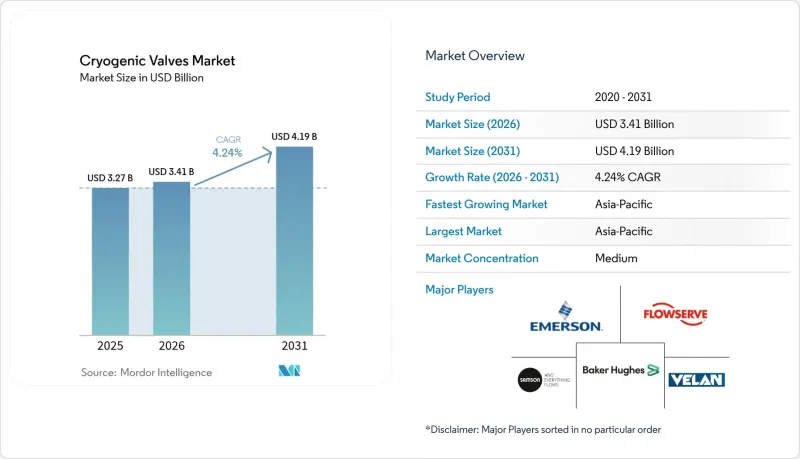
本報告按產品類型(球閥、閘閥、截止閥、止回閥及其他產品類型)、操作方式(手動、氣動、電動)、氣體類型(液態氮、液化天然氣等)、終端用戶產業(石油天然氣、能源電力、化學等)以及地區(亞太、北美、歐洲等)進行細分。市場預測以美元計價。
全球低溫閥門市場趨勢及洞察
增加對液化天然氣基礎設施的投資
2024年至2028年間的擴建計畫預計將使全球液化天然氣(LNG)產能提高40%。這將使美國超越卡達,成為最大的LNG出口國,而亞太地區將成為新增貨物的主要買家。貝克休斯公司已獲得一份價值56億美元的LNG設備訂單,用於路易斯安那州的兩條生產線,這表明承包商對能夠保證超低洩漏性能、經過現場驗證的閥門合作夥伴有著很高的需求。預計到2030年,船舶燃料庫需求將超過每年1600萬噸,這將促使港口更多地採用具有整合式緊急切斷閥的自動化低溫輸送系統。企業產品合作夥伴公司(Enterprise Products Partners)正在將休士頓航道的製冷能力擴大至每天30萬桶,並因此獲得了一份新的訂單,訂購額定溫度低至-162 度C的三偏心截止閥。沙烏地阿美公司投資 77 億美元的法迪利升級項目將使脫臭氣處理能力每天增加 13 億立方英尺,每條生產線都將配備冗餘的低溫通道,以適應混合冷媒。
工業氣體需求不斷成長
液化空氣集團位於德克薩斯州的四座模組化空氣分離器每天向埃克森美孚的低碳氫氣生產聯合裝置供應9000噸氧氣,同時也是北美最大的氬氣來源,這為經認證可用於氧氣應用的閥門製造商創造了長期需求。隨著醫療產業的擴張,液態氧消耗量持續成長,醫院需要設計出能夠防止顆粒物在病患迴路中脫落的閥門。食品加工商傾向於使用液態氮隧道進行快速冷凍,這要求閥門能夠承受低至-196 度C的快速溫度變化,同時保持衛生潔淨。可再生能源運作的空氣分離裝置需要快速反應的控制閥芯,以便根據電價波動調整輸出。
安全和合規的複雜性
ASME B31.3 標準強制要求使用在低於 -425°F (-220°C) 的環境下通過衝擊試驗的材料。符合此標準的閥門採用經擺錘測試驗證的奧氏體不銹鋼或鋁合金。 2025 年 ASME VIII 修訂版引入了新的低溫外殼,要求設計人員增加更厚的閥蓋和波紋管密封件以滿足新規要求。 MSS SP-158-2021 標準強制要求進行高壓氣體測試,這導致開發成本增加,但公共產業越來越需要這項認證以降低停電風險。美國聯邦法規 (49 CFR) 規定閥門必須在不洩漏的情況下維持儲罐的測試壓力,並具有強大的機械損傷防護能力,這影響了拖車佈局的選擇。安全閥的五年重新認證週期帶來了持續的業務收益,但也增加了小規模企業的擁有成本。小規模製造商難以跟上多個司法管轄區的標準,這使得老牌企業擁有競爭優勢。
細分市場分析
球閥憑藉其可靠的密封性能和易於維護的特點,預計到2025年將佔據低溫閥門市場33.74%的主導佔有率。製造商正在採用加長閥桿設計,將閥座與沸騰的液化氣體隔離,從而減少結冰和閥座損壞。艾默生的Fischer HP系列採用彈簧加載的聚四氟乙烯(PTFE)環,可在-198 度C下保持VI級密封性能。儘管截止閥的安裝量相對較小,但由於其在氫氣液化項目中具有重要的精確流量控制能力,預計其市場將以5.18%的複合年成長率成長。在生產8-10噸/小時液氫的先導工廠中,由於需要可變流量控制來管理正仲氫轉化產生的熱量,因此截止閥的低溫閥門市場預計將顯著成長。
兩種閥門的技術改進都在持續進行中。球閥製造商正在採用符合 ISO 15848-1 A 級認證的石墨閥蓋密封件,該密封件可實現超低洩漏排放水平,這對於尋求 ESG 積分的企業至關重要。截止閥 OEM 廠商正在使用具有等百分比特性的模製閥芯,從而提高多級膨脹機的製程穩定性。閘閥和止回閥仍保持特定的應用領域。閘閥適用於最大 42 英吋的全通徑 LNG 裝載管線,而雙板低溫止回閥可防止蒸發氣再循環迴路中的回流突波。專用蝶閥和塞閥填補了市場空白,例如在對扭矩要求極低的超低密度氦氣應用中。
截至2025年,手動齒輪驅動和手輪驅動裝置將佔據低溫閥門市場59.10%的佔有率,其優勢在於結構簡單,且在斷電情況下具有固有的故障安全功能。液化天然氣出口碼頭採用手動截止閥,以便在碼頭發生緊急情況時可靠地關閉貨物管線。然而,由於設施業主轉向遠端操作以減少人員需求,該領域的成長較為緩慢。預計到2031年,氣動執行器將以5.33%的複合年成長率成長,利用工廠空氣或氮氣,在「故障關閉」邏輯下實現快速行程。在氫氣相關設施中,氣動驅動裝置是首選,以避免與電動馬達相關的火災風險。
在一些需要豐富位置回饋的特定應用領域,例如用於微調流量以維持產品質地的數位化控制氮氣冷凍隧道,電動致動器正被日益廣泛地採用。結合氣壓驅動和無離合器變速箱的混合解決方案,透過兼顧手排超控和自動速度控制,滿足了雙用途驅動裝置的需求。原始設備製造商 (OEM) 擴大採用智慧定位器,可測量閥桿摩擦和循環次數,並將資料傳送到工廠歷史記錄系統,以便在洩漏發生之前觸發維護工單。這種預測性維護模式加強了售後市場聯繫,並提高了每個已安裝閥門的終身收益。
區域分析
預計到2025年,亞太地區將佔低溫閥門市場26.10%的佔有率,並在2031年之前以5.48%的複合年成長率持續成長。中國「天然氣發電」政策的轉變以及印度熱浪帶來的成長需求,推動了進口成長的復甦;與此同時,日本和韓國正在投資建設樞紐設施,以便從美國轉運貨物。在澳大利亞,老舊的液化工廠正進入維修週期,從而提振了售後閥門服務需求。中國、韓國和澳洲政府制定的氫能發展藍圖,也推動了試辦液化工廠高壓截止閥新競標的成長。
北美正受惠於美國成為全球最大的液化天然氣出口國以及聯邦政府對氫能中心的積極資助。墨西哥灣沿岸的棕地液化計畫要求加入北美閥門製造商協會,這使得擁有本地庫存的國內供應商享有優先待遇。受液化空氣集團在貝城投資以及多個中型液態氧建設和所有權項目的推動,工業氣體閥門的需求仍然強勁。加拿大首批液化天然氣預計將於2027年在不列顛哥倫比亞省交付,這將進一步提振西半球的需求。
在歐洲,儘管預計液化天然氣進口量將在2024年放緩,但氫能發展正得到大力推動。德國計劃建造10吉瓦的電解槽產能,該產能與液化和地下儲罐計劃密切相關,這兩項計劃都要求使用超低洩漏截止閥。歐洲地平線計畫正在資助西班牙和荷蘭之間移動式液氫儲罐的試運行,並由此獲得了專用貨物裝卸閥門的訂單。在北歐港口,液化天然氣燃料庫的引入正在加速,以支持綠色走廊航運聯盟。
中東和非洲正在興建大規模天然氣加工計畫。沙烏地阿美公司的法迪利擴建計畫、卡達的北方南田計畫以及阿曼的多個石化聯合裝置都需要能夠耐受酸性氣體化合物的高耐久性低溫金屬材料。在阿布達比,藍氨的研發工作正在推進,預計液化天然氣工廠的設計概念將被應用於閥門組件。在非洲,莫三比克陸上液化天然氣工廠的建設已被推遲,但一旦安全局勢穩定,預計將啟動新一輪閥門採購。
南美洲仍處於發展中階段,但其未來前景廣闊。巴西正考慮引入浮體式儲存再氣化裝置(FSRU)以應對季節性天然氣短缺,這將需要緊湊型低溫閥門撬裝設備。阿根廷的瓦卡穆爾塔頁岩天然氣田未來有潛力為液化天然氣(LNG)出口駁船計畫供氣,但由於計畫進度不確定,短期需求較為有限。智利採礦業正在考慮引入液態氧以提高製程效率,儘管目前規模較小,但預計對高利潤閥門的需求將十分旺盛。
其他好處:
- Excel格式的市場預測(ME)表
- 3個月的分析師支持
目錄
第1章:引言
- 研究假設和市場定義
- 調查範圍
第2章:調查方法
第3章執行摘要
第4章 市場狀況
- 市場概覽
- 市場促進因素
- 增加對液化天然氣基礎設施的投資
- 工業氣體需求成長
- 加速氫能經濟工程建設進程
- 石化及特殊氣體廠產能提升
- 全球港口的小規模液化天然氣燃料庫
- 市場限制因素
- 與安全和合規相關的複雜挑戰
- 不銹鋼和鎳的價格波動
- 真空釬硬焊件供應鏈供不應求
- 價值鏈分析
- 波特五力模型
第5章 市場規模與成長預測
- 依產品類型
- 球閥
- 閘閥
- 球閥
- 止回閥
- 其他產品類型
- 驅動
- 手動的
- 氣壓
- 電的
- 氣體類型
- 液態氮
- 液化天然氣
- 氫
- 氧
- 其他氣體
- 按最終用戶行業分類
- 石油和天然氣
- 能源與電力
- 化學品
- 食品/飲料
- 醫學領域
- 其他終端用戶產業
- 按地區
- 北美洲
- 美國
- 加拿大
- 墨西哥
- 南美洲
- 巴西
- 阿根廷
- 其他南美國家
- 歐洲
- 德國
- 英國
- 義大利
- 法國
- 其他歐洲國家
- 亞太地區
- 中國
- 印度
- 日本
- 韓國
- 其他亞太國家
- 中東和非洲
- 沙烏地阿拉伯
- 南非
- 其他中東和非洲國家
- 北美洲
第6章 競爭情勢
- 市場集中度分析
- 策略趨勢
- 市佔率分析
- 公司簡介
- BAC Valves
- Baker Hughes
- Bray International
- Burkert India Private Limited
- Cryofab Inc.
- Emerson Electric Co.
- Flowserve Corporation
- Habonim
- HEROSE GmbH
- L&T Valves Limited
- Meca-Inox
- Neway Valve
- OPW, A Dover Company
- Parker Hannifin Corp
- Powell Valves
- Samson AG
- Swagelok Company
- Velan
第7章 市場機會與未來展望
According to Mordor Intelligence, the cryogenic valves market size was valued at USD 3.27 billion in 2025 and estimated to grow from USD 3.41 billion in 2026 to reach USD 4.19 billion by 2031, at a CAGR of 4.24% during the forecast period (2026-2031).
This report is Segmented by Product Type (Ball Valve, Gate Valve, Globe Valve, Check Valve, Other Product Types), Actuation (Manual, Pneumatic, Electric), Gas (Liquid Nitrogen, Liquid Natural Gas, and More), End-User Industry (Oil and Gas, Energy and Power, Chemicals, and More), and Geography (Asia-Pacific, North America, Europe, and More). The Market Forecasts are Provided in Terms of Value (USD).
Global Cryogenic Valves Market Trends and Insights
Rising LNG Infrastructure Investments
Expansions slated between 2024-2028 will lift global LNG liquefaction capacity by 40%, with the United States overtaking Qatar as lead exporter while Asia-Pacific purchases the bulk of incremental cargoes. Baker Hughes secured USD 5.6 billion of LNG equipment awards for two Louisiana trains, illustrating contractor appetite for field-proven valve partners able to guarantee ultra-low-leak performance. Marine bunkering demand is forecast to exceed 16 million t annually by 2030, prompting ports to specify automated cryogenic transfer assemblies that integrate emergency shut-off valves. Enterprise Products Partners is expanding Houston Ship Channel refrigeration capacity by 300,000 bbl/d, creating new orders for triple-offset stop-valves rated down to -162 °C. Saudi Aramco's USD 7.7 billion Fadhili upgrade will add 1.3 Bcf/d of sweet-gas processing, each train fitted with redundant cryogenic flow-paths to handle mixed refrigerants.
Growth in Industrial Gas Demand
Air Liquide's four modular air-separation units in Texas will deliver 9,000 t/d of oxygen to ExxonMobil's low-carbon hydrogen complex and generate the continent's largest argon stream, placing long-cycle demand on valve makers able to certify for oxygen service. Healthcare expansion keeps liquid-oxygen consumption rising, and hospitals mandate valve designs that prevent particle shedding in patient circuits. Food processors favour liquid nitrogen tunnels for flash-freezing, with valves that tolerate rapid thermal cycling down to -196 °C while maintaining hygienic finishes. Renewable-powered air-separation plants require fast-response control trim so operators can throttle output to match fluctuating grid tariffs.
Safety & Compliance Complexities
ASME B31.3 mandates impact-tested materials below -425 °F; complying valves use austenitic stainless or aluminium alloys proven by Charpy testing. The 2025 ASME VIII update introduces fresh cryogenic case studies, prompting designers to add thicker bonnets or bellows seals to satisfy the new rules. MSS SP-158-2021 requires high-pressure gas tests that inflate development costs, yet utilities increasingly insist on the certification to reduce outage risk. U.S. Code 49 CFR obliges valves to hold tank test pressure without seepage and to include robust guards against mechanical damage, shaping layout choices on trailers. Five-year recertification cycles for safety valves generate recurring service revenue but raise ownership costs for small operators. Smaller fabricators struggle to keep pace with multi-jurisdiction code work, giving established brands a competitive edge.
Other drivers and restraints analyzed in the detailed report include:
- Hydrogen-Economy Project Pipeline Acceleration
- Capacity Additions in Petro-chem & Specialty Gas Plants
- Stainless-Steel & Nickel Price Volatility
For complete list of drivers and restraints, kindly check the Table Of Contents.
Segment Analysis
Ball valves held a dominant 33.74% cryogenic valves market share in 2025, owing to proven tight shut-off and straightforward maintenance. Manufacturers supply extended-stem designs that isolate the seat from boiling liquefied gases, cutting ice buildup and seat damage. Emerson's Fisher HP series uses spring-energised PTFE rings to hold Class VI shut-off at -198 °C. Globe valves, though smaller in installed base, are expected to grow at 5.18% CAGR as hydrogen liquefaction projects favour their throttling precision. The cryogenic valves market size for globe valves is anticipated to widen notably in pilot plants producing 8-10 t/h of liquid hydrogen, each calling for variable-flow control to manage ortho-para conversion heat.
Technical enhancements continue across both lines. Ball-valve makers are adding graphite bonnet seals certified to ISO 15848-1 Class A for ultra-low fugitive emissions, an important factor for operators seeking ESG credits. Globe-valve OEMs are deploying contoured plugs that deliver equal-percentage characteristics, enhancing process stability in multi-stage expanders. Gate and check valves retain niche uses: gate valves accommodate full-bore LNG loading lines up to 42 in, while dual-plate cryogenic check valves prevent reverse surge in boil-off gas recirculation loops. Specialty butterfly and plug valves fill gaps such as helium service at ultra-low density where very low torque is essential.
Manual gear and hand-wheel operators represented 59.10% of the cryogenic valves market in 2025, prized for simplicity and intrinsic fail-safe capability during power loss. LNG export terminals rely on manual isolation valves to secure cargo lines during berth-side emergencies. The segment, however, grows slowly as facility owners look to remote operation to cut staffing. Pneumatic actuation will expand at 5.33% CAGR to 2031, leveraging plant air or nitrogen to deliver quick stroke times under fail-closed logic. Hydrogen sites favour pneumatic drives to avoid ignition risks linked to electric motors.
Electric actuators achieve niche uptake where data-rich position feedback is essential, such as in digitally managed nitrogen freezing tunnels that fine-tune flow to maintain product texture. Hybrid solutions that bolt a declutchable gearbox onto a pneumatic drive combine manual override with automated speed, capturing demand in dual-use installations. OEMs increasingly embed smart positioners measuring stem friction and cycle count, feeding plant historians that trigger service work orders before leakage occurs. This predictive-maintenance model strengthens aftermarket ties and lifts lifetime revenue per installed valve.
Complete Report Scope:
- By Product Type
- Ball Valve
- Gate Valve
- Globe Valve
- Check Valve
- Other Product Types
- By Actuation
- Manual
- Pneumatic
- Electric
- By Gas
- Liquid Nitrogen
- Liquid Natural Gas
- Hydrogen
- Oxygen
- Other Gases
- By End-user Industry
- Oil and Gas
- Energy and Power
- Chemicals
- Food and Beverage
- Medical
- Other End-user Industries
- By Geography
- North America
- United States
- Canada
- Mexico
- South America
- Brazil
- Argentina
- Rest of South America
- Europe
- Germany
- United Kingdom
- Italy
- France
- Rest of Europe
- Asia-Pacific
- China
- India
- Japan
- South Korea
- Rest of Asia-Pacific
- Middle East and Africa
- Saudi Arabia
- South Africa
- Rest of Middle East and Africa
- North America
Geography Analysis
Asia-Pacific controlled 26.10% of the cryogenic valves market in 2025 and is projected to expand by a 5.48% CAGR through 2031. China's gas-to-power policy reversal and India's heat-wave-driven demand are reviving import growth, while Japan and South Korea invest in re-loading hubs that reposition cargoes from the United States. Australia's ageing liquefaction trains enter refurbishment cycles, pushing aftermarket valve services. Government hydrogen roadmaps in China, South Korea and Australia create incremental bids for high-pressure globe valves at pilot liquefier sites.
North America benefits from the United States becoming the world's largest LNG exporter and from aggressive federal funding for hydrogen hubs. Gulf Coast brownfield liquefaction projects stipulate North American Valve Manufacturers Association membership, favouring domestic suppliers with local inventories. Air Liquide's Baytown investment plus multiple mid-scale liquid-oxygen build-owns maintain steady industrial-gas valve uptake. Canada's first LNG shipment slated for 2027 from British Columbia will add western-hemisphere demand.
Europe, despite softer LNG imports in 2024, commits heavily to hydrogen. Germany's planned 10 GW of electrolyser capacity links to liquefaction and underground storage schemes, each specifying ultra-low-leak isolation valves. Horizon Europe funds mobile LH2 tank trials between Spain and the Netherlands, generating specialty cargo-handling valve orders. Nordic ports accelerate LNG bunkering roll-outs supporting green-corridor shipping alliances.
The Middle East and Africa witness sizeable greenfield gas processing. Saudi Aramco's Fadhili expansion, Qatar's North Field South and multiple Omani petro-chem complexes need durable cryogenic metallurgy that resists sour-gas compounds. Abu Dhabi is exploring blue-ammonia, which will import design philosophies from LNG trains to valve packages. In Africa, Mozambique's postponed onshore LNG plant, once security stabilises, promises a fresh cycle of valve procurement.
South America remains nascent yet promising. Brazil eyes floating storage and regasification units to manage seasonal gas deficits, requiring compact cryogenic valve skids. Argentina's Vaca Muerta shale may eventually feed LNG export barge projects, though timetable uncertainty tempers near-term demand. Chile's mining sector investigates liquid oxygen for process efficiency, presenting small but high-margin valve prospects.
- BAC Valves
- Baker Hughes
- Bray International
- Burkert India Private Limited
- Cryofab Inc.
- Emerson Electric Co.
- Flowserve Corporation
- Habonim
- HEROSE GmbH
- L&T Valves Limited
- Meca-Inox
- Neway Valve
- OPW, A Dover Company
- Parker Hannifin Corp
- Powell Valves
- Samson AG
- Swagelok Company
- Velan
Additional Benefits:
- The market estimate (ME) sheet in Excel format
- 3 months of analyst support
TABLE OF CONTENTS
1 Introduction
- 1.1 Study Assumptions & Market Definition
- 1.2 Scope of the Study
2 Research Methodology
3 Executive Summary
4 Market Landscape
- 4.1 Market Overview
- 4.2 Market Drivers
- 4.2.1 Rising LNG infrastructure investments
- 4.2.2 Growth in industrial gas demand
- 4.2.3 Hydrogen-economy project pipeline acceleration
- 4.2.4 Capacity additions in petro-chem & specialty gas plants
- 4.2.5 Small-scale LNG bunkering at global ports
- 4.3 Market Restraints
- 4.3.1 Safety & compliance complexities
- 4.3.2 Stainless-steel & nickel price volatility
- 4.3.3 Supply-chain gaps in vacuum-brazed components
- 4.4 Value Chain Analysis
- 4.5 Porter's Five Forces
- 4.5.1 Bargaining Power of Suppliers
- 4.5.2 Bargaining Power of Buyers
- 4.5.3 Threat of New Entrants
- 4.5.4 Threat of Substitutes
- 4.5.5 Competitive Rivalry
5 Market Size & Growth Forecasts (Value)
- 5.1 By Product Type
- 5.1.1 Ball Valve
- 5.1.2 Gate Valve
- 5.1.3 Globe Valve
- 5.1.4 Check Valve
- 5.1.5 Other Product Types
- 5.2 By Actuation
- 5.2.1 Manual
- 5.2.2 Pneumatic
- 5.2.3 Electric
- 5.3 By Gas
- 5.3.1 Liquid Nitrogen
- 5.3.2 Liquid Natural Gas
- 5.3.3 Hydrogen
- 5.3.4 Oxygen
- 5.3.5 Other Gases
- 5.4 By End-user Industry
- 5.4.1 Oil and Gas
- 5.4.2 Energy and Power
- 5.4.3 Chemicals
- 5.4.4 Food and Beverage
- 5.4.5 Medical
- 5.4.6 Other End-user Industries
- 5.5 By Geography
- 5.5.1 North America
- 5.5.1.1 United States
- 5.5.1.2 Canada
- 5.5.1.3 Mexico
- 5.5.2 South America
- 5.5.2.1 Brazil
- 5.5.2.2 Argentina
- 5.5.2.3 Rest of South America
- 5.5.3 Europe
- 5.5.3.1 Germany
- 5.5.3.2 United Kingdom
- 5.5.3.3 Italy
- 5.5.3.4 France
- 5.5.3.5 Rest of Europe
- 5.5.4 Asia-Pacific
- 5.5.4.1 China
- 5.5.4.2 India
- 5.5.4.3 Japan
- 5.5.4.4 South Korea
- 5.5.4.5 Rest of Asia-Pacific
- 5.5.5 Middle East and Africa
- 5.5.5.1 Saudi Arabia
- 5.5.5.2 South Africa
- 5.5.5.3 Rest of Middle East and Africa
- 5.5.1 North America
6 Competitive Landscape
- 6.1 Market Concentration Analysis
- 6.2 Strategic Moves
- 6.3 Market Share Analysis
- 6.4 Company Profiles (includes Global level Overview, Market level overview, Core Segments, Financials as available, Strategic Information, Market Rank/Share for key companies, Products & Services, and Recent Developments)
- 6.4.1 BAC Valves
- 6.4.2 Baker Hughes
- 6.4.3 Bray International
- 6.4.4 Burkert India Private Limited
- 6.4.5 Cryofab Inc.
- 6.4.6 Emerson Electric Co.
- 6.4.7 Flowserve Corporation
- 6.4.8 Habonim
- 6.4.9 HEROSE GmbH
- 6.4.10 L&T Valves Limited
- 6.4.11 Meca-Inox
- 6.4.12 Neway Valve
- 6.4.13 OPW, A Dover Company
- 6.4.14 Parker Hannifin Corp
- 6.4.15 Powell Valves
- 6.4.16 Samson AG
- 6.4.17 Swagelok Company
- 6.4.18 Velan
7 Market Opportunities & Future Outlook
- 7.1 White-space & Unmet-need Assessment

 低溫和超低溫閥門市場:全球市場預測,2026-2032年
 閥門組裝機市場規模、佔有率和成長分析:按機器類型、閥門類型、應用、最終用戶、運作模式和地區分類-2026-2033年產業預測低溫閥門市場-2026-2032年全球市場預測
 低溫閥門市場報告:按產品、氣體、終端用戶產業和地區分類(2026-2034 年)
 2026年全球航太應用低溫閥門市場報告
 低溫閥門市場規模、佔有率、成長及全球產業分析:按類型、應用和地區分類,並提供 2026-2034 年的洞察和預測2026年全球低溫閥門組裝市場報告2026年全球碳鋼低溫閥門市場報告
 2026-2030年全球低溫閥門市場
 工業氣體用低溫閥市場機會、成長促進因素、產業趨勢分析及預測(2025-2034年)