


 |
市場調查報告書
商品編碼
2122816
相機模組:市場佔有率分析、產業趨勢與統計、成長預測(2026-2031)Camera Module - Market Share Analysis, Industry Trends & Statistics, Growth Forecasts (2026 - 2031) |
||||||

※ 本網頁內容可能與最新版本有所差異。詳細情況請與我們聯繫。
預計相機模組市場將從 2025 年的 411.2 億美元成長到 2026 年的 430.3 億美元,然後在 2031 年達到 529.1 億美元,2026 年至 2031 年的複合年成長率為 4.22%。
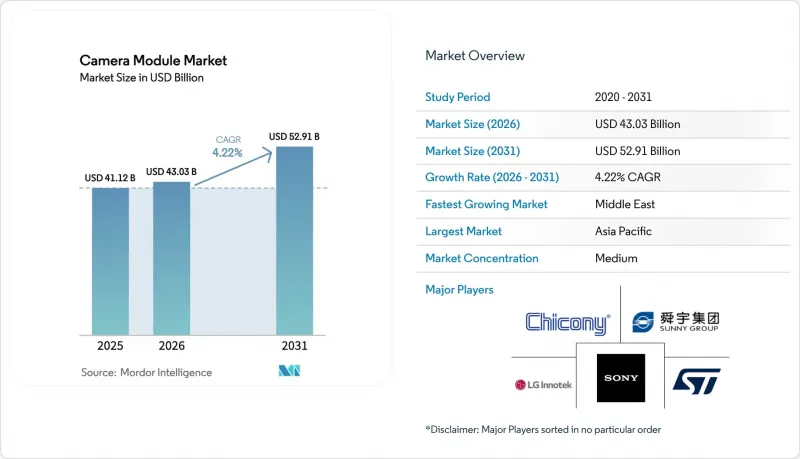
本報告按組件(影像感測器、鏡頭組等)、感測器類型(CMOS、CCD)、像素數或解析度(700萬像素及以下、800萬至1300萬像素、其他)、對焦方式(定焦、自動對焦)、製造流程(晶片封裝等)、模組外形尺寸模組(緊湊型、MIPI介面、自動對焦)、製造流程(晶片封裝等)、模組外形尺寸模組(緊湊型、MIPI介面、自動對焦)、製造流程(板載晶片等)、模組外形尺寸模組(緊湊型、MIPI介面、自動對焦)、製造流程(晶片封裝等)、模組外形規格模組(緊湊型、MIPI介面、自動對焦)、製造流程(晶片封裝等)、模組外形尺寸模組(緊湊型、MIPI介面、自動對焦)、製造流程(晶片封裝等)、模組外形尺寸模組(緊湊型、MIPI介面、自動對焦)、製造流程(晶片封裝等)、模組外形尺寸模組(緊湊型、MIPI介面、自動對焦)。市場預測以美元計價。
全球相機模組市場趨勢及洞察
配備三個以上相機系統的智慧型手機的普及
如今,中國旗艦手機普遍配備四個或更多獨立鏡頭,平均每台設備增加約1.3個模組。小米17 Ultra率先搭載了2億像素潛望式鏡頭,並配備超廣角、廣角和微距鏡頭,每個鏡頭都擁有獨立的自動對焦機制。 OPPO和vivo也分別在其Find X8和X200 Pro系列中採用了類似的策略,在保持出貨量的同時提高了平均售價。曾經僅限於旗艦機型的飛行時間(TOF)深度檢測模組,如今已成為售價超過400美元設備的標配,從而實現了全新的擴增實境(AR)購物功能。因此,儘管全球智慧型手機更換需求趨於平穩,但對相機模組的需求仍在穩步成長。三星的「棱鏡全鏡頭」設計將潛望式相機的Z軸高度降低了22%,使得競爭對手能夠在不犧牲電池容量的情況下整合折疊式光學元件。
關於後視視野和ADAS攝影機的相關規定
安全法規正推動選用攝影機系統轉向標配。在美國,FMVSS-111 法規強制要求所有輕型車輛從 2026 年起配備後視攝影機。歐盟的通用安全法規也施加了類似的壓力,要求新車從 2024 年 7 月起配備前置攝影機,用於車道維持輔助和限速輔助。一級供應商目前在每輛車上整合 3 到 4 個攝影機,並結合雷達和LiDAR,預計到 2030 年,模組數量將達到 3.8 個。在北美銷售的Lexus車型將從 2026 年起至少配備 4 個攝影機,這將加快汽車級零件的認證週期。
2024年地震後VCM執行器的供應將受到限制
2024年4月花蓮地震損毀了台灣主要執行器供應商的無塵室,導致用於自動對焦和光學防手震的音圈馬達交貨前置作業時間延長一倍。三星馬達和LG Innotek報告稱,由於取得有限零件的物流成本高昂,模組出貨量較上一季下降了12%。儘管預計到2025年底恢復率將達到85%,但為了應對未來的供應衝擊,原始設備製造商(OEM)目前正從日本供應商購買零件。
細分市場分析
2025年相機模組市場中,影像感測器佔銷售額的47.17%,而執行器雖然市佔率較小,但成長率最高,到2031年年複合成長率(CAGR)將達到5.07%。SONY的堆疊式CMOS組件價格較高,但潛望鏡模組對雙軸光學防手震執行器的需求正在縮小價格差距。隨著每個鏡頭現在都整合了自己的自動對焦驅動裝置,音圈馬達的出貨量也在增加,汽車專案也指定使用耐溫範圍為-40 度C至105 度C的堅固耐用的執行器。鏡頭組件仍然是第二大組件,在高溫環境下,模壓玻璃非球面鏡片取代了塑膠鏡片。組裝服務雖然市佔率最小,但在長壽命汽車平台上卻能提供附加價值,因為這些平台對減震和氣密性的要求遠超過消費級產品。
各應用領域都出現了構成比的變化。在汽車攝影機領域,高動態範圍 (HDR) 感測器和全局百葉窗的價格上漲了 30%;而在家用電子電器,像素合併的背照式晶片正逐漸成為主流。意法半導體 (STMicroelectronics) 和安森美半導體 (ON Semiconductor) 推出了用於夜間駕駛輔助的 0.1 勒克斯感測器,即使出貨量不大,也推高了平均售價。同時,隨著各大智慧型手機品牌紛紛將設計工作轉移到內部,專業組裝廠商正面臨產品同質化的困境。
預計到2025年,CMOS技術將佔總銷售額的89.22%,年複合成長率達4.73%,並在科學領域的細分市場中取代CCD(電荷耦合元件)。深溝槽隔離、釘扎光電二極體和片上A/D轉換等技術透過提高靈敏度並降低功耗,鞏固了CMOS的市場主導地位。三星的1.08億像素「ISOCELL」感測器和OmniVision的交錯式HDR「OV50K」感測器在汽車行業中屢獲殊榮,取代了傳統的CCD單元。相較之下,Teledyne的超低雜訊CCD在天文和實驗設備等領域仍佔有一席之地,因為在這些領域,像素純度比影格速率更為重要。
新一代CMOS元件具備全域百葉窗和16位元雙增益輸出等曾經是CCD的標誌性特徵,可望進一步蠶食CCD在相機模組市場的佔有率。 OEM廠商越來越傾向選擇替代CCD的方案,而CCD的應用範圍也逐漸侷限於一些特殊的影像應用。這種轉變的驅動力在於成本優勢和技術進步的雙重作用,這些優勢和進步顯著提升了裝置的效率和性能。
像素超過1300萬的相機模組正以4.83%的複合年成長率快速成長,主要得益於潛望式長焦鏡頭和4K影片技術的普及。小米的2億像素感測器在低光條件下會進行像素合併,將影像解析度降至1,250萬像素,但在數位變焦時仍能保持全解析度,從而在市場宣傳和實用性之間取得了平衡。雖然傳統的800萬至1300萬像素相機仍佔據48.54%的市場佔有率,但隨著入門級智慧型手機迅速向更高解析度發展,其市場佔有率正在萎縮。此外,為了滿足市政採購中關於臉部辨識的法規要求,安防攝影機正在升級到4K解析度,而200萬像素的類比設備則正在逐步被淘汰。
光學物理定律存在極限。例如,使用 f/1.8 光圈鏡頭,像素尺寸為 1.0µm 時,超過 1.08 億像素後便達到衍射極限,因此在不犧牲影像品質的前提下進一步提高解析度是不切實際的。SONY的 IMX989 擁有 5,000 萬像素和 1.6µm 的像素間距,它優先考慮單像素靈敏度而非簡單的像素數量,從而在低光源環境下實現更佳的性能和更清晰的影像。在汽車領域,800 萬像素感測器在成本效益和功能性之間取得了平衡,其解析度足以在 50 公尺外識別車牌。對於注重性價比和性能的普通車輛而言,這種配置設定了一個實際的極限。
區域分析
到2025年,亞太地區將佔據全球42.37%的相機模組市場。這主要得益於中國感測器製造廠、鏡頭拋光廠和組裝線的集中佈局,從而縮短了設計週期。舜宇光學、歐菲光和力視科技等公司生產的智慧型手機模組佔全球總出貨量的60%以上,這些模組的生產工廠距離最終組裝廠方圓500公里以內。印度價值7.3萬印度盧比(約87.7億美元)的「生產連結獎勵計畫計畫」正在引導產能流向迪克森科技和巴格瓦蒂產品等國內企業,使區域品牌能夠更快地獲得模組。日本正將重心轉向車用級感測器,而韓國則利用垂直整合優勢,將感測器和鏡頭捆綁銷售,以滿足高階汽車的需求。
中東地區雖然規模較小,卻是成長最快的地區,年複合成長率高達5.21%。 NEOM和杜拜智慧城市計畫對人工智慧監控硬體的需求,推動了高利潤率產品的出貨。隨著海灣國家加強對體育場、交通樞紐和重要公共設施的監控,預計4K 120fps臉部辨識攝影機的採購競標將激增。這項擴張是加強安全基礎設施建設、確保人流密集區域和關鍵場所公共安全的更廣泛措施的一部分。
在北美,受強勁需求和創新驅動,對汽車和工業領域的依賴日益增強,而智慧型手機生產則正轉移到其他地區。在歐洲,由於EN 303645網路安全法規導致物聯網攝影機認證延遲,部分部署被推遲至2027年,影響了技術普及的速度,成長面臨挑戰。在南美,市場呈現復甦跡象,這得益於巴西和阿根廷汽車生產的復甦以及經濟狀況的改善。同時,在非洲這個仍屬小眾市場的地區,重點主要集中在南非採礦業的自動化,利用技術進步來提高效率和生產力。
其他好處:
- Excel格式的市場預測(ME)表
- 3個月的分析師支持
目錄
第1章:引言
- 研究假設和市場定義
- 調查範圍
第2章:調查方法
第3章執行摘要
第4章 市場狀況
- 市場概覽
- 市場促進因素
- 中國旗艦機型中配備三個或更多相機系統的智慧型手機正在普及。
- 強制安裝後視攝影機和ADAS攝影機,符合FMVSS-111和歐盟GSR標準。
- 在中東的智慧城市計畫中實施人工智慧驅動的邊緣分析監控系統。
- 潛望鏡或折疊式光學臂增加了每個模組的透鏡數量。
- 在印度進行模組本地組裝,並得到生產關聯激勵計劃的支持。
- 美國和韓國對XR頭顯的3D或深度感知功能的需求
- 市場限制因素
- 2024年台灣地震後,VCM執行器的供應將面臨限制。
- 螢幕下相機模組。
- 與堆疊式CIS架構相關的專利訴訟案件增加
- EN 303645:歐盟網路連線模組網路安全合規性導致的延誤
- 產業價值鏈分析
- 宏觀經濟因素對市場的影響
- 監理情勢
- 技術展望
- 波特五力分析
- 價格分析
- 超小型相機模組的發展趨勢
- 投資分析,組裝和檢驗生產線的資本投資
第5章 市場規模與成長預測
- 按組件
- 影像感測器
- 鏡頭組
- 相機模組組件
- 音圈馬達、自動對焦和光學防手震
- 依感測器類型
- CMOS
- CCD
- 按像素或解析度
- 700萬像素或更少
- 8~13 MP
- 1300萬像素或以上
- 焦點類型
- 固定焦距
- 自動對焦
- 透過製造程序
- 板載晶片
- 覆晶/晶圓級封裝
- 模組外形規格
- 袖珍的
- MIPI介面模組
- 透過使用
- 手機和智慧型手機
- 家用電子產品
- 車
- 醫療保健和醫學影像
- 安全監控
- 工業和機器人領域
- 按地區
- 北美洲
- 美國
- 加拿大
- 墨西哥
- 歐洲
- 德國
- 英國
- 法國
- 俄羅斯
- 其他歐洲國家
- 亞太地區
- 中國
- 日本
- 印度
- 韓國
- 澳洲
- 其他亞太國家
- 中東和非洲
- 中東
- 沙烏地阿拉伯
- 阿拉伯聯合大公國
- 其他中東國家
- 非洲
- 南非
- 埃及
- 其他非洲國家
- 中東
- 南美洲
- 巴西
- 阿根廷
- 其他南美國家
- 北美洲
第6章 競爭情勢
- 市場集中度
- 策略性舉措、併購、合資、資本投資
- 市佔率分析
- 公司簡介
- LG Innotek Co. Ltd
- Samsung Electro-Mechanics Co. Ltd
- Sunny Optical Technology Group Co. Ltd
- O-Film Group Co. Ltd
- Hon Hai Precision Industry Co., Ltd.
- Chicony Electronics Co. Ltd
- LuxVisions Innovation Ltd, Lite-On
- Cowell E Holdings Inc.
- Sony Group Corporation
- OmniVision Technologies Inc.
- STMicroelectronics NV
- AMS Osram AG
- ON Semiconductor Corp.
- Panasonic Corp.
- Largan Precision Co. Ltd
- MINEBEA MITSUMI Inc.
- Canon Inc.
- Robert Bosch GmbH
- Continental AG
- Magna International Inc.
- Valeo SA
- e-con Systems Pvt Ltd
第7章 市場機會與未來展望
According to Mordor Intelligence, the camera module market size is expected to grow from USD 41.12 billion in 2025 to USD 43.03 billion in 2026 and is forecast to reach USD 52.91 billion by 2031 at 4.22% CAGR over 2026-2031.
This report is Segmented by Component (Image Sensor, Lens Set, and More), Sensor Type (CMOS, and CCD), Pixel or Resolution (Up To 7 MP, 8-13 MP, and More), Focus Type (Fixed-Focus, and Autofocus), Manufacturing Process (Chip-On-Board, and More), Module Form-Factor (Compact, and MIPI-Interface Modules), Application (Automotive, and More), and Geography. The Market Forecasts are Provided in Terms of Value (USD).
Global Camera Module Market Trends and Insights
Multi-Camera Smartphone Adoption Exceeding Three Lenses
Chinese flagship devices now integrate four or more discrete cameras, adding roughly 1.3 modules per handset. Xiaomi's 17 Ultra debuted a 200-megapixel periscope alongside ultra-wide, wide, and macro units, each with its own autofocus chain. OPPO and vivo mirrored this approach in the Find X8 and X200 Pro series, raising average selling prices while maintaining shipment volumes. Depth-sensing time-of-flight modules, once confined to halo products, are now standard above USD 400 retail, unlocking new augmented-reality shopping features. The cumulative effect is incremental module demand despite a plateau in global smartphone replacements. Samsung's All Lenses on Prism design shaved 22% off periscope z-height, enabling competitors to embed folded optics without sacrificing battery capacity.
Rear-Visibility and ADAS Camera Mandates
Safety regulations are transforming optional camera systems into base-grade hardware. In the United States, FMVSS-111 requires rear-view cameras on all light vehicles from model year 2026. The European Union General Safety Regulation applies similar pressure, mandating forward-facing cameras for lane-keeping and speed-limit assistance on new vehicle types from July 2024. Tier-one suppliers now integrate three to four cameras per vehicle, bundled with radar and lidar, raising module content to a forecast 3.8 units by 2030. Lexus models sold in North America will feature at least four cameras from 2026, accelerating the qualification cycle for automotive-grade components.
VCM Actuator Supply Constraints Post-2024 Earthquake
The April 2024 Hualien earthquake damaged clean rooms at key Taiwanese actuator suppliers, doubling lead times for autofocus and optical image stabilization voice-coil motors. Samsung Electro-Mechanics and LG Innotek reported a 12% sequential decline in module shipments as they paid premium logistics costs to secure limited parts. Restoration reached 85% by late 2025, but OEMs have since dual-sourced from Japanese vendors to mitigate future shocks.
Other drivers and restraints analyzed in the detailed report include:
- AI-Enabled Edge-Analytics Surveillance Rollouts
- Periscope or Folded-Optics Boom
- Wafer-Level Optics Yield Loss in Under-Display Modules
For complete list of drivers and restraints, kindly check the Table Of Contents.
Segment Analysis
The camera module market size for image sensors accounted for 47.17% of revenue in 2025, while actuators captured a smaller share but posted the strongest 5.07% CAGR through 2031. Sony's stacked CMOS parts fetch premium pricing, but demand for dual-axis optical image stabilization actuators in periscope modules is narrowing the gap. Voice-coil motor volumes rose as every additional lens now ships with its own autofocus drive, and automotive programs specify ruggedized actuators rated for -40 °C to 105 °C. Lens sets remained the second-largest element, with glass-molded aspherics replacing plastic in high-temperature environments. Assembly services, though the smallest component share, deliver value in long-life automotive platforms where vibration damping and hermetic sealing outstrip consumer-grade requirements.
A shift in mix is visible across applications. Automotive cameras pay a 30% premium for high-dynamic-range sensors and global shutters, while consumer electronics gravitate toward pixel-binned back-side illuminated chips. STMicroelectronics and ON Semiconductor released 0.1 lux sensors for night-time driver assistance, raising average selling prices even when unit volumes stay modest. Meanwhile, pure-play assemblers face commoditization as flagship smartphone brands bring design in-house.
CMOS technology accounted for 89.22% of 2025 sales and is forecast to grow at a 4.73% CAGR, crowding out charge-coupled devices in scientific niches. Deep-trench isolation, pinned photodiodes, and on-chip analog-to-digital conversion lifted sensitivity while cutting power draw, sealing CMOS dominance. Samsung's 108-megapixel ISOCELL sensors and OmniVision's staggered-HDR OV50K captured automotive awards, displacing legacy CCD units. In contrast, Teledyne's ultra-low-noise CCDs survive in astronomy and lab instruments where pixel purity trumps frame rate.
Next-generation CMOS parts, now boasting global shutters and 16-bit dual-gain output-features that were once the hallmark of CCD-are poised to further erode the market share of CCD in the camera module arena. OEMs are increasingly favoring alternatives over CCDs, reserving the latter primarily for specialty imaging. This shift is driven by the compounded cost advantages and technological advancements that enhance both efficiency and performance.
Modules above 13 megapixels are expanding at a 4.83% CAGR, supported by periscope telephoto lenses and pervasive 4K video capture. Xiaomi's 200-megapixel sensor bins to 12.5 megapixels for low-light shots yet retains full resolution for digital zoom, bridging marketing specs with real-world usability. The entrenched 8-13-megapixel class still accounts for 48.54% of revenue but faces erosion as entry-level smartphones leapfrog to higher resolutions. Security cameras are also being upgraded to 4K to meet municipal procurement rules for facial recognition, retiring 2-megapixel analog inventory.
Optical physics sets boundaries: f/1.8 lenses with 1.0 µm pixels hit diffraction limits past 108 megapixels, making further increases in resolution less practical without compromising image quality. Sony's IMX989, boasting a 1.6 µm pixel pitch at 50 megapixels, emphasizes per-pixel sensitivity over sheer pixel count, ensuring better performance in low-light conditions and enhanced image clarity. In the automotive realm, 8-megapixel sensors strike a balance between cost efficiency and functionality, offering sufficient resolution to recognize license plates from 50 meters. This configuration establishes a practical limit for mainstream vehicles, where affordability and performance must align.
Complete Report Scope:
- By Component
- Image Sensor
- Lens Set
- Camera Module Assembly
- Voice-Coil Motor, AF and OIS
- By Sensor Type
- CMOS
- CCD
- By Pixel or Resolution
- Up to 7 MP
- 8 - 13 MP
- Above 13 MP
- By Focus Type
- Fixed-Focus
- Autofocus
- By Manufacturing Process
- Chip-on-Board
- Flip-Chip/Wafer-Level Packaging
- By Module Form-Factor
- Compact
- MIPI-Interface Modules
- By Application
- Mobile and Smartphones
- Consumer Electronics
- Automotive
- Healthcare and Medical Imaging
- Security and Surveillance
- Industrial and Robotics
- By Geography
- North America
- United States
- Canada
- Mexico
- Europe
- Germany
- United Kingdom
- France
- Russia
- Rest of Europe
- Asia-Pacific
- China
- Japan
- India
- South Korea
- Australia
- Rest of Asia-Pacific
- Middle East and Africa
- Middle East
- Saudi Arabia
- United Arab Emirates
- Rest of Middle East
- Africa
- South Africa
- Egypt
- Rest of Africa
- Middle East
- South America
- Brazil
- Argentina
- Rest of South America
- North America
Geography Analysis
Asia-Pacific commanded 42.37% of the camera module market share in 2025, powered by China's clustering of sensor fabs, lens grinders, and assembly lines that condense design cycles. Sunny Optical, O-Film, and LuxVisions shipped more than 60% of global smartphone modules from plants within 500 kilometers of final assembly sites. India's INR 73,000 crore Production-Linked Incentive scheme (USD 8.77 billion) is redirecting capacity to domestic players Dixon Technologies and Bhagwati Products, giving regional brands faster access to modules. Japan pivots toward automotive-grade sensors, while South Korea leverages vertical integration to bundle sensors and lenses for premium vehicle contracts.
The Middle East, though small, is the fastest-growing region, with a 5.21% CAGR. NEOM and Dubai smart-city mandates for AI-ready surveillance hardware propel high-margin shipments. As Gulf states enhance surveillance at stadiums, transport hubs, and major public venues, the adoption of 4K, 120-fps facial recognition cameras will drive a surge in tender volumes. This expansion is part of broader efforts to strengthen security infrastructure and ensure public safety in high-traffic and sensitive areas.
North America leans heavily towards automotive and industrial sectors, driven by robust demand and innovation, while smartphone production has been offshored to other regions. In Europe, growth faces challenges as EN 303645 cybersecurity regulations delay IoT camera certifications, pushing certain rollouts to 2027 and impacting the pace of technological adoption. South America witnesses a rebound, supported by the recovery of vehicle production in Brazil and Argentina, which is further bolstered by improving economic conditions. Meanwhile, Africa, still a niche market, focuses primarily on the automation of South African mining operations, leveraging advancements in technology to enhance efficiency and productivity.
- LG Innotek Co. Ltd
- Samsung Electro-Mechanics Co. Ltd
- Sunny Optical Technology Group Co. Ltd
- O-Film Group Co. Ltd
- Hon Hai Precision Industry Co., Ltd.
- Chicony Electronics Co. Ltd
- LuxVisions Innovation Ltd, Lite-On
- Cowell E Holdings Inc.
- Sony Group Corporation
- OmniVision Technologies Inc.
- STMicroelectronics N.V.
- AMS Osram AG
- ON Semiconductor Corp.
- Panasonic Corp.
- Largan Precision Co. Ltd
- MINEBEA MITSUMI Inc.
- Canon Inc.
- Robert Bosch GmbH
- Continental AG
- Magna International Inc.
- Valeo SA
- e-con Systems Pvt Ltd
Additional Benefits:
- The market estimate (ME) sheet in Excel format
- 3 months of analyst support
TABLE OF CONTENTS
1 INTRODUCTION
- 1.1 Study Assumptions and Market Definition
- 1.2 Scope of the Study
2 RESEARCH METHODOLOGY
3 EXECUTIVE SUMMARY
4 MARKET LANDSCAPE
- 4.1 Market Overview
- 4.2 Market Drivers
- 4.2.1 Multi-Camera Smartphone Adoption Exceeding Three Lenses in Chinese Flagships
- 4.2.2 Rear-Visibility and ADAS Camera Mandates, FMVSS-111 and EU-GSR
- 4.2.3 AI-Enabled Edge-Analytics Surveillance Roll-outs in Middle-East Smart-City Projects
- 4.2.4 Periscope or Folded-Optics Boom Elevating Lens Count per Module
- 4.2.5 PLI Scheme-Driven Local Assembly of Modules in India
- 4.2.6 3D or Depth-Sensing Demand for XR Headsets in United States and Korea
- 4.3 Market Restraints
- 4.3.1 VCM Actuator Supply Constraints Post-2024 Earthquake in Taiwan
- 4.3.2 Wafer-Level Optics Yield Loss in Under-Display Camera Modules
- 4.3.3 Escalating Patent Litigation on Stacked CIS Architectures
- 4.3.4 EN 303645 Cyber-Security Compliance Delays for Networked Modules in EU
- 4.4 Industry Value Chain Analysis
- 4.5 Impact of Macroeconomic Factors on the Market
- 4.6 Regulatory Landscape
- 4.7 Technological Outlook
- 4.8 Porter's Five Forces Analysis
- 4.8.1 Bargaining Power of Suppliers
- 4.8.2 Bargaining Power of Buyers
- 4.8.3 Threat of New Entrants
- 4.8.4 Threat of Substitutes
- 4.8.5 Intensity of Competitive Rivalry
- 4.9 Pricing Analysis
- 4.10 Ultra-Miniature Camera Module Dynamics
- 4.11 Investment Analysis, CapEx in Assembly and Test Lines
5 MARKET SIZE AND GROWTH FORECASTS (VALUE)
- 5.1 By Component
- 5.1.1 Image Sensor
- 5.1.2 Lens Set
- 5.1.3 Camera Module Assembly
- 5.1.4 Voice-Coil Motor, AF and OIS
- 5.2 By Sensor Type
- 5.2.1 CMOS
- 5.2.2 CCD
- 5.3 By Pixel or Resolution
- 5.3.1 Up to 7 MP
- 5.3.2 8 - 13 MP
- 5.3.3 Above 13 MP
- 5.4 By Focus Type
- 5.4.1 Fixed-Focus
- 5.4.2 Autofocus
- 5.5 By Manufacturing Process
- 5.5.1 Chip-on-Board
- 5.5.2 Flip-Chip/Wafer-Level Packaging
- 5.6 By Module Form-Factor
- 5.6.1 Compact
- 5.6.2 MIPI-Interface Modules
- 5.7 By Application
- 5.7.1 Mobile and Smartphones
- 5.7.2 Consumer Electronics
- 5.7.3 Automotive
- 5.7.4 Healthcare and Medical Imaging
- 5.7.5 Security and Surveillance
- 5.7.6 Industrial and Robotics
- 5.8 By Geography
- 5.8.1 North America
- 5.8.1.1 United States
- 5.8.1.2 Canada
- 5.8.1.3 Mexico
- 5.8.2 Europe
- 5.8.2.1 Germany
- 5.8.2.2 United Kingdom
- 5.8.2.3 France
- 5.8.2.4 Russia
- 5.8.2.5 Rest of Europe
- 5.8.3 Asia-Pacific
- 5.8.3.1 China
- 5.8.3.2 Japan
- 5.8.3.3 India
- 5.8.3.4 South Korea
- 5.8.3.5 Australia
- 5.8.3.6 Rest of Asia-Pacific
- 5.8.4 Middle East and Africa
- 5.8.4.1 Middle East
- 5.8.4.1.1 Saudi Arabia
- 5.8.4.1.2 United Arab Emirates
- 5.8.4.1.3 Rest of Middle East
- 5.8.4.2 Africa
- 5.8.4.2.1 South Africa
- 5.8.4.2.2 Egypt
- 5.8.4.2.3 Rest of Africa
- 5.8.4.1 Middle East
- 5.8.5 South America
- 5.8.5.1 Brazil
- 5.8.5.2 Argentina
- 5.8.5.3 Rest of South America
- 5.8.1 North America
6 COMPETITIVE LANDSCAPE
- 6.1 Market Concentration
- 6.2 Strategic Moves, M&A, JVs, CapEx
- 6.3 Market Share Analysis
- 6.4 Company Profiles (includes Global Level Overview, Market Level Overview, Core Segments, Financials as Available, Strategic Information, Market Rank or Share, Products and Services, and Recent Developments)
- 6.4.1 LG Innotek Co. Ltd
- 6.4.2 Samsung Electro-Mechanics Co. Ltd
- 6.4.3 Sunny Optical Technology Group Co. Ltd
- 6.4.4 O-Film Group Co. Ltd
- 6.4.5 Hon Hai Precision Industry Co., Ltd.
- 6.4.6 Chicony Electronics Co. Ltd
- 6.4.7 LuxVisions Innovation Ltd, Lite-On
- 6.4.8 Cowell E Holdings Inc.
- 6.4.9 Sony Group Corporation
- 6.4.10 OmniVision Technologies Inc.
- 6.4.11 STMicroelectronics N.V.
- 6.4.12 AMS Osram AG
- 6.4.13 ON Semiconductor Corp.
- 6.4.14 Panasonic Corp.
- 6.4.15 Largan Precision Co. Ltd
- 6.4.16 MINEBEA MITSUMI Inc.
- 6.4.17 Canon Inc.
- 6.4.18 Robert Bosch GmbH
- 6.4.19 Continental AG
- 6.4.20 Magna International Inc.
- 6.4.21 Valeo SA
- 6.4.22 e-con Systems Pvt Ltd
7 MARKET OPPORTUNITIES AND FUTURE OUTLOOK
- 7.1 White-Space and Unmet-Need Assessment

 相機模組保護罩市場:全球市場預測,2026-2032年
 2026-2030年全球相機模組市場汽車分割畫面相機模組市場:依車輛類型、影像技術、安裝方式、訊號介面、應用和銷售管道分類-2026-2032年全球市場預測相機模組市場:按類型、組件、解析度、對焦方式、應用和最終用戶分類-2026-2032年全球市場預測
 相機模組市場報告:按組件、對焦方式、介面、像素數量、製造流程、應用和地區分類(2026-2034 年)
 全球相機模組市場規模、佔有率、趨勢及成長分析報告(2026-2034)
 相機模組市場機會、成長要素、產業趨勢分析及2026-2035年預測
 相機模組市場分析及預測(至2035年):按類型、產品類型、技術、組件、應用、設備、最終用戶、功能和安裝類型分類全球CCTV IP相機模組市場規模、佔有率、趨勢和成長分析報告(2026-2034年)
 2026年全球相機模組市場報告